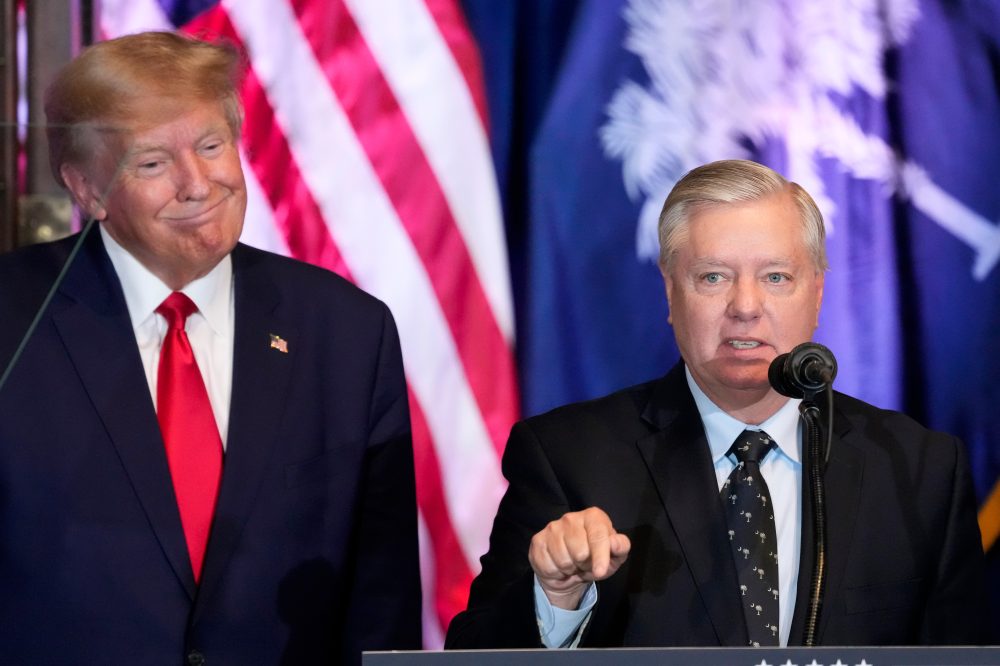

WASHINGTON — Sen. Lindsey Graham had what seemed like a defining moment of separation from President Donald Trump on the night of January 6, 2021, after a mob of rioters stormed the U.S. Capitol. Standing in the Senate chamber once order had been restored, a visibly shaken Graham delivered what sounded like a farewell to their political partnership.
“Trump and I, we’ve had a hell of a journey. I hate it to end this way. Oh my God, I hate it. From my point of view, he’s been a consequential president,” Graham said that evening. “All I can say is count me out. Enough is enough.”
But it was not the end — not even close.
Graham, the South Carolina Republican who passed away unexpectedly Saturday night at the age of 71, quickly concluded that the future of his party was bound up with Trump, and he pivoted back to being one of the president’s most reliable defenders. That reversal transformed what had looked like a permanent falling-out into just one more unpredictable chapter in a relationship that defined much of his later career.
By May 2021, only four months after the Capitol attack, Graham had made his position clear: “Can we move forward without President Trump? The answer is no. I’ve determined we can’t grow without him.”
Trump, who referred to Graham as a “true American Patriot” in a social media post the day after his death, said he was stunned by the sudden loss.
“I just can’t believe it,” Trump told NBC’s ‘Meet the Press.’ “He was like a member of the family.”
Graham had been a trusted voice in Trump’s ear on foreign policy, especially regarding Israel, Ukraine, and Iran, and was a regular presence at the White House. Trump recalled their last conversation fondly, saying he told Graham, “We’ll see you soon, come over anytime you want.”
The two men’s relationship had a rocky start. They first collided during the race for the 2016 Republican presidential nomination, when Graham called Trump “unfit for office” and grew furious after Trump mocked the military service of Graham’s close friend, Sen. John McCain of Arizona. Trump’s comment — “I like people that weren’t captured” — referred to McCain’s years as a prisoner of war in Vietnam.
Trump retaliated by publicly releasing Graham’s personal cell phone number. Graham responded with a now-famous video in which he destroyed a string of flip phones in increasingly dramatic fashion — using a meat cleaver, a golf club, lighter fluid, a blender, and a toaster oven, before throwing one off a rooftop.
Graham ultimately compared Trump winning the nomination to “being shot in the head” and declined to vote for him in November 2016. Yet the two men later found common ground over golf outings and what Graham described as a shared, irreverent sense of humor.
Their time on the golf course became frequent enough that Graham leaned into it as a political strategy, lavishing Trump with the kind of praise the president openly enjoyed. In 2017, Graham joked that Trump had beaten him “like a drum” on the course — an even bigger defeat, he said, than losing to him in the primary.
Sen. Tim Scott of South Carolina reflected on the bond between the two men on ABC’s ‘This Week,’ saying, “Their true friendship could only be seen behind the curtain.” Scott noted the relationship began as one between political rivals but deepened through more than 100 hours spent golfing together.
Throughout Trump’s first term, Graham played a significant role in shepherding Trump’s Supreme Court nominees through the confirmation process, lent his credibility to the administration’s legislative goals, and at times operated as part of the president’s inner circle. He frequently described Trump as someone who was maturing and growing in the role.
Graham’s divergence from his longtime friend McCain became most apparent in 2017, when McCain cast the decisive vote against a Trump-backed effort to repeal the health care law signed by former President Barack Obama — a bill that Graham himself had co-sponsored.
In the aftermath of January 6, Graham said he had “never been so humiliated and embarrassed for the country.” But the rupture with Trump did not last. Within weeks, Trump extended an invitation to Graham for golf and dinner at his Mar-a-Lago estate in Florida, and their alliance was back on track. During the 2024 campaign, Graham frequently appeared on television as a Trump surrogate, promoting a vision of American military strength tied to “America First” priorities.
Graham never abandoned his more traditional Republican positions on foreign policy. He was a vocal supporter of Ukraine following Russia’s invasion and consistently pushed the White House to stand firmly behind Israeli Prime Minister Benjamin Netanyahu while taking a harder stance toward Iran.
After the U.S. and Israel launched strikes against Iran in February, Graham defended the action forcefully, pushing back against voices within the “Make America Great Again” movement who believed “America First” meant staying out of such conflicts.
“To those who say Iran is stronger now than before, that is an insult to the American military and it is delusional thinking because the Iranian economy is in shambles,” Graham wrote on social media on June 19.
His admiration for Trump extended well beyond policy. When Graham secured victory in the South Carolina Republican primary last month, he offered remarks that drew laughter from the crowd — placing Trump just below the Almighty in his personal rankings.
“I want to start with a bunch of thank yous. I want to thank the big guy, God. Trump comes later,” Graham said with a laugh. “Mr. President, you’re not far behind God, but we’re gonna start with him.”