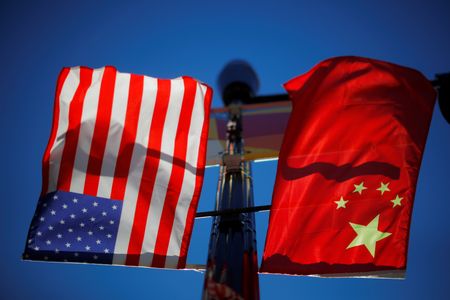
WASHINGTON — A key U.S. Senate committee is set to hold a vote on July 15 on bipartisan legislation aimed at strengthening the American government’s ban on Chinese automakers entering the U.S. vehicle market.
A Republican senator from Ohio, Bernie Moreno, and a Democratic senator from Michigan, Elissa Slotkin, jointly introduced the bill back in April. The legislation is designed to formally write into law a regulation that was put in place by the Biden administration — one that effectively prevents all Chinese automakers from selling passenger cars in the United States.
Beyond locking in that existing ban, the bill would also take additional measures to keep Chinese manufacturers out of the broader U.S. light-duty vehicle market. The Senate Commerce Committee is scheduled to take up the measure on July 15.
WASHINGTON — President Donald Trump announced Wednesday that he plans to ask the U.S. Supreme Court to take another look at a case involving birthright citizenship, expressing sharp frustration over the court’s recent decision to reject one of his key policy goals.
Last month, the high court — which carries a 6-3 conservative majority that includes three justices appointed by Trump himself — turned down his bid to limit birthright citizenship in the United States.
Trump lashed out at the 6-3 decision, which was written by conservative Chief Justice John Roberts, labeling it a “miscarriage of justice.”
Taking to Truth Social, Trump wrote: “AMERICAN CITIZENSHIP IS NOT FOR SALE! In fact, that is a crime, and therefore, the Supreme Court’s ruling is wrong.”
He added: “I will be asking for a Rehearing by the United States Supreme Court, IMMEDIATELY.”
The president signed an executive order on his first day back in office last year, seeking to end birthright citizenship as part of a broader set of measures aimed at tightening restrictions on both legal and illegal immigration. Trump has repeatedly pushed the boundaries of presidential authority across both domestic and foreign policy matters.
Some of the biggest names in American technology have made their presence felt at the Calgary Stampede this year, reflecting a surge of interest in Alberta from major U.S. tech companies looking to build large-scale data centers in Canada.
While oil and gas firms have traditionally dominated the annual energy gathering held alongside Calgary’s well-known rodeo, U.S. tech giants have carved out a noticeable footprint at this year’s event, according to sources who attended various functions.
Among the most visible participants was Alphabet’s Google, which sponsored the Stampede for the second consecutive year. The company held a private gathering on Sunday at the Corona Skydeck, an upscale rooftop venue overlooking the rodeo grounds that can accommodate up to 300 people. Federal and provincial politicians, along with government staff, were among those who attended, a Reuters source said.
A Google spokeswoman confirmed the company has a larger presence at the Calgary Stampede this year than it has ever had before.
Two separate sources indicated that Meta and Amazon have also been participating in events and holding meetings at the Stampede. Neither company responded when asked for comment.
Meta made a major announcement Wednesday, revealing plans to construct a large data center in central Alberta — its first facility of this kind in Canada. The project, which will be located in Sturgeon County, is designed to deliver one gigawatt of power capacity and carries a total price tag of C$13 billion, or approximately $9.17 billion U.S., according to Meta. The move is part of the company’s push to rapidly expand computing infrastructure to support the worldwide artificial intelligence boom.
Alberta has set an ambitious goal of attracting C$100 billion worth of data center investment, promoting its plentiful and low-cost natural gas supply as a key selling point. The province’s combination of affordable energy and cold weather — which helps cool data center equipment — could make it appealing to U.S. tech companies that are running into power shortages and community pushback at home.
The province’s technology minister previously told Reuters that Alberta is actively in discussions with several tech companies searching for locations where they can connect to the electrical grid without lengthy delays.
Alberta is also giving developers the option to build their own power generation facilities, helping them sidestep constraints on available grid capacity.
Although Alberta does not yet have any data centers operating at the so-called hyperscale level — which requires at least 50 megawatts of power — nearly 100 such projects have been proposed, and at least one large-scale facility is already set to begin construction.
GSK has officially pulled out of its neuroscience research partnership with Alector, following the collapse of two experimental drug programs targeting serious brain diseases, the biotech company announced Wednesday.
The collaboration, established in 2021, centered on developing two monoclonal antibody drugs — latozinemab and nivisnebart — intended to combat dementia and Alzheimer’s disease. Both drugs encountered significant clinical failures that ultimately led to the breakdown of the agreement.
The first blow came when a late-stage clinical trial of latozinemab — tested against a rare inherited form of frontotemporal dementia — failed last year. Then in April, a mid-stage trial of nivisnebart for Alzheimer’s disease was discontinued after an interim analysis determined the study was unlikely to achieve its primary objective.
Under the original 2021 deal, Alector received $700 million upfront from GSK, with the potential to earn up to $1.5 billion more through milestone payments tied to drug development progress and royalties. That potential now appears lost.
The fallout from the latozinemab failure was severe enough that Alector cut nearly half of its workforce. GSK formally submitted written termination notice on July 6, triggering a 180-day notice period that will bring the partnership to a close on January 2 of next year.
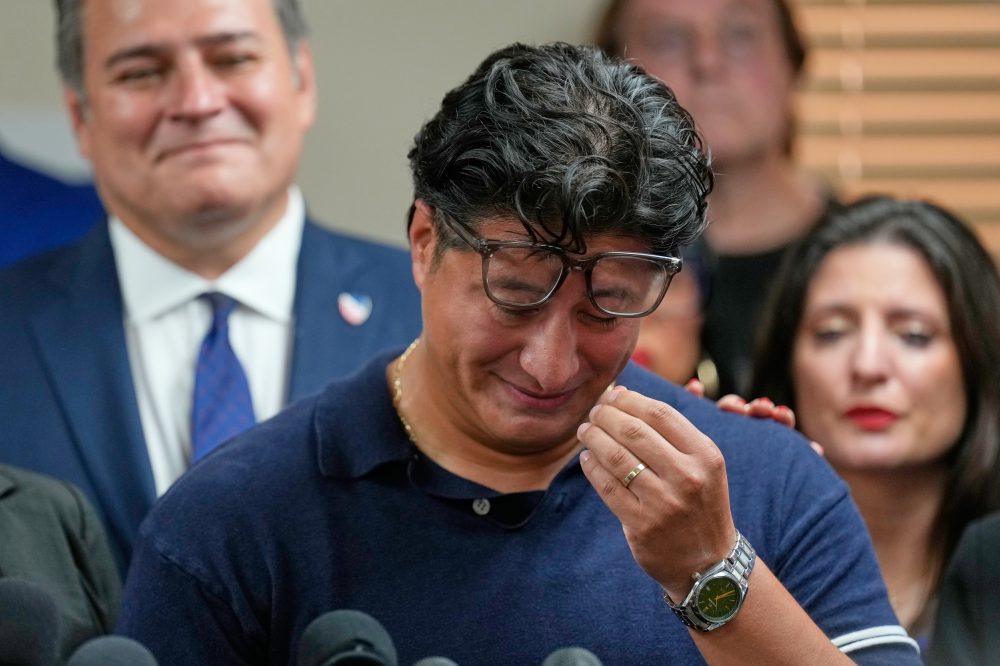
The family of a Houston man and several immigration advocacy organizations are demanding a thorough, independent investigation after U.S. Immigration and Customs Enforcement agents shot and killed him during a traffic stop.
The fatal shooting has prompted calls from both loved ones and immigrant rights groups for a full accounting of what took place during the encounter with ICE agents.
Motorists traveling on Cherry Road should be prepared for intermittent lane closures between Ivy Lane and Ridge Drive, according to a traffic advisory.
The lane restrictions are the result of construction work in the area. Drivers are advised to use caution when passing through the affected stretch of roadway.
The closures are expected to remain in effect until 5:00 PM. No additional detour information was provided at this time.
CHICAGO — Connor Bedard, the star center for the Chicago Blackhawks, went under the knife Wednesday for surgery on his left shoulder, and he won’t be ready when the puck drops to open the new season.
Team physician Michael Terry indicated that Bedard is expected “to make a full recovery in an approximate timeline of four months.” While the NHL has yet to release its regular-season schedule, the Blackhawks opened play last year on October 7.
Bedard, who will turn 21 on July 17, suffered the injury while skating with a group of NHL players last week in western Canada. The setback is a tough blow for a Blackhawks organization that has been working hard to climb out of a difficult rebuilding stretch.
This past season, Bedard put up career-best numbers, recording 30 goals and 45 assists across 69 games. He had already missed 12 games earlier in the year after injuring his right shoulder during a faceoff in a 3-2 loss at St. Louis on December 12.
General manager Kyle Davidson spoke glowingly of Bedard back in April, saying, “He’s so important to our team. He took such a big step forward this year in every facet.”
Bedard currently holds restricted free agent status, and it’s unclear whether the injury will complicate ongoing contract negotiations. This isn’t his first major health scare — he also missed nearly six weeks of his rookie season after breaking his jaw.
Chicago finished last season with a 29-39-14 record, which represented an 11-point improvement over the prior year, though the team remained well out of playoff contention. The Blackhawks have landed at No. 31 in the NHL standings in each of the last three seasons.
The team has been active in adding new players, acquiring defenseman Bowen Byram from Buffalo in a trade on June 23, and signing forward Cole Smith and defenseman Ian Cole on the opening day of NHL free agency.
Despite his injury, Bedard personally reached out to welcome Byram, Smith, and Cole to the organization.
When asked Wednesday about the prospect of playing alongside Bedard, Ian Cole offered his thoughts: “Obviously a superb young talent. Unfortunately, yeah, it sounds like it’s going to be a little later than originally anticipated, but you know he seems like a great guy.”
Chicago has not appeared in the postseason since the NHL used an expanded playoff format following the COVID-19-shortened 2020 season.
Bedard has been the cornerstone of the franchise since being selected with the No. 1 overall pick in the 2023 draft. He made his highly anticipated NHL debut that October and went on to claim the Calder Trophy as the league’s top rookie. In his second season, he appeared in all 82 games, tallying 23 goals and 44 assists.
SpaceXAI rolled out its latest artificial intelligence model on Wednesday, introducing Grok 4.5 as the company’s most advanced product to date, built specifically for coding and so-called agentic tasks — work that AI can carry out with greater independence.
The company said Grok 4.5 was developed using tens of thousands of Nvidia GB300 graphics processing units, with heavy emphasis on careful data filtering, removing duplicate information, and evaluating the quality of training data.
The popular AI coding tool Cursor confirmed its involvement in the project, stating, “We’ve partnered with SpaceXAI to train Grok 4.5.” SpaceX announced last month that it plans to acquire Anysphere, the startup that created Cursor, through an all-stock deal valued at $60 billion, a move aimed at strengthening its foothold in the enterprise AI tools market.
Grok 4.5 is now accessible through SpaceXAI’s own AI coding agent called Grok Build, within Cursor, and via the SpaceXAI console — the company’s developer portal — using an API key. Availability in the European Union is expected to follow in mid-July.
In terms of pricing, SpaceXAI set Grok 4.5 at $2 per million input tokens and $6 per million output tokens. For context, input tokens refer to the text, code, or other data a user sends to an AI model, while output tokens are what the model produces in return.
SpaceX CEO Elon Musk weighed in on the release through a post on X, describing the model as “an Opus-class model, but faster, more token-efficient and lower cost.”
The launch comes after Musk’s AI startup xAI was acquired by SpaceX back in February. Musk announced in May that xAI would no longer operate as a standalone company and would be folded into what is now called SpaceXAI.
By comparison, rival Anthropic’s Claude Opus 4.8 is priced at $5 per million input tokens and $25 per million output tokens. OpenAI’s GPT-5.6 Luna, meanwhile, is priced at $1 per million input tokens and $6 per million output tokens.
OpenAI is set to publicly release its most powerful AI model, GPT-5.6, on Thursday. That launch had been delayed last month after the U.S. government raised national security concerns about the possible misuse of highly capable AI technologies.
Levi Strauss announced Wednesday that it is raising its annual sales forecast, expressing confidence that demand for its denim and clothing lines will hold up even as broader economic uncertainty continues to dampen consumer spending.
Despite the upgraded outlook, the company’s stock slipped roughly 5% in after-hours trading. Shares had already gained 17.5% earlier in the year.
The San Francisco-based company surpassed Wall Street’s expectations for second-quarter sales, buoyed by strong performance in denim and dressier casual styles — including baggy and loose-fitting fits — that have resonated especially well with Gen Z consumers.
Beyond its core denim line, Levi’s has broadened its product range to include dresses, skirts, and tops, while putting significant resources into its direct-to-consumer business, which carries higher profit margins. The company says these moves have helped reignite growth, with revenue climbing every quarter for the past two years.
Net revenue for the quarter ending May 31 climbed 8% to $1.56 billion, topping analyst projections of $1.52 billion. Adjusted earnings came in at 28 cents per share, beating the expected 24 cents.
Looking ahead, Levi’s now projects fiscal 2026 net revenue growth of 7.0% to 7.5%, up from its earlier estimate of 5.5% to 6.5%. Analysts had been forecasting an average increase of 6.6%, which would bring total revenue to roughly $6.70 billion, according to data from LSEG.
The company also revised its adjusted earnings per share forecast upward to a range of $1.46 to $1.52, compared with the previous estimate of $1.42 to $1.48.
CEO Michelle Gass described the ongoing sales momentum as “another proof point that our strategies are working and our team is executing.” She added: “Our evolution into a DTC-first, denim lifestyle company — with a much larger addressable market — is translating to faster growth and higher profitability.”
The iconic brand, which was founded in 1853 and returned to public markets in 2019 after more than 30 years as a privately held company, has leaned into high-profile marketing partnerships as part of its turnaround effort.
One recent campaign drew widespread attention after FIFA temporarily removed Levi’s branding from Levi’s Stadium during World Cup preparations. The company turned that moment into a global marketing push that racked up millions of views on social media, reflecting leadership’s push to keep the 173-year-old brand relevant with younger audiences.
Levi’s has also been shifting its supply chain away from China, Bangladesh, and Cambodia in an effort to ease the impact of tariffs.
In April, the company announced it is searching for a new chief financial officer after finance chief Harmit Singh said he would retire following roughly 13 years in the position. Singh is expected to remain with the company until a successor is named.
Singh noted earlier this year that the company’s Middle East operations make up less than 1% of total sales and are mainly distribution-focused, meaning current regional instability there is not expected to have a significant effect on the business.
The results stand in contrast to struggles seen elsewhere in the apparel sector. Retailers broadly have flagged cautious shoppers and inconsistent demand, particularly for clothing and other non-essential items. Gap and American Eagle Outfitters both pointed to softness in women’s apparel in May, with weaker sales of dresses and bottoms weighing on their overall growth.
By region, Levi’s saw its strongest gains in Asia, where sales jumped 10% during the quarter. Sales in the Americas — its largest market — rose 9%, while Europe posted a 4% increase.
A federal judge on Wednesday gave the green light to a settlement between Elon Musk and the U.S. Securities and Exchange Commission over his acquisition of Twitter shares — even as she voiced “significant misgivings” about the agreement and the “red flags” it presented.
U.S. District Judge Sparkle Sooknanan, sitting in Washington, D.C., acknowledged that her authority to evaluate the deal was narrow — confined to determining whether it cleared minimum thresholds of fairness and reasonableness. She added that it would ultimately fall to the public, through the ballot box, to decide whether the SEC had done enough to hold Musk accountable.
Under the terms of the settlement, a trust bearing Musk’s name must pay $1.5 million to settle SEC allegations that the world’s wealthiest individual waited 11 days longer than required — during March and April of 2022 — before disclosing his early share purchases in Twitter.
The SEC contends that the delayed disclosure allowed Musk to continue buying shares at lower prices before other investors became aware of his stake, resulting in approximately $150 million in improper gains.
Musk has maintained that the delay was unintentional. He went on to complete his full acquisition of Twitter for $44 billion in October 2022, later rebranding the platform as X.
The social media company is now part of his rocket and satellite enterprise SpaceX. Musk also serves as the head of electric vehicle manufacturer Tesla.
MEXICO CITY — Mexico’s football federation announced Wednesday that Rafael Marquez has been named the country’s new national team head coach, taking over from Javier Aguirre following Mexico’s exit from the World Cup.
Marquez, 47, spent the World Cup campaign working alongside Aguirre as his assistant. During that tournament, Mexico achieved a milestone not seen in 40 years — advancing past the knockout stage — before ultimately falling to England 3-2 in the round of 16.
The new appointment is a continuation of the federation’s “Project 2030” initiative, which was first unveiled in August 2024. At that time, Marquez was brought on as Aguirre’s assistant with the clear intention that he would eventually step into the top role.
Aguirre’s third tenure leading the Mexican national team came to a close with an overall record of 22 victories, nine draws, and six defeats across 37 matches. His time in charge also included a flawless group stage performance at the World Cup, going three wins from three games. Additionally, Mexico claimed the 2024-2025 CONCACAF Nations League title and the 2025 Gold Cup under his leadership.
As a player, Marquez had a distinguished career representing Mexico, captaining the national side at five separate World Cups and earning 148 international appearances. He also won the 1999 FIFA Confederations Cup and CONCACAF Gold Cup championships in both 2003 and 2011.
Before joining the Mexican national team’s coaching staff, Marquez gained managerial experience with Spanish clubs RSD Alcala and Barcelona Atletic. He later joined Aguirre’s staff during the World Cup qualifying campaign before transitioning to his new role as head coach.
WASHINGTON — The U.S. military has launched a new wave of strikes against Iran, U.S. Central Command confirmed on Wednesday. The military action came just hours after President Donald Trump announced that an interim agreement designed to bring an end to the conflict with Iran was “over.”
According to U.S. Central Command, the strikes are specifically aimed at weakening Iran’s ability to threaten the free flow of ships through the Strait of Hormuz, a critical international waterway used for global commerce.
In a statement posted to X, U.S. Central Command said: “The United States is holding Iran accountable for recent unjustified aggression against commercial shipping and civilian crews freely navigating a vital international waterway.”
Drivers traveling along Commerce Street, also known as Route 14, should be aware of intermittent lane closures currently in effect due to construction activity in the area.
The affected stretch runs between Park Brown Road/West Street and Elizabeth Avenue. Motorists can expect disruptions to normal traffic flow as work continues in the area.
The lane closures are expected to remain in place until 4 p.m. Drivers are encouraged to allow extra travel time or consider alternate routes if possible.
Drivers heading along Commerce Street, also known as Route 14, should be prepared for some slowdowns today due to ongoing construction work in the area.
Intermittent lane closures are in place along the stretch between Park Brown Road/West Street and Elizabeth Avenue. The closures are expected to remain in effect until 5PM.
Motorists are encouraged to allow extra travel time or consider using an alternate route to avoid potential delays in the construction zone.
UME Hawks women’s bowling standout Gabriela Beccera Diaz delivered a golden performance at the Colombia National Tournament, capturing three gold medals at the prestigious competition.
The accomplished bowler represented her country at the national level and came away with top honors across multiple events, cementing her status as one of the top competitors in Colombian bowling.
The nation’s top vehicle safety regulator is demanding that self-driving car companies take immediate action to stop a troubling trend of autonomous vehicles getting in the way of emergency personnel.
Jonathan Morrison, who leads the U.S. National Highway Traffic Safety Administration, sent a letter to the industry this Wednesday outlining serious concerns. According to Morrison, NHTSA has recorded numerous cases of driverless vehicles driving “directly into active emergency scenes, blocked the paths of ambulances and firefighters, or failed to recognize and respond to basic safety conditions like flashing lights, flares, smoke, fire, and traffic cones.”
Morrison described the problem as a “clear pattern” that requires swift attention from autonomous vehicle developers.
NHTSA called the behavior unacceptable and announced it would set up meetings with vehicle developers before the end of July to hear what solutions the companies plan to put in place.
The death of a Mississippi teenager is sparking conversation across the country, and people want to know more about what happened.
NPR’s Mary Louise Kelly sat down with Anita Lee, a reporter for the Sun Herald, to discuss the growing national interest surrounding the case of Nolan Wells, a student-athlete whose body was discovered off the coast of Mississippi’s Gulf Coast region.
Lee spoke about why this particular case has drawn so much attention from people well beyond the local Mississippi community where Wells lived and competed as a student-athlete.
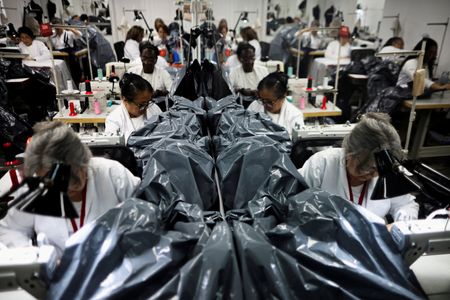
The farm-to-table movement has reshaped how many Americans think about what they eat — and now one Ohio entrepreneur wants to apply that same idea to what they wear.
The business owner is working to establish a regional textile economy, drawing inspiration from the decades-old farm-to-table model that revolutionized the food industry by connecting consumers more directly with local producers.
Just as farm-to-table dining emphasizes knowing where your food comes from, the concept would encourage consumers to consider the origins of their clothing — from the raw materials to the finished product — all sourced and manufactured closer to home.
Cooler weather has been welcoming anglers back to the water across Maryland, from inland freshwater spots to the Chesapeake Bay and the Atlantic Ocean. The Maryland Department of Natural Resources (DNR) is reminding fishermen to take extra care when targeting striped bass, as both water and air temperatures remain elevated.
Once anglers have reached their daily limit for striped bass, they are encouraged to stop targeting the species and move on to other fish in order to reduce the number being caught and released. Any striped bass that does not meet keeper size should be released directly into the water without being lifted out. Safe catch-and-release guidelines are available on the DNR website.
Forecast Summary: July 8 – July 14
Surface water temperatures in the main Bay and at river mouths have climbed into the low 80s and are expected to keep rising throughout the week. Smaller rivers and streams are holding in the upper 70s. As water warms, oxygen levels near the bottom are dropping. Adequate oxygen currently exists in most Bay bottom waters, with the exception of the Potomac River between Indian Head and the Wicomico River, and the Bay between the Sassafras River and the Bay Bridge area. These warm, low-oxygen zones reduce the amount of livable habitat available for striped bass.
River and stream flows across most of Maryland are expected to run below average. Water clarity in the Bay and rivers should be near normal. Strong tidal currents are anticipated from Sunday through Tuesday due to the July 14 full moon and the resulting King Tides.
Upper Chesapeake Bay
At the Conowingo Dam pool, turbines are running in the evenings in a typical summer power generation pattern. Anglers there are landing Chesapeake Channa — also known as snakeheads — along with three types of catfish: blue, flathead, and channel. Casting paddletail lures is a go-to method for targeting snakeheads, while catfish are biting on cut bait drifted near the bottom. Early morning and late evening are the best windows for catching striped bass on topwater lures and crankbaits.
The lower Susquehanna and North East rivers are also producing striped bass along flat edges in the early morning, often before daylight. As the sun heats the water, striped bass push into deeper areas. Catfish can be found in those deeper channel zones as well.
Water temperatures in the mid-80s are prompting DNR to urge anglers to move away from catch-and-release striped bass fishing. Blue catfish is suggested as a more sustainable alternative. Zones with insufficient oxygen at depth are beginning to form, making it harder for released striped bass to recover from the stress of being caught.
This week, striped bass are being found near Pooles Island, Swan Point, and Love Point. Live-lining spot is the most effective technique, and spot can be located in the shallows near the mouths of the Magothy and Chester rivers and other upper Bay shallows. The influx of spot and small croaker has drawn growing numbers of bottlenose dolphins into the upper Bay. White perch and small striped bass are also on the dolphins’ menu. Large groups of cownose rays are also present, stirring up shallow bottom areas as they hunt for clams.
The best time to fish the shallows for striped bass is just before and at sunrise. Poppers, Zara Spooks, and paddletails work well along shoreline structure and drop-off edges. As the morning progresses, jigging along channel edges is a solid option for those not live-lining. Trolling with umbrella rigs is another viable approach. White perch can be found in tidal rivers and creeks, with grass shrimp, peeler crab, or bloodworm pieces on a bottom rig working well near docks and structure during a moving tide.
Middle Bay
There is quality fishing this week for a combination of striped bass and bluefish along the main shipping channel edges. The Bay Bridge, Kent Narrows, and the mouth of the Choptank River are also productive spots for striped bass and white perch.
Sea nettles have moved into the middle Bay due to elevated salinity levels and are creating headaches for anglers by fouling lines. If stung, rinsing with Bay water to remove tentacles and applying vinegar can help ease the sting.
Bay water temperatures are now in the 80s, with salinity measuring 15 parts per thousand in the middle of the Bay and as high as 5 ppt up the Choptank at the mouth of Tuckahoe Creek. Anglers who fill their striped bass limit are urged to stop targeting the species and consider switching to bluefish or blue catfish instead.
Live-lining spot remains the top method for striped bass this week. Good locations include the 30-foot channel edges off Kent Island, Thomas Point, south of Bloody Point down to Sharps Island, and below the mouth of the Choptank River. Kent Narrows is also a productive spot for live-lining or jigging. Bluefish frequently cut off the back half of spot, so saving the remains for cut bait drift fishing is an efficient strategy. Trolling with Drone spoons and surge tube lures behind inline weights is effective for targeting bluefish along channel edges. Bluefish in the middle Bay are running 3 to 6 pounds and are good table fare whether broiled, baked, grilled, or smoked.
Blue catfish in the Choptank River are offering great action and have moved as far up as the Denton area, where anglers are catching plenty on various baits in deeper channel water. A boat ramp is available at Crouse Landing in Denton, though a Caroline County boat ramp pass is required. Shoreline fishing is also available at that site. The Tuckahoe River is another good option for blue catfish.
White perch are scattered through the region’s tidal rivers and creeks this month. Fishing near docks and oyster reefs during a moving tide with grass shrimp, peeler crab, or bloodworm on a single-hook bottom rig is a popular and effective approach — especially for younger anglers, since no casting is needed.
Lower Bay
Water temperatures in the lower Bay have climbed into the mid-80s this week. Reports indicate the Potomac River above the Route 301 Bridge has reached temperatures in the 90s.
Striped bass fishing remains solid, with anglers catching fish in the 19-to-24-inch slot by live-lining spot, jigging, or casting. Key locations include the channel edge from St. Georges Island to Piney Point, below the Route 4 Bridge in the Patuxent, Cedar and Cove Points, and channel edges off Hoopers Island and Tangier Sound. Non-offset circle hooks are required when using live or cut bait for striped bass. Bluefish are also in the mix, and drifting fresh-cut spot is a reliable way to catch them.
Jigging along channel edges works well for striped bass, particularly at dawn and dusk. Soft plastic jigs, poppers, Zara Spooks, and paddletails are popular choices for fishing the shallows. Speckled trout have also been showing up in some locations.
Anglers are again reminded to minimize catch-and-release fishing for striped bass. If a fish must be released, it should go back in the water without being removed from it. Low-oxygen zones are beginning to form in the lower Potomac, limiting the fish’s ability to recover after release.
Bluefish are chasing bait throughout the lower Bay. Anglers are advised to approach from upwind and drift toward the action rather than motoring directly in and breaking up the surface feeding. Metal jigs and spoons are effective in these situations. Large marks on depth finders could indicate big red drum or cobia lurking below feeding bluefish.
Cobia anglers are having success by chumming and drifting live eels behind chum slicks. Large red drum are providing exciting catch-and-release opportunities when spotted near slicks or chasing menhaden. Sheepshead are being found near the Target Ship and other submerged structures.
Spot fishing is excellent right now, with many fish at eating size. Croakers are mixed in, and a good share of them are measuring above the 9-inch minimum. White perch are also part of the mix and can be found further up tidal rivers and creeks.
Blue Crabs
Recreational crabbing has been producing some interesting results. Crabbers are pulling up 8-inch crabs in waters up to 20 feet deep, and many believe the resource will be caught up on soon. Waters shallower than 12 feet are yielding 5.5-to-6-inch crabs, with the shallows holding a large number of smaller ones. Commercial trot liners are averaging 2 to 3 bushels of large and extra-large crabs per trip, while recreational crabbers are averaging a few dozen to a bushel depending on location. The lower Eastern Shore tends to offer some of the best crabbing.
Freshwater Fishing
While last week’s extreme heat has eased somewhat, water temperatures in coldwater trout management streams in the western and central regions remain elevated. DNR warns that during hot, dry stretches, many coldwater streams reach temperatures that put trout under stress. These fish require cold, clear water to survive, and even carefully handled trout face a higher risk of dying after being caught and released when water temperatures are high. Advisory information for trout anglers during summer is available on the DNR website.
The upper Potomac River received a boost in water flow from recent rainfall but is still running at typical summer levels. Anglers targeting smallmouth bass are making long casts with light line during the early morning and evening hours. Root beer-colored tube baits, swimbaits, and small crankbaits are good choices around pools and current breaks. Topwater lures are a thrilling option along grass bed edges at dawn.
Both largemouth and smallmouth bass are following typical summer patterns, feeding mostly at night in shallow grass and structure before retreating to shaded spots — under docks, fallen trees, brush piles, and floating grass mats — as the day heats up. Wacky rigged worms and urchin soft plastics are good slow presentations for holding bass. Soft frogs, chatterbaits, and buzzbaits can work well over grass beds, while spinnerbaits, jerkbaits, and paddletails are effective along grass bed edges in open water.
Chesapeake Channa are thriving in the warm water and are actively feeding after the spawn. Targeting grass beds in the upper sections of tidal rivers is productive. Soft frogs, chatterbaits rigged with a white soft plastic craw or creature bait, and white paddletails are all excellent choices.
Atlantic Ocean and Coastal Bays
The Ocean City beaches were a popular escape during last week’s heat wave, and the fishing along Assateague was also worth the trip. Kingfish are being caught in the surf during morning hours on bloodworm pieces or artificial bloodworm baits. Soft plastic jigs tipped with a strip of squid are a good bet for flounder or an occasional blowfish. Anglers using larger cut bait continue to catch and release big red drum and various small inshore sharks. Finger mullet rigs are working well for bluefish in the surf.
At the inlet and the Route 50 Bridge area, striped bass and bluefish are being caught during early morning, late evening, and nighttime hours. Flounder fishing has been solid at the inlet, and sheepshead are being landed near jetty rocks, bridge piers, and bulkheads using sand fleas. Back bay channel flounder fishing is very good, with Gulp baits accounting for some of the larger fish.
Just outside the inlet, anglers are catching bluefish and Spanish mackerel by trolling Clark and Drone spoons behind inline weights. Flounder are biting well on many lumps and shoals. At offshore wrecks and reef sites, black sea bass fishing has been productive, with flounder and triggerfish also in the mix. The first small dolphinfish of the season have begun arriving in the area, with a few already being caught.
Further offshore, yellowfin tuna fishing has been good and catch-and-release white marlin action continues to improve. Offshore anglers are eagerly awaiting more dolphinfish at the lobster pot buoys for light tackle fun. Most charter boats are also scheduling deep drop sessions for blueline and golden tilefish. Anglers and boat captains are reminded that tilefish catches must be reported electronically, with instructions available on the NOAA website.
The Maryland Fishing Report is written and compiled by Keith Lockwood, a fisheries biologist with the Maryland Department of Natural Resources. The Forecast Summary is written by Tidewater Ecosystem Assessment Director Tom Parham. Maryland anglers are encouraged to participate in DNR’s Volunteer Angler Surveys to help scientists monitor and manage important fish species.
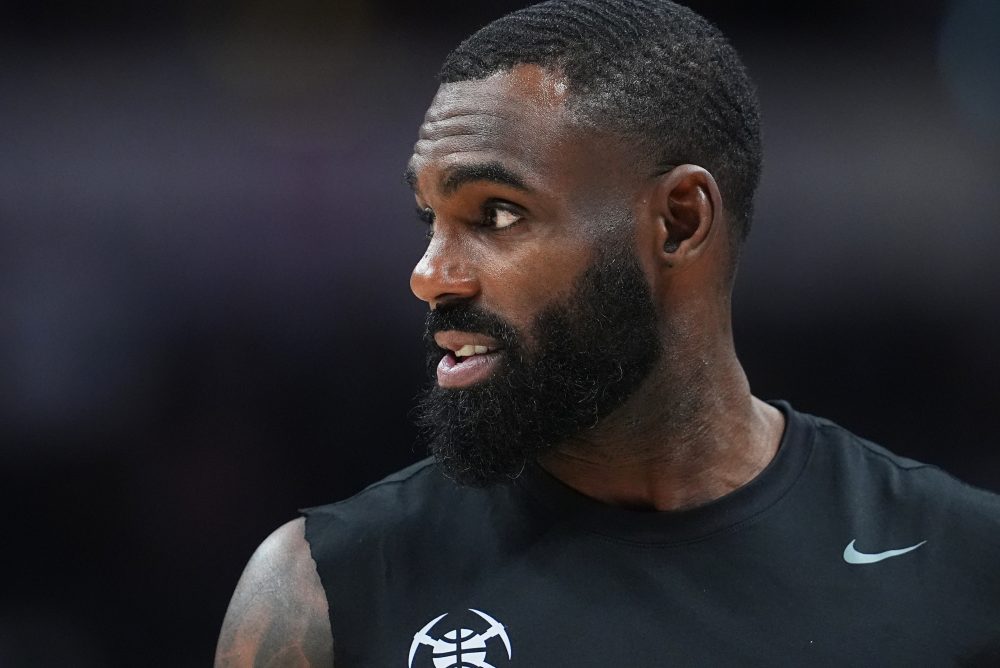
MIAMI (AP) — Every time Tim Hardaway Jr. walked into the arena as a visiting player over 15 trips to Miami, he had a ritual. He would look up into the rafters and find one particular banner hanging above the court.
That banner reads “Hardaway 10” — a tribute to his father’s career with the Heat and the jersey the franchise retired in the elder Hardaway’s honor.
“Coming here when I was an opponent, I felt like it gave me a superpower,” Hardaway Jr. said.
Now, that number belongs to him.
The Heat officially unveiled their newest player Wednesday, giving the 34-year-old Hardaway Jr. a formal introduction — and handing him a No. 10 Heat jersey, this one with “Jr.” stitched after the family name on the back.
“This is really bizarre,” said Heat President Pat Riley, who once coached Hardaway’s father in Miami.
As a child, Hardaway Jr. would roam the Heat practice facility while his dad played for the team, spending time in the family room playing video games. As he grew older, Riley would arrange for a staff member to put the younger Hardaway through workouts on the practice floor.
That staff member was Erik Spoelstra — who is now the Heat’s head coach.
“I think things are going to be a little bit more serious now than before,” Hardaway said. “But I mean, I’m very comfortable and confident to be able to go up there and talk to coach anytime I need some guidance or assistance on anything. I feel like he’s a great person in order to do that.”
Miami came into this offseason with a clear list of priorities. The team wanted a superstar and landed one by acquiring Giannis Antetokounmpo. The Heat were also searching for shooting ability and a player who could stay healthy. Hardaway checks both boxes — he set career highs last season with 224 three-pointers made and a three-point shooting percentage of nearly 41%, and he appeared in 236 out of a possible 246 regular-season games over the past three seasons.
Whether he starts or comes off the bench, his role is straightforward: make things easier for Antetokounmpo and Heat center Bam Adebayo.
“Once the call came, I think it was kind of a no-brainer,” Hardaway said. “It’s the right fit, not only for this franchise, but for me personally — especially when you have two guys out there that definitely need spacing for them to go out there and operate and do what they do best. My job here, it’s just to make their life easy and that’s to knock down shots.”
For Hardaway, this move is also deeply personal. Born and raised in Miami, the Heat will be his sixth NBA team — and the one playing in the city he still considers home.
“I’ve been praying for this day,” Hardaway said. “I’ve always wanted this day to come, ever since I was a kid.”
A new type of savings account aimed at children — dubbed Trump Accounts — has launched, and parents across the country are weighing whether it makes sense for their families.
While the program includes a free $1,000 contribution from the federal government for eligible children, families whose kids don’t qualify for that benefit may still be able to take advantage of the accounts.
The accounts made their public debut on July 6, 2026, when President Donald Trump rang the opening bell of the New York Stock Exchange from the Oval Office to mark the first day of trading for the new program.
Before deciding whether to enroll your child, financial experts suggest there are four important things parents should think through carefully.
First, eligibility for the government’s free $1,000 starter contribution is not universal — not every child will qualify, so it’s worth checking whether your family meets the requirements before assuming that benefit applies to you.
Second, even without the government contribution, the accounts may still offer savings or investment advantages that could benefit families in other ways over the long term.
Third, as with any financial product, parents should review the terms, fees, and rules associated with the accounts before committing.
Fourth, families should consider how a Trump Account fits alongside any other savings tools they may already be using for their children’s futures.
CAPE CANAVERAL, Fla. — Three months after making history by flying around the moon, the four-member Artemis II crew returned to Kennedy Space Center on Wednesday for a reunion with the very capsule that carried them on their record-setting journey.
It was the first time the crew had set foot at the launch site since lifting off in April. Standing at the now-empty pad where a massive Space Launch System rocket once towered, commander Reid Wiseman reflected on the sight. “It’s a lonely place without that rocket on it,” he said. The crew spent the day expressing gratitude to the many workers and teams who made the mission a success.
During the lunar fly-around, the three NASA astronauts and one Canadian space traveler shattered distance records, venturing 252,756 miles — or 406,771 kilometers — from Earth. It marked the first time humans had journeyed to the moon in more than 50 years.
Wiseman noted that excitement surrounding the mission remains strong among the public. He shared a touching moment from about a week ago, when a woman approached him while he was boarding a plane in France and handed him her boarding pass with a handwritten note. The message read: “Thank you for reminding us about joy and hope in the universe again.”
The crew is enthusiastic about passing the torch to the next mission team. Last month, NASA announced the Artemis III crew — three NASA astronauts and one Italian — who are set to fly next year. That mission will stay in Earth orbit and practice docking procedures with lunar landers currently being developed by SpaceX and Blue Origin. Artemis IV is tentatively planned for as early as 2028 and will include a moon landing by two astronauts who have not yet been named.
The Artemis III crew is entirely male, but Artemis II astronaut Christina Koch — who made history as the first woman to travel to the moon — said that fact does not trouble her. What would concern her more, she explained, would be if someone overrode NASA’s crew selection process just “to make it look a certain way.” “I am so glad and so proud that that’s not the situation we have,” she told reporters.
Koch flew to the moon alongside Wiseman, pilot Victor Glover, and Canada’s Jeremy Hansen. Earlier this week, Hansen announced he will be departing the Canadian Space Agency in September, though he plans to remain a reservist in the Royal Canadian Air Force and will continue to support the Artemis program going forward.
President Donald Trump returned home from a NATO summit in Turkey aboard one of the older, baby blue Air Force One aircraft rather than the gleaming red, white, and navy blue jet donated by Qatar — a last-minute switch that caught many by surprise and came just as the United States and Iran were exchanging military strikes.
Trump gave little explanation for the change, telling reporters he wanted to ride the older plane “for old time’s sake.” He also said both aircraft would make an unplanned stop at Royal Air Force Mildenhall, a base in the United Kingdom used by American military personnel, before heading back to the United States.
The sudden aircraft swap sparked new questions about the security readiness of the Qatari-gifted jet, which the U.S. spent $400 million to modify. Photos of the aircraft taken since its public debut show it is missing some of the missile detection and countermeasure systems found on the older presidential planes.
The timing added to the intrigue — the switch was announced less than a day after the U.S. military launched a series of major strikes against Iran in response to Iranian attacks on commercial shipping in the region. Iran shares a border with Turkey, where the summit was held.
Trump initially broke the news on social media, saying the new jet would stop at the UK air base so that military personnel could get a look at the plane. He said he would fly home separately on an older aircraft that had previously served as Air Force One.
At a news conference, when a reporter asked whether security concerns drove the decision, Trump didn’t give a direct answer. He did note, however, that regarding Iran, he was “No. 1 on the list for killing.” When pressed further, he said he would be “going home by normal methods” while the new plane was shown off to troops.
When reporters asked the U.S. Air Force whether the missing countermeasure systems factored into the swap, officials there referred questions to the White House. The White House did not respond to a request for comment.
Trump left Turkey on one of the older Boeing VC-25A aircraft that have transported U.S. presidents for more than three decades. Consumer flight tracking services lost the plane’s signal shortly after takeoff, indicating the crew had switched off its transponder — a security protocol typically used when flying the president through high-risk areas such as active war zones, not routine trips departing from a NATO ally hosting a pre-scheduled summit.
By contrast, flights carrying other world leaders — including those from Germany and the United Kingdom — departed with their transponders active and visible to trackers.
The Qatari-donated Boeing 747-800, which was customized for Trump’s use, left Turkey earlier that Wednesday and touched down at RAF Mildenhall that same afternoon, according to flight tracking data.
Iran has missiles and drones with enough range to cover the roughly 800-mile distance from its borders to Turkey, including certain Shahed drones and Shahab ballistic missiles. However, according to the Center for Strategic and International Studies, Iran does not have weapons capable of effectively reaching England, which sits approximately 2,500 miles away.
The U.S. Air Force, which manages the fleet of presidential aircraft, had previously acknowledged that not all necessary upgrades were completed on the Qatari jet in order to get it into service more quickly. While officials stated the conversion was done “without accepting any risk regarding security, safety, or secure communications,” they also admitted that “several highly complex engineering modifications required for the final Air Force One aircraft were intentionally excluded from the Bridge aircraft.”
A senior analyst at Teal Group, an aviation and defense consulting firm, previously told The Associated Press that the absence of countermeasure systems — along with what appeared to be fewer communications antennas — indicated the Qatari jet was more appropriate for domestic flights only.
Trump’s first trip aboard the new Qatari plane took place last week, when he flew to North Dakota.
The original Air Force One jets were constructed near the close of the Cold War and were designed to withstand the effects of a nuclear blast. They include a variety of security features such as anti-missile countermeasures and an onboard operating room. The planes are also capable of mid-air refueling, though that capability has never been used with a president aboard.
Two Boeing jets currently being built as permanent replacements for the aging Air Force One fleet have faced delays and are now expected to be delivered in 2028.
Veterinarians and humane societies issued warnings Wednesday after more than 30 confirmed cases of the New World screwworm were identified in Texas and New Mexico — two of them involving dogs — urging pet owners to stay alert and take steps to protect their animals.
The parasite made its return to the United States in June, more than half a century after it had been largely wiped out. Unlike most fly larvae that feed on dead tissue, the New World screwworm fly’s larvae consume living flesh and bodily fluids, making it especially dangerous to any mammal it infects.
The fly began moving north from Panama in 2024 and crossed into Mexico in 2025. While agriculture officials have focused on the threat it poses to the $113 billion U.S. cattle industry, the larvae can take hold in any mammal — including wildlife, dogs, cats, and occasionally humans.
The infestation begins when a female fly deposits eggs in open wounds or mucous membranes. Once hatched, the larvae feed for roughly a week before maturing, dropping to the ground, and eventually developing into adult flies.
The American Veterinary Medical Association notes that newborns and animals with open wounds or those who have recently had surgery or medical procedures face the highest risk. Even a tick bite can become a site for infestation, according to Aaron Grady, executive director of the Houston Humane Society shelter, who spoke during a webinar on the screwworm.
Animal health experts advise pet owners in affected areas — currently southern and southwestern Texas and southeastern New Mexico — to inspect their animals frequently for any wounds, cuts, or bites.
Signs of a possible infestation include visible maggots or movement within a wound, a foul odor, and unusual restlessness or anxiety in the animal. Melissa Stansell, a veterinarian at the shelter Austin Pets Alive!, also noted that an animal “hyper-fixating on looking or chewing in a certain area of the body” is a warning sign worth taking seriously.
Any of these symptoms should prompt an immediate call to a veterinarian. Infected animals are likely experiencing severe pain, which can lead to death from shock. The larvae can also be fatal if they migrate into vital organs or trigger life-threatening infections.
Shelters across Texas are working to prevent infestations by administering prescription flea and tick medications to animals in their care, and veterinarians recommend that pet owners do the same.
“It will kill the larvae as they ingest the blood and tissue,” Stansell explained. “The chemical compositions of those products are what kill the actual larval stages of these flies.”
Veterinarians can treat infestations, and animals can recover if care is sought promptly. Stansell said treatment may involve antibiotics, adding a reassuring note: “It is only fatal if left untreated.”
As a tropical species, the New World screwworm fly historically died off each year when cooler fall and winter temperatures arrived. However, state and federal agriculture officials aren’t counting on the weather to solve the problem.
Authorities have revived an eradication strategy that proved successful decades ago: breeding sterile male flies and releasing them into the wild. Since the female New World screwworm fly mates only once during her months-long life, pairing with a sterile male means her eggs will never hatch — gradually reducing and eventually eliminating the local population.
For years, the only facility in the Western Hemisphere breeding sterile flies was located in Panama. The U.S. Department of Agriculture has since invested $21 million to convert a site in southern Mexico — previously used to breed fruit flies — into a screwworm fly breeding operation. The agency also plans to spend $750 million on a new facility in Texas, expected to open next year.
A new piece of legislation aimed at strengthening retirement savings for Delaware state employees is one step away from becoming law.
The Delaware General Assembly voted on Tuesday, June 30, to pass HB 423, a bill that would automatically enroll newly hired state workers in Delaware DEFER — the state’s 457(b) deferred compensation savings plan.
Lawmakers say the measure is intended to address a persistent shortfall in retirement preparedness among state employees. Under the new system, new hires would be enrolled automatically rather than having to opt in on their own.
The legislation now moves to Governor Meyer’s desk, where it awaits a signature to become law.
Eleven more migrants removed from the United States by the Trump administration have landed in Eswatini, a small southern African nation, according to a U.S. attorney closely following the matter.
The new arrivals push the total number of deportees sent to the country to 29, all under a $5.1 million agreement between the two governments. The arrangement has drawn legal challenges from attorneys who argue that these individuals are being detained even though they had already finished serving their sentences for crimes committed on U.S. soil.
Attorney Alma David, who represents some of the original group of deportees sent to Eswatini last year and maintains contact with sources inside local prisons there, confirmed the latest arrivals to Reuters via text message.
Of the 29 people deported from the United States to Eswatini, only two have been released and sent back to their home countries — one to Jamaica and the other to Cambodia.
The newly arrived detainees have already been transferred to Eswatini’s Matsapha correctional facility, which has a notorious reputation, David said. A spokesperson for the Eswatini government had not responded to a request for comment at the time of reporting.
Eswatini is not the only destination being used under this policy. The Trump administration has also deported migrants to other nations across Africa, Asia, and the Americas as part of its broader third-country deportation strategy.
FIFA and Global Citizen, an organization dedicated to fighting extreme poverty, have announced that Canadian pop sensation Justin Bieber will join the World Cup final halftime show as a co-headliner. Bieber will share the stage with music legends Madonna, Shakira, and K-pop group BTS when the event takes place on July 19 at the New York New Jersey Stadium.
Nigerian Afrobeats star Burna Boy will also perform during the 11-minute broadcast. His collaboration with Shakira on the track “Dai Dai” has been making waves on music charts around the globe.
The entire halftime production will be shaped by Chris Martin of the rock band Coldplay, who is serving as curator for the show.
Adding a family-friendly element to the spectacle, beloved characters from both Sesame Street and The Muppets are expected to make appearances during the performance.
The halftime show is tied to a broader humanitarian effort. The initiative aims to raise $100 million to improve access to quality education and soccer opportunities for children around the world. So far, the campaign has surpassed the halfway mark, having already collected more than $50 million. One dollar from every World Cup match ticket sold is being directed toward the cause.
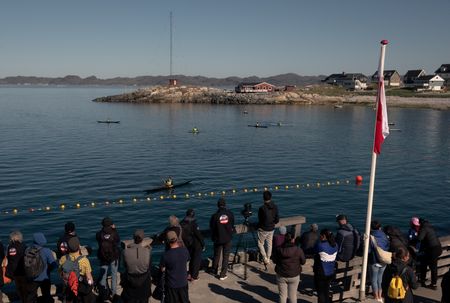
NUUK — People gathered at a traditional kayaking championship in Nuuk, Greenland, made their feelings clear on Wednesday: U.S. President Donald Trump’s latest push to take control of their island is unwelcome, and the island’s future belongs to its own people.
Trump renewed his call to gain control of Greenland — a semi-autonomous territory of Denmark — while speaking at a NATO summit held in Ankara, Turkey this week. He argued that controlling the island is critical to U.S. national security.
But at the kayaking championships taking place in Nuuk harbour, where athletes wowed crowds by flipping their kayaks completely upside down and rolling back upright, spectators were quick to dismiss Trump’s ambitions. Many said they believed he was more interested in the island’s natural resources than in the well-being of its people.
“He only thinks of commodities and oil,” said Frederik Larsen, 72, a retired Greenland native. “I think we can manage without him.”
Birgithe Geisler, 60, a public school teacher, put it simply: Greenland belongs to Greenlanders.
“No one else should decide for us,” she said.
Hans David Ezekiassen, an instructor at the Greenland Maritime Center, offered perhaps the most direct response of all.
“I think it’s shit, to put it mildly,” he said. “He can’t even control his own country, so why must he try to take over other countries?”
Even an American visitor had reservations about Trump’s push. Andy Thon, 49, an engineer and member of Qajaq USA who traveled from the United States to take part in the championships, noted that Greenland is already working toward greater independence from Denmark.
“With Denmark, they’re making their way towards full autonomy and the U.S. wouldn’t need Greenland as a strategic point if the U.S. was playing nicely with our allies,” he said.
The remarks from Trump also drew sharp responses from officials. Greenland’s Prime Minister Jens-Frederik Nielsen stated Wednesday that no matter how many times the call to take over the island is repeated, the answer remains the same — Greenland is not for sale.
FIFA announced Wednesday that pop star Justin Bieber will co-headline the halftime show at the World Cup final, joining an already impressive roster of performers.
Bieber will take the stage alongside Madonna, Shakira, and BTS for the 11-minute performance on July 19 — marking the first time a live musical halftime show has ever been featured at a World Cup final, according to a statement from the soccer governing body.
The championship match will be held in East Rutherford, New Jersey, just outside New York City.
A parasitic infection linked to prolonged, watery diarrhea has now sickened close to 1,300 people across Michigan and neighboring Ohio, marking the largest outbreak of its kind in Michigan’s recorded history and one of the biggest in the United States in recent years.
No fatalities have been reported, and investigators have not yet pinpointed where the cyclospora parasite is coming from. Similar illness clusters are also being looked into across 28 other states.
Michigan health authorities first alerted the public about the outbreak last week, at which point more than 170 cases had been confirmed — all concentrated in the southeastern part of the state — dating back to June 22. The state typically sees only around 50 such cases in an entire year.
By Wednesday, Michigan’s case count had climbed to 992, with roughly 40 people requiring hospitalization. Just over the state border, Lucas County in Ohio had logged 306 cases as of Wednesday, with the broader northwest Ohio region reporting more than 400 total infections.
Tracking down the source of cyclospora outbreaks is notoriously difficult, but Michigan’s chief medical executive, Dr. Natasha Bagdasarian, told the Associated Press on Wednesday that “there is clearly a linked outbreak happening right now.”
Cyclospora is a tiny, round parasite that the U.S. Centers for Disease Control and Prevention describes as causing watery diarrhea “with frequent and sometimes explosive bowel movements.” The illness it produces, known as cyclosporiasis, is rarely life-threatening and can usually be treated with antibiotics. Outbreaks are most common during late spring and summer months.
The parasite thrives in warm conditions, infects the intestines, and spreads through fecal matter. Past outbreaks have been traced to fruits and vegetables irrigated with water contaminated by feces.
Cyclospora is less common than other foodborne illnesses like salmonella or E. coli. For many years, only a handful of U.S. outbreaks were documented annually, but that number began climbing roughly a decade ago, with a notable spike in 2018 and 2019. Researchers point to climate change and improved detection methods as likely reasons for the increase.
Detailed data on cyclospora outbreaks is limited, but available records show that only a small number of documented outbreaks in the past two decades have exceeded 1,000 cases. Notable examples include a 1997 outbreak tied to raspberries from Guatemala that sickened more than 1,000 people in the U.S. and Canada, and a 2019 outbreak connected to basil from Mexico that affected more than 2,400 people.
Melanie Firestone, a foodborne illness researcher at the University of Minnesota, explained that the true scope of cyclospora cases is hard to measure because some standard food poisoning tests are not designed to detect the parasite. “So there is a lot of underreporting when it comes to this,” she said.
Additional complications arise because the parasite cannot be cultured in a laboratory setting, making it difficult to gather evidence from contaminated produce. Investigators also struggle to identify which specific food item people who fell ill had in common, especially when the culprit might be a single ingredient — such as basil or cilantro — used across many different dishes.
There is also the possibility that contaminated food is being distributed to both grocery stores and restaurants through the same supply channels, further complicating efforts to trace the source. Investigations of this type can stretch on for months and sometimes never reach a definitive conclusion.
While cases appear to be concentrated in and around southeastern Michigan, officials do not consider this a national health emergency. Dianna Blau, the CDC’s acting parasitic diseases branch chief, said there is no indication the parasite has mutated to become more contagious.
Thousands of cyclospora cases are reported in the U.S. each year, and it remains unclear how unusual this year’s numbers will ultimately be. However, current CDC national data shows the case count so far is four times higher than at the same time last year — though that federal data significantly lags behind what states are currently reporting.
Dr. Bagdasarian acknowledged that Michigan’s thorough approach to investigating and reporting cases may be “part of the reason why this looks like a Michigan problem.”
Health officials advise anyone experiencing diarrhea that does not resolve on its own within a few days to seek medical care and specifically bring up the possibility of cyclospora infection.
The most effective way to reduce the risk of infection is to avoid food or water that may have been exposed to contamination. Fresh produce should always be thoroughly washed before eating, though officials caution that the parasite can cling stubbornly to certain foods, meaning washing alone may not fully eliminate the risk.
While the source of the current outbreak is still under investigation, Michigan health officials are recommending that consumers buy whole heads of lettuce rather than pre-washed, bagged lettuce or salad mixes. They advise removing the outer two or three leaves and washing the remaining leaves under running water. Cooking vegetables when possible is also recommended.
NEWARK, Del. — The University of Delaware women’s lacrosse team is continuing to build its roster through the transfer portal, announcing the addition of midfielder Avery Olschefskie on Wednesday.
Head coach Amy Altig confirmed that Olschefskie becomes the fourth transfer to join the Fightin’ Blue Hens this offseason.
Olschefskie, a native of Glastonbury, Connecticut, brings two seasons of collegiate experience to Newark. She appeared in 35 games during her time at Niagara before making the move to Delaware.
The University of Delaware volleyball program is bolstering its coaching staff with two new additions. Head coach Kimberly Lambert announced that Anna Palmer and Jayden Nembhard have both been hired as assistant coaches.
The pair will join Lambert on the sidelines as the Blue Hens look to build on their program moving forward.
The latest broiler hatchery figures from federal agriculture officials show a modest uptick in poultry production activity across the United States.
According to the report, the number of broiler-type eggs set nationally rose by 3 percent compared to the previous period. At the same time, the number of broiler-type chicks placed across the country climbed by 1 percent.
These figures track the early stages of commercial chicken production, from egg incubation through the placement of young chicks at grow-out facilities. Increases in both categories can indicate growing demand for broiler chickens in the marketplace.
FIFA has officially unveiled the lineup for what is being billed as the first-ever FIFA World Cup Final Halftime Show — and the roster of performers is nothing short of spectacular. Justin Bieber, Madonna, Shakira, and K-pop group BTS are all set to take the stage during the World Cup final scheduled for July 19, just outside New York City.
Additional performers rounding out the event include Afrobeats star Burna Boy, Venezuelan conductor Gustavo Dudamel, and the PS22 Chorus — a choir made up of elementary school students from Staten Island, New York — who will share the stage with Coldplay.
The 11-minute show has been put together under the creative direction of Coldplay’s Chris Martin. Beyond the entertainment, the performance carries a meaningful purpose: it will raise awareness and funds for the FIFA Global Citizen Education Fund, an initiative working to secure $100 million to help children around the world gain access to both education and soccer.
Bieber expressed his enthusiasm for being part of the event. “The FIFA World Cup brings the world together in a way nothing else can,” he said in a statement. “I’m grateful to be part of this Halftime Show, and even more grateful knowing it’s already helping expand access to education for children around the world.”
Among the announced acts, Burna Boy’s inclusion carries special significance. He is one half of the official song for this year’s World Cup — a track called “Dai Dai” — which he recorded alongside Shakira. The song blends Afrobeats and Latin rhythms into a multilingual, globally-flavored pop anthem. In one section, Shakira calls out the names of competing nations and players: “Brazil, Uruguay, Argentina, Colombia… Mexico, Japan, Korea, Netherlands.”
Burna Boy spoke about what the opportunity means to him. “The FIFA World Cup is one of the few moments that truly brings the entire world together,” he said. “To represent Africa on the first-ever FIFA World Cup Final Halftime Show is a privilege and a responsibility that I don’t take lightly.”
It’s worth noting that elaborate halftime performances are not a tradition in soccer the way they are in American football. Events like the UEFA Champions League final typically feature a pre-match concert rather than a halftime spectacle.
Adding a touch of family-friendly fun to the occasion, the halftime show will also feature some of The Muppets from Sesame Street, including Kermit and Miss Piggy.
NEW YORK (AP) — The possible collapse of an already fragile ceasefire between the United States and Iran has reignited fears Wednesday that fuel prices could climb again if ongoing conflict prevents oil tankers from safely navigating the Persian Gulf.
Oil prices surged to their highest levels in several weeks after President Donald Trump declared the U.S. ceasefire with Iran finished, citing Iranian strikes on commercial vessels in the Strait of Hormuz and attacks on American military installations in other Gulf nations. Higher crude oil costs typically translate into more expensive fill-ups at gas stations, just as drivers across many countries had been catching a break from the elevated prices the war had caused.
“Tanker traffic through the Strait of Hormuz has essentially stopped, which tells you more about risk perception right now than any statement from Washington or Tehran,” said Jorge Leon, head of geopolitical analysis at Rystad Energy, in an email. “Oil markets reacted quickly to the renewed geopolitical risk.”
According to motor club federation AAA, the average price for a gallon of regular gasoline in the United States ticked up slightly Wednesday to $3.80, compared to $3.79 the previous day. That said, it remains considerably lower than the month-ago average of $4.16.
Because crude oil accounts for the largest share of what goes into the price of gasoline, rising oil costs eventually push pump prices higher. However, it can take several weeks before consumers feel the full effect. Refiners typically purchase oil in advance, and the finished gasoline product must travel through a network of pipelines and tanker trucks before reaching local gas stations.
Gas station operators set their own prices at the pump and sometimes choose to absorb higher oil costs rather than immediately passing the burden on to customers in order to stay competitive.
Starting in March, the U.S. and other nations began tapping their emergency oil reserves to help keep prices in check during the conflict. Those reserves, however, are not unlimited.
As of July 3, the U.S. Strategic Petroleum Reserve stood at 319.5 million barrels — the lowest level recorded since 1983, when the reserve was first being built up.
“Unfortunately, the drawdown of strategic stocks means that there is a lot less ammunition in Trump’s holster,” said Michael Lynch, a distinguished fellow at Energy Policy Research Institute in Amherst, Massachusetts.
On Wednesday, a barrel of U.S. benchmark crude was trading at $75.80, marking the highest price in over two weeks. Brent crude, the global standard, climbed to nearly $79 per barrel, its highest point since June 19.
The market’s response “highlights how sensitive prices remain to any escalation around the strait, given its role as a critical transit route for global oil flows,” Leon added.
One day after the U.S. accused Iran of attacking three commercial ships and stripped the country of its ability to openly trade crude oil on the world market, shipping industry officials were being urged to reconsider the safety of sending crewed vessels through the Strait of Hormuz and the broader Middle East region.
International Maritime Organization Secretary-General Arsenio Dominguez spoke out strongly against the attacks on ships in the strait.
“As long as the safety and security of crews cannot be assured, I urge flag states, shipowners, operators and all relevant authorities to avoid exposing seafarers to unnecessary danger by transiting the strait,” Dominguez said Wednesday. “The situation in the region remains volatile.”
Data and analytics company Kpler reported that some vessels did cross the strait on Tuesday, recording 41 crossings compared to 36 on Monday. It remains unclear whether those crossings occurred before or after the strikes took place. Some ships have also been turning off their location broadcasts while passing through the strait, making an accurate count even more difficult.
With the main central route through the strait blocked by mines, ships have been rerouting through two alternative paths — a smaller northern route through Iranian waters and a southern route through Omani waters. The three vessels struck on Tuesday appeared to have been using the Omani route.
An economist at advisory firm Oxford Economics suggested the ceasefire would likely continue in an on-and-off pattern, and that Washington and Tehran might still find a way to ease the latest tensions short of returning to full-scale conflict.
“The question is whether the latest developments merely represent a bump in the road or if we’re emerging from the ‘eye of the storm,’” wrote Ben May, the firm’s director of global macroeconomic research. “While Trump said negotiations with Iran were a ‘waste of time’, he maintained an off-ramp by noting that U.S. negotiators would continue talks with Iran, suggesting the truce hasn’t been irrevocably broken.”
The renewed uncertainty over the Strait of Hormuz comes just days after two of the world’s largest shipping companies, Maersk and Hapag-Lloyd, announced Monday through their Gemini Corporation joint venture that they would gradually restart service through the Suez Canal, which had been suspended because of attacks in the Red Sea by Yemen’s Houthis.
Recent stability in the Middle East had made that decision possible, but “the recent deterioration could put this resumption in jeopardy once again,” said Judah Levine, head of research at freight booking platform Freightos.
Hapag-Lloyd confirmed in a Wednesday statement that the joint decision was made following “thorough assessments of the security situation in the Red Sea area,” and noted that “if the situation changes or deteriorates, contingency plans are in place.”
The fatal shooting of a Houston man by a federal immigration officer on Tuesday has become at least the eighth death tied to the Trump administration’s ongoing immigration enforcement effort — and the first fatality during what officials describe as a newly intensified push toward mass deportations.
Department of Homeland Security officials released a statement identifying the victim as Lorenzo Salgado Araujo, a Mexican national. According to DHS, Araujo refused to comply with commands while attempting to avoid arrest during an enforcement operation, and allegedly tried to use his vehicle to strike an agent. The agent fired in self-defense, officials said.
Araujo’s family, however, said he was simply on his way to a construction job when the encounter occurred. He died before reaching the hospital.
The shooting quickly sparked outrage among immigrant rights organizations and some Democratic lawmakers, who called for an independent investigation and demanded that all video footage, communications, and evidence be preserved.
This is not the first time video evidence has raised questions about federal officers’ accounts. In several earlier fatal shootings, footage emerged that contradicted what agents reported. To date, no immigration officers have faced criminal charges in any of those deadly encounters.
One of the earliest deaths in the immigration crackdown occurred during a late-night traffic stop in Texas in March 2025. It took nearly a year for records related to that shooting to become public. The victim was a 23-year-old U.S. citizen.
A Homeland Security Investigations team working alongside local police stopped Ruben Ray Martinez during a drive from San Antonio to South Padre Island. His family said he had just turned 23 and was traveling with his best friend to celebrate his birthday.
DHS officials stated that Martinez was ordered to get out of the vehicle, refused, and instead “intentionally ran over” an agent. A second agent fired through the open driver’s window, striking Martinez, who later died at a hospital. The HSI agent involved sustained a knee injury, the nature of which was not disclosed.
Martinez’s mother said investigators with the Texas Rangers contacted her and told her video existed that contradicted the federal agents’ version of events. Both federal and state authorities have refused to address the reported discrepancies.
On January 24, a Border Patrol officer shot and killed Alex Pretti, a 37-year-old nurse, during a protest against the Metro Surge immigration operation in Minneapolis. Federal authorities quickly labeled Pretti, a U.S. citizen, as an armed agitator who posed a threat to officers.
Bystander video told a different story — it showed Pretti on the ground and holding a cellphone during the encounter. The footage also appeared to show an officer removing a gun from Pretti’s waistband and stepping back before the first shot was fired by a different officer, followed by additional shots. Pretti had a legal permit to carry a firearm.
State and local officials pushed back hard against the federal characterization of events. Gov. Tim Walz called the federal comments “despicable.”
Earlier that month, on January 7, an ICE officer repeatedly shot Renee Good, a U.S. citizen, in Minneapolis. Video shows Good turning her car’s wheels away from officer Jonathan Ross at the moment he opened fire. Trump administration officials have continued to defend Ross, arguing his life was endangered by the moving vehicle.
Good’s death ignited a national controversy. The U.S. Justice Department announced it would not share information about the shooting with state authorities. State and local officials later filed lawsuits in an attempt to halt the immigration sweeps, and protesters followed officers through the streets, prompting agents to deploy tear gas and chemical irritants.
On September 12, ICE agents fatally shot Silverio Villegas González during a traffic stop in a suburb of Chicago. Family members said the 38-year-old, a line cook from Mexico, had dropped a child off at daycare earlier that morning.
At the time, DHS said agents were targeting a man with a reckless driving history who was in the country illegally, and alleged that Villegas González had tried to evade arrest and dragged an officer with his vehicle. Homeland Security said the agent fired out of fear for his life and was hospitalized with “serious injuries.” Local police video, however, showed the agent moving around and describing his injuries as “nothing major.” DHS has said the case remains under investigation.
On July 10, immigration authorities were arresting dozens of farmworkers at Glass House Farms in southern California when Jaime Alanis fell from the roof of a greenhouse and broke his neck. The 57-year-old laborer from Mexico died at a hospital two days later.
Relatives said Alanis had worked at the farm in Camarillo — about an hour east of Los Angeles — for a decade. During the raid, he called family members to say he was hiding. Officials said he fell approximately 30 feet from the greenhouse roof. Homeland Security stated that Alanis was never taken into custody and was not being pursued by agents at the time.
On August 14, a man fleeing immigration officers near a Home Depot in southern California was struck and killed by an SUV while attempting to cross a freeway. Police in Monrovia, northeast of Los Angeles, said ICE agents were conducting enforcement operations when the man ran across the eastbound lanes of Interstate 210 and was hit. The man was later identified by the National Day Laborer Organizing Network as Roberto Carlos Montoya Valdez, 52, of Guatemala. He died at a hospital. Homeland Security said Montoya Valdez was not being actively chased by agents when he ran.
Most recently before Tuesday’s Houston shooting, Josué Castro Rivera, 24, of Honduras, was struck and killed by a pickup truck on a highway in Norfolk, Virginia, on October 23, while trying to flee officers during a traffic stop. His brother, Henry Castro, said Castro Rivera had been heading to a gardening job with three passengers when ICE officers pulled the vehicle over. State and federal authorities confirmed he ran from the scene on foot and was hit by a pickup truck on Interstate 264. Homeland Security said the stop was part of a “targeted, intelligence-based” operation and that Castro Rivera had “resisted heavily and fled.”
HOUSTON — The family of a Mexican national killed by an Immigration and Customs Enforcement officer in Houston says the man had no criminal record after decades of living in the United States and was on his way to a home construction job when he was shot and killed.
Lorenzo Salgado Araujo was in the process of obtaining legal immigration status and had prepared himself for what to do if he were ever stopped by ICE, according to his son.
Ronaldo Salgado told reporters at a news conference that his father may have panicked when he saw people approaching in unmarked vehicles, fearing they were there to rob the tools he had used for 35 years to build homes — tools that helped put his three American-born sons through college.
“He did not deserve to die. He did not deserve to be reduced to a headline of Mexican man shot and killed by ICE. He deserved to live a quiet life as Lorenzo Salgado Araujo, a husband, a father and a job creator for dozens of men who also wanted the American dream,” Salgado said at the news conference.
The fatal shooting occurred Tuesday in Magnolia Park, a neighborhood that has served as a center of Houston’s Mexican American community for more than a century.
The Department of Homeland Security, which oversees ICE, said in a statement Tuesday that Salgado Araujo ignored commands and tried to run over an officer, who fired in self-defense. The department said ICE was targeting him because he was in the country without legal authorization, and that his vehicle struck an ICE vehicle during the encounter.
Democratic U.S. Rep. Sylvia Garcia confirmed that Salgado Araujo had no criminal convictions on his record.
Houston firefighters reported he was shot in the abdomen. He later died at a hospital.
According to Ronaldo Salgado, three other men — one of whom was his uncle — appeared to be detained while his father lay moaning on the ground. He said no one has heard from any of those men since.
Federal officials have not released any video footage or photographs of the shooting or the claimed vehicle damage. Salgado joined civil rights organizations and Democratic officials in calling on federal authorities to make all footage and related information public.
In previous incidents involving federal officers, early accounts from immigration officials have later been contradicted by video evidence.
A bystander named Juliet Martinez captured video showing a black vehicle positioned at an angle near a white van, with both vehicles’ doors open. In the footage, a bleeding, handcuffed man can be heard groaning loudly on the ground as his leg shakes. Several federal officers stand over at least three other handcuffed individuals nearby.
League of United Latin American Citizens President Roman Palomares said at the news conference that the federal crackdown has turned the country into a place where it is “open season on Latinos” — where officers believe they can “shoot and explain later.”
Palomares said ICE’s handling of past investigations shows the agency has not earned the public’s trust to take its statements at face value without supporting evidence such as video.
“Your pattern has been one of inaccuracies of prejudicial leaks before the facts are known, of twisting the narrative to fit your version of events,” Palomares said.
The league announced a $5,000 reward for witness information and video footage, while also calling for an independent investigation. Other civil rights leaders urged anyone with video not to hand it over to ICE, warning that such evidence could be destroyed.
Harris County District Attorney Sean Teare said the family and community deserve answers, but noted that federal authorities are currently handling the investigation exclusively.
Representatives for ICE and DHS did not respond to repeated requests for comment Wednesday.
Homeland Security Secretary Markwayne Mullin took over leadership of the department in March with the stated goal of avoiding the controversies that had defined his predecessor Kristi Noem’s time in the role.
Following two fatal shootings in Minnesota that sparked significant public backlash, immigration arrests nationwide declined and ICE appeared to adjust its approach. However, in late June, arrests surged to 10,000 over a five-day period, driven in part by a major increase in Congressional funding.
This shooting is believed to be at least the eighth death resulting from an encounter with federal immigration officers since the Trump administration launched its immigration enforcement crackdown.
Ronaldo Salgado said his mother received word around 7 a.m. Tuesday that something had happened to his father. After rushing to the job site and finding his father’s empty van, he came across a video online.
“I recognized him, not from his appearance but from his voice crying for help as he lay on the street,” Salgado said.
Salgado Araujo met his future wife as a teenager in Mexico. The couple came to the United States and built their own home in Houston with the help of friends and family members from his work crew. His wife prepared his lunch each morning before he left and had a full meal waiting when he returned. He would relax on his porch listening to music and petting his dog, his son recalled.
“After nearly 35 years of working to give us the American dream, he made the choice to begin the process of obtaining his American dream through a work permit,” Salgado said. “We dotted every I, crossed every T, filled every document, attended every appointment. He was close to obtaining his legal status.”
Salgado Araujo had completed biometric scans and fingerprinting earlier this year and had carefully studied what to do if ICE pulled him over. His son said that if his father was driving away, it was likely out of fear that his tools were about to be stolen.
“Had my father seen an emblem of ICE or an emblem that says anything about a law enforcement agency, my father would have complied,” his son said.
Mexican President Claudia Sheinbaum said she is weighing legal options and may call on the United Nations to intervene to stop what she described as violence against Mexicans in the United States.
“There has been another tragic death of one of our compatriots in the United States due to detention issues, even though their only ‘offense’ is not yet having proper documentation,” Sheinbaum said.
Houston has seen increased immigration enforcement activity since the crackdown began, and the efforts have not gone without resistance. The Houston City Council passed an ordinance limiting cooperation with ICE, but later reversed the decision after Gov. Greg Abbott, a Republican, threatened to cut more than $100 million in state funding for public safety.
WASHINGTON — The United States is pushing back against China after Beijing provided only a few hours of advance warning before firing a ballistic missile from a nuclear-powered submarine into the Pacific Ocean on July 6, a State Department official announced Wednesday.
Chinese state media confirmed the missile launch took place Monday, triggering criticism from the U.S., Japan, Australia, New Zealand, and Taiwan.
A State Department official said the warning China gave was far too little and lacked critical detail. “China’s notification to the United States came only a few hours before the launch and failed to provide sufficient detail, falling considerably short of standards adopted by all other P5 nuclear weapon states,” the official stated. The P5 refers to the five permanent members of the United Nations Security Council — the only countries officially recognized as nuclear-weapon states under the 1968 Nuclear Non-Proliferation Treaty.
The official went on to say the test was deeply troubling given China’s ongoing military expansion. “The test occurred amid China’s rapid and opaque nuclear weapons buildup and is of great concern to the region,” the official added.
In a statement to Reuters, the official described the launch as “irresponsible,” noting that China failed to use the standard diplomatic channels for advance notification that other nations follow when conducting such tests.
The official also called on Beijing to engage in constructive talks, saying, “We urge Beijing to engage in meaningful discussions on strategic stability and arms control,” while affirming that the U.S. “remains steadfast in its defense commitments to our allies and partners.”
China’s state-run Xinhua news agency characterized the launch as a “routine arrangement” tied to annual military training exercises, emphasizing it was not aimed at any particular country or target. China’s embassy in Washington had not responded to a request for comment at the time of publication.
While China did not identify the specific missile used, state-controlled tabloid Global Times, citing a military expert, suggested it was likely the JL-3 — China’s most advanced submarine-launched ballistic missile. According to a Pentagon report, that missile is capable of reaching the continental United States from Chinese coastal waters.
China has been rapidly expanding its nuclear arsenal and has repeatedly rejected U.S. attempts to start arms control negotiations. Beijing has long maintained that the U.S. already holds a significantly larger nuclear stockpile. In 2024, China suspended early-stage talks with Washington over the issue, citing U.S. arms sales to Taiwan, which China considers part of its territory despite Taiwan’s democratic self-governance.
An Irish-founded drone delivery startup is betting big on the American Southwest, announcing plans to bring autonomous drone delivery to the vast majority of Tulsa, Oklahoma within the next year.
Manna, which is headquartered in Ireland, says 90% of Tulsa residents will have access to drone delivery service within that timeframe. The company plans to begin flying orders for partners including DoorDash, McDonald’s, and Uber Eats within the next two months, and aims to operate out of 40 locations across Oklahoma’s second most populous city by mid-2027.
Executive chairman Kenny Jacobs spoke to Reuters at the launch of the company’s first full-scale U.S. operation, describing the region as a critical testing ground for the industry. “This part of the U.S., Oklahoma, Texas, states around here will really be the battleground for scaling up and proving all types of drone delivery globally,” Jacobs said.
Jacobs, a former Dublin Airport CEO and former marketing chief at Ryanair who joined Manna this week, said the company has moved past the technology hurdles. “The technology is proven. Now it’s about the commercial scalability and showing how quickly you can open up bases and deliver all types of things,” he added.
Manna faces competition from established players including Zipline, Alphabet’s Wing, Amazon’s Prime Air, and other startups. The company has logged more than 300,000 deliveries to date, primarily in Ireland, though it recently suspended operations there due to a lack of clear national planning regulations.
Jacobs said he expects no similar regulatory obstacles in the United States. He expressed confidence that Manna would expand into at least one additional U.S. city before the end of the year, pointing to other parts of Oklahoma, as well as Texas and Arizona, as likely candidates.
One advantage the company cites is its ability to grow quickly and affordably — each local launch site requires no more space than four parking spots, keeping capital costs per location low.
Manna secured $50 million in Series B funding earlier this year. The company is also eyeing an expansion into Britain by early 2028, with a potential push into the United Arab Emirates possibly coming even sooner, according to Jacobs.
ANKARA — Turkey rolled out an elaborate welcome for President Donald Trump at a NATO summit in Ankara, staging a red, white, and blue aerial display and even naming a new airport terminal in his honor — all in a bid to strengthen ties between Washington and Ankara at one of the alliance’s most high-profile gatherings.
Turkish President Recep Tayyip Erdogan personally greeted Trump at the airport on Tuesday, and the two leaders walked arm-in-arm. Trump, referring to Erdogan as his “dear friend,” later pledged to lift sanctions he had personally imposed on Turkey during his first term in office six years ago — a period widely regarded as one of the lowest points in U.S.-Turkish relations.
The warmth between the two leaders only deepened over the course of the two-day summit, which wrapped up Wednesday. Trump indicated he was open to selling Turkey F-35 fighter jets — though he later walked that back slightly, saying he hadn’t fully made up his mind. He repeatedly praised Erdogan throughout the summit, and the two shared smiles, laughter, and embraces while communicating through interpreters.
For many diplomats, simply getting Trump to show up had been Turkey’s biggest hurdle. Trump, who has long criticized NATO allies for not spending enough on defense, said the only reason he attended was because Erdogan was the host. That statement alone was considered a diplomatic achievement for Turkey, which has been working to raise its standing within the alliance and resolve longstanding friction with the United States.
“It was valuable that Trump emphasised the importance he places on myself and our friendship,” Erdogan said as the summit came to a close. “I thank my dear friend once again.”
Despite the warm bilateral atmosphere, Trump stirred controversy on Wednesday — the day after his cordial meetings with Erdogan — by calling on the U.S. to sever trade ties with Spain and repeating his claims over Greenland, which irritated NATO ally Denmark. He later described the leaders’ meeting as full of love and “a lot of unity,” offering some reassurance to an alliance that has grown uneasy with an unpredictable American president who has at times questioned NATO’s worth.
Trump also took the unusual step of publicly defending Erdogan against criticism from Israeli Prime Minister Benjamin Netanyahu, who had warned against the potential F-35 sale to Ankara. Trump made the defense while seated alongside NATO Secretary General Mark Rutte.
Earlier, in front of reporters, Trump signaled he would remove U.S. sanctions that were put in place after Turkey’s 2019 purchase of Russian S-400 air defense systems — a move that drew a thumbs-up from Erdogan. He also hinted at a willingness to sell Turkey the F-35s that had been blocked as a result of those sanctions and other U.S. laws.
Turkey had been pushing for both of those steps for years, even as it refused to back away from the S-400 acquisition, which had at the time angered the U.S. and other NATO members and damaged trust within the alliance.
Even so, Trump’s pledge is expected to run into resistance in the U.S. Congress, where existing laws require Turkey to no longer possess the S-400 systems. The move could also create complications with Russia, which has end-user conditions attached to the original purchase agreement.
The diplomatic progress, even if largely symbolic at this stage, comes just weeks after a U.S. court brought to a close a lengthy criminal case involving Turkish state bank Halkbank — a case Erdogan had publicly criticized as unjust.
The developments could also provide a domestic political boost for Erdogan, who has led Turkey for 23 years and whose popularity has been under pressure amid an unprecedented legal crackdown on the country’s main opposition party. Critics have pointed to that crackdown as a significant test of Turkey’s democratic standing.
NATO Secretary General Mark Rutte, when asked about a series of arrests in Turkey just before the summit — including journalists and a well-known comedian — said that democracy encompasses more than just elections, noting it also means the right to protest and freedom of the press.
“Never before in our history has there been a government so deeply dependent on the U.S. administration,” said Ozgur Ozel, the ousted leader of Turkey’s main opposition Republican People’s Party, speaking on Tuesday.
Trump’s predecessor, Joe Biden, had kept Erdogan at a distance largely due to concerns over human rights and civil liberties in Turkey. Since then, Western nations have largely gone quiet on those concerns as Turkey has grown into a significant defense industry power and a key buffer against Russian aggression along NATO’s southeastern border.
The pageantry of Trump’s arrival at the 1,100-room presidential palace in Ankara on Tuesday underscored the importance Turkey placed on the visit. He was escorted by 100 horsemen and greeted by a ceremonial guard that, in a first for the palace, included soldiers dressed as historical Ottoman warriors. As Trump and Erdogan walked side by side, Turkish military jets streaked overhead, leaving trails of red, white, and blue in the sky.
LONDON — Just two weeks ago, virtually nobody would have predicted that Marta Kostyuk, Linda Noskova, Karolina Muchova, and Coco Gauff would be the last four women standing at Wimbledon.
The surprising group doesn’t exactly have an impressive track record on grass courts. Among the four, only Muchova had ever advanced as far as the quarterfinals at the All England Club — and even that achievement had become a distant memory after she was eliminated in the first round on each of her last four appearances there.
Despite all of that, when Muchova walks out onto Centre Court to face Gauff on Thursday afternoon — followed by Noskova squaring off against Kostyuk — one of these four players will be just two victories away from lifting the most iconic trophy in tennis, the Venus Rosewater Dish.
A First-Time Champion Is Guaranteed
Wimbledon has not seen a repeat women’s champion since Serena Williams captured the last of her seven titles there back in 2016. For the ninth consecutive edition of the tournament, someone will be hoisting the trophy for the very first time.
That reality prompted Noskova to observe: “Anybody can beat anybody, it’s wide open.”
No other Grand Slam event has cycled through so many different first-time champions in a row, a pattern that only adds to the legendary status surrounding Wimbledon.
Of the four remaining players, world No. 7 Gauff is the only one who has ever won a Grand Slam title, having previously claimed both the U.S. Open and French Open trophies. Yet even she admits her run to the semifinals caught her off guard, given how poorly she had performed on grass in recent years.
Gauff Reflects on Her Wimbledon Journey
“If you told me I would be in the semis … I’d be, ‘You’re funny’. Especially … the last two years not winning anything on here,” said the 22-year-old American, who has been a familiar face at Wimbledon since 2019, when she defeated Venus Williams in the first round as a 15-year-old.
“Do I feel like Wimbledon is part of my destiny? If you asked me seven days ago, the answer would have been no. Honestly, I was writing it off a little bit. But I hope it is part of my destiny, whether it’s this year or in the future. I definitely would love to see my name on the champions’ wall, for sure.”
Heading into their semifinal matchup, Gauff holds a commanding 6-1 head-to-head record against 10th seed Muchova. The Czech player, however, is choosing to focus on a more favorable statistic.
“I’m happy we have 0-0 on the grass. That’s a bit better balance for me there,” Muchova said with a smile.
Czech Players Have Long Thrived at Wimbledon
There is a long history of Czech women excelling on the Wimbledon grass. Since tennis turned professional nearly six decades ago, Czech players have won the Rosewater Dish seven times — a tally that includes the first two titles won by Martina Navratilova before she became a U.S. citizen in 1981.
Combined, Navratilova, Jana Novotna, Petra Kvitova (twice), Marketa Vondrousova, and Barbora Krejcikova account for more Wimbledon titles than the total of five Grand Slam titles Czech women have won at the other three major tournaments combined since 1968.
Both Muchova and Noskova also have the added motivation of potentially setting up the first all-Czech Grand Slam final in history.
Ninth seed Noskova, like her semifinal opponents, is still having trouble believing she is this close to tennis history. Still, that sense of disbelief hasn’t stopped her from dreaming of achieving “big things in the world” — just like her idol, Kvitova.
“We had two matches against each other … I was just kind of stunned that I was on the same court with ‘the’ Petra Kvitova,” said Noskova, who lost to Ukrainian 12th seed Kostyuk in their only prior meeting. “As a kid, I was always looking up to her. She was the face of Czech tennis. When she won two Wimbledons … she helped me to get into tennis a little bit. I would love to follow her in her footsteps. If the outcome’s going to be the same, I would love nothing more.”
For Kostyuk, she is hoping her deep run at Wimbledon can offer a moment of joy to her homeland, which continues to endure the hardships of war. “I’m hoping it would mean a lot,” she said.
Thursday’s Order of Play — Women’s Semifinals (Centre Court, 12:30 p.m. GMT)
The United States Supreme Court’s yearly financial disclosure reports are offering the public a closer look at how the justices earn money beyond their judicial salaries, including income generated from book deals and other personal ventures.
These annual reports serve as a window into the personal and financial lives of the nation’s top jurists, covering everything from gifts they received to travel they took and other sources of outside income.
Among the details drawing attention this year is how book-related income is contributing to the justices’ overall earnings, adding a notable revenue stream on top of their court compensation.
The disclosures are required annually and are intended to promote transparency among members of the nation’s highest court.
Pressure is building for an independent inquiry into the fatal shooting of a Houston man by a federal immigration agent, the latest in a series of deadly confrontations involving U.S. Immigration and Customs Enforcement officers.
ICE released a statement following the Tuesday morning shooting identifying the victim as Lorenzo Salgado Araujo, a Mexican national it described as living in the country without legal authorization. According to the agency, Salgado used his vehicle to ram an ICE vehicle and attempted to strike an officer with it, prompting the officer to open fire in what ICE called “self-defense.” Salgado was transported to a hospital, where he later died. Reuters was unable to independently confirm his immigration status or the specific circumstances surrounding the shooting.
At a press conference held Wednesday, Salgado’s son, Ronaldo, painted a very different picture of his father — describing him as a peaceful construction worker who had lived in the United States for 35 years. “He dedicated his life in the United States to giving his family the American dream,” Ronaldo said. He added that his father had been working toward legal immigration status and was close to obtaining it.
Ronaldo said he only found out what had happened after stumbling upon a social media video. “I recognized him immediately, not from his appearance, but from his voice, crying for help as he lay on the street, bleeding out,” he said, visibly emotional.
Surrounded by members of Congress, Latino community leaders, and Houston officials, Ronaldo called for “a full investigation” into his father’s death.
Roman Polares, president of the League of United Latin American Citizens, also addressed the press conference with sharp words. “It is un-American to use a fatal force against a human being, then lock away the evidence,” he said. “For too long, we have watched an open season declared on Latinos, and communities of color, under the guise of public safety.”
ICE announced Tuesday that its parent agency, the U.S. Department of Homeland Security, would oversee an investigation into the shooting, while the FBI would separately examine the “potential assault on a law enforcement officer.”
That wasn’t enough for many Houston officials. Alejandra Salinas, a member of the Houston City Council, wrote in a newspaper opinion piece Wednesday: “I am calling for an immediate and impartial investigation, with all available video and findings released as soon as possible.”
U.S. Representative Sylvia Garcia, a Texas Democrat whose district includes the neighborhood where the shooting occurred, echoed that call. She framed the incident as further evidence that Congress needs to reform ICE. “We need independent investigations, we need body cameras, clear identification, no masks and an end to paramilitary-style immigration enforcement in our streets,” Garcia said at the press conference.
Houston Mayor John Whitmire, speaking at a City Council meeting Wednesday, said he has been in “constant touch” with federal officials. He called for a “transparent, independent” investigation but said the city would not lead its own separate probe, stating there “could not be two ongoing investigations.”
The shooting adds a new layer of tension to the mayor’s already complicated relationship with immigration enforcement. Months ago, Whitmire clashed with Texas Governor Greg Abbott over whether Houston police officers could work alongside ICE. Political analysts say he has since tried to sidestep direct confrontations on the issue. “If the mayor can ignore this then he’ll try to, with the effort to try to focus on things that he can more directly control,” said Brandon Rottinghaus, a political science professor at the University of Houston.
This incident is part of a broader and troubling pattern. At least six people have been shot and killed by federal immigration agents since January 2025, when President Donald Trump began his second term and launched large-scale deportation operations. Immigration arrests have surged in recent weeks, with officers detaining roughly 2,000 migrants per day last week, according to two sources familiar with the situation.
As of Wednesday afternoon, no video of the actual shooting had surfaced, and it remained unclear whether the agents involved were equipped with body cameras. The Trump administration has moved slowly on expanding body camera use among immigration officers and significantly reduced oversight staffing over the past year, raising concerns about accountability.
This is not the first time federal agencies’ accounts of use-of-force incidents have come under scrutiny. In October, a Chicago-area woman named Marimar Martinez was accused of ramming law enforcement officers with her vehicle and was shot five times. She survived, charges against her were eventually dropped, and video evidence indicated the agents may have actually caused the collision.
Earlier this year, Trump administration officials maintained that two U.S. citizens — Renee Good and Alex Pretti — who were shot and killed by federal agents on the streets of Minneapolis in January had threatened the officers beforehand. Video evidence appeared to contradict that account. In May, a Minnesota prosecutor filed charges against an ICE agent in connection with a separate non-fatal shooting of a Venezuelan man in Minneapolis during the same enforcement operation.
Mark your calendars — the New Castle County Division of Police is welcoming residents and their families to this year’s National Night Out celebration on Tuesday, August 4, 2026.
The event will be held at Delcastle Recreational Park and is part of an annual tradition aimed at strengthening the bond between community members and local law enforcement officers.
Attendees will have the chance to meet the officers who serve their neighborhoods, get an up-close look at police vehicles, and explore some of the department’s specialized units. The evening is designed to be both informative and entertaining for people of all ages.
DETROIT — One of baseball’s most decorated pitchers is hanging up his cleats. Justin Verlander announced Wednesday that this season will be his last, choosing to end his career where it began — with the Detroit Tigers.
The 43-year-old right-hander, currently the oldest active player in Major League Baseball, broke the news on social media shortly after being named a Legend Pick to the American League All-Star roster.
“While I’m fully committed to giving my team everything I have for the rest of this season, I’ve decided this will be my last,” Verlander wrote. “It’s fitting that I get to finish where it all started — with the Detroit Tigers, the organization that drafted me and gave me my first opportunity.”
Verlander returned to Detroit this past February on a one-year, $13 million deal. His 2025 campaign has been limited by injuries — he landed on the injured list early in the year with hip inflammation, and then suffered a hamstring pull during a bullpen session just as he was approaching a comeback. His only start this season came on March 30, when he allowed five runs over 3 2/3 innings in a 9-6 road defeat at Arizona.
Despite the setbacks, Verlander says the decision to retire wasn’t driven by a specific number or moment.
“I never wanted to retire because of a milestone, a number, or a date on the calendar,” he said. “I wanted the game to tell me when it was time. Over the last several months, I’ve realized that time has come.”
He had been scheduled to pitch in June in what would have been his first appearance at Comerica Park since August 30, 2017 — the day before he was traded away to Houston.
Verlander’s legacy with the Tigers alone is remarkable. From 2005 to 2017, he went 183-115, claimed the American League Rookie of the Year award in 2006, and swept both the AL MVP and Cy Young Award in 2011. He helped lead Detroit to the World Series in 2006 and 2012, as well as four consecutive division titles from 2011 through 2014.
After being traded to Houston, he continued to thrive. He was named the 2017 ALCS MVP and was part of World Series championship teams that year and again in 2022. He also earned his second and third Cy Young Awards in 2019 and 2022.
“I’ve been fortunate to play with and against incredible players, for outstanding organizations, and compete in front of fans who deeply appreciate the game,” Verlander said.
He added: “It’s time for the next chapter. But first, I’m excited to finish this season the only way I know how — with everything I’ve got.”
Over his 21 major league seasons with the Tigers, Houston Astros, New York Mets, and San Francisco Giants, Verlander compiled a career record of 266-159 with a 3.33 ERA across 556 starts. He struck out 3,554 batters and threw 26 complete games, including nine shutouts.
Although he won’t take the mound at the All-Star Game in Philadelphia on Tuesday, MLB Commissioner Rob Manfred confirmed Verlander will attend and be honored during the festivities.
“The opportunity to attend once again is something I’ll cherish and it will be an incredibly special moment for me and my family,” said Verlander, who is married to model Kate Upton and has two children.
Verlander joins Bryce Harper of the host Philadelphia Phillies as a Legend Pick for the 2026 Midsummer Classic. Previous All-Star games have honored legends including Albert Pujols, Miguel Cabrera, and Clayton Kershaw.
GEORGETOWN, Del. — Motorists traveling through Georgetown in Sussex County will need to find alternate routes beginning next week due to a full road closure on Gravel Hill Road.
Delmarva Central Railroad crews are scheduled to begin resurfacing and general maintenance work at their railroad crossing on Gravel Hill Road, located between Lewes Georgetown Highway (SR 9) and Bennum Switch Road. Work is set to begin at 7:00 a.m. on Friday, July 17, 2026.
The project will require Gravel Hill Road (SR 30) to be completely closed at the railroad crossing for the duration of the work. The closure is expected to remain in effect through Friday, July 24, 2026.
Message signs will be placed along the roadway ahead of the closure to alert drivers and give them time to plan alternate routes before the work begins.
BEIRUT — A Lebanese pop star who abandoned his music career to become a militant has walked free on bail, according to judicial officials, after spending months behind bars awaiting a new trial.
Fadel Shaker turned himself in to Lebanese military intelligence last October, ending more than a decade on the run. He had been hiding inside the Palestinian refugee camp of Ein el-Hilweh, located near the port city of Sidon.
In 2020, Shaker was convicted in absentia and handed a 22-year prison sentence for supporting what was classified as a “terrorist group.” The charges stemmed from violent street fighting that broke out in 2013 between Sunni militants and soldiers from the Lebanese army in the area around Sidon.
Four judicial officials told The Associated Press — speaking anonymously in accordance with regulations — that Shaker paid 500 million Lebanese pounds, equivalent to roughly $5,500, to secure his release. Before being freed Wednesday, he was questioned about multiple allegations, including participation in an armed group, financing armed factions, money laundering, and most critically, direct involvement in the 2013 Sidon clashes.
Those cases remain open as investigators continue their work. Following his release, Shaker departed a military facility located in a suburb of Beirut, where he had been held, and has since moved into a rented apartment, the officials said. Neither Shaker nor his attorney responded to requests for comment.
After his October surrender, Lebanese law required that his original conviction be set aside and a new trial be initiated. That retrial began in January. During his testimony, Shaker acknowledged having been close to Sunni Muslim cleric Ahmed al-Assir and said he had received threats from the Lebanese militant group Hezbollah and from backers of ousted Syrian President Bashar Assad.
Al-Assir was found guilty in 2017 and sentenced to death for his role in the 2013 clashes, which left 18 soldiers dead. That trial lasted two years, and al-Assir remains on death row.
During his January testimony, Shaker said his relationship with al-Assir had cooled and that the two had disagreements before the 2013 violence erupted. He firmly denied any personal involvement in the fighting near Sidon.
Despite those denials, a video posted to YouTube during the 2013 clashes shows a bearded Shaker hurling insults at his enemies and taunting the military. In the footage, he says “we have two rotting corpses that we snatched from you yesterday,” an apparent reference to two pro-Hezbollah fighters killed during the clashes.
The 2013 violence deepened the sectarian divide between Sunni and Shiite Muslims in Lebanon, tensions that were being stoked by the civil war raging in neighboring Syria, where Hezbollah fighters had joined forces with Assad against predominantly Sunni rebel and militant groups.
Before his transformation into a militant figure, Shaker had been a celebrated entertainer across the Arab world, rising to fame with a major hit in 2002. His fans were stunned when he began appearing at rallies beside al-Assir, and he later announced he had given up singing to draw closer to God.
Even while living as a fugitive, Shaker continued releasing music. A song recorded with his son Mohammed last July spread widely across the Arab world after going viral.
MAIQUETÍA, Venezuela — Weeks after a catastrophic pair of earthquakes rocked Venezuela, thousands of survivors in the hardest-hit region are now facing a growing crisis over access to clean water and basic sanitation.
In La Guaira state, desperate families have turned to the Caribbean shoreline to bathe and use the bathroom, leaving human waste scattered across beaches that were once popular gathering spots. Those with a small amount of water still remaining in their home storage tanks are stretching it as far as possible for washing dishes and personal hygiene. With 190 buildings completely collapsed and 856 more left damaged by the June 24 earthquakes — according to Venezuelan officials — many residents have been forced into temporary shelters or are sleeping outside. The death toll from the twin quakes stands at 3,685.
Juliani Herrera, 20, described how the earthquakes wiped out the water supply that families had carefully stored. “We always have water in the tank — water reserved — but with the earthquake, most of the tanks in the houses broke,” she said, referring to the large blue plastic containers many Venezuelan households rely on to collect water during the infrequent days when the state utility delivers service. “Now, we have to wait to see if a tanker comes and fills buckets.”
The situation is particularly grim because some of these communities were already receiving potable water only once every month or two before the disaster struck. In Maiquetía — the city best known for housing Venezuela’s primary international airport — residents gathered Wednesday to collect boxes marked with the United States flag, each containing food, water, and a hygiene kit with soap, a toothbrush, and body cleansing towelettes.
Herrera was among those who received one of the aid boxes at a temporary shelter set up near the beach. She carried the box several blocks home, her chin, upper arm, and hands bearing iodine-stained scratches — injuries she suffered when she was thrown from a motorcycle as the violent shaking from the quakes hit.
Beatriz Ochoa, who serves as regional head of advocacy for Latin America at the Norwegian Refugee Council, issued a warning that the crowded, hot, and rainy conditions survivors are enduring could quickly lead to the spread of illness. She said better sanitation conditions must be established without delay.
“I have seen families doing everything they can to maintain dignity in extremely difficult conditions,” Ochoa said. “In one temporary shelter, I saw families organizing themselves to keep common spaces clean, including through makeshift toilets and basic waste management arrangements. Their determination is remarkable, but families should not have to shoulder this burden alone.”
WASHINGTON — Federal Reserve policymakers agreed to leave their benchmark interest rate unchanged at last month’s meeting, but sharp disagreements among officials about the future course of inflation were on full display in meeting minutes published Wednesday.
The documents, the first set of minutes released since Kevin Warsh took over as chair, showed that “many” of the 19 members participating in the rate-setting committee’s deliberations believed the Fed’s key rate — currently at 3.6% — would either stay the same or dip slightly lower by the end of the year. At the same time, “many” others anticipated the rate would actually be higher by year-end.
The central divide among officials centered on the future path of inflation. While policymakers broadly expected that easing gas prices and the fading impact of tariffs would bring inflation down, a significant number expressed concern that heavy spending on artificial intelligence infrastructure could keep prices elevated — particularly for semiconductors and other tech-related goods.
Warsh was tapped by President Donald Trump earlier this year to lead the Fed, taking over after Jerome Powell’s term as chair wrapped up in May. Trump had been a vocal critic of Powell, repeatedly arguing he was too slow to lower borrowing costs. So far, however, there is little indication that Warsh is moving toward rate cuts. Powell remains part of the Fed’s policymaking body, continuing to serve as a Fed governor with a term that runs through January 2028.
The Trump administration is turning up the heat on states over their election practices, threatening to cut off certain federal dollars and warning that election officials could face criminal charges if noncitizens are allowed to remain on voter rolls.
The latest moves — including letters sent to state election officials and conditions tied to federal grant money — represent an ongoing push by the administration to influence how elections are conducted, a responsibility that has traditionally belonged to individual states.
Courts have largely blocked earlier attempts by the administration to make similar changes. Those efforts have been rooted in claims of widespread voting fraud that have been found to be untrue, and they come fewer than four months before crucial midterm elections in which Democrats are hoping to gain control of at least one chamber of Congress.
Rick Hasen, a law professor at UCLA and director of the Safeguarding Democracy Project, offered this assessment: “The overall point is that Trump is trying to use whatever levers of power and persuasive power that he might have to try to interfere with how states and localities are going to conduct the 2026 election. Some of this is aimed at changing how the rules are conducted. Some of it appears to be aimed at undermining voter confidence in the integrity of the election process.”
On Tuesday, the Justice Department’s Civil Rights Division sent letters to election administrators — frequently secretaries of state — in all 50 states and the District of Columbia. The letters stated that those officials could face criminal prosecution if they knowingly allow ineligible voters to cast ballots or stay on voting rolls. States were given five days to respond explaining how they plan to follow the law.
The letter also put officials on notice that anyone who deliberately provides false information when registering to vote or casting a ballot could face criminal charges.
Derek Muller, an election law specialist and professor at the University of Notre Dame, questioned the significance of the letter, saying it largely restates existing law and requests a follow-up response, “which I’m sure many states will ignore.”
Separately, a Federal Emergency Management Agency announcement from June tied election-related conditions to an antiterrorism grant program. Under the terms, 20% of grant funds for states and urban areas would be held back until those requirements are met.
The grant program distributes more than $1 billion to state, local, and tribal governments to fund efforts aimed at preventing terrorism in crowded public spaces, online, at borders, and around elections. FEMA anticipates awarding 56 grants in total.
The grant announcement described securing election infrastructure as a national security priority, stating that recipients can help build “a secure, transparent, and resilient electoral process, thereby reinforcing public trust and the integrity of democratic institutions.”
Among the requirements listed: states must verify the citizenship of all registered voters and election workers. Jurisdictions that use electronic voting systems relying on bar codes or QR codes to tabulate votes would need to submit a plan to transition to hand-marked paper ballots. All jurisdictions would also be required to demonstrate that they conduct audits of election results.
Hasen noted that compliance could be a challenge even for states that want to cooperate, pointing out that the election is too close to make some of the required changes, and that others would need new legislation passed by state legislatures.
The White House directed questions to FEMA on Wednesday, and FEMA did not respond to an interview request.
Reactions from state officials appear to be splitting along party lines.
Oregon’s secretary of state, Democrat Tobias Read, accused the Justice Department of “knocking on our door again with more threats and no evidence to back up their fever dreams about non-existent voter fraud.” He declared that Oregon’s elections are secure, accurate, and fair, and said he isn’t “intimidated by political threats or manufactured controversy.”
The Michigan secretary of state’s office, led by Democrat Jocelyn Benson, said it has shared information about its election practices with the Justice Department on multiple occasions — through public statements, congressional hearings, and court testimony. The office said that information “is either in the DOJ’s possession or easy reach” and added, “We will be happy to provide it again to help address any confusion.”
Ohio Republican Secretary of State Frank LaRose took the opposite stance, defending the Justice Department’s letter as a legitimate reminder to states of their legal responsibilities around election integrity. He said many states aren’t taking those obligations seriously, though he did not provide examples or evidence to support that claim. LaRose said Ohio has collaborated with the federal government to keep its voter rolls accurate and to ensure only U.S. citizens cast ballots.
Georgia’s secretary of state’s office said the state has already carried out many of the actions called for in the FEMA grant requirements, including conducting a citizenship audit of its voter rolls.
President Trump has repeatedly and falsely claimed that fraud was responsible for his 2020 election loss, and his administration has pursued a series of policies targeting how elections are managed.
In recent days, federal courts rejected the Justice Department’s attempts to obtain names and contact details for every Georgia election worker involved in the 2020 election, as well as efforts to compel New Hampshire and Pennsylvania to hand over detailed voter registration data. With those rulings, the federal government has now lost more than 10 similar cases involving requests for voter data from 30 states and the District of Columbia.
Last week, a coalition of Democratic governors called on the U.S. Postal Service to pull back a proposed rule that would implement a Trump order to create a list of eligible voters and potentially restrict who receives mail-in ballots. A court had already placed that order on hold, ruling it was unconstitutional.
Also last week, the U.S. Supreme Court ruled against Trump, deciding that states are permitted to count mailed ballots that arrive after Election Day.
NEW YORK — A federal judge ruled Wednesday that E. Jean Carroll may now receive the $5.8 million that was set aside following a jury’s determination that President Donald Trump sexually abused her in 1996 — before he became president — and later defamed her after she went public with her account of the attack.
Judge Lewis A. Kaplan signed an order releasing the funds to Carroll, along with interest that has accumulated since the original verdict. Carroll’s legal team had sought the disbursement after the U.S. Supreme Court declined to take up an appeal of the 2023 civil verdict. Trump had already paid the money into a holding fund while the appeals process played out, pending a final court order.
Even as Trump’s attorneys were weighing whether to ask the high court to reconsider its decision, Trump had resumed making defamatory statements against Carroll, according to the record in the case.
Attorneys representing both sides did not respond to requests for comment in time for publication.
The jury delivered its verdict in a trial that Trump chose not to attend. Carroll testified that Trump sexually assaulted her inside the dressing room of an upscale Manhattan department store, describing how what began as a chance, friendly encounter turned violent.
Carroll, who is 82 years old, first spoke publicly about the alleged attack in 2019 in a memoir she published while Trump was serving as president. Trump repeatedly denied ever knowing Carroll and accused her of fabricating the story to sell books and advance a political agenda.
Separately, Trump is appealing an $83 million defamation judgment that a different Manhattan jury awarded Carroll following a January 2024 trial, at which Trump briefly took the stand. In that proceeding, Judge Kaplan instructed the jury to accept the findings from the earlier trial as established fact and focus solely on determining the amount of damages Trump owed Carroll for statements he made about her during his presidency.
President Donald Trump has officially notified Congress of his plan to remove Syria from the United States’ list of State Sponsors of Terrorism, a senior administration official confirmed on Wednesday.
The decision does not take immediate effect. Under the process, Congress is required to carry out a 45-day review before the designation can be formally lifted.
OpenAI rolled out a new family of artificial intelligence voice models on Wednesday, called GPT-Live, which are capable of both listening and speaking at the same time in real time.
The AI startup, which is preparing for an initial public offering, announced it would release two versions of the technology — GPT-Live-1 and GPT-Live-1 mini — to users across the globe on Wednesday.
The launch builds on efforts OpenAI made back in May, when the company introduced three audio models for its developer platform. Those models were designed to make voice-based software agents more conversational and better equipped to handle tasks on the fly in real time.
MARACAY, Venezuela — Inside a fashion workshop normally filled with sketches of elegant dresses and bolts of colorful fabric, something very different is being made these days.
Designer Efrain Mogollon sits at his desk surrounded by his usual dress designs, but his team of workers bent over sewing machines are not crafting his signature bright, playful clothing. Instead, with solemn expressions, they are assembling dark plastic sheaths to be used as body bags — a response to earthquakes that struck two weeks ago and claimed more than 3,500 lives, pushing disaster response services to their limits. Each bag carries a single embossed image of Jesus Christ near the zipper.
“It is a completely different feeling,” Mogollon said, as he loaded several of the finished bags into the back of an ambulance in Catia la Mar, a coastal neighborhood in La Guaira state near Caracas that was among the areas hardest hit by the June 24 tremors, which registered magnitudes of 7.2 and 7.5.
“At the same time it fills us with satisfaction to know that, from our small contribution and from our platform, we are helping,” he added, speaking on a street where buildings had been reduced to piles of concrete, brick, and twisted metal.
Much of the rescue and recovery work on the ground has been carried out by ordinary citizens, alongside professional rescue teams from across the globe, firefighters, and army volunteers. In the early days following the quakes — particularly in La Guaira — civilians also supplied a large portion of in-kind assistance such as food and clothing. Global humanitarian organizations, including the International Rescue Committee, have stated that the relief effort has not kept pace with the scale of need.
Back at the crowded workshop, Mogollon’s crew rolls out sheets of black polyethylene across a wide table. Colorful bolts of pink, red, and blue fabric lean against the walls, and dress mannequins have been pushed out of the way.
Seamstress Mary Castillo has been sewing body bags every single day for the past two weeks. She describes the work as heartbreaking, yet meaningful.
“It is very sad. But we have to keep working and make the effort to move forward,” she said.
Spain and Belgium are scheduled to meet Friday in a World Cup quarter-final matchup that sets one of the tournament’s most consistent sides against a Belgian team riding high after a dominant 4-1 victory over the United States — a win that came on the heels of one of soccer’s most unusual political moments in recent memory.
Before Belgium’s big win, the match was overshadowed by remarkable off-field drama. U.S. forward Folarin Balogun had been handed a one-game suspension stemming from a red card, but that ban was put on hold after President Donald Trump personally reached out to FIFA President Gianni Infantino requesting the case be reconsidered.
Despite the controversy surrounding the buildup, Belgium coach Rudi Garcia’s squad delivered a convincing four-goal performance, punching their ticket to the quarterfinals in emphatic fashion.
Now they face a much sterner test.
Spain arrive at this stage of the tournament having gone 35 consecutive matches without a defeat — a remarkable stretch that has transformed coach Luis de la Fuente’s squad from promising European title-holders into a team known for dominating their opponents with calm authority.
De la Fuente took over following Spain’s unexpected penalty shootout loss to Morocco in the round of 16 at the 2022 World Cup in Qatar under previous coach Luis Enrique. The current manager, who previously worked with many of these players during their youth development years, has reshaped the national team in a significant way.
The transformation has produced a national squad that plays with the kind of unity and organization more commonly associated with a club team — disciplined, well-balanced, and hard to score against.
During De la Fuente’s tenure, Spain captured the Nations League title in 2023, then claimed a fourth European Championship crown in 2024 — a long-awaited achievement for the program. They reached yet another Nations League final the following year, though they fell to Portugal on penalties after a scoreless draw.
Portugal, with Cristiano Ronaldo in the lineup, also happened to be Spain’s most recent opponent at this World Cup. Spain edged them 1-0 thanks to a late goal that highlighted one of the team’s most valuable assets — the impact of their substitutes.
Mikel Merino came off the bench to score the match-winner, while fellow substitute Ferran Torres provided the assist just minutes after stepping onto the pitch.
Spain’s strength doesn’t rely on a single superstar carrying the load. Instead, their depth is what sets them apart. At Euro 2024, the team found the net 15 times, with 10 different players scoring — setting a tournament record for the most individual scorers on one team in a single edition of the competition.
Even young phenom Lamine Yamal, who is still working his way back to full fitness after a hamstring injury in April, has demonstrated that even brief stretches of his creativity are enough to unsettle opposing defenses and open up opportunities for his teammates.
Belgium, meanwhile, will have to find a way to slow Spain down without one of their key players. Midfielder Amadou Onana tore his anterior cruciate ligament during the win over the United States, going down in the 21st minute after an awkward landing. Despite the injury, he later appeared on crutches to join his teammates in celebrating the victory.
His absence leaves Garcia with a significant void to address going up against a Spanish side that rarely needs much of an opening to take over a game.
That said, Belgium has already proven this tournament that they can rise to the occasion when the odds aren’t in their favor.
Abu Dhabi’s Etihad Airways appears to be on the verge of placing an order for 10 Boeing 787 widebody aircraft, according to industry insiders who spoke on Wednesday. The deal could be publicly announced at the upcoming Farnborough Airshow, scheduled for July 20-24 in Britain.
Both Etihad and Boeing declined to offer any comment on the reported negotiations.
However, sources familiar with the talks warned that nothing is finalized yet, as discussions are still ongoing ahead of the British aviation event.
Etihad’s CEO Antonoaldo Neves indicated to Reuters last month that the airline was weighing an order for a double-digit number of wide-body planes, though he did not provide any additional specifics at the time.
The airline has been working to rebuild its flight schedule after reducing operations in March, a move prompted by rising fuel costs tied to the U.S.-Israeli war on Iran.
European aircraft manufacturer Airbus noted earlier that airlines across the Middle East are bouncing back strongly following the region’s fragile ceasefire, with major Gulf aviation hubs seeing traffic levels return toward pre-conflict norms.
Drivers traveling along Rothbury Road should be prepared for intermittent lane closures as construction work continues in the area.
The lane restrictions are expected to remain in place until 5 PM, potentially causing delays for motorists passing through the affected stretch of roadway.
Travelers are encouraged to plan ahead, consider alternate routes if possible, and exercise caution when navigating through the construction zone.
Bank of America has issued a $520 million credit line to OpenAI, representing the bank’s first-ever loan to the AI powerhouse as it gears up for an initial public offering, according to a person familiar with the matter who spoke with Reuters on Wednesday.
The credit arrangement places Bank of America among OpenAI’s largest lenders and strengthens the bank’s position as a major player in financing AI-related ventures, the source said. The source requested anonymity due to the sensitive nature of the information.
According to internal figures reviewed by Reuters, Bank of America has helped generate nearly $500 billion in capital for AI-related businesses since 2025, representing roughly 60% of such fundraising across investment-grade debt, leveraged finance, and equity capital markets.
A second source familiar with the situation said the bank — the second-largest lender in the United States — is also pursuing advisory roles on the anticipated IPOs of both OpenAI and Anthropic.
This latest move follows Bank of America’s involvement in a high-profile IPO, where it served as a joint bookrunner and led the U.S. retail distribution effort. That company, led by Elon Musk, made its public debut in June at a valuation surpassing $2 trillion, making it the world’s largest IPO on record.
OpenAI quietly filed paperwork for a U.S. IPO last month. Reuters has previously reported that the company behind ChatGPT is aiming for a valuation of more than $1 trillion, with a potential listing that could happen before the end of this year.
For major Wall Street banks, blockbuster IPOs like this can be enormously profitable, generating hundreds of millions of dollars in fees and creating opportunities for years of additional business.
OpenAI had not responded to a request for comment at the time of publication. Bloomberg was the first to report the credit line extension earlier Wednesday.
OpenAI was established in 2015 as a nonprofit focused on AI research. Four years later, it launched a for-profit division to help cover the rapidly growing costs of developing advanced AI systems.
The Maryland Department of Natural Resources has officially crowned a new state record holder for false albacore in the Atlantic Division — and the angler almost threw the fish in the bait box without a second thought.
Cooper Clark, a 19-year-old Ocean City resident, landed a 28.2-pound false albacore on July 3, 2026, topping the previous record of 26.0 pounds that had only been set in July 2025 — itself just the second time the record had been broken in 30 years. That means the Atlantic Division record for this species has now been broken three times in a single year.
Clark hooked the fish at a popular offshore fishing spot known as the “Jackspot,” located roughly 20 to 30 nautical miles off Ocean City near the 20-fathom line. He and his fishing party were trolling for bluefin tuna using skirted ballyhoo when the fish struck. Clark initially believed he had a small bluefin on the line. Once they got it into the boat and identified it as a false albacore, the group was unimpressed and tossed it in the fish box to use as bait later.
It wasn’t until the next day that someone in the group wondered if the fish might actually be a record catch. Clark is a lifelong Ocean City-area resident who attends Salisbury University and works for his uncle’s construction business. He frequently fishes with his uncle and cousins aboard his uncle’s boat, called “Baby Girl.” The July 3 outing was their fourth fishing trip of the year.
On July 4, the fish was weighed on a certified scale and verified by DNR fisheries biologist Gary Tyler at Sunset Marina in Ocean City, making the record official.
False albacore are a common summer visitor to the waters off Ocean City. Despite their nickname “little tunny,” they are actually more closely related to mackerel than to tuna. Their meat is very dark and typically not eaten, making them more useful as bait — which is exactly what Clark’s group had planned. They are, however, known as hard fighters and a real challenge when caught on light tackle.
The Maryland Department of Natural Resources tracks sport fishing records across four divisions: Atlantic, Chesapeake, Nontidal, and Invasive. Anglers who think they may have caught a record fish are encouraged to fill out a state record application and call 410-991-0748. DNR recommends keeping the fish submerged in ice water to help preserve its weight until it can be officially verified. Maryland fishing licenses are available through DNR’s MD Outdoors website.
Speaking to reporters in Ankara following a NATO summit on Wednesday, U.S. President Donald Trump said he does not believe a full-scale conflict with Iran will reignite despite recent military exchanges between the two countries.
“I don’t think it’s going to start again. I think it’s going to go very quickly. They hit a couple of ships, and so we hit them much harder,” Trump said.
The president added that any future hostilities would be short-lived and would ultimately benefit stability, including energy markets. “Anything that happens is going to be over very quickly … and will only make it safer, including for oil,” he said.
Trump also brought up what he described as a personal threat from Tehran, reiterating comments he has made previously on the subject. “I’m number one on the kill list for Iran,” the president told reporters.
The Delaware Department of Agriculture’s Poultry and Animal Health Section has been closely watching the situation after the U.S. Department of Agriculture’s Animal and Plant Health Inspection Service confirmed the presence of New World Screwworm in Texas on June 3.
Despite the detection in Texas, state agriculture officials want Delaware residents to know that no cases of the pest have been identified in Delaware or anywhere else in the mid-Atlantic region. Officials also emphasize that the national food supply is not at risk.
The New World Screwworm is a parasitic fly whose larvae can infest the open wounds of warm-blooded animals, posing a serious threat to livestock. Delaware agriculture authorities say they are actively monitoring the situation and will continue to track any developments as they unfold.
Delaware’s General Assembly is considering legislation that would set the framework for the state’s borrowing and capital spending through the end of fiscal year 2027.
House Bill 500, known as the Fiscal Year 2027 Bond and Capital Improvements Act, would authorize the state to issue general obligation bonds and allow the Delaware Transportation Authority to issue revenue bonds as well.
The bill also calls for appropriating funds from the Transportation Trust Fund, along with special funds and general funds of the state. In some cases, previously designated state funds would be reprogrammed under the legislation.
Beyond authorizing the spending, the bill lays out specific procedures, conditions, and limitations governing how those funds can be used. It also includes amendments to certain existing state laws.
This type of legislation is a routine but significant part of the state’s annual budget process, determining how Delaware will invest in infrastructure and other capital improvements in the coming fiscal year.
Officials from the Department of Commerce and NOAA gathered on July 8, 2026, to mark the official opening of the agency’s brand-new Charleston Port Facility in South Carolina, celebrating the completion of a major upgrade to NOAA’s marine infrastructure.
The new facility will serve as home port for NOAA ships Ronald H. Brown and Nancy Foster, strengthening the agency’s ability to carry out vital research missions across the Atlantic Ocean.
The vessels that operate out of NOAA’s Atlantic fleet gather data that supports a wide range of critical functions — from protecting marine mammals, coral reefs, and historic shipwrecks, to managing commercial fisheries, creating nautical charts that keep mariners safe, and deploying buoys that monitor ocean and weather conditions and provide tsunami warnings.
NOAA Administrator Neil Jacobs, Ph.D., spoke at the ribbon-cutting ceremony, saying: “Today, we cut the ribbon on an innovative, next-generation maritime home port. This crucial investment in our marine infrastructure will help ensure NOAA’s fleet can continue to deliver the critical observations and data that protect lives, strengthen our economy, and advance our nation’s security.”
Back in 2023, NOAA awarded a $59.8 million contract to Manson Construction Company to overhaul its pier facility in North Charleston. The project involved tearing down the existing pier and constructing a new floating pier measuring 62 by 360 feet, complete with shoreside power connections for docked ships. The renovation also added a warehouse and a small boat pier to support day-to-day operations. The new floating pier — considered one of the largest of its kind in the United States — was successfully launched and placed into position earlier this year.
Rear Adm. Chad M. Cary, who serves as NOAA Corps director and assistant administrator for NOAA Marine and Aviation Operations, emphasized the facility’s importance: “This pier and facility are integral to safe and efficient research ship operations in the Atlantic. The new infrastructure allows both NOAA ships homeported in Charleston to once again have designated berths and better accommodate research missions in the area.”
Commerce Department Deputy Secretary Paul Dabbar and NOAA Administrator Neil Jacobs, Ph.D., were among the dignitaries who participated in the ribbon-cutting ceremony.
NOAA’s Office of Marine and Aviation Operations oversees a fleet of 15 vessels, including hydrographic survey ships, oceanographic research vessels, and fisheries survey ships. These ships operate both domestically and internationally, crewed by a combination of NOAA commissioned officers and civilian professional mariners.
A federal appeals court has ruled against President Trump, refusing to block the removal of his name from a well-known Washington, D.C. arts institution.
The D.C. circuit appeals court rejected all of the arguments Trump’s legal team presented in their effort to stop his name from being taken off the Kennedy Center.
The ruling means the process of removing the president’s name from the prominent cultural venue can move forward.
Kansas City Royals slugger Jac Caglianone has become the newest confirmed participant in the Home Run Derby, set to take place Monday in Philadelphia.
The 23-year-old joins New York Yankees outfielder Ben Rice and Tampa Bay’s Junior Caminero as the three players announced so far. The remaining five spots in the competition have not yet been filled publicly.
Caglianone will be just the sixth Royals player ever to appear in the event. Kansas City’s previous representatives include Bo Jackson in 1989, Danny Tartabull in 1991, Mike Moustakas in 2017, Salvador Perez in 2021, and Bobby Witt Jr. in 2024. Not one of them has taken home the trophy.
Witt came the closest last year, finishing as runner-up after launching a total of 50 home runs throughout the competition. In the championship round, he connected for 13 home runs — just one behind winner Teoscar Hernandez’s 14.
In his first complete season wearing a Royals uniform, Caglianone is batting .258 with a .322 on-base percentage and a .455 slugging percentage. He’s gone 77-for-299 at the plate, leading the team with 14 home runs and adding 33 RBIs across 85 games. Those 14 long balls have traveled an average of 418 feet each — a mark tied for the best average distance in all of Major League Baseball this season.
Delaware’s legislature has passed a resolution formally establishing the state’s official financial projections for Fiscal Year 2027.
Known as Senate Joint Resolution 22, the measure sets the official estimates for general fund revenue, refunds, and unencumbered funds that will guide the state’s budget planning for the coming fiscal year.
These figures serve as the foundation for how Delaware allocates spending across state government programs and services.
RIO DE JANEIRO — Brazilian federal police conducted a search of former President Jair Bolsonaro’s residence on Wednesday, looking for weapons and ammunition, but walked away without seizing anything, according to his attorney.
Bolsonaro is currently confined to house arrest in the nation’s capital, Brasilia, where he is serving a 27-year prison sentence for attempting a coup following his loss to President Luiz Inácio Lula da Silva in the 2022 presidential election.
His attorney, João Henrique Nascimento de Freitas, posted on X that he had personally witnessed the police search. “I just left the residence of (Bolsonaro) after witnessing yet another search and seizure by the federal police,” he wrote. “Nothing was found.”
A federal police official, who spoke on condition of anonymity because they were not authorized to comment publicly, confirmed that no items were taken during the search.
The Brazilian Supreme Court authorized the search after a mismatch was identified between the number of firearms legally registered under Bolsonaro’s name and the number of weapons actually surrendered to the appropriate authorities. The order was signed by Justice Alexandre de Moraes on Tuesday.
The search comes just weeks after police discovered one of Bolsonaro’s registered firearms in the hands of a military officer at a checkpoint. Despite that incident, Justice De Moraes allowed Bolsonaro to remain under house arrest rather than return to a detention facility.
Bolsonaro was convicted by a panel of Supreme Court justices in September and began his sentence in November. He was moved to house arrest in March after concerns arose about his health.
The case attracted significant international attention when U.S. President Donald Trump imposed a 50% tariff on Brazilian goods, citing — among other reasons — what he called a “witch hunt” against his political ally Bolsonaro.
Adding to the legal troubles surrounding the family, Bolsonaro’s son Eduardo was also convicted this year for illegally lobbying the U.S. government in an effort to pressure Brazilian officials into halting his father’s trial.
While many of the tariffs Trump imposed were later removed, the U.S. administration has since threatened additional trade penalties over what it describes as unfair commercial practices — even as the United States maintains a significant trade surplus with Brazil.
SCARBOROUGH, Maine — Democrat Graham Platner has yet to say whether he will exit the Maine U.S. Senate race, even as a former girlfriend has accused him of sexual assault — an allegation he firmly denies.
Platner, a first-time candidate, has been facing intense calls from within his own party to step down. He has also been accused of attempting to influence how a potential replacement would be chosen — something he likewise denies.
The uncertainty surrounding Platner has thrown a critical U.S. Senate race into disarray just months before November’s midterm elections. The Maine Democratic Party, which is legally responsible for selecting any replacement candidate, has not yet outlined how it would go about doing so. At the same time, several prospective candidates have already begun hinting at their desire to enter the contest.
Here is a breakdown of where things stand and what could happen next:
Under Maine state law, there is a narrow window for replacing a general election candidate. Platner would need to voluntarily step aside by 5 p.m. on July 13 in order for a replacement to be considered. As of now, he has only agreed to pause his campaign.
If he does withdraw, Maine law gives the state Democratic Party the authority to select a replacement, and that decision must be made by July 27.
What the actual selection process would look like, however, remains unclear. It could involve a vote by the state committee, a caucus, or possibly a state political convention.
Such a situation — a general election candidate stepping away from a race — is extremely uncommon in Maine and across the country, leaving party officials scrambling to put a plan in place if and when Platner formally announces his withdrawal.
A central question in this saga is how much leverage Platner — an oyster farmer and Marine veteran — actually holds in the situation.
On Tuesday, Devon Murphy-Anderson, the Maine Democratic Party’s executive director, issued a statement accusing Platner’s campaign of repeatedly attempting to “put their thumb on the scale” when it comes to choosing the next Democratic nominee.
“We have repeatedly reiterated to Graham Platner’s team that they have no role in determining our next Democratic nominee for the U.S. Senate, nor in determining what this process looks like,” she said.
Platner’s team fired back with their own statement, saying “at no point has the campaign tried to ‘put its finger on the scale’” and that they are simply trying to understand how the process works. The campaign pointed out that thousands of Maine residents voted and volunteered for Platner — a progressive candidate who outlasted establishment-backed Gov. Janet Mills — and argued that should factor into any decision.
Among those considering a run is Nirav Shah, the former director of Maine’s Center for Disease Control and Prevention, who said he is “evaluating” whether to enter the race. Shah said he has been in contact with the Maine Democratic Party about making sure any replacement process reflects “openness, transparency and robustness.”
Another name in the mix is Troy Jackson, Maine’s former state Senate president, who ran unsuccessfully for the Democratic gubernatorial nomination earlier this year with the support of Platner and Our Revolution, the political organization founded by Sen. Bernie Sanders. Jackson filed paperwork with the Federal Election Commission on Tuesday to establish a Senate exploratory committee.
Jordan Wood, a former U.S. Senate candidate who later switched to run for Maine’s 2nd District and lost, posted Tuesday that he was “continuing conversations” with voters about potentially joining the race.
Other names being floated include Shenna Bellows, the current Maine secretary of state; Dan Kleban, founder of Maine Beer Co.; and Hannah Pingree, who is currently the Maine Democratic nominee for governor.
Platner’s campaign had energized hundreds of volunteers across the state. This week, many of them have expressed disappointment over the behavior he stands accused of, while wrestling with what the right path forward should be.
A number of those supporters have called on him to drop out of the race.
Paul Attardo, 64, of Scarborough, said he can no longer back Platner following the allegation — even though a campaign sign still sits at the end of his driveway. He described the accusation as “disappointing” and “indisputably sincere,” and said the party needs to move quickly to find a replacement.
The situation brought to mind for Attardo the last-minute replacement of Joe Biden during the 2024 presidential campaign.
“We rally behind somebody, and not unlike the Biden administration, when everybody rallied behind Joe Biden, at the eleventh hour that failed,” he said. “I sort of feel we’re in a similar boat.”
A panel of three judges on Wednesday turned down a request from the Kennedy Center’s board of trustees to restore President Donald Trump’s name to the building while the board pursues an appeal. The judges had earlier ruled that adding his name to the venue was illegal, and that decision led to the name being removed.
The ruling is the latest blow to the board, which Trump chairs, in a legal dispute that began earlier this year when the performing arts institution was renamed “The Donald J. Trump and The John F. Kennedy Center for the Performing Arts.”
The high-profile name addition — and the court fight that followed — came to represent Trump’s broader effort to leave his mark on the nation’s capital during his final term in office.
In their Wednesday ruling, the judges stated that the board “failed to show how they will be irreparably injured” if Trump’s name stays off the building while the appeal moves forward.
The board had contended that keeping his name off the building “threatens to impede” the center’s ability to raise funds. However, the judges determined that argument was not backed by “specific facts or evidence.”
A federal judge earlier this year declared the name change unlawful, and Trump’s name was taken down from the building’s white marble facade in June. The Kennedy Center did not respond to a request for comment before publication.
French President Emmanuel Macron declared Wednesday that Europe has significantly stepped up its role within NATO, and said he plans to announce new defense initiatives and joint military exercises at an upcoming summit of Ukraine’s allies next week.
Speaking at NATO’s annual gathering in Ankara, Macron said Europe has demonstrated it is investing more in its own defense, protecting its sovereignty, and building what he calls strategic autonomy — all while remaining firmly within the NATO alliance.
The summit, set for July 13 and expected to draw roughly 35 leaders from the Coalition of the Willing, will address Russia’s so-called shadow fleet, new military capabilities for Ukraine, expanded mobilization of defense industries, and deeper cooperation among the countries backing Kyiv, Macron said.
Macron has long pushed for greater European independence in defense matters. He argued that Russia’s ongoing war in Ukraine, combined with uncertainty about long-term American military commitments, has pushed Europe to accelerate its own defense buildup — even as it stays anchored within NATO.
More than seven years ago, Macron sparked a heated debate among alliance members when he declared NATO was experiencing “brain death,” pointing to what he viewed as poor strategic coordination and the unpredictability of the then-U.S. president at the time. Now, as he enters the final year of his presidency, Macron used the Ankara summit to argue that the changes he has long called for are finally taking shape — including higher European defense spending, a greater operational role within the alliance, and a stronger European defense industrial base.
“France has long advocated that Europeans must support and defend a European defence industry. If we spend more, it should not simply be to buy non-European equipment,” he said.
Macron outlined that Europe is now developing its own missile-defense systems, long-range precision-strike weapons, early-warning networks, and artificial-intelligence-driven command systems.
He also sought to ease concerns about Washington’s dedication to NATO, noting that the U.S. president had privately reaffirmed support for the alliance despite occasional public criticism of European allies.
“The United States has announced a redeployment of its efforts, which seems entirely legitimate to me, and Europeans must organise themselves accordingly,” Macron said. “But we should not do this because someone asks us to. We should do it for ourselves.”
France’s history with NATO has been complicated. Though a founding member of the alliance, France pulled out of NATO’s integrated military command structure in 1966 before fully rejoining in 2009. Since taking office, Macron has worked to deepen France’s role within the alliance while also strengthening what he describes as a European pillar of NATO.
Russia’s invasion of Ukraine has only reinforced that push. Despite financial pressures at home, France has kept its defense spending in line with NATO targets, expanded its military footprint along the alliance’s eastern flank, and offered greater cooperation with European partners on nuclear deterrence. French forces are currently deployed in Romania and the Baltic states.
On Wednesday, Macron announced that France will participate in NATO force rotations in Finland alongside Finnish and Swedish forces — making France one of the first alliance members to contribute to the newly established deployment near NATO’s border with Russia.
A federal judge in Manhattan has turned down prediction markets company Kalshi’s request to prevent New York from applying its gambling laws to the platform, dealing a setback to the company in an escalating dispute between state and federal regulators over who controls the booming industry.
U.S. District Judge Analisa Torres issued her ruling Tuesday, finding that Kalshi did not meet the legal standard for a preliminary injunction. She determined that the federal Commodity Exchange Act does not override New York’s gambling statutes when it comes to Kalshi’s sports-event contracts.
Judge Torres further concluded that New York’s concerns — including combating gambling addiction, protecting the integrity of sports, and preventing an explosion of unregulated contracts — “heavily” outweigh Kalshi’s interests in asserting the supremacy of federal law and avoiding what the company described as “intractable” technology problems for its users.
“Kalshi has not, therefore, made a clear or substantial showing that it is likely to succeed on the merits,” Torres wrote in her decision, noting that other federal courts are split on the matter.
An attorney representing Kalshi declined to offer any comment following the ruling. The company quickly moved to appeal Torres’ decision to the federal appeals court in Manhattan.
New York Governor Kathy Hochul and Attorney General Letitia James issued a joint statement Wednesday expressing support for the outcome.
“New York’s gambling laws are designed to protect consumers,” they said. “We will continue to hold all gambling platforms accountable to the law — and that includes prediction markets.”
The U.S. Commodity Futures Trading Commission disagrees with New York’s position. CFTC Chairman Michael Selig has argued the agency holds “exclusive” jurisdiction over commodity derivatives markets, which he says includes prediction markets.
Prediction markets platforms like Kalshi and Polymarket allow users to place wagers on the outcomes of events ranging from sports competitions to elections. These platforms saw a dramatic rise in popularity following the 2024 U.S. presidential election, when their real-time odds outperformed traditional polling in forecasting Republican Donald Trump’s win over Democrat Kamala Harris.
Kalshi first took New York to court last October, after the state’s gaming commission directed the company to stop offering sports event contracts without a license. New York then went on offense on April 21, filing lawsuits against Coinbase Financial Markets and Gemini Titan, accusing both of facilitating gambling through their own event contracts.
The CFTC entered the fray three days after that, suing New York. The federal agency announced last month that it has also challenged similar state-level regulatory actions in Arizona, Connecticut, Illinois, Kentucky, Minnesota, New Mexico, Rhode Island, and Wisconsin.
Global investors received a jarring reminder Wednesday of just how fast the oil market can rattle financial markets, after U.S. President Donald Trump declared that a temporary deal with Iran aimed at ending the war “is over.”
The announcement sent oil prices surging nearly 6% to a two-week high, while assets sensitive to inflation — including bonds and gold — took a hit.
“It’s a big wake-up call for markets,” said Aneeka Gupta, director of macroeconomic research at Wisdomtree. The expectation had been “that we were likely to start to see the flow of oil coming back into the markets, and we saw inflation expectations being dialled down.”
Oil markets were the first to feel the shock, with prices climbing as much as 6% on Wednesday following Trump’s comments. Even so, Brent crude futures remain near $78 per barrel — well below the $100-plus levels seen for two months starting in mid-March, a period that had inflation gauges flashing red for policymakers.
Prices had dropped sharply after the United States and Iran signed an initial memorandum of understanding in June, which reopened the Strait of Hormuz. Oil from tankers previously stranded inside the Gulf then flooded the market, creating a temporary oversupply. Now, analysts are asking where prices will stabilize once that surplus clears — and whether the latest developments will discourage tankers from returning to the Gulf.
The market turbulence arrived at an already uncertain moment for stocks. Doubts are emerging about the artificial intelligence boom, as traders question whether companies that have collected billions in revenue from chips and AI products will continue to do so if supply constraints ease or demand falls short of projections.
Since the Nasdaq reached a record high on June 1, memory chip manufacturers have experienced a rough stretch. An exchange-traded fund tracking memory chip stocks has dropped nearly 8%, while the Philadelphia semiconductor index has declined 5%. Meanwhile, broader markets have performed better — the equal-weight S&P 500, which reduces the influence of the largest companies, has gained nearly 3%, and Europe’s STOXX 600 index is up 4%.
Bond markets also reacted strongly to Trump’s comments. Yields jumped as traders raised their inflation forecasts and began pricing in higher interest rates, reversing recent trends that had pointed toward fewer rate hikes. Contracts tracking eurozone inflation expectations one year out rose 14 basis points to 1.992%. Traders were pricing in roughly 35 basis points of additional tightening from the European Central Bank this year, up from 25 basis points the day before.
According to LSEG data, markets were also pricing in 36 basis points of tightening from the U.S. Federal Reserve and 32 basis points from the Bank of England. Despite the renewed inflation concerns, U.S. consumer inflation is still expected to come in around 2.15% in a year’s time — a significant drop from the 4.2% figure recorded in May.
Germany and Britain both saw their two-year bond yields jump 10 basis points to their highest levels in nearly a month. The reaction in the U.S. — which exports energy — was more muted, with two-year yields rising 5 basis points.
Market volatility, which had been largely calm for much of the past several months, picked up sharply on Wednesday. The VIX volatility index had returned to its pre-war levels by early June, aside from a brief spike tied to concerns about high-priced tech stocks. Similar patterns played out in volatility measures for bonds and currencies, which had seen a nearly unbroken decline in recent weeks before Wednesday’s jump. Equity markets with heavy chip exposure — such as those in South Korea and Taiwan — continue to see especially elevated volatility.
Gold, meanwhile, fell on the news. The precious metal is currently trading 23% below where it stood before the war began. Prior to the conflict, gold had enjoyed a six-month rally that lifted its price by 70%, driven by buying from central banks, institutional investors, and individual traders alike.
After a modest recovery since the start of July, gold gave back those gains Wednesday, falling 1.1% to $4,060 an ounce. Though gold is typically viewed as a safe-haven investment and a hedge against inflation, it initially rose when the Iran conflict began before quickly reversing course. A stronger dollar and rising expectations for central bank rate hikes have weighed heavily on the metal’s price.
Ipswich Town has officially brought in Brazilian striker Emersonn Correia da Silva from French Ligue 1 club Toulouse, locking him in on a five-year deal, the Premier League club announced Wednesday.
At just 21 years old, Emersonn is the first player acquired under the club’s new manager Gary O’Neil. British media reports indicate the transfer came at a record-breaking cost of 26.6 million pounds, equivalent to approximately $35.54 million.
The young forward expressed excitement about his move in an official club statement. “I am very proud to sign for Ipswich Town,” he said. “Playing in the Premier League is something I have always dreamed of and I know I have picked the perfect club to do that with.”
Emersonn added, “I will give everything for the team every time I play and I can’t wait to get started and meet my new teammates as well as the supporters.”
During his lone season with Toulouse — which he joined last September — Emersonn appeared in 31 matches and found the back of the net seven times. Prior to his time in France, the forward made 13 appearances for Brazilian club Athletico Paranaense and also had a stint with Turkish side Goztepe.
Ipswich Town will make their return to England’s top division on August 22 when they face Sunderland to open the Premier League campaign. The club last competed in the Premier League back in 2001, earning their way back after finishing as runners-up in last season’s Championship.
LONDON — Alexander Zverev broke through one of the biggest obstacles standing between him and a Wimbledon championship on Tuesday, defeating Taylor Fritz 6-4, 6-4, 6-2 to advance to the semi-finals and keep alive his bid for back-to-back Grand Slam titles.
Zverev, the French Open champion and second seed, had lost his previous seven matches against Fritz — including a defeat at Wimbledon in 2024 — but put that streak firmly to rest with a commanding performance. His next opponent will be Arthur Fery, the British hope who defeated Flavio Cobolli to earn his own spot in the final four.
With the victory, Zverev became just the fifth German man to reach a Wimbledon semi-final in the professional era, which dates back to 1968. He joins an elite group that includes Boris Becker, Michael Stich, Rainer Schuettler, and Tommy Haas.
“It sounds great. I hope to play two more matches here, so we’ll see how it goes, but for now I’m extremely happy to be in the semi-finals especially after beating Taylor, who I hadn’t won against in more than two years,” Zverev told the crowd after the match. “He’s been beating me for two years straight, and yeah, I played a fantastic match.”
Zverev got off to a strong start on Court One, earning an early break to build a 5-4 lead in the opening set. He let out an audible roar of relief after holding off a late push from Fritz in the 10th game to close out the first set under bright sunshine.
Fritz’s momentum was further disrupted in the second set when he took a medical timeout after three games to address a nagging right knee issue. Zverev capitalized, breaking Fritz decisively and celebrating with visible emotion as his opponent’s chances began to slip away.
The crowd on Court One briefly shifted its attention to Centre Court, where news spread that Briton Fery had taken a two-set lead in his own match. Zverev held serve comfortably and continued to pull away.
“Nothing on a tennis court is ever easy. If I would play my 5-year-old daughter, then it would maybe be easy … for her, but I knew I had to focus from the first moment,” Zverev said. “The first game on my serve, I had three breakpoints against me and I knew that it’s going to be a difficult match, no matter what, since it’s in the back of your mind that you haven’t beaten an opponent for more than two years. I knew that I had to play an almost perfect match to have a chance, and I feel like I did that today.”
In the third set, Zverev delivered a stunning backhand winner to go up a double break at 4-1 and closed out the match without difficulty, reaching his 12th Grand Slam semi-final overall.
Zverev had some lighthearted words for the crowd when asked about facing the popular home favorite Fery in the semi-finals. “You guys can all be for Fery,” he joked. “It’s totally fine. I understand and I don’t have a problem with it. I hope it’ll be good for me, not so good for everyone else.”
He added: “But no, look, it’s going to be an exciting day for both of us, first time in the semi-finals at Wimbledon. For him, it’s a ‘Fery-tale’ story. You see what I did there? Yeah, there you go. Very clever. But I have to trust myself and trust my tennis. Hopefully I can show a good performance and then we’ll see what happens.”
A westbound lane on Marsh Road, between Clay Road and Wescoats Road, is temporarily closed due to ongoing construction work.
Motorists traveling through the area should anticipate potential delays and are encouraged to allow extra travel time or seek an alternate route if possible.
The lane closure is expected to be lifted by 5 p.m. Drivers are reminded to slow down and use caution when passing through active construction zones.
The family of 18-year-old Nolan Xavier Wells has hired well-known civil rights attorney Ben Crump as they seek answers surrounding the young man’s death.
Wells’ body was recovered Monday off Horn Island, Mississippi — the same location where he had last been seen with friends on Saturday.
Attorney Crump has stated that the family is looking for answers regarding the circumstances of the teenager’s death.
Anyone heading outside to enjoy Maryland’s parks and natural areas this season should take tick prevention seriously — and who better to learn from than the people who work outdoors every day?
Field staff from the Maryland Department of Natural Resources have shared their top strategies for avoiding tick bites and reducing the risk of tick-borne illnesses like Lyme disease and Alpha-gal syndrome.
Ticks are found throughout Maryland and are active in the spring, summer, and fall — though bites can happen any time of year. According to the University of Maryland Extension, ticks cannot jump, fly, or drop from trees. Instead, they wait on grass and leaves and latch on when a person or animal brushes past.
Before You Head Out
Start with your clothing. Wearing light-colored clothes makes it easier to spot a tick that has climbed onto you. Cover as much skin as you can — long sleeves, long pants, and tuck your pants into your socks and your shirt into your pants. This limits the number of ways a tick can reach your skin.
For exposed skin, use EPA-registered repellents such as DEET, picaridin, or IR3535. Like sunscreen, these products can wash off with sweat or water, so reapply as directed on the label.
DNR Agro-Forester Francis Smith takes his preparation a step further — he wraps tape around his waist and pant cuffs before going into the field, layering it so his skin is fully sealed inside. His final layer goes on adhesive-side out, which he says catches ticks as they crawl up his legs.
DNR Center for Ecological Restoration Director Claudia Donegan relies on clothing treated with permethrin, an EPA-approved repellent that can be applied to fabric items like clothes, tents, and backpacks. Permethrin spray is also available for home application — but it should only go on the outside of clothing, never directly on skin. After treating clothes with permethrin, wash them separately so the chemical does not transfer to other garments.
Habitat Restoration Crew member Erin Collins shared a firsthand example of just how much gear choices matter. “A few weeks ago, our crew visited a newly installed habitat restoration project. The crew member wearing hiking boots and untucked pants found around 20 ticks crawling on them by the end of the day,” Collins said. “Our other members wore waterproof knee-high boots with pants tucked into their socks and found no ticks.”
Smith also recommends hard rubber boots, which make it more difficult for ticks to climb up your legs. Planning your route matters too — in the summer, try to stick to established trails and walk in the center, away from tall grass and brush where ticks tend to gather.
While You’re Outside
Carrying a lint roller is considered standard practice among members of the Maryland Geological Survey, according to Resource Assessment Service Director Rich Ortt — and it’s one of the most highly recommended tools on this list. Maryland Forest Service Recreation Planner Sara Kramer always has one in the field. Tick nymphs, sometimes called seed ticks, are extremely small and hard to see. Running a lint roller over your arms and legs can pick up many of them at once. Tape works as well.
Kramer also keeps a tick key handy. This small tool has a teardrop-shaped hole that allows you to slide it under a tick and pull it out completely. Tick keys are small enough to attach to a keychain, making them easy to have on hand at all times.
Checking yourself for ticks regularly throughout the day is essential. Senior Restoration Specialist Sarah Hilderbrand recommends checking every few hours — mid-morning, at lunch, mid-afternoon, at dinner, and during any break in activity. She learned the value of frequent checks early in her career while working at an overnight camp in the woods. “The best way to find a tick is while it’s crawling, before it’s had a chance to bite,” she said.
Dog owners should also inspect their pets after any time outside and speak with their veterinarian about tick prevention options. Pets can bring ticks into the home without you realizing it.
After the Hike
Once you’re done outdoors, do a thorough tick check and change into fresh clothes. According to Donegan, ticks can fall off during the drive home and potentially bite someone else in the vehicle. She recommends placing used clothes in a plastic bag and putting it in the back of your car.
At home, wash those clothes in hot water. If hot water isn’t an option, toss them in the dryer on high heat for at least 10 minutes — extreme temperatures will kill any ticks hiding in the fabric. Remember to keep permethrin-treated items separate from regular laundry.
Also shake out and check any pet leashes, harnesses, and seat covers. Shower as soon as possible after coming inside — it’s another good opportunity to check your skin for ticks.
If you do find a tick attached to your skin, remove it immediately and let your doctor know about the exposure.
What You Should Know About Ticks
Ticks are small, blood-feeding arachnids that can carry and transmit a range of serious illnesses. Lyme disease — which can affect the brain, joints, and heart — is among the most well-known. Cases of Lyme disease in Maryland tripled between 2021 and 2024, according to Maryland Health Department data.
Other illnesses that can result from tick bites include Anaplasmosis, Ehrlichiosis, Babesiosis, Spotted Fever Rickettsiosis, Alpha-gal syndrome, Powassan Virus, Rocky Mountain Spotted Fever, Southern Tick-Associated Rash Illness (STARI), and Tularemia.
Maryland is home to six species of ticks, each going through four life stages: egg, larva, nymph, and adult. The University of Maryland Extension notes that ticks need three blood meals to complete their life cycle and can triple in size as they feed.
For more information on tick-borne diseases and how to protect your family and pets, visit the Maryland Department of Health at health.maryland.gov/tick.
As the midterm elections approach, the rules that govern how Americans vote are undergoing major changes — and one journalist says voters should be paying close attention.
Ari Berman, a journalist with Mother Jones, is sounding the alarm about what he describes as new barriers being put in place that could make it harder for some people to vote. The changes span a range of areas, including redistricting and campaign finance.
Berman argues that President Trump appears, in his words, “obsessed with the mechanics of voting” — a focus that the journalist says is reshaping how elections will be conducted heading into the midterms.
Among the concerns being raised: whether voters have the proper documentation, such as a birth certificate, that may be required under new rules. Many Americans may not know where those documents are — or may face challenges obtaining them.
Long before any official approval was granted, the concept behind a massive new arch monument tied to President Trump was already taking shape — and experts say the way it got pushed through raises serious questions.
According to a new report, a tight-knit group of people with close connections to the president had an unusually large influence over the project’s rapid approval process. The proposed structure would stand 250 feet tall and, based on imagery released by Harrison Design — the studio involved in the project — would frame Robert E. Lee’s house behind it when viewed at night.
Specialists who study the design and approval of public memorials say this kind of project should not be rushed through or steered by a small number of insiders. Proper memorial design, they argue, typically involves a broader, more deliberate process with input from multiple stakeholders.
Instead, those close to the president appear to have played a defining role in moving the arch concept forward well ahead of any formal design approval — a timeline that critics say bypassed the kind of careful review such a significant monument would normally require.
DUBAI — Eight Iranian military personnel lost their lives following U.S. strikes on southern areas of Iran in the early hours of Wednesday, according to reports from Iranian state media.
The deceased were members of the Iranian air force and navy, and their deaths resulted from attacks carried out in the cities of Bandar Abbas and Bushehr, state media reported.
Delaware Libraries have announced the start of a new 10-week summer initiative focused on helping residents build their digital skills.
As part of the program, trained AmeriCorps VISTA members have been placed at 21 library locations throughout the state, where they are available on a walk-in basis to assist members of the public with computer and technology-related questions.
The Digital Literacy Specialists are on hand to guide Delawareans through a range of technology topics, making the program a free and accessible resource for anyone who needs help getting comfortable with digital tools.
The program was announced out of Dover and represents a statewide effort to connect residents with the support they need to navigate an increasingly digital world.
German police arrested a 16-year-old boy Wednesday after he allegedly wounded two 13-year-old girls at a high school in the Bavarian town of Schongau, located southwest of Munich.
Bavarian police said the suspect was found in possession of both a knife and a firearm when he was taken into custody. Investigators said it was not immediately clear exactly how he injured the two girls at Welfen high school.
Authorities stated that the suspect is believed to have acted alone, and that neither of the victims’ lives is considered to be in danger.
Bavaria’s state interior minister, Joachim Herrmann, told the German news agency dpa that the teenage suspect had previously received psychiatric treatment, though he did not elaborate on the details. Herrmann also noted that the suspect is a Croatian national who had been living with his parents in the area.
Schongau is a community of more than 12,000 residents situated to the southwest of Munich.
Kentucky Gov. Andy Beshear has formally called on Sen. Mitch McConnell — the state’s most influential voice in Congress — to come forward with a public update on his health. The request comes after three weeks without any word from the 84-year-old senator since he was admitted to a hospital in Washington.
In a letter made public on Wednesday, Beshear, a Democrat who is seen as a possible presidential contender in 2028, wrote to the former Senate Republican leader that “Kentuckians have grown increasingly concerned about the current state of your health and well-being, and ability to hold office.”
McConnell, whose physical health has noticeably deteriorated in recent years, entered the hospital on June 14. Since that date, he has not appeared publicly, released any statements, or shared any photos or video. His staff has offered little in the way of specifics, saying only last week that McConnell “continues to improve, and is working closely with his staff on Kentucky and Senate matters while the Senate is out of session.”
The vague response has sparked widespread speculation about his condition and whether he will return when the Senate reconvenes next week. The growing controversy prompted Republican Senate leaders on Tuesday to publicly confirm they had spoken with McConnell and that he was alert and engaged in conversations about current events.
McConnell is set to retire when his current term concludes in January, and the race to choose his successor is already underway. Kentucky’s law governing Senate vacancies — which Republican lawmakers have changed twice during Beshear’s time as governor — does not allow the governor to appoint a temporary replacement if McConnell’s seat were to open before his term is up.
Under changes made to the law in 2024, if the seat were to become vacant before August 3, a special election would be triggered to choose a replacement, possibly running alongside the general election in November. The winner of that special election could be seated almost immediately, while the general election winner would be sworn in with the new Congress in January.
Should the seat become vacant after August 3, the law would not allow enough time to hold a special election, meaning the seat would remain empty until January.
Beshear closed his letter by expressing his hope that McConnell enjoys “a safe and speedy recovery.”
Workers labored through the night to reinforce a towering apartment building under construction in Manhattan after support columns gave way and floors began to droop, setting off a wave of evacuations and road closures amid fears the structure could collapse.
City officials say the building — once home to the headquarters of pharmaceutical giant Pfizer — has been brought to a stable condition. However, as of Wednesday, several neighboring buildings remained under evacuation orders and a number of normally busy midtown streets were still off-limits while crews continued their work at the scene.
Ahmed Tigani, commissioner of the city’s Department of Buildings, addressed the situation late Tuesday. “The two most important things right now is making it stable and safe for the people who are working inside, for the people who are nearby,” he said.
Emergency responders were called to the building early Tuesday and found two badly damaged support beams along with sagging floors on the 21st level. The building itself and a large section of the surrounding neighborhood — located near the Grand Central transit hub and the Chrysler Building — were cleared of people and closed to foot traffic.
After city officials conducted a floor-by-floor inspection of the structure, contractors working on-site were eventually permitted back inside to carry out emergency repairs. No one other than those workers was inside the building at the time.
The renovation project is being promoted as the largest conversion of office space into residential housing in the city’s history, with plans to create roughly 1,600 housing units. The project involves transforming two office towers — adding more than a dozen new stories to one of them and redesigning the other.
MetroLoft, the developer behind the project, has stated the building is not in danger of collapsing and that no debris fell from the structure. Still, the firm’s founder, Nathan Berman, acknowledged that the additional weight placed on the building from expanding the upper 15 or so floors likely caused the structural damage.
NATO has agreed to transform its long-running Baltic air policing operation into a full-scale air defense mission, giving allied pilots broader authority — including the power to destroy “objects that pose a threat” — Lithuanian President Gitanas Nauseda announced Wednesday.
The air policing mission covering Lithuania, Latvia, and Estonia — three Baltic nations near Russia that do not maintain their own fighter jet fleets — has been in operation since 2004, when all three countries joined the NATO alliance.
Under the current mission, allied aircraft intercept and escort Russian military planes flying near the three nations. Earlier this year, those jets shot down suspected stray Ukrainian drones over Estonia and Latvia — events NATO described as the first time the mission had ever fired weapons in defense of the alliance.
“(The current) air policing mission is meant for peacetime, when fighters react to incidents by escorting. This way, we show that we take note of the incidents. It’s a kind of deterrence,” Nauseda told reporters in Ankara.
“But what is happening today is not a totally peaceful environment,” he added.
Estonian Foreign Minister Margus Tsahkna announced on X that the upgraded mission would bring “greater flexibility and faster response to air threats.”
At present, Baltic Air Policing jets are dispatched to intercept and identify every Russian military aircraft flying over international waters near the three Baltic states — a stretch of airspace running from the Russian exclave of Kaliningrad to the Gulf of Finland, extending to the border of Russia itself.
The mission was previously expanded in 2014 following Russia’s seizure of Crimea from Ukraine. It currently involves more than a dozen fighter jets from up to three rotating NATO member nations, operating out of two airfields in the region.
Last year, the mission jets were scrambled after Russia sent a Su-35 fighter to escort a shadow oil fleet tanker that Estonia had attempted to detain. The NATO aircraft did not engage the Russian Su-35.
A senior official with Donald Trump’s Board of Peace has revealed that the group is developing plans for a pilot humanitarian zone in Gaza — a move intended to revive the U.S. president’s stalled peace initiative, even if no agreement is reached with Hamas on the plan’s second phase.
The official did not disclose where the zone would be located, but said the Trump-appointed board has already identified secure areas capable of sheltering tens of thousands of Gazans. Those areas would see an expansion of goods and services designed to meet the humanitarian needs of residents willing to relocate there.
Gaza continues to suffer the devastating aftermath of two years of full-scale warfare, which began following the Hamas-led attacks on Israel on October 7, 2023.
Following a ceasefire agreement, Trump put forward a peace plan calling for a significant increase in humanitarian aid, governance by a group of Palestinian technocrats, the disarmament of Hamas, and a withdrawal of Israeli forces from the territory.
However, the plan has hit a wall. The technocrat group — formally known as the National Committee for the Administration of Gaza, or NCAG — has yet to enter Gaza. Meanwhile, Israel has continued carrying out military strikes in the territory, where more than 2 million people are struggling with hunger, disease, and displacement. Israel has also announced plans to expand its control over 70% of the enclave.
A separate aid effort run by the U.S.- and Israeli-backed Gaza Humanitarian Foundation was shut down after the ceasefire following intense criticism from the United Nations and others over Palestinian deaths that occurred near its food distribution sites.
According to the Board of Peace official, the pilot zone would give the NCAG a chance to exercise governing authority. A newly trained police force would serve as a law enforcement presence, alongside an International Stabilization Force made up of multinational peacekeeping troops.
Three Hamas officials reached by reporters declined to comment on the proposal, and Israeli authorities did not respond to requests for comment.
Negotiations over the second phase of Trump’s Gaza plan — involving Hamas leaders, mediators from Egypt, Qatar, and Turkey, and Board of Peace Gaza envoy Nickolay Mladenov — have not yet produced an agreement, according to sources familiar with the discussions.
The board official stressed that the pilot humanitarian zone would not depend on reaching a deal with Hamas, though he acknowledged that such an agreement would accelerate and expand the effort.
Entry into the pilot zone would be on a voluntary basis, with vetting carried out by the NCAG and supported by the International Stabilization Force. Land ownership rights would also factor into the process, though the official did not detail how the vetting would work.
Aid organizations have long maintained that humanitarian assistance should be distributed based on need alone, without any form of discrimination.
The official said dedicated funding would be raised for the pilot project but stopped short of giving a timeline, saying only that speed was a priority.
On Monday, Hamas announced it had dissolved its de facto governing body in Gaza and signaled a willingness to hand control over to the NCAG, framing the move as pressure on Israel to fulfill other parts of the stalled peace agreement.
The Board of Peace acknowledged Hamas’ announcement in a statement but cautioned that “ultimately, our assessment will be guided by actions, not promises, to meet the critical needs of the people of Gaza.” Israel dismissed Hamas’ move as a “stunt.”
TIRANA — Albania’s prime minister is standing behind his government’s choice to spend €4 million — roughly $4.56 million — to host a concert by American rapper Kanye West, as public anger over the decision adds fuel to weeks of ongoing street protests and growing calls for him to step down.
Kanye West, who also goes by the name YE, has been barred from performing in several European nations this summer after making statements that included praise for Adolf Hitler and using imagery associated with the Nazi regime.
The concert is set for July 11 at a temporary stadium built specifically for the event, located just outside the Albanian capital of Tirana.
Prime Minister Edi Rama took to Facebook to explain the expenditure, writing: “We allocated €4 million at the last minute to avoid embarrassing Albania in the eyes of nearly 25,000 foreign visitors from 80 countries who had already purchased tickets to see Kanye West, while many others were wary that the concert might be cancelled.”
Rama also argued the event is projected to bring in at least €100 million in economic benefit to the country, citing a significant spike in lodging reservations tied to the concert dates.
The prime minister’s Facebook post quickly drew a wave of critical responses from the public. “Albania is disgraced when it welcomes a singer who admires Hitler,” wrote one commenter. Another added simply: “Shame, not with my money!”
Demonstrations have been held daily in Tirana for more than a month, originally triggered by a proposed luxury resort connected to U.S. President Donald Trump’s son-in-law, Jared Kushner. Protesters have since expanded their grievances to include other development projects near environmentally protected coastal areas, and have called on Rama to resign over corruption allegations — charges his government rejects.
A quasar is one of the most powerful and brilliant objects in the entire universe — essentially a supermassive black hole at the center of a galaxy that is actively consuming surrounding matter. Now, scientists have discovered quasars so ancient that their very existence in the early universe has left researchers searching for answers.
Using the European Space Agency’s Euclid space telescope, a team of researchers identified 31 of these extremely old quasars. The findings deepen an already puzzling mystery: how was the early universe so much more developed than scientists had previously imagined?
Among the newly identified quasars are the two oldest ever recorded, both dating back more than 13.1 billion years. At that point, the universe was only about 5% of its current age — roughly 670 million years after the Big Bang. Each of those two quasars radiates light approximately one trillion times brighter than our sun.
Quasars of this type are fueled by black holes with masses ranging from hundreds of millions to billions of times that of the sun. The precise masses of these two particular quasars have not yet been determined.
Daming Yang, a doctoral student in astrophysics at Leiden Observatory at Leiden University in the Netherlands and the study’s lead author, described what a quasar actually is: “A quasar is the blazing core of a galaxy. At the center sits a giant black hole. Black holes themselves are dark, but the black hole’s gravity pulls in gas and dust, which spiral toward it like water going down a drain. As this happens, the gas gets incredibly hot and shines brighter than the entire galaxy around it.”
The two most ancient quasars in the study existed during what scientists refer to as the “epoch of reionization,” also known as cosmic dawn. Yang described that era this way: “The universe back then was much smaller and denser, and filled with a fog of neutral hydrogen. It was also a time of rapid change: the first stars, galaxies and black holes were lighting up and burning away that fog, transforming the universe into the transparent one we see today.”
During that period, hydrogen atoms had their electrons stripped away, leaving hydrogen in the ionized state that still dominates intergalactic space today.
In recent years, instruments like the James Webb Space Telescope and Euclid have helped scientists better understand the universe’s earliest chapters — revealing that it contained mature galaxies and enormous, matter-hungry black holes far earlier than expected.
Study co-author Joseph Hennawi, an astrophysicist at the University of California, Santa Barbara and Leiden University, explained the scale of the discovery: “Everything was packed into a much smaller volume since the universe has expanded roughly eightfold in linear scale since then.”
Hennawi went on to say, “The most important thing these distant quasars tell us is that these supermassive black holes were already present in the extremely early cosmic times. This does not provide very much time to grow these objects, because the universe is simply too young. This is a major unsolved problem in astrophysics.”
The existence of such massive black holes at that early stage stretches current scientific understanding of how black holes grow to its breaking point. Yang put it plainly: “Either the first black holes were born already massive through some exotic channel, or they grew much faster than we thought possible. Every step further back in time makes that puzzle harder. That is precisely the core mystery of these objects. And honestly, this study deepens it rather than solving it.”
The galaxies of that early era looked nothing like the large spiral and elliptical galaxies visible today. They were smaller in size but packed with the gas needed to rapidly produce new stars.
Just as they do today, each of those early galaxies had a supermassive black hole at its core. Our own Milky Way galaxy is home to one called Sagittarius A*, though it is currently in a quiet, inactive phase.
Euclid was launched in 2023 with a primary mission of studying dark energy and dark matter, but its observations of quasars have yielded an unexpected scientific bonus.
Yang reflected on what this new era of discovery means for the field: “Before Euclid, decades of searching by the whole astronomical community had yielded only a handful of quasars from the early era, limited mainly by the telescopes available. With this sample, we are entering a new era: studying these earliest supermassive black holes as a population, and finally addressing how they were born and grew so quickly when the universe was very young.”
The study was published in the journal Astronomy & Astrophysics.
Airbus delivered 351 aircraft during the first half of the year, a jump of roughly 15% compared to the 306 planes it handed over during the same period in 2025, the European planemaker announced Wednesday. The company turned over 89 jets in June alone.
According to analyst estimates, those numbers put Airbus broadly on course to hit its full-year delivery target of 870 aircraft. Earlier reporting indicated the world’s largest planemaker was growing more confident it could reach an informal goal of 900 deliveries, even while keeping its official guidance unchanged.
Despite the positive momentum, the company has not been without obstacles. Supply chain difficulties — including limited engine availability and delays on jets headed to China — weighed on Airbus’ performance in the first quarter, allowing U.S. competitor Boeing to pull ahead in deliveries during that period. Engine availability has since improved.
Historically, Airbus tends to see its delivery pace pick up during the second half of the year.
In its monthly report, the Toulouse, France-based company also disclosed that it recorded orders for 887 aircraft between January and June, or a net total of 822 planes once cancellations were factored in.
Rory McIlroy has spent much of the last seven weeks back in Europe, using the time away from tournament play to rest and prepare for the back-to-back links golf events that kick off Thursday at the Scottish Open.
The break was far from uneventful. McIlroy showed up at Wimbledon’s Royal Box wearing his Masters champion green jacket, seated alongside Ryder Cup captain Luke Donald. He also made a quiet visit to Royal Birkdale — the site of next week’s Open Championship — for a reconnaissance round, though the trip didn’t stay quiet for long.
“Birkdale was definitely just a scouting trip for The Open for sure. I would have liked to have not have it known that I was there but (Nick) Faldo couldn’t put his phone away, so,” McIlroy said with a laugh. “I love Nick. In fairness, he’s great. I had a good time with him. He walked a few holes with me.”
McIlroy says his relationship with the Scottish Open venue — Renaissance Club in North Berwick — has warmed considerably over time. His comfort level there is no surprise given that in 2023, he swept the Scottish title and followed it up with a victory at the Open Championship.
He arrived Monday and settled into the same house he has stayed in for several years, with golfer Tommy Fleetwood and his family living right next door, as he shifted back into competition mode after his holiday.
“When I first came here, I wasn’t enamored with the course or the place. But as time has went on and I’ve played it more, I’ve started to like it more and appreciate the golf course a little bit more,” McIlroy said. “It’s definitely become a great venue for this tournament.”
The field this week is stacked with elite talent. World No. 1 Scottie Scheffler, McIlroy at No. 2, No. 4 Matt Fitzpatrick of England, and No. 5 Russell Henley headline the star power in Scotland. World No. 3 Cameron Young — who has played the Scottish Open just once before, missing the cut in 2022 — and No. 6 Collin Morikawa are among the few top-ranked players sitting out. In 2025, Morikawa missed the cut after posting rounds of 68 and 76, finishing 123rd at 4-over par.
Thursday’s opening round is expected to bring mild conditions — around 71 degrees with no rain — a far cry from the typically harsh Open Championship weather.
McIlroy will tee off alongside Scotland’s Robert MacIntyre, who claimed the Scottish Open title in 2024, and 2025 champion Chris Gotterup. Last July, Gotterup edged out McIlroy, who tied for second with Marco Penge at 13-under par. The three past champions are scheduled to go off around 3:30 a.m. ET on Thursday, starting on the 10th hole, one group behind Shane Lowry — a fan favorite who spent time last week on a four-day trip with McIlroy and Donald.
By the time Spain’s Jon Rahm reaches the course, that group should already be finishing up. Rahm, ranked No. 11 in the world and a two-time major champion, is making his first Scottish Open appearance since 2022. He is one of seven LIV Golf players in this week’s field — a subject McIlroy has addressed openly in recent years.
“I’ve talked about wanting to have just all of the best players in the world play together,” McIlroy said Wednesday. “Yeah, I guess this is a good — and it’s not as if this hasn’t been open to them before. It’s just because Valderrama (on the LIV Golf circuit) was always this week. Having Jon in this event is better for the event than him not being here, and obviously everyone else that’s here, as well. That’s a good thing.”
China is reportedly preparing to give its top artificial intelligence firms the green light to purchase a restricted quantity of Nvidia H200 chips, according to a report from the Information published Wednesday.
According to the report, Chinese government officials have reached out to Alibaba, ByteDance, and DeepSeek in recent weeks, indicating that those companies may soon be granted permission to acquire some of the H200 chips. The report was based on information from two people familiar with the discussions.
TEL AVIV, Israel — Rahm Emanuel, a longtime defender of Israel and potential Democratic presidential candidate, stood before a packed auditorium at Tel Aviv University on Wednesday and delivered a stinging warning: Israel’s own leadership has turned the country into a “territorial pariah,” leaving it dangerously isolated from the rest of the world.
The sharp condemnation from a centrist Democrat who has historically backed Israel signals just how dramatically the party’s relationship with the country has shifted over the three years since the war in Gaza began. While Prime Minister Benjamin Netanyahu has worked to build close ties with President Donald Trump and the Republican Party, Israel’s standing among Democrats has fallen sharply.
A new survey from The Associated Press-NORC Center for Public Affairs Research found that roughly 58% of Democrats now believe the United States is “too supportive” of Israel — up from 45% in January 2024. About half of Democrats also believe Israel has committed genocide against Palestinians during the Gaza conflict, a claim Israel strongly rejects.
The poll also found that Jewish adults, who tend to lean Democratic, hold a slightly more favorable view of New York City Mayor Zohran Mamdani — a vocal critic of Israel — than they do of Prime Minister Netanyahu.
Speaking to students and supporters at an event hosted by the university’s Center for the Study of the United States, Emanuel delivered a blunt message. “You cannot fight indefinitely against a world that has stopped believing you have the right to fight,” he said. “You must instead find a new sustainable path to peace, security, and economic prosperity.”
Emanuel laid out a series of recommendations designed to pull Israel out of what he called its “strategic pariah status.” His proposals centered on rebuilding Israel’s diplomatic relationships with Arab nations and strengthening economic ties through the India-Middle East-Europe Economic Corridor — positioning it as a counterweight to China’s global infrastructure program.
Among his specific proposals: ending U.S. subsidies to Israel’s defense budget, arguing that Israel should pay for American defense support the same way any other ally would. He also called for sanctions against Israelis who carry out attacks on Palestinian civilians and property, as well as against politicians who publicly support such violence. Emanuel said America’s tendency to look the other way at Israeli injustices had “engendered the worst of your domestic politics.”
The audience at the liberal-leaning Tel Aviv University responded warmly, applauding even as Emanuel criticized Israeli policies — including Netanyahu’s failure to plan for what would come after the fighting in Gaza. Emanuel told the crowd that “true friends tell each other the truth.”
Israeli media, meanwhile, were largely focused on the NATO conference in Turkey and a potential escalation with Iran, and gave little attention to Emanuel’s visit.
Rather than advocating for a traditional two-state solution, Emanuel proposed what he called a 23-state solution — involving 21 Arab nations — that would hold Palestinians responsible for working toward statehood while acknowledging the historic Jewish connection to the land. The three-part U.S. policy framework would draw on the Arab world’s desire for regional stability, Israel’s need for security, and Palestinian aspirations for sovereignty.
Emanuel arrived in Israel on Sunday and spent several days visiting various initiatives before his speech, including a joint program between hospitals in Tel Aviv and Nablus where Israeli and Palestinian doctors train side by side. He also met with President Isaac Herzog and paid a visit to Yad Vashem, Israel’s Holocaust museum and memorial in Jerusalem.
He told The Associated Press earlier in the week that he is intentionally avoiding meetings with political leaders ahead of Israel’s elections this fall. Israel’s presidency is a symbolic, appointed position rather than an elected office.
Netanyahu’s office did not respond to requests for comment on the speech. The prime minister previously called Emanuel a “self-hating Jew” back in 2009, when Emanuel condemned Israel’s expansion of settlements while serving as President Barack Obama’s chief of staff. The backlash was intense enough that far-right activists were detained while protesting Emanuel’s son’s bar mitzvah in Jerusalem the following year, Emanuel recalled.
One of those detained by police at the time was Itamar Ben-Gvir, who now serves as Israel’s public security minister and has authority over the police. Emanuel noted the irony with dry humor, calling it emblematic of the direction Israel’s politics have taken over the past 15 years.
Emanuel, whose father was born in Jerusalem and fought in the 1948 war that led to Israel’s founding, also addressed the devastating Hamas-led attacks of October 7, 2023, in which militants launched air and ground strikes on Israel, killing nearly 1,200 people and taking more than 250 hostages.
Israel’s retaliatory military campaign in Gaza has since killed more than 73,000 Palestinians, including those who died after a ceasefire went into effect, according to Gaza’s Health Ministry. The ministry operates under the Hamas-led government but is staffed by medical professionals and keeps detailed records that United Nations agencies and independent experts generally consider reliable.
Before taking the stage, Emanuel told reporters that conversations with Israelis over the previous days had left him struck by the depth of their feeling that their own government had let them down. “This sense of post-Oct. 7 vulnerability, I had read about it, but you don’t feel the visceralness of this and the rawness of this until you sit across the table from people,” he said.
While no major Democratic figure has formally entered the 2028 presidential race, that is expected to change following the November midterms. Emanuel — who has also served as a congressman, Chicago mayor, and U.S. ambassador to Japan — has been among the most transparent about his interest in running, including conducting bike tours through early voting states like New Hampshire.
Though he said he has not yet made a final decision on a run, Emanuel was firm Wednesday that Democrats do not need to abandon Israel in order to win the White House in 2028. But he insisted that America must chart a new course. “The status quo is unacceptable, where you can’t say anything negative, which is an implicit endorsement,” he said.
While Turkish President Recep Tayyip Erdogan welcomed NATO leaders to Ankara on Wednesday, his most prominent political opponent was across the country in a courtroom, fighting serious corruption allegations.
Istanbul Mayor Ekrem Imamoglu, a member of the Republican People’s Party — known as the CHP — was taken into custody back in March 2025. Over the past two years, hundreds of CHP members and elected officials have also been detained in what critics describe as a deliberate effort to dismantle Turkey’s largest opposition party.
The court proceedings took place in a specially constructed facility adjacent to the Silivri prison complex on the outskirts of Istanbul. Imamoglu pushed back against the judge’s decision to bar him from attending hearings for nearly a week, citing what he called “disruptive behavior.” He argued that his legal rights had been ignored in the process.
Addressing the presiding judge directly, Imamoglu challenged the optics of the situation. “How can you explain to world leaders at the NATO summit, in Turkey, in Ankara, the silencing of Ekrem Imamoglu?” he said, according to the opposition-aligned Cumhuriyet newspaper.
Shortly after his arrest, the CHP chose Imamoglu as its candidate for a future presidential run. He is broadly viewed as the strongest threat to Erdogan’s grip on power, which has now lasted 23 years. Adding to the political turmoil, a court order in May nullified the CHP’s 2023 congress and removed the party’s leadership.
Turkish authorities maintain that the country’s courts operate independently and without political influence.
Wednesday’s proceedings centered on the most serious case Imamoglu is facing. Prosecutors allege he used his position as head of the Istanbul Metropolitan Municipality to run a criminal organization engaged in widespread corrupt activity. He is confronting 142 charges in total, including allegations that he built what prosecutors dubbed the “Imamoglu criminal organization for profit” dating back to 2015, when he served as mayor of Istanbul’s Beylikduzu district.
The indictment, spanning 3,900 pages, claims the scheme was designed not only to financially enrich Imamoglu and his 413 co-defendants through bid rigging and bribery, but also to funnel money into his political rise within the CHP — a climb that ultimately led to his presidential candidacy.
Responding to the charges on Wednesday, Imamoglu insisted that prosecutors had failed to back up their claims, saying “not a single piece of evidence or document … Not a single audio recording could be presented” to support their case.
Should he be found guilty, the combined potential prison time he faces would exceed 2,000 years.
The court announced that the submission phase will wrap up Thursday, leaving Imamoglu just a single day to lay out his defense.
In a separate development Wednesday, the Bakirkoy Prosecutor’s Office in Istanbul announced a new criminal investigation into Imamoglu, accusing him of “threatening a public official” based on remarks he made during the hearing. Specifically, prosecutors cited his statement that he would “judge those who prepared the indictment” against him.
On Monday, the 62nd session in the corruption case was scheduled at the same time as two other separate hearings involving Imamoglu — one concerning allegations that he fraudulently obtained his college degree in 1994, and another accusing him of political and military espionage.
The European Parliament’s rapporteur for Turkey, Nacho Sanchez Amor, drew attention to the overlap in timing with the NATO gathering. “These hearings are happening today because there’s a NATO summit in Ankara,” he told reporters gathered outside the courthouse Monday. “It’s statistically impossible that there can be three hearings for the same person for three cases on – a great surprise – the same day that attention is on Ankara with another summit.”
Imamoglu first rose to national prominence in 2019 when he delivered Istanbul to the CHP, wresting Turkey’s largest city away from Erdogan’s Justice and Development Party — known as the AKP — and its predecessor parties for the first time in a quarter century.
He successfully held onto the mayoral seat in the 2024 local elections, during which the CHP posted further notable gains against the AKP across the country.
Turkey’s next scheduled presidential and parliamentary elections are set for 2028, though the government has the option to call for earlier elections.
LONDON — More than seven decades after being hanged for shooting her abusive partner outside a London pub, Ruth Ellis — the last woman ever executed in Britain — is set to receive a conditional pardon, Deputy Prime Minister David Lammy announced Wednesday.
Ellis was a 28-year-old single mother who worked as a nightclub hostess when she shot race-car driver David Blakely outside the Magdala pub in London’s Hampstead neighborhood on April 10, 1955. She was executed by hanging on July 13, 1955.
“While the pardon does not claim she was innocent of killing David Blakely, it replaces the death penalty with a sentence of life imprisonment to recognize a profound injustice in this exceptional case,” Lammy said.
The case gripped the nation at the time, turning Ellis into a widely discussed public figure. On the day she was executed, a crowd of 1,000 people gathered outside Holloway Prison in north London to hold a silent vigil.
Her case is widely credited with reshaping British law. During her trial, she was prohibited from arguing that the emotional toll of the abuse she suffered influenced her actions. Just two years after her execution, Parliament passed legislation allowing defendants to use a diminished responsibility defense.
The push for a pardon came from Ellis’s grandchildren, who spent years fighting to have her conviction reduced. They argued that the repeated sexual, emotional, and physical abuse she endured was never taken into account — not during the trial and not afterward, when she could have been spared from execution.
“Justice has finally been done,” said Laura Enston, a granddaughter of Ellis, in a written statement. “This pardon does not undo what happened 71 years ago. It does not restore the lives that were broken — the children left behind, the years lost. But it says, formally and finally, that Ruth should not have been executed; that the justice system failed her. That acknowledgment matters profoundly to our family.”
Lawyers for the family filed for the pardon last year, presenting evidence that Ellis likely suffered from what is now referred to as “battered woman syndrome.”
According to the Mishcon de Reya law firm, which represented the family, Ellis and multiple witnesses — including friends and medical professionals — described how Blakely threatened to kill her and repeatedly assaulted her in public, including pushing her down stairs. At one point, she was reportedly struck in the abdomen with such force that it caused a miscarriage.
Despite all of this, jurors were specifically instructed not to take into account that Ellis had been “badly treated by her lover.” The trial lasted barely more than a day, and the jury returned its verdict in under 30 minutes.
Attorneys who sought the pardon argued that if the diminished responsibility defense had existed at the time, Ellis would have faced a manslaughter conviction at most and would not have been sentenced to death.
Britain suspended capital punishment in 1965 and permanently abolished it in 1970.
Enston also spoke about the lasting damage the execution caused to Ellis’s two children — her mother and uncle.
“My uncle took his own life; my mother’s trauma left her unable to be the parent we needed,” Enston said. “The shadow of Ruth’s execution has fallen across two generations. We have carried shame that was never ours to bear.”
The story of Ruth Ellis has been told on screen multiple times, including in the 1985 feature film “Dance with a Stranger” and a miniseries that aired on ITV last year titled “A Cruel Love: The Ruth Ellis Story.”
Civilian and naval search teams off the coast of Pakistan located and recovered wreckage Wednesday from a cargo plane that disappeared while on approach to the southern port city of Karachi, with the hunt for five missing crew members still ongoing, officials confirmed.
The aircraft, belonging to private carrier K2 Airways, had taken off from Sharjah in the United Arab Emirates. Before contact was lost, the crew reported a problem with the plane’s navigational system. Radar and radio contact went silent late Tuesday night.
Pakistan’s Airports Authority announced on X that navy vessels and civilian aircraft and ships found the wreckage after roughly 12 hours of searching in the Arabian Sea. The effort to locate the five people who were on board continues.
Three officials with knowledge of the search operation, speaking anonymously due to the sensitive nature of the situation, said rescue teams are facing major obstacles — including a vast search zone and turbulent monsoon-season waters.
Pakistan’s Airports Authority previously reported that radar data captured the plane making a sudden change in direction and dropping rapidly before disappearing from radar at approximately 9:21 p.m., at a point roughly 155 nautical miles — about 178 miles — west of Karachi.
Prime Minister Shehbaz Sharif offered his condolences to the families of the missing crew members and ordered the government to commit every available resource to the search, according to a statement from his office.
K2 Airways released a statement identifying the five missing crew members as Capt. Muhammad Rizwan Idris, First Officer Faisal Jatoi, flight engineers Muhammad Hamid and Muhammad Arif Siddiqui, and aircraft loader Muhammad Taufiq Khan. “We continue to pray earnestly for the safety of our colleagues,” the airline said.
Aviation expert Imran Aslam, speaking to local broadcaster ARY News on Tuesday night, said the cause of the disappearance remained unknown. He noted that even a complete engine failure would typically allow a plane to glide rather than drop abruptly from radar. He added that investigators would need to gather more evidence before the true cause could be determined.
Pakistan has experienced notable aviation disasters in recent years. In May 2020, a Pakistan International Airlines flight carrying 98 passengers and crew went down in a heavily populated area near Karachi’s airport while attempting to land. All but one of the 99 people on board lost their lives. A subsequent government inquiry determined that mistakes made by the pilots and air traffic controllers were responsible for the crash.
Major League Soccer revealed its All-Star Game roster on Wednesday, announcing that 13 players who took part in this year’s World Cup — representing eight nations — will participate in the showcase event. American goalkeeper Matt Freese and Croatian forward Petar Musa were among the newest additions, joining the already-selected Argentina icon Lionel Messi.
The United States leads all countries with four World Cup players on the roster. They are joined by athletes from fellow co-host nations Canada and Argentina, as well as South Africa, Australia, South Korea, Croatia, and first-time World Cup participants Cape Verde.
New York City FC’s Freese was named to the squad alongside fellow American and Columbus Crew defender Max Arfsten. Two of their U.S. teammates — Charlotte FC defender Tim Ream and Vancouver Whitecaps midfielder Sebastian Berhalter — had already been chosen when the first 11 All-Star selections were announced last month.
Toronto FC defender Richie Laryea and Orlando City goalkeeper Maxime Crepeau, both of whom played a role in Canada’s memorable World Cup run, were also added to the roster.
Columbus defender Steven Moreira, who represents Cape Verde, earned his spot as well. Cape Verde captured widespread attention at the tournament after drawing with former champions Spain and Uruguay in group play before ultimately being eliminated by Argentina.
Additional World Cup veterans named Wednesday include Colorado Rapids defender Lucas Herrington of Australia, Inter Miami midfielder Rodrigo De Paul of Argentina, and Croatia’s Musa, who has been on fire for FC Dallas this season with 12 goals in just 13 regular-season appearances.
Messi had been part of the initial round of selections, as had South Korean star Son Heung-Min of LAFC and Chicago Fire center-back Mbekezeli Mbokazi, considered one of South Africa’s standout performers at the World Cup.
Rounding out the All-Star roster are top MLS performers Thomas Mueller, Evander, and Sam Surridge. Vancouver Whitecaps midfielder Mueller, who lifted the World Cup trophy with Germany back in 2014, has contributed four goals and four assists through 12 regular-season matches this year. FC Cincinnati’s Evander and Nashville SC forward Surridge have each found the back of the net nine times this season.
The MLS All-Stars are set to take on the best from Mexico’s top flight, LIGA MX, on July 29 in Charlotte, North Carolina. This year’s World Cup marked a record-setting moment for MLS, with 45 players from 22 clubs and 17 countries representing the league on the global stage.
Pakistani search and rescue teams discovered the wreckage of a missing Boeing cargo plane Wednesday following a 12-hour deep-sea search operation off the coast of Karachi, as crews continued working to locate the five people who were on board, officials confirmed.
The Pakistan Airports Authority reported that the wreckage of the K2 Airways Boeing 737 was found approximately 53 nautical miles — or about 98 kilometers — south of Ormara port.
The Pakistan Navy and Pakistan Maritime Security Agency deployed what authorities described as “various air and sea borne assets” to locate the debris field. The search for the crew members was still ongoing, officials said.
Prime Minister Shehbaz Sharif had previously ordered authorities to accelerate the search effort for the 27-year-old converted freighter, which disappeared over the Arabian Sea after the crew reported a problem with the aircraft’s navigational system.
K2 Airways identified the five people on board as two pilots, two engineers, and one support staff member. While no official determination has been made regarding their fate, Prime Minister Sharif offered his “heartfelt condolences” to the families of those on board.
According to flight-tracking service Flightradar24, the aircraft may have gone down in the sea southwest of Karachi following a series of dramatic altitude changes that culminated in a steep final dive.
The plane’s navigational system issue was first reported at 9:18 p.m. Pakistan Standard Time — 1618 GMT — while the aircraft was heading toward Karachi, the airports authority said. Local air traffic controllers attempted to assist the crew, but just three minutes later, radar showed the plane dropping rapidly and all communication was lost. At that point, the aircraft was approximately 155 nautical miles, or 287 kilometers, west of Karachi.
Flightradar24’s final tracking data painted a chaotic picture of the plane’s last moments — dropping roughly 5,000 feet in under a minute, then climbing about 6,000 feet in just 30 seconds, before entering a catastrophic plunge from an altitude of 36,550 feet. The last data point recorded the plane at 1,100 feet above sea level, descending at a vertical rate of minus 22,400 feet per minute — equivalent to approximately 400 kilometers per hour — an extraordinarily steep and abnormal rate of descent.
The aircraft involved is a Boeing 737-400, a model two generations older than the 737 MAX that has been at the center of a separate aviation safety controversy. Its engines were manufactured by CFM International, a joint venture between GE Aerospace and France’s Safran.
According to Flightradar24, the plane was originally delivered as a passenger aircraft to Russia’s Aeroflot in 1999 and was later converted to a freighter in 2012. It was K2 Airways’ sole aircraft and had only entered service with the carrier in 2024. The plane’s most recent previous flight was recorded on June 28.
K2 Airways stated it is cooperating fully with the Pakistan Civil Aviation Authority and other government agencies. Boeing has not issued a comment at this time.
If confirmed as a fatal crash, it would mark Pakistan’s first aviation disaster of this kind since 2020, when a Pakistan International Airlines Airbus A320 fell short of the runway in Karachi, claiming the lives of 97 people.
JPMorgan Chase is growing its investment banking footprint with the launch of a new small-cap banking division, and it has tapped a seasoned industry veteran to run it, according to an internal memo reviewed by Reuters on Wednesday.
Michael Flynn has joined the firm as head of small-cap investment banking. The new division broadens JPMorgan’s existing mid-cap business to take on clients in commercial and specialized industries whose enterprise values fall in the range of approximately $100 million to $500 million.
The hiring reflects a broader trend among the nation’s largest financial institutions, which are anticipating a robust dealmaking environment in 2026 and are investing in new teams and wider client coverage to capitalize on it.
Flynn brings more than 25 years of experience spanning investment banking, corporate development, and private equity. He previously served as a managing director at G2 Capital Advisors and will work out of New York in his new role.
Two additional hires round out the new team: Arash Farin, who comes aboard as a managing director in Los Angeles after leaving Centerstone Capital, and Jamie Eastham, who joins as executive director.
The small-cap investment banking unit will operate out of five cities — Atlanta, Chicago, Dallas, Los Angeles, and New York — and will initially concentrate on diversified industries, consumer and retail, and business services.