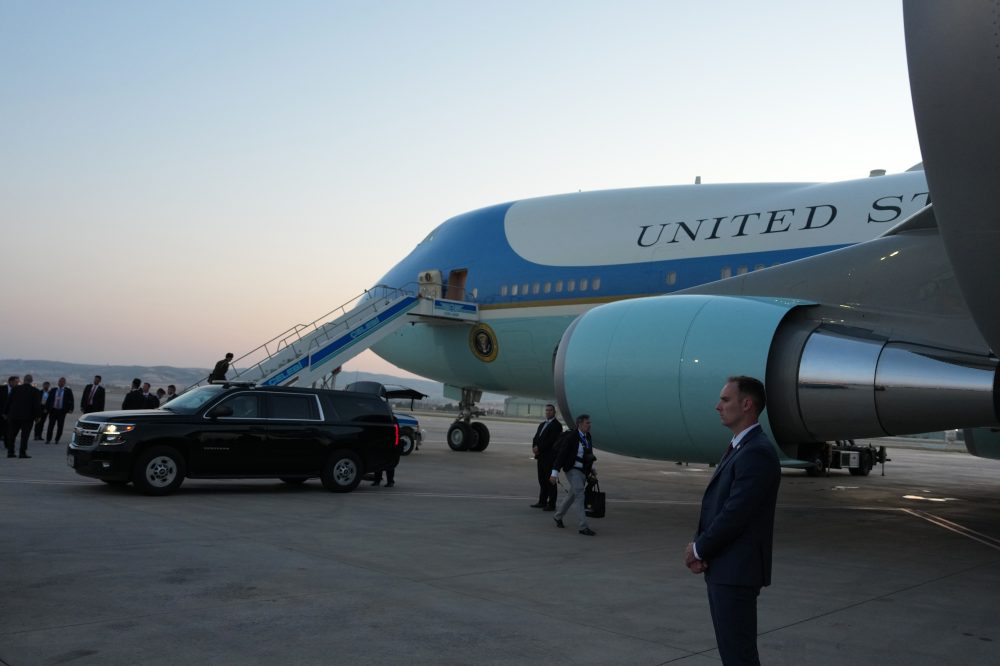

President Donald Trump returned home from a NATO summit in Turkey aboard one of the older, baby blue Air Force One aircraft rather than the gleaming red, white, and navy blue jet donated by Qatar — a last-minute switch that caught many by surprise and came just as the United States and Iran were exchanging military strikes.
Trump gave little explanation for the change, telling reporters he wanted to ride the older plane “for old time’s sake.” He also said both aircraft would make an unplanned stop at Royal Air Force Mildenhall, a base in the United Kingdom used by American military personnel, before heading back to the United States.
The sudden aircraft swap sparked new questions about the security readiness of the Qatari-gifted jet, which the U.S. spent $400 million to modify. Photos of the aircraft taken since its public debut show it is missing some of the missile detection and countermeasure systems found on the older presidential planes.
The timing added to the intrigue — the switch was announced less than a day after the U.S. military launched a series of major strikes against Iran in response to Iranian attacks on commercial shipping in the region. Iran shares a border with Turkey, where the summit was held.
Trump initially broke the news on social media, saying the new jet would stop at the UK air base so that military personnel could get a look at the plane. He said he would fly home separately on an older aircraft that had previously served as Air Force One.
At a news conference, when a reporter asked whether security concerns drove the decision, Trump didn’t give a direct answer. He did note, however, that regarding Iran, he was “No. 1 on the list for killing.” When pressed further, he said he would be “going home by normal methods” while the new plane was shown off to troops.
When reporters asked the U.S. Air Force whether the missing countermeasure systems factored into the swap, officials there referred questions to the White House. The White House did not respond to a request for comment.
Trump left Turkey on one of the older Boeing VC-25A aircraft that have transported U.S. presidents for more than three decades. Consumer flight tracking services lost the plane’s signal shortly after takeoff, indicating the crew had switched off its transponder — a security protocol typically used when flying the president through high-risk areas such as active war zones, not routine trips departing from a NATO ally hosting a pre-scheduled summit.
By contrast, flights carrying other world leaders — including those from Germany and the United Kingdom — departed with their transponders active and visible to trackers.
The Qatari-donated Boeing 747-800, which was customized for Trump’s use, left Turkey earlier that Wednesday and touched down at RAF Mildenhall that same afternoon, according to flight tracking data.
Iran has missiles and drones with enough range to cover the roughly 800-mile distance from its borders to Turkey, including certain Shahed drones and Shahab ballistic missiles. However, according to the Center for Strategic and International Studies, Iran does not have weapons capable of effectively reaching England, which sits approximately 2,500 miles away.
The U.S. Air Force, which manages the fleet of presidential aircraft, had previously acknowledged that not all necessary upgrades were completed on the Qatari jet in order to get it into service more quickly. While officials stated the conversion was done “without accepting any risk regarding security, safety, or secure communications,” they also admitted that “several highly complex engineering modifications required for the final Air Force One aircraft were intentionally excluded from the Bridge aircraft.”
A senior analyst at Teal Group, an aviation and defense consulting firm, previously told The Associated Press that the absence of countermeasure systems — along with what appeared to be fewer communications antennas — indicated the Qatari jet was more appropriate for domestic flights only.
Trump’s first trip aboard the new Qatari plane took place last week, when he flew to North Dakota.
The original Air Force One jets were constructed near the close of the Cold War and were designed to withstand the effects of a nuclear blast. They include a variety of security features such as anti-missile countermeasures and an onboard operating room. The planes are also capable of mid-air refueling, though that capability has never been used with a president aboard.
Two Boeing jets currently being built as permanent replacements for the aging Air Force One fleet have faced delays and are now expected to be delivered in 2028.