
NEW YORK (AP) — The possible collapse of an already fragile ceasefire between the United States and Iran has reignited fears Wednesday that fuel prices could climb again if ongoing conflict prevents oil tankers from safely navigating the Persian Gulf.
Oil prices surged to their highest levels in several weeks after President Donald Trump declared the U.S. ceasefire with Iran finished, citing Iranian strikes on commercial vessels in the Strait of Hormuz and attacks on American military installations in other Gulf nations. Higher crude oil costs typically translate into more expensive fill-ups at gas stations, just as drivers across many countries had been catching a break from the elevated prices the war had caused.
“Tanker traffic through the Strait of Hormuz has essentially stopped, which tells you more about risk perception right now than any statement from Washington or Tehran,” said Jorge Leon, head of geopolitical analysis at Rystad Energy, in an email. “Oil markets reacted quickly to the renewed geopolitical risk.”
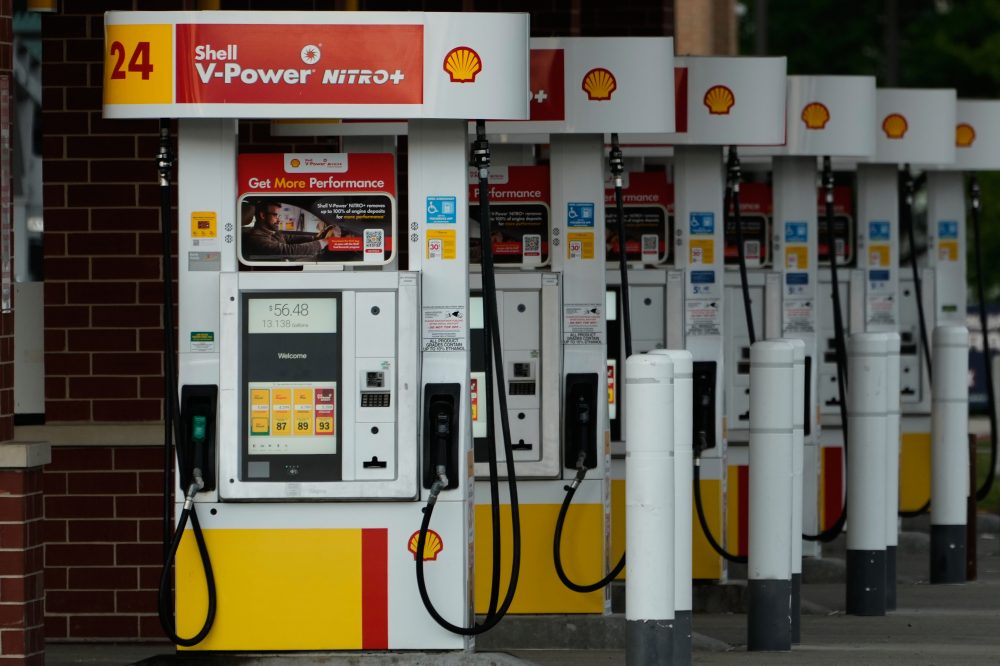
According to motor club federation AAA, the average price for a gallon of regular gasoline in the United States ticked up slightly Wednesday to $3.80, compared to $3.79 the previous day. That said, it remains considerably lower than the month-ago average of $4.16.
Because crude oil accounts for the largest share of what goes into the price of gasoline, rising oil costs eventually push pump prices higher. However, it can take several weeks before consumers feel the full effect. Refiners typically purchase oil in advance, and the finished gasoline product must travel through a network of pipelines and tanker trucks before reaching local gas stations.
Gas station operators set their own prices at the pump and sometimes choose to absorb higher oil costs rather than immediately passing the burden on to customers in order to stay competitive.
Starting in March, the U.S. and other nations began tapping their emergency oil reserves to help keep prices in check during the conflict. Those reserves, however, are not unlimited.
As of July 3, the U.S. Strategic Petroleum Reserve stood at 319.5 million barrels — the lowest level recorded since 1983, when the reserve was first being built up.
“Unfortunately, the drawdown of strategic stocks means that there is a lot less ammunition in Trump’s holster,” said Michael Lynch, a distinguished fellow at Energy Policy Research Institute in Amherst, Massachusetts.
On Wednesday, a barrel of U.S. benchmark crude was trading at $75.80, marking the highest price in over two weeks. Brent crude, the global standard, climbed to nearly $79 per barrel, its highest point since June 19.
The market’s response “highlights how sensitive prices remain to any escalation around the strait, given its role as a critical transit route for global oil flows,” Leon added.
One day after the U.S. accused Iran of attacking three commercial ships and stripped the country of its ability to openly trade crude oil on the world market, shipping industry officials were being urged to reconsider the safety of sending crewed vessels through the Strait of Hormuz and the broader Middle East region.
International Maritime Organization Secretary-General Arsenio Dominguez spoke out strongly against the attacks on ships in the strait.
“As long as the safety and security of crews cannot be assured, I urge flag states, shipowners, operators and all relevant authorities to avoid exposing seafarers to unnecessary danger by transiting the strait,” Dominguez said Wednesday. “The situation in the region remains volatile.”
Data and analytics company Kpler reported that some vessels did cross the strait on Tuesday, recording 41 crossings compared to 36 on Monday. It remains unclear whether those crossings occurred before or after the strikes took place. Some ships have also been turning off their location broadcasts while passing through the strait, making an accurate count even more difficult.
With the main central route through the strait blocked by mines, ships have been rerouting through two alternative paths — a smaller northern route through Iranian waters and a southern route through Omani waters. The three vessels struck on Tuesday appeared to have been using the Omani route.
An economist at advisory firm Oxford Economics suggested the ceasefire would likely continue in an on-and-off pattern, and that Washington and Tehran might still find a way to ease the latest tensions short of returning to full-scale conflict.
“The question is whether the latest developments merely represent a bump in the road or if we’re emerging from the ‘eye of the storm,’” wrote Ben May, the firm’s director of global macroeconomic research. “While Trump said negotiations with Iran were a ‘waste of time’, he maintained an off-ramp by noting that U.S. negotiators would continue talks with Iran, suggesting the truce hasn’t been irrevocably broken.”
The renewed uncertainty over the Strait of Hormuz comes just days after two of the world’s largest shipping companies, Maersk and Hapag-Lloyd, announced Monday through their Gemini Corporation joint venture that they would gradually restart service through the Suez Canal, which had been suspended because of attacks in the Red Sea by Yemen’s Houthis.
Recent stability in the Middle East had made that decision possible, but “the recent deterioration could put this resumption in jeopardy once again,” said Judah Levine, head of research at freight booking platform Freightos.
Hapag-Lloyd confirmed in a Wednesday statement that the joint decision was made following “thorough assessments of the security situation in the Red Sea area,” and noted that “if the situation changes or deteriorates, contingency plans are in place.”