
The Trump administration is turning up the heat on states over their election practices, threatening to cut off certain federal dollars and warning that election officials could face criminal charges if noncitizens are allowed to remain on voter rolls.
The latest moves — including letters sent to state election officials and conditions tied to federal grant money — represent an ongoing push by the administration to influence how elections are conducted, a responsibility that has traditionally belonged to individual states.
Courts have largely blocked earlier attempts by the administration to make similar changes. Those efforts have been rooted in claims of widespread voting fraud that have been found to be untrue, and they come fewer than four months before crucial midterm elections in which Democrats are hoping to gain control of at least one chamber of Congress.
Rick Hasen, a law professor at UCLA and director of the Safeguarding Democracy Project, offered this assessment: “The overall point is that Trump is trying to use whatever levers of power and persuasive power that he might have to try to interfere with how states and localities are going to conduct the 2026 election. Some of this is aimed at changing how the rules are conducted. Some of it appears to be aimed at undermining voter confidence in the integrity of the election process.”
On Tuesday, the Justice Department’s Civil Rights Division sent letters to election administrators — frequently secretaries of state — in all 50 states and the District of Columbia. The letters stated that those officials could face criminal prosecution if they knowingly allow ineligible voters to cast ballots or stay on voting rolls. States were given five days to respond explaining how they plan to follow the law.
The letter also put officials on notice that anyone who deliberately provides false information when registering to vote or casting a ballot could face criminal charges.
Derek Muller, an election law specialist and professor at the University of Notre Dame, questioned the significance of the letter, saying it largely restates existing law and requests a follow-up response, “which I’m sure many states will ignore.”
Separately, a Federal Emergency Management Agency announcement from June tied election-related conditions to an antiterrorism grant program. Under the terms, 20% of grant funds for states and urban areas would be held back until those requirements are met.
The grant program distributes more than $1 billion to state, local, and tribal governments to fund efforts aimed at preventing terrorism in crowded public spaces, online, at borders, and around elections. FEMA anticipates awarding 56 grants in total.
The grant announcement described securing election infrastructure as a national security priority, stating that recipients can help build “a secure, transparent, and resilient electoral process, thereby reinforcing public trust and the integrity of democratic institutions.”
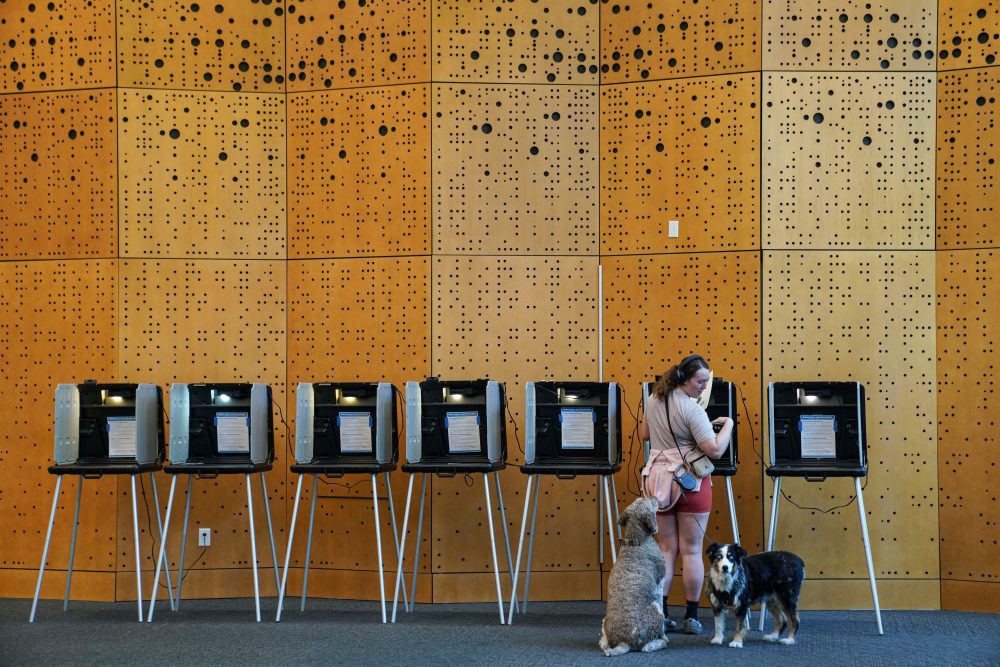
Among the requirements listed: states must verify the citizenship of all registered voters and election workers. Jurisdictions that use electronic voting systems relying on bar codes or QR codes to tabulate votes would need to submit a plan to transition to hand-marked paper ballots. All jurisdictions would also be required to demonstrate that they conduct audits of election results.
Hasen noted that compliance could be a challenge even for states that want to cooperate, pointing out that the election is too close to make some of the required changes, and that others would need new legislation passed by state legislatures.
The White House directed questions to FEMA on Wednesday, and FEMA did not respond to an interview request.
Reactions from state officials appear to be splitting along party lines.
Oregon’s secretary of state, Democrat Tobias Read, accused the Justice Department of “knocking on our door again with more threats and no evidence to back up their fever dreams about non-existent voter fraud.” He declared that Oregon’s elections are secure, accurate, and fair, and said he isn’t “intimidated by political threats or manufactured controversy.”
The Michigan secretary of state’s office, led by Democrat Jocelyn Benson, said it has shared information about its election practices with the Justice Department on multiple occasions — through public statements, congressional hearings, and court testimony. The office said that information “is either in the DOJ’s possession or easy reach” and added, “We will be happy to provide it again to help address any confusion.”
Ohio Republican Secretary of State Frank LaRose took the opposite stance, defending the Justice Department’s letter as a legitimate reminder to states of their legal responsibilities around election integrity. He said many states aren’t taking those obligations seriously, though he did not provide examples or evidence to support that claim. LaRose said Ohio has collaborated with the federal government to keep its voter rolls accurate and to ensure only U.S. citizens cast ballots.
Georgia’s secretary of state’s office said the state has already carried out many of the actions called for in the FEMA grant requirements, including conducting a citizenship audit of its voter rolls.
President Trump has repeatedly and falsely claimed that fraud was responsible for his 2020 election loss, and his administration has pursued a series of policies targeting how elections are managed.
In recent days, federal courts rejected the Justice Department’s attempts to obtain names and contact details for every Georgia election worker involved in the 2020 election, as well as efforts to compel New Hampshire and Pennsylvania to hand over detailed voter registration data. With those rulings, the federal government has now lost more than 10 similar cases involving requests for voter data from 30 states and the District of Columbia.
Last week, a coalition of Democratic governors called on the U.S. Postal Service to pull back a proposed rule that would implement a Trump order to create a list of eligible voters and potentially restrict who receives mail-in ballots. A court had already placed that order on hold, ruling it was unconstitutional.
Also last week, the U.S. Supreme Court ruled against Trump, deciding that states are permitted to count mailed ballots that arrive after Election Day.