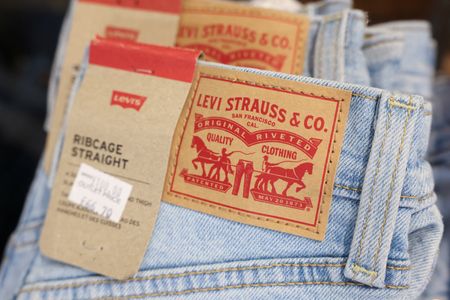

Levi Strauss announced Wednesday that it is raising its annual sales forecast, expressing confidence that demand for its denim and clothing lines will hold up even as broader economic uncertainty continues to dampen consumer spending.
Despite the upgraded outlook, the company’s stock slipped roughly 5% in after-hours trading. Shares had already gained 17.5% earlier in the year.
The San Francisco-based company surpassed Wall Street’s expectations for second-quarter sales, buoyed by strong performance in denim and dressier casual styles — including baggy and loose-fitting fits — that have resonated especially well with Gen Z consumers.
Beyond its core denim line, Levi’s has broadened its product range to include dresses, skirts, and tops, while putting significant resources into its direct-to-consumer business, which carries higher profit margins. The company says these moves have helped reignite growth, with revenue climbing every quarter for the past two years.
Net revenue for the quarter ending May 31 climbed 8% to $1.56 billion, topping analyst projections of $1.52 billion. Adjusted earnings came in at 28 cents per share, beating the expected 24 cents.
Looking ahead, Levi’s now projects fiscal 2026 net revenue growth of 7.0% to 7.5%, up from its earlier estimate of 5.5% to 6.5%. Analysts had been forecasting an average increase of 6.6%, which would bring total revenue to roughly $6.70 billion, according to data from LSEG.
The company also revised its adjusted earnings per share forecast upward to a range of $1.46 to $1.52, compared with the previous estimate of $1.42 to $1.48.
CEO Michelle Gass described the ongoing sales momentum as “another proof point that our strategies are working and our team is executing.” She added: “Our evolution into a DTC-first, denim lifestyle company — with a much larger addressable market — is translating to faster growth and higher profitability.”
The iconic brand, which was founded in 1853 and returned to public markets in 2019 after more than 30 years as a privately held company, has leaned into high-profile marketing partnerships as part of its turnaround effort.
One recent campaign drew widespread attention after FIFA temporarily removed Levi’s branding from Levi’s Stadium during World Cup preparations. The company turned that moment into a global marketing push that racked up millions of views on social media, reflecting leadership’s push to keep the 173-year-old brand relevant with younger audiences.
Levi’s has also been shifting its supply chain away from China, Bangladesh, and Cambodia in an effort to ease the impact of tariffs.
In April, the company announced it is searching for a new chief financial officer after finance chief Harmit Singh said he would retire following roughly 13 years in the position. Singh is expected to remain with the company until a successor is named.
Singh noted earlier this year that the company’s Middle East operations make up less than 1% of total sales and are mainly distribution-focused, meaning current regional instability there is not expected to have a significant effect on the business.
The results stand in contrast to struggles seen elsewhere in the apparel sector. Retailers broadly have flagged cautious shoppers and inconsistent demand, particularly for clothing and other non-essential items. Gap and American Eagle Outfitters both pointed to softness in women’s apparel in May, with weaker sales of dresses and bottoms weighing on their overall growth.
By region, Levi’s saw its strongest gains in Asia, where sales jumped 10% during the quarter. Sales in the Americas — its largest market — rose 9%, while Europe posted a 4% increase.