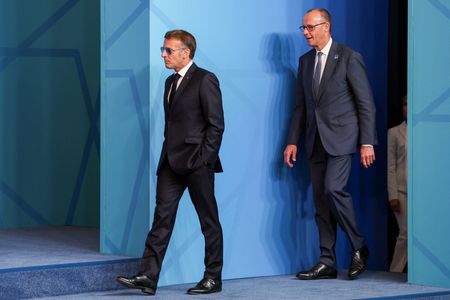

French President Emmanuel Macron declared Wednesday that Europe has significantly stepped up its role within NATO, and said he plans to announce new defense initiatives and joint military exercises at an upcoming summit of Ukraine’s allies next week.
Speaking at NATO’s annual gathering in Ankara, Macron said Europe has demonstrated it is investing more in its own defense, protecting its sovereignty, and building what he calls strategic autonomy — all while remaining firmly within the NATO alliance.
The summit, set for July 13 and expected to draw roughly 35 leaders from the Coalition of the Willing, will address Russia’s so-called shadow fleet, new military capabilities for Ukraine, expanded mobilization of defense industries, and deeper cooperation among the countries backing Kyiv, Macron said.
Macron has long pushed for greater European independence in defense matters. He argued that Russia’s ongoing war in Ukraine, combined with uncertainty about long-term American military commitments, has pushed Europe to accelerate its own defense buildup — even as it stays anchored within NATO.
More than seven years ago, Macron sparked a heated debate among alliance members when he declared NATO was experiencing “brain death,” pointing to what he viewed as poor strategic coordination and the unpredictability of the then-U.S. president at the time. Now, as he enters the final year of his presidency, Macron used the Ankara summit to argue that the changes he has long called for are finally taking shape — including higher European defense spending, a greater operational role within the alliance, and a stronger European defense industrial base.
“France has long advocated that Europeans must support and defend a European defence industry. If we spend more, it should not simply be to buy non-European equipment,” he said.
Macron outlined that Europe is now developing its own missile-defense systems, long-range precision-strike weapons, early-warning networks, and artificial-intelligence-driven command systems.
He also sought to ease concerns about Washington’s dedication to NATO, noting that the U.S. president had privately reaffirmed support for the alliance despite occasional public criticism of European allies.
“The United States has announced a redeployment of its efforts, which seems entirely legitimate to me, and Europeans must organise themselves accordingly,” Macron said. “But we should not do this because someone asks us to. We should do it for ourselves.”
France’s history with NATO has been complicated. Though a founding member of the alliance, France pulled out of NATO’s integrated military command structure in 1966 before fully rejoining in 2009. Since taking office, Macron has worked to deepen France’s role within the alliance while also strengthening what he describes as a European pillar of NATO.
Russia’s invasion of Ukraine has only reinforced that push. Despite financial pressures at home, France has kept its defense spending in line with NATO targets, expanded its military footprint along the alliance’s eastern flank, and offered greater cooperation with European partners on nuclear deterrence. French forces are currently deployed in Romania and the Baltic states.
On Wednesday, Macron announced that France will participate in NATO force rotations in Finland alongside Finnish and Swedish forces — making France one of the first alliance members to contribute to the newly established deployment near NATO’s border with Russia.