
PHILADELPHIA — Some of baseball’s biggest stars are drawing a hard line against Major League Baseball’s salary cap proposal, though they say there’s still enough time on the clock to prevent a work stoppage from cutting into the 2027 season.
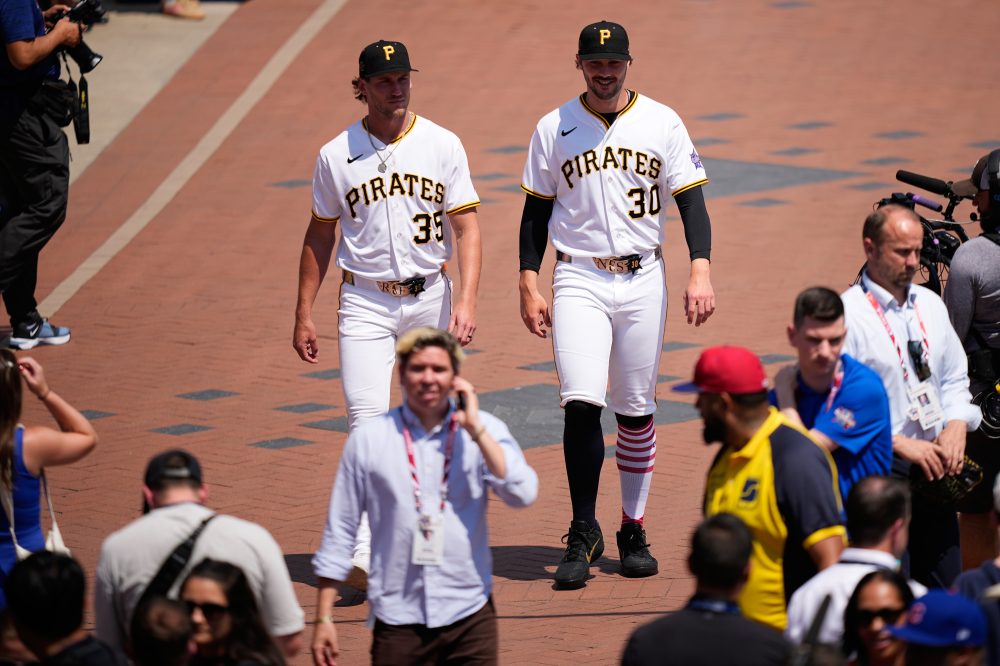
Pittsburgh Pirates pitcher Paul Skenes, who also sits on the union’s eight-man negotiating committee, summed up where things stand. “Both sides kind of have their line that they’re not going to cross,” he said Monday. “Whether that results in missing games or missing a season, we’ll see.”
The current five-year labor agreement between players and owners expires December 1, at which point MLB is expected to lock players out. The more critical deadline, however, falls in late February or early March, when the league would have to decide whether to push back opening day.
Owners have put a salary cap on the table for the first time since the union fought off a similar effort with a 7½-month strike in 1994-95 — a work stoppage that led to the first World Series cancellation since 1904. Baseball Commissioner Rob Manfred has argued that a cap is necessary to reduce the growing gap between high- and low-spending teams.
Juan Soto, who signed a record-setting $765 million, 15-year deal with the New York Mets following the 2024 season, would have seen his contract capped at $265 million over six years under MLB’s current proposal. His reaction was blunt: “Yeah, that sucks. It shouldn’t be there.”
Under the league’s plan, team payrolls would be capped at $245.3 million in 2027, a figure that includes $20.1 million in benefits and a pre-arbitration bonus pool. The proposal also sets a payroll floor of $171.2 million, which would require lower-spending franchises to increase what they spend on players. MLB has not yet outlined how high-spending clubs — like the Los Angeles Dodgers, whose opening day payroll this year reached $415.2 million — would transition to the new system.
Los Angeles Angels outfielder Mike Trout, 34 years old and in the eighth year of a $426.5 million, 12-year contract, acknowledged what the proposal is designed to do. “It’s trying to minimize the years and obviously the totals. For sure, we see that,” he said. “I think baseball’s in a good spot right now and we can’t mess this up.”
Philadelphia’s Bryce Harper, also in the eighth year of his $330 million, 13-year contract, said he couldn’t imagine any situation in which the players’ association would sign off on a cap. “The opportunity for players to get paid is what this is all about,” Harper said, pointing to the union’s long history of fighting for player rights dating back to when Curt Flood helped organize players in the 1970s. “We owe it to the guys that have come before us to do the same thing.”
Harper, who inked his first professional contract at age 17, also took issue with MLB’s proposal to prevent players from signing until they are at least 20 years old by September 1 of their signing year and at least two years past their high school graduation class. The league argues that college baseball offers a better path for player development. Harper disagreed. “If you’re in the top three rounds as a high school kid, I think you should be able to do whatever you want,” he said. “It would really be tough for a guy like Jackson Holliday to not be the number one pick and not get the chance to go to the big leagues at 19 or 18 if he’s able to.”
Formal bargaining got underway in May and is set to continue after the All-Star break. The players’ union has called for expanded free agency rights, earlier access to salary arbitration, and nearly doubling the major league minimum salary.
Pirates pitcher Braxton Ashcraft described the early rounds of talks as “back-and-forth proposals that may or may not be unrealistic.”
Skenes, a 24-year-old right-hander in his second full big league season, stands to lose significant earning potential under the proposed system. He is currently on track for free agency after the 2029 season, earns $1,085,000 this year in the final season before arbitration eligibility, and has collected nearly $5.6 million from the pre-arbitration bonus pool that launched in 2022. Still, he sees the negotiations as early-stage posturing. “MLB is kind of presenting their perfect-world offers and we’re kind of presenting our perfect-world offers,” Skenes said. “So there’s a lot of time before there’s any real movement, I think.”
San Diego closer Mason Miller, considered baseball’s top reliever, also faces free agency after the 2029 season. The 27-year-old right-hander is making $4 million this year and expressed cautious hope. “I still have some optimism,” he said. “The place that the game’s at right now, I think killing that momentum is kind of fruitless for everybody.”