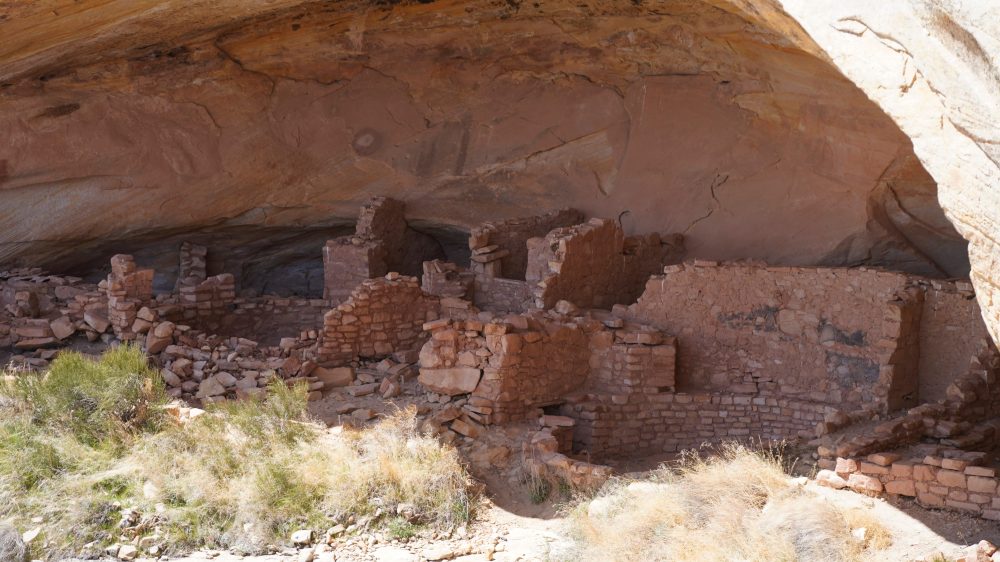

SALT LAKE CITY — President Donald Trump announced Monday that he intends to reduce the size of two major national monuments in Utah — Bears Ears and Grand Staircase-Escalante — marking a return to similar actions he took during his first term in office.
Trump’s move reverses decisions made by previous presidents who determined these areas deserved protection under the Antiquities Act, a law dating back to 1906 that grants presidents the authority to safeguard lands of cultural, historical, or scientific significance.
Trump took comparable steps during his first term, but those reductions were later undone by his successor, President Joe Biden. The ongoing back-and-forth highlights how national monuments have become a deeply contested issue in the broader debate over the management of public lands. Trump is not the first president to scale back a monument’s boundaries.
During his first term, Trump made only a limited number of Antiquities Act designations, including the two that cut the size of the Utah monuments. Those sprawling sites contain natural wonders and locations considered sacred by some Native American tribes. Trump also used the act to establish the 340-acre Camp Nelson National Monument in Kentucky, which served as a Union Army hospital, supply depot, and recruitment center for African American soldiers during the Civil War.
When Biden took office, one of his first uses of the Antiquities Act was to restore Bears Ears and Grand Staircase-Escalante to their previous sizes, pointing to their spiritual, cultural, and prehistoric significance. Biden went on to create 10 new monuments during his presidency, including one at the location of a 1908 race riot in Springfield, Illinois, and another honoring Mamie Till-Mobley and her son Emmett — a Black teenager from Chicago who was tortured and killed in 1955 after being accused of whistling at a white woman in Mississippi. Additional monuments were established in the mountains of California and on a sacred Native American site near the Grand Canyon.
Environmental advocates have long argued that the Antiquities Act only allows presidents to create monuments, not shrink or eliminate them. However, history tells a more complicated story. According to a National Park Service database, presidents have issued more than a dozen proclamations reducing monument size since 1912.
Woodrow Wilson cut the acreage of what is now Olympic National Park in Washington state by roughly half. Harry Truman did the same with Santa Rosa Island National Monument. Dwight Eisenhower was the most active in reversing his predecessors’ monument designations, reducing six in total — including Arches in Utah, Great Sand Dunes in Colorado, and Glacier Bay in Alaska, all of which have since been elevated to national park status.
Unlike national parks, which require an act of Congress to establish, most of the more than 100 national monuments were created through presidential action. They are managed by agencies such as the National Park Service, the Bureau of Land Management, or the National Oceanic and Atmospheric Administration.
A monument designation provides broad protections for geological features, artifacts, and the surrounding landscape, prohibiting drilling, mining, and new construction. Supporters of reducing the Utah monuments have argued that the protected boundaries were drawn too wide and were blocking access to critical mineral resources.
The U.S. Forest Service, established in 1905, oversees roughly 300,000 square miles of land across 43 states, including 154 national forests and 20 national grasslands. These lands are managed for renewable uses such as timber, clean water, wildlife habitat, livestock grazing, and recreation — though they can also be leased for extraction of nonrenewable resources like oil, gas, and coal. Some forest areas include specially designated wilderness zones where even bicycles and hang gliders are prohibited because they are considered mechanical.
National parks operate under some of the strictest development rules in the country, governed by a 1916 law called the Organic Act. That law states that the fundamental mission of the parks is to protect their scenery, nature, history, and wildlife and to preserve them for the enjoyment of future generations.
The Antiquities Act itself was signed by President Theodore Roosevelt following years of advocacy by educators and scientists who wanted to stop commercial looting and unregulated collection of artifacts from federal lands. It was the first U.S. law to establish legal protections for cultural and natural resources on federal property.
On September 24, 1906, Roosevelt used the act to designate Devils Tower in eastern Wyoming — a massive rock butte later featured in the film “Close Encounters of the Third Kind” — as the nation’s first national monument. Scientists have long studied how cooled lava formed the tower’s distinctive columns, and Native American tribes, who still hold ceremonies there, have their own accounts of its origins.
All but three U.S. presidents have used the Antiquities Act at some point to protect significant landscapes or cultural resources.