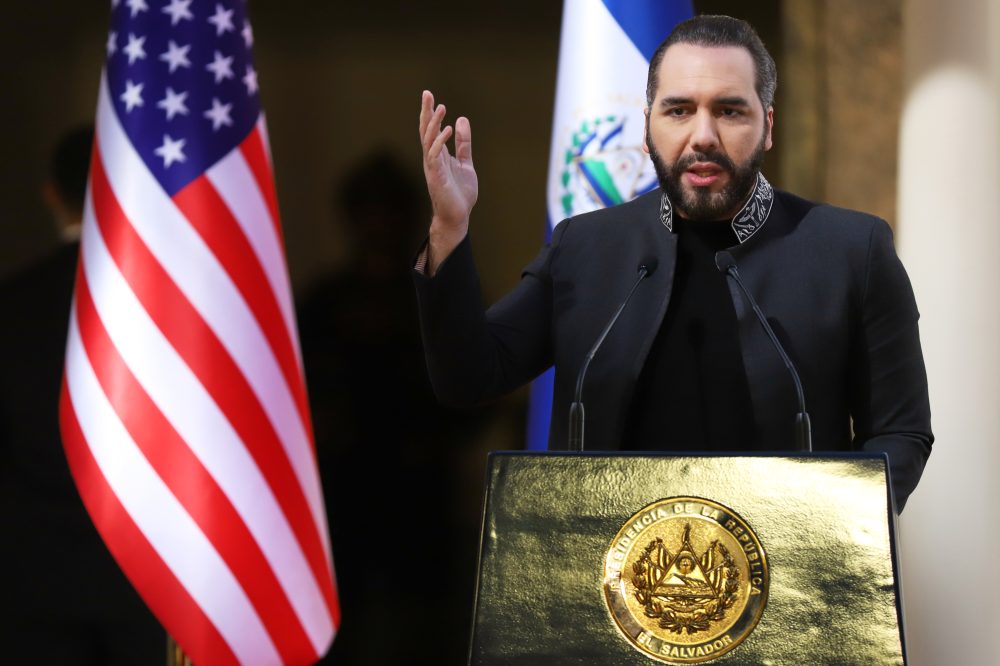

SAN SALVADOR — El Salvador’s ruling party has officially nominated President Nayib Bukele to run in the February 2027 presidential elections, setting the stage for what would be his third consecutive term in office — a prospect that lawyers and human rights advocates say is deeply troubling.
Bukele’s party, Nuevas Ideas, which holds a supermajority in the country’s legislative assembly, conducted its internal elections on Sunday and announced the outcome via Twitter on Monday. Vice President Félix Ulloa is set to join the ticket once again as Bukele’s running mate.
Bukele, who is 44 years old, first took office in June 2019, making him the youngest president in the region at the time. He has maintained strong public approval throughout his tenure.
His February 2024 reelection victory — in which he captured nearly 85% of valid votes — drew sharp criticism from constitutional scholars who argued it violated a constitutional prohibition against consecutive reelection. Critics further allege that Bukele unlawfully replaced judges on the country’s constitutional court and removed the attorney general in an effort to consolidate his grip on power.
A ruling by the constitutional court in September 2021 had permitted presidential reelection, but only for a single additional term.
The legislative assembly, under the control of Bukele’s party, then went further in July 2025, passing a constitutional amendment allowing unlimited presidential reelection. The reform stripped away penalties — including loss of citizenship rights — for those who advocated for presidential reelection, and removed the ban on running for president if a person had served in the previous term.
The same constitutional overhaul also lengthened the presidential term from five years to six and moved the next presidential election up to 2027. Under the prior constitution, a former president could only seek reelection after being out of office for at least 10 years.
Bukele has stood behind the constitutional changes pushed through by the assembly. He argued that “90% of developed countries allow the indefinite reelection of their head of government and nobody bats an eye,” and said that when a small, impoverished country like El Salvador attempts the same, “it suddenly becomes the end of democracy.”
Many Salvadorans have credited Bukele’s hardline security approach — including a four-year state of emergency that has resulted in the imprisonment of more than 90,000 people — with dramatically cutting homicide rates and improving public safety. In 2015, El Salvador recorded one of its most violent years, with 6,656 murders and a homicide rate of 106 per every 100,000 residents.
By the end of 2025, government figures showed the country had reached a historic low of just 82 homicide cases for the entire year.
However, human rights organizations report that more than 500 people have died while in custody since the state of emergency began, with most deaths attributed to health-related causes and some linked to violence inside prisons.