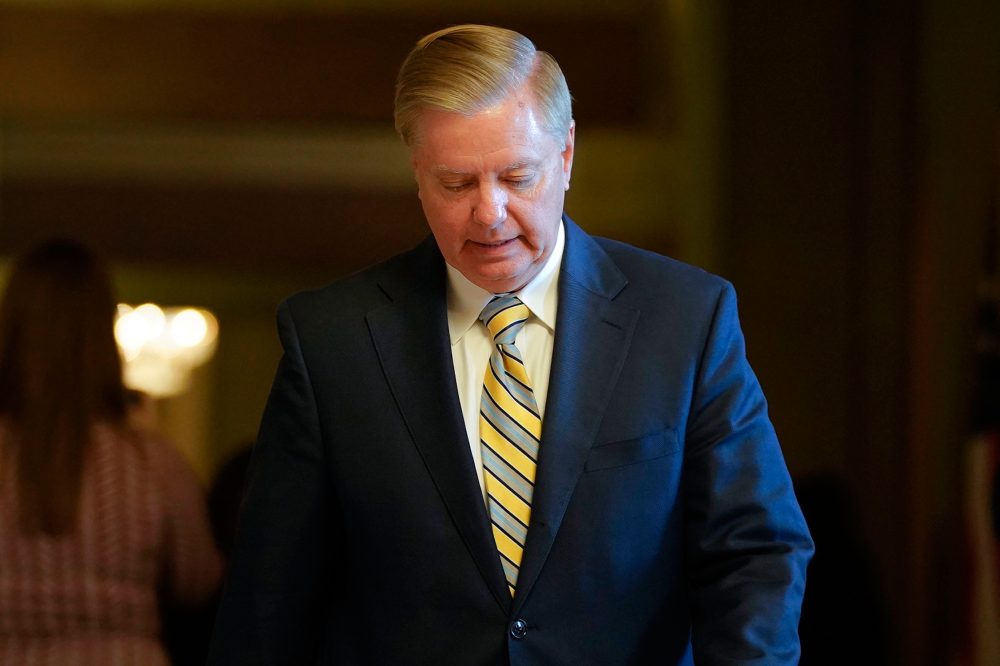

WASHINGTON — When Sen. Chuck Schumer saw Sen. Lindsey Graham’s name appear on his phone, he said his heart skipped a beat.
It was shortly after the 2012 presidential election, a rough one for Republicans who had lost decisively to President Barack Obama. Graham was on the line with a bold idea — “getting the band back together” — pitching a bipartisan push for immigration reform.
That kind of move was pure Graham.
Over the years, colleagues gave him many labels: the “bridge,” the “dealmaker,” the senator always at the center of the action. Most recently, he earned the title of “the Trump whisperer.”
Graham brought a kind of energy to the Senate that kept the institution moving — talking, debating, even laughing — through his relentless drive to make things happen when gridlock seemed inevitable.
Following Graham’s sudden death over the weekend, senators on both sides of the aisle are left wondering who will step into that role — if anyone can.
Sen. Chris Coons, the Democrat representing Delaware, was among those paying tribute. He had celebrated Graham’s birthday over dinner following the NATO summit in Turkey just days before the South Carolina senator passed away.
“Few have been able to frustrate and anger, amuse and engage me in a single conversation the way Lindsey could,” Coons said. “I will miss having him as a partner in the Senate.”
While many lawmakers imagine themselves as central players, Graham was one of the rare few who truly was. His ability to adapt to shifting political winds allowed him to champion causes at home and overseas, and he made a habit of pulling others into the conversation.
There was hardly a bipartisan congressional group that didn’t include Graham — from the Gang of Eight he formed alongside Schumer and Sen. John McCain, which pushed immigration reform through the Senate in 2013, to a more recent effort to impose sanctions on Russia over its ongoing war against Ukraine.
At a moment when Congress struggles to carry out even its most basic functions — let alone maintain basic civility — Graham stood out as someone who worked to bring the two sides together.
The outpouring of tributes following his death, from prominent senators to lesser-known House members, spoke to just how wide his network of partnerships had grown.
Sen. Richard Blumenthal of Connecticut, who teamed up with Graham on the Russian sanctions legislation, reflected on the bond they shared. “We talked at all hours of the day or night, and traveled through all kinds of weather, meeting dictators and democracy defenders,” Blumenthal said.
Though their views often diverged, Blumenthal noted that Graham “listened to me and sought to bridge our differences.”
Graham wasn’t always successful, of course. There were plenty of moments when fellow Republican senators walked out of private party lunches simply shaking their heads at his latest attempt to break a legislative logjam.
His political flexibility drew critics, as did his strong support for military action abroad. His bipartisan immigration efforts with Schumer and Democrats left him largely shunned by the anti-immigration wing of his own party.
Perhaps most damaging to his reputation with some potential allies was his decision to reconcile with former President Trump — even after previously declaring their relationship over following Trump’s role in the January 6, 2021 Capitol attack.
Even so, Graham’s close relationship with Trump during the president’s second term kept him at the center of the action. Senators from both parties leaned on him to get a read on the White House’s thinking.
“Many of us consider him the Trump whisperer,” said Sen. Adam Schiff of California, who served as a manager during Trump’s first impeachment trial — a trial that ended in Trump’s acquittal by the Senate. “If we wanted to know what the president’s thinking was, or how he might be moved on something, you would go to Lindsey to discuss it,” Schiff said.
In a chamber filled with large personalities and even larger egos, Graham’s self-deprecating sense of humor helped ease tensions and soften divisions. He had “a wonderful sense of humor that he used to cut through the tension,” Schiff said.
Sen. Amy Klobuchar of Minnesota shared a personal story about seeking Graham’s support for legislation to secure visas for Afghan refugees. “I remember standing outside of a little phone booth in the Republican cloakroom last year as he spoke with the Vice President, holding up a sign that said ‘Save the Afghans’ and he put the phone on hold and said ‘OK OK I will go on your bill even if it gets me in trouble,’” she recalled. “I will miss him.”