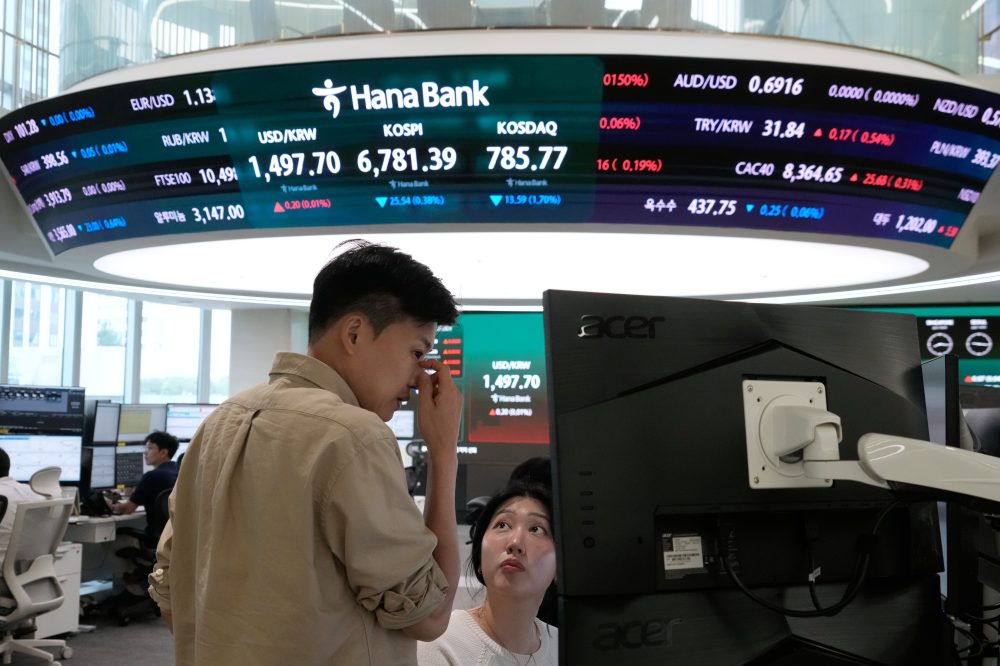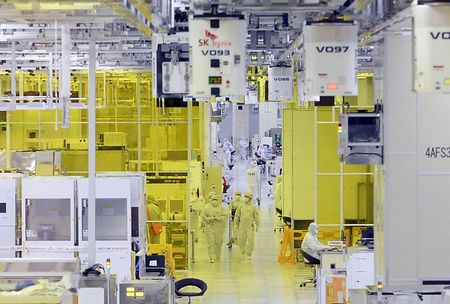

South Korea announced Tuesday that it is moving quickly to accelerate artificial intelligence investments as part of a broader push to strengthen its economy, raising its 2026 growth outlook to a five-year high of 3.0% on the strength of a worldwide semiconductor surge.
The country’s finance ministry, in semi-annual economic policy plans, projected next year’s growth at 3.0% — the best performance since 2021 and a significant jump from the previous forecast of 2.0%, as well as last year’s modest 1.1% growth rate.
The ministry outlined three key goals for its economic policies, including pushing the economy’s potential growth rate up to 3% from its current estimated level of below 2%.
To help reach that target, the government plans to accelerate three “mega projects” announced last month, focusing on semiconductor development, AI data centers, and physical AI investments.
Earlier this week, officials revealed plans to boost 2027 budget spending by at least 10%, bringing total spending to more than 800 trillion won — roughly $532.73 billion — with priority given to those mega projects. The increased spending would be supported by stronger tax revenues flowing in from the semiconductor industry.
“While robust economic indicators, such as exports, driven by a semiconductor boom are clearly opportunity factors, there remain tasks that our economy needs to overcome at the same time,” said Vice Finance Minister Lee Hyoung-il.
The nation, which ranks as Asia’s fourth-largest economy, recorded its strongest quarterly growth in nearly six years last quarter, fueled by surging chip exports as global demand for AI technology continues to climb.
The ministry also set long-term targets, including positioning South Korea among the world’s four largest exporters and raising gross national income per capita to $50,000, up from an expected $40,000 this year. The country currently sits among the top five exporters globally.
Officials also pledged steps to address ongoing challenges, including stubborn inflation, a weakened currency, and elevated bond yields tied to the Middle East conflict. Planned measures include fuel price caps, extended foreign-exchange regulatory relief, and low-cost policy loans in the second half of the year.
Inflation is now forecast at 2.6% for 2026, higher than the earlier projection of 2.1% set in January, largely due to elevated oil prices. That would outpace the 2.1% inflation rate seen in 2025 and mark the fastest pace since 2023.
Looking further ahead, the ministry projected 2027 economic growth at 2.2%, with inflation also expected to come in at 2.2% that year.