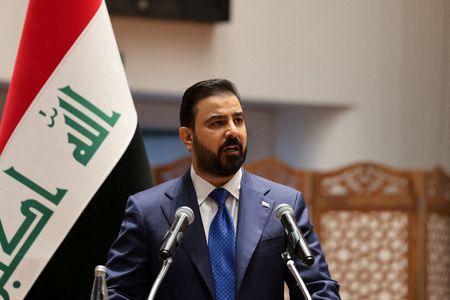

BAGHDAD — Iraq’s newly installed prime minister, Ali al-Zaidi, is making a push for large-scale American investment in his country’s energy sector during a White House visit this week, following the damage the Iran war inflicted on Iraq’s oil output and government revenues.
The visit, scheduled from July 13 to July 18, reflects Iraq’s growing effort to broaden its international partnerships as a way of managing the instability that has plagued the region, according to analysts.
The move marks one of the most direct efforts in recent memory to draw major U.S. investment into a sector that has long been controlled by Chinese, Russian, and European companies. Iraqi officials, however, push back on the idea that Baghdad is pulling away from its close relationship with Tehran in order to grow closer to Washington.
“The Iran war was a turning point,” said Baghdad-based political analyst Ahmed Younis. “It highlighted the risks of overreliance on any single regional partner.”
Younis added that Zaidi “views energy as the fastest route to deeper cooperation with Washington.”
According to Iraqi and U.S. officials, the strategy involves talks with Chevron about major upstream oil projects, backing for U.S.-supported power and liquefied natural gas ventures, security assurances for American operators in Iraq’s semi-autonomous Kurdistan region, and renewed planning for export pipelines that would connect Iraq to Mediterranean markets.
Among the deals already approved by Zaidi’s cabinet is an agreement with U.S.-based HKN Energy to develop the Himreen oilfield in northern Iraq. The government has also given the green light for the Electricity Ministry to finalize a broad cooperation deal with General Electric focused on expanding Iraq’s power generation and transmission systems.
Zaidi has stated that his government intends to “significantly” boost oil production within three years, according to a release from his office. He made those comments while meeting in Washington with Iraqi business leaders and members of the Iraqi Christian community, encouraging them to invest in areas such as education, healthcare, and petroleum products.
These energy deals are expected to be central to discussions between Zaidi — a multimillionaire who took office in May — and U.S. President Donald Trump, who has expressed strong support for the new Iraqi leader.
“We have directed the Ministries of Oil, Electricity and Communications to give priority to reputable American companies working in energy, telecommunications, technology, and development,” Zaidi said in a statement released before the trip.
Despite the optimism, analysts caution that pulling in enough investment to develop oilfields and address long-standing infrastructure problems will be a difficult task.
An internal government document reviewed by Reuters showed that in early June, Iraq’s cabinet instructed the state-run Basra Oil Company to waive certain regulatory requirements for U.S. energy firms currently in talks about energy projects.
“The recent decisions regarding Chevron, U.S. operators in the Kurdistan region, and other U.S. energy projects reflect a deliberate policy shift,” said Mohammed Abbas, a former manager at the state-run Basra Oil Company who now works as an energy consultant. “Zaidi is using Iraq’s energy sector to strengthen ties with Washington and to reverse a perception among some U.S. energy majors that Iraq is a challenging environment for large-scale investment.”
Four Iraqi oil officials who are familiar with the ongoing talks — involving companies including Chevron, ExxonMobil, HKN, and others — said the effort reflects Baghdad’s wider goal of deepening economic cooperation with the United States.
Iraq faces a challenge common to many oil-producing nations: trying to attract investment and grow production while remaining bound by output limits set by the OPEC+ group. Despite holding some of the world’s largest crude oil reserves, Iraq has struggled to raise the revenues needed to support its rapidly expanding population.
Talks with Chevron have become one of the most closely watched parts of Iraq’s strategy. Earlier this year, Chevron entered exclusive negotiations with Iraq over the massive West Qurna-2 oilfield after Baghdad moved to replace Russia’s Lukoil as the operator — a deal that could hand the American company control of one of Iraq’s top-producing assets.
Several Iraqi lawmakers and analysts said the government’s energy push is designed to send a message to Washington that Iraq has become a more appealing place for large-scale investment, after years marked by security concerns, red tape, and legal disputes.
Security conditions have improved considerably since Islamic State was defeated roughly a decade ago, though occasional drone strikes and regional tensions still present risks to energy infrastructure. Iraqi officials say protections around key oil facilities have been strengthened since the Iran conflict, with new measures intended to reassure foreign energy companies.
“Prime Minister Zaidi comes from a business background and understands that winning over American energy companies, especially amid fragile regional security, is no easy task,” said Murad Ismael, a lawmaker and member of Iraq’s parliamentary oil and gas committee.