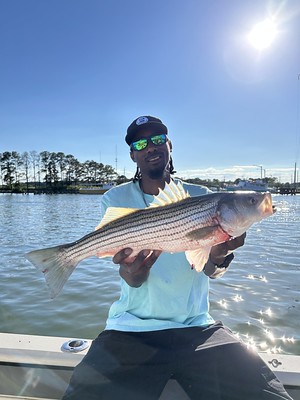

Fishing conditions across Maryland are looking good this week, with striped bass action reported throughout the Chesapeake Bay, solid freshwater opportunities, and exciting catches along the Ocean City coast.
With the first day of summer arriving Sunday, June 21 — the longest day of the year — anglers have more daylight to enjoy the water. However, the Maryland Department of Natural Resources is urging fishermen to be mindful of rising water temperatures and their impact on fish survival during catch-and-release fishing.
The Department of Natural Resources is running its Striped Bass Summer Fishing Advisory Forecast, a campaign designed to reduce striped bass deaths from catch-and-release fishing during hot weather. The agency monitors temperature forecasts and issues daily recommendations for the week ahead.
Forecast Summary: June 17 – June 23
Main Bay surface and river mouth water temperatures have climbed into the mid to upper 70s and are expected to keep rising throughout the week. Bottom waters are currently cooler and offer better conditions for striped bass. Smaller rivers and streams have also warmed to the upper 70s. As waters heat up, oxygen levels at the bottom are beginning to drop. Adequate oxygen is present in most Bay bottom waters, with the exception of the area near Quantico to Colonial Beach in the Potomac River, and from Swan Point down to the Bay Bridge area.
Most Maryland rivers and streams are running below average flow levels. Water clarity throughout the Bay and its rivers is expected to be near average. Strong tidal currents are anticipated from Saturday through Tuesday due to the new moon on Monday, June 15.
Upper Chesapeake Bay
At the Conowingo Dam pool, anglers are making long casts toward the turbine wash where striped bass are holding. Topwater lures and paddletails have been effective during morning and evening hours, while cut bait is drawing striped bass, blue catfish, and flathead catfish throughout the day. In the lower Susquehanna, striped bass are being found along grass flat edges during low-light hours, with poppers and paddletails among the top lure choices.
Blue catfish fishing has been solid near the mouths of the Susquehanna and Elk rivers, even as many of the larger females are in spawning mode. The upper Bay and its tidal rivers also hold blue catfish populations.
Striped bass fishing has been strong this month in the upper Bay. Live-lining spot has become the go-to technique now that spot are widely available. The 30-foot outside edge of Swan Point, the area near Pooles Island, and the Love Point rocks are all producing well. Spot are also being located on the shallow west side of the Bay Bridge, at Podickory Point, near the mouth of the Magothy River, and in the Chester River near Hail Point. White perch and small croaker occasionally show up in the same areas, though white perch fishing in the tidal rivers and creeks of the upper Bay is currently rated fair to poor.
Middle Bay
The Bay Bridge remains a popular destination this week. Anglers are drifting live spot and other baits along the east side of the bridge near the 30-foot drop-off, targeting striped bass around the pier bases. Soft plastic jigs cast close to the piers are also producing results. On the shallower west side, spot, croaker, and white perch are being caught.
Live-lining spot along channel edges has been very popular. Good reports are coming in from the channel edge off Kent Island between the Brick House Bar area and Bloody Point. A few boats are trolling umbrella rigs, but live-lining remains the most popular approach, with jigging a close second. Action is also picking up along the edge from Buoy 84A south to Stone Rock, the Clay Banks, and the False Channel. The Kent Narrows area is also worth fishing for striped bass. Bluefish are in the mix this week, and Thomas Point on the western shore is worth checking. Anglers are reminded to use proper release techniques as warming water temperatures make fish more vulnerable.
Shallow-water striped bass fishing along Bay shores and in the lower sections of tidal rivers continues to be productive, though a higher percentage of smaller fish is expected. The best action is happening during the early morning and late evening hours. Poppers, skipping bugs, paddletails, and jerkbaits are all working well. Speckled trout are occasionally showing up, and cownose rays are stirring up the shallows at times.
White perch fishing in the tidal rivers and creeks of the middle Bay is rated fair to good. Anglers are targeting deep-water docks, piers, submerged rocks, and oyster reefs using bottom rigs baited with grass shrimp, peeler crab, or bloodworm pieces. Casting spin-jigs, small spinnerbaits, and spinners along promising shorelines during morning and evening hours is a fun way to target larger white perch.
Lower Bay
Higher salinity and clearer water — a result of the current drought in Maryland — may bring Spanish mackerel and cobia to the lower Bay earlier than usual and keep them around longer. The 2026 Maryland cobia season opened June 15. The minimum size is 43 inches total length, with a limit of one cobia per angler per day and two per vessel when two or more anglers are aboard. The minimum length for Spanish mackerel is 14 inches with a daily creel limit of 15 fish. The bluefish daily limit is five fish.
Striped bass fishing is good this week across a variety of locations and depths in the lower Bay. As water temperatures push past the mid-70s, larger slot-size striped bass are moving to deeper, cooler water during the day, while shallower areas produce action during the early morning and late evening hours.
The lower Potomac and Patuxent rivers are productive spots for live-lining spot or jigging along channel edges, with the 30-foot depth range being especially productive. Artificial reef sites are also worth checking with depth finders. Early morning and late evening hours offer good shallow-water striped bass fishing at the St. Marys River, Cedar Point, Tangier Sound, and the cuts through Hoopers Island. Paddletails, soft plastic jigs, and poppers are all effective. Speckled trout may also be in the mix.
For trolling, umbrella rigs, tandem-rigged bucktails, and swim shads remain popular. Drone spoons are now being added to trolling spreads as bluefish move into the lower Bay and Spanish mackerel become a possibility. The outside channel edges from Buoy 68 north past the Southwest and Northwest Middle Grounds to Buoy 72 have been productive for both trolling and jigging.
Spot and croaker can be found in several lower Bay locations, including the Cobb Island area, the mouths of the Wicomico and St. Marys rivers, Cornfield Harbor in the lower Potomac, the mouth of the Patuxent, Tangier Sound, and the mouth of the Honga River. Most croaker are running slightly under the required 9-inch minimum. White perch occasionally mix in.
Large red drum are providing exciting catch-and-release action near the Target Ship and Point Lookout areas, where anglers are jigging, trolling, and dropping soft crab baits. Cobia are also expected to be roaming these same areas this week.
Blue Crabs
Recreational crabbers are seeing fair to good catches in the middle and lower Bay this week. The best hauls are coming from the southern region on the eastern side of the Bay. Larger crabs are being found in 10 to 12 feet of water, while smaller crabs are showing up in shallower areas under 8 feet.
Freshwater Fishing
At Deep Creek Lake, smallmouth and largemouth bass are settling into their summer routines. Early morning finds them on main lake points and grass edges, while later in the day they seek shade under floating docks, fallen treetops, and submerged stumps. Bluegills are near docks, and trout are holding deep along the dam face.
Trout fishing in the Group II Delayed Harvest areas has been good since those sections opened June 15. Sections of the North Branch of the Potomac, the Casselman, and the Youghiogheny are now open to trout harvest. Anglers should confirm which specific sections are open before fishing — details are available on the DNR website or on page 25 of the Maryland Fishing and Crabbing Guide.
The upper Potomac is running low and clear. Long casts and light lines are essential. Smallmouth bass fishing is good with crawfish crankbaits and topwater lures in the early morning. Deeper-holding smallmouth and walleye can be targeted with ring worms, paddletails, and tubes.
Water levels are low in central region reservoirs, but fishing for largemouth and smallmouth bass remains good. The best action is during early morning and late evening near grass beds and shoreline structure. Spinnerbaits, paddletails, poppers, and soft plastics are all productive choices. Largemouth bass are transitioning to a summer pattern, feeding mostly at night and in low-light conditions. Targeting floating grass mats with wacky-rigged stick worms, flipping under docks and fallen treetops, or working deep structure are all solid tactics. Chesapeake Channa (snakeheads) are holding in grass beds of the tidal rivers and can be targeted with frogs, buzzbaits, or chatterbaits.
Atlantic Ocean and Coastal Bays
Surf anglers near Ocean City are pulling in kingfish along with a mix of flounder, blowfish, and bluefish. Bloodworms and artificial bloodworm baits are the top choice for kingfish; squid works well for flounder and blowfish; and cut mullet or finger mullet is the go-to for bluefish.
At the inlet and Route 50 Bridge area, striped bass are being caught during morning and evening hours near jetty rocks and bridge and dock piers. Soft plastic jigs and paddletails are popular lures. After dark, anglers are catching striped bass and bluefish by drifting cut bait. Sheepshead are being caught near the jetty rocks and bulkheads using sand fleas.
Flounder fishing has been good in the channels leading from the inlet and in some back bay channel areas. Drifting in front of the airport is reported to be a productive spot for flounder. Striped bass are still being caught during early morning and late evening hours at the Verrazzano and Route 90 bridge piers, with soft plastic jigs and paddletails as the top lure choices.
Black sea bass fishing remains solid at offshore wreck and reef sites. Flounder are also being found at those same locations and on shoals and lumps outside the inlet. At the canyon areas, the first white marlin release of the season has been reported, and some yellowfin tuna and golden tilefish have been brought to the docks.
The Maryland Fishing Report is written and compiled by Keith Lockwood, a fisheries biologist with the Maryland Department of Natural Resources. The Forecast Summary is written by Tidewater Ecosystem Assessment Director Tom Parham. Maryland anglers are encouraged to participate in DNR’s Volunteer Angler Surveys to help scientists monitor and manage important fish species.