
NEW YORK — The Federal Reserve left its key interest rate unchanged Wednesday, but policymakers signaled that borrowing costs could rise later this year as concerns mount over inflation running above the central bank’s 2% target.
Updated quarterly projections revealed that nine Fed officials now anticipate a rate increase before the end of 2026. The Fed also stripped language from its policy statement that had previously hinted at the possibility of additional rate cuts in 2026.
With U.S. job growth remaining strong, unemployment holding at a relatively low 4.3%, and inflation continuing to exceed the Fed’s 2% goal, most analysts had already expected the central bank to leave rates where they are.
Kevin Warsh, who is now leading the Fed as its new chair, addressed reporters Wednesday afternoon and quickly pivoted to explaining why the central bank is changing how it talks to the public — including modifications to the so-called dot plot, which tracks economic projections from individual Fed officials. Warsh noted that those submissions are made in pencil “that have big erasers,” and that policymakers “don’t feel bound by their dots.”
MARKET REACTION:
STOCKS: Major indexes turned mixed after spending most of the day in negative territory. The S&P 500 slipped 0.1% after Warsh began speaking, while the Dow industrials were essentially flat and the Nasdaq Composite edged up 0.1%.
BONDS: The yield on the benchmark 10-year U.S. Treasury note climbed 1 basis point to 4.453%, while the 2-year note yield jumped 9 basis points to 4.14%.
FOREX: The U.S. dollar index gained 0.4%, reaching 99.91.
ANALYST REACTIONS:
Michael Pearce, chief U.S. economist at Oxford Economics in New York, said the Fed’s message was clear despite a leaner-than-usual communication: “In a dramatically slimmed-down communication from the Federal Reserve, the key message was that roughly half the committee are now projecting a rate hike this year, reflecting persistent inflation concerns. Our inflation projections for this year and next are far lower than the median projection, which is why we expect the next move will still be a cut. In his first meeting as chair, Kevin Warsh took an axe to the policy statement, which now offers next to no guidance beyond a factual summary of the economic situation. He also appears to have declined to offer economic projections, with 17 of 18 participants submitting rate forecasts for this year and next. The committee is divided roughly in half, with nine participants seeing a hike or a few hikes this year, while a similar number expect cuts by end-2027. Some participants also raised their estimates of long-run neutral rates.”
Michele Raneri, vice president and head of U.S. research and consulting at TransUnion in Chicago, said the hold should bring near-term stability to consumer credit markets: “The Federal Reserve’s decision today to keep interest rates unchanged should support near-term stability across most consumer credit markets. Recent inflation data adds complexity to the outlook, however, as headline inflation rose above 4% for the first time in three years, driven largely by increasing energy costs, while core CPI advanced a more modest and better-than-expected 0.2% in April. This divergence reinforces expectations that the Fed will likely remain on hold rather than pursue additional rate hikes or cuts in the near term.”
Brian Storey, head of multi-asset strategies at Orion in Omaha, Nebraska, noted the unanimous vote and the shift in the economic outlook: “As the market was expecting, the FOMC left the fed funds rate unchanged at a target range of 3.5% to 3.75%. As opposed to multiple dissenters in the past several meetings, this vote to keep the policy rate unchanged was unanimous. Overall, the Fed struck a slightly less upbeat tone on the economy; the updated Statement of Economic Projections showed a slightly lower forecast for GDP growth in 2026 and a notably higher forecast for inflation, with core PCE projected to be 3.3% in 2026 vs. the March forecast of 2.7%. The updated ‘dot plot’ removed the prior outlook for one rate cut in 2026 with a shift to a median outlook of one rate hike by year-end. As it relates to financial markets, the fairly close alignment between the Fed’s ‘dot plot’ and the message from the markets via fed funds futures reduces the likelihood of monetary policy upending equity markets as we move into the back half of the year.”
Kay Haigh, global head of fixed income and liquidity solutions at Goldman Sachs Asset Management in New York, said the meeting confirmed the Fed’s hawkish lean goes beyond just energy prices: “Today’s meeting confirms that the Fed’s recent hawkish shift was not just about higher energy prices. Despite the recent pullback in oil, half of the members of the FOMC expect rate hikes as soon as this year, reflecting strong labor market and inflation data. Our base case remains that the Fed can just about avoid hikes, but the path is narrow and there will be a high premium on the incoming inflation data.”
Stephen Coltman, head of macro at 21Shares in London, pointed to growing hawkish influence within the committee: “The committee remains divided, but the hawks have clearly gained ground since the previous meeting, and the committee is perhaps feeling some pressure in the wake of hikes by the Bank of Japan and the ECB. Warsh’s priority will be to achieve as smooth a handover from Powell as possible, and the recent collapse in oil prices will have been most welcome in this regard. Despite the hawkish tilt in the statement, the Iran deal does ease the pressure on the Fed and provides breathing space for Warsh to establish himself with the media in a calmer environment.”
Phil Blancato, chief market strategist at Osaic in New York, described the moment as a challenging debut for the new Fed leader: “Kevin Warsh is making his debut as chairman of the Fed in a tough moment for the Fed, when inflation is once again on the rise. Inflation is above the Fed’s 2% target, with it being 4.2% at the end of May, its highest level in three years. The labor market remains strong, meaning there is no need for a cut. I’d anticipate the Fed to hold rates here for the foreseeable future. Christopher Waller stated they should remove ‘easing bias’ language from Fed Policy. This is a bearish interest rate move, suggesting that the next move for rates does not have to be down. There is a 98% chance of a hold right now and markets will be more tuned into the Fed’s comments.”
Tom Graff, chief investment officer at Facet in Phoenix, Maryland, highlighted the significance of the dot plot shift: “While the Fed officially made no changes to their rate target today, there has clearly been a big shift. The most notable was the dot plot, where half of FOMC members penciled in at least one hike for the remainder of 2026, while only one member favored a cut. That’s a marked change from the last dot plot where the median forecast was for cuts. We also got our first taste of how Kevin Warsh will handle communication. The post-meeting statement was much more concise, and included only a cursory discussion of the economy. In terms of future rate decisions, the statement only said that ‘The Committee will deliver price stability.’ Overall, this is clearly a bit more hawkish than the market was expecting.”
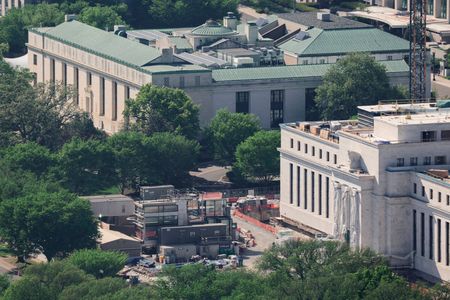
Brian Jacobsen, chief economic strategist at Annex Wealth Management in Brookfield, Wisconsin, warned that Warsh’s communication overhaul could have unintended consequences: “Warsh turned the table over in the Eccles Building with a radical simplification of the Fed’s policy announcement. By doing this, he’s actually inviting more Fed-speak, not less. Now every Fed President will fill the gap left by the punchy policy announcement. This may backfire on Warsh.”
Ryan Detrick, chief market strategist at Carson Group in Omaha, Nebraska, said Warsh avoided rocking the boat too much in his opening act: “It doesn’t look like Warsh rocked the boat too much with his first meeting in charge. The realization is inflation has clearly been heating up, but the other side is the economy has been fairly firm as well. The chances are, as was widely expected, that there’s probably not going to be a rate cut this year. This further confirms that. Now the question becomes, will we really see a hike or is the Fed on pause the rest of this year?”
Matthias Scheiber, head of the multi-asset team at Allspring Global Investments in London, said consumers have held up better than expected but inflation remains a concern: “The consumer has surprised to the upside, maintaining robust growth of around 2% quarter over quarter but with a falling savings rate. Growth expectations have begun to reprice higher, with investment and consumption both balanced nicely. Inflation, on the other hand, has proved stubborn and is likely to continue to pick up from here. Tariff uncertainty remains, including a small left tail risk that a ‘resolution’ in the geopolitical backdrop could open a flood of demand. The Fed’s balance sheet remains a central question and will increasingly be in focus over the next few Fed meetings. Markets will continue to watch the chair as he implements his vision for the FOMC, which may see subtle shifts in the communications process and provisioning of data. The market will be keenly looking for these signals.”
Karl Schamotta, chief market strategist at Corpay in Toronto, described the statement overhaul as swift and striking: “This Fed decision was short, but not sweet. Kevin Warsh moved swiftly to put his stamp on the central bank’s communication strategy by executing a dramatic revision to the official statement, wiping out anything resembling forward guidance and editing out the bulk of the contextual information typically parsed most closely in financial markets. The committee turned sharply hawkish, with the median participant yanking inflation projections much higher — suggesting that officials don’t expect this weekend’s US-Iran deal to result in a serious easing in price pressures — and penciling in at least one hike this year, marking a stark contrast with the cut previously expected.”
Mark Hackett, chief market strategist at Nationwide Investment Management in Philadelphia, said the outcome largely matched expectations: “So far, as expected — incrementally hawkish with a less detailed statement. Initial market reaction has not meant much in the past several years. We will need to wait for the press conference. They telegraphed the significant changes to the statement, and dropping the easing bias was expected. It’s interesting that gold is having the most significant reaction to what should not have been a surprise.”