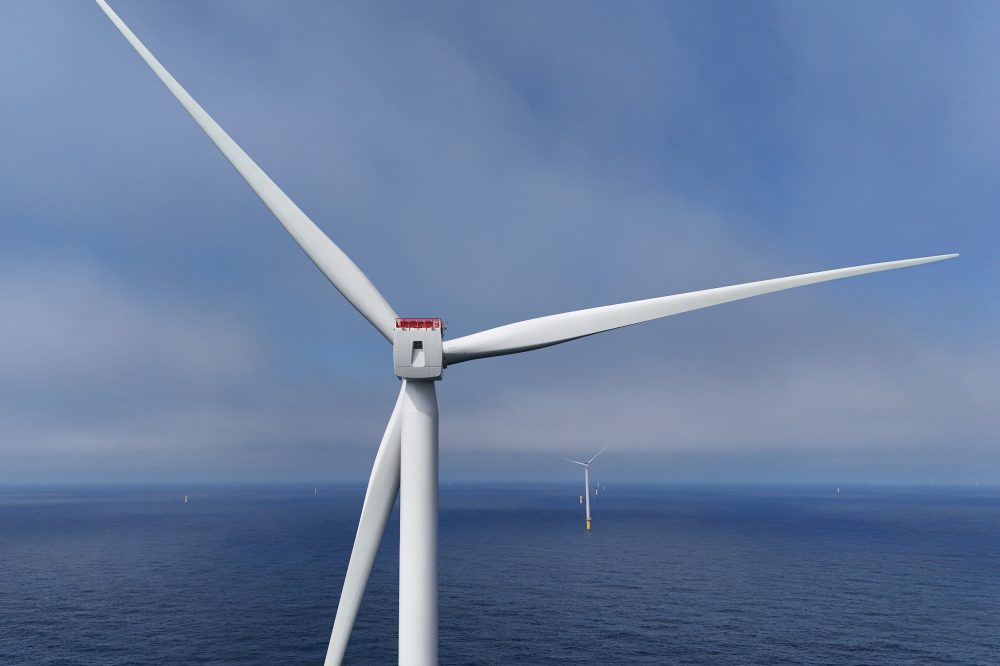

The Trump administration announced Wednesday that it has reached an agreement to purchase back four offshore wind leases from an energy company, pushing the total amount spent on these types of deals to nearly $2.6 billion.
Chicago-based Invenergy has agreed to surrender its four offshore wind leases — all of which were in very early stages of development — in exchange for $765 million in lease fee reimbursements. The company had already pulled the plug on the largest of the four projects, Leading Light Wind off the New Jersey coast, back in November. The remaining three projects were located off the coasts of Maine and California. Invenergy plans to put that money toward natural gas and geothermal projects that can be completed more quickly.
The Republican administration’s lease buyback strategy is designed to halt offshore wind development that President Donald Trump opposes, while steering money toward fossil fuel projects he supports. The approach came after federal courts blocked Trump’s attempts to halt offshore wind development through executive orders. Trump has repeatedly expressed his opposition to wind power, often calling turbines unsightly.
Interior Secretary Doug Burgum praised the deal in a statement, saying, “Under President Trump, companies are shifting investment back toward dependable, secure energy infrastructure that can power our economy and lower utility costs. We applaud Invenergy for recognizing the importance of baseload power and investing in energy solutions that deliver real benefits to American consumers.”
However, not everyone is on board. Hillary Bright, executive director of the offshore wind advocacy group Turn Forward, pushed back on the idea that these deals represent an equal trade. She pointed out that the fossil fuel projects being funded won’t deliver electricity to the same regions that would have benefited from the offshore wind farms.
“Replacing coastal offshore wind with geothermal or natural gas infrastructure in another region does nothing to address rising ratepayer affordability concerns, reliability challenges or potential gaps in power supply in the Northeast and mid-Atlantic,” Bright said in a statement.
This is not the first such deal. Back in March, French energy company TotalEnergies reached the first agreement of this kind, receiving close to $1 billion — essentially a full refund on two offshore wind leases off the coasts of North Carolina and New York — on the condition that the money be reinvested in fossil fuels. New York is currently leading a lawsuit challenging that agreement, and Democratic members of Congress have launched an investigation into it.
In April, two additional companies — Golden State Wind and Bluepoint Wind — agreed to give up their leases in exchange for reimbursements totaling nearly $900 million, with the same requirement to reinvest equally in fossil fuels. California is investigating the Golden State Wind deal, which involved a floating offshore wind project proposed off the state’s central coast. Bluepoint Wind was an early-stage project planned for waters off New Jersey and New York.
Invenergy holds four offshore leases in total: the Leading Light Wind lease area, which would have used traditional turbines anchored to the seafloor; two leases for floating turbine projects in the Gulf of Maine; and one lease for a floating project off California’s central coast. The company is North America’s largest privately held independent power producer.
For Invenergy, the agreement provides a path to move forward with energy projects that can get power to customers faster than the stalled offshore wind leases could. The Trump administration has created significant obstacles for wind energy permitting while simultaneously working to fast-track fossil fuel development.
The company left open the possibility of returning to offshore wind down the road. Daniel Runyan, senior vice president for development at Invenergy, said in a statement that given unprecedented energy demand, they “will deploy additional capital into projects that can be delivered on a commercially reasonable timeline and meet customer demand while continuing to evaluate opportunities as market conditions evolve.”
Leading Light Wind had been designed to generate as much as 2.4 gigawatts of electricity — enough to power more than one million homes. When Invenergy canceled it in November, the company cited supply chain difficulties, equipment and vendor challenges, and shifting regulatory requirements as reasons.
The floating offshore wind projects were so early in the planning stages that Invenergy had not yet determined how much power those locations could ultimately produce.
Invenergy is already a significant player in the natural gas industry, with 14 natural gas facilities currently in operation. The company is also expanding into geothermal energy, holding 45 leases covering 144,000 acres across Nevada, Idaho, California, Utah, and New Mexico. The $765 million from this latest deal is earmarked for natural gas facilities in Indiana, Wisconsin, Iowa, Kansas, and Missouri, as well as geothermal development in the West. The company will not be reimbursed for interest paid on lease payments or additional development costs already incurred.
It’s worth noting that Invenergy’s portfolio extends well beyond offshore wind. The company operates roughly 125 land-based wind farms, more than 60 solar projects, and nearly 30 battery storage facilities, with many more in active development.