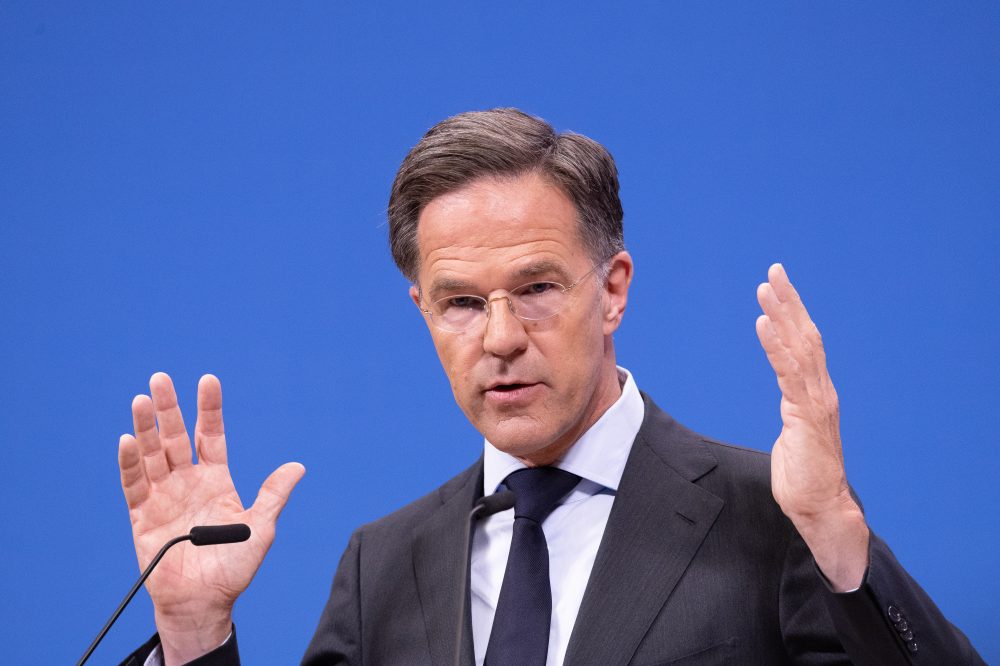

BRUSSELS (AP) — NATO Secretary-General Mark Rutte sought Wednesday to minimize concerns over the Trump administration’s move to scale back the number of American troops and military resources it would make available to allies in the event of an attack.
NATO’s top military commander — an American — has been developing alternative defense plans for Europe after the U.S. signaled on June 3 that it would no longer commit an aircraft carrier, support vessels, aerial refueling aircraft, and dozens of fighter jets, among other assets, to alliance emergencies.
Rutte was quick to clarify, however, that American forces are not being pulled out of Europe. “This is not about where forces and assets are currently located,” he said on the day before a NATO defense ministers meeting he will lead in Brussels.
“It’s about who would do what if our defense plans were activated. So, let’s say in case of an Article 5 situation,” Rutte told reporters.
Article 5 of NATO’s founding treaty — the alliance’s collective defense guarantee — holds that an attack against one of the 32 member nations is considered an attack against all of them. It does not require military assistance, though many allies would likely respond with force.
In practical terms, the United States is reducing the role it would play if an ally invoked Article 5. The U.S. commands by far the largest military force within NATO. The country has not signaled any intention to remove its nuclear weapons from Europe, which remain a cornerstone of the alliance’s deterrence strategy.
The NATO Force Model serves as the alliance’s primary framework for organizing military contributions from all 32 member nations during peacetime, crises, or armed conflict. It defines what military resources commanders can draw upon across the first six months of any potential conflict.
Earlier this month, the Pentagon notified NATO allies that it would be reducing its commitments to the alliance as it shifts focus toward other potential threats, particularly from China in the Indo-Pacific region.
Rutte said NATO’s supreme commander, U.S. Gen. Alex Grynkewich, believes “there are largely capabilities available that other allies already have, or will have in the near future,” that can offset the reduction in American contributions.
“The overall picture is looking good,” Rutte added.
Still, some of the withheld equipment has caught U.S. allies off guard. Many of those assets are scarce in Europe. The U.S. is pressing allies to outline how they plan to replace or compensate for the missing resources before President Donald Trump and fellow heads of state gather for a NATO summit on July 7-8.
Ahead of that summit, European allies and Canada are seeking a clearer picture from U.S. Defense Secretary Pete Hegseth about the administration’s agenda for the gathering in Ankara, Turkey’s capital. Hegseth was absent from the alliance’s previous ministerial meeting in February.
Trump added to the confusion last month when he announced plans to send 5,000 additional U.S. troops to Poland — a move that conflicted with his administration’s stated goal of reducing America’s military presence in Europe.
Reductions are already underway. NATO’s military headquarters announced Friday that it will shrink the size of its peacekeeping force in Kosovo, with American troops expected to be among those withdrawn.
The U.S. currently has 590 soldiers serving with KFOR in Kosovo, placing it second among the 31 contributing nations behind Italy, which has 907 personnel deployed. U.S. Black Hawk helicopters are also based at Camp Bondsteel, the large American installation in the country.
KFOR was established in 1999 to maintain stability between Kosovo and Serbia. Once numbering 50,000 troops, the force has been gradually reduced as tensions declined over the years, though 1,000 additional soldiers were deployed in 2023 following an outbreak of renewed violence.
Rutte confirmed Wednesday that more than 1,000 KFOR personnel would be withdrawn. Gen. Grynkewich has stated that the situation in Kosovo is now stable enough to “optimize” the mission’s troop levels.