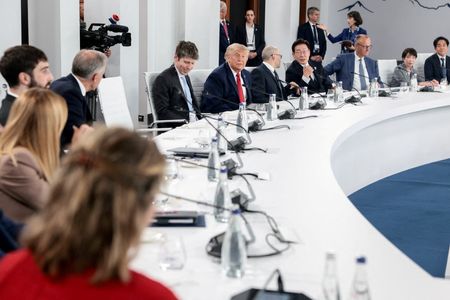

EVIAN-LES-BAINS, France — On the final day of the Group of Seven summit held June 15-17 at the French resort of Evian-les-Bains, world leaders committed to strengthening cooperation on both the dangers and the potential of advanced artificial intelligence technology.
In a joint statement issued Wednesday, the G7 leaders said they would direct finance officials, regulators, and cybersecurity specialists to examine how the most advanced AI models might affect financial stability, worker productivity, and job markets.
A significant point of discussion was a proposed “trusted partners” program that could allow non-U.S. countries to gain access to advanced American AI systems from companies such as Anthropic — potentially offering a way around recent U.S. access restrictions.
The proposal came in response to a directive from U.S. President Donald Trump last week, ordering Anthropic to cut off foreign nationals from its most advanced AI models due to national security concerns. As Reuters reported Tuesday, the “trusted partners” designation could apply to both nations and companies, enabling them to use those models to build stronger cybersecurity defenses against rivals such as China.
Meanwhile, cybersecurity experts have raised alarms about Anthropic’s Mythos — a tool designed to identify coding weaknesses and strengthen cyber defenses — warning that it could potentially be turned around to supercharge attacks on the very systems it was built to protect.
On Wednesday, executives from Anthropic, OpenAI, and Google joined G7 leaders for a working lunch focused on AI regulation and infrastructure development. All three companies are actively building highly advanced AI models.
Europe’s struggle to strike the right balance between technological independence and keeping pace with U.S.-led innovation was also a central theme at the summit. European policymakers have increasingly framed AI as both an economic and a national security priority. The European Commission recently unveiled plans for AI “gigafactories” and large-scale computing infrastructure aimed at giving the region its own access to computing power, and has proposed legislation to grow domestic cloud, AI, and semiconductor industries while reducing reliance on major U.S. technology firms — though critics argue Europe remains years behind its American counterparts.
European Commission President Ursula von der Leyen, speaking at the tech executives’ lunch, argued that it serves both the U.S. and the European Union for Europe to have access to the best AI tools available. She also praised American efforts to ensure AI companies act responsibly when rolling out powerful new systems.
“We use each other’s trusted technology, and our financial systems are interconnected,” von der Leyen said.