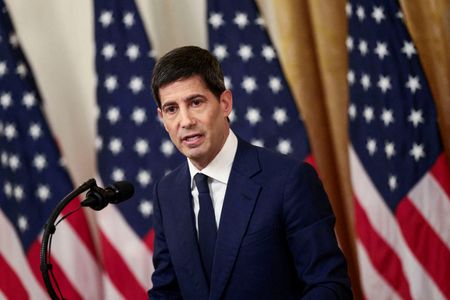

Federal Reserve Chairman Kevin Warsh appears to have declined to submit an interest rate projection as part of the central bank’s latest quarterly forecasting exercise — a departure from established practice that could hint at the early stages of the sweeping changes he has pledged to make at the institution.
The Fed released its latest “dot plot” on Wednesday, a chart that displays the anonymous rate-path forecasts of individual policymakers. That chart contained just 18 submissions, even though the Fed’s full policymaking body consists of 19 members. The central bank did not identify which member chose not to participate.
Analysts are likely to point the finger at Warsh. He has been a vocal critic of the kind of forward guidance the dot plot represents, and he is the only new addition to the policymaking table since the previous round of forecasts was submitted.
The dot plot has been a fixture of Fed communications since 2012, published four times annually to give the public and financial markets a window into where policymakers think interest rates may be heading — whether that means a cut, a hike, or holding steady for an extended period.
Fed officials themselves acknowledge the tool has its limitations. It does not, for example, show how each policymaker’s outlook on employment or inflation connects to their rate-path view. Still, it has been part of an ongoing effort toward greater transparency that officials believe has helped make monetary policy more effective by giving investors and the public a clearer picture of the Fed’s thinking.
Warsh has long taken issue with that approach, contending that forward guidance can trap policymakers into a predetermined rate path even when fresh economic data would call for a different course. Whether his apparent decision to skip the dot plot signals something meaningful or simply reflects the fact that he is still getting settled in his new role remains to be seen. Either way, it is certain to fuel speculation about the future of the dot plot and the Fed’s overall communication strategy.
The only other Fed policymaker known to have withheld a dot in the past was former St. Louis Fed President James Bullard, who routinely submitted near-term rate projections but stopped short of providing an estimate for the longer-run neutral rate.
The Fed also noted that only 17 of the 19 policymakers submitted projections for the year 2028.