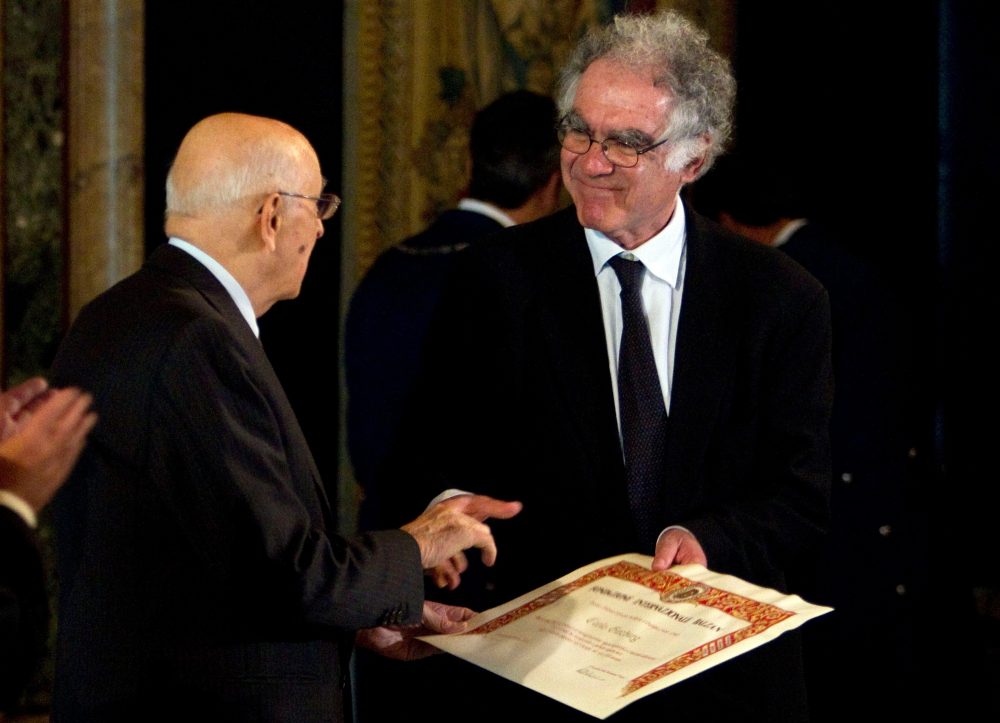

ROME (AP) — Carlo Ginzburg, an Italian historian whose groundbreaking approach to the past gave a platform to people long excluded from mainstream historical narratives, passed away Wednesday at the age of 87.
The Scuola Normale Superiore in Pisa — an institution where Ginzburg studied and later served as professor emeritus — confirmed that he died in the northern Italian city of Bologna.
Ginzburg was widely recognized as a trailblazer in the field of microhistory, a discipline that examines small, specific subjects — an individual person, a single community, or one particular event — in order to shed light on much larger historical patterns and social questions.
As one of the most influential figures in modern historical scholarship, Ginzburg developed what became known as the “evidential paradigm” — an approach that relies on reading clues, traces, and seemingly insignificant details to reconstruct the lives and experiences of those left out of dominant historical accounts.
His early scholarship centered on the “benandanti,” a pagan fertility cult that existed in the Friuli region of Italy during the 16th and 17th centuries. Members of the group, who were regarded as shamanic healers, faced accusations of heresy from the Inquisition.
That research formed the foundation of his first book, released in 1966, in which he connected the cult’s origins to older belief systems rooted in Central Europe.
His most celebrated work, “The Cheese and the Worms,” published in 1976, is widely considered one of the most significant contributions to Italian historical writing. The book reconstructed the trial of a Friulian miller from the 16th century who was accused of holding unconventional views about the creation of the world and the nature of Jesus Christ.
By drawing on records from inquisitorial proceedings, Ginzburg demonstrated how the same documents can simultaneously reflect both power and resistance, using individual cases to illuminate broader conflicts between elite and popular culture, and between authority and those who challenged it.
Born in Turin in 1939, Ginzburg was the son of writer Natalia Ginzburg and anti-fascist activist Leone Ginzburg. Over the course of his career, he held teaching positions at Harvard, Yale, Princeton, and the University of California, Los Angeles. His body of work was translated into more than 30 languages.
He was the recipient of numerous prestigious international awards, among them the Prix Aby Warburg, the Balzan Prize, the Antonio Feltrinelli Prize, and the Humboldt Research Award.
In a 2023 interview with the Italian cultural publication Lucy, Ginzburg reflected that his scholarly method had uses beyond the academic world, saying it should be applied “in everyday life” as a way to better understand other people.
In a formal statement, the Scuola Normale Superiore said Ginzburg “changed the way of practicing the historian’s craft,” noting that he “restores voice to those who lack it, shows that the rigor of proof is a form of justice, and upholds a demanding idea of truth.”
He is survived by two daughters — Silvia, an art historian, and Lisa, a writer and essayist — from his marriage to the late historian Anna Rossi-Doria.