TORONTO – City officials in Toronto have backtracked on controversial admission charges for their upcoming World Cup fan festival following strong opposition from council members and residents who argued the fees violated earlier commitments.
The Toronto City Council voted 18-3 this week to approve a modified plan that eliminates entrance fees for most attendees. The decision comes after city staff initially proposed charging $10 for general admission to the festival, which will feature live game screenings, food vendors, and entertainment during the June 11-July 19 tournament.
The proposed charges sparked immediate criticism since city officials had previously marketed the event as a “free and inclusive space” for soccer fans to gather and watch matches together.
Following concerns raised by council members about making the event affordable for all residents, Mayor Olivia Chow directed city staff to reconsider the ticketing structure earlier this week.
Under the revised plan announced Wednesday, 15,600 of the 20,000 available daily general admission spots will be completely free. An additional 500 tickets will be set aside at no charge for community organizations. The city will still offer 3,900 premium tickets each day, priced between $100 and $300.
City staff had defended the original fee proposal as necessary for managing crowds and funding what they called an “enhanced fan experience.”
“Fan Fest should be free for general admission,” Chow stated to reporters before the council vote. “We can offer VIP packages for those who want them, but the gates should be open for everyone.”
Toronto is among 16 host cities across Canada, the United States, and Mexico that will welcome the expanded 48-team World Cup. The city is scheduled to host six tournament matches.
A Maryland nuclear technology company made an impressive entrance into the stock market Friday, with shares climbing more than 30% on opening day and pushing the firm’s total worth to nearly $12 billion.
X-Energy, headquartered in Rockville, Maryland, completed its initial stock offering Thursday by raising $1.02 billion after selling 44.3 million shares at $23 each in an expanded offering. When trading began Friday, the stock immediately jumped to $30.11 per share.
This successful market launch represents a crucial funding achievement for X-Energy as the company works to bring its “Xe-100” small modular reactors to market. Industry experts consider these compact nuclear systems essential technology that could deliver the first commercial small reactor power to American electrical grids before 2030.
The strong investor response reflects growing enthusiasm for clean energy technologies, particularly those capable of supporting the massive power demands of artificial intelligence development.
A significant prisoner exchange took place Friday between Ukraine and Russia, with each nation releasing 193 captured military personnel in a deal brokered with assistance from the United States and United Arab Emirates.
Ukrainian President Volodymyr Zelenskiy expressed satisfaction with the swap in a Telegram message, stating: “It is important that there are exchanges and that our people are returning home.”
Both Kyrylo Budanov, Zelenskiy’s chief of staff, and Russia’s defense ministry confirmed that American and UAE officials helped coordinate the prisoner transfer.
This exchange represents the latest in a series of captive swaps that have occurred throughout the four-year conflict, with both countries having traded thousands of prisoners during the war.
According to Zelenskiy, the freed Ukrainian personnel included military members, border patrol agents, and police officers. Some returnees sustained wounds during their captivity, while others had been facing criminal prosecution in Russia.
Emotional scenes unfolded as the released Ukrainians disembarked from transport vehicles, with many wrapped in Ukrainian flags and visibly moved by their return.
One returning soldier named Serhiy, who provided only his first name, described his feelings upon release: “It still hasn’t sunk in that I’m home, I was in captivity for three years … our Ukrainian sky, our trees — this is happiness.”
Law enforcement officials in Peru conducted a search of the former top election official’s residence on Friday as investigators examine claims of voting process misconduct following his resignation earlier this week due to ballot counting delays from the April 12 national election.
Television footage from local news outlets captured police officers entering Piero Corvetto’s home in Lima’s Miraflores neighborhood, acting under court authorization. The former director of Peru’s National Office of Electoral Processes (ONPE) was the target of the search, while authorities simultaneously examined up to 12 additional locations during the investigation.
The nation’s prosecutor’s office confirmed that anti-corruption officers worked alongside prosecutors during the operation, responding to mounting public accusations of electoral process violations.
Defense attorney Ricardo Sanchez Carranza informed Reuters that while a magistrate approved searching his client’s residence, officials rejected prosecutors’ request to place Corvetto in preliminary custody. The lawyer emphasized that Corvetto provided complete cooperation with investigators.
Lead prosecutor Raul Martinez directed the confiscation of cellular devices, computer equipment and paperwork from Corvetto’s residence, according to local broadcaster RPP’s reporting.
Corvetto stepped down from his position on Tuesday, describing his departure as “necessary and unavoidable” to help rebuild public trust in the electoral system following organizational failures that caused extended wait times at voting locations and delayed result announcements.
In his resignation statement, he rejected any allegations of misconduct and advocated for addressing outstanding concerns through an unbiased investigation.
European Union monitoring teams reported finding no indication of fraudulent activity during their observation.
The prolonged ballot counting process has sparked fraud accusations from multiple candidates across Peru. Election officials began this week examining thousands of disputed ballots containing discrepancies or mistakes on counting forms, creating additional delays in finalizing outcomes.
By Friday morning, approximately 95% of ballots had been processed according to ONPE data, showing conservative contender Keiko Fujimori in the lead with about 17% support. A close competition for second place continues between leftist legislator Roberto Sanchez and former Lima Mayor Rafael Lopez Aliaga, with Sanchez expanding his advantage over Lopez Aliaga to approximately 20,000 votes from 14,000 earlier in the week.
Peru’s National Jury of Elections announced that complete results will be released by May 15, preceding the planned presidential runoff between the leading two candidates scheduled for June 7.
ST. PAUL, Minn. — State governments across America have dramatically enhanced security protocols at capitol buildings and expanded protection measures for elected officials following the shocking murder of Minnesota House Democratic leader Rep. Melissa Hortman nearly one year ago.
The enhanced security measures come as political violence has escalated nationwide, including Hortman’s assassination last June and the September murder of conservative activist Charlie Kirk during a speaking engagement at a Utah college campus.
Minnesota’s state capitol now operates with most entrances secured, requiring all visitors to pass through metal detection systems before entry. Those wishing to observe legislative sessions from public galleries must clear an additional security checkpoint.
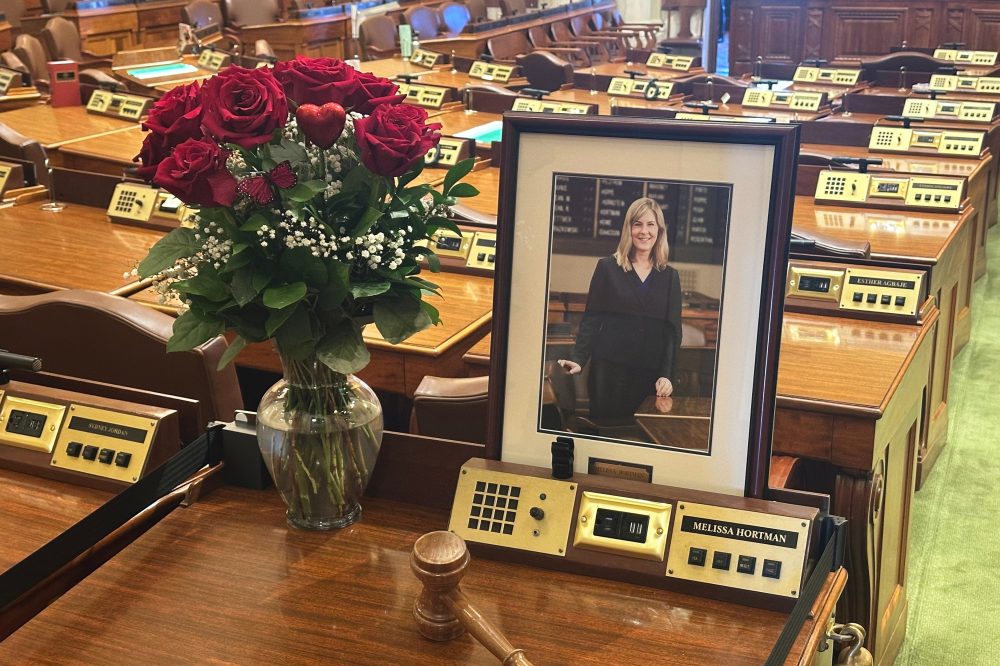
“It’s important for us to be able to not have our government fall apart if our legislators are under threat,” said Minnesota Rep. Julie Green, a Democrat who sits directly across the aisle from Hortman’s old desk, which remains empty except for fresh roses, her portrait and a speaker’s gavel. “It’s a complicated, complex, very emotional issue, as you can imagine.”
The violence against Hortman and Kirk represents part of a broader pattern of attacks on political figures, including a 2024 arson incident at Democratic Pennsylvania Gov. Josh Shapiro’s residence, an assassination attempt against then-candidate Donald Trump during a Pennsylvania campaign event in 2024, and the 2022 hammer assault on Democratic then-House Speaker Nancy Pelosi’s husband at their California residence.
Currently, 25 states including Minnesota have established formal policies permitting political candidates to allocate campaign dollars toward personal security expenses. The majority of these changes occurred following the Kirk and Hortman killings. According to data from the National Conference of State Legislatures and the VoteMama Foundation, eleven states have enacted specific legislation, while others have implemented the policy through regulatory or administrative channels.
During this year alone, Alabama, Oregon, Nebraska and Utah have passed legislation authorizing campaign security expenditures. Approximately twelve additional states are currently considering similar proposals.
The trend extends beyond state politics. Congressional and presidential campaign security expenditures have increased five times over the previous ten years. According to an April analysis by the nonpartisan Public Service Alliance, federal political organizations allocated over $40 million for security-related costs during the 2023-24 election period.
Alaska installed metal detection equipment at its capitol facility last year, representing one of the most obvious indicators of growing concerns about political violence. Democratic Rep. Sara Hannan attributed the installation to “increased risk of violence in our public institutions.” State legislators approved the security measures prior to Hortman’s death.
However, certain states have resisted implementing stricter access controls to government buildings. Wisconsin Assembly Speaker Robin Vos, a Republican who had personal knowledge of Hortman, opposed proposals for metal detector installation in his state, explaining he preferred not to “fortify” the capitol building. According to a state audit, Wisconsin ranks among eleven state capitols operating without metal detection systems.
Minnesota legislators are also evaluating the creation of a specialized State Patrol division responsible for capitol security that would extend protection services to legislators, the state attorney general, secretary of state, state auditor, and Supreme Court justices.
Democratic Sen. John Hoffman, a primary sponsor of the legislation, survived being shot nine times during the same night Hortman was murdered. According to prosecutors, the perpetrator disguised himself as a law enforcement officer and initiated his attack by shooting Hoffman and his spouse, then traveled to two other lawmakers’ residences where they were not present. The gunman subsequently arrived at Hortman’s residence, where he killed both the representative and her husband, and injured their dog so severely that veterinarians had to euthanize the animal.
During Tuesday’s legislative hearing, Hoffman described his proposal as “a necessary response” that would “keep elected officials and Supreme Court justices safe and dedicate the resources necessary and hopefully stop future tragedies from happening.”
Multiple states have also implemented measures to safeguard lawmakers’ private information. North Dakota legislators discussed draft legislation Wednesday that would allow candidates and public officials to request confidential treatment of their home addresses.
The NCSL established a $1.5 million reimbursement program in February to cover legislature expenses related to lawmaker safety and security when they are away from state capitol buildings. According to NCSL spokesperson Katie Ziegler, more than 30 states have submitted applications or are preparing to do so.
RALEIGH, N.C. — An Army special forces member connected to the Venezuelan President Nicolás Maduro capture operation will appear before a judge Friday following allegations that he illegally profited from secret mission details through online gambling, earning over $400,000.
According to federal authorities, Gannon Ken Van Dyke exploited his clearance to classified details regarding the January operation targeting Maduro to generate substantial winnings on Polymarket, a prediction betting platform.
The 38-year-old soldier, previously based at Fort Bragg in Fayetteville, North Carolina, faces multiple federal charges filed Thursday including improper use of confidential government data for financial benefit, stealing nonpublic federal information, commodities fraud, wire fraud, and conducting illegal financial transactions.
Van Dyke potentially faces several years behind bars. No working phone number could be located for him, and legal representation has not yet been documented in court filings.
Court documents reveal Van Dyke participated in approximately one month of planning and executing Maduro’s capture. Despite signing confidentiality contracts prohibiting disclosure of “any classified or sensitive information” about the operations, prosecutors claim he violated these agreements by placing multiple wagers predicting Maduro’s removal from office by January 31, 2026.
FBI Director Kash Patel commented on social media: “This involved a U.S. soldier who allegedly took advantage of his position to profit off of a righteous military operation.”
Polymarket representatives stated they identified suspicious trading activity involving classified government intelligence, immediately notified the Justice Department, and “cooperated with their investigation.”
The extraordinarily profitable wagers generated significant public scrutiny following the Venezuelan raid and prompted lawmakers from both parties to demand tighter oversight of prediction markets, where participants can bet on virtually any outcome.
The Commodity Futures Trading Commission, which oversees prediction markets, simultaneously filed its own legal action against Van Dyke on Thursday.
According to the commission’s filing, Van Dyke transferred $35,000 from his personal banking account into a cryptocurrency trading platform on December 26 — approximately one week before American forces entered Caracas and apprehended Maduro.
The complaint details how Van Dyke executed multiple wagers regarding Maduro’s potential overthrow between December 30 and January 2, with most bets placed during the evening of January 2 — mere hours before the initial strikes hit Caracas.
These gambling activities generated “more than $404,000 of profits,” according to the legal filing.
Commission Chairman Michael Selig stated: “The defendant was entrusted with confidential information about U.S. operations and yet took action that endangered U.S. national security and put the lives of American service members in harm’s way.”
A University of Delaware rowing coach has earned a prestigious appointment to the United States national rowing program.
Kirby Droogan, who serves as an assistant rowing coach at UD, has been selected to join the US Rowing U-19 selection team staff. In this role, Droogan will work with young athletes who are training for potential spots on the team that will compete at the 2026 World Rowing U-19 Championships, scheduled to take place in Plovdiv, Bulgaria.
The appointment represents a significant recognition of Droogan’s expertise and coaching abilities in the sport of rowing. As part of the national selection staff, Droogan will be involved in identifying and developing the next generation of elite American rowers at the under-19 level.
The Delaware Forest Service marked this year’s Arbor Day observance on Friday, emphasizing the crucial benefits that trees provide to communities across the First State.
This annual celebration takes place each year on April’s final Friday, drawing attention to how forests and trees contribute to cleaner air and water, provide essential wildlife habitats, build stronger communities, and improve overall quality of life for Delaware residents.
The Delaware Forest Service, operating under the Delaware Department of Agriculture, remains committed to promoting forest conservation and tree-related initiatives throughout the state.
A family with deep ties to Salisbury University has announced the creation of a memorial endowment dedicated to one of their own who exemplified Sea Gulls pride.
The endowment honors Shari Burke, who passed away and was remembered as possibly the most passionate Sea Gulls supporter in her family. Shari was married to Bill Burke and was the mother of four children: Keaton, Declan, McKenna, and Keegan.
The Burke family has maintained a longstanding relationship with the university, contributing significantly through financial donations over the years. However, their impact extends far beyond monetary gifts, as family members have served the institution in various capacities including faculty positions, coaching roles, staff positions, and as students.
This latest endowment, which will carry Shari Burke’s name, is designed to benefit Salisbury University’s track and field and cross country programs, specifically supporting both the teams and their coaching staff.
The establishment of this fund represents the family’s continued commitment to the university while creating a lasting tribute to Shari’s memory and her dedication to Sea Gulls athletics.
WASHINGTON, D.C., April 24, 2026 – Congressional representatives are divided over farm bill provisions that would address California’s Proposition 12, a state law requiring specific animal housing standards that affects pork producers across the nation.
More than 60,000 American pork producers are calling for congressional action to address what they describe as conflicting state regulations stemming from California’s ballot measure, which mandates housing requirements for animals whose products are sold in the state.
Agricultural leaders, veterinary professionals, the current administration, and elected officials from both political parties have voiced concerns about allowing individual states to regulate farming practices beyond their borders.
President Donald Trump stated:
“…Article I, Section 8 of the Constitution plainly states that Congress – not individual states – has the power to regulate commerce ‘among the several States.’ For many years, this provision has been understood to block efforts by individual states to regulate interstate trade in ways that are discriminatory or burdensome. I will use all authority under the Constitution and U.S. law to stop efforts by California – or other states – that hurt American farmers in other states…”
Agriculture Secretary Brooke Rollins explained that Prop. 12 “…is not just affecting California. It’s affecting multitudes of other states, multitudes of other parts of the ag community, including our hog family farms.”
“When those ideas, and those rules, and those laws begin to impact other states in such a negative way, that is not what our founders intended. That is not constitutional, and it is not OK,” Rollins continued.
“California has the right to do what California wants to do, but the minute that crosses the border and starts to compromise in such a significant way our pork producers, we need to act,” she added.
“This war against consumer choice and against our farmers forces Californians and those who receive those goods across the country to buy more expensive eggs and pork. California’s actions under Proposition 12 fly in the face of federal jurisdiction and regulation over food production and safety…”
Former Agriculture Secretary Tom Vilsack noted:
“Every state has the right to regulate the activities of farmers within their state borders. Where there’s disagreement is whether states have the right or the ability to extend their view about how livestock should be raised to farmers in other states.”
“At some point in time, somebody’s got to provide some degree of consistency and clarity otherwise you’re just inviting 50 different states to do 50 different iterations of [Prop. 12]. Farmers don’t need the chaos; they need clarity and certainty.”
“If we don’t take this issue seriously, we’re going to have chaos in the marketplace.”
USDA Deputy Secretary Stephen Vaden warned:
“This internal protectionism is what led to the demise of the Articles of Confederation. If one state can block products from another state, the country ceases to function as a unified national market.”
Senate Agriculture Committee Chairman John Boozman (R-AR) emphasized:
“Agriculture needs to stick together … to get this done.”
Sen. Chuck Grassley (R-IA) argued:
“California’s Proposition 12, along with Massachusetts’ Question 3, are based on arbitrary, nonsensical standards and have resulted in a harmful patchwork of regulations across the 50 states. They’re a threat to Iowa, which leads the nation in pork production, and to farmers and consumers across this country. Consistent with its authorities under the Commerce Clause, it’s time for Congress to solve this problem by passing legislation. Our bill will end California’s war on breakfast and make sure delicious Iowa pork can be sold everywhere.”
Sen. Joni Ernst (R-IA) called “Proposition 12 is dangerous and arbitrary overregulation that stands in direct opposition to the livelihoods of Iowa pork producers, increases costs for both farmers and consumers, and jeopardizes our nation’s food security.”
Sen. Roger Marshall (R-KS) said:
“The United States is constantly faced with non-tariff trade barriers from protectionist countries, which hurts American agriculture’s access to new markets. The last thing we need is for states like California imposing its will on ag-heavy states like Kansas with regulations that will also restrict our ability to trade among the states. Midwest farmers and ranchers who produce our nation’s food supply should not be hamstrung by coastal activist agendas that dictate production standards from hundreds of miles away.”
House Agriculture Committee Chairman Glenn “GT” Thompson (R-PA) questioned:
“The data shows that both producers and consumers are facing significant cost increases due to Prop 12. It begs the question – if producers are paying more, and consumers are paying more, who is winning?”
House Agriculture Committee Ranking Member Angie Craig (D-MN) acknowledged:
“Any true representative of farm country knows that Prop 12 is a concern for producers on both sides. We cannot ignore the questions and challenges Prop 12 raises. Even the Biden administration’s Ag Secretary said we need to treat this issue seriously to ensure stability in the marketplace. I agree that we cannot have 50 states with 50 different regulatory frameworks because of the significant challenges it would present to producers, but I believe that there are ways to avoid that situation.”
Former House Agriculture Committee Chairman David Scott (D-GA) noted:
“We have a substantial burden on our interstate commerce and the implications that this may have on the producers.”
Rep. Don Davis (D-N.C.) stressed:
“We need a long-term solution that does not disadvantage eastern North Carolina producers or others and potentially put some out of business. I work with anyone, to be clear, anyone on this committee to come up with that fix and a workable solution. But for us to not address this, I believe would be a fatal mistake–fatal mistake for our pork producers.”
Rep. Shomari Figures (D-AL) observed:
“But this is where state rights—one state’s rights—run up against the rights of companies that reside and operate in other states. It runs up against their ability to make a living… Some decisions should be left to the states, who know their own agricultural realities best.”
Rep. Ashley Hinson (R-IA) declared:
“California’s Proposition 12 and Massachusetts’ Question 3 pose a major threat to family farms and food security—both in Iowa and across the country.”
Rep. Randy Feenstra (R-IA) criticized:
“For too long, Iowa’s hog farmers have faced growing uncertainty because of California’s egregious Proposition 12. This unfair mandate has imposed costly, unscientific regulations on pork producers across the country – even though California produces less than one-tenth of one percent of the nation’s hogs.”
Iowa Governor Kim Reynolds commented:
“With Proposition 12, California has set out-of-touch, arbitrary requirements for how producers should operate their farming businesses. California activists now claim to know what’s best for the producers who have raised livestock from generation to generation.”
Florida Governor Ron DeSantis expressed concerns:
“You also have the situation where a state like California could adopt something like Proposition 12, and that ends up having a devastating impact in Iowa because of the size of California’s market. I don’t think California should be able to dictate how people are producing pork. I mean, that’s just not good for the economy. It’s not the way the system was designed to work. And I want states to be able to make their own decisions, but when they’re trying to do things that have an effect outside their state, well, that’s a different beast there. And I think what they’ve done — they do these initiatives, people don’t even know what they’re voting on. They have no sense of how that would impact people who are actually in the industry. It’s just kind of a thing that someone gets on the ballot, it sounds good, so they do it. That is not the way you do policy, particularly. And you don’t want any industry, agriculture or others, to be at the mercy of the whims of the state like California, like that is just not going to work for this country.”
Veterinary organizations have also weighed in on the scientific basis of the regulations.
The American Veterinary Medical Association stated:
“The arbitrary housing requirements in Prop 12 do not objectively improve animal welfare and may unintentionally cause harm.”
The American Association of Swine Veterinarians concluded:
“The ballot initiative does not objectively improve animal welfare. In fact, in some cases, it may compromise animal welfare.”
Even California’s own agricultural department has raised questions about the scientific foundation of the law.
California’s Department of Food and Agriculture determined:
“Animal confinement space allowances prescribed in the Act are not based in specific peer-reviewed published scientific literature or accepted as standards within the scientific community to reduce human food-borne illness, promote worker safety, the environment, or other human or safety concerns.”
Business leaders have highlighted the economic impact on communities.
Ruben Guerra, Latin Business Association Chairman, explained:
“The impacts of Proposition 12 are devastating our Latino businesses and families across California. With pork prices soaring up to 41% higher than the rest of the country and more than one in three Latino adults already living in food-insecure households, this misguided law is creating unintended food insecurity in our communities.”
Lilly Rocha, Latino Restaurant Association Executive Director, questioned:
“It would be one thing if the regulations imposed on pork producers were based on data and scientific research. But it’s not. We’ve had a great pork industry forever. Why do we need to change a good thing all of a sudden? It makes no sense. It seems to be regulation stemming from a social agenda, not a scientific one.”
Additionally, multiple agricultural organizations representing millions of farmers nationwide have written to Congress requesting action to address the regulatory conflicts created by Proposition 12.
SALISBURY, MD — Hannah Long has been selected to fill the position of Public Information Officer for the City of Salisbury, officials announced.
Long will handle the city’s public communication responsibilities, which include processing Maryland Public Information Act requests and helping deliver timely and accurate information to city residents. She will report to the Mayor and City Administrator while working alongside the Director of Communications and supporting day-to-day operations in the Mayor’s Office.
Her background includes previous employment with Salisbury in multiple departments. Long initially worked as an Office Administrator for the Fire Department, where she built skills in organization, communication, and operational assistance. She subsequently moved to the Clerk’s Office, where she gained experience with legislative procedures and municipal government operations.
“Now, as a Public Information Officer, I’m excited to step into a new role where I can be a bridge between the City and the community,” said Long. “I want to ensure information is clear, timely, and easy to understand. With my background in both administrative and legislative work, I feel like I bring a balanced perspective, and I’m really looking forward to growing in this role and connecting more with the community.”
Salisbury officials expressed optimism about Long’s ability to enhance communication and community outreach efforts.
Delaware lawmakers are considering legislation that would significantly extend how long physical therapists can treat patients without requiring a doctor’s referral.
Senate Bill 110 proposes changing current state law to allow physical therapy treatment for up to 90 days before a physician consultation becomes mandatory. Under existing regulations, physical therapists must obtain a doctor’s referral after treating a patient for 30 days.
The proposed change aims to improve patient access to physical therapy services and ensure uninterrupted care, according to the bill’s language. Physical therapists would continue operating under their established professional training and expertise guidelines.
The legislation also addresses administrative matters by updating license renewal and reactivation procedures for physical therapists and athletic trainers. These changes would align the licensing process with standards used by other professional regulatory boards in Delaware and the Division of Professional Regulation.
The bill specifically targets Title 24 of the Delaware Code, which governs the Examining Board of Physical Therapists and Athletic Trainers.
Delaware legislators are considering legislation that would substantially raise the maximum fees charged for pesticide registration in the state.
House Bill 221 would authorize the Delaware Department of Agriculture to collect up to $500 every two years for pesticide registration, representing a significant jump from the current ceiling of $140 per registration period.
The proposed measure also includes minor technical updates to bring current pesticide regulations in line with Delaware’s legislative drafting standards.
Due to constitutional provisions outlined in Article VIII, Section 10 of the Delaware Constitution, the bill will need approval from three-fifths of elected members in both chambers of the General Assembly to become law. This supermajority requirement applies to any legislation that raises tax rates or licensing fees.
The Department of Agriculture has not yet indicated whether it plans to implement the full $500 fee or a smaller increase if the legislation passes.
Delaware State Police are looking into a deadly collision involving two vehicles that happened Thursday evening in Wilmington.
Authorities were called to Powder Mill Road close to Alapocas Drive around 10:20 p.m. on April 23, 2026, following reports of a crash. Initial findings show that a Saturn SC2 was driving southbound on Powder Mill Road in the right lane when a Dodge Charger, also heading south, came up behind it at speeds exceeding 120 mph. The Charger’s front end collided with the Saturn’s rear, causing the Saturn to spin out and hit a guardrail. Following the collision, the Charger traveled a short distance before veering into the northbound lanes and colliding directly with a tree.
The Charger’s operator, a 26-year-old Wilmington resident who was not using a seatbelt, was declared dead at the crash site. Authorities are withholding his identity pending family notification.
The Saturn’s operator, a 27-year-old Wilmington man, escaped without injuries.
Traffic was blocked for a considerable time as investigators examined and cleared the crash scene.
The investigation remains active under the Delaware State Police Troop 2 Collision Reconstruction Unit. Witnesses or anyone with video footage of the incident should reach out to Master Corporal R. Kunicki at (302) 365-8417. Tips can also be submitted through private Facebook messages to the Delaware State Police or by calling Delaware Crime Stoppers at 1-800-847-3333.
Crime victims, witnesses, or families dealing with sudden loss can access support through the Delaware State Police Victim Services Unit and Delaware Victim Center, available around the clock at 1-800-VICTIM-1 (1-800-842-8461) or via email at [email protected].
A coastal low pressure system will bring a stretch of cool, damp, and breezy conditions to the Delmarva Peninsula this weekend, with the most impactful weather arriving Saturday night into early Sunday.
Saturday starts off mostly dry, but clouds will thicken through the day ahead of an approaching system. A few showers may begin to develop after 2 PM, though rainfall during the daytime hours looks light and spotty. High temperatures will struggle to reach the upper 50s, with an easterly wind increasing to 10 to 15 mph and gusts pushing up to 30 mph, especially near the coast.
Saturday Night is when conditions deteriorate more noticeably. Steadier rain moves in after 8 PM and continues overnight, with a high likelihood of widespread rainfall. Periods of moderate rain are possible, with totals generally between a quarter and half an inch. Overnight lows will fall into the mid 40s, while a persistent northeast wind around 15 mph keeps conditions raw and chilly.
Sunday remains unsettled, although trends suggest the steadiest rain shifts out of the region. Scattered showers will linger through the day under mostly cloudy skies. It will stay cool, with highs only in the low to mid 50s. Gusty northeast winds continue, with occasional gusts near 30 mph maintaining a brisk feel.
Sunday Night, conditions gradually improve as the system pulls away. A few leftover showers are possible early in the evening, but skies will begin to clear overnight. Lows drop into the lower 40s with lighter winds developing late.
Delaware State Police are continuing their investigation into a deadly crash that claimed the life of a Georgetown man last week.
The incident happened on April 17, 2026, around noon when an 81-year-old driver was heading south on DuPont Boulevard just north of McColley’s Chapel Road. According to preliminary findings, the Ford Explorer slowly drifted off the roadway’s western side, colliding with a mailbox, traffic sign, and substantial earthen embankment. The vehicle burst into flames following the impact, and witnesses at the scene extracted the unconscious driver and attempted to provide emergency care.
The victim has been identified as Michael Jeffra, 81, of Georgetown, Delaware. Initially, investigators suspected a medical episode may have caused the accident, and Jeffra was transported to a local medical facility where he later passed away. However, continued investigation has determined that his death resulted from trauma sustained during the collision.
Traffic on DuPont Boulevard was temporarily halted for roughly two hours as investigators examined the scene and crews worked to clear the roadway.
The investigation remains active under Delaware State Police Troop 5. Officials are seeking anyone who may have witnessed the accident to reach out to Corporal Grade One K. Marvel at DSP Troop 5 by calling (302) 232-3435. Tips can also be submitted through private message to the Delaware State Police Facebook page or by contacting Delaware Crime Stoppers at 1-800-847-3333.
Those affected by crime or sudden loss can access support through the Delaware State Police Victim Services Unit and Delaware Victim Center, available around the clock at 1-800-VICTIM-1 (1-800-842-8461) or via email at [email protected].
NAHUNTA, Ga. — Emergency officials in rural Georgia are warning residents to be ready for immediate evacuations as a destructive wildfire continues to threaten communities after already leveling close to 90 homes.
Since starting Monday, the blaze in Brantley County has consumed more than 8 square miles, driven by strong winds through drought-stricken pine forests. The destruction includes scorched vehicle remains and damaged road signs scattered among burned tree stumps.
According to the Georgia Forestry Commission, firefighters had achieved 15% containment of the Brantley County fire by Friday. However, county leaders emphasized that weather conditions could quickly deteriorate.
“If you receive a mandatory evacuation notice, we need you to evacuate just as quickly as possible,” Joey Cason, county manager for Brantley County, said in a Facebook video Friday. “That containment can move from 15% to 0% in a matter of minutes with the wind.”
This fire represents just one of more than 150 active wildfires burning throughout Georgia and Florida, creating smoky conditions that have prompted air quality alerts in multiple cities.
Experts point to climate change, unprecedented drought conditions, and debris from Hurricane Helene in 2024 as contributing factors that have increased wildfire risk across the Eastern United States.
Approximately 200 Brantley County residents have been forced from their homes, leaving many concerned about abandoned pets and whether their properties will survive. Authorities report no casualties or injuries so far.
Emergency crews are using bulldozers to create firebreaks while firefighters from numerous local departments focus on structure protection by removing dry vegetation and continuously watering homes and surrounding areas.
“We’ve definitely had the local fire guys out there literally hosing stuff down,” said Seth Hawkins, a Georgia Forestry Commission spokesperson dispatched to the Brantley County fire.
Meanwhile, Georgia’s largest active fire near the Florida border has burned approximately 50 square miles in a remote area — roughly twice Manhattan’s size.
Florida firefighters were combating more than 120 wildfires Friday, primarily in the northern regions. Georgia fire crews responded to 31 additional small fires Thursday, according to state forestry officials.
Authorities say substantial rainfall is essential to extinguish the major blazes. Weather forecasts show a 20% to 40% chance of showers and possible thunderstorms this weekend in affected Georgia areas.
While precipitation might slow the fires’ progress, Hawkins explained it won’t eliminate them completely. Additionally, lightning from storms could ignite new fires.
“We’re going to need several inches of rain, and then maybe another blast of several inches, to extinguish this thing,” Hawkins said.
OKLAHOMA CITY (AP) — When Isaiah Hartenstein joined the Oklahoma City Thunder as a free agent two years ago, he never anticipated that a required museum tour would profoundly change his perspective.
Thunder General Manager Sam Presti mandates that all new team members visit the Oklahoma City National Memorial and Museum, where 168 lives were lost during the April 19, 1995 bombing of the Alfred P. Murrah Federal Building. The 7-foot center’s experience there led him to create a 14-minute film titled “The Oklahoma Standard.”
This phrase was created by journalists and emergency responders who witnessed how local residents rallied to support victims and rescue operations following the devastating attack. The community’s response to that tragedy established a mindset of collective strength that has helped Oklahoma City weather major tornado disasters in 1999, 2003, and 2013.
“We know when we put on the jersey what we’re playing for,” Hartenstein said. “I have a lot of respect for that.”
Since the Thunder relocated from Seattle in 2008, Presti has woven this community-first philosophy throughout the organization, from player selection to extensive charitable work. The team has cultivated one of the NBA’s most passionate fan bases, with the arena’s upper sections earning the nickname “Loud City.”
The Thunder’s success has united a sports community typically divided between University of Oklahoma and Oklahoma State loyalties. Following last season’s championship victory over Indiana, thousands of fans packed the streets for a celebration parade.
“They work hard, they play hard,” longtime season ticket holder “Thunder Rob” Shahan said of the players. “As an Oklahoman, we’re not afraid to roll up our sleeves. We’re not afraid to help our neighbor when they need help. And that’s what the team embodies.”
The franchise and city have grown together since former Mayor Mick Cornett and businessman Clay Bennett brought professional basketball to Oklahoma City. The city will host canoe slalom and softball events during the 2028 Summer Olympics, and the Thunder will move into a new arena that same year.
Current Mayor David Holt explained the team’s significance beyond sports: “We’re rightfully proud of the way we responded to the bombing. But you can’t really build an identity on an act of terrorism, right? We were grateful that people helped us and we were thankful that people respected the way we responded, but we really ultimately needed a different word to follow Oklahoma City than bombing. And we found that word, and it’s the Thunder.”
The relationship between team and community extends far beyond basketball games. When the Moore tornado struck in 2013, both Kevin Durant and the Thunder Cares Foundation contributed $1 million each for disaster relief efforts. The Thunder Community Foundation has built or renovated 31 basketball courts across 17 Oklahoma counties.
Hartenstein demonstrated this community connection by premiering his documentary at Classen SAS Middle School’s renovated auditorium, with eighth-grade drama students serving as ushers for the April 11 screening downtown.
These efforts have earned recognition, including Russell Westbrook’s NBA Community Assist Award for the 2014-15 season and Hartenstein’s NBA Cares Award during the 2025 offseason.
Fan loyalty has remained strong through challenging periods, including Durant’s 2016 departure to join Golden State and the team’s rebuilding phase after the 2020-2021 season. While Oklahoma has supported minor league teams in baseball and hockey for years, none have matched the Thunder’s impact.
“The very existence of the team has elevated us into a new tier of American city,” Holt said. “And because the reality is in American life, unless you have a team in the NBA, the NFL or the MLB, you don’t really get treated like a real city by lots of things that have nothing to do with sports. It just opens a lot of doors because it just sort of bestows this credibility on you.”
Local entrepreneur Juan Guerra credits the Thunder with enabling his business success. The 36-year-old Oklahoma City native operates Kicklahoma, a sneaker and clothing convention plus retail store, which he launched in 2014 during Durant’s MVP season.
“Kicklahoma doesn’t exist without the Thunder, in my narrative,” Guerra said. “Or maybe not even the Thunder but even breaking down to, without Kevin Durant having that signature line.”
The city’s basketball enthusiasm began when the New Orleans Hornets temporarily relocated following Hurricane Katrina. Fans embraced Chris Paul, who earned Rookie of the Year honors in 2006, proving Oklahoma City could support NBA basketball.
Durant became the franchise’s first superstar, capturing four scoring championships and leading the team to the 2012 NBA Finals. Other notable players have included James Harden, who won Sixth Man of the Year in 2012, Russell Westbrook, Paul George, and Carmelo Anthony. Current stars include reigning MVP Shai Gilgeous-Alexander, Jalen Williams, and Chet Holmgren.
Fans have equally embraced role players like Kendrick Perkins, Steven Adams, Enes Kanter, Nick Collison, and currently Jaylin Williams and Alex Caruso.
The organization’s commitment to community service intensified after the devastating 2013 tornado that destroyed Briarwood and Plaza Towers elementary schools. Players provided immediate personal and financial assistance before any formal rebuilding efforts began.
“There were Thunder players who came here and met with people and financially helped people,” recalled Leesa Kniffen, a season ticket holder who has taught at Briarwood for 25 years. “It started way before there was any formal rebuilding going on. It started at a personal level.”
When Briarwood reopened in 2014, the Thunder built a basketball court that they resurfaced again last year. The school’s library features a large Lego-style display of a boy wearing a Thunder jersey.
Hezekiah Darbon, who was 6 during the tornado and is now 19, remembers meeting Durant at a camp and Serge Ibaka when the court was constructed in 2014.
“They don’t say ‘Thunder Cares’ for nothing,” Darbon said. “And after going through that, honestly, it kind of feels more like ‘Thunder Loves.’”
The team reached the 2016 Western Conference Finals, holding a 3-1 lead over Golden State before losing the series in seven games. Durant’s subsequent free agency departure to join the Warriors devastated fans.
“I think that’s what hurt so most when he left us July 4th, is we thought he was one of us, and we still do,” Shahan said. “We felt hurt, we felt betrayed. He could have been the king of Oklahoma.”
Westbrook’s decision to remain provided healing, as he won MVP the following season with a memorable campaign of triple-doubles and spectacular plays. His defiant attitude resonated with Oklahomans who felt historically overlooked. Beyond basketball, Westbrook invested in Oklahoma City and Tulsa, serving needy families each Thanksgiving and participating in local comedy and fashion scenes. Though traded in 2019, he maintains ties to the city, including an ownership stake in the minor-league soccer team that will play in a new 10,000-seat downtown stadium opening in 2028.
The Thunder endured difficult seasons, posting 22-50 and 24-58 records in consecutive years. However, those struggles enabled the team to draft Holmgren second overall and Williams 12th in 2022, with both becoming All-Stars. By 2024, Oklahoma City earned the Western Conference’s top seed for two straight years.
Rob Clay, whose distinctive voice has made him a popular national anthem performer since the team’s arrival, sang before Game 1 of last year’s Finals. The 51-year-old Chicago native moved to Oklahoma City in 2001 and compares the current team to the 1990s Bulls dynasty he grew up watching.
“If you are a true fan of basketball, if you are true analyst of basketball, you cannot deny that Oklahoma City — they are next in line and have the opportunity to be the next dynasty,” he said. “And it happened authentically. We drafted our team and we picked up free agents. It wasn’t something that was just put together to be a superteam.”
The team’s organic development mirrors the city’s own rebuilding process. Last year’s championship parade route passed directly by the Oklahoma City National Memorial and Museum, and this year’s playoff opener coincidentally fell on the bombing’s 31st anniversary.
“For us to represent the city and honor the victims and the families today with a home playoff game was a privilege for us,” Thunder coach Mark Daigneault said. “We don’t take that lightly.”
LONDON (AP) — As she trains through the streets near Buckingham Palace, Tilly Dowler is pursuing an achievement that once seemed impossible to reach.
Diagnosed with Stargardt disease and retaining only about 10% of her vision, Dowler just started running last year. She began with a basic couch-to-5K program and gradually increased her distance to marathon length. Now she’s getting ready for the London Marathon alongside her boyfriend as her guide, utilizing artificial intelligence-equipped Oakley Meta Vanguard smart glasses for navigation and performance tracking.
“They are AI assisted,” she said. “While running, I can ask for live cues, such as what landmarks are around me and how far I have run.”
The glasses enable her to blend audio information with direction from her running companion, she explained.
“I can put my music on but still be able to listen to my guide runner,” she said.
Speed isn’t her primary focus.
“My mission was to inspire other people with sight loss and people going through something really tough and inspire them to believe in themselves,” she said.
Dowler joins an increasing number of vision-impaired athletes utilizing AI-enhanced smart glasses. These devices merge typical consumer technology with cameras, microphones and open-ear audio systems. Users can operate them through voice commands, buttons or basic hand movements, while artificial intelligence analyzes the environment and delivers audio information.
Meta, the technology company, produces the most recognized smart glasses through collaborations with Ray-Ban and Oakley. Sales exceeded 7 million pairs of Meta Ray-Bans in the previous year, demonstrating their rising acceptance. However, the devices have raised privacy concerns, including unauthorized recording of individuals and worries about Meta sharing video content with human reviewers for AI development.
For Sha Khan, who lost approximately 90 percent of his sight in 2021 from retinitis pigmentosa and Stargardt disease, this technology has integrated into both everyday activities and athletic training.
“It’s like literally a part of me now,” he said. “If I step out the front door, I wouldn’t do that without my glasses on.”
Khan depends on his guide dog, Moby, for daily navigation outside of running activities.
The hands-free design proves particularly valuable because it lets him concentrate on working with Moby without managing a mobile device, he noted.
Khan started running in 2022 following encouragement from a Guide Dogs UK volunteer, a charity providing guide dogs and mobility assistance for vision-impaired individuals, after his sudden sight loss affected his mental well-being.
During training sessions with guide runners, he operates the glasses through voice controls.
“If they say that’s Big Ben ahead of us I can just say ‘hey Meta take a picture,’” he said.
The hands-free functionality matters significantly to him.
“I don’t need to be worrying about fumbling with a mobile phone,” he said.
Smart glasses employ forward-facing cameras to capture visual data and artificial intelligence to process it, transforming the details into audio through speakers integrated in the frame.
Chris Lewis, a technology expert who experiences visual impairment and has tested smart glasses while skiing, described the system as providing extra situational awareness.
“The AI is taking the images coming in, analyzing it and giving you the information about what’s in front of you, what might be moving and what might be changing,” he said.
This enables users to obtain immediate information while maintaining environmental awareness, which proves crucial for activities like running, he explained.
Lewis noted that marathon events can create additional obstacles, with dense crowds straining cellular networks and potentially reducing signal strength, which may impact the glasses’ ability to provide consistent real-time data.
Guide Dogs UK, which offers various services to promote independent living, recommends using the technology to supplement rather than substitute existing support methods.
“These glasses can really support and enhance somebody’s independence but they’re not there to be relied upon or replace core independent skills,” said Tommy Dean, a technology specialist at the charity.
Guide dogs, mobility instruction and human assistance remain crucial, especially in challenging environments, he emphasized.
Ben Hatton, an analyst at CCS Insight who examines new consumer technologies, identified reliability as a primary obstacle.
“If you’re going to allow visually impaired people to walk down the street or cross busy roads with the technology then it has to be perfectly reliable every single time,” he said.
Factors including precision, connectivity and affordability will influence how broadly this technology becomes available, he added.
Even with these constraints, specialists believe artificial intelligence improvements are allowing mainstream devices to contribute more significantly to accessibility solutions.
“The fact that consumer technology can enhance the experience of someone with a sight problem adds to the potential to be more and more independent,” Lewis said.
Over 59,000 participants are anticipated for Sunday’s London Marathon, according to event organizers, following a 26.2-mile course through the capital city beginning in Greenwich and ending near Buckingham Palace.
ROJ CAMP, Syria (AP) — Thirteen Australian women and children departed a Syrian detention facility on Friday in a second effort to return to their homeland, following a previous unsuccessful repatriation attempt earlier this year.
Journalists witnessed the group leaving Roj camp, a isolated detention center located close to Iraq’s border that holds relatives of individuals suspected of Islamic State connections. The families traveled by bus with a Syrian government official escort.
According to Lana Hussein, a representative from the Women’s Protection Units within the Kurdish-led Syrian Democratic Forces that oversees camp security, the families’ departure was coordinated with Syria’s central government in Damascus.
Hussein indicated the families would spend approximately 72 hours in Damascus before being “deported under security procedures.”
Neither Syrian foreign ministry officials nor Australian government representatives immediately provided comments when contacted.
An earlier effort in February to bring 34 women and children back to Australia from the same facility was halted when Syrian officials turned them back. Australian officials stated at that time they would not facilitate the families’ return, and the government subsequently issued a temporary exclusion order preventing one woman from re-entering the country.
Officials have not confirmed whether Friday’s new attempt involved coordination with Australian authorities.
While Roj camp sits in northeastern Syria under Kurdish-led Syrian Democratic Forces control, the Australians had intended to fly from Damascus.
Camp administrators previously stated that family members of the returnees, rather than Australian officials directly, had organized the planned repatriations.
Following the Islamic State’s territorial defeat in Syria during 2019, former fighters from various nations along with their spouses and children were detained in multiple camps and facilities across northeastern Syria. Despite their defeat, the organization continues operating through sleeper cells that conduct fatal attacks throughout Syria and Iraq.
The larger al-Hol camp has since been shuttered, while the U.S. military transferred thousands of suspected IS fighters previously detained in Syria to Iraq for trial proceedings.
These developments followed January clashes between government troops and the SDF, during which government forces captured significant SDF-controlled territory. The resulting turmoil led to numerous detainee escapes from al-Hol and prisoner breakouts from detention centers.
Australian authorities have previously facilitated the return of Australian women and children from Syrian detention facilities on two separate occasions, while other Australians have returned independently without government assistance.
WASHINGTON — First Lady Melania Trump revealed Friday her plans to enhance the presidential residence’s beekeeping initiative by introducing a uniquely designed hive shaped like the White House itself.
This distinctive addition will join the pair of beehives that have operated on the south lawn since 2009, officials announced. During the busiest summer period, the current hives house approximately 70,000 bees and generate between 200 and 225 pounds of honey annually, according to White House officials. The newly installed hive is expected to boost yearly honey output by roughly 30 pounds.
The clover honey produced serves multiple purposes throughout the administration, including meal preparation, ceremonial gifts presented by the president and first lady, and charitable contributions to local food assistance programs.
These industrious bees play a crucial role in pollinating the nearby vegetable garden established by former First Lady Michelle Obama in 2009, as well as a flower cutting garden and various plants throughout the National Mall area.
The beekeeping initiative originated in 2009 when a White House carpenter began pursuing apiculture as a personal interest on the grounds.
Funding for the distinctive new hive came through the Trust for the National Mall, White House representatives confirmed.
The specialized hive and its foundation were conceived by White House residence staff members and crafted by hand by a skilled Virginia artisan.
President Donald Trump plans to dispatch special envoy Steve Witkoff along with Jared Kushner to Pakistan for diplomatic discussions with Iran’s foreign minister, according to a Friday CNN report citing two administration officials with knowledge of the plan.
While Vice President JD Vance does not currently have plans to participate in the talks, he will remain available to travel to Islamabad should the negotiations show progress, CNN reported.
Federal officials announced Friday that the U.S. Justice Department has entered a legal battle between artificial intelligence company xAI and the state of Colorado over controversial technology regulations.
The Justice Department confirmed its participation in the ongoing court case where xAI is contesting Colorado’s recently enacted legislation targeting algorithmic bias and discrimination in artificial intelligence systems.
The federal intervention adds a new dimension to the legal dispute that pits Elon Musk’s AI company against state regulators who implemented the anti-discrimination technology law.
Alphabet, the parent company of Google, is preparing to make a massive financial commitment to artificial intelligence startup Anthropic, according to a Bloomberg News report released Friday.
The investment plan calls for an initial $10 billion injection into the AI company, with the potential for an additional $30 billion in future funding, bringing the total possible investment to $40 billion.
This significant financial backing represents one of the largest investments in the rapidly expanding artificial intelligence sector as major tech companies compete to advance their AI capabilities and market position.
NICOSIA, April 24 – Germany’s Chancellor Friedrich Merz proposed Friday that the European Union might consider reducing sanctions against Iran as part of a broader peace agreement, though fellow EU leaders responded with more reserved positions.
For several years, the 27-member European Union has maintained sanctions against Tehran, implementing travel restrictions and freezing assets of high-ranking officials and organizations due to human rights abuses, nuclear programs, and military assistance to Russia.
American officials have indicated that a wide-ranging agreement addressing Iran’s nuclear and missile capabilities and reopening the Strait of Hormuz could potentially bring a lasting conclusion to the U.S.-Israeli conflict with Tehran, extending beyond the existing ceasefire.
Following an EU summit held in Cyprus, Merz indicated the European bloc might consider a step-by-step reduction of Iran sanctions if a comprehensive agreement were achieved.
While European leaders have found themselves mostly on the sidelines during the ongoing Middle East crisis, some European officials view the bloc’s sanctions as a potential avenue for EU participation in diplomatic solutions.
“The easing of sanctions can be part of a process,” Merz stated to reporters following the Nicosia summit.
“No one has objected to that,” he commented regarding the summit discussions. “It is, so to speak, part of the contribution we can make to advance this process and, hopefully, lead to a permanent ceasefire.”
However, European Council President Antonio Costa, who chaired the summit, expressed a different view during a press conference after the meeting concluded: “It is too early to talk about relieving any kind of sanctions.”
European Commission President Ursula von der Leyen stated that lifting sanctions would require concrete proof of significant policy changes from Iran.
“We believe that sanctions relief should be conditional on verification of de-escalation, particularly on progress on the international effort to contain its nuclear threat, and on a change to the repression of its own people,” she said during the same press conference.
Delaware lawmakers have passed legislation that will change who has the legal authority to declare someone deceased and fill out official death documentation in the state.
Under the new law, physician assistants with valid Delaware licenses will now be permitted to officially pronounce when someone has died and handle the completion of medical death certifications. This represents an expansion of responsibilities for PAs working in the First State.
At the same time, the legislation strips registered nurses of their previous ability to complete medical death certifications. State officials say this change was necessary because allowing nurses to perform this function went against the established boundaries of their professional duties as outlined in Delaware’s legal code.
The bill also includes minor technical adjustments to ensure the language matches current legislative writing standards.
Delaware legislators are moving forward with proposed legislation that would explicitly ban artificial intelligence systems and other non-human entities from receiving medical professional licenses in the state.
House Bill 191 seeks to modify Delaware’s medical professional regulations to make clear that only humans can be licensed to practice as nurses, advanced practice registered nurses, licensed practical nurses, doctors, or physician assistants.
The proposed changes to Title 24 of the Delaware Code would also prohibit any non-human entity from using these protected professional medical titles.
The legislation represents Delaware’s effort to address emerging questions about artificial intelligence in healthcare as AI technology becomes increasingly sophisticated.
ASHEVILLE, NC – A North Carolina chocolate manufacturer has announced a product recall affecting certain bonbon collections that may contain unlisted walnut ingredients.
French Broad Chocolates PBC issued the recall on April 23, 2026, for their Bette’s Bake Sale Bonbon Collection. The recall covers boxes containing 6, 12, and 24 pieces with batch numbers 260414 and 260417.
The company initiated the recall after discovering the chocolates may contain walnuts that are not listed on the product labeling. This poses a serious health threat to individuals who suffer from walnut allergies or sensitivities, who could experience dangerous allergic reactions if they consume the product.
Customers who purchased the affected bonbon collections are advised to check their batch numbers and discontinue use immediately if they match the recalled items. Those with walnut allergies should be particularly cautious and seek medical attention if they have already consumed the product and experience symptoms.
Authorities in Newark have apprehended a Claymont resident after a comprehensive investigation uncovered multiple stolen automobiles, weapons, and controlled substances.
The case originated on April 16, 2026, around 9:17 p.m. when Newark Police Department officers conducting routine patrol duties discovered a stolen vehicle in the area. This initial discovery sparked a broader investigation that ultimately led to significant recoveries.
During the course of their investigation, law enforcement officials were able to locate and recover a total of six stolen vehicles. Additionally, officers seized firearms and illegal narcotics as part of the operation.
The suspect, whose identity has not been released pending formal charges, was taken into custody without incident. The individual is facing multiple charges related to the stolen vehicles, weapons possession, and drug-related offenses.
Newark Police Department officials have not yet disclosed the specific locations where the vehicles were recovered or provided details about the types of firearms and drugs that were seized during the investigation.
The case remains under active investigation, and additional arrests may be forthcoming as detectives continue to examine the evidence collected during the operation.
HARRISONBURG, Va. — From multi-generational farming families to agricultural newcomers, female farmers across Virginia are creating meaningful change in their local communities.
The Virginia Farm Bureau Federation Women’s Leadership Program made history at their annual gathering by breaking from tradition. Instead of selecting just one recipient for their yearly “Distinguished Farm Bureau Woman” award, which recognizes contributions to farming enterprises, agricultural businesses, or rural leadership, they chose to honor exceptional women from every single district.
The decision came as the United Nations designated 2026 as the International Year of the Woman Farmer, an initiative aimed at showcasing women’s vital roles in food systems, agricultural commerce, and improving family welfare. The VFBF Women’s Leadership Committee marked this milestone by celebrating female farmers from all 14 organizational districts during their April 11 gathering in Harrisonburg.
“We thought it fitting to honor more than just one distinguished farmer this year,” said keynote speaker Kiah Twisselman Burchett, a ranch girl-turned-motivational-speaker called Coach Kiah. “We’ve had so many incredible women making a difference in agriculture every day.”
According to Faye Hundley, Women’s Leadership Committee chair, these women serve diverse functions within agriculture.
“These remarkable ladies are leaders, educators and advocates,” she said. “And true champions of the farm!”
Each 2026 Distinguished Farm Bureau Woman recipient earned an all-expenses-paid journey to the upcoming American Farm Bureau Federation Convention scheduled for January in Charlotte, North Carolina.
“The nominees were all surprised to be honored,” said Christy Murphy, VFBF Women’s Leadership coordinator. “They expected only one of them to be selected Distinguished Farm Bureau Woman.”
The honorees include:
DISTRICT 1 — Cindy Mullins of Wise County represents fourth-generation farming traditions while raising her daughter using the same hands-on methods, demonstrating dedication to agricultural success in rural Wise County.
DISTRICT 2 — Kristy Waller of Smyth County operates as a first-generation dairy farmer while managing livestock for beef and pork production, marketed through their family business, The Farmhouse Market.
DISTRICT 3 — Sheila Newman of Carroll County manages a cow-calf enterprise while championing agricultural heritage preservation. Newman played a key role in establishing the Carroll County Special Assessment Land Program and supports area producers via the Southwest Virginia Farmers’ Market.
DISTRICT 4 — Monica Bowman of Franklin County continues third-generation dairy farming while advocating for agriculture through Agriculture Literacy Week activities and farm safety event coordination. Bowman participates on her Farm Bureau board, various subcommittees, and the county’s Ag Development Committee.
DISTRICT 5 — Elaine Martin of Augusta County operates a direct-sales beef enterprise and recognizes public knowledge gaps about food origins. She builds community connections by sharing personal farming experiences.
DISTRICT 6 — Kayla Lawrence of Frederick County helps manage Richard’s Fruit Market, a fifth-generation diversified agricultural operation. Lawrence has spearheaded award-winning agritourism programs that promote rural tourism in Frederick County.
DISTRICT 7 — Helen Taylor of Prince William–Fairfax County serves as a veteran women’s leader and WLC project supporter, ensuring agricultural education, community outreach, and literacy programs create lasting multigenerational impact.
DISTRICT 8 — Cheryl Falvella of Fluvanna County builds local agricultural interest through various educational and artistic programs, including the “Soil your Undies” decomposition experiment that teaches soil health concepts. She also conducts barn quilt painting workshops that benefit youth organizations.
DISTRICT 9 — Karen Jones of Chesterfield County has dedicated over two decades to women’s committee service. The retired educator advocates for agricultural learning with exceptional interpersonal skills and talent for welcoming Farm Bureau newcomers.
DISTRICT 10 — Katie Hammock of Pittsylvania County works as a nurse while earning recognition as “The Dairy Wife.” Her firsthand experience with farming injuries motivated her safety advocacy work, including statewide workshop presentations and Farm Bureau first aid kit development.
DISTRICT 11 — Katrina Wells of Lunenburg County cultivates flower fields at Lunenburg Lavender. Her lavender farming and bath product creation has evolved into a passionate venture that allows agricultural storytelling with visitors.
DISTRICT 12 — Stacy Richardson of King & Queen County works in real estate while integrating agricultural education into client property tours, helping them appreciate farmland value and local agricultural significance. Her family farm hosts an Ag Day event that builds community farming awareness.
DISTRICT 13 — Stephanie Ripchick of New Kent County welcomes school groups and community members to her seasonal farm operation, providing agricultural experiences that expand farming knowledge and strengthen farmer-consumer relationships.
DISTRICT 14 — Roxanne Stonecypher of Chesapeake-Virginia Beach leads efforts that have enhanced local agricultural programming, expanded Farm Bureau participation, and increased WLC initiative visibility. She has been essential to locally-based farm projects that received national recognition.
Other nominees included Aimee Adams of Charlotte County; Sandra Heath of Patrick County; Cheyenne Rhodes of Shenandoah County; Ashley Fisher of Tazewell County; and Shawn Carr of Isle of Wight County.
“And we had a couple nominees who withdrew their names,” Murphy added. “They said they didn’t feel worthy of the honor.”
The Virginia Farm Bureau Women’s Leadership Program participants advance agriculture, the state’s primary industry, through community education initiatives, local outreach activities, and Farm Bureau policy advocacy.
For additional information, contact Christy Murphy, women’s leadership program coordinator, at 804-290-1031.
Delaware has formally enacted legislation establishing the state police’s “blue envelope” initiative as an official program designed to improve safety during traffic encounters involving people with disabilities.
House Bill 277 officially recognizes the Delaware State Police program that distributes specially designed blue envelopes to individuals with disabilities. These envelopes serve a dual purpose: helping officers understand how to properly interact with disabled individuals while also providing guidance to envelope holders on how to safely engage with law enforcement during vehicle stops.
The program addresses safety concerns for everyone involved in these interactions. The specially sized envelopes are designed to hold essential documents including driver’s licenses, vehicle registration papers, insurance cards, and other necessary paperwork, along with important information about the driver’s specific disability.
By writing this program into Delaware law, state officials are formalizing what had previously been an informal police initiative, ensuring its continuation and standardization across the state.
Motorists using northbound Route 1 should expect delays and lane changes in the Broadkill Road area today as traffic crews conduct flagging operations along the busy coastal corridor.
The Delaware Department of Transportation reports that lane shifts are currently affecting the northbound lanes of Coastal Highway between Broadkill Road (Route 16) and Deep Branch Road. Traffic control personnel are directing vehicles through the work zone.
Officials indicate the flagging operation and associated lane restrictions will continue until 3 PM this afternoon. Drivers are advised to allow extra travel time and exercise caution when approaching the work area.
A talented fifth-grade artist from Carroll County has brought home the top prize in Maryland’s annual Arbor Day poster competition, earning his school 15 new trees in the process.
Levi Rentch, a student at Piney Ridge Elementary School, claimed first place in the 2026 Maryland Fifth Grade Arbor Day Poster Contest, which is organized by the Maryland Forest Service.
This statewide competition invites fifth-grade students to showcase their artistic talents while creating posters that celebrate a tree-focused theme. This year’s challenge asked students to interpret “Trees are Terrific … And Color Our World!”
Rentch’s winning design depicted a vibrant woodland scene with various creatures including an owl, fox, cardinal, squirrel, butterflies, hedgehog, and beetle all gathered beneath a towering tree.
As the first-place winner, Rentch will receive a Smokey Bear gift package, and his school will benefit from the planting of 15 new trees. Second-place winners receive 10 trees for their schools, while third-place finishers earn five trees.
The competition follows an annual format where the theme begins with “Trees are Terrific,” highlighting how crucial forests and trees are to Maryland’s environmental health. The second portion of the theme varies each year, with previous versions including “…And Forests are Too” and “…In All Shapes and Sizes.”
“We give them a theme, and magic happens,” said Maryland Forest Service Director Anne Hairston-Strang.
This year’s judging panel included Hairston-Strang alongside Maryland Department of Natural Resources Secretary Josh Kurtz and Comptroller Brooke Lierman. Lierman expressed gratitude to DNR staff for inspiring children about natural resources and forestry.
“Events like this demonstrate to young Marylanders that we value their contributions, and they in turn learn the importance of our natural resources, like trees,” Lierman said. “I appreciate the work of our forestry staff and all team members at the Department of Natural Resources for their efforts to create beautiful, natural spaces for all Marylanders, and for their outreach to people of all ages.”
Maryland’s forests provide stunning seasonal displays, from spring’s fresh green foliage to autumn’s brilliant reds and oranges that transform the state’s landscape.
“Each year, I’m always impressed with the creativity and artistic skills of our Maryland 5th graders thanks to this event. You can tell that they learn about the ecological value of trees through the process of creating their art,” said Maryland Department of Natural Resources Secretary Josh Kurtz, who also thanked Comptroller Lierman for her continued support of the poster contest. “Comptroller Lierman really has been a champion for forests and for all of our natural resources and the environment. We are deeply appreciative of her.”
The Maryland Forest Service collaborates with Maryland Forest Conservancy District Boards each year to coordinate this competition for the state’s fifth-graders. County-level winners advance to the statewide competition, which is evaluated by the Maryland Urban and Community Forestry Committee.
The judging ceremony took place on April 22 at DNR headquarters in Annapolis, with Comptroller Lierman participating as a special guest.
Yohan Kagheni from Rockland Woods Elementary School in Washington County secured second place, while Leighton Chlebowski from Liberty Elementary School in Frederick County earned third place.
A Lebanese man experienced profound shock when he witnessed through social media an Israeli soldier destroying a religious statue that belonged to his family in their private garden located in the southern Lebanese village of Debel.
Houssam Naddaf explained that he discovered the incident online like countless others. “I saw it on the internet like everyone else,” Naddaf stated. Due to movement limitations enforced by Israeli military forces in the region, he was unable to personally visit his property to assess the destruction.
The area fell under Israeli military control during the current Israel-Hezbollah conflict, which commenced on March 2 following Iran-backed Lebanese militants launching missiles across the border two days after the United States and Israel initiated their campaign against Iran. Subsequently, Israel conducted a ground operation in southern Lebanon, maintaining their presence even after last week’s ceasefire declaration.
The footage showing the soldier wielding an axe against the fallen Jesus statue in Debel generated significant international criticism and outrage throughout Lebanon and beyond.
On Tuesday, Israel’s military announced they had provided a replacement sculpture. Naddaf verified that Israeli forces delivered a similar but smaller crucifix, presented their apologies, and completed the installation with local clergy present.
Nevertheless, Naddaf revealed that his family members, who were absent during that ceremony, had already been approached by United Nations peacekeeping forces regarding a crucifix donation from Italy. The family chose to accept Italy’s contribution, which matched the original statue’s dimensions, while donating the Israeli-provided replacement to a neighborhood church.
Wednesday’s installation of the Italian-donated crucifix featured a modest ceremony with local religious leaders, community members, UN peacekeepers, and Naddaf’s family in attendance.
From Italy, Prime Minister Giorgia Meloni transmitted a message describing the replacement statue as “a powerful message of peace, hope, and dialogue.”
The family had originally placed the crucifix in their garden during 2018, within shared property that Naddaf and his three brothers subdivided into four family apartments beginning in 2010.
According to Naddaf, his residence sits at Debel’s perimeter, positioned between the village and neighboring Rmeish—a location residents view as more vulnerable compared to the village center, which remains largely outside the primary conflict zone. When hostilities resumed between Hezbollah and Israel on March 2, Naddaf relocated with his wife and three children to his parents’ residence deeper within Debel.
Following last week’s ceasefire agreement with Hezbollah, Israeli forces have been demolishing neighborhoods throughout towns and villages along the Lebanese-Israeli border.
Military officials claim they exclusively target structures that served as militant outposts for the Iran-supported organization. However, destruction appears nearly comprehensive across many regions. This extensive devastation has heightened concerns among Lebanese authorities and citizens that numerous war-displaced individuals may lack homes to return to should the fragile ceasefire endure.
Even with the ceasefire in effect, Naddaf reported that Israeli forces continue preventing his family from returning to their residence.
Israeli troops maintain control over a border zone extending approximately 10 kilometers (6 miles) into Lebanese territory, characterizing this area as an essential buffer zone protecting their northern communities from Hezbollah rocket attacks. Many Lebanese civilians worry these actions could result in extended displacement.
Unlike the 2024 Israel-Hezbollah conflict when Naddaf’s family sought refuge in Beirut, they decided to stay within their village this time. “It was clear that the plan was expulsion, so we say good thing we didn’t leave this time,” he explained.
During his UN peacekeeper-escorted visit to his home for the crucifix ceremony, he discovered a “total mess,” though expressed gratitude that his house remained intact, unlike several neighboring homes that faced demolition.
PHNOM PENH, Cambodia (AP) — Cambodia’s Cabinet has approved legislation mandating two years of military service for men between the ages of 18 and 25, following deadly border conflicts with Thailand that occurred twice last year.
Government spokesperson Pen Bona announced Friday that this new conscription legislation will replace a 2006 law that was never put into practice and no longer meets current military requirements.
The previous legislation set the maximum draft age at 30 years old. Under the new rules, women may join the armed forces voluntarily.
According to Pen Bona, the Cabinet adopted the comprehensive draft legislation, which contains eight chapters and 20 articles, during Thursday’s meeting.
Border disputes between Cambodia and Thailand erupted into violence on two separate occasions last year over competing territorial claims along their mutual boundary.
The conflicts resulted in the displacement of hundreds of thousands of residents in both nations and claimed the lives of approximately 100 Cambodian military personnel and civilians. While a December ceasefire ended active hostilities, regional tensions continue to simmer.
According to an official government statement, military service represents both a fundamental obligation and a distinguished honor that enables Cambodians to support national progress and protect their homeland.
Prime Minister Hun Manet announced in July of last year, as relations with Thailand worsened, that Cambodia would enact conscription during this year. He argued that drafted soldiers demonstrate greater effectiveness and professionalism compared to volunteer forces, and that mandatory service would address personnel shortfalls while enhancing military readiness.
The proposed legislation must receive approval from both the National Assembly and Senate before King Norodom Sihamoni can sign it into law.
The Department of Justice has concluded its investigation into Federal Reserve Chairman Jerome Powell, according to recent reports.
This development removes a potential obstacle for the Senate’s consideration of Kevin Warsh, who has been nominated by the president to take over leadership of the central bank.
The investigation’s closure comes as the Federal Reserve continues to navigate economic policy decisions affecting interest rates and monetary policy nationwide.
Warsh’s nomination now moves forward in the Senate confirmation process without the complication of an ongoing investigation into the current Fed chair.
Young visitors are once again enjoying rides on a beautifully restored historic carousel that has returned to operation on Washington D.C.’s National Mall after undergoing extensive renovation work.
The antique merry-go-round carries significant historical importance, having originally operated at Baltimore’s Gwynn Oak Amusement Park where it became part of civil rights history when the attraction was integrated in 1963.
After Gwynn Oak Amusement Park shuttered its operations, the vintage carousel found a new permanent home on the National Mall, where it has delighted families and children for years before requiring the recent restoration work.
The newly refurbished attraction is now welcoming riders again, with families like Denay Wilkerson and her 2-year-old son Cairo among those enjoying the classic carnival experience in the heart of the nation’s capital.
The Smithsonian’s decision to preserve and restore this particular carousel honors both its entertainment value and its role in American civil rights history, ensuring future generations can experience this piece of the past.
WASHINGTON — Federal authorities have concluded their criminal investigation into Federal Reserve Chair Jerome Powell, eliminating a significant barrier to the Senate confirmation of his designated replacement, Kevin Warsh.
On Friday, District of Columbia U.S. Attorney Jeannine Pirro announced via social media that her office was concluding its examination of the Federal Reserve’s extensive facility renovation projects, transferring oversight responsibilities to the Fed’s inspector general instead.
This development may accelerate Senate approval for Warsh, a former senior Federal Reserve official selected by President Donald Trump in January to succeed Powell. Powell’s chairmanship expires on May 15. Republican Senator Thom Tillis of North Carolina had previously indicated he would vote against Warsh’s confirmation while the investigation remained active, creating a potential confirmation roadblock.
With the inquiry now closed, the leadership change at the nation’s most influential central banking institution could move forward rapidly. Republican senators expressed support for Warsh during Tuesday’s hearing, while Democratic members raised concerns about his autonomy from Trump, questioned transparency regarding his financial assets, and criticized what they characterized as inconsistent positions on interest rate policy. However, Trump’s earlier Federal Reserve board appointee, Stephen Miran, received full Senate confirmation within just 13 days of his nomination.
This investigation represented one of several Justice Department inquiries targeting individuals Trump considers political opponents. The case had struggled to gain momentum for months as federal prosecutors found difficulty establishing grounds for suspected criminal activity.
During a private court proceeding in March, a prosecutor acknowledged that investigators had not discovered evidence of criminal wrongdoing. Subsequently, Judge James Boasberg invalidated subpoenas directed at the Federal Reserve, stating prosecutors had presented “essentially zero evidence” suggesting Powell committed crimes. Boasberg criticized the prosecution’s rationale for the subpoenas as “thin and unsubstantiated.”
In a recent development, prosecutors conducted an unexpected visit to a construction location at Fed headquarters but were denied access, prompting criticism from a defense lawyer who deemed the action “not appropriate.”
During Tuesday’s Senate hearing, Warsh stated he had never committed to the White House regarding interest rate reductions, despite the president’s continued advocacy for such cuts.
“The president never once asked me to commit to any particular interest rate decision, period,” Warsh testified before the Senate Banking Committee. “Nor would I ever agree to do so if he had. … I will be an independent actor if confirmed as chair of the Federal Reserve.”
These remarks followed Trump’s CNBC interview earlier that day, where he expressed potential disappointment if Warsh didn’t immediately implement rate cuts, stating “I would.”
The decision to terminate this investigation marks an unusual retreat for a Justice Department that has pursued aggressive, though largely unsuccessful, prosecutions of public figures who have drawn presidential criticism over the past year.
Robert Hur, legal counsel for the Federal Reserve Board of Governors, did not respond to Friday requests for comment.
WASHINGTON – America and the European Union rolled out a collaborative strategy Friday designed to align their trade approaches regarding essential minerals supply chains, with plans to eventually establish a formal multilateral agreement.
While the initiative doesn’t explicitly name China, it represents part of a wider effort by the Trump administration to partner with Western nations in reducing China’s control over materials essential for high-tech manufacturing.
Beijing has leveraged its dominance in mineral processing as a tool for economic influence, occasionally restricting exports, manipulating prices, and undermining other nations’ efforts to diversify their sources of materials needed for semiconductors, electric vehicles, and sophisticated military equipment.
U.S. Trade Representative Jamieson Greer, scheduled to meet with EU Commissioner Maros Sefcovic later Friday, stated that America and the European Union share a dedication to “addressing the non-market policies and practices that have distorted critical minerals supply chains.”
Greer explained that Washington and Brussels plan to investigate how trade mechanisms, including border-adjusted price floors, might bolster domestic critical minerals sectors and related industries vital to industrial competitiveness.
European Union member nations have decided to continue advocating for worldwide carbon emissions pricing in the shipping industry during upcoming United Nations maritime discussions, potentially creating another diplomatic confrontation with the United States over environmental policy.
Last year, officials at the International Maritime Organization chose to delay the environmental initiative by twelve months following intense resistance from the Trump administration, which had threatened to implement sanctions and travel restrictions on representatives backing the measure.
Despite this setback, European nations remain determined to resurrect their climate proposal, based on the EU’s negotiating strategy for the upcoming IMO discussions, which Reuters has reviewed.
According to the strategic document, EU member states “shall oppose any attempts” to eliminate these climate initiatives from the negotiation agenda during the scheduled meeting.
The document indicates that European countries are willing to modify their original carbon pricing framework if such changes would help build broader international support. Nevertheless, several EU representatives expressed doubt that any compromise agreement on environmental measures could succeed, considering America’s steadfast resistance.
Norway’s Environment Minister Andreas Bjelland Eriksen stated that the IMO maintains an opportunity to achieve a groundbreaking agreement, but must explore “different approaches” to prevent a recurrence of last year’s unsuccessful outcome.
“Also… whether we can do some things already now and potentially postpone other parts of the regulation to a later stage, for example,” he added while speaking to journalists.
During October’s meeting, 57 nations – including China and significant maritime countries such as Liberia – voted to postpone the carbon pricing mechanism, while 49 countries pushed for immediate implementation.
Those favoring the proposal included European states, Brazil, and several small island nations facing climate change threats.
A group representing the world’s three largest ship registration countries – Liberia, Panama, and the Marshall Islands – along with oil transport companies including Saudi Arabia’s Bahri, have encouraged IMO participants to explore alternatives to the existing carbon pricing framework during next week’s sessions.
“Support for the framework in its current form has continued to erode” since the IMO meeting last year, they said in a statement.
Last year’s IMO decision created divisions within the EU, as Greece and Cyprus – both hosting substantial shipping sectors – departed from the bloc’s unified position and abstained rather than supporting the European-backed environmental proposal.
Greece, Malta, and Italy refused to approve the new EU negotiating strategy, which received approval from a reinforced majority of European Union countries, according to officials.
Newark residents will have the chance to safely dispose of unwanted prescription medications this Saturday during a community collection event hosted by local police.
The Newark Police Department is teaming up with the U.S. Drug Enforcement Administration for the 30th National Take Back Initiative, scheduled for Saturday, April 25th, running from 10 a.m. until 2 p.m.
The program gives community members a secure way to get rid of expired, unused, and unwanted prescription medications from their homes, helping to reduce the risk of pill abuse and medication theft.
Officials encourage residents to bring any potentially dangerous medications they no longer need to help protect their families and community from prescription drug misuse.
Mary Anne Blanton watched her mother Tammy’s life fall apart over years of opioid use that began with migraine treatments, leaving her isolated from family and unable to work before her accidental death in 2017 at age 58.
Medical records show Tammy received opioid prescriptions from various doctors for decades, averaging more than 200 pills monthly during a two-year stretch. A medical examiner determined that oxycodone and extended-release morphine, combined with alcohol and anti-anxiety medications, led to her death.
When Purdue Pharma filed for bankruptcy protection in 2019, Blanton thought her mother’s case would qualify for compensation from the company whose OxyContin painkiller has been widely blamed for sparking the opioid epidemic. Purdue admitted wrongdoing and promised to pay those who suffered harm.
Although opioid-related lawsuits have produced over $57 billion in settlements primarily going to government entities, Purdue’s bankruptcy agreement stands alone in dedicating substantial funds—approximately $865 million—directly to individuals affected by opioids.
This compensation fund represents the final opportunity for opioid crisis victims to receive individual payments. The extensive legal battles that once targeted major drug manufacturers, distributors and pharmacy chains have mostly concluded, with no similar individual victim fund expected in the future.
However, Blanton and countless others now find their hopes fading. A Reuters investigation examining six years of bankruptcy records, including hundreds of court documents, over 100 victim letters, and interviews with eight affected individuals and attorneys, reveals how the lengthy legal process created significant obstacles for those seeking compensation.
Blanton joins many who may receive nothing because they cannot document that Purdue specifically manufactured the pills they or their family members used, rather than generic alternatives. Numerous individuals initially filed claims without supporting documentation, only to discover years later that necessary records had been destroyed.
Proving use of Purdue-manufactured opioids presents major challenges years after the fact. Medical records typically note the prescribed drug but not its manufacturer. Insurance providers often direct patients toward generic versions for cost savings. Pharmacies may change suppliers frequently, and most states don’t require doctors, hospitals, pharmacies or insurers to maintain records beyond several years.
“To me, it’s irrelevant whether Purdue manufactured her specific prescription — it ultimately came from them,” Blanton said. Purdue told “everybody that they were safe and not addictive. They created this mess.”
The Sackler family, which owned Purdue, directed inquiries to the company. Purdue declined repeated requests for comment.
The documentation requirement was built into the bankruptcy plan Purdue negotiated with creditors, reflecting the company’s position that it should only be liable for harm directly linked to its products.
Victims and their attorneys argue that Purdue and the Sackler family should bear broader responsibility for igniting an opioid epidemic through aggressive and deceptive marketing that promoted widespread prescription painkiller use, including generics, with many patients eventually turning to illegal substances.
Purdue has pleaded guilty twice to federal criminal charges related to OxyContin marketing, acknowledging it misled regulators, doctors and patients about addiction risks while engaging in illegal practices to increase opioid sales.
When the company entered Chapter 11 bankruptcy, people claiming harm from its opioid medications became creditors in the case, placed in the same legal category as states, cities and other governments that had sued the company.
In March 2021, when Purdue unveiled its initial bankruptcy plan, board chairman Steve Miller called it “historic” and said it would have “a profoundly positive impact on public health by directing critically-needed resources to communities and individuals nationwide.”
Purdue urged individuals to submit claims. Nearly 140,000 people did so by the September 2021 deadline, completing a seven-page form that didn’t require detailed documentation. Some claims came from attorneys representing multiple clients, but many were filed by people battling addiction or unable to afford legal representation.
Purdue’s bankruptcy then stretched on for years, becoming entangled in appeals that ultimately reached the U.S. Supreme Court. The settlement was negotiated privately through confidential mediation sessions as part of a complex bankruptcy that generated more than 9,000 court filings.
In May 2025, nearly four years after the claim filing deadline passed, a trustee appointed to manage the fund requested for the first time that people provide records proving Purdue manufactured the drugs that caused their harm. He established a 60-day deadline. The extended delay increased the likelihood that requested documents would no longer be available from doctors, pharmacies or insurers, which typically only retain records for a few years.
An earlier plan version would have allowed people without prescription records to qualify for a $3,500 payment by signing a sworn statement saying they used the drug. People with records and more severe harm could qualify for up to $48,000, according to court documents. But after the appeals process, the revised deal restricted payouts only to people with records. The change wasn’t discussed publicly in court, which ProPublica first reported Thursday.
Ed Neiger, an attorney who helped represent approximately 30,000 victims, said plaintiffs’ lawyers tried to make proof requirements as flexible as possible but faced demands from other attorneys negotiating the bankruptcy settlement that claimants provide evidence similar to what would be required in a lawsuit. “We couldn’t get it to a point where you could get recovery without a prescription. And the option was either, you know, blow up the settlement or take the concessions that you were able to extract.”
Despite its limitations, the Purdue settlement provides an easier compensation path than traditional litigation, Neiger said. Individual lawsuits against Purdue or the Sackler family would likely take years, cost substantial amounts and require far more detailed evidence, with no guarantee of success. No individual has ever successfully sued the Sacklers or Purdue over personal opioid addiction.
Nevertheless, U.S. District Judge Sean Lane in White Plains, New York, who oversees Purdue’s bankruptcy, has already rejected more than 40% of filed claims.
Even for those whose claims receive approval, compensation is expected to be relatively modest. Purdue estimated in December that eligible individuals could receive approximately $8,000 or $16,000, depending on how long opioids were prescribed. These figures are estimates and could increase if fewer claimants ultimately meet documentation requirements, since the money pool would be divided among fewer people.
Purdue sold extended-release morphine under the MS Contin brand and later extended-release oxycodone as OxyContin—the same drugs Blanton said her mother consumed in large quantities over decades. She said in an interview that she knows her mother took some Purdue-manufactured pills but couldn’t prove Purdue made the morphine or oxycodone her mother used. While Purdue developed and first marketed both drugs, many other companies later received approval to sell generic versions.
Following her mother’s death, Blanton began searching for records from doctors, hospitals and pharmacies to support her claim but said much of the required information either no longer exists or was never recorded initially. Tammy’s primary care physician had legally destroyed her records, Blanton said, and hospital records she obtained often didn’t identify the manufacturer. She was also unable to obtain records from Arizona’s Medicaid program, which paid for most of her mother’s prescriptions, because of documentation hurdles tied to proof of next-of-kin status and privacy rules.
Purdue says it has adopted a flexible documentation approach, accepting various evidence including prescription records, references to Purdue opioids in other qualifying documents, or photographs of prescription bottles. In a January court filing, the company described its requirements as “flexible and far less onerous” than the proof a plaintiff would need in a lawsuit.
Michele Capozzi-Pollock, a 59-year-old Massachusetts resident whose husband died after years of opioid use, laughed when told pill bottles could be used as claim proof. “Like I’m going to save 16 years’ worth of prescription bottles,” she said in an interview.
Capozzi-Pollock said she was told the claim would be denied because she didn’t respond to the documentation request sent last summer and addressed to her husband three years after his death.
“How much time do I put towards this, and energy and money, just to get to the end and then have them say, ‘No, denied’?”
When Purdue asked the bankruptcy court in January to dismiss more than 57,000 claims from people who didn’t respond to the trustee’s May 2025 documentation request, hundreds of victims sent protest letters to the court.
Their letters describe not only difficulty obtaining records but basic confusion about how the settlement operates.
“I am at a loss and do not know what to do,” wrote Terry Hughes, an inmate at Huttonsville Correctional Center in West Virginia, in a February 20 letter to the bankruptcy court. Hughes said the pharmacy where he filled opioid prescriptions had closed years ago.
Michael Galipeau, a 41-year-old Red Hook, New York resident, received an email in January with the subject line: “Purdue Pharma L.P., et al., Case No. 19-23649 Omnibus Claims Objection to Unsubstantiated Claims,” almost six years after filing his claim.
Galipeau, who has battled opioid addiction for nearly two decades, became dependent on painkillers prescribed for a broken wrist in 2007, served prison time for drug dealing, and now counsels people recovering from addiction.
Only after reaching page 3,024 of a 17,101-page PDF attachment did he see the words: “Claimant failed to provide information to substantiate claim.”
In an interview, Galipeau, who attended a February 26 court hearing in White Plains, said he tried to argue to Lane, the presiding judge, that the settlement’s documentation requirements were too restrictive. Lane interrupted him and moved on to other speakers, including dozens who joined by Zoom.
During the hearing, the judge acknowledged the frustration many people expressed—over bureaucratic complexity and a sense that the process had left ordinary victims without guidance or recourse. Still, he agreed to Purdue’s request to dismiss nearly all of the 57,000 claims.
Lane declined to comment.
The hearing, which Reuters monitored by phone, was one of several scheduled for this spring and summer as the court considers whether to dismiss tens of thousands of remaining claims.
Not everyone will be excluded. Jill Cichowicz, a 47-year-old Richmond, Virginia resident who lost her twin brother Scott to an overdose in 2017, said she has records showing he was prescribed OxyContin and expects to qualify for payment. She said Scott kept detailed notes about the drugs he was taking and that her family hired an investigator and saved pill bottles listing Purdue as the manufacturer after his death—advantages she said many families lack. “I don’t think the average person that’s battling addiction is keeping, you know, copious records and Excel spreadsheets of everything they’re taking,” Cichowicz said. “I think they’re just trying to survive.”
Brazilian law enforcement officials are conducting a criminal investigation into Caldic, an international chemical distribution company majority-controlled by American private equity giant Advent International, over allegations the firm supplied materials for an enormous methanol smuggling operation.
Authorities last year dismantled what they described as a massive $10 billion fuel fraud network operated by Brazil’s most powerful criminal organization, the First Capital Command (PCC), which illegally distributed methanol as automotive fuel through gas stations.
According to a source with direct knowledge of the investigation, Caldic served as the primary methanol supplier in the case under scrutiny.
While law enforcement has not uncovered evidence suggesting Caldic or Advent were aware their products were being misused, the source noted that the investigation by São Paulo state prosecutors highlights how even well-established American investment firms can become inadvertently connected to criminal enterprises that have infiltrated large portions of Latin America’s business sector.
This marks the first public disclosure that the Netherlands-headquartered Caldic faces investigation for potential connections to the fuel fraud network run by the PCC criminal syndicate.
Another distributor, GPC Química, is also facing examination regarding its methanol transactions, though the volumes in question are reportedly smaller than those involving Caldic, according to the source.
The PCC, which originated three decades ago within a São Paulo correctional facility, has evolved into South America’s most extensive drug trafficking organization, operating a money laundering division that has increasingly penetrated legitimate business sectors including real estate, financial technology companies, and fuel distribution.
The criminal organization has created diplomatic friction, with the United States urging Brazil’s government to designate it as a terrorist entity as part of a broader regional approach to combat transnational gangs engaged in what officials term “narcoterrorism.”
Prosecutors plan to file formal charges in the methanol investigation by June and continue assessing the scope and character of Caldic’s involvement in the operation, the source revealed, noting the company could face civil litigation while employees might encounter criminal charges.
When questioned about the criminal investigation, Caldic issued a response through its Brazilian division Quantiq, stating the company is “cooperating with investigators” and “is firmly committed to the highest standards of compliance and integrity.” The statement added that an internal review discovered no misconduct by company leadership.
GPC Química, which neither confirmed nor denied being under investigation, informed reporters it operates “strictly following the legislation and current regulations.”
Advent, consistently ranked among America’s ten largest private equity companies, stated the investigations do not directly involve the investment firm, emphasizing it “conducts all of its business with the highest integrity, and holds its portfolio companies to the same high standards.”
Brazil’s fuel oversight agency ANP announced it has initiated an ongoing “administrative proceeding” to examine Quantiq’s methanol transactions. Internal documents from that separate regulatory investigation, currently sealed, reveal it was prompted by the criminal probe and references prosecutors’ initial conclusions, including electronic communications between Quantiq staff and individuals connected to the PCC.
The regulatory body has already limited Caldic’s methanol distribution in Brazil and could potentially revoke the company’s authorization to handle the substance, according to ANP records.
Methanol, a regulated chemical in Brazil, poses dangers to vehicles and can be fatal to humans. Beginning in 2024, ANP made distributors accountable for improper use of the substance by their clients.
An ANP document from November, obtained from the regulator’s confidential investigation, indicated nearly 25% of Quantiq’s methanol transactions triggered concerns because the listed purchasers, including some connected to the PCC, were either non-operational, never received deliveries, or had no apparent need for the quantities bought.
The document accused Quantiq of failing to establish basic compliance procedures, thereby enabling “the irregular methanol trade, with potential risk to public health and to the regular supply of fuels.” These allegations have not been independently confirmed.
Responding to inquiries about the document’s findings, Quantiq stated it would not address speculation, anonymous sources, or partially disclosed information.
The São Paulo prosecutors’ office refused to discuss specifics of the ongoing sealed investigation.
Both methanol and ethanol play crucial roles in Brazil’s expanding biofuels sector. Methanol serves in small amounts for biodiesel manufacturing, while ethanol functions widely as both an additive and gasoline replacement in Brazilian vehicles.
Since methanol typically costs less than ethanol, criminal actors can blend the substances to increase profits from fuel sales, explained Carlo Faccio, director of ICL, an industry organization established to fight fuel fraud in Brazil.
During the multi-billion-dollar fuel fraud and money-laundering scheme targeted by officials in August, PCC members obtained methanol to contaminate fuel distributed to suppliers and gas stations, the government reported.
Among those served with warrants were two individuals who had been employed for more than ten years at Quantiq, the Caldic subsidiary, according to documents from the ANP investigation. These workers, who held non-executive positions, exchanged electronic messages arranging methanol deliveries with people directly tied to the PCC, the investigation source confirmed.
The company reported its internal review found “no indication of involvement by Quantiq’s representatives or management” in the alleged methanol smuggling, declining to elaborate on specific accusations. Quantiq refused to share audit documentation or identify who performed it, and the findings could not be independently verified.
During the previous year, Quantiq ranked as Brazil’s second-largest methanol importer, trailing GPC Química, based on ANP statistics.
ANP investigation records showed Quantiq distributed approximately 190 million liters of methanol between January and August of last year.
Hundreds of these shipments, which Quantiq brought through the Paranaguá port in southern Brazil, failed to reach their designated recipients, according to financial tracking information examined by ANP officials in their sealed administrative review.
Quantiq also delivered methanol shipments to companies that had ceased operations or lacked clear purposes for the chemical, ANP determined.
When customers did show legitimate uses, ANP officials discovered several purchased far more than their documented requirements.
For instance, Quantiq sold roughly 25 million liters over eight months to a purchaser that informed ANP in October it uses approximately 630,000 liters of methanol monthly, the ANP documents indicated. The destination of the excess amount could not be determined.
In November, ANP prohibited Quantiq from methanol sales while examining issues identified by last year’s criminal investigation. ANP also referenced a regulatory review into similar problems in 2023, when it advised the company to enhance its compliance procedures.
Regarding ANP’s recent conclusions, Quantiq said it maintained compliance and client verification processes, “incorporating regulatory recommendations.”
In February, the regulator permitted Quantiq to restart limited methanol sales to designated buyers under new protective measures, pending a final decision based on its continuing administrative investigation.
Russian President Vladimir Putin is considering attending the G20 summit scheduled for Miami in December, according to Kremlin officials who confirmed Friday that Moscow received an invitation from the United States.
The potential attendance would mark Putin’s first appearance at a G20 gathering since 2019, as he skipped previous meetings due to the coronavirus pandemic and later because of Russia’s invasion of Ukraine in 2022, which severely damaged relations between Russia and Western nations.
Kremlin spokesperson Dmitry Peskov addressed the possibility during an interview with state television, stating: “President Putin may go to Miami as a member of the G20, or he may not go, or another Russian representative may go.”
A U.S. official confirmed that Washington has extended an invitation to Russia for the annual gathering of the world’s 20 largest economies, and Moscow has accepted the invitation.
The development comes after reports emerged Thursday that President Trump planned to invite Putin, though Trump later told journalists he was unaware of any invitation or whether the Russian leader would attend.
A senior administration official clarified that formal invitations have not yet been distributed. “But Russia is a G20 member and will be invited to attend ministerial meetings and the leaders’ summit,” the official said while requesting anonymity.
Peskov emphasized that Russia will ensure appropriate representation at the summit, noting that Moscow considers the G20 forum extremely valuable given the various global crises currently unfolding.
The Kremlin previously expressed agreement with Trump’s assessment that removing Russia from the Group of Eight in 2014 was an error, though Moscow has since characterized the G7 as insignificant and “rather useless” for Russian interests.
Russian Deputy Foreign Minister Alexander Pankin confirmed through state news agencies that Russia received an invitation to participate at the highest level in the Miami G20 summit.
During Thursday’s remarks to reporters, Trump suggested that Putin felt deeply insulted by his removal from the G8. “He was very offended by that. I’d venture to say you probably wouldn’t be having these problems if you didn’t throw him out,” Trump commented. “I’m of the opinion that you talk to everybody.”
However, Trump expressed skepticism about Putin’s actual attendance. “I doubt he’d come, to be honest with you. I sort of doubt he’d come,” Trump said while discussing his efforts to resolve the Ukraine conflict.
Since beginning his second presidential term, Trump has demonstrated a more accommodating approach toward Russia and has criticized Ukraine regarding the ongoing war. The administration recently extended exemptions allowing Russian oil purchases without triggering sanctions.
Trump has faced ongoing criticism for his historically positive statements about Putin, with critics arguing he maintains a lenient stance toward Russia. Trump disputes these characterizations, claiming no previous U.S. president took a tougher approach with Moscow.
A State Department representative clarified the administration’s position Thursday, explaining: “As a member of the G20, Russia has been invited to all working-level meetings to date. President Trump has been clear that Russia is welcome to attend all G20 meetings as the United States focuses on delivering a successful and productive summit.”
A Virginia high school senior’s mission to connect consumers with agricultural producers has earned her statewide recognition from the Farm Bureau.
Savannah Jones from Appomattox County High School received the title of 2026 Virginia Farm Bureau Ambassador during the Virginia Farm Bureau Federation Women’s Leadership Conference held in Harrisonburg.
According to Faye Hundley, chair of VFBF’s Women’s Leadership Committee, this honor celebrates young people’s agricultural accomplishments and gives them a platform to represent Farm Bureau and Virginia’s top industry.
Jones, who comes from four generations of farming families and participates actively in FFA and 4-H organizations, intends to earn her bachelor’s degree in animal science before becoming a veterinarian specializing in large animals.
During her conference presentation, Jones highlighted a startling statistic: “Did you know that 7% of Americans believe that chocolate milk comes from a brown cow? While that doesn’t seem like much, it equates to 23 million people.”
Given that most Americans are now three generations away from farming life, Jones proposes creating agricultural education packages for schools. These resources would feature brief 10-20 minute lessons, interactive components, spotlights on Virginia agricultural products, and educational videos.
Her plan also includes establishing year-round virtual farm partnerships with elementary students. Using photographs, video content, and live question-and-answer sessions, this program would link “students to real Virginia agriculture” while giving farmers chances to tell their stories.
“These activities will introduce consumers to what farmers are doing and why they’re doing it, as well as highlight the deep passion and love agriculturalists have for growing crops and raising livestock,” Jones explained.
Jones has taken on leadership positions within her school’s FFA chapter, worked as a 4-H Youth Livestock State Ambassador, and participates in the Appomattox Student Internship Program. She credits these youth organizations with influencing her career direction.
“Our youth are the next generation of agriculture supporters, and we must start there to invoke change,” Jones said. “I hope to sow a seed for a love of ag that will blossom as they grow.”
Jones received a $2,000 monetary prize provided by Colonial Farm Credit and Farm Bureau.
Second place went to Mindi Burch from Shenandoah County, who holds an MBA from Perdue University Global. Along with her husband Ben, she operates Corner Market Farm to Table, works as an EMT with Augusta County Fire and Rescue, and teaches part-time at Bridgewater College. She earned a $500 cash award.
Members of the Virginia Farm Bureau Women’s Leadership Program promote agriculture, the state’s biggest industry, by conducting community education programs, local outreach projects, and advocating for Farm Bureau policies.
VFBF represents Virginia’s largest farmers’ advocacy organization with nearly 137,000 members across 88 county Farm Bureaus. The organization operates as a non-governmental, nonpartisan, voluntary group dedicated to supporting Virginia’s agricultural sector.
For more information, contact Christy Murphy, Women’s Leadership Program coordinator, at 804-584-6210.
Motorists traveling through the intersection of Route 1 (Coastal Highway) and Route 26 (Garfield Parkway) should expect delays due to ongoing construction work affecting traffic flow in both directions.
DelDOT reports that construction crews have closed the right lane for southbound traffic on Route 1, while northbound drivers will find the left lane blocked at the same location.
The lane restrictions are expected to remain in place until 3:30 PM today. Drivers are advised to allow extra travel time and use caution when passing through the work zone.
Delaware Department of Transportation crews are performing mobile lane striping work on Rockland Road that may impact traffic flow through midday.
The striping operations are affecting both northbound and southbound lanes of Rockland Road in the stretch between Augustine Cutoff/West Park Road and Mt Lebanon Road.
According to DelDOT, the mobile striping work is expected to conclude by 12 PM today. Motorists traveling through the area should expect possible delays and exercise caution around work crews.
Motorists traveling on Foulk Road should expect delays this afternoon as construction crews continue work that requires periodic lane restrictions.
According to the Delaware Department of Transportation, the affected area spans from Naamans Road to Grubb Road, where workers are causing intermittent lane closures.
The construction activity and associated traffic disruptions are scheduled to wrap up by 3:30 PM today.
Drivers are advised to plan for extra travel time or consider alternate routes to avoid potential backups in the area.
Authorities in Portugal announced Friday they have confiscated a massive collection of 278 artworks from a former domestic worker who may have been attempting to sell pieces that didn’t belong to him.
The collection, which investigators say includes potential works by renowned artists Pablo Picasso and Joan Miró, was discovered in the possession of a man who previously worked as a butler for an American citizen living in Penalva do Castelo. The artwork’s original owner passed away in 2024.
Investigators have not yet verified whether the pieces are authentic, according to authorities. The former employee is currently being questioned by police in connection with suspected attempts to sell portions of the valuable collection.
Law enforcement conducted their investigation through what they dubbed “Operation Butler,” working alongside art experts from the National Museum Machado de Castro to properly handle and assess the seized items.
The remarkable collection spans multiple centuries and artistic movements, featuring works attributed to 27 different creators. Among them are pieces believed to be by German Renaissance artist Albrecht Dürer, Spanish masters Picasso and Miró, and contemporary British artist David Hockney. The haul also contains various sculptures and cultural artifacts.
Police have launched a formal investigation into the matter but have not released additional information regarding potential criminal charges at this time.
Motorists traveling along Route 40 should expect potential delays as Delaware Department of Transportation crews conduct trash removal operations on the highway shoulders.
The cleanup work is taking place on both the eastbound and westbound lanes of Route 40 between Christiana Road (Route 273) and the Maryland state line. DelDOT officials report the shoulder operations are scheduled to wrap up by 4:30 PM this afternoon.
Drivers are advised to exercise caution when passing through the work zone and allow extra travel time for their commute.
DAMASCUS, Syria (AP) — A former Syrian intelligence operative featured in a disturbing leaked video showing mass executions has been captured by authorities, officials announced Friday.
The Interior Ministry confirmed that Amjad Yousef was taken into custody in Hama province, where he had been in hiding. Officials released an image showing him wearing a striped prison jumpsuit.
The arrest follows the December 2024 overthrow of former President Bashar Assad by insurgent forces, leading to the capture of numerous security personnel accused of committing war crimes. Assad has since fled to Russia for refuge.
The devastating conflict that erupted from peaceful demonstrations in March 2011 eventually escalated into a full-scale civil war, resulting in approximately 500,000 deaths and more than one million injuries.
Yousef was identified as one of multiple Syrian security operatives featured in footage that surfaced in 2022, depicting the systematic execution of bound and blindfolded prisoners who were shot and disposed of in a pit.
The disturbing 6-minute and 43-second recording captured members of the infamous Military Intelligence Branch 227 executing approximately 40 detainees in a deserted structure in Tadamon, a Damascus suburb adjacent to the Yarmouk Palestinian refugee settlement. This area remained a battleground between government troops and rebel forces throughout much of the war.
The victims appeared with blindfolds and hands restrained behind them. The Branch 227 operatives systematically positioned each prisoner at the rim of a pit containing old tires before forcing them inside and shooting them as they fell.
During the recording, intelligence personnel deceived some prisoners by claiming they would traverse a dangerous sniper zone and instructed them to run quickly. The victims collapsed onto the remains of previous victims. As corpses accumulated in the pit, some victims continued moving, prompting additional gunfire into the mass of bodies.
The perpetrators subsequently ignited the remains, apparently attempting to destroy evidence of their crimes.
Syrian security forces announced last year that three additional individuals connected to these same killings had been apprehended.
Friday’s Interior Ministry announcement emphasized that authorities remain committed to tracking down everyone involved in the Tadamon executions to ensure they face prosecution.
The U.S. State Department imposed travel restrictions on Yousef, his spouse, and immediate family members in March 2023, barring their entry into the United States.
Leading Chinese automobile manufacturers unveiled revolutionary electric vehicle technologies and advanced automotive innovations at Beijing’s biennial auto show, demonstrating their growing dominance in the global automotive market.
The exhibition, which opened to media Friday and continues through May 3, features over 1,450 vehicles including 181 worldwide premieres. Industry experts note that the event highlights China’s position at the forefront of automotive innovation, particularly in electric vehicles and battery technology, surpassing many international brands that previously led the market.
XPeng, a prominent Chinese electric vehicle company, presented its newest GX model – a six-passenger SUV featuring fully reclining third-row seating along with other advanced technologies. Company founder and CEO He Xiaopeng drew large audiences as he explained the vehicle’s sophisticated features.
“When you’re driving on the highway, you fall asleep, or if you feel unwell and can no longer control the vehicle, the system can detect the situation, pull over automatically and alert emergency services,” He said. “Many people who have tried it say it’s amazing.”
Electric vehicle manufacturer BYD presented its newest generation of rapid-charging “blade” battery technology, initially revealed last month, capable of reaching nearly full power in just nine minutes. The company also demonstrated charging capabilities in extreme cold conditions of minus 30 degrees Celsius.
Yijing, a collaborative venture between Chinese manufacturer Dongfeng Motor Corp. and tech company Huawei, displayed their premium X9 six-seat SUV. According to Chairman Wang Junjun, this flagship model incorporates cutting-edge automotive technology, featuring an advanced Qiankun intelligent driving system and Huawei’s latest HarmonyOS cockpit and operating platform.
Prior to the exhibition, Chinese battery manufacturer CATL announced Tuesday a new iteration of its “Shenxing” battery technology, capable of charging from 10% to 98% capacity in approximately six-and-a-half minutes.
Tu Le, managing director of consultancy Sino Auto Insights, described the auto show as demonstrating the “speed and aggressiveness of advancement” among Chinese manufacturers. “It just reinforces that the Chinese — whether in EVs, batteries, intelligent driving — are setting the pace for all these important sectors,” he said.
“China has become one of the fastest-moving markets for deploying and iterating new vehicle technologies, giving consumers early access to some of the most advanced features,” said Chris Liu, a senior analyst at research and advisory group Omdia.
China has emerged as the world’s largest automotive exporter, leveraging massive production scale advantages, substantial government subsidies, and support systems that enabled manufacturers to expand rapidly and introduce new models and technologies faster than international competitors.
However, Chinese automakers face significant challenges from intense pricing competition in recent months. This year, government subsidies encouraging electric and plug-in hybrid vehicle adoption have been reduced, affecting domestic sales.
Passenger vehicle sales in China declined 23% during the January-March period compared to the previous year, totaling approximately 4 million vehicles, according to the China Association of Automobile Manufacturers. Meanwhile, exports surged 63% to nearly 2 million vehicles as Chinese automobiles gained market share in Europe, Southeast Asia, and Latin America.
Omdia projects China’s passenger vehicle exports will increase approximately 14% year-over-year by 2026.
The intensely competitive Chinese market has driven vehicle prices down by one-fifth over the past two years, according to a recent AlixPartners consultancy report.
Liu noted that many new technologies displayed at the auto show may not reach international markets immediately due to regulatory and safety requirements, but they indicate “capabilities that can be refined and adapted for global markets over time.”
Despite foreign automakers losing market position in China recently, some are attempting comebacks. Volkswagen Group announced Tuesday plans to integrate “agentic” artificial intelligence into vehicles for the Chinese market and revealed new electric vehicle models, including the UNYX 09 electric sedan developed in partnership with XPeng.
While foreign automotive brands may attempt to “stabilize” their Chinese market presence, “gaining back a significant market share they had before is, to my perspective, not realistic,” said Andreas Radics, managing director at Berylls by AlixPartners, specializing in automotive industry analysis.
With increasing demand and improved profitability in international markets, Chinese automakers are transitioning from exporting China-manufactured vehicles to establishing overseas production facilities, including operations in Hungary and Turkey, to boost international supply and reduce trade tensions.
Chinese manufacturers are expected to nearly triple overseas production by 2030, reaching 3.4 million vehicles from 1.2 million last year, according to AlixPartners projections.
Norfolk Southern Corporation announced Friday that its first-quarter earnings declined compared to the previous year, as the railroad company grappled with mounting operational expenses and surging fuel costs.
The transportation industry has faced significant pressure as fuel expenses have soared following the U.S.-Israeli conflict with Iran, creating challenges for energy-dependent sectors like shipping and logistics operations.
Gas prices across the United States exceeded $4 per gallon during March, representing the first time this threshold was crossed in over three years and marking one of the most significant monthly price jumps in recent decades.
Company CEO Mark George acknowledged the company successfully managed through the challenging period but pointed to the impact of a “dramatic rise” in fuel costs during March, along with harsh winter conditions and an unstable economic landscape.
Railroad companies nationwide have encountered rising operational expenses due to elevated labor costs, maintenance requirements, increased safety investments, and weather-related network disruptions.
The company’s railway income remained unchanged at $3 billion during the first quarter when compared to the same period last year, while shipping volumes decreased by 1% year-over-year.
The Atlanta-headquartered Norfolk Southern posted adjusted earnings of $2.65 per share for the quarter, down from $2.69 per share during the corresponding period in 2023.
The company’s adjusted operating ratio, a critical efficiency metric, deteriorated by 80 basis points to 68.7% compared to the previous year.
Union Pacific, which completed an $85 billion acquisition of Norfolk Southern last year, indicated Thursday that it anticipates fuel price increases stemming from Middle Eastern conflicts will continue to strain the railroad operator’s profit margins.
Facebook’s parent company Meta Platforms announced Friday a significant partnership with Amazon Web Services that will see the social media giant utilize Amazon’s custom-designed Graviton5 processor chips in a deal worth billions of dollars over multiple years.
The arrangement will involve Meta using “tens of millions of cores” from Amazon’s Graviton processors. Each individual chip contains 192 cores that can be allocated to various computing tasks, according to the companies.
Although graphics processing units from companies like Nvidia continue to be crucial for developing artificial intelligence models, central processing units like Amazon’s Graviton chips are often used to run these AI systems once they’re completed and operational.
The processor market is experiencing renewed growth driven by artificial intelligence demand, with Intel reporting this week that CPU prices are climbing as orders increase significantly.
Amazon Web Services has been creating its proprietary processors internally since 2018 and is currently manufacturing its fifth-generation chip through Taiwan Semiconductor Manufacturing Co.
“We pass that savings on to the customers,” said Nafea Bshara, vice president and distinguished engineer at Amazon Web Services, confirming the Meta partnership would extend across multiple years with a value reaching billions of dollars.
This latest agreement adds to Meta’s portfolio of major processor partnerships, which includes previous contracts with Nvidia and Advanced Micro Devices, plus collaborative work with Arm Holdings on their latest CPU technology.
“As we scale the infrastructure behind Meta’s AI ambitions, diversifying our compute sources is a strategic imperative,” stated Santosh Janardhan, head of infrastructure at Meta.
President Donald Trump has approved a three-month extension of a shipping exemption designed to help reduce energy costs across the nation, according to a White House announcement Friday.
The extension lengthens the current waiver by approximately 90 days beyond its scheduled May 17 expiration date, permitting international vessels to transport oil, fuel and fertilizer between American ports until mid-August. The move comes as the administration seeks to address climbing energy prices tied to ongoing conflict with Iran.
White House spokesperson Taylor Rogers verified Friday that Trump had authorized the extension.
“This waiver extension provides both certainty and stability for the U.S. and global economies,” Rogers said.
The Jones Act continues to create tension between competing economic interests and national security concerns. Those who support the legislation, including domestic shipbuilders, maritime labor unions and certain members of Congress, maintain the law plays a vital role in preserving America’s shipping sector and merchant marine fleet for military logistics and national defense purposes.
However, opponents of the act — which include energy companies, oil refiners and farming organizations — contend that mandating the use of American-built vessels with U.S. crews significantly increases transportation expenses and reduces available capacity, especially during supply chain interruptions, ultimately raising consumer prices for fuel and other essential products.
Charter Communications experienced a sharper drop in internet subscribers during the first quarter than Wall Street analysts had predicted, as wireless companies launched aggressive marketing campaigns to lure customers away from traditional cable internet services.
The telecommunications giant saw its stock price fall approximately 3% in early Friday trading following the earnings announcement.
During the three-month period, Charter lost 120,000 broadband subscribers, exceeding analyst projections of roughly 100,000 customer departures, based on data from Visible Alpha.
However, the company performed better than expected in retaining television subscribers, losing 60,000 video customers compared to forecasted losses of nearly 86,000. Charter attributed this improvement to streamlined pricing structures and package offerings. The company maintained 12.5 million total television subscribers by the end of March.
Industry experts point to intensified competition from major wireless carriers who are heavily promoting fixed-wireless home internet services as an alternative to cable broadband, creating significant pressure on traditional cable companies.
Despite subscriber losses, Charter’s financial performance exceeded expectations, generating $13.60 billion in quarterly revenue compared to analyst estimates of $13.55 billion, according to LSEG data.
The company’s mobile division added 368,000 new lines during the quarter, though this fell short of the anticipated growth of approximately 432,000 new subscribers.
In related corporate news, the Federal Communications Commission granted approval in February for Charter’s massive $34.5 billion acquisition of Cox Communications.
Ukrainian President Volodymyr Zelenskyy landed in the Saudi city of Jeddah on Friday, marking his second trip to the kingdom within a month as Ukraine works to strengthen security partnerships and showcase its military technology throughout the Middle East during ongoing regional tensions.
Upon his arrival, Zelenskyy posted on social media platform X: “Yesterday, at a meeting with European leaders, we secured financial guarantees for our resilience. Today, we are advancing our agreements with Saudi Arabia in the areas of security, energy, and infrastructure.”
The Ukrainian leader indicated his intention to hold discussions with Crown Prince Mohammed bin Salman during the visit. While Zelenskyy did not specify his destination in his own statements, Saudi state television confirmed his arrival in Jeddah.
This follows Zelenskyy’s previous trip to Saudi Arabia in late May, where Ukraine and the kingdom established a defense cooperation framework that the president characterized as creating extensive groundwork for future military contracts.
Following regional conflicts involving Iran, Ukraine has successfully negotiated agreements with multiple Middle Eastern nations by offering its technology and knowledge in intercepting Iranian long-range attack drones.
Zelenskyy has previously highlighted Ukraine’s support as producing positive outcomes across the Middle East region, and has also proposed that Kyiv could contribute its specialized knowledge to help restore safe passage through the Strait of Hormuz.
LONDON — Legislation permitting terminally ill adults in England and Wales to choose assisted death will expire Friday as the parliamentary session concludes without final passage.
While the Terminally Ill Adults (End of Life) Bill successfully passed through the elected House of Commons last June, the upper chamber House of Lords has effectively stalled the measure through extensive debate and procedural delays.
Supporters of what advocates call “assisted dying” — also known as “assisted suicide” — viewed this legislation as potentially the most significant social policy transformation in Britain since abortion became partially legal in 1967.
However, House of Lords opponents successfully delayed passage by submitting over 1,200 proposed amendments to the legislation. This represents what experts believe is the highest number of amendments ever filed for a backbencher-sponsored bill rather than government-introduced legislation. Parliamentary rules restrict backbencher bills to Friday debate sessions only, severely limiting available discussion time.
Since the current parliamentary session ends next week, the legislation will expire. Britain’s five-year parliamentary terms include multiple government-determined sessions, and bills must complete the entire legislative process within one session to become law.
Assisted dying advocates have expressed frustration that unelected House of Lords members blocked the will of elected representatives and pledge to reintroduce the measure in the upcoming parliamentary session beginning after King Charles III delivers the government’s agenda speech to both chambers on May 13.
The legislation under consideration for approximately 18 months would have permitted adults in England and Wales with terminal diagnoses of six months or less to request assisted death following approval from two physicians and an expert review panel.
House of Lords members filing amendments argued they were conducting essential legislative review to improve the bill. Critics labeled the measure dangerous and impractical, expressing concerns about potential pressure on vulnerable individuals and insufficient protections for disabled persons.
Kim Leadbeater, who introduced the legislation to the House of Commons in late 2024, has committed to entering the backbencher ballot to reintroduce the bill next session.
“I will keep pushing for a safer, more compassionate law until Parliament reaches a final decision,” she stated.
Last month, Scottish Parliament members defeated similar legislation that would have made Scotland the first UK region to permit terminally ill adults to end their lives. Scotland maintains semi-autonomous governance with authority over various policy areas including healthcare.
Physician-assisted suicide — where patients consume lethal medication prescribed by doctors — is currently legal in multiple countries including Australia, Belgium, Canada, Luxembourg, the Netherlands, New Zealand, Portugal, Spain, Switzerland and several U.S. states, with varying qualification requirements across jurisdictions.
Since its establishment following World War I, the White House Correspondents’ Dinner has transformed through several different formats over the decades.
Saturday’s Washington elite gathering is now recognized for its contemporary structure: a glamorous red carpet event featuring top journalists, government officials, business executives, and Hollywood stars — culminating with comedic roasts delivered by both the president and a featured entertainer.
While some annual events fade into obscurity on C-SPAN recordings, others create unforgettable moments — whether hilarious, awkward, or notably uncomfortable — that live on through social media.
Here’s an examination of the dinner’s most significant moments as Donald Trump gets ready to participate for the first time as president:
Drawing on his Hollywood background, the 40th president possessed natural charisma and comedic timing on stage, and Reagan’s era marked when entertainers became a regular fixture at the annual event.
During the 1983 dinner, Mark Russell, known for his political satire on PBS, delivered mild jokes targeting Reagan. “There is another speaker following me,” he began, “and so it is quite an honor for me to be doing the warmup for my chief writer here.”
When Reagan took the podium, he declined to perform his usual routine. He told attendees he had completed “a sad journey” to Andrews Air Force Base that day to honor Americans who died in the April 18 bombing of the U.S. Embassy in Lebanon.
“I realize the original plan was that I would, in a sense, sing for my supper. In fact, I was prepared, not really to sing, but to do what you expected,” Reagan explained, noting it would be inappropriate to deliver comedy that evening. “If you’ll forgive us,” he continued, “I’ll keep my script, and I hope you’ll give us a rain check, and it’ll still be appropriate next year.”
While NBC’s “Saturday Night Live” has mocked presidents since Chevy Chase portrayed Gerald Ford in 1975, Dana Carvey and President George H.W. Bush established an exceptional relationship.
Carvey, famous for his Church Lady character, exaggerated the 41st president’s distinctive voice and aristocratic demeanor, popularizing catchphrases like: “Not gonna do it. Wouldn’t be prudent.”
Bush embraced the impersonation. During Bush’s final dinner as president in 1992, he and Carvey shared the same table. Following his electoral loss to Bill Clinton that November, the president brought Carvey to a White House Christmas celebration. Their friendship continued beyond the presidency.
In 2004, U.S. troops were still deployed in Iraq following the 43rd president’s military action based on claims that Saddam Hussein possessed dangerous weapons.
When the annual dinner occurred, those assertions had proven exaggerated. Bush joked about the situation using photographs of himself searching the White House for Saddam’s arsenal.
“Those weapons of mass destruction have got to be here somewhere,” he remarked while slides depicted him peering under Oval Office furniture.
The crowd responded with laughter and applause. Some military veterans, including then-Sen. John Kerry, the 2004 presidential candidate, found it distasteful. Bush still defeated Kerry in November’s election.
Early in his second administration, Bush appeared visibly uncomfortable as Stephen Colbert, then hosting on Comedy Central, attacked him with unprecedented intensity for the dinner.
“The greatest thing about this man is he’s steady,” Colbert declared in 2006. “You know where he stands. He believes the same thing Wednesday that he believed on Monday, no matter what happened Tuesday. Events can change; this man’s beliefs never will.”
He mockingly encouraged Bush to dismiss his approval ratings, which had fallen to the low 30s: “We know that polls are just a collection of statistics that reflect what people are thinking in reality. And reality has a well-known liberal bias.”
Colbert also criticized the dinner’s media hosts, claiming Washington journalists shielded the Bush administration.
“Over the last five years you people were so good — over tax cuts, WMD intelligence, the effect of global warming. We Americans didn’t want to know,” Colbert stated, “and you had the courtesy not to try to find out.”
Throughout his initial presidency, Trump ended the tradition of presidential participation. Comedian Michelle Wolf still made him a target.
“It’s 2018, and I’m a woman, so you cannot shut me up — unless you have Michael Cohen wire me $130,000,” she joked, alluding to hush money payments preventing an adult film actress from revealing alleged intimate encounters with Trump.
When audience members reacted negatively to her crude humor, Wolf responded, “Yeah, shoulda done more research before you got me to do this.”
With Trump’s absence, his press secretary and current Arkansas Gov. Sarah Huckabee Sanders occupied the head table and became Wolf’s primary focus. Wolf likened Sanders’ position with Trump to a character from “The Handmaid’s Tale,” a dystopian story about authoritarian, misogynistic rule.
Her most cutting joke referenced a well-known Maybelline cosmetics advertisement.
“I actually really like Sarah. I think she’s very resourceful,” Wolf declared. “But she burns facts and then she uses that ash to create a perfect smoky eye. Like maybe she’s born with it; maybe it’s lies. It’s probably lies.”
Trump, who was campaigning in Michigan, described the performance as “disgusting.”
Hours later, the Correspondents’ Association released a statement explaining the dinner should celebrate “our common commitment to a vigorous and free press while honoring civility, great reporting and scholarship winners” and declared Wolf’s routine “was not in the spirit of that mission.”
Sanders referenced the incident earlier this year at Washington Gridiron, another annual political-journalism gathering. “I’m proud to note that color has really taken off,” she commented. “In fact, it’s the exact same thing worn by Vice President JD Vance.”
Although Trump hasn’t yet participated as president, he experienced his own memorable dinner moment.
In 2011, he was promoting the birther conspiracy against then-President Barack Obama. Trump utilized social media and regular Fox News Channel segments to spread the debunked theory that America’s first Black president was born in Kenya rather than being a natural-born citizen.
However, at the Washington Hilton, Obama controlled the microphone — and he wielded it effectively with Trump seated before him.
“Tonight, for the first time, I am releasing my official birth video,” Obama said with deadpan delivery, before screening the opening sequence from Disney’s “The Lion King,” showing baby Simba’s presentation on the African plains.
Obama then aimed his criticism directly at the reality television personality.
“No one is happier, no one is prouder to put this birth certificate matter to rest than the Donald,” Obama declared. “And that’s because he can finally get back to focusing on the issues that matter. For example, did we fake the moon landing? What really happened in Roswell? And where are Biggie and Tupac?”
“We all know about your credentials and breadth of experience,” the president remarked, expressing amazement that Trump had to determine responsibility when “the men’s cooking team cooking did not impress the judges from Omaha Steaks.”
“These are the kind of decisions that would keep me up at night,” Obama finished. “Well handled, sir. Well handled.”
Trump’s expression remained coldly hostile.
By November 2012, as Obama began his second term, Trump had submitted a trademark request for the slogan he would make nationally famous four years later: “Make America Great Again.”
Federal authorities have unveiled a major offensive targeting cybercrime networks operating across Southeast Asia, with U.S. Attorney Jeanine Pirro describing the effort Friday as part of a “new theater of war” the Trump administration is waging against Chinese organized crime syndicates.
The comprehensive operation, spearheaded by a newly formed Scam Center Strike Force, resulted in Treasury Department sanctions against 29 individuals and entities, including a high-profile Cambodian legislator. Federal prosecutors have also brought criminal charges against two Chinese citizens connected to similar schemes in Myanmar.
During a virtual news conference linking Washington with reporters across Asia, Pirro outlined the scope of the initiative, which includes obtaining warrants to dismantle a significant recruitment operation on Telegram and freezing hundreds of millions in criminal proceeds.
Online fraud has exploded throughout Southeast Asia in recent years, with Cambodia and Myanmar serving as major hubs for illegal enterprises that generate enormous profits by targeting victims worldwide, according to United Nations researchers and crime analysts. FBI data shows Americans alone suffered losses approaching $21 billion from cyber-enabled fraud and digital scams during 2025.
These criminal enterprises are deeply connected to human trafficking networks, exploiting foreign workers who are lured with promises of legitimate employment only to be forced into operating romance scams and cryptocurrency fraud under conditions resembling modern slavery.
The strike force brings together Pirro’s U.S. Attorney’s Office for the District of Columbia, the Justice Department’s Criminal Division, along with the FBI and Secret Service.
The operation’s highest-profile target is Kok An, a Cambodian senator and influential business figure whom Treasury officials have labeled a “scam center kingpin.”
The Treasury’s Office of Foreign Assets Control imposed sanctions on Kok An and his associates for their alleged roles in a criminal network that has reportedly stolen millions from American victims. The penalties freeze any U.S.-based assets belonging to Kok An and ban American businesses from conducting transactions with him.
Attempts by The Associated Press to reach Kok An or his representatives were unsuccessful.
“His Excellency Kok An is a Cambodian Senator and he was elected by elections, and as a senator he has parliamentary immunity,” stated Chea Thyrith, a spokesperson for Cambodia’s Senate, adding that only American officials could provide clear details about the sanctions.
This marks at least the second time the U.S. has sanctioned a Cambodian senator. In 2024, Washington took similar action against another wealthy businessman, Ly Yong Phat, who faced accusations of involvement in forced labor, human trafficking and profitable online fraud schemes.
According to Pirro, the current enforcement action began in November when FBI agents deployed to Thailand gained access to extensive evidence recovered from a deserted scam facility in Myanmar, including over 8,000 mobile phones and 1,500 computer devices.
This evidence led to wire fraud conspiracy charges against two Chinese nationals, Huang Xing Shan and Jiang Wen Jie, who allegedly managed the Myanmar compound before attempting to relocate their operations to Cambodia. Both men are currently detained by Thai authorities on immigration charges while the U.S. pursues their extradition, Pirro explained.
Cambodia’s parliament unanimously passed legislation in March specifically targeting online scam operations with penalties up to life imprisonment, following government promises to eliminate these centers by April’s end.
This past January, Cambodia extradited another suspected scam leader, Chen Zhi, founder of the Prince Holding Group business empire, to China despite U.S. efforts to secure custody after indicting him last year for allegedly orchestrating a massive fraud operation.
ISLAMABAD (AP) — Pakistani leaders held discussions Friday with Iran’s foreign minister about ceasefire arrangements in the ongoing conflict involving the United States and Israel, as Islamabad continues pushing to arrange another round of peace negotiations between Tehran and Washington.
Islamabad has been working to bring American and Iranian representatives back to the negotiating table, though anticipated discussions earlier this week failed to occur. President Donald Trump agreed to extend the ceasefire indefinitely at Pakistan’s urging this week, giving diplomats additional time to pursue talks.
Despite the ceasefire extension, the situation in the Strait of Hormuz remains volatile. This crucial shipping route handles one-fifth of global oil and natural gas transportation during normal conditions. Iranian forces continue blocking vessel traffic and launched attacks on three ships this week, while American forces maintain their blockade of Iranian harbors and have authorized military personnel to “shoot and kill” small watercraft suspected of laying mines.
The U.S. military presence in the area has expanded significantly with the arrival of the USS George H.W. Bush in the Indian Ocean this week, joining the USS Abraham Lincoln in the Arabian Sea and the USS Gerald R. Ford in the Red Sea.
This marks the first instance since 2003 that three American aircraft carriers have operated simultaneously in the region. According to U.S. Central Command, the combined naval force includes 200 aircraft and 15,000 sailors and Marines.
The conflict has caused dramatic increases in global oil costs, with Brent crude reaching over $107 per barrel in Friday’s spot trading — nearly 50% higher than February 28 levels when the U.S. and Israel initiated military action against Iran.
During Friday’s diplomatic conversation, Iranian Foreign Minister Abbas Araghchi spoke with Pakistani Foreign Minister Ishaq Dar and Pakistan’s army chief Field Marshal Asim Munir about “regional developments and issues related to the ceasefire,” according to Araghchi’s statement, though specific details were not disclosed.
Pakistan’s Foreign Ministry later confirmed that “both sides exchanged views on regional developments, the ceasefire, and ongoing diplomatic efforts being pursued by Islamabad in the context of U.S.-Iran engagement.”
The ministry added that Dar “underscored the importance of sustained dialogue and engagement to address outstanding issues, in order to advance regional peace and stability at the earliest.”
Casualty figures from the conflict show at least 3,375 deaths in Iran and more than 2,290 in Lebanon, according to official sources. Israel has reported 23 fatalities, while Gulf Arab nations have lost more than a dozen people. Military losses include 15 Israeli soldiers in Lebanon and 13 U.S. service members across the region.
A woman whose partner perished in the Francis Scott Key Bridge disaster now confronts the possibility of deportation, creating additional hardship for a family already devastated by loss.
Zoila Guerra Sandoval is the mother of José Mynor López’s child. López was among the construction workers who died when the bridge collapsed in 2024. Now, the Department of Homeland Security has initiated deportation proceedings against Guerra Sandoval.
Her situation illustrates the dramatic shifts that can occur in immigration enforcement when presidential administrations change, demonstrating how policy reversals can upend the lives of immigrant families.
Guerra Sandoval was recently photographed at the Eldridge Crandell Law Firm offices in Baltimore, where she stood overlooking the city’s downtown area as she navigates her legal challenges.
The case represents a compelling example of how immigration policy fluctuations between different administrations can fundamentally alter the trajectory of immigrant lives, particularly for those already facing personal tragedies.
China’s leading electric vehicle manufacturer BYD is betting on ultra-rapid charging technology to win over drivers who remain committed to gasoline-powered vehicles, as the company works to maintain its competitive advantage in the global automotive market.
Despite achieving remarkable growth to become the world’s top EV producer, BYD has experienced declining sales in its home market for seven consecutive months due to aggressive pricing competition and increased pressure from domestic competitors.
The automaker is now introducing additional vehicle models featuring ultra-fast charging capabilities, aiming to convert drivers who have resisted electric vehicles because of worries about limited range and lengthy charging periods, according to executive vice president Stella Li, who spoke with Reuters during the Beijing Auto Show on Friday.
“Flash charging is so important for BYD because this solves the last barrier for EV adoption,” Li stated. “This means we now can compete with the gas market.”
According to BYD, their newest battery technology can power up from 20% to 97% capacity in less than 12 minutes, maintaining this performance even in extreme cold conditions of minus 20 degrees Celsius, while providing a maximum driving distance of 777 kilometers.
Li explained that this technological advancement could establish a strong competitive advantage against rivals. To support this initiative, the company intends to construct approximately 20,000 rapid-charging facilities throughout China and an additional 6,000 internationally within the coming year.
The recent domestic market challenges for BYD highlight the intense competitive environment within China’s automotive industry, where the company previously seemed to hold an unshakeable position.
Vehicle sales jumped dramatically from 420,000 units in 2020 to 4.6 million in 2025, propelling BYD to become the world’s fifth-largest automaker by sales volume.
BYD, which produces both fully electric vehicles and plug-in hybrid models, displaced Volkswagen as China’s leading automaker in 2024, breaking the German manufacturer’s 25-year dominance. The company also surpassed Tesla to claim the title of world’s largest electric vehicle producer last year.
However, since reaching its peak in late May of last year, BYD’s stock price has dropped 25%, and the company recently reported its first annual profit decrease in four years.
Domestic market performance has suffered due to competition from rivals such as Geely and Leapmotor, leading BYD to introduce its first significant battery technology update in six years.
“It’s not that BYD is necessarily doing badly,” commented Gartner analyst Pedro Pacheco. “But they were growing so fast, where they are now seems bad.”
Geely achieved the highest new vehicle sales in China during January and February, temporarily dropping BYD to fourth position. A company insider revealed that Geely plans to establish itself as China’s leading automaker on a long-term basis within 12 to 18 months.
“It’s not that they are misjudging consumers in China,” observed automotive analyst Felipe Munoz. “BYD knows very well what consumers want, but there is just more competition.”
Although domestic sales have decelerated, BYD continues aggressive international expansion. European sales increased 270% in 2025, while first-quarter sales rose 156%.
In March, the company expressed strong confidence to analysts about achieving its 2026 international sales goal of 1.5 million vehicles or higher, following overseas sales of 1 million vehicles in 2025.
BYD has set an ambitious target for half of its new vehicle sales to originate from international markets by 2030.
Major hospital chain HCA Healthcare reported first-quarter earnings that exceeded Wall Street expectations on Friday, powered by increased patient demand for healthcare services.
The healthcare giant posted adjusted earnings of $7.15 per share for the quarter, narrowly surpassing analyst predictions of $7.14 per share based on data from LSEG.
The stronger-than-expected financial performance reflects continued high utilization of the company’s medical facilities and services during the opening months of 2024.
Consumer products giant Procter & Gamble exceeded Wall Street expectations Friday despite warning that ongoing Middle East conflicts will slash $150 million from annual profits due to rising production costs.
The company behind household brands like Tide detergent and Pantene shampoo reported stronger-than-expected quarterly results, driven by robust sales of premium hair care and skincare products. However, P&G cautioned that fiscal 2026 earnings per share will likely fall at the bottom of its projected range of flat to 4% growth.
According to company officials, the financial strain stems from multiple factors including commodity price inflation, raw material exposure, and shipping disruptions tied to Middle East tensions. Oil prices have surged from $60 per barrel before the conflict began to approximately $100 currently, driving up costs for plastic and paper packaging materials as well as transportation fees.
A P&G representative indicated the financial impact could intensify starting in the first quarter of fiscal 2027 if regional conflicts persist. The company has not yet released its fiscal 2027 projections.
Other major consumer brands including Nestle have similarly flagged increased expenses due to shipping blockades in the Strait of Hormuz, which have contributed to oil price spikes.
Despite cost pressures, P&G saw volume growth across three of its five business divisions during the March quarter, bolstered by new product launches including updated Pantene formulations and Olay skincare lines priced at premium levels in North American and European markets.
Market trends show affluent shoppers continue purchasing higher-end items while budget-conscious consumers shift toward cheaper alternatives amid persistent cost-of-living pressures.
“We’re increasing investments to accelerate momentum with consumers despite the challenging geopolitical and economic environment,” stated Shailesh Jejurikar, who assumed the CEO role at the beginning of this year.
The company’s gross profit margins declined 100 basis points on a currency-neutral basis, marking the sixth consecutive quarterly drop, partially attributed to tariff expenses and continued product development investments.
P&G maintained its forecast of nearly $400 million in tariff-related losses for fiscal 2026. Roughly half of this impact resulted from tariffs enacted under the International Emergency Economic Powers Act, which the U.S. Supreme Court struck down in February.
Company officials plan to pursue refund applications through a process initiated this week, though they noted uncertainty regarding when any refunds might be processed.
Overall organic sales volume increased 2%, with the beauty division leading growth at 5%, while total pricing rose 1% during the third quarter.
French competitor L’Oreal similarly reported strong performance for luxury hair care products and fragrances across North America and Europe, achieving its fastest quarterly expansion in two years.
Meanwhile, Beiersdorf, which produces Nivea products, indicated it may implement price increases during the year’s second half if raw material costs continue climbing.
P&G’s quarterly revenue jumped 7% year-over-year to $21.24 billion, surpassing analyst projections of $20.50 billion according to LSEG data.
Investors who purchased Nvidia stock in 2017 have watched their holdings skyrocket by more than 3,400%, yet a group of shareholders continues pursuing a securities fraud lawsuit against the technology company that has stretched on for nearly eight years.
The legal battle stems from a brief downturn in Nvidia’s stock value during the cryptocurrency market chaos of 2018. Now, the plaintiffs appear closer to a significant legal win as their case advances through the 9th U.S. Circuit Court of Appeals in San Francisco following a federal judge’s decision last month to approve class certification.
The California-based chipmaker has petitioned the appeals court to take the rare action of stepping in before lower court proceedings conclude. Nvidia seeks to have the 9th Circuit reverse U.S. District Judge Haywood Gilliam Jr.’s ruling that certified a group of investors claiming the company understated its reliance on unpredictable cryptocurrency mining revenues during 2017 and 2018.
Nvidia declined to provide a statement. However, the company’s legal representatives from Milbank and Cooley contend in legal filings that the 9th Circuit must urgently address what they describe as two persistently unclear legal issues within the circuit.
The attorneys argue that Gilliam incorrectly interpreted Supreme Court precedent when evaluating whether alleged false statements by company executives actually influenced Nvidia’s share price. Additionally, they claim the judge made an error by approving the class without demanding plaintiffs present a comprehensive damages calculation model – a position that has recently gained support in other federal circuits.
Major players in securities defense law have rallied behind Nvidia’s appeal, including the U.S. Chamber of Commerce, the Securities Industry and Financial Markets Association, and the National Association of Manufacturers.
According to Sullivan & Cromwell co-chair Robert Giuffra Jr., who submitted a supporting brief on behalf of seven former Securities and Exchange Commission officials and legal scholars backing Nvidia, the case involves what may be the two most frequently disputed matters during class certification in securities litigation.
Legal representatives for the plaintiffs from Kessler Topaz Meltzer and Bernstein Litowitz Berger and Grossmann have not responded to inquiries. In their court documents, they maintain the case meets all necessary criteria for class certification and resembles other recent securities lawsuits in the Northern District of California that received approval.
A group of Nvidia stockholders spearheaded by Stockholm-based investment firm E. Ohman J:or Fonder AB initiated the lawsuit in December 2018 following the company’s failure to meet revenue expectations.
Judge Gilliam threw out the case in 2021, but the 9th Circuit later reinstated it, determining that plaintiffs had sufficiently demonstrated that Nvidia and CEO Jensen Huang made statements that were misleading or false, doing so either intentionally or with reckless disregard for the truth.
The Supreme Court accepted the case for review in 2024 but ultimately dismissed it after oral arguments, determining it had been inappropriately granted. The matter then returned to Judge Gilliam’s court.
In his comprehensive 50-page ruling on March 25 approving class certification, Gilliam examined statements made by Nvidia and Huang to investors during 2017 and 2018 regarding the company’s cryptocurrency operations. Huang had stated that cryptocurrency was a minor part of their business, saying the company’s primary focus lay in other areas.
The plaintiffs contend these reassurances concealed reality – that cryptocurrency generated more revenue for Nvidia than the company disclosed. Starting in 2017, as certain cryptocurrency values climbed, Nvidia’s processors became highly sought after for crypto mining, which requires solving intricate mathematical problems to validate cryptocurrency transactions. However, when crypto values dropped, chip demand declined accordingly.
The consequences became apparent in November 2018 when Nvidia announced it had fallen short of its third-quarter revenue goals by 2% due to what it termed a dramatic cryptocurrency decline. The company’s stock value dropped 28.5% across two trading days.
For a securities fraud claim to succeed, plaintiffs must demonstrate they depended on false statements and, importantly, that these alleged misstatements affected stock prices. The challenge lies in establishing whether Nvidia’s earlier general remarks about cryptocurrency actually artificially boosted its stock value.
Nvidia maintains that its November disclosures did not rectify any previous misrepresentations. Referencing the Supreme Court’s 2021 Goldman Sachs Group Inc. v. Arkansas Teacher Retirement System ruling, the company argues there was a crucial disconnect between earlier broad statements minimizing cryptocurrency’s significance and subsequent specific disclosures about quarterly revenue.
While recognizing some disconnect existed, Gilliam remained unconvinced that the initial comments had no market impact. He referenced analyst observations, who found the November revelations contradicted Nvidia’s previous assurances downplaying cryptocurrency exposure.
Gilliam also dismissed Nvidia’s objections to the plaintiffs’ damages calculation approach. The judge determined that the plaintiffs’ expert had suggested a workable methodology for calculating class-wide damages, even though specifics would be developed later – a conclusion Nvidia claims conflicts with the Supreme Court’s 2013 Comcast Corp. v. Behrend decision.
Comparable disputes are emerging in other jurisdictions. The 4th U.S. Circuit Court of Appeals is considering the issue in a securities fraud case involving Boeing, while the 6th Circuit last year revoked class certification in a lawsuit against Ohio utility FirstEnergy partly due to problems with the plaintiffs’ damages model.
Either the price-impact question or the damages issue could provide sufficient grounds for the 9th Circuit to consider Nvidia’s appeal – potentially offering the company a crucial opportunity.
During an April 21 status hearing before Judge Gilliam, Nvidia’s attorneys provided little indication about whether the company would be willing to proceed to trial if class certification stands.
Meanwhile, Gilliam directed both parties to provide their best projections for trial duration.
The judge noted that while both sides claim it’s too early to estimate trial length, such planning is necessary for court scheduling purposes.
A recently established conservative super PAC is setting its sights on Republican House members who have endorsed comprehensive immigration reform, potentially creating primary challenges for the 2026 midterm elections.
The Homeland Political Action Committee, led by founder Ryan Girdusky, is specifically targeting GOP lawmakers who have thrown their support behind the bipartisan DIGNIDAD Act, a sweeping immigration reform measure crafted by Florida Republican Representative María Elvira Salazar.
Girdusky characterized the legislation as going against both the president’s agenda and core party principles. While he would prefer to challenge all Republicans backing the measure, he acknowledged that such an approach would be impractical given the party’s narrow House majority.
“We’re not here to burn the party down,” Girdusky explained. “It’s to challenge pro-amnesty Republicans in safe Republican seats and to defend Republicans in challenging seats or in swing districts that need support.”
The DIGNIDAD Act currently has backing from 19 Republican co-sponsors and would permit undocumented immigrants to remain, work, and reside in the United States provided they lack criminal backgrounds. The legislation requires annual fines for those without legal status but stops short of offering citizenship pathways. Additionally, the measure allocates billions in funding to the Department of Homeland Security for border security technology improvements.
Girdusky previously established the 1776 Project PAC, which has accumulated over $5 million primarily from small-dollar contributions since early 2025 to support conservative school board candidates nationwide, based on federal records.
The political operative also hosts a podcast titled “It’s a Numbers Game with Ryan Girdusky.” He gained notoriety in 2024 when CNN banned him following comments to Muslim journalist Mehdi Hasan, saying “I hope your beeper doesn’t go off,” referencing deadly Israeli strikes against Hezbollah operatives in Lebanon, which Girdusky later claimed was meant as humor.
The strategy aims to force House Republicans into a difficult position: either support Trump’s immigration stance or potentially face primary opposition from candidates endorsed by Homeland PAC.
Beyond Salazar, Girdusky’s target list encompasses Republicans in secure GOP districts who support the DIGNIDAD Act, including Representatives Lloyd Smucker from Pennsylvania, along with Marlin Stutzman and Jim Baird from Indiana.
Each of these four lawmakers currently faces primary challengers in their respective contests. While Girdusky has not yet endorsed or financially backed any opponents in these races, he indicated plans to do so if their positions match his organization’s values.
Additional Republicans supporting the DIGNIDAD Act are either stepping down from office, such as Representatives Dan Newhouse from Washington and Neal Dunn from Florida, or competing in competitive races like Representatives Young Kim and David Valadao from California.
None of the Republican representatives’ offices provided responses to requests for comment.
According to Girdusky, Homeland PAC will likely resonate with conservative voters who prioritize immigration enforcement or border security as their primary concerns.
This effort against the legislation underscores a strategic dilemma facing the Republican Party, which finds itself balancing Trump and his supporters’ demands for stringent immigration policies while avoiding the alienation of Latino voters.
Girdusky revealed that Homeland PAC has not secured endorsement from House Speaker Mike Johnson, who faces his own challenging battle to maintain chamber control in November, based on discussions with Johnson and his political advisors.
Johnson’s political operation representatives did not respond to comment requests.
Latino voters demonstrated significant movement toward Trump in 2024, primarily driven by economic concerns including inflation and elevated living costs. Trump secured approximately 48% of Latino support in 2024, representing a 12-point increase from his 36% showing in 2020, according to Pew Research Center data.
However, most Latinos reported increased difficulty affording daily expenses compared to previous years, based on a national survey of 2,413 Latinos conducted by civic participation organization Voto Latino during late March and early April this year.
A recent Reuters/Ipsos poll indicated that Trump’s aggressive deportation campaign could negatively impact Republicans in November’s elections. Approximately 52% of Americans stated they would be less inclined to support candidates who endorse Trump’s deportation approach.
While Salazar expressed confidence about maintaining her coalition, which includes 20 Democrats, she voiced concerns about Republicans potentially losing House control in November.
“There is a very important coalition of Hispanics, the largest and fastest growing minority in the country,” Salazar stated. “These people feel targeted, and they feel that they are not welcome in the Republican Party and that concerns me.”
Latinos have historically avoided monolithic voting patterns in the United States, noted Daniel Alegre, CEO of Spanish-language media company TelevisaUnivision. However, in recent electoral cycles, Latino voters have emphasized economic issues over partisan allegiance.
“Ignore the Hispanic vote at your own peril,” Alegre warned. “It’s the Hispanic vote in so many of the key races that will determine the control of Congress.”
Delaware Department of Transportation officials are advising drivers of a traffic restriction affecting southbound travel on the Indian River Inlet Bridge.
Construction crews have closed the right lane for southbound traffic on the bridge, with the closure expected to last until 5 PM today.
Motorists should plan for potential delays and consider alternate routes if possible. Drivers using the bridge are encouraged to exercise caution and merge safely into the available left lane.
Military families and veterans took their message directly to the nation’s capital, staging a demonstration demanding an end to the ongoing conflict with Iran. The protest at the U.S. Capitol resulted in dozens of arrests and captured widespread media coverage across the country.
According to NPR reports, several demonstrators expressed concerns that the United States cannot financially sustain involvement in another military conflict. The protesters, many with personal military experience or family members in service, made their voices heard on Capitol Hill as they called for peace.
The demonstration represents growing opposition to military action from those most directly affected by warfare – service members and their loved ones who understand the true cost of armed conflict.
WASHINGTON – Kevin Warsh, nominated to lead the Federal Reserve, has proposed a comprehensive overhaul of inflation measurement methods, but economists warn he may discover the challenge lies not in finding new approaches but in selecting among numerous existing alternatives that often contradict each other.
Recent February data illustrates this complexity perfectly. The Fed’s primary inflation gauge registered nearly a full percentage point above the central bank’s 2% goal. However, the Dallas Federal Reserve’s calculations, using Warsh’s preferred methodology that eliminates extreme outliers such as moving services’ 384% annualized price spike or calculators and typewriters’ 50% price collapse, indicated inflation was much closer to target at just 2.3%.
Meanwhile, the Cleveland Fed’s Center for Inflation Research examined median price increase rates and found results similar to the Bureau of Economic Analysis’ main figure. The New York Fed’s sophisticated statistical model painted an even grimmer picture, suggesting underlying inflation trends were worsening at 3.1%.
Omair Sharif, who leads Inflation Insights as president and founder, criticized the notion that a perfect inflation measure exists but has been ignored by Fed officials. This perspective “sounded like somebody who has not been in the building for a while and has not looked at inflation research since he left the Fed” in 2011 following his term as governor, Sharif observed.
Sharif pointed out that Warsh’s favored alternative during Tuesday’s Senate confirmation hearing – the trimmed mean approach – currently shows the lowest inflation rate among standard measurements, aligning with President Donald Trump’s expectations for rate reductions. However, this same measure failed to detect inflation’s broadening and acceleration in 2021, a critical oversight that conventional inflation statistics successfully identified.
The Dallas Fed’s trimmed mean calculation, which removes items showing extreme price movements before averaging remaining data, may currently underestimate inflation due to shifts in the comparative distribution between the fastest and slowest price changes.
Krishna Guha, Evercore ISI’s vice chair, noted in his analysis of Warsh’s inflation framework comments that maintaining established measures like the personal consumption expenditures price index excluding food and energy, or core PCE, offers advantages because “it is better known in the market and possibly easier to explain with limited reference to statistics.”
Though core PCE serves as the preferred indicator for inflation trends, the Fed bases its 2% target on headline PCE. Warsh stopped short of explicitly proposing target modifications but suggested focusing should remain “left of the decimal point,” implying acceptance of inflation somewhat above the established goal.
During his hearing, Warsh emphasized his commitment to challenging what he termed “the tyranny of the status quo,” though developing successful “new framework, new tools, and new communications” won’t be straightforward.
The Federal Reserve’s structure makes change difficult, encompassing the Washington-based Board of Governors, an influential economics team, 12 regional banks with distinct staffs and philosophies, plus numerous former officials and staff frequently consulted for research and policy discussions. Current Chair Jerome Powell, despite sharing some of Warsh’s communication concerns, faced significant resistance from colleagues and staff when proposing modifications last year.
However, Fed thinking isn’t completely rigid. When mainstream economists warned in 2022 that rapid rate increases could trigger massive unemployment, research by Governor Christopher Waller and staff economist Andrew Figura demonstrated why such outcomes were improbable, helping ease policymakers’ concerns about aggressive rate hikes to combat inflation.
The Fed completely abandoned its previous approach in 2020, adopting a new framework that demonstrated both its capacity for innovation and the associated risks. This framework was discarded last year after it underestimated inflation at a crucial moment and delayed officials’ response.
Similar to how Powell’s Fed attempted to improve economic outcomes by boosting inadequate inflation to test maximum employment limits through lower rates, Warsh believes he can explore the boundaries of non-inflationary economic growth with reduced rates, based on expectations that artificial intelligence will enhance productivity and reduce price pressures.
During his hearing, Warsh remained cautious about timing specifics, keeping his short-term rate outlook uncertain.
His direction was clear nonetheless. AI could “increase the potential output of the economy,” Warsh told lawmakers concerned that misinterpreting its impact might lead to policy errors and higher inflation. “We don’t know that. We can’t bank on that, but considerable work needs to be done by the Federal Reserve in evaluating this productivity wave.”
Current Fed officials have expressed similar views: AI will bring changes, but at an uncertain pace and magnitude that’s difficult to incorporate into present policy.
Regarding inflation measurement, Warsh will discover extensive ongoing research aimed at improving calculations, plus abundant opinions about optimal methods for distinguishing temporary price fluctuations from the sustained upward movement economists define as inflation.
Separating broad, persistent trends from narrow, temporary changes represents a well-established challenge. Fed officials during the pandemic inflation surge developed numerous approaches to analyze available data for meaningful signals and explored alternative “big data” sources similar to those Warsh mentioned during his hearing.
Government agencies have already integrated additional real-world pricing data from private sources into their indexes, Sharif noted. He suggested that if Warsh seeks rapid improvements to inflation statistics, he should focus on persuading Congress to increase funding and staffing for existing projects at agencies like the Bureau of Labor Statistics.
“I think what he was going for was we need to understand the data collection for all types of prices. That is a laudable goal. It is what BLS has been doing for many years,” Sharif explained. “But I don’t think you get to some big new trend you never thought of. What he should have said is what everyone says. We will look at a variety of things to get a handle on inflation.”
Federal authorities announced Thursday they have imposed financial sanctions against Kok An, a prominent Cambodian senator with ties to Senate President Hun Sen, along with 28 other individuals and organizations accused of defrauding American citizens out of millions through elaborate romance scams involving cryptocurrency.
According to the Treasury Department, Kok An leveraged his political influence to shield an extensive network of fraudulent operations. These schemes involved criminals posing as potential romantic partners or friends to manipulate vulnerable Americans into handing over their life savings through digital currency transfers, falsely promising substantial returns before stealing the money entirely.
The sanctioned senator controls multiple businesses, including Crown Resorts, plus additional properties that serve as headquarters for these fraudulent operations, Treasury officials revealed.
Federal investigators discovered that human trafficking victims reported being forced to work at these facilities alongside thousands of others, compelled to defraud Americans under threats of physical harm.
“Eliminating fraud is a top priority for the Trump administration,” Treasury Secretary Scott Bessent stated. “Treasury will continue to target fraudsters and scam centers that steal billions of dollars from hardworking Americans, no matter where they operate or how well-connected they are.”
The announcement coincided with criminal charges filed by an interagency Scam Center Strike Force against two Chinese citizens connected to cryptocurrency fraud schemes operating from a compound in Myanmar.
These Chinese nationals, who also tried establishing a similar operation in Cambodia, were apprehended in Thailand during 2026 on immigration violations, according to the Strike Force, which includes federal prosecutors, the Justice Department, FBI and Secret Service.
“This is an incredibly aggressive move from a diplomatic standpoint,” explained Brett Erickson, managing principal at Obsidian Risk Advisors. “The Trump administration is viewing this as a national security threat. These scams are wiping out people’s life savings. This is devastating families.”
The sanctions were revealed just hours after Tether, a major stablecoin company, froze more than $344 million in USDT cryptocurrency allegedly connected to sanctions violations, criminal organizations and other illegal activities. The company said it coordinated with Treasury’s Office of Foreign Assets Control and additional law enforcement agencies to implement these restrictions.
Federal task force members also confiscated a social media application used for recruiting human trafficking victims and shut down 503 fake websites designed to facilitate cryptocurrency investment fraud, Treasury Department officials announced.
The State Department has additionally posted a reward up to $10 million for information that leads to seizing or recovering stolen funds from a different Myanmar-based scam operation that received sanctions last November.
Cambodia’s government issued a Friday statement that did not directly address the American government’s actions but declared that “combating online scams has been set as a top national priority.”
Between early 2025 and April 19 of this year, Cambodia completed deportation procedures for 13,039 foreign nationals involved in online fraud schemes, according to the government statement.
A new national survey reveals widespread public anxiety about pesticide safety as the Supreme Court prepares to hear arguments in a major case involving Bayer’s Roundup weedkiller on Monday.
The Reuters/Ipsos poll, which surveyed 4,557 American adults, found that 78% of respondents expressed concern about pesticide use in food crops. The worry crossed party lines, with 81% of Democrats, 78% of Republicans, and 77% of independents sharing these concerns.
The survey comes as German pharmaceutical giant Bayer seeks to limit thousands of lawsuits claiming its Roundup product causes cancer. The Trump administration has sided with the company in the legal battle.
Additionally, 63% of those polled opposed giving companies protection from lawsuits when they sell products that cause cancer, even if warning labels are included. This opposition was strongest among Democrats at 71%, with 57% of Republicans and 61% of independents also opposing such protections.
Bayer faces tens of thousands of legal claims alleging the company failed to adequately warn users that glyphosate, Roundup’s main ingredient, may cause cancer. While the Environmental Protection Agency has not concluded that glyphosate causes cancer, the World Health Organization has labeled the chemical as “probably carcinogenic to humans.”
The case centers on John Durnell, a Missouri man who won a $1.25 million jury verdict after claiming he developed non-Hodgkin lymphoma following years of glyphosate exposure. Glyphosate ranks among the most widely used herbicides in American farming.
At the heart of the legal dispute is whether consumers can pursue state-level lawsuits over inadequate safety warnings when federal agencies have already approved a product’s labeling.
Bayer maintains that state-level lawsuits should be blocked because the EPA has determined Roundup poses no cancer risk and requires no cancer warning. The company argues federal regulations prevent it from adding warnings beyond what the EPA mandates.
Trump administration lawyers have supported Bayer’s position, arguing that federal law takes precedence over state laws that have formed the basis for many lawsuits against the company.
Some state Farm Bureau organizations have warned the Supreme Court that ruling against Bayer could harm farmers if the company stops selling Roundup due to liability concerns.
The poll also revealed broader health anxieties, with 79% of respondents worried about health impacts from chemicals, food additives, and microplastics in drinking water. The online survey, conducted April 15-20, has a margin of error of 2 percentage points.
The bipartisan nature of these concerns could create political challenges for Republicans heading into November’s congressional elections, where the party aims to maintain narrow control of both chambers.
Health and Human Services Secretary Robert F. Kennedy Jr., appointed by Trump, has been promoting administration efforts to restrict food dyes and encourage healthy eating at campaign events nationwide.
Trump’s support for Bayer has created tension with some supporters of the Make America Healthy Again movement, who prioritize pesticide concerns. Kelly Ryerson, co-executive director of American Regeneration and known online as “The Glyphosate Girl,” attended White House meetings on April 9 where MAHA leaders discussed pesticide issues with Trump and senior officials.
Ryerson warned administration officials that glyphosate represents a major concern for MAHA voters and that backing Bayer could cost Republican votes in the midterms.
MAHA activists have also criticized Trump’s February executive order aimed at increasing domestic glyphosate production, viewing it as another potential threat to midterm support.
Ryerson, scheduled to speak at Monday’s rally outside the Supreme Court, said Trump “has a full understanding of how important the MAHA vote is to midterms.”
Other planned rally speakers include social media personality Vani Hari, known as “The Food Babe,” anti-vaccine activist Del Bigtree, and Democratic Representative Chellie Pingree.
A Vancouver senior citizen is speaking out after she claims medical staff at a Canadian hospital suggested physician-assisted suicide as her initial treatment option when she sought care for intense back pain. Miriam Lancaster, 84, told the Western Standard that after providing her basic medical information, hospital workers inquired whether she would consider ending her life. Lancaster declined the suggestion and ultimately received proper medical care for what was diagnosed as a hairline fracture in her pelvis. The incident has sparked anger among Canadian organizations that oppose assisted suicide.
A major Christian humanitarian organization reports it has delivered close to 300 million pounds of food assistance to Ukraine following the Russian invasion that began in 2022. Samaritan’s Purse continues its relief efforts in the war-torn nation where widespread infrastructure damage has created severe challenges for residents seeking basic necessities.
The ongoing conflict has particularly impacted elderly and vulnerable populations who find themselves cut off from essential services and unable to reach stores for food purchases. Military operations throughout the region have made travel extremely hazardous for civilians attempting to move around their communities.
Officials with Samaritan’s Purse are calling on American Christians to continue offering prayers for the Ukrainian people as the humanitarian crisis persists.
A federal judge in Washington state has denied the state’s motion to throw out a legal case brought by a Christian married couple seeking to become foster parents. Shane and Jennifer DeGross initiated their lawsuit after state officials turned down their application when they declined to accept new state requirements mandating foster families assist children who wish to transition to living as a different gender.
The couple’s legal representation comes from Alliance Defending Freedom, which argues that Washington state officials are prioritizing political beliefs over what’s best for children in the foster care system.
PRAGUE (AP) — Czech Republic’s leading electricity provider ČEZ announced Friday it has entered into an agreement with British company Rolls-Royce SMR for preliminary development of the country’s inaugural small modular nuclear reactor.
According to ČEZ chief executive Daniel Beneš, the collaboration will focus on creating project blueprints and obtaining the regulatory documentation required for construction permits.
Beneš expressed optimism that all necessary governmental approvals will be secured by 2030. Construction of the compact nuclear facility is planned for the location where the current Temelín nuclear power station operates.
Earlier this year on April 13, Great Britain Energy – Nuclear, a governmental organization, entered into an agreement with Rolls-Royce SMR to initiate design development for Britain’s first small nuclear reactors.
According to Beneš, the Czech facility will represent the British company’s second small nuclear reactor project, following completion of their initial installation in the United Kingdom.
ČEZ maintains a 20% ownership stake in Rolls-Royce SMR, and the two companies previously established a strategic alliance aimed at developing up to 3 gigawatts of energy capacity within Czech borders.
The Czech government controls nearly 70% of ČEZ shares and is working toward complete ownership of the utility company.
Small modular reactors represent a nuclear technology designed to produce less electricity than conventional large-scale reactors. Proponents argue these compact units can be constructed more quickly and economically than traditional nuclear facilities, with flexibility to match specific regional energy demands.
RUYIGI, Burundi (AP) — Hundreds of Congolese refugees who fled violence in their homeland are now making the journey back across the border from Burundi, taking advantage of enhanced safety conditions after rebel forces pulled back from strategic locations.
The most recent group of 470 individuals crossed into eastern Congo after spending nearly four months at the Busuma refugee facility in Burundi’s Buhumuza province, where they had taken shelter following clashes near Uvira. United Nations data shows these returnees are part of a larger movement, with no fewer than 33,000 Congolese having made the trip home by March.
The M23 rebel organization, which captured extensive territory across North and South Kivu provinces along Rwanda’s border last year, subsequently pulled out of Uvira under mounting international pressure.
President Donald Trump has taken on a significant role in peace negotiations as the United States works to secure lasting ceasefire commitments from both nations, while potentially creating opportunities for American businesses to access Congo’s valuable mineral resources essential for technology ranging from aircraft to smartphones.
A Congolese Embassy representative from Burundi supervised Thursday’s homecoming ceremony, which brought joy to refugees who had endured food shortages and supply deficits at the Busuma facility.
Officials from the U.N. High Commissioner for Refugees announced the transport operation will extend for several more weeks, with a minimum of two bus groups departing weekly.
“I am happy, very joyful,” Hassan Masemo, one of those returning home, expressed, while thanking Burundian officials for “reopening the border for us.”
UNHCR statistics indicate Burundi currently provides refuge to over 200,000 Congolese displaced persons, with 66,000 residing in the Busuma location alone.
The facility opened in December 2025 to house Congolese civilians escaping the rebel offensive toward Uvira, which led Burundi to shut down the Gatumba crossing point. The border resumed operations following M23’s departure.
“This is being done only for those who are going straight to their homes, because for areas which are not yet safe for return, we are not going to organize the return,” stated Brigitte Mukanga-Eno, UNHCR’s representative in Burundi.
After local administration was reestablished in Uvira, some refugees began voluntary returns in March, which encouraged others to follow their example, she explained.
Eastern Congo’s resource-abundant region has endured generations of conflict as government military units battle more than 100 armed organizations, with M23 representing the most formidable threat.
While neither Rwanda nor M23 have openly confirmed Rwandan military participation alongside the rebels, United Nations investigators have documented proof of their engagement. Rwanda characterizes its actions as protective steps to safeguard its borders from Hutu militants linked to Rwanda’s 1994 genocide.
SEOUL, South Korea — Prosecutors in South Korea have declined a police request to arrest Bang Si-Hyuk, the billionaire music executive who chairs the company that manages global K-pop sensation BTS, citing insufficient grounds for detention in a major investor fraud investigation.
The Seoul Metropolitan Police Agency had sought an arrest warrant earlier this week for Bang, who founded and leads Hybe. However, the Seoul Southern District Prosecutors’ Office determined the police request didn’t provide adequate justification for holding the executive and directed investigators to build a stronger case.
Bang has been prohibited from traveling outside South Korea since August, though authorities don’t consider him a significant flight risk.
The 53-year-old executive faces accusations of deceiving investors in 2019 by suggesting Hybe had no immediate intentions of becoming a publicly traded company, leading investors to sell their stakes to a private equity firm just before the company launched its stock market debut.
Investigators suspect the private equity fund may have paid Bang approximately 200 billion won ($135 million) through a separate agreement that guaranteed him 30% of profits from stock sales following the public offering.
According to Hybe representatives, Bang maintains his innocence. His attorneys have condemned the police effort to arrest him, emphasizing that he has fully participated in the investigation for several months.
The legal challenges facing Bang create unwelcome publicity for Hybe as BTS embarks on a worldwide tour following a nearly four-year break while the group’s seven members completed required military service.
BTS recently performed before thousands of international fans at a free reunion concert in Seoul and has since held shows in Goyang city, South Korea, and Tokyo. The band is scheduled to begin its American tour dates with a performance in Tampa, Florida, this weekend.
NICOSIA, Cyprus (AP) — Spain’s Prime Minister Pedro Sánchez declined Friday to engage with reports suggesting the Pentagon might consider disciplinary action against NATO members who don’t back U.S. military operations in Iran.
Spain finds itself potentially targeted after blocking American military forces from utilizing Spanish territory and airspace for Iran-related operations. Spanish officials argue that actions taken by the U.S. and Israel in the Iran conflict violate international law.
Reports indicate the Pentagon may be considering Spain’s suspension from NATO, based on an unnamed U.S. official’s reference to a Defense Department email cited by Reuters.
“Well, we do not work with emails,” Sánchez stated to media during a European Union summit in Cyprus. “We work with official documents and positions taken, in this case, by the government of the United States.”
“The position of the government of Spain is clear: absolute collaboration with the allies, but always within the framework of international legality,” he added.
NATO functions through unanimous agreement among members. The alliance’s charter contains no provisions for removing or suspending any of its 32 nations, though countries can voluntarily withdraw after providing one year’s notice to other members. NATO itself plays no direct part in the Iran conflict beyond protecting member territory.
President Donald Trump has expressed frustration with what he perceives as inadequate support from certain NATO allies regarding American Iran operations and assistance with securing the Strait of Hormuz shipping lane. Trump has publicly questioned America’s continued participation in the military alliance.
EU foreign policy leader Kaja Kallas expressed confusion about U.S. complaints, noting that Britain and France are spearheading efforts to secure maritime trade in the strait post-conflict.
“When we have had contacts with the American counterparts, then actually their asks for us have been exactly what we are able to offer after the cessation of hostilities,” she explained. “Demining, escorting of ships, all of this that we have been discussing.”
However, NATO Secretary-General Mark Rutte has emphasized that America maintains “long-standing arrangements and agreements with European allies on overflight, on basing” that deserve respect, appearing to criticize countries like Spain and France.
Despite Spain’s restrictions on U.S. military activities tied to the Iran situation, American aircraft have operated through other NATO nations’ airspace and utilized U.S. installations in different member countries for conflict-related missions.
Trump has even suggested potential trade restrictions against Spain due to its base and airspace limitations. Additionally, Spain has disappointed allies by not matching their planned defense spending commitments.
While Elon Musk promotes SpaceX as humanity’s pathway to Mars, internal documents reveal the company’s true focus lies in artificial intelligence development, according to IPO registration materials reviewed by Reuters.
The space exploration firm is using a unique funding strategy compared to tech giants like Google and Microsoft. Instead of relying on established cash flows from existing operations, SpaceX depends on income from rocket launches and satellite services to finance its ambitious AI projects.
Starlink, the company’s satellite internet service, generated $4.42 billion in operating income last year – double the previous year’s figure. These earnings successfully offset losses in SpaceX’s space operations division, which continues heavy investment in advanced satellite-carrying rockets.
This financial success has encouraged Musk to transform SpaceX into an AI-centered enterprise, fundamentally changing how the company allocates resources. During 2025, the AI segment – which houses xAI – consumed 61% of the company’s total $20.74 billion in capital expenditures. Despite this massive investment, the AI unit recorded a $6.4 billion operating loss due to escalating expenses.
Plans for space-based data center networks suggest spending will continue at high levels. “What investors will be looking for is clear visibility on how the business model evolves with this financing and whether it can make the economics of compute work at scale,” explained Melissa Otto, head of research at S&P Global Visible Alpha. “In many ways, SpaceX looks like a super-sized startup.”
SpaceX’s spending, while substantial, remains smaller than Silicon Valley competitors. Technology leaders including Alphabet, Microsoft, Meta, Amazon, and Oracle plan to invest over $600 billion collectively in AI development this year.
These established tech companies benefit from diverse revenue streams through digital advertising, cloud services, and business software, providing greater financial flexibility and protection against AI market fluctuations.
This distinction becomes crucial as SpaceX prepares its potentially record-breaking public offering, targeting a $28.5 trillion addressable market largely connected to business AI applications. The company seeks to raise $75 billion at a $1.75 trillion valuation but may need additional funding if capital spending continues exceeding revenue growth.
Last year, SpaceX’s capital expenditures more than doubled, surpassing revenue by approximately $2 billion. Industry analysts estimate that launching one million data-center satellites could cost trillions of dollars, potentially widening this financial gap.
“The (financial) overhang matters but it is manageable if the AI revenue ramp arrives on the timeline management is implying,” noted Shay Boloor, chief market strategist at Futurum Equities. “It becomes much riskier once (Starlink) subscriber growth matures or if AI spend keeps scaling faster than monetization.”
Adding complexity is a recently disclosed agreement with AI coding startup Cursor. SpaceX holds an option to acquire Cursor for approximately $60 billion or abandon the purchase while paying $10 billion for a partnership arrangement.
This structure permits SpaceX to postpone the decision until after its IPO, though the financial consequences vary significantly. Choosing the smaller partnership payment would likely cost access to Cursor’s valuable client base but would impact the company’s cash reserves for months rather than years.
Under this scenario, Cursor could enhance SpaceX’s AI operational efficiency without dramatically affecting balance sheet risk, supporting theories that AI investments can become more cost-effective over time.
Neither company has disclosed financing details for the potential deal. A stock-only transaction would preserve SpaceX’s cash position, but any cash component could accelerate the need for additional capital or require significant spending reductions.
SpaceX did not respond to requests for comment. According to Boloor, the company’s current financial profile reflects its rocket and satellite origins rather than the AI infrastructure company it aspires to become.
“That doesn’t make the story broken but it does mean IPO buyers would be paying upfront for a transformation that still needs to show up more clearly in the numbers,” Boloor concluded.
Russian President Vladimir Putin has directed the country’s primary intelligence training facility to restore the name of Felix Dzerzhinsky, the controversial figure who established the Soviet Union’s brutal secret police apparatus following the 1917 revolution.
Known as “Iron Felix,” Dzerzhinsky was a Polish aristocrat who became a revolutionary and helped create the oppressive security system that would later be expanded under Josef Stalin. While Russian dissidents view him as a symbol of tyranny, current intelligence officials in Putin’s administration regard him as a heroic figure.
The fall of communist regimes brought symbolic rejections of Dzerzhinsky’s legacy. Celebrating crowds destroyed his statue in Warsaw, Poland in 1989 when the Berlin Wall came down. Two years later, as the Soviet Union collapsed, Moscow residents toppled his monument outside KGB headquarters at Lubyanka Square.
However, “Iron Felix” has now returned to the FSB training institution, following a similar restoration at the Foreign Intelligence Service nearly two years ago.
According to a Kremlin announcement released this week, Putin has mandated that the FSB Academy, formerly called the KGB Higher School, will now operate under the title “F.E. Dzerzhinsky Academy of the Federal Security Service.”
Putin, who served as a KGB lieutenant colonel before entering politics, justified the change by citing Dzerzhinsky’s “outstanding contribution to ensuring state security,” the official decree stated.
Historical records show the KGB Higher School previously carried Dzerzhinsky’s name from 1962 through 1993. Putin himself trained at the facility during 1979 and the early 1980s, according to his official biographical information.
Located in southern Moscow, the FSB academy operates departments covering foreign languages, information security, counterintelligence, operational support, applied mathematics, and specialized equipment.
**REVOLUTIONARY ENFORCER**
Many Russians interpret Dzerzhinsky’s return as evidence of increasing authoritarian control during wartime and Russia’s complete break from its post-Soviet efforts to align with Western nations.
Serving as one of Vladimir Lenin’s most devoted supporters, Dzerzhinsky helped consolidate revolutionary power through merciless Leninist methods: savage persecution of enemies and anyone merely suspected of opposition.
From 1917 until his death in 1926, Dzerzhinsky directed the secret police operations for both Lenin and Stalin, orchestrating the campaign of fear, arrests, violence and killings that became infamous as the “Red Terror.”
He created the All-Russian Extraordinary Commission, called the Cheka, which carried out widespread executions without trial during the Civil War period.
His influence remains so significant that contemporary Russian intelligence operatives still identify themselves as Chekists, referencing his security organization, and honor Dzerzhinsky as “Chekist no. 1.”
Some officials anticipate Dzerzhinsky may eventually return to the FSB’s main Lubyanka Square location.
“After the return of Dzerzhinsky to the FSB Academy, many really await the return of Felix Edmundovich (Dzerzhinsky’s) statue to its rightful place on Lubyanka,” said Igor Korotchenko, editor-in-chief of the National Defence magazine.
Chinese authorities are implementing new measures that would block major technology companies from accepting American investment dollars without first obtaining government clearance, according to a Bloomberg News report released Friday.
The news outlet cited sources with knowledge of the situation, though Reuters has not been able to independently confirm these details.
According to the report, Chinese government agencies, including the National Development and Reform Commission, have recently directed multiple private technology companies to turn down investment from United States sources during funding rounds unless they secure explicit approval beforehand.
The new guidance has reportedly reached artificial intelligence companies Moonshot AI and StepFun, Bloomberg indicated. Additionally, ByteDance, the parent company behind the popular social media platform TikTok, has been instructed that it must obtain clearance before allowing any secondary share transactions involving American investors.
The development represents another layer in the ongoing technological tensions between the world’s two largest economies, as both nations continue to scrutinize cross-border investments in sensitive technology sectors.
Investment money flowing into worldwide stock funds reached its highest weekly level in more than 17 months during the period ending April 22, driven by enthusiasm for artificial intelligence developments and strong quarterly results from major U.S. banking institutions.
Data from LSEG Lipper shows that international equity funds received $48.72 billion in net weekly investments, representing the largest weekly total since November 13, 2024.
Stock prices for TSMC, the globe’s largest contract producer of sophisticated AI semiconductors, and SK Hynix, a supplier of high-bandwidth memory chips, reached all-time highs this week following positive earnings reports.
American stock funds captured $27.98 billion, their strongest performance in four weeks, while European and Asian funds recorded net investments of $18.41 billion and $157 million respectively.
Industry-specific funds pulled in $8.22 billion net, achieving their biggest weekly gains in three months. Technology sectors led the way with $6.21 billion, followed by industrial funds at $1.82 billion, and metals and mining investments totaling $1.02 billion.
Fixed-income fund investments climbed nearly one-third to $12.85 billion, up from the previous week’s $9.78 billion.
Hard currency bond funds attracted $3.13 billion in net investments, marking their largest weekly intake since March 18. At the same time, money leaving short-term bond funds decreased to $2.21 billion from the prior week’s $7.08 billion.
Money market funds experienced their second consecutive week of outflows, losing $20.26 billion after the previous week’s $173.09 billion in net withdrawals.
Gold and precious metals funds continued their recent popularity streak for a fourth straight week, drawing $841 million in net investments.
Developing market funds maintained their appeal for three consecutive weeks, with equity funds gaining $4.34 billion and bond funds receiving $3.64 billion, according to data covering 28,853 combined funds.
Financial markets showed uncertain direction Friday morning as the ongoing diplomatic crisis between the United States and Iran continued to create anxiety among investors, bringing a turbulent week of trading to a close.
Expected negotiations between Washington and Tehran failed to materialize despite widespread anticipation of a second round of diplomatic discussions, leaving the timeline for future talks completely unclear.
President Donald Trump chose to unilaterally extend the current ceasefire agreement with Iran while keeping the naval blockade of Iranian ports in place. Meanwhile, Iran has been intercepting vessels trying to navigate through the Strait of Hormuz.
Market watchers are also experiencing signs of exhaustion from the prolonged uncertainty. While Trump successfully facilitated a three-week extension of the ceasefire between Israel and Lebanon, investors remain cautious and want to see more concrete evidence of sustainable diplomatic progress.
Positive quarterly reports from multiple major companies provided some relief to nervous investors. However, since these financial results only reflect one month of war-related disruptions, some market analysts are questioning whether they accurately predict future performance.
Early morning trading showed the Dow E-minis declining 177 points or 0.36% at 5:19 a.m. ET, while S&P 500 E-minis remained unchanged and Nasdaq 100 E-minis gained 162.25 points or 0.60%.
Energy prices continue to be the primary concern for market stability, with Brent crude futures maintaining levels approximately 47% higher than before the conflict began due to shipping disruptions in the vital Strait of Hormuz passage.
However, some analysts view the current market decline as a potential investment opportunity, suggesting that stock valuations have become more attractive.
Both the S&P 500 and Nasdaq Composite recently reached new record peaks as investors maintain confidence that underlying economic conditions remain strong despite ongoing international conflicts.
“Optimal market entry points rarely emerge during periods of comfort or clarity. Rather, the most appealing investment opportunities typically occur during times of market uncertainty,” explained Jeff Schulze, who serves as head of economic and market strategy at ClearBridge Investments.
Individual companies drawing attention in pre-market trading included Intel, which surged 23.3% following predictions of second-quarter revenue exceeding analyst expectations. Competitor AMD also gained 7.3%.
Educational technology company Coursera dropped 10.2% following disappointing first-quarter financial results.
Chinese artificial intelligence company DeepSeek, whose affordable AI model created significant industry disruption last year, unveiled a preview of its anticipated new system designed specifically for Huawei processor technology.
However, American technology stocks that were negatively impacted by the previous model showed resilience in current trading. Microsoft, which backs ChatGPT, increased 0.7%, while semiconductor company Marvell Technology climbed 3.5%.
Good morning, Delmarva! We’re looking at a pleasant start to your Friday with mostly sunny skies and comfortable temperatures reaching around 69 degrees. It’s shaping up to be a nice spring day, perfect for getting outside and enjoying the weather.
However, keep an eye on the sky this afternoon – there’s a slight chance of light rain showers developing after 3 PM. The odds are pretty low at just 20%, and if we do see any rain, amounts will be minimal – less than a tenth of an inch. East winds will be generally light, ranging from calm to about 15 mph.
Tonight, we’ll see our rain chances increase as temperatures drop to around 50 degrees. Looking ahead to Saturday, pack the umbrella! Light rain becomes likely with cooler conditions and highs only reaching 57 degrees. Saturday night will bring more steady rain with lows dipping to 45 degrees.
So enjoy today’s sunshine while you can, Delmarva! The weekend will be a washout, making it perfect for indoor activities. Stay dry and have a great Friday!
Purchasing a home across America has become increasingly challenging for families, and federal lawmakers believe they have identified part of the problem. Congressional representatives are now proposing legislation that would place limits on how many single-family residences corporations can acquire.
The proposed restrictions target corporate entities that have been purchasing residential properties in large numbers, potentially making it more difficult for individual families to compete in the housing market.
Whether these proposed limitations will actually improve home affordability and accessibility for average American families remains to be seen as the legislation moves through the congressional process.
House Speaker Mike Johnson has introduced a fresh proposal to renew controversial surveillance authorities after facing two unsuccessful attempts in recent votes.
The Louisiana Republican revealed his latest strategy to extend the FISA 702 surveillance program as lawmakers work against an April 30 deadline.
The program has generated significant debate among members of Congress, with previous efforts to reauthorize the intelligence-gathering tool falling short of the votes needed for passage.
Johnson’s new approach represents another attempt to find common ground on the contentious surveillance legislation before the current authorization expires at month’s end.
International development organizations have released a sobering assessment indicating that worldwide food insecurity will continue at alarming levels throughout 2026, as armed conflicts, climate-related droughts, and decreased international assistance create a perfect storm for hunger.
The latest edition of the Global Report on Food Crises, marking its tenth year of tracking worldwide hunger patterns, reveals that severe food shortages have increased twofold during the past ten years. For the first time since the report began, two regions – Gaza and Sudan – were officially classified as experiencing famine conditions in 2025.
The comprehensive study documented that 266 million individuals across 47 nations and territories experienced dangerous levels of food shortage during 2025, while 1.4 million people endured the most extreme hunger conditions in Haiti, Mali, Gaza, South Sudan, Sudan and Yemen.
The crisis has particularly impacted children, with 35.5 million young people worldwide suffering from acute malnutrition in 2025 alone. Nearly 10 million of these children faced the most severe form of nutritional deficiency.
Examining current conditions, the assessment indicates that crisis-level hunger persists, with only Haiti showing signs of potential improvement from the most catastrophic category due to modest security gains and expanded humanitarian support.
Alvaro Lario, who leads the U.N. International Fund for Agricultural Development and contributes to the annual assessment, emphasized the evolving nature of the crisis. “We are no longer seeing just temporary shocks, but persistent shocks over time,” Lario stated.
He further explained to Reuters: “The main message is that food insecurity is not an isolated issue anymore, but is putting pressure on global stability.”
The ongoing U.S.-Israeli conflict with Iran has intensified concerns about food security, according to Lario. He cautioned that extended disruptions to energy and fertilizer markets could impact global food systems and intensify hunger in nations that rely heavily on food imports and are already experiencing crises.
“Even if the conflict in the Middle East were to end right now, we know that a lot of the food price shocks and inflation will happen in the next six months,” he explained.
Beyond Middle Eastern tensions, West African nations and the Sahel region face continued challenges from violence and ongoing price increases, with Nigeria, Mali, Niger and Burkina Faso expected to experience particular difficulties.
Nigeria specifically is anticipated to witness one of the most significant rises in food insecurity during 2026, with projections showing 4.1 million additional people will face acute hunger.
In East Africa, insufficient rainfall throughout much of the Horn of Africa region is expected to intensify hardships in Somalia and Kenya, where drought conditions, security threats, elevated food costs and diminished humanitarian support are likely to create deteriorating circumstances.
The report also highlighted concerning trends in international funding, noting that humanitarian and development financing for food-related programs dropped significantly in 2025 and is expected to decline further.
Financial support for humanitarian food initiatives is estimated to have decreased by approximately 39% in the previous year compared to 2024 figures, while development aid contracted by no less than 15%.
Indonesia’s finance minister confirmed Friday that the nation has abandoned any consideration of charging fees to vessels navigating through the Malacca Strait, following international concern over earlier remarks about monetizing the crucial shipping corridor.
Finance Minister Purbaya Yudhi Sadewa reinforced a statement made Thursday by Indonesia’s foreign minister, emphasizing that the Southeast Asian nation will not implement any tariff system for the strategic waterway.
During a Friday press briefing, Purbaya stated that Indonesia remains committed to following the United Nations Convention on the Law of the Sea (UNCLOS), which establishes international guidelines for maritime passages used by global shipping.
The clarification came after Purbaya created international concern Wednesday when he publicly discussed potential methods for countries to charge vessel fees in the strait, though he had noted such arrangements would not be feasible.
The controversy emerged as Asian policymakers grapple with maritime security challenges following the effective shutdown of the Strait of Hormuz in the Middle East, raising concerns about other critical shipping passages.
The Malacca Strait spans 900 kilometers (550 miles) and borders Indonesia, Thailand, Malaysia and Singapore. The U.S. Energy Administration has designated it as the world’s largest “oil transit chokepoint,” serving as the most direct maritime route connecting East Asia with the Middle East and Europe.
According to data from Malaysia’s Marine Department, more than 102,500 vessels—primarily commercial ships—passed through the Malacca Strait in 2025, representing an increase from approximately 94,300 ships in 2024.
French President Emmanuel Macron and German Chancellor Friedrich Merz have instructed their defense departments to move ahead with a troubled European fighter jet initiative worth $116 billion, according to government officials.
The ambitious military aviation program, which includes Spain as a partner, has faced serious obstacles due to public disagreements between France’s Dassault Aviation and Airbus over who should lead the massive undertaking.
When a journalist questioned whether the FCAS program had failed, Macron responded firmly. “No, not at all,” the French leader stated during an EU summit in Cyprus, where he had met with Merz to address the issue.
“We had a good discussion this morning with the chancellor, and we gave a mandate to our defence ministries to work precisely on several areas, on a range of different issues,” Macron explained. “Not just the future combat aircraft, but various levers of cooperation between our two countries.”
A representative from the German government verified that the two leaders had discussed the matter.
“The Chancellor and the President instructed their defence ministers to continue working on various areas of cooperation and to agree on the next steps. This work will be completed in the coming weeks,” the spokesperson confirmed.
Earlier this week, defense officials from both nations presented conflicting schedules for resolving the fighter jet program’s future, with some suggesting an immediate decision while others requested additional time for negotiations.
The central conflict revolves around which country will oversee the primary fighter aircraft component of a comprehensive system designed to connect manned aircraft with armed drones through advanced digital technology.
Industry experts have anticipated that Germany and France might scale back their joint fighter development while maintaining collaboration on drone technology and the digital infrastructure that would link various military assets including aircraft, unmanned vehicles, and ground-based radar systems. However, abandoning the original plan would create political difficulties for Macron.
German luxury automaker Porsche has completed the sale of its ownership interests in high-end car manufacturers Bugatti and Rimac to an investment consortium headed by a United States-based fund, according to a Friday announcement from one of the purchasing investors.
The transaction involves Porsche selling off a 45% ownership share in Bugatti Rimac, the partnership that houses the legendary Italian brand, along with a 20.6% interest in Rimac Group, according to BlueFive Capital, which participated in the acquisition.
Although BlueFive Capital chose not to reveal the transaction’s dollar amount, Reuters previously reported that Croatia-based Rimac carried a valuation exceeding 2 billion euros, equivalent to approximately $2.34 billion.
“In setting up the joint venture Bugatti Rimac together with Rimac Group, we successfully laid the foundation for Bugatti’s future,” Porsche CEO Michael Leiters stated in the announcement. “Now, with the sale of our stake, we are focusing Porsche on the core business.”
The divestiture comes as Porsche faces mounting financial pressures and the need to reduce expenses while freeing up investment capital.
Porsche AG established the partnership with Rimac during 2021, when the German manufacturer’s former chief executive Oliver Blume promoted the arrangement as combining Bugatti’s hypercar manufacturing excellence with Rimac’s cutting-edge electric vehicle technology.
However, Porsche has since become a financial challenge for its parent company Volkswagen, experiencing a dramatic decline in profit margins that plummeted to just 1.1% in the previous year, compared to 14.1% in 2024. The company has struggled with U.S. trade tariffs and declining sales in the Chinese market.
Leiters, who assumed the chief executive role at the start of this year, now faces significant pressure to implement cost reductions and generate additional capital.
Rimac announced in November that discussions were underway with Porsche regarding the joint venture’s organizational structure.
BlueFive Capital, which manages $15 billion in assets, confirmed Friday that it joined the investment group led by HOF Capital, a U.S.-based fund co-established by Onsi Sawiris.
BlueFive Capital began operations in November 2024 and maintains offices throughout the Gulf region, London, and Beijing, providing private equity, real estate, infrastructure, and financial services to wealthy individuals, institutions, and retail investors.
Following the transaction’s completion, Rimac Group will assume control of Bugatti Rimac and establish a strategic alliance with BlueFive Capital and HOF Capital to facilitate ongoing expansion, according to BlueFive Capital’s statement.
Three major Texas cities face the potential loss of nearly $150 million in state funding after Governor Greg Abbott issued an ultimatum regarding cooperation with federal immigration authorities.
Abbott has warned Houston, Dallas, and Austin that they must modify their police departments’ current policies for working with Immigration and Customs Enforcement or risk having their state grants revoked.
The governor’s demand puts significant financial pressure on the cities, as the threatened funding represents a substantial portion of their state assistance.
Federal officials have announced an immediate reclassification of medical marijuana under national drug scheduling laws, moving it into a category with reduced restrictions.
The directive from the Trump administration marks a significant shift in how the United States handles cannabis policy at the federal level, representing what many consider a landmark change in the nation’s approach to marijuana regulation.
The rescheduling affects medical cannabis specifically, placing it under less stringent federal oversight than it previously faced under current classification systems.
Cannabis industry officials are analyzing the potential consequences of federal marijuana rescheduling for both patients and businesses nationwide. NPR host Michel Martin recently spoke with Gillian Schauer, who serves as executive director of the Cannabis Regulators Association, about what immediate changes consumers and the industry might expect.
The conversation centered on how shifts in federal cannabis classification could reshape the landscape for medical marijuana users and the companies that serve them. Industry leaders are closely monitoring these developments as they could significantly alter how cannabis is regulated and accessed across the country.
A chance encounter at a park bench has blossomed into a meaningful friendship between two women who understand each other’s grief.
Both women, having experienced the loss of their spouses, found comfort and companionship in an unexpected place. What started as a simple meeting on a park bench has developed into a bond that helps them navigate life after loss.
The women spoke about how their friendship began and how it has provided them with support during difficult times. Their story highlights how connections can form in the most ordinary places, bringing people together when they need it most.
Their experience demonstrates the power of shared understanding and how strangers can become sources of strength for one another during life’s most challenging moments.
Destructive blazes continue ravaging communities across South Georgia, where flames have consumed close to 90 residential properties. The ongoing fires show no signs of slowing as they tear through the drought-stricken region.
Months of deteriorating dry conditions have created a perfect storm for fire activity, allowing flames to rapidly advance across the parched landscape. The extended period without adequate rainfall has left vegetation extremely vulnerable to ignition and has hampered firefighting efforts throughout the area.
European Union officials will develop a comprehensive plan for the bloc’s mutual defense agreement following concerns about America’s dedication to NATO, according to announcements made during a summit in Cyprus this week.
The decision comes as President Donald Trump’s recent criticism of NATO over the Iran conflict, combined with his earlier threats to take control of Greenland from Denmark, has prompted European leaders to strengthen their own security arrangements.
Cyprus President Nikos Christodoulides announced that EU leaders reached consensus during Thursday evening’s summit to create detailed procedures for Article 42.7, the union’s mutual assistance provision.
“We agreed last night that the (European) Commission will prepare a blueprint on how we respond in case a member state triggers Article 42.7. There are a number of questions that we need to have an answer to,” Christodoulides said.
The EU’s mutual assistance agreement differs significantly from NATO’s Article 5 collective defense provision, which serves as Europe’s primary security foundation and includes detailed military planning and operational structures.
France remains the only nation to invoke the EU clause, doing so following the 2015 Paris terrorist attacks that claimed 130 lives. Member countries responded by contributing to EU and international military operations, allowing France to redeploy its forces.
Cyprus has particular interest in strengthening Article 42.7 after a drone attack targeted a British military installation on the island during last month’s Iran conflict. The nation, which currently leads the rotating EU Council presidency, does not belong to NATO.
However, several EU member states worry about appearing to distance themselves from NATO and its established Article 5 defense framework.
“For me it is an absolutely crucial thing that Article 5 is the key of our collective defence and collective security and it will remain so,” Lithuania’s President Gitanas Nauseda told reporters on Thursday.
Article 42.7 of the Treaty on the European Union states that “if a Member State is the victim of armed aggression on its territory, the other Member States shall have towards it an obligation of aid and assistance by all means in their power.”
“Let’s say France triggers Article 42.7. Which countries are going to be the first to respond to the request of the French government, what are the needs of the government or the country that triggers Article 42.7? All those will be put in a blueprint,” Christodoulides said.
EU foreign policy chief Kaja Kallas provided leaders with updates on current efforts to develop Article 42.7 procedures during the summit, according to EU sources.
“NATO remains the bedrock of collective defence,” said the official, speaking on condition of anonymity. “But the EU has tools available that are complementary to NATO – such as sanctions, financial assistance and humanitarian aid – which could come into play in an Article 42.7 situation.”
Kallas’ team is examining various scenarios including hybrid warfare, traditional military attacks, and situations where both Article 42.7 and NATO’s Article 5 might be activated simultaneously, the official added.
BEIJING – Chinese foreign ministry officials on Friday dismissed President Donald Trump’s suggestion that a recently seized Iranian cargo vessel contained materials provided by Beijing.
U.S. forces opened fire on and captured an Iranian-flagged cargo ship that attempted to bypass American enforcement of sanctions at Iranian ports. Iranian military officials confirmed the vessel had departed from China and promised to respond to what they characterized as “armed piracy by the U.S. military.”
During a Tuesday interview with CNBC, Trump suggested the intercepted ship “had some things on it, which wasn’t very nice. A gift from China perhaps, I don’t know.”
Beijing’s foreign ministry dismissed those remarks during Friday’s briefing.
“China opposes any accusations and associations that lack a factual basis,” ministry spokesperson Guo Jiakun told reporters in Beijing.
“Normal international trade relations between countries should not be subject to interference and disruption,” he added.
The cargo vessel Touska was boarded and captured by American forces on Sunday. Maritime security experts indicated Monday that the ship likely carried what U.S. officials consider dual-use materials that could potentially serve military purposes.
Japan’s biggest investment banking firm Nomura Holdings delivered consecutive record-breaking annual earnings and stated that Middle East conflicts involving the U.S., Israel and Iran haven’t caused lasting disruption to fundamental growth drivers in Japan’s domestic market.
The Tokyo-based financial services company has spent several years shifting its strategy toward steady fee-generating revenue streams that remain more stable during volatile market periods.
“Markets have been favourable up to now, but there are various risk factors at present,” Chief Financial Officer Hiroyuki Moriuchi said at a briefing.
“For M&A and equity capital markets, some decision making may be held up, but looking at the mid- to long-term, the structural challenges facing Japanese companies, such as a declining population and overseas expansion aims, are unaffected by the situation in the Middle East,” Moriuchi explained.
The investment bank’s quarterly earnings from January through March increased 3% compared to the previous year, reaching 73.9 billion yen, equivalent to $462.60 million. Annual profits climbed to 362.1 billion yen from the prior year’s 340.7 billion yen.
Nomura holds a leading position in Japan’s wealth management sector, supported by a solid foundation of consistent fee income. The company also gained from transaction fees created by market fluctuations during the quarter.
The firm’s wholesale operations, encompassing investment banking and trading activities, achieved its strongest annual revenue performance since launching in April 2010.
A Chinese artificial intelligence company that caused global market turbulence last year has unveiled preview editions of its newest major technology upgrade on Friday, intensifying the competitive battle between China and the United States in the AI sector.
The V4 release from DeepSeek has been eagerly awaited by technology enthusiasts wanting to evaluate its performance against leading American AI systems including OpenAI’s ChatGPT, Anthropic’s Claude, and Google’s Gemini. Both Anthropic and OpenAI have previously claimed that DeepSeek improperly developed its technology using their innovations.
Technology industry experts had predicted the new model would debut over a month ago during the beginning of the Lunar New Year celebrations.
According to DeepSeek, the newly released V4 open-source models come in both “pro” and “flash” editions, featuring significant enhancements in knowledge processing, logical reasoning, and autonomous task execution capabilities – the ability to handle complex operations and workflows independently.
This V4 system follows the V3 model that DeepSeek introduced in the final months of 2024.
However, it was DeepSeek’s specialized reasoning AI system, known as R1, that surprised financial markets when it launched in January 2025. The company maintained it offered better cost efficiency than OpenAI’s comparable model and became representative of China’s progress in matching American technological innovation.
DeepSeek stated that its “V4 Pro Max” edition demonstrates “superior performance” on standard reasoning evaluations compared to OpenAI’s GPT-5.2 model and Google’s Gemini 3.0-Pro. The company acknowledged it performs “marginally” below GPT-5.4 and Gemini 3.1-Pro levels.
Regarding autonomous capabilities, the Chinese firm claimed its V4 “pro” edition could surpass Claude’s Sonnet 4.5 and nearly matches Claude’s Opus 4.5 model according to their internal testing.
The “flash” edition of V4 matches the “pro” version’s performance on basic automated tasks and demonstrates reasoning abilities that closely approach it, DeepSeek reported.
“Based on the benchmark results, it does appear DeepSeek V4 is going to be very competitive against its U.S. rivals,” said Lian Jye Su, chief analyst at the technology research and advisory group Omdia.
Marina Zhang, an associate professor at the University of Technology Sydney, described DeepSeek’s V4 launch as a “pivotal milestone for China’s AI industry”, particularly as worldwide competition grows more intense in the race for technological independence in essential technologies.
DeepSeek provides a free web-based and mobile chatbot service. Unlike leading models from Anthropic, Google and OpenAI, it characterizes its technology as “open source” by allowing developers access to modify and expand upon its fundamental technology.
Both V4 editions feature a 1 million token context window, which measures how much data an AI model can process and remember, and operate more efficiently, the company announced. This represents a substantial advancement from previous versions, as the V3 supported only a 128,000 token context window.
A Microsoft report from January revealed that DeepSeek usage has been expanding across numerous developing countries.
Nevertheless, some experts remain doubtful. Ivan Su, a senior equity analyst at Morningstar, described V4 as a “competent” successor but noted it doesn’t represent as significant an advancement as the R1 launch.
“Domestic competition has intensified significantly since R1’s release,” Su said. “Against U.S. models, DeepSeek’s own evaluation suggests its capabilities largely match on most fronts, but independent evaluations are needed before final conclusions can be drawn.”
In February, Anthropic accused DeepSeek and two additional China-based AI companies of conducting “industrial-scale campaigns” to “illicitly extract Claude’s capabilities to improve their own models.” The company said they accomplished this through a method called distillation that “involves training a less capable model on the outputs of a stronger one.” OpenAI made comparable accusations in correspondence to U.S. lawmakers.
This week, Michael Kratsios, chief science and technology adviser to U.S. President Donald Trump, also accused foreign technology companies “principally based in China” of distilling leading U.S. AI systems and “exploiting American expertise and innovation.”
China’s embassy in Washington responded to the accusations, calling them “unjustified suppression of Chinese companies by the U.S.”