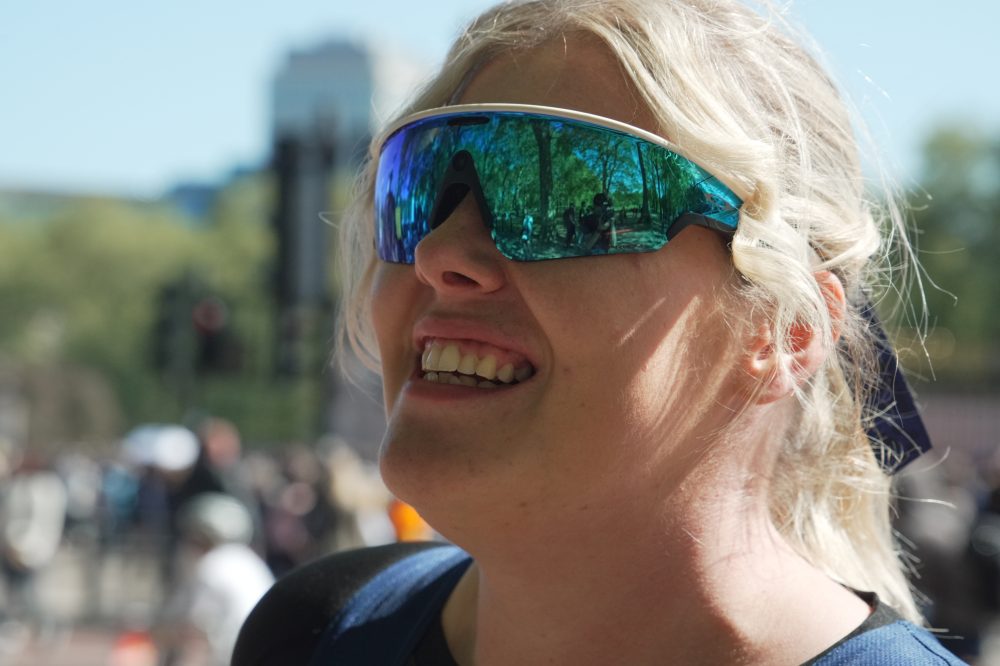

LONDON (AP) — As she trains through the streets near Buckingham Palace, Tilly Dowler is pursuing an achievement that once seemed impossible to reach.
Diagnosed with Stargardt disease and retaining only about 10% of her vision, Dowler just started running last year. She began with a basic couch-to-5K program and gradually increased her distance to marathon length. Now she’s getting ready for the London Marathon alongside her boyfriend as her guide, utilizing artificial intelligence-equipped Oakley Meta Vanguard smart glasses for navigation and performance tracking.
“They are AI assisted,” she said. “While running, I can ask for live cues, such as what landmarks are around me and how far I have run.”
The glasses enable her to blend audio information with direction from her running companion, she explained.
“I can put my music on but still be able to listen to my guide runner,” she said.
Speed isn’t her primary focus.
“My mission was to inspire other people with sight loss and people going through something really tough and inspire them to believe in themselves,” she said.
Dowler joins an increasing number of vision-impaired athletes utilizing AI-enhanced smart glasses. These devices merge typical consumer technology with cameras, microphones and open-ear audio systems. Users can operate them through voice commands, buttons or basic hand movements, while artificial intelligence analyzes the environment and delivers audio information.
Meta, the technology company, produces the most recognized smart glasses through collaborations with Ray-Ban and Oakley. Sales exceeded 7 million pairs of Meta Ray-Bans in the previous year, demonstrating their rising acceptance. However, the devices have raised privacy concerns, including unauthorized recording of individuals and worries about Meta sharing video content with human reviewers for AI development.
For Sha Khan, who lost approximately 90 percent of his sight in 2021 from retinitis pigmentosa and Stargardt disease, this technology has integrated into both everyday activities and athletic training.
“It’s like literally a part of me now,” he said. “If I step out the front door, I wouldn’t do that without my glasses on.”
Khan depends on his guide dog, Moby, for daily navigation outside of running activities.
The hands-free design proves particularly valuable because it lets him concentrate on working with Moby without managing a mobile device, he noted.
Khan started running in 2022 following encouragement from a Guide Dogs UK volunteer, a charity providing guide dogs and mobility assistance for vision-impaired individuals, after his sudden sight loss affected his mental well-being.
During training sessions with guide runners, he operates the glasses through voice controls.
“If they say that’s Big Ben ahead of us I can just say ‘hey Meta take a picture,’” he said.
The hands-free functionality matters significantly to him.
“I don’t need to be worrying about fumbling with a mobile phone,” he said.
Smart glasses employ forward-facing cameras to capture visual data and artificial intelligence to process it, transforming the details into audio through speakers integrated in the frame.
Chris Lewis, a technology expert who experiences visual impairment and has tested smart glasses while skiing, described the system as providing extra situational awareness.
“The AI is taking the images coming in, analyzing it and giving you the information about what’s in front of you, what might be moving and what might be changing,” he said.
This enables users to obtain immediate information while maintaining environmental awareness, which proves crucial for activities like running, he explained.
Lewis noted that marathon events can create additional obstacles, with dense crowds straining cellular networks and potentially reducing signal strength, which may impact the glasses’ ability to provide consistent real-time data.
Guide Dogs UK, which offers various services to promote independent living, recommends using the technology to supplement rather than substitute existing support methods.
“These glasses can really support and enhance somebody’s independence but they’re not there to be relied upon or replace core independent skills,” said Tommy Dean, a technology specialist at the charity.
Guide dogs, mobility instruction and human assistance remain crucial, especially in challenging environments, he emphasized.
Ben Hatton, an analyst at CCS Insight who examines new consumer technologies, identified reliability as a primary obstacle.
“If you’re going to allow visually impaired people to walk down the street or cross busy roads with the technology then it has to be perfectly reliable every single time,” he said.
Factors including precision, connectivity and affordability will influence how broadly this technology becomes available, he added.
Even with these constraints, specialists believe artificial intelligence improvements are allowing mainstream devices to contribute more significantly to accessibility solutions.
“The fact that consumer technology can enhance the experience of someone with a sight problem adds to the potential to be more and more independent,” Lewis said.
Over 59,000 participants are anticipated for Sunday’s London Marathon, according to event organizers, following a 26.2-mile course through the capital city beginning in Greenwich and ending near Buckingham Palace.