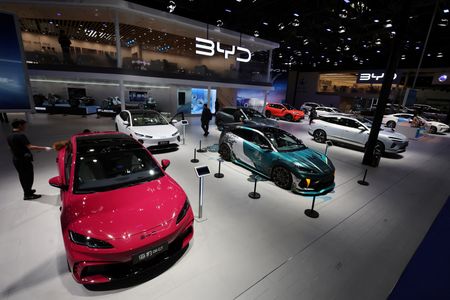

China’s leading electric vehicle manufacturer BYD is betting on ultra-rapid charging technology to win over drivers who remain committed to gasoline-powered vehicles, as the company works to maintain its competitive advantage in the global automotive market.
Despite achieving remarkable growth to become the world’s top EV producer, BYD has experienced declining sales in its home market for seven consecutive months due to aggressive pricing competition and increased pressure from domestic competitors.
The automaker is now introducing additional vehicle models featuring ultra-fast charging capabilities, aiming to convert drivers who have resisted electric vehicles because of worries about limited range and lengthy charging periods, according to executive vice president Stella Li, who spoke with Reuters during the Beijing Auto Show on Friday.
“Flash charging is so important for BYD because this solves the last barrier for EV adoption,” Li stated. “This means we now can compete with the gas market.”
According to BYD, their newest battery technology can power up from 20% to 97% capacity in less than 12 minutes, maintaining this performance even in extreme cold conditions of minus 20 degrees Celsius, while providing a maximum driving distance of 777 kilometers.
Li explained that this technological advancement could establish a strong competitive advantage against rivals. To support this initiative, the company intends to construct approximately 20,000 rapid-charging facilities throughout China and an additional 6,000 internationally within the coming year.
The recent domestic market challenges for BYD highlight the intense competitive environment within China’s automotive industry, where the company previously seemed to hold an unshakeable position.
Vehicle sales jumped dramatically from 420,000 units in 2020 to 4.6 million in 2025, propelling BYD to become the world’s fifth-largest automaker by sales volume.
BYD, which produces both fully electric vehicles and plug-in hybrid models, displaced Volkswagen as China’s leading automaker in 2024, breaking the German manufacturer’s 25-year dominance. The company also surpassed Tesla to claim the title of world’s largest electric vehicle producer last year.
However, since reaching its peak in late May of last year, BYD’s stock price has dropped 25%, and the company recently reported its first annual profit decrease in four years.
Domestic market performance has suffered due to competition from rivals such as Geely and Leapmotor, leading BYD to introduce its first significant battery technology update in six years.
“It’s not that BYD is necessarily doing badly,” commented Gartner analyst Pedro Pacheco. “But they were growing so fast, where they are now seems bad.”
Geely achieved the highest new vehicle sales in China during January and February, temporarily dropping BYD to fourth position. A company insider revealed that Geely plans to establish itself as China’s leading automaker on a long-term basis within 12 to 18 months.
“It’s not that they are misjudging consumers in China,” observed automotive analyst Felipe Munoz. “BYD knows very well what consumers want, but there is just more competition.”
Although domestic sales have decelerated, BYD continues aggressive international expansion. European sales increased 270% in 2025, while first-quarter sales rose 156%.
In March, the company expressed strong confidence to analysts about achieving its 2026 international sales goal of 1.5 million vehicles or higher, following overseas sales of 1 million vehicles in 2025.
BYD has set an ambitious target for half of its new vehicle sales to originate from international markets by 2030.