
A Lebanese man experienced profound shock when he witnessed through social media an Israeli soldier destroying a religious statue that belonged to his family in their private garden located in the southern Lebanese village of Debel.
Houssam Naddaf explained that he discovered the incident online like countless others. “I saw it on the internet like everyone else,” Naddaf stated. Due to movement limitations enforced by Israeli military forces in the region, he was unable to personally visit his property to assess the destruction.
The area fell under Israeli military control during the current Israel-Hezbollah conflict, which commenced on March 2 following Iran-backed Lebanese militants launching missiles across the border two days after the United States and Israel initiated their campaign against Iran. Subsequently, Israel conducted a ground operation in southern Lebanon, maintaining their presence even after last week’s ceasefire declaration.
The footage showing the soldier wielding an axe against the fallen Jesus statue in Debel generated significant international criticism and outrage throughout Lebanon and beyond.
On Tuesday, Israel’s military announced they had provided a replacement sculpture. Naddaf verified that Israeli forces delivered a similar but smaller crucifix, presented their apologies, and completed the installation with local clergy present.
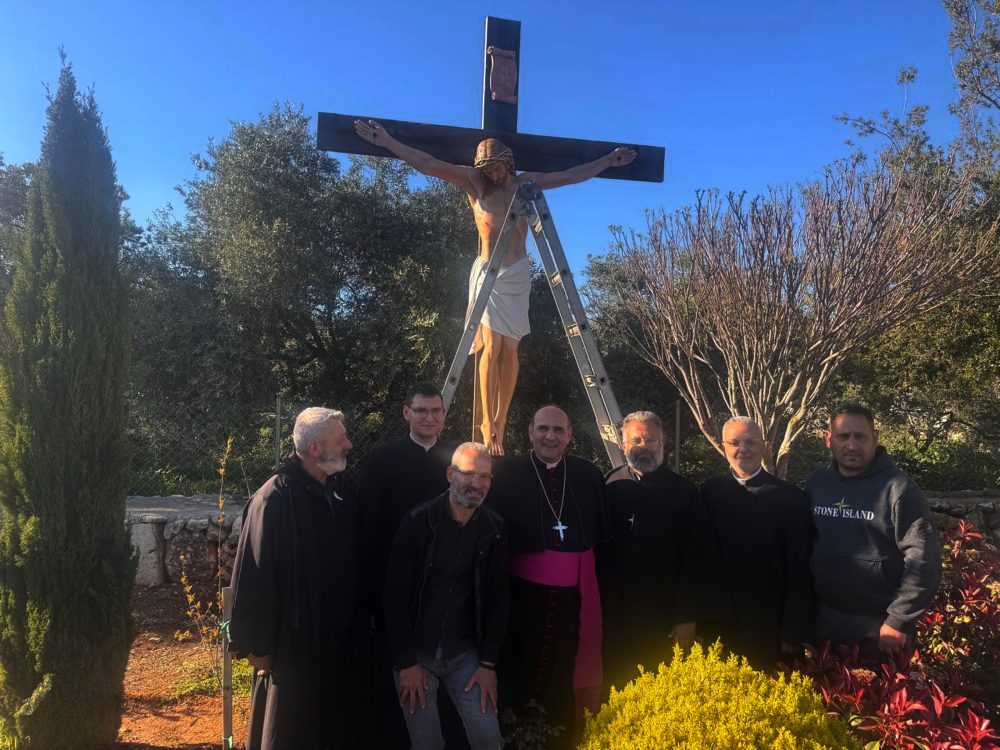
Nevertheless, Naddaf revealed that his family members, who were absent during that ceremony, had already been approached by United Nations peacekeeping forces regarding a crucifix donation from Italy. The family chose to accept Italy’s contribution, which matched the original statue’s dimensions, while donating the Israeli-provided replacement to a neighborhood church.
Wednesday’s installation of the Italian-donated crucifix featured a modest ceremony with local religious leaders, community members, UN peacekeepers, and Naddaf’s family in attendance.
From Italy, Prime Minister Giorgia Meloni transmitted a message describing the replacement statue as “a powerful message of peace, hope, and dialogue.”
The family had originally placed the crucifix in their garden during 2018, within shared property that Naddaf and his three brothers subdivided into four family apartments beginning in 2010.
According to Naddaf, his residence sits at Debel’s perimeter, positioned between the village and neighboring Rmeish—a location residents view as more vulnerable compared to the village center, which remains largely outside the primary conflict zone. When hostilities resumed between Hezbollah and Israel on March 2, Naddaf relocated with his wife and three children to his parents’ residence deeper within Debel.
Following last week’s ceasefire agreement with Hezbollah, Israeli forces have been demolishing neighborhoods throughout towns and villages along the Lebanese-Israeli border.
Military officials claim they exclusively target structures that served as militant outposts for the Iran-supported organization. However, destruction appears nearly comprehensive across many regions. This extensive devastation has heightened concerns among Lebanese authorities and citizens that numerous war-displaced individuals may lack homes to return to should the fragile ceasefire endure.
Even with the ceasefire in effect, Naddaf reported that Israeli forces continue preventing his family from returning to their residence.
Israeli troops maintain control over a border zone extending approximately 10 kilometers (6 miles) into Lebanese territory, characterizing this area as an essential buffer zone protecting their northern communities from Hezbollah rocket attacks. Many Lebanese civilians worry these actions could result in extended displacement.
Unlike the 2024 Israel-Hezbollah conflict when Naddaf’s family sought refuge in Beirut, they decided to stay within their village this time. “It was clear that the plan was expulsion, so we say good thing we didn’t leave this time,” he explained.
During his UN peacekeeper-escorted visit to his home for the crucifix ceremony, he discovered a “total mess,” though expressed gratitude that his house remained intact, unlike several neighboring homes that faced demolition.