
Leading Chinese automobile manufacturers unveiled revolutionary electric vehicle technologies and advanced automotive innovations at Beijing’s biennial auto show, demonstrating their growing dominance in the global automotive market.
The exhibition, which opened to media Friday and continues through May 3, features over 1,450 vehicles including 181 worldwide premieres. Industry experts note that the event highlights China’s position at the forefront of automotive innovation, particularly in electric vehicles and battery technology, surpassing many international brands that previously led the market.
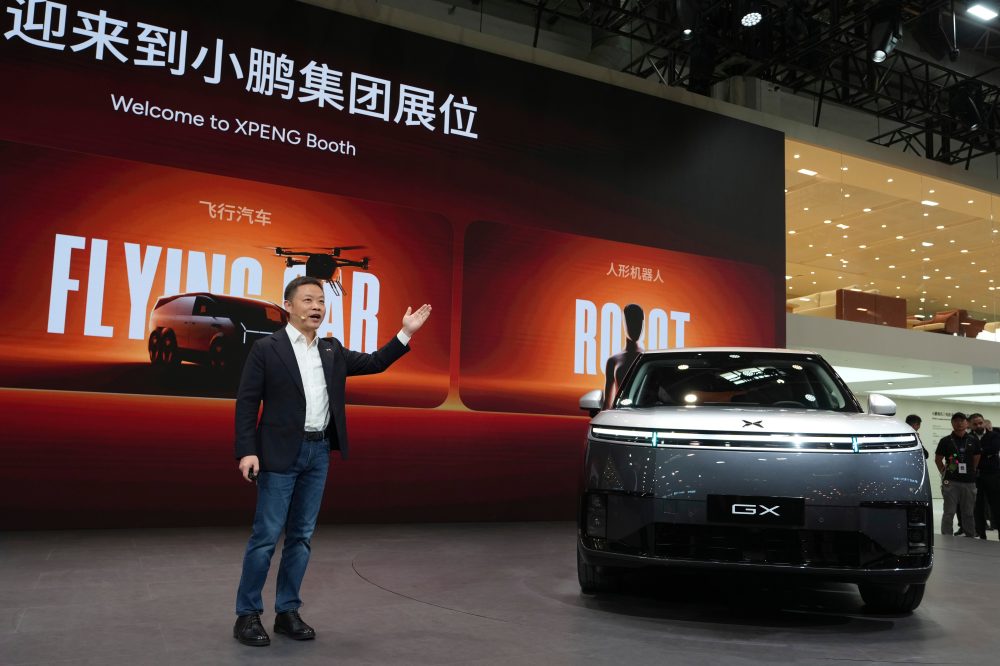
XPeng, a prominent Chinese electric vehicle company, presented its newest GX model – a six-passenger SUV featuring fully reclining third-row seating along with other advanced technologies. Company founder and CEO He Xiaopeng drew large audiences as he explained the vehicle’s sophisticated features.
“When you’re driving on the highway, you fall asleep, or if you feel unwell and can no longer control the vehicle, the system can detect the situation, pull over automatically and alert emergency services,” He said. “Many people who have tried it say it’s amazing.”
Electric vehicle manufacturer BYD presented its newest generation of rapid-charging “blade” battery technology, initially revealed last month, capable of reaching nearly full power in just nine minutes. The company also demonstrated charging capabilities in extreme cold conditions of minus 30 degrees Celsius.
Yijing, a collaborative venture between Chinese manufacturer Dongfeng Motor Corp. and tech company Huawei, displayed their premium X9 six-seat SUV. According to Chairman Wang Junjun, this flagship model incorporates cutting-edge automotive technology, featuring an advanced Qiankun intelligent driving system and Huawei’s latest HarmonyOS cockpit and operating platform.
Prior to the exhibition, Chinese battery manufacturer CATL announced Tuesday a new iteration of its “Shenxing” battery technology, capable of charging from 10% to 98% capacity in approximately six-and-a-half minutes.
Tu Le, managing director of consultancy Sino Auto Insights, described the auto show as demonstrating the “speed and aggressiveness of advancement” among Chinese manufacturers. “It just reinforces that the Chinese — whether in EVs, batteries, intelligent driving — are setting the pace for all these important sectors,” he said.
“China has become one of the fastest-moving markets for deploying and iterating new vehicle technologies, giving consumers early access to some of the most advanced features,” said Chris Liu, a senior analyst at research and advisory group Omdia.
China has emerged as the world’s largest automotive exporter, leveraging massive production scale advantages, substantial government subsidies, and support systems that enabled manufacturers to expand rapidly and introduce new models and technologies faster than international competitors.
However, Chinese automakers face significant challenges from intense pricing competition in recent months. This year, government subsidies encouraging electric and plug-in hybrid vehicle adoption have been reduced, affecting domestic sales.
Passenger vehicle sales in China declined 23% during the January-March period compared to the previous year, totaling approximately 4 million vehicles, according to the China Association of Automobile Manufacturers. Meanwhile, exports surged 63% to nearly 2 million vehicles as Chinese automobiles gained market share in Europe, Southeast Asia, and Latin America.
Omdia projects China’s passenger vehicle exports will increase approximately 14% year-over-year by 2026.
The intensely competitive Chinese market has driven vehicle prices down by one-fifth over the past two years, according to a recent AlixPartners consultancy report.
Liu noted that many new technologies displayed at the auto show may not reach international markets immediately due to regulatory and safety requirements, but they indicate “capabilities that can be refined and adapted for global markets over time.”
Despite foreign automakers losing market position in China recently, some are attempting comebacks. Volkswagen Group announced Tuesday plans to integrate “agentic” artificial intelligence into vehicles for the Chinese market and revealed new electric vehicle models, including the UNYX 09 electric sedan developed in partnership with XPeng.
While foreign automotive brands may attempt to “stabilize” their Chinese market presence, “gaining back a significant market share they had before is, to my perspective, not realistic,” said Andreas Radics, managing director at Berylls by AlixPartners, specializing in automotive industry analysis.
With increasing demand and improved profitability in international markets, Chinese automakers are transitioning from exporting China-manufactured vehicles to establishing overseas production facilities, including operations in Hungary and Turkey, to boost international supply and reduce trade tensions.
Chinese manufacturers are expected to nearly triple overseas production by 2030, reaching 3.4 million vehicles from 1.2 million last year, according to AlixPartners projections.