
OKLAHOMA CITY (AP) — When Isaiah Hartenstein joined the Oklahoma City Thunder as a free agent two years ago, he never anticipated that a required museum tour would profoundly change his perspective.
Thunder General Manager Sam Presti mandates that all new team members visit the Oklahoma City National Memorial and Museum, where 168 lives were lost during the April 19, 1995 bombing of the Alfred P. Murrah Federal Building. The 7-foot center’s experience there led him to create a 14-minute film titled “The Oklahoma Standard.”
This phrase was created by journalists and emergency responders who witnessed how local residents rallied to support victims and rescue operations following the devastating attack. The community’s response to that tragedy established a mindset of collective strength that has helped Oklahoma City weather major tornado disasters in 1999, 2003, and 2013.
“We know when we put on the jersey what we’re playing for,” Hartenstein said. “I have a lot of respect for that.”
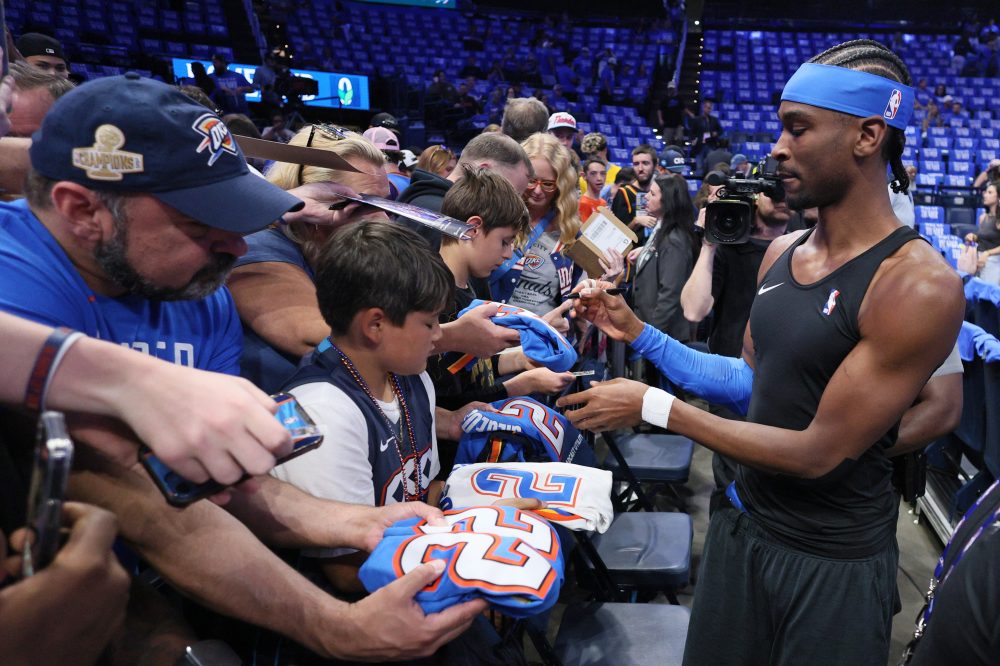
Since the Thunder relocated from Seattle in 2008, Presti has woven this community-first philosophy throughout the organization, from player selection to extensive charitable work. The team has cultivated one of the NBA’s most passionate fan bases, with the arena’s upper sections earning the nickname “Loud City.”
The Thunder’s success has united a sports community typically divided between University of Oklahoma and Oklahoma State loyalties. Following last season’s championship victory over Indiana, thousands of fans packed the streets for a celebration parade.
“They work hard, they play hard,” longtime season ticket holder “Thunder Rob” Shahan said of the players. “As an Oklahoman, we’re not afraid to roll up our sleeves. We’re not afraid to help our neighbor when they need help. And that’s what the team embodies.”
The franchise and city have grown together since former Mayor Mick Cornett and businessman Clay Bennett brought professional basketball to Oklahoma City. The city will host canoe slalom and softball events during the 2028 Summer Olympics, and the Thunder will move into a new arena that same year.
Current Mayor David Holt explained the team’s significance beyond sports: “We’re rightfully proud of the way we responded to the bombing. But you can’t really build an identity on an act of terrorism, right? We were grateful that people helped us and we were thankful that people respected the way we responded, but we really ultimately needed a different word to follow Oklahoma City than bombing. And we found that word, and it’s the Thunder.”
The relationship between team and community extends far beyond basketball games. When the Moore tornado struck in 2013, both Kevin Durant and the Thunder Cares Foundation contributed $1 million each for disaster relief efforts. The Thunder Community Foundation has built or renovated 31 basketball courts across 17 Oklahoma counties.
Hartenstein demonstrated this community connection by premiering his documentary at Classen SAS Middle School’s renovated auditorium, with eighth-grade drama students serving as ushers for the April 11 screening downtown.
These efforts have earned recognition, including Russell Westbrook’s NBA Community Assist Award for the 2014-15 season and Hartenstein’s NBA Cares Award during the 2025 offseason.
Fan loyalty has remained strong through challenging periods, including Durant’s 2016 departure to join Golden State and the team’s rebuilding phase after the 2020-2021 season. While Oklahoma has supported minor league teams in baseball and hockey for years, none have matched the Thunder’s impact.
“The very existence of the team has elevated us into a new tier of American city,” Holt said. “And because the reality is in American life, unless you have a team in the NBA, the NFL or the MLB, you don’t really get treated like a real city by lots of things that have nothing to do with sports. It just opens a lot of doors because it just sort of bestows this credibility on you.”
Local entrepreneur Juan Guerra credits the Thunder with enabling his business success. The 36-year-old Oklahoma City native operates Kicklahoma, a sneaker and clothing convention plus retail store, which he launched in 2014 during Durant’s MVP season.
“Kicklahoma doesn’t exist without the Thunder, in my narrative,” Guerra said. “Or maybe not even the Thunder but even breaking down to, without Kevin Durant having that signature line.”
The city’s basketball enthusiasm began when the New Orleans Hornets temporarily relocated following Hurricane Katrina. Fans embraced Chris Paul, who earned Rookie of the Year honors in 2006, proving Oklahoma City could support NBA basketball.
Durant became the franchise’s first superstar, capturing four scoring championships and leading the team to the 2012 NBA Finals. Other notable players have included James Harden, who won Sixth Man of the Year in 2012, Russell Westbrook, Paul George, and Carmelo Anthony. Current stars include reigning MVP Shai Gilgeous-Alexander, Jalen Williams, and Chet Holmgren.
Fans have equally embraced role players like Kendrick Perkins, Steven Adams, Enes Kanter, Nick Collison, and currently Jaylin Williams and Alex Caruso.
The organization’s commitment to community service intensified after the devastating 2013 tornado that destroyed Briarwood and Plaza Towers elementary schools. Players provided immediate personal and financial assistance before any formal rebuilding efforts began.
“There were Thunder players who came here and met with people and financially helped people,” recalled Leesa Kniffen, a season ticket holder who has taught at Briarwood for 25 years. “It started way before there was any formal rebuilding going on. It started at a personal level.”
When Briarwood reopened in 2014, the Thunder built a basketball court that they resurfaced again last year. The school’s library features a large Lego-style display of a boy wearing a Thunder jersey.
Hezekiah Darbon, who was 6 during the tornado and is now 19, remembers meeting Durant at a camp and Serge Ibaka when the court was constructed in 2014.
“They don’t say ‘Thunder Cares’ for nothing,” Darbon said. “And after going through that, honestly, it kind of feels more like ‘Thunder Loves.’”
The team reached the 2016 Western Conference Finals, holding a 3-1 lead over Golden State before losing the series in seven games. Durant’s subsequent free agency departure to join the Warriors devastated fans.
“I think that’s what hurt so most when he left us July 4th, is we thought he was one of us, and we still do,” Shahan said. “We felt hurt, we felt betrayed. He could have been the king of Oklahoma.”
Westbrook’s decision to remain provided healing, as he won MVP the following season with a memorable campaign of triple-doubles and spectacular plays. His defiant attitude resonated with Oklahomans who felt historically overlooked. Beyond basketball, Westbrook invested in Oklahoma City and Tulsa, serving needy families each Thanksgiving and participating in local comedy and fashion scenes. Though traded in 2019, he maintains ties to the city, including an ownership stake in the minor-league soccer team that will play in a new 10,000-seat downtown stadium opening in 2028.
The Thunder endured difficult seasons, posting 22-50 and 24-58 records in consecutive years. However, those struggles enabled the team to draft Holmgren second overall and Williams 12th in 2022, with both becoming All-Stars. By 2024, Oklahoma City earned the Western Conference’s top seed for two straight years.
Rob Clay, whose distinctive voice has made him a popular national anthem performer since the team’s arrival, sang before Game 1 of last year’s Finals. The 51-year-old Chicago native moved to Oklahoma City in 2001 and compares the current team to the 1990s Bulls dynasty he grew up watching.
“If you are a true fan of basketball, if you are true analyst of basketball, you cannot deny that Oklahoma City — they are next in line and have the opportunity to be the next dynasty,” he said. “And it happened authentically. We drafted our team and we picked up free agents. It wasn’t something that was just put together to be a superteam.”
The team’s organic development mirrors the city’s own rebuilding process. Last year’s championship parade route passed directly by the Oklahoma City National Memorial and Museum, and this year’s playoff opener coincidentally fell on the bombing’s 31st anniversary.
“For us to represent the city and honor the victims and the families today with a home playoff game was a privilege for us,” Thunder coach Mark Daigneault said. “We don’t take that lightly.”