Three home runs and a dominant pitching performance powered the Arizona Diamondbacks to an 8-0 shutout victory over the San Diego Padres on Monday night, with Max Kepler, Geraldo Perdomo, and Nolan Arenado each going deep.
Brandon Pfaadt earned the win, improving to 2-1 on the season after cruising through five innings without allowing a run. He gave up just four hits, walked no one, and struck out six batters. Two relievers combined to complete the shutout, holding San Diego to eight hits total.
Walker Buehler took the loss for the Padres, dropping to 5-5 after surrendering seven hits and seven earned runs across five innings. It was his second consecutive defeat. Since a strong outing against the Los Angeles Dodgers on June 26 — a 7-1 win — Buehler has given up 16 runs in just nine innings, sending his ERA climbing from 3.81 all the way up to 5.07.
The trouble started almost immediately for San Diego. Just four pitches into the game, Ketel Marte lined a leadoff triple to center field and Perdomo was hit by a pitch. With Corbin Carroll at the plate, Perdomo broke for second base. Buehler stepped off the mound and attempted a throw but sailed it over shortstop Sung-Mun Song’s head for an error, allowing Marte to score.
Arizona added another run before the inning ended. After a one-out walk to Gabriel Moreno, Kepler lined a two-out single to left field, pushing the lead to 2-0 before Pfaadt had even thrown a pitch in the game.
The Diamondbacks blew the game open in the third inning with a four-run outburst. Carroll doubled with one out, Moreno singled, and Lourdes Gurriel Jr. drove in a run with a single of his own. Kepler then launched a three-run blast to right field — his first home run of the year — that traveled an estimated 417 feet.
Perdomo added to the lead in the fourth inning with his sixth home run of the season, a shot estimated at 377 feet that landed in right field, making it 7-0. Arenado then led off the sixth with his 10th homer of the year, a 361-foot drive that struck the Western Metal Supply Co. building beyond the left field wall.
San Diego struggled to threaten throughout the night, not getting a runner into scoring position until the seventh inning. Jackson Merrill reached on an infield single and advanced to second on a groundout by Song, but Rodolfo Duran struck out to end the threat.
The loss came just one night after the Padres had snapped an eight-game losing streak with a 5-2 win over the Los Angeles Dodgers.
A Munich-based nuclear fusion startup announced Tuesday that it has secured €411 million — roughly $469.69 million — in a major financing round backed by some of the world’s largest companies, including Alphabet’s Google and German energy giant RWE.
The funding round for Proxima Fusion was led by XTX Ventures and East X Ventures, with Google and RWE participating as strategic investors. The new investment pushes the company’s total valuation to €2.4 billion, or approximately $2.7 billion.
Proxima Fusion’s chief executive, Francesco Sciortino, expressed confidence in Europe’s ability to compete on the global technology stage. “Proxima’s financing demonstrates that Europe can not only invent breakthrough technologies, but also build globally competitive companies around them,” he said in a prepared statement.
German utility RWE contributed €25 million to the round and also signed a separate partnership agreement with Proxima Fusion. Under that deal, the two companies will work together toward constructing the first stellarator fusion power plant on the grounds of a former nuclear fission facility located in Gundremmingen, Bavaria.
Unlike conventional nuclear power plants, which generate energy by splitting atoms — a process known as fission — fusion technology works by combining atoms, mimicking the same reaction that powers the sun. Fusion can be achieved using lasers or powerful magnets. Proponents say the technology holds the promise of producing vast amounts of clean energy without generating pollution, radioactive waste, or greenhouse gas emissions.
India is set to deliver BrahMos supersonic cruise missiles and Astra air-to-air missiles to Indonesia, an Indian government official confirmed on Tuesday, as Indian Prime Minister Narendra Modi kicked off a two-day trip to Jakarta.
Sources within the Indian government previously told Reuters that the agreement, valued at roughly $630 million, was likely to be formally signed during Modi’s visit to the Indonesian capital.
With this deal, Indonesia would become the third nation to enter into a purchase agreement for the missiles, which are produced by BrahMos Aerospace Private Limited.
The transaction represents a significant milestone in the expansion of India’s defense exports and is expected to strengthen strategic relationships with Southeast Asia’s largest economy. It comes amid increasing competition between India and China for regional influence across the Indo-Pacific.
The BrahMos missile was jointly developed by India and Russia and ranks among the fastest cruise missiles in the world. It can be launched from land, sea, and air-based platforms.
The Astra beyond-visual-range air-to-air missiles are designed to be integrated with Russian-built Sukhoi fighter jets currently operated by the Indonesian Air Force.
The Indian government had not responded to prior requests for comment, and the Indonesian embassy in New Delhi also did not immediately reply to media inquiries.
Back in March, Indonesia announced it had reached an agreement with India to acquire the BrahMos missile system, which is jointly owned by the Indian and Russian governments. At that time, Indonesia’s Defence Ministry indicated to Reuters that the deal was in its final stages and could be valued somewhere between $200 million and $350 million.
Global interest in the BrahMos missile has surged following India’s four-day military conflict with Pakistan last year, during which the weapon system was used in live combat for the first time.
India has already finalized BrahMos sales agreements with Vietnam and the Philippines and has received expressions of interest from more than six other countries, including the United Arab Emirates.
During his visit, Modi is scheduled to meet with Indonesian President Prabowo Subianto to discuss topics including maritime security, defense cooperation, regional connectivity, and broader strategic coordination across the Indo-Pacific, according to Indian sources.
Negotiations surrounding the BrahMos deal are expected to center on a phased acquisition approach, which would allow Indonesia to build up its missile capabilities gradually over time, a third Indian source said. The package being considered includes missile systems, supporting infrastructure, operator training, maintenance services, and additional technical assistance needed for long-term use.
Trade between India and Indonesia reached $28.15 billion during the 2024-25 fiscal year, with Indonesia standing as India’s second-largest trading partner within the Association of Southeast Asian Nations.
In the lead-up to his trip, Modi stated that his visits to Indonesia, Australia, and New Zealand would reinforce India’s “Act East” policy, its Mutual and Holistic Advancement for Security Across Regions vision, and its dedication to a free, open, and inclusive Indo-Pacific region.
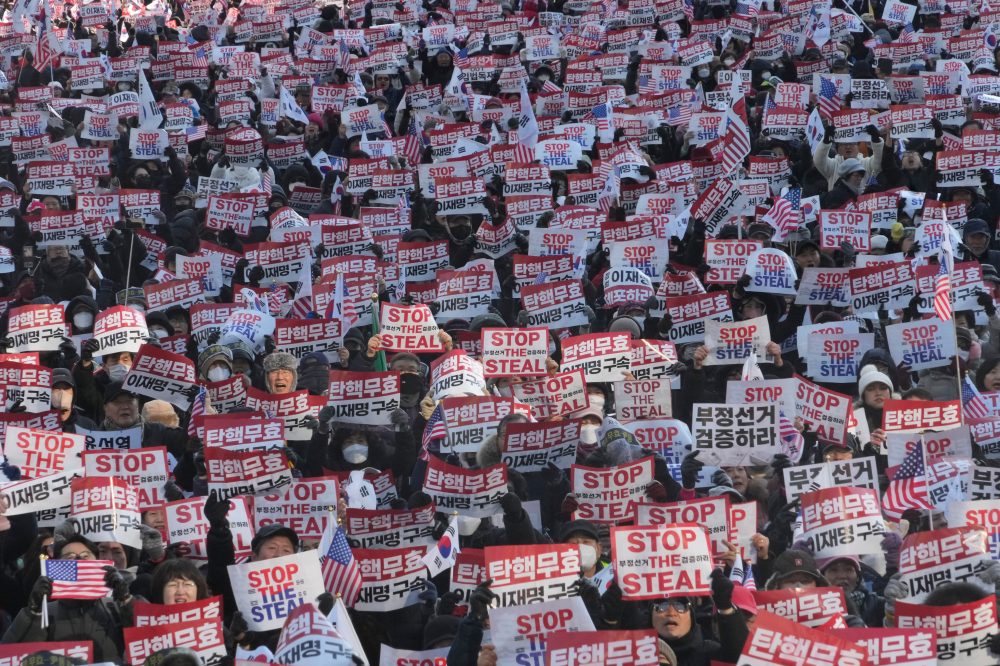
South Korea put a new law into effect Tuesday that opens the door to significant financial penalties against news organizations and social media content creators accused of spreading false information — but press freedom advocates are sounding the alarm over what it could mean for free speech.
Journalist organizations and civil liberties groups have raised serious concerns about the law, saying its language is too vague to clearly define what content is actually prohibited and that it does not provide enough protections for the press. Critics warn the legislation could discourage reporters from covering government officials, politicians, and major corporations.
Under the law, courts can order news outlets and large social media channels — including YouTube creators — to pay up to five times the documented damages if they are found to have spread illegal, false, or manipulated content that caused harm or was used to generate profit.
The law also carries additional penalties: anyone who continues sharing content that a court has determined to be false or manipulated — doing so more than twice — could face fines of up to 1 billion won, equivalent to roughly $656,000, imposed by the country’s media regulatory body. Large social media platforms with more than one million daily users would be required to remove content or suspend accounts when false or fabricated information is reported to them.
The legislation was championed by President Lee Jae Myung’s liberal Democratic Party and approved by the National Assembly in December, despite a boycott from the conservative opposition. Supporters of the law argue it is a necessary tool to fight disinformation, which they say is threatening democracy by deepening division and fueling hate speech.
The Journalists Association of Korea warned that the threat of repeated large-scale legal claims could have what it called an “unavoidable chilling effect” on the press.
“Even if a law’s objective is legitimate, it could erode the foundations of democracy if it’s enforced in a way that discourages the media and ordinary citizens from freely criticizing and scrutinizing those in power,” the organization stated.
The Seoul Foreign Correspondents’ Club also voiced concern about how the law might affect journalism and the free flow of information.
The push for the legislation gained momentum after Lee raised alarms about South Korea’s online information environment following the brief imposition of martial law by then-President Yoon Suk Yeol in 2024. Yoon was subsequently impeached and removed from office, then convicted of rebellion and sentenced to life in prison — a ruling he appealed in February. Yoon, who faces additional criminal charges, had promoted unverified election fraud claims circulated on YouTube to justify his actions and rally his conservative base against the Democrats. Critics say his campaign deepened the country’s political divisions by injecting falsehoods into already contentious disputes.
The Korea Media and Communications Commission has pushed back against fears of government-sponsored censorship, arguing that private platform operators — not government officials — would be responsible for determining whether reported content qualifies as false or manipulated. The commission also noted last week that reporting done in the public interest is exempt from damage claims.
However, a professor at Seoul’s Duksung Women’s University, Kim Hong-yeol, cautioned that the law could lead to widespread self-censorship and cause internet companies to over-moderate content in order to avoid liability — potentially removing legitimate material in the process. Kim made those observations in an article published by the news website Medius.
Major South Korean internet companies like Naver and Kakao have reportedly been updating their systems to comply with guidelines from the Korea Internet Self-Governance Organization, but it remains unclear how large foreign platforms — such as Google’s YouTube — plan to respond. Google did not immediately reply to a request for comment.
Following the law’s passage in December, U.S. Under Secretary of State Sarah B. Rogers criticized it in a post on X, writing that the revised law puts tech cooperation at risk and that “it’s better to give victims civil remedies than give regulators invasive license for viewpoint-based censorship.”
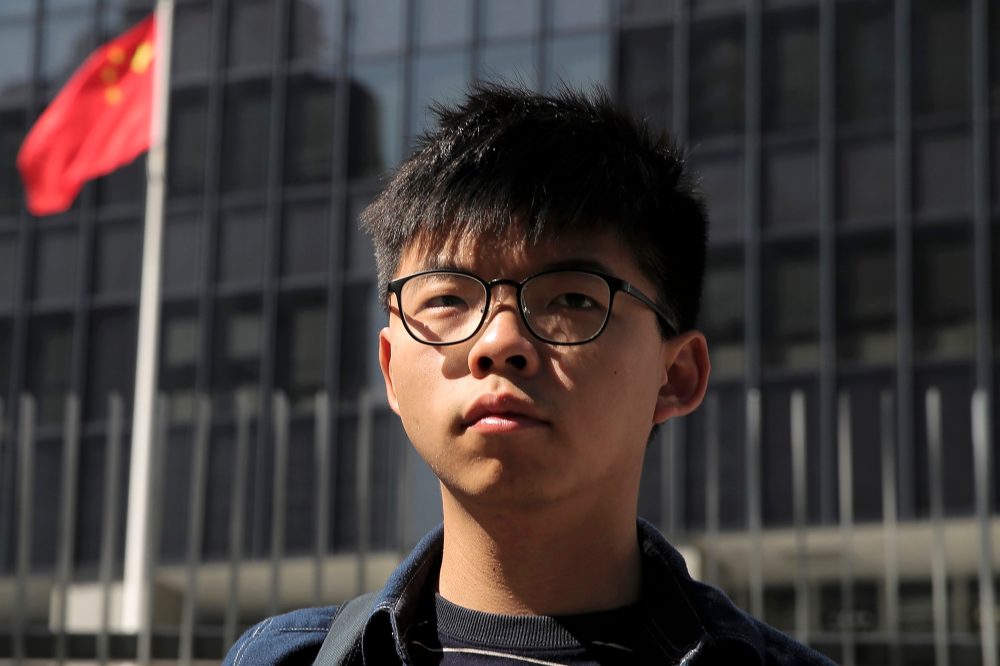
Hong Kong democracy activist Joshua Wong is scheduled to face sentencing this coming September in a case brought under a national security law that Beijing imposed on the city — legislation that critics argue has been used to crush the pro-democracy movement there.
Wong, who first gained recognition as a student leader in Hong Kong’s pro-democracy movement, was taken into custody in June 2025. He faces charges of conspiracy to collude with foreign forces in a way that endangers national security. This marks the second time he has been charged under the security law, which was introduced in Hong Kong in 2020 following sweeping anti-government protests that swept through the city the year prior.
Court records posted on the judiciary’s website Tuesday show a combined plea and sentencing hearing has been set for September 2, with the proceedings expected to wrap up in a single day.
Prosecutors allege that Wong conspired with fellow activist Nathan Law and others to urge foreign governments, institutions, organizations, or individuals outside of China to impose sanctions, blockades, or carry out other hostile actions against Hong Kong or China. The alleged conduct is said to have taken place between July 1 and November 23, 2020.
If convicted, the charge carries a prison term of between three and ten years. However, if authorities determine the offense is “of a grave nature,” the sentence could extend to life imprisonment.
This is not Wong’s first brush with the national security law. In 2024, he pleaded guilty in a separate case tied to an unofficial primary election and received a sentence of four years and eight months behind bars.
Wong first came to public attention in 2012, when, as a high school student, he led protests against a proposed national education curriculum in Hong Kong’s schools. He later became an internationally recognized figure as a leader of the 2014 Occupy Movement.
In 2016, Wong co-founded a political party called Demosisto alongside other young activists, including Law. During the 2019 pro-democracy protests, Wong worked to build support for the movement from overseas. His efforts prompted Beijing to label him a proponent of Hong Kong independence who “begged for interference” from foreign powers.
Demosisto dissolved when Beijing enacted the security law in 2020. Authorities have maintained that the law has restored stability to the city.
Hong Kong authorities have placed bounties of 1 million Hong Kong dollars — roughly $127,600 — on Law, who relocated to Britain, and other activists living abroad, offering the reward to anyone who provides information leading to their arrest.
Just last month, a court in London handed down prison sentences to a former U.K. border official and a retired Hong Kong police officer after they were convicted of spying on dissidents and critics of Beijing living in Britain. Prosecutors said Law was among those targeted.
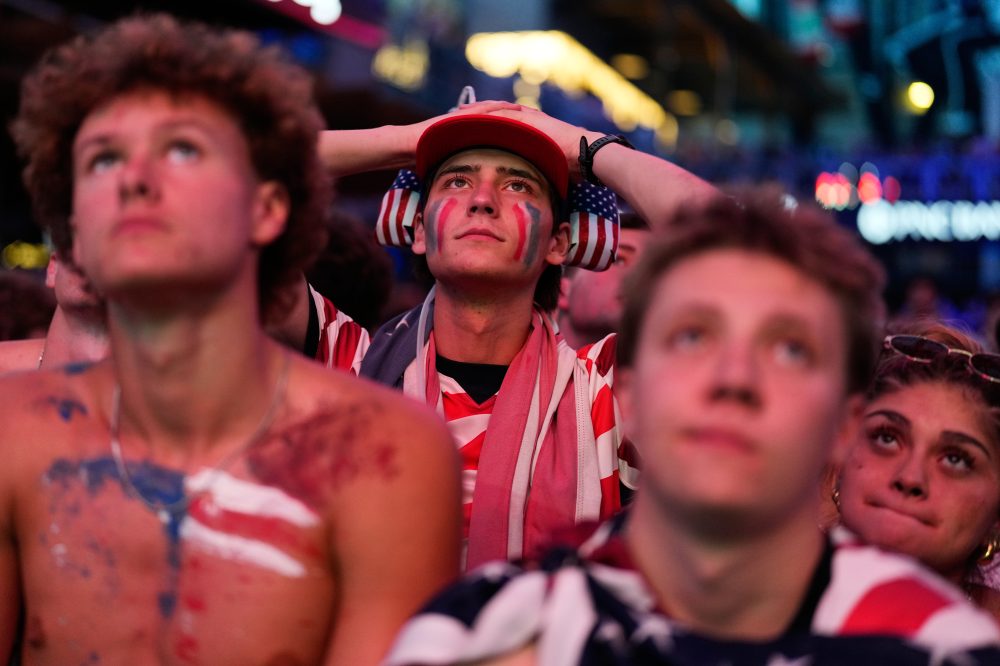
What started as a night full of promise for American soccer fans quickly turned to heartbreak Monday, as Belgium dominated the United States 4-1, sending the U.S. home in the round of 16 and ending their World Cup run.
The lopsided result dashed the hopes of fans across the country who had rallied behind the team heading into the knockout stage matchup.
This report is accompanied by a photo gallery assembled by AP photo editors capturing the emotional highs and lows fans experienced throughout the evening.
India has announced it will deliver the BrahMos cruise missile system along with the Astra air-to-air missile to Indonesia, according to an Indian government official who spoke on Tuesday.
The announcement coincides with a visit by Indian Prime Minister Narendra Modi to the Southeast Asian nation — his first trip there since 2023.
When Mehr Khan, a 26-year-old event planner and transgender woman from India, arrived at her clinic for a standard hormone therapy appointment, she found the treatment had been put on hold. The reason: a recent legal change had narrowed who qualifies for such services.
“The doctor was really just hiding his face. He didn’t know what to say,” Khan recalled, describing what she witnessed at the clinic in the southern city of Hyderabad. She said she could see “fear on the staff’s faces” as well.
Khan is among a growing number of transgender Indians who have been denied care following a March change in the law that eliminated the option to self-identify gender. Under the revised rules, legal gender recognition now requires certification from a panel of medical professionals rather than a letter from a gender-affirming care provider such as a surgeon or psychiatrist.
However, the government has not yet clarified what types of specialists must serve on these panels, nor whether those panels answer to state or national authorities — leaving providers in a state of legal limbo.
India’s government says the change is intended to prevent misuse of welfare benefits and strengthen protections. But medical professionals and activists warn the vague language is creating confusion and cutting patients off from essential medications.
Neither the government nor Tata Trusts, which funds the Sabrang Clinic where Khan was receiving treatment, responded to requests for comment.
Reuters spoke with at least a dozen transgender individuals who said the law change had disrupted their medical care, with clinics pausing services and postponing surgeries. Five physicians said they are proceeding with extra caution, with some now requiring patients to sign declarations confirming they are seeking treatment voluntarily.
“Doctors are very concerned and confused as to what kind of care they are now allowed to give,” said Arundhati Katju, a senior attorney with a Supreme Court practice.
The shift in India comes amid a broader global pattern of restricting transgender healthcare. The United States has recently moved to limit access to gender-affirming care, while countries in Asia such as Thailand offer wider access to treatment but less legal recognition.
In the southern city of Bengaluru, 24-year-old business development manager Ananya Balamurali said a gender-affirming surgery she had scheduled for July at a private clinic in New Delhi has been placed on indefinite hold because of the legal change.
In the port city of Kozhikode in the southern state of Kerala, 30-year-old makeup artist Ichu said a government hospital refused to approve her hormone replacement therapy even after months of consultations. She said doctors had initially been “ready to give the letter” but pulled back after an internal board meeting.
The Association of Transgender Health in India puts the country’s transgender population at approximately 20 million out of a total population of 1.4 billion — far higher than the roughly 500,000 counted in the country’s most recent census from 2011.
Association founder Dr. Sanjay Sharma said the amended law undermines a landmark 2014 Supreme Court ruling that recognized transgender people as a third gender. “This is a public health emergency,” said Sharma, a former air force official and the father of a transgender child.
Sharma warned that the legal provisions could be interpreted as penalizing hormonal and surgical treatments, potentially exposing doctors to criminal prosecution. He also raised concerns that medical board evaluations could become physically and mentally invasive.
The 2026 law recognizes only certain groups as having “legitimate” transgender status: members of traditional communities who are culturally invited to bless weddings and births, intersex individuals, and people described as having been “coerced” into being transgender. It explicitly rules out self-identification and bars gender changes on official documents for those outside this narrow definition.
Gender-affirming hormone replacement therapy, or HRT, uses hormones such as estrogen or testosterone to align a person’s physical characteristics with their gender identity. Surgeries are typically preceded by up to a year of such treatment. Doctors warn that abruptly stopping HRT can disrupt the body’s hormonal system, leading to bone density loss and symptoms resembling menopause.
Activists fear that restricted access to regulated care will drive transgender people toward unqualified providers. “We’re worried that the new law might push the transgender community into a shell,” said Hyderabad-based activist Rachana Mudraboyina, warning that many may turn to unlicensed practitioners to avoid documentation requirements.
In Bengaluru, Debbie Das, who owns a design business, said the uncertainty caused her to postpone starting HRT. She is chronically ill and has lost income after the legal change led to the cancellation of some work projects. “I didn’t want to start HRT and then have to panic about whether I should stop,” she said.
Fred Rogers, a counselor based in the southern city of Chennai, noted that transgender men may be particularly at risk since the law does not clearly include them, and public awareness of transgender issues tends to center on women.
The government maintains the law is designed to combat exploitation and trafficking and to expand access to welfare services. Activists, however, say some provisions may produce the opposite effect.
Ichu, who uses only one name, now travels 50 kilometers — about 31 miles — to reach a clinic outside her hometown, while Khan has been relying on an older prescription after missing a planned dosage adjustment. “People at the clinic said, ‘Give us a week or two, we’ll figure this out,’” Khan said. “It’s been months now and we’re still entirely clueless about where to go, what to do.”
A Paris appeals court began delivering its verdict Tuesday afternoon that will determine the political future of French far-right leader Marine Le Pen — and potentially reshape the country’s next presidential race.
The ruling, which began at 1:30 p.m. and was expected to take several hours to read, centers on whether Le Pen will be permitted to seek the French presidency in 2027. That election will choose a successor to President Emmanuel Macron, who is constitutionally barred from seeking a third consecutive term.
Le Pen, 57, is challenging a March 2025 conviction in which she and fellow members of her National Rally party were found guilty of misappropriating European Parliament funds. The case involves allegations that the party paid its own staff using money that was designated for EU parliamentary assistants — a practice prosecutors say continued from 2004 through 2016.
The original lower court ruling handed Le Pen a suspended prison sentence and a five-year ban on holding elected office. She has consistently denied any wrongdoing and has expressed her intention to make a fourth run at the presidency.
Should the appeals court uphold a lengthy ban, Le Pen’s presidential ambitions would effectively be ended, and her career — which transformed the National Rally into one of France’s most significant political forces — would be placed on hold. Such a ruling could also have wider implications for the European Union, as Le Pen has been a prominent critic of the 27-nation bloc.
If she is disqualified from running, her protege Jordan Bardella, 30, who currently leads the anti-immigration, EU-skeptic National Rally as its president, would be positioned to take her place as the party’s standard-bearer.
However, the court has other options available. It could uphold the guilty finding while reducing the office-holding ban to two years or less — or eliminate the ban entirely. A ban of two years or less would run out before the first round of the French presidential election, currently scheduled for April 2027.
Even so, Le Pen has indicated that simply being legally eligible to run may not be enough. She has said that if the court imposes conditions that interfere with her ability to campaign freely — such as a prison sentence, electronic monitoring, or other judicial restrictions — she may choose not to enter the race.
“If I’m allowed to be a candidate but am effectively prevented from campaigning freely, then you understand that wouldn’t be possible,” Le Pen said in an interview last week.
Prosecutors urged the appeals court to sentence Le Pen to four years in prison — three of which would be suspended — along with a five-year ban on holding public office. They characterized her as the architect of a scheme designed to “siphon off” EU public funds for the benefit of her party.
While prosecutors did not specifically request it, the appeals court has the authority to order any ban to take immediate effect, as the lower court previously did.
Le Pen retains the right to appeal further to France’s highest court, the Court of Cassation, though it remains uncertain whether that court would pause enforcement of the sentence while it reviews the case. The Court of Cassation has previously indicated that, if asked to weigh in, it would aim to issue a decision before the 2027 presidential election.
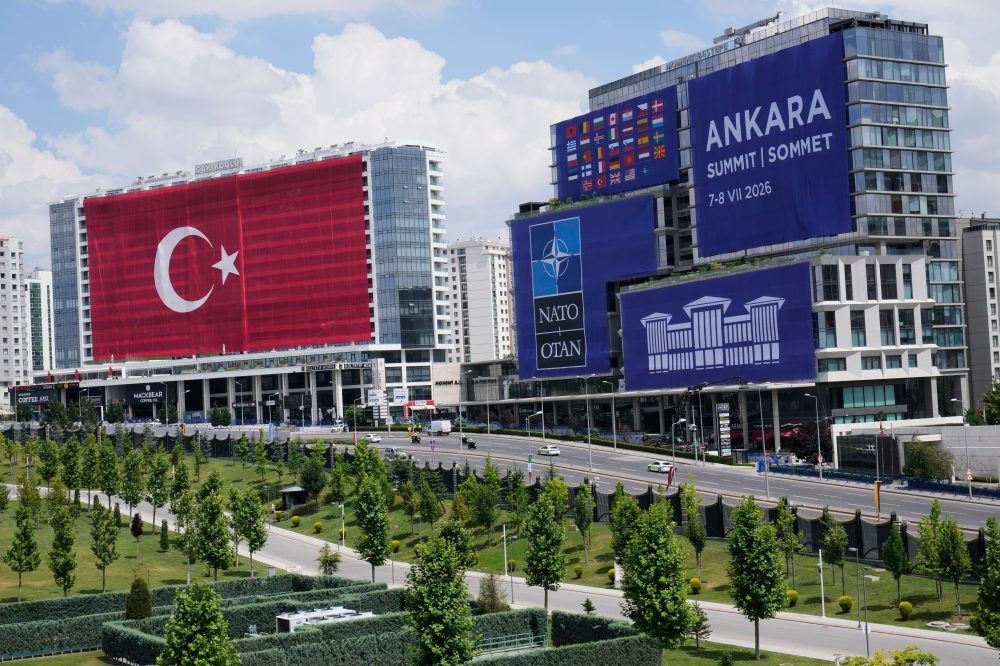
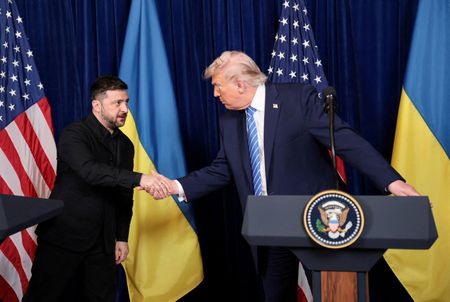
ANKARA, Turkey — NATO is preparing to unveil a series of new military contracts worth tens of billions of dollars Tuesday, in a direct effort to show U.S. President Donald Trump that member nations are not just spending more on defense — they’re turning that money into actual weapons and equipment.
The announcement, being called the “big reveal,” will feature several alliance leaders announcing new agreements with defense manufacturers, many of them based in the United States. Trump has previously dismissed NATO as a “paper tiger” that couldn’t function without American weapons and leadership.
“We will announce tens of billions in new contracts that will provide the crucial kit we need to deter and defend,” NATO Secretary-General Mark Rutte told journalists on the eve of the summit, which is being held over two days in Turkey.
The push to showcase defense investments follows an earlier attempt by Rutte to address U.S. concerns, when he presented a chart he called “The Trump Trillion” — illustrating $1.2 trillion in defense spending by European allies and Canada since 2017. Trump appeared unimpressed, expressing frustration that some NATO allies refused to support the Iran war, which he launched alongside Israel without consulting the alliance.
“We don’t need their money — we don’t need anything,” Trump said. “I just want loyalty.”
Among the expected announcements is a contract to replace NATO’s aging fleet of surveillance aircraft. While NATO does not own weapons — those belong to its 32 member nations — it does operate a fleet of AWAC surveillance planes that are roughly 50 years old, along with some newer surveillance drones.
Several of the new projects will be funded through a European Union loan program designed specifically for defense purposes, which can raise up to $170 billion through capital markets.
“We need to ensure that we are translating our economic might into military capabilities, putting the cash to work from defense plans to drones, from money to missiles and interceptors,” Rutte said.
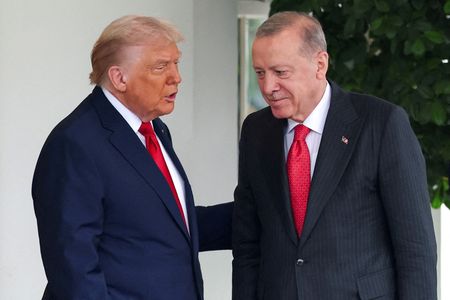
The summit is taking place at President Recep Tayyip Erdogan’s expansive palace complex in Ankara. Trump has suggested he plans to arrive with favorable news for the Turkish leader, hinting that F-35 fighter jet sales to Turkey — halted since 2019 after Turkey bought Russian S-400 missile defense systems — could soon resume.
However, Israeli Prime Minister Benjamin Netanyahu pushed back Monday during an appearance on the morning program “Fox & Friends,” urging the U.S. not to sell F-35s to Turkey. He said Erdogan “calls openly for the annihilation of Israel.” Turkey and Israel have had a deeply strained relationship, with Erdogan regularly accusing Israel of committing genocide in its war in Gaza, which was triggered by the Hamas-led attack on southern Israel on October 7, 2023.
Netanyahu warned that arming Turkey with F-35s would “upset the power balance in the Middle East, which is ultimately guaranteed by Israeli air superiority and also, I think, by America’s posture in the Middle East.” Israel’s air force relies on hundreds of U.S. fighter jets, including F-35s, F-16s, and F-15s.
The broader theme of the summit centers on building a stronger Europe capable of handling more of its own security needs. The Trump administration has signaled that the U.S. intends to shift its focus toward China and the Indo-Pacific, leaving Europe to take on a larger share of its own defense responsibilities. The Pentagon has been promoting what it calls “NATO 3.0” — a restructured alliance in which European nations shoulder more of the burden.
But increasing defense budgets requires either raising taxes or pulling funding from other priorities. The U.K.’s Defense Secretary John Healey unexpectedly stepped down last month, citing the government’s reluctance to boost military spending despite growing threats.
Some nations in northern and central eastern Europe are increasingly worried that Russia may be planning a hybrid attack on the continent — combining traditional military force with tactics such as cyberattacks — as Russian President Vladimir Putin continues to struggle to achieve a decisive victory in Ukraine.
British Prime Minister Keir Starmer is attending what is expected to be his final foreign trip as leader, after announcing his resignation on June 22. His office said he will focus on “building a stronger and more European NATO.” Starmer has faced criticism from military officials, opposition lawmakers, and members of his own center-left party over the pace of defense spending increases. While his government has committed to reaching NATO’s target of spending 3.5% of gross domestic product on defense by 2035, no concrete roadmap exists to get there — current plans would bring spending to 2.7% of GDP by 2029.
CARABALLEDA, Venezuela — Along Venezuela’s Caribbean coastline, the community of Caraballeda was once a place where wealthy and working-class residents lived remarkably close together. Marina-access apartments sat near towering public housing blocks on the same curved road, with both sets of residents enjoying the same stunning views of white sand beaches and clear blue water.
Yacht owners and everyday commuters alike called this stretch of coast home. Many of them were relaxing or celebrating on June 24 when a violent earthquake reduced their homes to rubble within seconds.
Now, approximately 17,000 survivors share an unusual and tragic circumstance — they are homeless in Venezuela. With the official death toll surpassing 3,500, many of those who made it out alive must now depend on a government that has been widely criticized for its handling of the disaster and has a history of using housing as a political tool.
For generations of Venezuelans, owning or securing a home has been a central life goal. During the country’s oil boom in the latter half of the 20th century, the government funded large housing developments, lower-income families built informal concrete and brick homes known locally as “ranchos,” and wealthier citizens purchased multiple properties.
Even as Venezuela’s economy collapsed in 2013, most residents managed to keep a roof over their heads — whether through government-provided housing, buying deeply discounted homes from people fleeing the country, stacking new ranchos on top of old ones, or occupying abandoned properties.
Those who received homes through the ruling party — which has been in power for 27 years and is currently led by acting President Delcy Rodríguez — never received legal ownership documents. Even so, those homes gave families stability and kept them off the streets.
“It was their home, their house. It was an immense joy when they were assigned these houses here,” said Carlos Ortega, whose relatives were given 12 apartments in Caraballeda more than a decade ago after losing nearly everything in a mudslide.
“Imagine, they were given a home after losing everything, but now they’ve lost everything, even their lives,” he added.
Only one of Ortega’s siblings survived when the public housing towers collapsed. His son, who lived on the ninth floor but happened to be working at a nearby convenience store when the earthquakes hit, has been missing for more than a week. Ortega said he was holding out hope of finding him at a hospital, a shelter, or one of the tent encampments that have sprung up in public spaces and private parking areas.
Not far from where Ortega paused from digging through rubble that buried his family, others were surveying the destruction near a yacht club, with some Jet Skis being towed away. Rescuers working through the debris were being handed food on plastic trays as the wife of a military general waited nearby, hoping her husband and children would be found.
Ronal Rodríguez, a researcher at the Venezuela Observatory at Colombia’s Universidad del Rosario, noted that Venezuelan governments — even before Hugo Chávez took office in 1999 — had made efforts to prevent the wealthy and poor from living in entirely separate neighborhoods by placing public housing near more exclusive areas. He said this approach also served a political purpose, helping to diversify the voter base in wealthier districts that typically lean toward the opposition.
However, homes constructed under Chávez’s “Grand Housing Mission” — a program his successor, Nicolás Maduro, continued until the U.S. military removed him from power in January — came with a significant catch: residents never received property deeds.
“What Chavismo tries to do is maintain political dependence,” Rodríguez said of Chávez’s political movement. “That is, if at any point you turn against me and stop supporting me, then I’ll take away the roof I’ve given you.”
That dynamic leaves earthquake survivors especially vulnerable, particularly as many have spoken out publicly about the government’s inadequate search and rescue response. The government of acting President Rodríguez, whose handling of the disaster has drawn sharp criticism from residents, has not provided any timeline for long-term housing recovery.
The full scope of the destruction is still being assessed, but satellite imagery analyzed by Microsoft’s AI for Good Lab indicates that at least 10,000 structures — roughly one-third of all buildings — were damaged in Catia La Mar, a city just west of Caraballeda in La Guaira state. Aging buildings, poor construction standards, and the region’s geography made many neighborhoods especially susceptible to the powerful tremors.
Benito Mantilla, 68, is now living in a tent in a pharmacy parking lot in Catia La Mar after his privately owned home was damaged. His wife traveled to the Dominican Republic last week, but Mantilla chose to stay and search for work about 40 minutes away in Caracas, as the earthquakes also destroyed the auto repair shop he runs with his brother.
Another woman sheltering in the same parking lot said she was still counting on the government to provide her with a new home. She mentioned that her daughter holds a local organizing role within the ruling party.
Caryudedi González, 44, who purchased her own home at age 21, was holding onto hope that her working-class house — half of which slid into a ravine — might somehow be salvageable.
“In many countries, it’s very difficult to own a home, and here, we work so hard to have what’s ours,” González said.
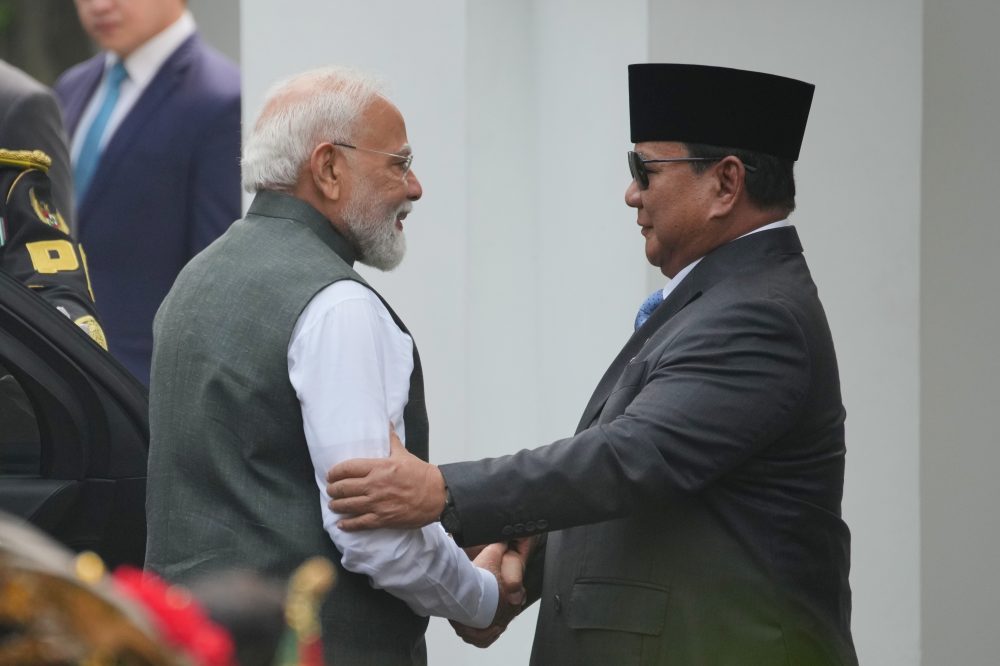
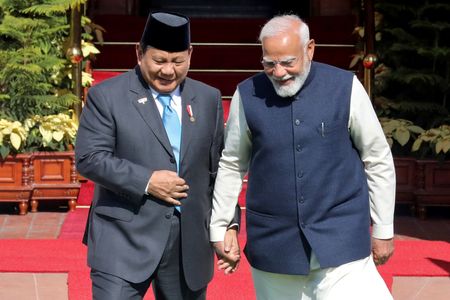
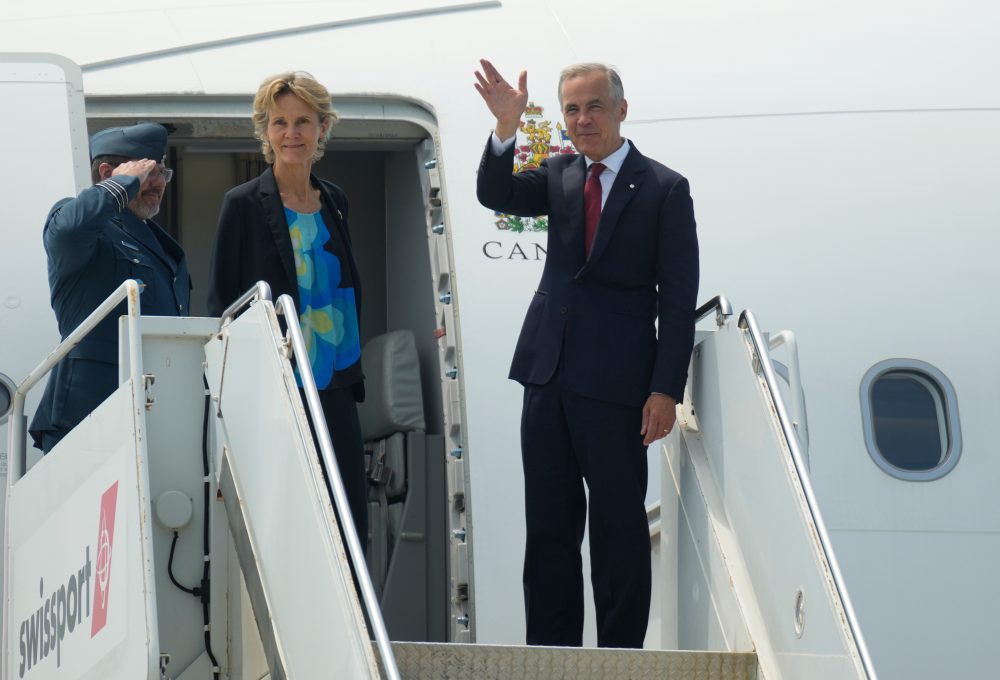
JAKARTA, Indonesia — Indian Prime Minister Narendra Modi sat down with Indonesian President Prabowo Subianto on Tuesday in Jakarta, as the two leaders sought to reinforce strategic partnerships between their nations at a time when global economic cooperation faces growing challenges.
The summit, held following a formal ceremony at Indonesia’s main presidential office, the Merdeka Palace, covered a broad range of topics. These included defense and security cooperation, trade and investment, food and energy security, critical minerals, and capacity-building efforts in health and education. Indonesia’s Foreign Minister Sugiono — who, like many Indonesians, goes by a single name — told reporters ahead of the meeting that eight formal agreements and a number of memorandums of understanding were expected to be unveiled.
This marks Modi’s second visit to Indonesia as prime minister, his first having occurred in 2018. The trip follows President Prabowo’s attendance at India’s Republic Day celebrations as the event’s chief guest last year. Modi landed in Jakarta on Monday afternoon, with his aircraft escorted into Indonesian airspace by three fighter jets. President Prabowo personally greeted him on the tarmac at Halim Perdanakusuma Air Force Base, a gesture that underscored the significance Jakarta places on its relationship with New Delhi.
The Jakarta stop is the first leg of a broader Indo-Pacific tour for Modi, which will also take him to Australia and New Zealand. Both India and Indonesia are members of the Group of 20 major economies and of BRICS.
India’s Ambassador to Indonesia, Sandeep Chakravorty, said Modi was also scheduled to address members of Indonesia’s Parliament on Tuesday and attend an evening gathering with the Indian community living in Indonesia. Chakravorty emphasized that the visit reflects deepening collaboration between two of Asia’s most consequential democracies.
“In the recent geopolitical context, closer ties between two leaders of the Global South are very essential so that we give the message to the world that we are together and we work for each other’s strength,” Chakravorty said.
On the defense front, Chakravorty noted that Indonesia has expressed strong interest in purchasing India’s BrahMos supersonic cruise missile system, with negotiations described as having reached an advanced stage. The two nations are also expected to explore broader maritime security arrangements, given their shared strategic interests along major shipping lanes connecting the Indian and Pacific oceans.
Another anticipated highlight of the visit is the planned launch of the Indonesia Open Network, a digital commerce platform modeled after India’s own digital public infrastructure system.
On Wednesday, Modi is expected to travel to the historic Indonesian city of Yogyakarta, where he may formally announce the beginning of an Indian-supported restoration effort at the Prambanan Hindu temple — one of Indonesia’s most treasured cultural heritage sites. That project stems from an agreement made during Prabowo’s earlier visit to India. Later that same day, Modi is set to fly to Australia for meetings with his Australian counterpart, Anthony Albanese.
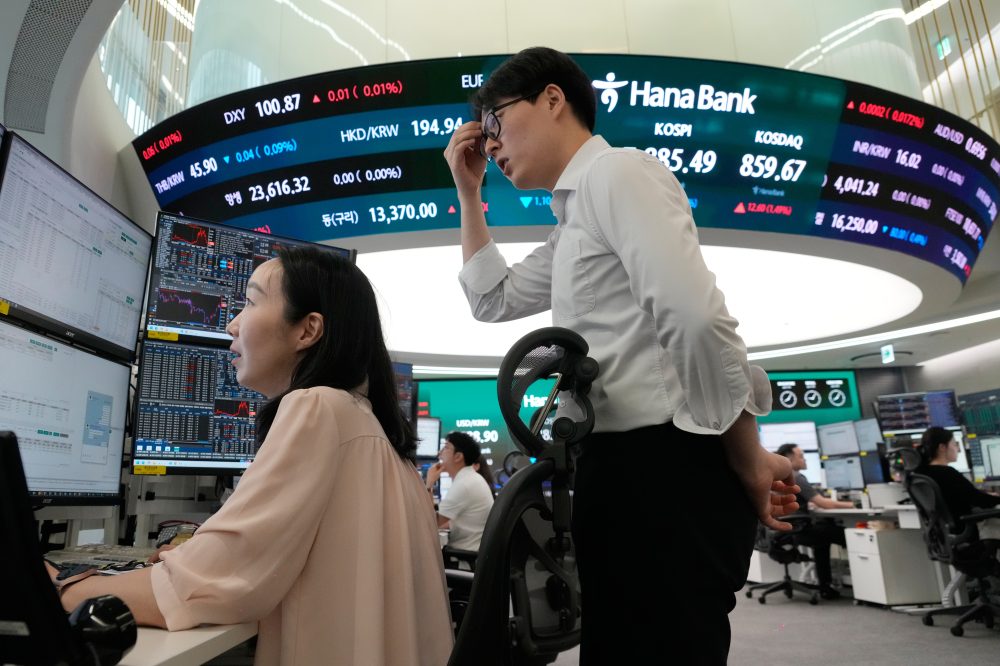
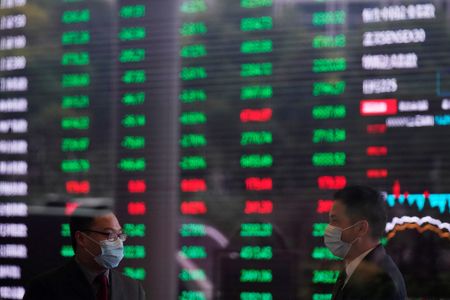
Asian stock markets fell sharply Tuesday even as a surge in artificial intelligence-related stocks pushed Wall Street’s S&P 500 close to a historic record the day before.
South Korea’s Kospi index dropped 7.6%, settling at 7,444.13. Shares in both Samsung Electronics and SK Hynix each fell 8.7% — a steep decline that came despite Samsung reporting its operating income jumped 19 times over to 89.4 trillion won, equivalent to $58.7 billion, in the most recent quarter. The company’s revenue also more than doubled during that period.
Stephen Innes of SPI Asset Management offered a striking take on the situation. “The first proper AI stress test may not have arrived with weak demand, a capex warning, or some sudden crack in the data center story. It may have arrived with Samsung posting an extraordinary quarter and the stock falling anyway,” he wrote in a commentary.
AI stocks have been swinging wildly amid growing concerns that valuations have climbed too high, with investors questioning whether the massive spending on AI chips and data centers can generate enough returns to justify the investment.
SK Hynix is looking to raise $28 billion this week by listing shares on the Nasdaq in the United States, which would rank it among the largest U.S. stock offerings ever — second only to SpaceX’s IPO last month, which raised $75 billion. SK Hynix’s stock in Seoul has more than tripled this year due to the AI boom, even after recent sharp losses.
Other Asian markets also declined. Tokyo’s Nikkei 225 dropped 1.8% to 68,493.52, with computer chipmaker Tokyo Electron losing 3.4% and Kioxia Holdings falling 10.7%. Hong Kong’s Hang Seng slipped 0.4% to 23,517.70, while China’s Shanghai Composite fell 1% to 3,999.03. Taiwan’s Taiex also lost 1.8%. Australia’s S&P/ASX 200 edged down 0.3%, while India’s Sensex managed a slight gain of 0.1%.
Back in the United States on Monday, the S&P 500 gained 0.7% to close at 7,537.54, landing within 1% of its record high even though most individual stocks within the index actually finished lower. The tech-heavy Nasdaq composite climbed 1.1% to 26,121.16, and the Dow Jones Industrial Average rose 0.3% to 53,055.91, setting a new record.
Broadcom was among the biggest drivers of the S&P 500’s gains, rising 3.7% after announcing long-term deals to supply silicon products to Apple. That came after two consecutive losses exceeding 2% the previous Wednesday and Thursday, before the Friday holiday ahead of the Fourth of July.
SpaceX, which is set to join the Nasdaq 100 index of the largest non-financial Nasdaq stocks, gave up an early gain and ended the day down 1%. Its inclusion in the index will require funds that track the Nasdaq 100 to purchase SpaceX shares.
Also in the AI space, TeraWulf jumped 4.9% after announcing that Anthropic agreed to a 20-year deal to use its data center located in Kentucky. TeraWulf expects the arrangement to generate roughly $19 billion in revenue. The company is currently shifting its focus away from bitcoin mining and toward high-performance computing.
In oil markets, Brent crude — the international benchmark — rose 52 cents to $72.51 a barrel, approaching the level it was at before the United States and Israel struck Iran in late February, which had caused prices to spike. U.S. benchmark crude added 43 cents, reaching $68.98 a barrel.
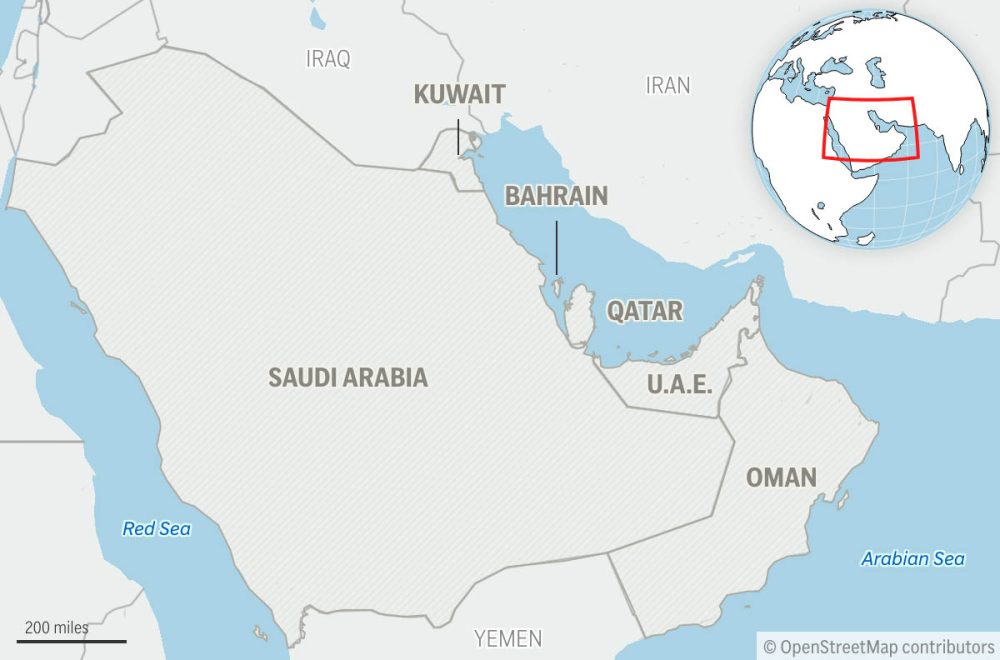
Uncertainty over oil supplies grew after a tanker traveling near the coast of Oman in the Strait of Hormuz caught fire early Tuesday after being struck by a projectile, according to the British military. The attack was the latest against a vessel passing through the narrow entrance to the Persian Gulf, a waterway through which one-fifth of all globally traded oil and natural gas once flowed during peacetime. Iranian state television said the liquefied natural gas tanker was targeted after failing to heed warnings, though it stopped short of claiming direct responsibility for the assault.
In currency markets, the U.S. dollar dipped to 161.73 Japanese yen from 162.09 yen, and the euro edged slightly lower to $1.1439 from $1.1442.
St. Louis Cardinals reliever Justin Bruihl was forced to exit Monday’s home game with no outs in the seventh inning after spraining his right ankle.
Just moments later in that same half-inning, Milwaukee Brewers third baseman David Hamilton was also removed from the game, replaced by a pinch runner after experiencing tightness in his left hamstring following a two-run double.
Bruihl’s injury occurred when he sprinted toward the third base line to field a slow grounder hit by Garrett Mitchell of the Brewers. After throwing to first base on what was ruled an infield single, Bruihl appeared to be limping. Ryan Fernandez came in to take over pitching duties.
Bruihl had entered the game in relief of Dustin May with two outs in the fifth inning, with two potential tying runs on base. He retired Christian Yelich on a groundout to end that threat. Over 1 1/3 innings of work, he surrendered one run on a hit and a walk, bringing his ERA to 3.70 across 39 relief appearances this season.
The 29-year-old left-hander is pitching in his sixth major league season. He has previously suited up for the Los Angeles Dodgers from 2021 to 2023, the Colorado Rockies in 2023, the Pittsburgh Pirates in 2024, and the Toronto Blue Jays in 2025 before joining St. Louis.
Hamilton finished the game 2-for-4, leaving him with a .240 batting average, three home runs, and 15 RBIs through 74 games this season. The 28-year-old spent the previous three seasons with the Boston Red Sox and carries a career batting average of .227, a .293 on-base percentage, a .352 slugging percentage, 17 home runs, and 62 RBIs over 278 major league games.
Three-time NBA Most Valuable Player Nikola Jokic has made it clear he wants to spend his entire career in Denver — he just isn’t in a rush to put pen to paper this offseason.
Speaking to reporters in his home country of Serbia following a FIBA World Cup qualifying match on Monday, Jokic laid out his intentions plainly. “My idea is to sign next summer and stay with Denver for the rest of my career,” he said in Serbian. “My idea and desire is to stay in Denver. I’ll probably sign next year. … My desire is to play the rest of my life in Denver.”
The reason for the wait comes down to money. Per ESPN, Jokic becomes eligible for a five-year contract worth $359.5 million in the summer of 2027 — a deal that would shatter the record for the largest contract in NBA history. That potential payday gives the 31-year-old center good reason to pass on the current max extension available to him, which would be worth four years and $278 million.
Jokic put together another dominant season for the Nuggets in 2025-26, leading the entire league in both rebounding (12.9 per game) and assists — the latter a career-best 10.7 per game — while averaging 27.7 points across 65 games. Despite his brilliance, he finished second in MVP voting to Oklahoma City’s Shai Gilgeous-Alexander for the second consecutive year. Jokic previously won the award in 2021, 2022, and 2024.
While Jokic led Denver to the NBA championship in 2023, this past season ended in disappointment. The Nuggets finished third in the Western Conference but were eliminated in the first round of the playoffs, falling to the Minnesota Timberwolves in six games.
On Monday in Belgrade, Jokic delivered a strong performance for the Serbian national team, recording 20 points, 10 rebounds, and 11 assists in a 94-81 victory over Bosnia and Herzegovina as part of qualifying for the 2027 FIBA World Cup.
South Korea’s Samsung Electronics delivered a jaw-dropping earnings forecast Tuesday, projecting a second-quarter operating profit nearly 19 times higher than the same period a year ago — a figure that also surpasses the company’s total combined earnings over the past three years.
Despite the remarkable numbers, investors were not impressed. Samsung shares tumbled more than 8%, and South Korea’s main benchmark stock index fell 6.7%, as traders grew skeptical about whether the surge in artificial intelligence demand powering those results can continue at the same pace.
The sell-off spread across the region, with MSCI’s broadest measure of Asia-Pacific stocks outside Japan declining 1.7%, taking its cues from the South Korean market’s sharp retreat.
Market strategist Michael McCarthy of Moomoo Australia explained the mixed reaction this way: “Investors still want to be exposed, but they are very nervous about valuations.”
The market swings serve as a warning sign about the instability running through stock markets as the AI investment wave expands beyond just semiconductor and chip-equipment companies into energy firms, copper mining operations, and lithium producers.
Early European market futures showed a mixed picture Tuesday morning. The pan-region Euro Stoxx 50 futures were down 0.34%, German DAX futures slipped 0.3%, while FTSE futures edged 0.15% higher. U.S. S&P 500 e-mini futures were slightly positive, up 0.07%.
On the diplomatic front, U.S. President Donald Trump is traveling to Turkey to attend a NATO leaders summit. Before his arrival, European government leaders were preparing to announce arms deals valued at tens of billions of dollars, signaling their increased commitment to regional defense.
In currency markets, Japan’s yen strengthened slightly against the U.S. dollar, gaining 0.15% to trade at 161.83 per dollar and pulling back from the weaker 162 level, with traders remaining watchful for any official intervention.
Key economic events scheduled to influence markets include the Bank of England’s financial stability report, German industrial output figures for May, British Halifax housing data for June, Canadian leading index and trade balance figures, and U.S. trade data for May.
North Korea’s state-run news agency KCNA published a commentary Tuesday taking aim at Japan’s military growth, asserting that Japanese overseas aggression is “not hypothetical but reality.”
The piece specifically highlighted Japan’s reported plans to develop unmanned submarines capable of conducting anti-ship attacks. According to the commentary, those vessels would be able to carry torpedoes and naval mines and could be positioned near the shores of neighboring countries, enabling pre-emptive strikes against enemy ships during a conflict.
KCNA accused Tokyo of walking away from its long-held policy of defense-only military operations, claiming Japan has transformed its armed forces into what it called a “thoroughly offensive and aggressive force.”
The commentary also pointed to several other Japanese military developments, including efforts to mass produce domestically built long-range missiles, the pursuit of a new ballistic missile with a range of up to 3,000 kilometers (1,864 miles), the deployment of upgraded anti-ship missiles and hypersonic glide weapons, and the acquisition of foreign-made missiles, including U.S. Tomahawks.
Japan’s foreign ministry did not respond to telephone calls requesting comment on the criticism.
The KCNA commentary arrives at a time when North Korea has been drawing attention to its own naval expansion. On Sunday, the agency reported that leader Kim Jong Un watched the launch of a strategic cruise missile and observed weapons tests conducted aboard the new 5,000-ton destroyer Kang Kon.
Kim has called for bolstering the country’s naval combat strength and directed the ship to be put into active service within two months.
North Korea recently brought the 5,000-ton destroyer Choe Hyon into commission and has announced intentions to construct additional warships, including larger vessels weighing in at 10,000 tons.
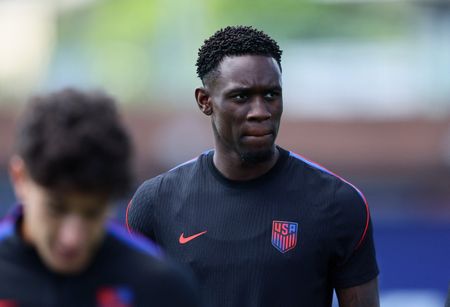
SEATTLE — Belgium’s coach Rudi Garcia says the heated controversy over FIFA’s decision to allow U.S. forward Folarin Balogun to play in Monday’s World Cup round-of-16 match had virtually no effect on his team, which went on to defeat the United States 4-1.
The dispute centered on Balogun’s red card during the round-of-32 match against Bosnia, which would normally have triggered an automatic one-game suspension. Instead, FIFA chose to suspend that ban for a one-year probationary period, clearing Balogun to take the field against Belgium — a move that drew fierce backlash from the Belgian soccer federation and sparked a broader international outcry. U.S. President Donald Trump also weighed in, stating he had requested that the decision be reviewed.
When asked at the post-match press conference whether he used the off-field drama to fire up his players, Garcia was direct: “No, it wasn’t at all necessary.”
“What really mattered to us was our game plan. We wanted to dominate the game, avoid their pressing and play higher up. We played with mastery, with willingness and dedication. It was a great night for us and a great qualification for the quarter-finals,” Garcia said.
Garcia noted that his players had been kept informed about the Balogun situation throughout the week, but said the group handled it with maturity.
“We told them about what was happening. The group is very mature. We have leaders to help us go through that,” he said.
“I told them that what mattered the most was us. Our team trying to set the game principles, whether it’s attack or defence. We were also underlining the strength and weaknesses of the opponent, but we’re not analysing anything more. We’re not adapting to the opponent. That’s not my style as a coach,” Garcia added.
Garcia, who had previously taken aim at FIFA’s ruling — likening it to an April Fool’s Day joke — said Balogun approached him after the final whistle, a gesture he said he appreciated.
“He came to talk to me. I really liked that. It’s not his fault. He’s not the one to blame. And that’s what I told him. I really appreciate that he came to see me,” Garcia said.
As for the American side’s performance, Garcia suggested the lopsided scoreline may have been partly rooted in psychological baggage from an earlier encounter. Belgium beat the United States 5-2 in a March friendly held in Atlanta.
“At some points of the game you got the feeling that was in their heads,” Garcia observed.
Belgium will next face Spain in Los Angeles on Friday in the quarterfinals. However, the team received a significant blow when midfielder Amadou Onana was forced off the pitch in the first half with a knee injury. Onana was later seen on crutches, and Garcia indicated the injury appeared serious enough to potentially end his tournament.
“We feel bad for him, but now that we are in the quarter-finals, we want to go to the semis,” Garcia said.
A crash has resulted in the closure of the southbound exit ramp connecting Interstate 495 to Interstate 95 southbound at Exit 5A-B, according to traffic officials.
Motorists traveling in the area are advised to use alternate routes until the ramp is reopened. The closure is in effect while crews respond to the scene.
No further details regarding the crash or an estimated time for reopening have been provided. Drivers should allow extra travel time and stay alert for changed traffic patterns in the area.
LONDON — Tuesday marks a turning point in Prince Harry’s years-long legal battle with the British press, as a judge in London’s High Court prepares to deliver a ruling in his privacy invasion lawsuit against the publisher of the Daily Mail.
The decision wraps up a series of three lawsuits in which Harry accused news outlets of unlawfully prying into his personal life. Harry and six co-claimants are seeking significant financial damages in the high-profile case, which involved an 11-week trial estimated to have cost roughly 40 million pounds — approximately $53.5 million.
Among those suing Associated Newspapers Ltd. alongside Harry are singer Elton John, actors Elizabeth Hurley and Sadie Frost, anti-racism activist Doreen Lawrence, former politician Simon Hughes, and John’s husband, David Furnish. The group alleged the company tapped their phones, intercepted voicemails, and used deceptive methods to collect private information.
The newspapers rejected those claims as “preposterous,” arguing that the approximately 50 articles in question were produced through legitimate reporting, with information coming from friends, royal aides, and publicists who voluntarily spoke to journalists.
The ruling arrives while Harry is visiting the United Kingdom, though attention has also turned to whether he will bring his wife, Meghan, Duchess of Sussex, and their children, Prince Archie and Princess Lilibet, to see his father, King Charles III, who is undergoing treatment for an undisclosed form of cancer.
Harry’s drive to challenge the press goes far beyond stories about his younger years or his romantic life. His testimony in February offered an emotional window into the deeper impact of press intrusion on his wellbeing.
He has long blamed the media for the 1997 death of his mother, Princess Diana, who was killed in a Paris car crash while being chased by paparazzi. He has also said relentless press attacks on his wife contributed to the couple’s decision to step back from royal duties and relocate to the United States in 2020.
“They continue to come after me, they have made my wife’s life an absolute misery,” Harry said, visibly emotional while testifying in court.
The phone hacking scandal, which began in the 1990s and stretched on for more than a decade, gave Harry an opening to pursue legal action — something unusual for a senior royal. Three years ago, he became the first high-ranking member of the royal family to appear in court in more than a century.
His legal efforts have already yielded results. In 2023, he won a ruling against the publishers of the Daily Mirror, which was found guilty of “widespread and habitual” phone hacking. More recently, Rupert Murdoch’s flagship U.K. tabloid, The Sun, issued an unprecedented public apology and agreed to pay substantial damages to settle a separate privacy lawsuit brought by Harry.
Harry’s attorney, David Sherborne, argued that the Daily Mail and its companion publication, the Mail on Sunday, deployed journalists, freelancers, and private investigators in a “clear, systematic and sustained use of unlawful information gathering” to spy on his clients. Sherborne pointed to payments made to private detectives and connected them to specific articles, including reporting on Harry’s then-girlfriend, Chelsy Davy, and her travel plans.
When he testified at the start of the trial in January, Harry said the press intrusions left him “paranoid beyond belief,” damaged his relationships, and seriously harmed his mental health.
Hurley testified that the Mail went as far as placing microphones outside her windows and obtaining her medical records, among what she described as “other monstrous, staggering things.”
“It is like there is someone peeping into your life and into your home,” she said in court. “My private life had been violated by violent intruders — that there had been sinister thieves in my home all along and that I had been living with them completely unaware.”
Defense attorney Antony White pushed back, saying the case was built on speculation and that the far more probable explanation was “ordinary, legitimate journalism.” He argued that Harry was “inclined to see unlawful evidence gathering, in particular voicemail interception, everywhere,” without sufficient proof to support those claims.
Unlike the Mirror case, the Mail trial featured journalists who were willing to defend their reporting in court. Some reporters identified official sources such as palace spokespersons, while others named their contacts directly to counter Harry’s claim that his inner circle did not leak information.
“They were not all tight-lipped,” said Katie Nicholl, a former Mail on Sunday editor. “I had very good sources in the inner circle.”
A significant legal question in the case was whether the claimants should have been permitted to bring allegations stretching back to the 1990s, well past a six-year statute of limitations. They argued the deadline did not apply because they only became aware of the hacking after private investigator Gavin Burrows came forward in 2021, saying he wanted to “do the right thing” and assist those he had targeted.
However, Burrows — who once apologized to Harry in a BBC documentary for aggressively targeting him for tabloids during his teenage years — testified at trial that he never worked for the Mail. He further claimed that a statement attributed to him had been fabricated by the claimants’ legal team and that his signature on the document had been forged.
Justice Matthew Nicklin pressed Sherborne multiple times on what would become of the case if the court rejected Burrows’ original statement. Sherborne maintained that other evidence still implicated the newspapers, while White argued that Burrows’ courtroom testimony effectively dismantled the entire case.
Burrows denied that he changed his account out of spite following a falling out with Harry’s legal team.
The ruling will be delivered remotely, without a courtroom hearing, while Harry is in London for charity engagements. Meanwhile, a potential family visit between Harry and King Charles remains uncertain, with disputes over security arrangements and accommodations still unresolved. A government committee declined to approve taxpayer-funded protection for Harry — an issue that has been the subject of repeated legal battles that Harry has consistently lost.
NASHVILLE, Tenn. (AP) — Viewers of the TV show “9-1-1: Nashville” might get the impression that the city is constantly ravaged by tornadoes turning concerts into disaster zones and sending tourists flying through the air. While that’s television drama, dangerous storms do strike Nashville on a regular basis — and when they do, many residents reach for their phones and turn to Nashville Severe Weather.
This volunteer-run operation has carved out a dedicated following on social media by doing something that seems almost out of place in today’s online world: staying calm. Volunteers Will Minkoff, Andrew Leeper, and Tom Johnstone livestream storm coverage that attracts tens of thousands of viewers who follow along in real time, asking questions and sharing what they’re seeing on the ground. It’s the kind of community-driven service that harkens back to the internet’s earliest ideals, long before the era of the influencer.
This is all unfolding at a moment when fewer people are sitting down to watch traditional local news broadcasts. Yet a professor of strategic communication at Belmont University in Nashville says an informal poll of his own students revealed many of them are regularly tuning in to Nashville Severe Weather.
“The millennials and Gen Z — and teaching college students, I know this all too well — their source of information is that handheld device,” he says. “It’s not turning on a TV. And it’s not even looking at a traditional media outlet’s online presence. It’s finding sources that provide them quick information when they need it.”
The growth of Nashville Severe Weather touches on several intersecting trends: a tornado alley that is moving eastward, a shifting climate, the dominance of social media, and the power of immediate, neighborhood-level information to protect lives.
The operation has grown over more than ten years, starting out as a Twitter feed and blog before expanding into regular YouTube livestreams whenever severe weather threatens Nashville or nearby counties. Because Leeper, Minkoff, and Johnstone all live in the area, they face the same dangers as the people watching them.
“There’s something about Nash Severe Weather that’s different from the hobbyist enthusiast,” the Belmont University professor says. “I think that’s why people are following them. That’s why they are trusting them. That’s why they’re tuning in and turning to them. … It is authentic and real.”
Leeper, who serves as a church pastor, speaks with a reassuring voice and keeps a sign on a shelf behind him that reads “prepared not scared.” During one storm, he had to step away from the livestream to wake his family and move them to safety — and he did it without a hint of panic, living out his own motto before returning to the stream once the danger had passed.
Katherine Moffat, who works as the executive director of the Tennessee Academy of Physician Assistants, says local TV weather coverage can sometimes feel “a little over-the-top” when storms approach. Nashville Severe Weather, she says, takes a different approach.
“They’re a little more calm and telling it to you straight,” she says. “They don’t get people overly excited.”
The demand for this kind of coverage is growing. Johnstone, a meteorologist who spent 33 years with the National Weather Service before joining the group last year, says the region traditionally known as Tornado Alley has been drifting away from the Midwest plains and toward states further east.
“The mid-South, especially down through Alabama, Mississippi, and into Tennessee and western Kentucky, has been where tornadoes have been most frequent … and people have been dying in the highest numbers,” he says.
Michelle Stewart gets all of her weather updates through push notifications from Nashville Severe Weather on her phone. She found the service especially valuable during an ice storm that knocked out power and internet access across much of the city for several days.
“They are very informative about, not just what to expect, but how to be prepared, and just giving everybody the lay of the land without it being too science-y. You know, it kind of feels like you’re talking to your neighbor,” says Stewart, a project manager at a healthcare research company. “They are so calming to me during those live events.”
Brett Withers, a former Nashville city councilman who witnessed two deaths in his district during a 2020 tornado that claimed 24 lives across Tennessee, calls Nashville Severe Weather a “godsend.”
“We have so many people moving to Nashville, and they might move from places where tornadoes are rare, if they ever happen,” he says.
The group’s popularity flies in the face of conventional social media wisdom. Their livestreams are not polished productions. There’s no manufactured drama, no storm chasing, no reporters standing outside in dangerous winds. The visual centerpiece is weather radar, with Minkoff, Leeper, and Johnstone — sometimes joined by other volunteers — each appearing from their own homes in small boxes along the edges of the screen. When they use graphics at all, they look like something a young child might have sketched out.
One beloved example is the “Dry Air Monster” — a stick figure with an oversized head and chomping jaws reminiscent of Godzilla. Nashville Severe Weather co-founder David Drobny created the character to illustrate how dry air could “eat” snow that was heading toward the city. In a Southern city where snow on the ground is a rare treat that often feels like a brief holiday, the monster’s catchphrase — “No Snow for You” — has become something of a local institution.
Their neighborhood-level focus allows them to do something even local TV stations struggle with: zeroing in on specific streets, schools, and churches to tell people exactly where a threat is headed.
“One of the things that Nash Severe can do that even the TV stations have trouble doing is really bring it down to intersection level, school level, church level to let people know where the danger and the threat is,” Johnstone says.
Their coverage runs both ways. Audience members contribute photos and video from the field and share observations in the chat. Nashville Severe Weather passes that information along to the National Weather Service and local TV meteorologists, while also fielding questions from viewers during streams.
Leeper recalls one particular day when schools dismissed early due to a tornado threat. When a child commented in the chat that they were home alone, he immediately shifted gears.
“We just stopped what we were saying on the stream, and I said, ‘Hey. It dawns on me that we’ve got a bunch of kiddos at home that are maybe by themselves. Hey. Here’s what you do,’” Leeper recalls. “I love those moments where we can just sort of put everything else aside to talk to the people who are listening, in whatever situation they’re in.”
Those moments keep the work grounded in something deeper than storm tracking. In 2023, a tornado took the lives of a mother and her young child living in a trailer in the area. Leeper didn’t know the family, but he attended the visitation.
“It just creates a whole other emotion when you walk into a funeral visitation for hurting families when it’s a weather event that you covered,” he says. “It’s not all action and adventure. It really affects people’s lives forever.”
Two passengers can board the same flight headed to the same city and have experiences that feel worlds apart — and that gap is growing by design.
Picture one traveler gliding through a priority security line, settling into an exclusive lounge with handcrafted cocktails and chef-prepared food, then stepping onto the plane early to be greeted with champagne and a warm towel before sinking into a roomy seat up front.
Now picture another traveler waiting in line at every turn — security, a terminal café charging $16 for a sandwich, a packed gate — then boarding among the last group, hoping to squeeze a carry-on into an overhead bin before wedging into a middle seat. Sleep comes in broken stretches, and a travel pillow barely helps.
None of this is by chance. Since the COVID-19 pandemic, the country’s major airlines have made a deliberate push to attract high-spending travelers willing to pay for comfort and exclusivity. Budget flyers are increasingly noticing the widening divide between the front and back of the plane as carriers build their business models around first-class, business-class, and premium-economy seating.
“We can’t win by trying to provide the cheapest. We have to be able to win by providing the best,” Delta Air Lines CEO Ed Bastian said during a recent Fortune podcast interview.
Delta, along with rivals American Airlines and United Airlines, has embraced this approach — a significant shift for an industry that spent decades making flying more affordable and accessible. The nation’s largest carriers are now reconfiguring planes to add more premium seats, designing new aircraft with bigger luxury cabins, and spending billions on amenities that extend the high-end experience beyond the flight itself.
United’s CEO Scott Kirby, however, has pushed back against the notion that airlines are only chasing big spenders. He argued that United’s premium investments are part of a wider effort to improve the experience for all passengers, pointing to things like seatback entertainment screens and upgrades to the airline’s app.
“We’re investing nose to tail for all customers,” Kirby said last month on financial firm Morgan Stanley’s Exceptional Leaders podcast.
This shift didn’t happen overnight. Airlines used to fill empty first-class seats largely by giving free upgrades to their most loyal frequent flyers. Delta changed the game in the early 2010s by using advanced pricing tools to offer those seats to coach passengers willing to pay a bit more, according to Henry Harteveldt, president of travel advisory firm Atmosphere Research Group.
That move revealed demand airlines hadn’t fully tapped into, encouraging more travelers to upgrade and setting the stage for today’s broader premium push.
“Travelers could and would pay for noticeably more comfort, noticeably better service, noticeably more amenities, if the price was right,” Harteveldt said.
Then the pandemic hit. When corporate travel dried up and video calls replaced business trips, industry analysts wondered if airlines would have to lure passengers back with deeply discounted fares. Instead, leisure travelers proved eager to spend on premium seats and perks — convincing airlines that the appetite for luxury extended well beyond the traditional business traveler, Harteveldt said.
That confidence has only strengthened over time. Premium revenue has become a regular talking point on quarterly earnings calls, with airline executives frequently highlighting it as they compete for higher-spending customers.
“When you think about what’s different and what’s changed over the last 10 or 15 years, the premium products used to be loss leaders, and now they’re the highest-margin products,” former Delta President Glen Hauenstein said last summer. “That’s really the headline.”
Analysts note that premium cabins — a category that grew with the addition of premium economy seats offering extra legroom and perks at a lower price point — now generate a disproportionately large share of airline revenue relative to the physical space they occupy on a plane.
On busy transatlantic routes, business-class tickets can bring in nearly as much revenue as all the fares and fees collected from the far larger economy cabin, according to an analysis by consulting firm McKinsey & Company.
The luxury makeover of air travel is hard to miss, even for those who only catch a glimpse through a lounge door or while walking down the aisle.
Delta’s new first-class lounges look more like upscale restaurants, complete with open kitchens, cocktail bars, soundproof relaxation pods, and outdoor decks overlooking the runway. American has updated its premium cabin menus with “globally inspired dishes” — including crispy maitake mushroom and fried chicken bao topped with yuzu aioli — developed in partnership with the James Beard Foundation. The airline also redesigned its newest Boeing 787-9 Dreamliners for long international flights, featuring private business-class compartments with sliding doors, lie-flat seats longer than a standard twin mattress, and amenity kits that may include a celebrity facialist’s line of sheet masks and under-eye patches.
United’s newest business-class suites come with oversized 27-inch entertainment screens, caviar service, luxury skincare products, and multi-course meals on long-haul international flights. The airline said its revamped menus “feature flavors and dishes” inspired by cities throughout its network.
“Marie Antoinette would feel very comfortable on any of the big three airlines these days,” said William J. McGee, senior fellow for aviation at the American Economic Liberties Project. “But instead of saying, ‘Let them eat cake’ in the back of the plane, she would say, ‘Let them eat Biscoffs.’”
The airlines show no signs of slowing their pursuit of premium passengers. On Delta’s next-generation Airbus A350-1000 aircraft, set to arrive in 2027, nearly half the cabin will be devoted to premium seating. American has announced plans to expand its premium cabins by 50% before the end of the decade.
Yet this new era of in-flight luxury is playing out against a very different reality for many travelers, as inflation has squeezed household budgets across the country.
New York-based travel advisor Mary Auteri said more of her clients are “experiencing sticker shock” as fares and added fees have climbed since the Iran war began and pushed up the price of jet fuel — one of the biggest operating costs for airlines.
A group of friends in their 20s recently asked Auteri to find flights to the beaches of Punta Cana, a resort destination in the Dominican Republic. After she sent them an itinerary, they said they had spotted what appeared to be the same flights on Google Flights for more than $100 less.
But those cheaper fares were basic economy tickets that didn’t include seat assignments, checked bags, or the flexibility to change plans. Once those costs were factored in, the trip no longer fit their budget.
Add-on costs like checked-bag fees and seat-selection charges hit economy travelers the hardest, McGee said. For wealthier passengers, those fees are little more than a minor inconvenience. For travelers watching their spending, they can be the deciding factor in whether a trip happens at all.
“The idea that we’re all created equal? Not in the airlines’ eyes,” McGee said. “Not by any means.”
PROVO, Utah — A Utah judge is hearing more evidence Tuesday in the preliminary hearing against the man accused of assassinating conservative activist Charlie Kirk, with prosecutors set to introduce additional law enforcement video and a recorded statement from the defendant’s roommate.
The weeklong proceeding, now in its second day, has not produced dramatic new revelations but represents the most substantial presentation of evidence yet against defendant Tyler Robinson, 23. Robinson faces an aggravated murder charge in connection with the killing of Kirk, a close ally of President Donald Trump.
A former Utah Valley University officer, Christopher Bagley, testified Monday that he was present and witnessed the shooting while Kirk was addressing a crowd of thousands on campus on September 10. After the shooting, Bagley said he went to a nearby gravel rooftop where it appeared someone had been lying flat with a direct line of sight to where Kirk had been standing.
“It looks like a sniper pad,” Bagley told the court.
Robinson has not yet entered a formal plea, and his legal team has not addressed his guilt or innocence publicly. His attorneys have, however, attempted without success to remove the death penalty as a possible punishment.
Based on an exhibit list prosecutors filed earlier this year, Tuesday’s session is expected to include video from the Washington County sheriff’s office recorded on September 11 — the day Robinson turned himself in — along with the roommate’s recorded testimony.
According to prosecutors, Robinson left a note for his roommate, who was also his romantic partner, that stated: “I had the opportunity to take out Charlie Kirk and I’m going to take it.” Prosecutors have also said Robinson texted his roommate that he targeted Kirk because he “had enough of his hatred.”
Prosecutors have indicated they also intend to present DNA evidence tying Robinson to the suspected murder weapon, autopsy results, witness accounts, and video footage of the killing itself. They are further expected to argue that the shooting put others at the campus event at risk — an aggravating factor that could make the offense eligible for the death penalty under Utah law.
Monday was the first time Kirk’s parents, Kathryn and Robert, and his widow, Erika, had been in the courtroom since proceedings began. Robinson’s parents were also present, seated a few rows behind the Kirk family. Robinson sat quietly between his attorneys, watching evidence on a monitor and occasionally writing notes. His wrists were secured with shackles connected to a chain around his waist.
Prosecutors played several graphic videos of the shooting, including footage of the moment Kirk was shot and of security personnel providing first aid, as they presented their case to state District Judge Tony Graf. Kirk’s family briefly stepped out of the courtroom on two occasions — when the officer began testifying about Kirk’s arrival on campus, and again when the shooting videos were introduced. Both times, they returned.
While the proceeding resembles a trial, prosecutors only need to demonstrate reasonable grounds to believe Robinson killed Kirk and that the case should proceed to trial. That standard is considerably lower than the “beyond a reasonable doubt” threshold required at an actual trial.
Mark Kouris, a former prosecutor and state judge in Salt Lake City, said prosecutors should have little difficulty clearing that bar. “This standard is extremely low and the chances of them not getting through it are, quite frankly, almost nothing,” said Kouris, who now serves as an adjunct professor at the University of Utah’s S.J. Quinney College of Law.
Defense attorney Kathryn Nester raised repeated objections to evidence presented by prosecutors, though the judge overruled most of them. During her cross-examination of Bagley, she questioned him about an empty pistol holster found on the ground after the crowd dispersed. Bagley acknowledged he never took possession of the holster and was unsure whether it had been fingerprinted. Utah allows residents to openly carry or conceal firearms without a permit.
Judge Graf sided with the defense on one matter, blocking prosecutors from introducing a compilation of surveillance videos from Utah Valley University because some had been digitally altered — zoomed in or marked with circles around certain individuals. Prosecutors indicated they would attempt again Tuesday to introduce the footage with those alterations removed.
Before his death, Kirk and the organization he co-founded, Turning Point USA, played a significant role in energizing conservative young voters during the election that gave Trump a second term. The Republican president has publicly stated he hopes Robinson receives the death penalty.
Erika Kirk said at her husband’s memorial service that she forgives Robinson. Before Monday’s hearing, she released a statement thanking supporters for their kindness and prayers. “Every court proceeding serves as a painful reminder of his death,” she wrote, “and the loss that has irrevocably impacted our lives and the lives of his children.”
Canadian swimming sensation Summer McIntosh may already be rewriting the record books, but her coach Bob Bowman believes the 19-year-old hasn’t even come close to hitting her ceiling yet.
McIntosh captured her fourth long-course world record at the Canadian trials on Sunday, breaking Liu Zige’s long-standing mark in the 200-metre butterfly final with an impressive performance in Montreal.
The three-time Olympic champion joined Bowman’s professional training program at the University of Texas last year, following the world championships in Singapore where she took home four individual titles.
Despite her already dominant presence in the sport, Bowman told the Canadian Broadcasting Corporation at the trials that her absolute best is still ahead of her.
“I think she’s entering it, probably in the next four years,” he said. “I think she can be stronger. There are a lot of things that we can add to help her be faster … just in terms of her physiological maturity kind of now and in the next few years.”
McIntosh has set world records at every Canadian trials going back to 2023, a streak Bowman attributes to her love of competing in front of her home country’s fans.
“She loves it. It’s a great environment for her,” Bowman said. “Number one, there’s so much support from the whole country here. She doesn’t get that a lot. She swims in America most of the time or other places. So I think that’s important.”
On Monday, McIntosh won the 400-metre individual medley with a time of four minutes, 27.35 seconds — more than three seconds off her own world record of 4:23.65. She said she was disappointed with the result and planned to review her data to figure out where things went wrong.
One highlight that did bring a smile to her face was seeing all-time great Michael Phelps post a congratulatory message on her Instagram after the butterfly world record.
“Of course, he’s like my main inspiration always. So that was really cool to see,” McIntosh said.
Smartphone sales in China took a significant hit during the country’s 618 shopping festival, falling 13% compared to the same period last year, according to new figures from Counterpoint Research.
The decline covered the period from May 26 through June 21, with nearly every major Chinese smartphone brand suffering double-digit drops. Honor saw its sales plunge 33%, while Xiaomi recorded a 24% decrease. The culprit, analysts say, was a combination of higher device prices and fewer aggressive promotions than shoppers saw during last year’s event.
The reason behind the pullback on discounts traces back to the cost of memory chips. The rapid expansion of artificial intelligence infrastructure has driven up memory prices, squeezing smartphone makers and leaving them with little room to slash prices during what is traditionally one of China’s biggest retail moments.
Ivan Lam, a senior analyst at Counterpoint Research, explained the situation this way: “Some older and newer models from Chinese smartphone brands were priced higher than comparable models a year earlier, while discounts during this year’s 618 festival were generally less aggressive, both in terms of the size of price cuts and the range of products covered.” He added, “Apple’s prices were broadly unchanged, but its discounts were also smaller.”
Huawei Technologies stood out as the clear exception, capturing a 21% market share and posting a 19% increase in sales year-over-year. Its Enjoy 90 Pro Max was its top-selling device, and the Mate 80 also performed well thanks to promotional support.
Apple, meanwhile, saw its sales slip 9% from a year ago, despite moving up to the second-place position in the market. The company had rolled out incentives roughly a month before June 18, offering savings of as much as 2,000 yuan — approximately $295 — on the iPhone 17 Pro series through a combination of official price reductions, platform subsidies, and trade-in offers. Even so, Apple’s numbers trailed last year’s figures, partly because promotions for the iPhone 16 series were more substantial during the same stretch in 2024.
The 618 festival traces its origins to a single-day event commemorating JD.com’s founding on June 18, 1998. Over the years, it has expanded into a month-long retail campaign, with e-commerce platforms competing intensely for consumer dollars.
In recent years, though, China’s major shopping festivals have lost some of their former energy. Extended discount windows and cautious consumer spending have dampened enthusiasm for big purchases, even when prices are reduced.
Counterpoint noted that the festival did help smartphone sales rebound in June compared to May. However, the research firm cautioned that the market is likely heading into a seasonal lull and could see shipments fall by double digits for the full year.
SEATTLE — U.S. men’s national soccer team head coach Mauricio Pochettino acknowledged Monday that his squad simply did not perform well enough after being eliminated from the World Cup with a 4-1 loss to Belgium in the round of 16.
Playing in front of an enthusiastic home crowd in Seattle, the Americans had entered the match with confidence following strong performances in the group stage and round of 32. Many had viewed Belgium as a beatable opponent. Instead, the U.S. turned in their most uncertain performance of the entire tournament and were thoroughly outplayed by a sharp Belgian side.
“We didn’t show our real quality as a team,” Pochettino said at a post-match press conference. “We never connected with the game. Belgium were better than us, and that’s it.”
“It was a very bad day. It wasn’t our day, collectively or individually. In a tournament like the World Cup, when that happens in a knockout stage, you are out and you need to go home.”
The Americans had a brief moment of hope when Malik Tillman found the net to tie the score at 1-1, but Belgium responded almost immediately to take back control of the match. Pochettino expressed frustration over his team’s failure to capitalize on the equalizer.
“Even when we scored, in the next action we conceded,” he said. “Normally you cannot concede in that moment.”
Questions were raised about whether controversy off the field had played a role in the team’s performance. The availability of Folarin Balogun had been a point of contention after FIFA suspended his red-card ban and Belgium’s appeal against that decision was dismissed. Pochettino pushed back firmly on any suggestion that the situation had impacted his players.
“We were not good enough today. We don’t need to find excuses,” he said. “All that was happening around was around, but it wasn’t a situation that affected us.”
With his contract set to expire at the conclusion of the World Cup, Pochettino said no determination has been reached regarding his future with the program.
“Now is a moment to rest a little bit, to think, to have conversations and then see what the decision is from the federation and from us,” he said.
Despite the disappointing result, Pochettino stood by the team’s overall growth, pointing to the strides made over the past year.
“We need to keep improving,” he said. “But I am proud. I think we settled the principles for the future.”
Four U.S. states are seeking a staggering $1.4 trillion in penalties from Meta Platforms, the company behind Facebook and Instagram, over claims that it deliberately engineered its platforms to be addictive to young users and deceived the public about the risks involved.
Meta disclosed the penalty figure in a court filing submitted Monday, responding to documents filed by state attorneys general outlining how damages should be calculated if the states win at trial. The amount is nearly equal to Meta’s current market capitalization of roughly $1.5 trillion — and had not been previously made public.
The case is heading toward an August trial in Oakland, California, brought by the attorneys general of California, Colorado, Kentucky, and New Jersey.
Meta pushed back sharply on the penalty demand, calling it completely unsupported by the evidence in the case.
“A sanction of that size has no analog in the history of consumer protection enforcement,” the company stated in the filing.
Representatives for the attorneys general did not respond to requests for comment following the filing.
While the states’ penalty filings remain sealed from public view, attorneys for the states explained at a June court hearing how they arrived at the figure. They said they multiplied the number of legal violations by fine amounts established under state law, with the violation count based on estimates of how many teens and young users were affected by Meta’s conduct.
In total, 29 states have filed federal lawsuits against Meta, with most alleging the company violated the federal Children’s Online Privacy Protection Act by gathering data from children without obtaining proper consent from parents. The August trial before U.S. District Judge Yvonne Gonzalez Rogers will cover all claims under that federal law, as well as the four states’ additional allegations that Meta broke state consumer protection laws by misleading users about platform safety.
Meta has denied all of the allegations. The company argues that the attorneys general have no evidence it misled anyone about its platforms’ supposed addictiveness, pointing out that “social media addiction” is not a recognized psychiatric diagnosis — and therefore, any statements it made denying addictiveness could not be considered false.
An additional 14 states have filed claims under their own state laws, and those cases are scheduled for a separate trial in February.
Last month, Judge Rogers turned down Meta’s attempt to have the trial thrown out, ruling that genuine factual disputes remain — including whether Meta’s platforms are addictive, whether the company falsely denied designing them that way, and whether it “partially” targeted children with its platforms.
Following that ruling, California Attorney General Rob Bonta said Meta was prioritizing profits over children’s well-being and violating consumer protection laws. He pledged to hold the company “fully accountable” for its part in the teen mental health crisis.
Meta is not alone in facing this type of legal pressure. Snapchat and its parent company Snap Inc., YouTube and parent Alphabet Inc., and TikTok and parent ByteDance are all confronting thousands of lawsuits in federal and state courts. The suits allege these companies knowingly built features into their platforms designed to addict children and teenagers, contributing to a growing mental health crisis among young people.
States across the country have pursued these companies in court, with some cases consolidated before Judge Rogers and others proceeding in individual state courts. New Mexico was the first state to take one of these cases to trial, and in March a jury awarded the state $375 million after determining that the company had misled New Mexico consumers. A judge in New Mexico is now weighing the second phase of that case, which seeks additional damages and a court order requiring changes to the company’s Instagram, Facebook, and WhatsApp platforms.
President Donald Trump is reportedly preparing to tell Turkish President Recep Tayyip Erdogan that the United States is willing to bring Turkey back into the F-35 stealth fighter jet program, according to a report published Monday by the New York Times. The newspaper cited four senior administration officials in its reporting.
The news comes as Trump makes his way to Ankara for a NATO summit, where a face-to-face meeting with Erdogan is anticipated. The summit is scheduled to kick off Tuesday evening.
The four officials cited in the New York Times report did not all agree on the specifics of how Trump would navigate existing congressional and legal barriers to such a move. However, they indicated that one possible approach could involve an exchange of formal letters between the two heads of state.
Reuters reached out to the White House for comment on the report but did not receive an immediate response.
The tension between Turkey and the United States over this issue dates back to 2019, when Turkey purchased the Russian-made S-400 air defense system. That decision strained the relationship between the two NATO allies, leading Washington to impose sanctions on Ankara and cut Turkey out of the F-35 program entirely.
Lawmakers on Capitol Hill went further, passing legislation that explicitly bans any F-35 sales to Turkey for as long as the country continues to hold onto its Russian S-400 system. Congress cited the national security risk the Russian technology poses to U.S.-built combat aircraft as justification for the ban.
Despite improved diplomatic relations between Turkey and the United States under the Trump administration, the F-35 dispute has continued to be a sticking point between the two nations.
The latest development appears to reflect a broader thaw in relations. Last month, the Trump administration formally notified Congress of its plan to sell Turkey dozens of jet engines valued at more than $700 million — a copy of that notification was reviewed by Reuters.
The United States men’s national soccer team’s World Cup campaign has come to an end following a decisive 4-1 loss to Belgium in the Round of 16 on Monday in Seattle.
The match was overshadowed by a controversy involving President Trump, who reportedly made a phone call to the head of FIFA regarding a red card that had been issued to a U.S. striker. The situation drew significant attention heading into the game.
However, even with the American squad playing at full strength following the red card controversy, Belgium proved too strong, cruising to a comfortable victory and advancing in the tournament.
Motorists traveling along US-40, also known as Pulaski Highway, are being advised of a lane closure currently in effect due to construction work in the area.
The right lane is shut down between Walther Road and Wellington Drive. The closure is expected to remain in place until 6 a.m.
Drivers are encouraged to use caution when passing through the work zone and should allow for additional travel time if this stretch of road is part of their route.
Israeli Foreign Minister Gideon Sa’ar on Monday accused Hamas of using a governance proposal as cover to hold onto its military power, declaring that any postwar arrangement for Gaza must require the complete disarmament of the militant group.
Sa’ar was responding to Hamas’s July 6 announcement that it would be willing to transfer Gaza’s civilian administration to a technocratic committee. Rather than viewing this as a genuine step toward peace, Sa’ar said the move is designed to replicate what he called the “Hezbollah model” — a setup where civilian institutions manage routine government functions while an armed faction continues to hold military dominance.
“The willingness to ‘make room’ for a technocratic government is designed to prevent Hamas from being disarmed,” Sa’ar said. “Hamas is interested in a ‘Hezbollah model’ in Gaza: the technocratic committee will be responsible for garbage collection and municipal services, and Hamas will remain the dominant military force.”
Sa’ar made clear that Israel is not budging from its stated position. “Israel insists on implementing the Trump plan as written, with the disarmament of Hamas and other terror organizations and the demilitarization of the Gaza Strip at its core,” he said.
Hamas has framed the governance transfer as a move intended to help revive a stalled peace process, but the proposal contains no pledge by the group to give up its weapons.
The official stated that a technocratic committee could only assume governing responsibilities in Gaza after Hamas has been fully stripped of its military capabilities. The official also made clear that Gaza’s reconstruction would not move forward as long as Hamas remains armed, and that any rebuilding proposals that come before the group’s military infrastructure is dismantled would be rejected outright.
Government authorities in the Gaza Strip have announced they have finished all preparations to transfer control of the territory to a newly established body known as the National Committee for Gaza Administration, or NCGA.
As part of the handover process, Mohammad Abdel Khaleq Al-Farra stepped down from his dual role as head of the Government Emergency Committee and acting head of Government Follow-up. The Government Emergency Committee itself was also formally dissolved to clear the way for the transition.
The Government Media Office issued a statement saying the moves reflect a genuine willingness to give up governing authority. “Today, we are not merely reaffirming this commitment and our firm principled position; rather, we are translating it into concrete actions on the ground by taking new and decisive strategic steps that pave the way for fulfilling this national responsibility,” the statement read.
Officials said all administrative and legal groundwork for the transfer had been completed and shared with representatives from Palestinian factions and political groups, the Higher Committee of Clans and Tribes, civil society organizations, and a United Nations observer representative.
The statement noted that only technical and professional staff would remain in leadership roles during the changeover, in order to keep government services running without interruption and to prevent “any administrative or technical vacuum that could harm our people.” Those arrangements, officials said, align with the roadmap agreed upon by Palestinian factions during talks held in Cairo, Egypt.
Public service workers would continue as state employees operating under the authority of the NCGA, the office added, working “in full compliance with its directives and decisions.”
The statement also called on all relevant parties to move quickly, urging them “to expedite the immediate deployment of the National Committee for Gaza Administration so that it may assume its national and administrative responsibilities, strengthen the resilience of our people, and help heal their wounds.”
Officials described the steps as being driven by the best interests of the Palestinian people and the urgency of moving the authority transfer forward without further delay.
The United States’ World Cup dreams at home came to a crashing halt Monday night in Seattle, as Belgium dismantled the Americans 4-1 to advance to the quarterfinals. Charles De Ketelaere was the standout performer for Belgium, netting two goals and setting up another, as American defenders made costly errors in the first half. Goalkeeper Matt Freese then committed a blunder that gifted Belgium a third goal early in the second half. Romelu Lukaku put the finishing touch on the victory with a goal in stoppage time.
Much of the pregame attention had centered on U.S. striker Folarin Balogun, whose one-match red-card suspension — earned during the win over Bosnia-Herzegovina — was controversially overturned by FIFA after U.S. President Donald Trump personally intervened on his behalf. The 25-year-old, who had scored three times in the tournament, ultimately had minimal impact on the match, though he did contribute to the setup of the Americans’ only goal. FIFA’s decision to reinstate Balogun drew sharp criticism from European soccer officials, who raised concerns about the integrity of the competition.
In Geneva, FIFA President Gianni Infantino confirmed that he received a phone call from President Trump following the Bosnia-Herzegovina match, before Balogun was cleared to face Belgium. The reversal of the suspension on Sunday sparked a day of controversy off the pitch, with soccer leaders across Europe questioning whether FIFA had compromised the tournament’s credibility.
In Arlington, Texas, Spain ended the legendary World Cup career of Cristiano Ronaldo, defeating Portugal 1-0 thanks to a goal from Mikel Merino in the opening minute of second-half stoppage time. Merino had just been fouled when he quickly put the ball back into play, received a pass from Ferran Torres, and slotted it past goalkeeper Diogo Costa. Spain reached the quarterfinals for the first time since claiming its only World Cup title back in 2010 in South Africa. The Spanish side will face either the United States or Belgium on Friday in Inglewood, California.
For Ronaldo, the 41-year-old superstar, it was a quiet and somber exit from what he confirmed the day before would be his final World Cup appearance. He had been denied a goal in the first half by an outstanding save from goalkeeper Unai Simón. Walking off the field, Ronaldo acknowledged the crowd with a brief wave but showed little emotion, departing with what he described as a clear conscience after his sixth and final World Cup campaign.
Over at Wimbledon in London, Italy had plenty to celebrate Monday as both Flavio Cobolli and Jasmine Paolini punched their tickets to the quarterfinals. Cobolli delivered an impressive 7-5, 7-6 (4), 6-3 victory over fifth-seeded Alex de Minaur, continuing the momentum he built with his run to the French Open final. Paolini defeated Alexandra Eala 6-4, 4-6, 6-3, returning to the Grand Slam quarterfinals for the first time since back-to-back finals appearances at Roland Garros and Wimbledon two years ago. Italian Formula One points leader Kimi Antonelli was watching from the Royal Box. Defending champion Jannik Sinner is set to play Tuesday.
In the NBA, Denver Nuggets center Nikola Jokic reaffirmed Monday that he wants to spend his entire career in Denver, though he plans to hold off on signing a contract extension until next summer. The three-time MVP made the comments after helping Serbia defeat Bosnia-Herzegovina in a FIBA World Cup qualifying match in Belgrade, finishing with 20 points, 10 rebounds, and 11 assists. By waiting until next summer to sign, Jokic would be eligible for a five-year supermax deal worth approximately $350 million.
In Milwaukee, Giannis Antetokounmpo opened up about the emotions surrounding his trade from the Milwaukee Bucks to the Miami Heat — the first team change of his NBA career. In a video posted Monday, the two-time MVP spoke with former Bucks broadcaster Jim Paschke, admitting he is “scared that the grass is not always greener.” Still, the 10-time All-Star said the fear of finishing his career with regrets ultimately pushed him to take the leap and pursue a better shot at winning another championship.
Finally, in Washington, NHL goal-scoring record holder Alex Ovechkin returned to the spotlight — but not with a retirement announcement. Ovechkin, who only committed last week to playing another season with the Washington Capitals, remained noncommittal about whether this upcoming year will be his last. He revealed his wife suggested he play “one more year, or maybe two years, I don’t know,” leaving fans without a definitive answer about when the hockey legend plans to hang up his skates.
As world leaders gathered in Ankara for a high-stakes NATO summit, Turkey’s government found itself facing sharp criticism over the detention of anti-NATO demonstrators — and the question of where legitimate security measures end and political suppression begins.
On Sunday, Turkish police detained more than 100 people during a march organized by the Communist Party of Turkey, known by its Turkish initials TKP, in Ankara’s Kızılay Square, according to Reuters. Officers deployed tear gas to disperse the crowd as demonstrators waved party flags and chanted against NATO’s presence in Turkey. Similar rallies took place under heavy police watch in Istanbul’s Taksim Square and the Kadıköy district.
It is worth noting that the TKP is not an outlawed organization. It is a legally registered political party that appears in the official registry maintained by Turkey’s Court of Cassation Chief Public Prosecutor’s Office, with Kemal İbrahim Okuyan listed as its leader. The fact that a lawful political party organized the protest makes the mass detentions more difficult to dismiss as purely a security response.
The arrests came just ahead of the July 7-8 NATO summit, which brought together leaders from all 32 member nations — including President Donald Trump — to discuss defense spending, the war in Ukraine, military production, recent regional conflicts, and Turkey’s expanding role in Western defense cooperation.
Turkish authorities have a straightforward argument for tightening security. A summit of this scale draws heads of state, cabinet ministers, large diplomatic delegations, media crews, and security personnel from across the alliance. In preparation, Ankara restricted movement in parts of the city, closed roads, increased police patrols, and prohibited public demonstrations near the venue.
But critics say those powers are being stretched well beyond their intended purpose. Turkey’s constitution guarantees freedom of expression, peaceful assembly, and association. In practice, those rights are governed by a law known as Law No. 2911, which gives provincial governors broad authority to ban gatherings on public order or security grounds. Human rights organizations have long argued that this authority is applied far too broadly, effectively turning constitutional protections into rights that exist only on paper.
Human Rights Watch reported that Turkish police arrested at least 209 people in Ankara during overnight raids on June 22-23, weeks before the summit. Those swept up in the raids included political activists, lawyers, an academic, and journalist and LGBT activist Yıldız Tar. Turkish officials said the operations targeted armed groups, including Islamic State and far-left organizations, but Human Rights Watch characterized the detentions as evidence of Turkey’s “ruthless intolerance of freedom of speech and assembly.”
Reuters also reported that Turkish prosecutors had issued arrest warrants for 241 suspects tied to investigations into Islamic State and far-left groups, including DHKP-C, MLKP, and TKP/ML. Opposition figures described the raids as part of a wider campaign against democratic freedoms and civil liberties.
The crackdown has spread beyond protest organizers. The Financial Times reported additional detentions in the lead-up to the summit, including journalists and opposition campaigners. Among those arrested was comedian Deniz Göktaş, taken into custody following a YouTube comedy sketch that mocked President Recep Tayyip Erdoğan. His case has deepened concerns about speech restrictions and the government’s use of law enforcement against its critics.
The pressure on the press has also drawn attention. Reuters reported that dozens of Turkish journalists from independent news outlets were denied credentials to cover the summit. NATO stated that accreditation decisions were made based on guidance provided by the host country.
Amnesty International has noted that freedom of peaceful assembly and association in Turkey remains arbitrarily restricted, with police using force against peaceful demonstrators and courts pursuing charges under protest-related statutes. That track record sits uneasily alongside a NATO summit built around the language of collective defense, democracy, and a rules-based international order.
Turkey has been a NATO member since 1952 and commands one of the alliance’s largest military forces. Its control of the Turkish Straits — the waterway connecting the Mediterranean and Black Seas — gives it enormous strategic importance. Turkey also sits at the crossroads of Europe, Russia, the Caucasus, Syria, Iraq, and Iran. For NATO, Turkey is not a country that can simply be sidelined.
Anti-NATO sentiment in Turkey runs deep across a range of political currents, from leftists and nationalists to Islamists and anti-imperialist movements. Critics of the alliance view it as an instrument of American power and foreign military influence, while supporters see it as a source of military strength and diplomatic standing.
That is the complicated backdrop to this week’s gathering. Erdoğan wants Turkey recognized as an indispensable NATO partner. Protesters want NATO out of Turkey altogether. Rights organizations want Western leaders to press Ankara on civil liberties. And those same Western leaders want Turkey’s cooperation on Ukraine, Black Sea security, defense production, and regional diplomacy.
The underlying tension is nothing new, but it is becoming harder to overlook. NATO needs Turkey, and Turkey’s government knows it. That leverage gives Erdoğan considerable room to host the alliance on his own terms — and the wave of arrests before the summit illustrates the cost of that arrangement. A gathering designed to project allied unity is simultaneously shining a spotlight on the shrinking space for dissent in the country where it is being held.
A newly released report from NGO Monitor claims that anti-Semitism and anti-Israel bias run deep within the culture of Doctors Without Borders — known internationally as Médecins Sans Frontières, or MSF. The findings build on an earlier NGO Monitor publication from April that examined MSF’s public communications regarding the war in Gaza.
The latest report, titled “Documenting the Antisemitic Organizational Culture of Doctors without Borders (MSF),” expands on a prior NGO Monitor publication from April 2026 called “NGO Malpractice: MSF (Doctors Without Borders) and the Gaza ‘Genocide’ Campaign.” That earlier report argued that MSF’s messaging about Israel relied on false testimonies and ran counter to medical ethics and the principle of neutrality. The new report contends those problems stem from a broader organizational culture marked by anti-Semitism, bias against Israel, and repeated expressions of support for Hamas.
To make its case, the report draws on statements from current and former MSF officials, staff members, and board members, as well as internal discussions and public interviews, arguing the organization has strayed from its own stated commitments to neutrality and impartiality.
Among those cited is Alain Destexhe, a former MSF secretary-general who accepted the Nobel Peace Prize on behalf of the organization in 1999. In an October 2025 interview, Destexhe stated, “MSF is lying, MSF is partial, MSF is biased and MSF are accomplices of Hamas.” He added that such a level of bias would have been unthinkable during his time leading the organization, saying MSF “has become a biased, partial and militant organization.” The report also references his earlier analysis, in which he argued that MSF failed to condemn Hamas’s October 7 attacks or Hamas’s use of hospitals, while repeatedly criticizing Israel.
The report also includes remarks from Richard Rossin, another former MSF secretary-general, who stated, “Anti-Semitism within MSF began under the cover of anti-Zionism.” Rossin recalled a 2010 incident during a mission in Uganda where an MSF team from the Netherlands refused to collaborate with an Israeli medical organization, which he described as an example of “one-way empathy.”
Michael Goldfarb, who spent more than 15 years working with Doctors Without Borders USA, said Jewish employees faced hostility inside the organization. “European colleagues freely told me, knowing I am Jewish, that Israel doesn’t have a right to exist,” he said. Goldfarb also alleged that complaints about anti-Semitism were not taken seriously and described what he called “extreme ideological fervor” among certain colleagues.
The report references MSF’s internal staff forum, known as the Souk, citing posts from current and former employees that described Israel as a “76-year-old crime scene” and a “textbook example of violent, racist settler colonialism.” One employee reportedly said MSF’s public messaging on the conflict was “one-sided, divisive, and inflammatory,” while an anonymous doctor was quoted saying, “I have never seen this level of polarization within the organization.”
Also cited is Dr. Estrella Lasry, a former consultant and board member at MSF’s Geneva headquarters, who criticized what she described as “the appalling lack of empathy in the organization towards the victims in Israel.” She said an MSF office in the Middle East made an explicit request “not to speak out on behalf of victims in Israel as it would victimize the perpetrators.” The report additionally quotes current employees, identified by pseudonyms, who raised concerns about MSF’s operations in Gaza, its public campaign accusing Israel of genocide, and how the organization internally handled questions about Hamas’s presence in hospitals.
In its conclusion, NGO Monitor calls for sweeping changes at MSF, including replacing current leadership, creating independent oversight mechanisms, and removing staff members it holds responsible for discrimination and anti-Semitism. The organization argues these reforms are essential to restoring MSF’s standing as a neutral provider of humanitarian and medical aid.
Iran has revealed plans to collect service fees from ships traveling through the Strait of Hormuz — a decision that flies in the face of President Donald Trump’s warning that any such charges would bring negotiations between the two nations to a halt.
Ambassador Abdolreza Rahmani Fazli made the announcement Saturday while speaking at the World Peace Forum in Beijing. He said Iran was working alongside Oman in “collaboration and cooperation” to establish “new arrangements” for how the strait would be managed. He also noted that “special considerations” would be given to “friendly countries” whose vessels pass through the waterway.
Fazli argued that the fees are justified because the Strait of Hormuz runs through Iranian territorial waters, though he pushed back against describing the charges as tolls.
“As a country where the Hormuz is part of its territorial waters, we will definitely charge service fees,” Fazli stated.
He went on to explain the purpose of the new framework, saying, according to AFP: “These new arrangements will be concerning guaranteeing the security of passage through the Straits of Hormuz, supervision of the passage of the vessels … and also guaranteeing and dealing with the environmental consequences of the massive number of ships.”
President Trump had previously made clear that any effort by Iran to levy charges on vessels using the strait would put an end to talks over a memorandum of understanding, or MoU, aimed at resolving the broader conflict between the two countries.
Just last month, Trump posted on Truth Social claiming that Iran had given the United States assurances it would not impose any fees on commercial shipping. “Iran has informed the US that, despite troublemaking Fake News reporting to the contrary, there are ‘NO TOLLS, NO INSURANCE COSTS, & NO OTHER CHARGES OF ANY KIND BEING SOUGHT OR RECEIVED BY IRAN ON SHIPS TRAVELING THE STRAIT OF HORMUZ,’” Trump wrote.
The original MoU signed between Iran and the United States included a provision allowing commercial vessels to pass through the strait without charge for a period of 60 days. However, the agreement left open the question of what rules would govern passage once that two-month window closed.
The Strait of Hormuz is one of the world’s most critical shipping routes, with roughly 20% of the global oil and gas supply moving through it during normal times. Shipping traffic through the waterway was disrupted during the conflict involving the United States, Iran, and Israel, which contributed to a significant spike in oil prices.
Aisha al-Khatib, a 32-year-old law student and coordinator of the “Power of Decision Through Women’s Voices” initiative, started her day doing household chores and caring for her children before meeting with the Norwegian ambassador during a visit to Aleppo. By afternoon, she was standing in the heart of the city holding a sign that read: “Representation Is Not Just Numbers.”
Al-Khatib was among dozens of women who gathered for a licensed demonstration calling for greater female involvement in political decision-making — the same day authorities in Damascus announced the formation of Syria’s first People’s Assembly since the fall of former President Bashar Assad. The timing was not lost on her.
The new parliament has 210 seats, though only 207 lawmakers have been named. Elections for the remaining three seats in the southern province of As-Suwayda could not take place due to sectarian violence in the region.
Under Syria’s Constitutional Declaration governing the transitional period, 137 members were chosen through indirect elections conducted by bodies established by the Higher Committee for People’s Assembly Elections. President Ahmed al-Sharaa then appointed an additional 70 members — referred to as the “presidential third” — to include professionals, specialists, and social groups that might otherwise have been left out of the process.
Among those 70 appointments were 15 women, which significantly increased female representation in the chamber. Depending on how different news outlets count the numbers, the new parliament now includes either 21 or 22 women, accounting for roughly 10% of the total membership.
While that figure represents a boost in women’s presence, it still falls well short of the global average and has sparked renewed debate about whether presidential appointments can truly make up for women’s limited success in the electoral process — or whether they simply delay addressing the deeper structural barriers that keep women from winning seats outright.
The Aleppo protest was organized within hours of the final parliamentary roster being released. Demonstrators argued that the assembly still fails to reflect the breadth of female expertise and leadership that developed throughout Syria’s years of conflict and upheaval.
“I joined because I believe change comes through action, not words,” al-Khatib told The Media Line. “I felt it was my duty as a Syrian woman to help create space for women’s voices, especially after years in which women carried enormous responsibilities during the revolution — within their families, at work, and in their communities — yet remained largely absent from positions where decisions are made.”
She argued that rebuilding Syria requires “justice and democracy based on merit rather than gender,” and that women should be genuine partners in shaping the country’s future rather than serving as symbolic figures.
For al-Khatib, speaking out publicly carried its own meaning. “For many years, expressing an opinion publicly was associated with fear and danger,” she said. “Standing peacefully in a public square today and demanding our rights was an extraordinary feeling.”
Asmaa al-Mahmoud, 28, a human rights advocate and governance consultant who also studied law, shares al-Khatib’s view that the problem goes deeper than seat counts. “We support merit and technocratic governance at every stage,” al-Mahmoud told The Media Line. “But during this transitional period, I believe a temporary gender quota is necessary.”
She pointed to Aleppo, Syria’s largest province in terms of parliamentary representation, which was allocated 46 seats in the new assembly — yet only two women from the province ended up securing seats. “That simply does not reflect the number of qualified women in Aleppo,” she said. “Women are not decoration. The current percentage is too low to create meaningful influence inside parliament, and the representation does not reflect all segments of Syrian society.”
Yafa Nawaf, a Syrian political activist focused on women’s political participation, said the numbers highlight the structural obstacles women continue to face. “Syrian women were active participants in the struggle for freedom and justice,” Nawaf told The Media Line. “They stood at the forefront of demonstrations against repression, endured imprisonment, displacement, and the loss of family members. That contribution should now be reflected more clearly in the country’s decision-making institutions.”
Government officials maintain that the presidential appointments were intended to address those gaps. Mohammad Taha al-Ahmad, head of the Higher Committee for People’s Assembly Elections, told The Media Line the appointments were made under authority granted by the Constitutional Declaration. He said the president appointed 55 men and 15 women representing a wide range of professional and social backgrounds, including academics, legal experts, community leaders, former political detainees, people injured during the Syrian revolution, and individuals with disabilities. “The objective,” al-Ahmad said, “was to achieve more balanced representation within the assembly.”
Al-Ahmad also confirmed that parliament is ready to hold its first session, during which members will elect a speaker and formal leadership, officially launching Syria’s first legislative body of the transitional era.
Among the more notable female appointees is Rozina Lazkani, 36, a Syrian actress from Hama province. A graduate of Damascus’ Higher Institute of Dramatic Arts with a focus on scenography, she began her television career in 2013 and has appeared in some of Syria’s most well-known TV dramas. Speaking to Syrian media after her appointment, Lazkani described the role as “both a vote of confidence and a great responsibility,” saying she hopes to represent citizens’ concerns and help rebuild Syria during its transitional period.
Other appointees include Samira Ayman al-Wattar, a member of the Higher Committee’s legal committee; Aisha al-Dibs, who led the Women’s Affairs Office in Syria’s post-Assad transitional administration; and Houda al-Atassi, an architect and advocate for women’s and children’s rights who previously served on the preparatory committee for Syria’s National Dialogue Conference.
The list also includes Israa al-Mashhour, an agricultural researcher from Deir ez-Zor who specializes in soil science and plant nutrition. She previously headed a department at the General Commission for Scientific Agricultural Research and has published work in scientific journals. In a statement following her appointment, al-Mashhour described the role as “a responsibility before it is an honor,” saying Syria’s next phase requires turning the people’s sacrifices into legislation that “strengthens justice, protects rights, and reinforces the rule of law.”
Additional appointees include Lara Qadid, a researcher in higher education policy; Madonna Bishara, a civil society activist focused on human rights and women’s issues; and Hanan Ibrahim al-Balkhi, an academic with a master’s degree from the University of Oslo who previously served in both the Syrian National Council and the Syrian Opposition Coalition. Community figures Najwa Qassas, known for supporting women’s economic empowerment, and Asmaa Farhan al-Sibai, a former political detainee and social activist, are also among the appointees.
Critics argue that the true measure of success will not be the diversity of backgrounds but whether these women can actually shape legislation and hold the executive branch accountable.
Mahmoud Hammam, a lawyer, legal researcher, and former parliamentary candidate, said presidential appointments alone will not resolve the deeper barriers to women’s political participation. “The international benchmark of at least 30% female representation is widely regarded as the minimum threshold at which women can form a parliamentary bloc capable of influencing legislation and public policy,” Hammam told The Media Line. “That is precisely the figure demanded by the women who protested in Aleppo.”
He said meaningful progress requires more than allocating seats — it requires building a political environment where qualified women with legal, political, and administrative experience can compete on equal footing.
At roughly 10%, Syria’s female parliamentary representation falls short of regional peers. Iraq’s constitution guarantees women at least 25% of parliamentary seats. Jordan has expanded its quota system in recent years, with women holding about one-fifth of seats in its House of Representatives. Lebanon, which has no parliamentary quota, still has fewer than 10% women — making Syria’s current level broadly comparable despite the countries’ very different political circumstances. According to the Inter-Parliamentary Union, women now hold more than 27% of parliamentary seats worldwide on average.
Women’s underrepresentation in Syrian politics is not new. Parliamentary records and Inter-Parliamentary Union data show no women served in Syria’s parliament after the 1947 or 1953 elections. Representation gradually climbed over the following decades, reaching 2.7% in 1973, 3.6% in 1977, 6.7% in 1981, and 8.4% in 1990. Under Assad’s rule, women generally held between 10% and 13% of seats, peaking at 13.2% in 2016 before dropping to roughly 9.6% in the parliament elected in 2024.
The stakes are particularly high because this new People’s Assembly is Syria’s first legislature since Assad’s fall. During the transitional period, it will be responsible for debating and passing laws, approving the state budget, ratifying international agreements, and exercising legislative authority until a permanent constitution is adopted and national elections are held.
Aqeel Hussein, an elected parliament member representing Aleppo, told The Media Line that success should not be measured by seat counts alone. “The real test,” he said, “will be their presence in key parliamentary committees and their ability to influence legislation and exercise meaningful oversight of the executive branch.”
For al-Khatib, the debate ultimately reaches beyond the makeup of this particular parliament. “We want women’s participation to become the natural result of merit and equal opportunity,” she said, “not an exception achieved only through appointments.”
As Syria’s new parliament prepares to meet for the first time, the debate over women’s representation is shifting beyond statistics and appointments. The months ahead will reveal whether the increase in female lawmakers signals a genuine change in women’s role in shaping Syria’s future.
Iran’s Revolutionary Guards launched at least two missiles at commercial vessels traveling through the Strait of Hormuz on Monday night, according to Axios, which cited two U.S. officials familiar with the situation.
Both targeted ships suffered considerable damage, though no crew members were killed or injured, a U.S. official told Axios. U.S. Central Command had not responded to requests for comment at the time of reporting.
The United Kingdom Maritime Trade Operations agency reported early Tuesday that a tanker had been struck by an unidentified projectile on its port side while traveling southbound, roughly 8 nautical miles — about 15 kilometers — east of Oman’s Limah. The strike sparked a fire aboard the vessel, though no casualties or environmental damage had been reported.
The incident follows the collapse of indirect diplomatic talks between the U.S. and Iran last week, which wrapped up without any visible progress toward a lasting peace agreement. Those negotiations had been taking place under a 60-day ceasefire meant to allow room for diplomacy after U.S. and Israeli military strikes sparked the conflict.
Earlier Monday, President Donald Trump stated that the United States would either negotiate a deal with Iran or “finish the job,” once again threatening military action. His remarks came as Iran showed a defiant posture following the funeral of former Supreme Leader Ayatollah Ali Khamenei.
Over the weekend, Iran’s Revolutionary Guard broadcast a warning to ships via maritime radio. The Wall Street Journal, which obtained a recording, reported the message: “Our missiles and drones are ready to fire at you.”
One of the vessels that came under attack appears to be the Al Rekayyat, a liquefied natural gas tanker owned and operated by Nakilat, the shipping division of Qatar’s LNG sector, according to the Wall Street Journal. The ship was reportedly struck on its port side near the top of the engine room.
A recording obtained by the Wall Street Journal captured a distress message from the vessel: “Engine room fire and full of smoke. Unable to assess further damage. All crew are safe and mustered on the starboard side.”
The ship was located at the entrance to the strait, in the Gulf of Oman, when the attack occurred, the Wall Street Journal reported.
Financial markets and global investors have been closely watching U.S.-Iran negotiations over the security of shipping lanes through the Strait of Hormuz, while also monitoring the pace of recovery in Gulf oil exports.
Asian stock markets retreated on Tuesday despite an extraordinary profit forecast from South Korea’s Samsung Electronics, while the Japanese yen continued to struggle near levels not seen in four decades.
Samsung Electronics, recognized as the world’s largest manufacturer of memory chips, projected operating profit for the April-through-June quarter at 89.4 trillion won — equivalent to roughly $58.44 billion. That figure represents a nearly 19-times increase over the same period last year and marks a third consecutive quarter of record operating profit for the company.
Despite the impressive forecast, South Korean shares dropped sharply, falling 4.1%. The MSCI’s broadest measure of Asia-Pacific stocks outside Japan slid 0.73%, and Japan’s Nikkei index declined 1.08%.
Toru Suehiro, chief economist at Daiwa Securities, offered an explanation for the unusual market dynamic, saying the recent surge in AI-related stocks has likely been fueled by economic and inflation concerns, with investors seeking shelter in that sector amid worries about the broader outlook — including rising tensions involving Iran.
“While it would be healthier for share prices to move in line with the economy and the real economy, those conditions do not change that rapidly,” Suehiro wrote, adding that markets were therefore likely to stay range-bound for the time being.
On Wall Street the night before, all three major U.S. stock indexes finished in positive territory, driven by expectations that artificial intelligence will power a strong second-quarter earnings season. The Dow Jones Industrial Average gained 0.29%, the S&P 500 climbed 0.72%, and the Nasdaq Composite rose 1.12%.
In other corporate news, South Korean chipmaker SK Hynix launched a U.S. share sale on Monday aimed at raising 43 trillion won, or about $28.07 billion, drawing interest of up to $7 billion from major investors. Separately, Broadcom announced an expanded partnership with Apple to develop and supply custom chips through 2031.
On the currency front, the yen remained pinned to the weaker side of 162 per dollar in early Asian trading on Tuesday, and fell to nearly its lowest level against the British pound since 2007, touching 217.09. Traders have grown increasingly bold in pushing the yen lower, as Japanese authorities have yet to step in — though the possibility of a surprise intervention continues to limit how far the currency falls.
A senior analyst at MUFG Bank, Akihiko Yokoo, noted that Japan is scheduled to hold an auction of 30-year government bonds Tuesday. A weak auction result could push government bond yields higher and accelerate further selling of the yen, he said.
The dollar index, which tracks the U.S. currency against a range of peers including the yen and euro, edged up 0.03% to 100.89. The euro dipped 0.01% to $1.1439.
Oil prices ticked higher but gains were modest as traders shifted focus to potential supply increases and questions about future demand, following a drop to pre-Iran war price levels on Monday. U.S. crude rose 0.54% to $68.92 per barrel, while Brent crude climbed 0.49% to $72.34 per barrel.
President Donald Trump said Monday that the United States would either reach a deal with Iran or “finish the job,” renewing his threat of military action as Tehran expressed defiance following the funeral of former Supreme Leader Ayatollah Ali Khamenei.
Trump is set to attend a NATO meeting in Turkey this week. Federal Reserve watchers will also be paying close attention Wednesday when the Federal Open Market Committee releases its minutes — the first under new Chair Kevin Warsh.
The yield on the benchmark U.S. 10-year Treasury note edged up slightly to 4.483%, compared with 4.479% the previous session.
In commodity markets, gold fell 0.49% to $4,143.59 per ounce. Silver dropped nearly 1% to $61.47 per ounce, and copper slipped 0.21% to $13,375.00 per ton.
A massive global prayer event is set to draw more than 70 million Christians from 175 countries on October 4, as the 24th Annual Day of Prayer for the Peace of Jerusalem gets underway. The Christian organization Eagles’ Wings, which organizes the event each year, made the announcement Sunday.
The gathering will be broadcast live from the Tower of David Jerusalem Museum in Jerusalem and hosted by Eagles’ Wings President and Founder Bishop Robert Stearns. The organization describes it as the largest yearly Christian prayer event held in support of Israel.
More than 500 senior Christian leaders representing churches and denominations from 50 countries are expected to be present in Jerusalem for the occasion. Official delegations from Nigeria, Kenya, and Togo are also anticipated, with attendees including senior government officials, the first ladies of Nigeria and Kenya, and the king and queen of Togo.
The event will also feature 175 Christian leaders from Latin America, headed by Reverend José Wellington Costa Jr., who serves as general superintendent of the Brazilian Assemblies of God. That denomination claims more than 33 million members in Brazil and is part of the broader Assemblies of God movement, which organizers say encompasses more than 90 million believers across 212 countries. Eagles’ Wings said the Latin American delegations collectively represent more than 51 million Christians throughout the region.
Israeli leaders have been invited to speak at the event, which organizers say is designed to highlight Christian solidarity with Israel and the Jewish people at a time of growing antisemitism worldwide and ongoing security concerns facing the country.
Stearns spoke to the significance of the occasion, saying: “This is far more than a prayer event. It is a global declaration that Israel is not alone. At a time when the Jewish people face extraordinary challenges, tens of millions of Christians are choosing to stand publicly with Israel, pray for her peace, and reaffirm the unbreakable bond between our people.”
The Day of Prayer for the Peace of Jerusalem has been observed annually for 24 years, growing steadily into a worldwide Christian initiative centered on Jerusalem. Eagles’ Wings said this year’s event is on track to be the biggest in its history, connecting faith communities through a live broadcast from the holy city.
Eagles’ Wings describes itself as an international Christian organization that works to strengthen ties between Christians, Israel, and the Jewish people through education, advocacy, and public engagement. The group says it has spent more than three decades mobilizing Christian support for Israel and working against antisemitism.
KUALA LUMPUR, Malaysia — When Vietnamese competitor Nguyen Thanh Hien Linh entered her very first virtual taekwondo match in Singapore in 2024, she was completely lost.
“I was just kicking into the air,” the 21-year-old recalled. Even with her background as an elite national taekwondo champion, she found herself at a total disadvantage in the virtual arena — with no understanding of the strategy, the skills required, or how the technology even functioned.
Fast forward two years, and Nguyen has claimed a gold medal at a virtual taekwondo competition held in Malaysia, joining a rapidly expanding community of athletes embracing this gamified combat sport throughout Southeast Asia.
What was once an unfamiliar experiment has evolved into a structured competitive discipline. Co-developed by World Taekwondo and Singapore-based technology firm Refract Technologies, the sport merges virtual reality with traditional taekwondo techniques to attract younger, tech-oriented athletes.
Competitors put on VR headsets that place them inside a digital three-dimensional arena, while motion-tracking sensors are attached to their spine, thighs, and shins. Players use their actual body movements to control digital avatars in noncontact virtual bouts, where well-timed and rapid strikes chip away at an opponent’s virtual health bar.
One major difference from conventional taekwondo: competitors are no longer separated by age, weight, or gender. In the virtual arena, everyone competes on the same digital playing field.
The sport was featured at Singapore’s Olympic Esports Week in 2023 and held its inaugural World Championships in Singapore in 2024. This year, it is set to make its debut at the Asian Games in Japan, and it is expected to be included in the 2027 Southeast Asian Games in Malaysia.
At last month’s competition in Malaysia, athletes and coaches spoke about how the sport is changing the way people think about both martial arts and gaming.
Singapore national athlete Brian Peh, 46, said he had no interest in gaming but decided to enter the 2024 championship alongside his son simply out of curiosity. Both walked away with gold medals and have since taken part in numerous local and regional events.
Peh now teaches virtual taekwondo to students at his dojang, or training hall. “I always tell parents: your kids love games. Do you want them using their hands to play, or using their legs?” he said. “When they put on the headset and start to fight, wow, their energy is so high. They can play and play and they love it.”
Cambodian coach Vandy Yiv noted that more children and their parents in his country are becoming interested in the sport largely because of the low risk of physical injury. He said that at a local tournament held earlier this year, participation in the virtual taekwondo division actually outnumbered those competing in traditional segments.
Many people initially assumed it was simply a video game, but quickly discovered it was a physically exhausting sport. “Your whole body is moving. There is action, but no injury,” Vandy said. He expressed hope that virtual taekwondo could one day become an Olympic medal event.
Some athletes described feeling disoriented at first, experiencing dizziness before getting used to the virtual environment. Younger players, however, were often immediately drawn in by the game-like experience. Matches are fast and intense, with each bout lasting only one minute and requiring constant offensive pressure.
For Nguyen, turning things around required understanding that virtual taekwondo demands much more than just throwing kicks. “You have to guess first where your opponent is and move” before they do, she explained.
Although matches take place in an immersive digital setting, coaches emphasize that physical conditioning is just as important as technical skill. Athletes still perform front kicks, turning kicks, and spinning techniques, with the edge going to those who can execute moves most quickly rather than most powerfully.
“So our training is first stamina, muscle endurance, flexibility. Then we go toward the skills, the strategies, how to fight,” said Malaysian coach Henry Lee during a recent club training session. “Strength … is about how fast your leg can lift and strike. Speed becomes your power.”
Lee, who is also an elite national taekwondo athlete, said he looks for players who have both a strong physical build and good “game sense” — the capacity to read movement and react instantly inside the virtual environment.
One of his students, 12-year-old Victoria Siow, said the biggest challenge is judging distances she cannot physically see. “You have to work on your mind — when to kick, how far to move,” she said during a training session. “It feels like a game and like a dream at the same time.”
For 45-year-old Raja Mardiah Idris, who trains at the same club and is a member of a state royal family, virtual taekwondo has opened competitive doors that traditional full-contact sparring no longer could. She said the sport allows older athletes and women to compete safely and on equal terms. Her young daughter has also taken up the sport as a healthy alternative to screen time.
“When you wear the VR, everybody is the same,” Raja said. “You win through your technique, your strategy and your fitness.”
Raja said she plans to step away from full-contact sparring to concentrate on virtual taekwondo. She trains regularly and hopes to represent Malaysia at the SEA Games next year.
Malaysia’s national virtual taekwondo coach Tony Lee acknowledged that the sport is still in its early stages. Equipment costs are high and access may be limited in some parts of the region, but he said growing enthusiasm will push clubs to invest. Malaysia has already established national programs and coaching certification courses. “Virtual taekwondo is our future because young people like gaming,” he said.
SEATTLE — American striker Folarin Balogun was back on the field for the United States against Belgium on Monday, but despite the enormous controversy surrounding his return, the 25-year-old had little to show for it as the U.S. was eliminated from the World Cup with a 4-1 defeat in the round of 16.
Balogun, who entered the tournament having scored three goals for the Americans, received a red card during the U.S. win over Bosnia-Herzegovina. That would have meant an automatic one-game suspension, keeping him out of Monday’s match. However, FIFA’s disciplinary committee stepped in on Sunday and suspended that punishment for one year, allowing Balogun to take the field.
The decision came after U.S. President Donald Trump spoke directly with FIFA president Gianni Infantino by phone. The move drew immediate backlash from across the soccer world. European soccer body UEFA said FIFA had “crossed a red line,” and Belgium’s soccer federation formally challenged Balogun’s eligibility to play.
On the field, Balogun’s impact was limited. He did play a role in the Americans’ lone goal — in the 31st minute, Belgian defender Brandon Mechele fouled him roughly 25 yards from the goal, and Malik Tillman converted the resulting free kick. Just before the goal, Balogun could be seen pumping up American fans in the stands.
The U.S. attempted to get Balogun involved throughout the match, and he used his speed on several runs, but he could not get past Belgian goalkeeper Thibaut Courtois. His clearest scoring opportunity came in the 82nd minute, when Courtois stopped a left-footed shot. Balogun was taken off the field in the 92nd minute, replaced by Haji Wright.
The red card that sparked the controversy was issued last Wednesday during the Americans’ 2-0 victory over Bosnia-Herzegovina. Brazilian referee Raphael Claus gave Balogun the card after he stepped on an opponent’s ankle, triggering the automatic suspension that FIFA later set aside.
Despite the disappointing finish, Balogun ended the tournament with three goals — tying Landon Donovan’s mark from 2010 for the second-most goals ever scored by an American in a single World Cup. The U.S. record belongs to Bert Patenaude, who scored four goals in the very first World Cup in 1930.
Playing in his first World Cup, Balogun also became the first U.S. player since 1930 to score two goals in a single World Cup match. However, he was unable to lead the Americans to consecutive knockout-stage victories, which would have been a historic achievement. The U.S. team’s best World Cup run since 1930 remains their quarterfinal appearance in 2002.
Morning commuters in Melbourne, Australia got quite a surprise Tuesday when a man climbed to the top of a 460-foot tower on a major cantilever bridge and painted a massive cartoon bird on it — then refused to budge unless police brought him a peanut butter sandwich via drone.
The incident took place on the Bolte Bridge, where the man scaled the 140-metre eastern tower and settled in, shutting down one lane of traffic and triggering a standoff with law enforcement.
Acting Sergeant Paul Hogan of Victoria Police confirmed the situation, saying, “A man has scaled the bridge and remains in a restricted area on the eastern tower. He is refusing to follow police direction and come down.”
Hogan added, “Police allege the man is responsible for graffitiing the bridge earlier this morning.”
The artwork painted on the bridge bears a strong resemblance to a character known as Pam the Bird — a graffiti symbol that has popped up on numerous buildings throughout Melbourne over the years, including on the heritage-listed Flinders Street railway station.
An Instagram account appeared to be streaming live from the scene, showing footage of a man sitting at the top of the tower with his legs hanging over the edge.
In follow-up posts, the man also called for lower taxes in Australia, in addition to his unusual demand for the drone-delivered sandwich.
The identity of the person behind Tuesday’s stunt was not confirmed. However, a separate individual faced court last year on more than 200 charges, many of them tied to previous incidents involving Pam the Bird graffiti.
Australian logistics software firm WiseTech Global announced Tuesday that co-founder Richard White has stepped down from his role as executive chair, effective immediately. In his place, Raelene Murphy has been named the company’s new independent chair.
Murphy joined the WiseTech board at the beginning of this year and was designated lead independent director back in May before assuming her current position.
Following the announcement, WiseTech shares climbed as much as 10.6%, reaching A$39.12 as of 0028 GMT — their highest point since June 15. The stock became the top gainer in the S&P/ASX 200 benchmark index.
White addressed the situation directly, stating that “recent personal media attention is creating an unnecessary distraction from the strength of WiseTech’s business.” He added that he “strenuously and unequivocally” denies the allegations that have appeared in recent media coverage.
Reports that surfaced in late June indicated that the Australian Federal Police had launched an investigation into White over allegations that he exploited a woman’s immigration status for sexual purposes and submitted false information in a visa application.
White also expressed concern about the financial impact of the coverage, saying, “I am conscious that personal attacks on me in the media that are unconnected to the performance of the Company nevertheless have the potential to encourage short-selling activity.”
Murphy offered her own perspective on White, saying, “My personal experience working with Richard is totally at odds with media reports.”
In an official statement, WiseTech said, “As always, the Board and its advisers will continue to monitor and consider any developments on matters reported in the media.”
The company’s stock has shed nearly 70% of its value since allegations surrounding White’s personal life first emerged in late 2024.
WiseTech had previously stated in June that any alleged investigation pertained to White in a personal capacity and that the company itself had no knowledge of an investigation as described in media accounts.
Analysts at RBC Capital Markets noted that while the board changes are a step in the right direction, “the market will likely want to see evidence that the refreshed board, CEO, and Chief Innovation Officer, operate independently before attributing any meaningful re-rating.”
Cornerback Terrion Arnold, who was cut by the Detroit Lions following his arrest on eight felony charges last month, has cleared waivers, according to multiple reports published Monday.
Arnold was taken into custody on June 24 and now faces charges of armed robbery and kidnapping connected to an incident that took place in February near Tampa, Florida.
Despite the serious legal trouble, Arnold is expected to sit down with NFL teams that have already shown interest in bringing him aboard.
His defense attorney, Harvey Steinberg, shared last week that other franchises had already been in touch. “Although Mr. Arnold has been released by the Detroit Lions organization, he already has been contacted by three other NFL clubs regarding his services,” Steinberg wrote.
Prosecutors allege that Arnold served as the ringleader of a scheme to get revenge for a theft by detaining and pistol-whipping men he believed were responsible. However, authorities say none of the three teenage victims — who Arnold and alleged co-conspirators are accused of kidnapping and attacking — had any involvement in the theft.
Court documents identify Arnold, 23, who played college football at Alabama before being drafted by the Lions, as the primary conspirator in the alleged plot.
Three days before the alleged kidnapping and assault took place, Arnold had reported the theft of more than $250,000 worth of property from an Airbnb in Largo, Florida, near Tampa.
Australian stocks were essentially unchanged on Tuesday, with losses in gold, mining, and consumer sectors canceling out gains made by banks and technology companies. Adding a bright spot to the session, software giant WiseTech Global climbed to its best level in almost three weeks following the announcement of a new chairperson.
The S&P/ASX 200 index dipped 0.1% to 8,824.70 by 0012 GMT, following a 0.2% decline the previous Monday. U.S. markets surged overnight, and oil prices settled back near levels seen before recent Iran-related tensions.
Traders were closely monitoring ongoing discussions between the United States and Iran regarding the future of shipping through the Strait of Hormuz, along with the pace of recovery in Gulf oil exports.
Attention was also focused on the upcoming release of minutes from the U.S. Federal Reserve’s June meeting, scheduled for Wednesday, which could offer insight into the interest rate outlook under Chairman Kevin Warsh.
In Sydney, gold-related stocks dropped 1.5% as bullion prices softened. Northern Star Resources, Australia’s largest publicly listed gold miner, fell 1.2%.
The broader mining sector lost 0.7%, with iron ore heavyweight Rio Tinto sliding 0.9%. Consumer staples edged down 0.1%, with supermarket chains Woolworths and Coles slipping 0.4% and 0.5%, respectively.
Financial stocks helped cushion the overall losses, gaining 0.4%. The country’s four major banks each rose between 0.2% and 0.3%.
Technology shares advanced 0.7%, following the lead of overnight gains on the Nasdaq, putting the sector on pace for a third consecutive session in positive territory.
WiseTech Global surged as much as 8.1% after the company named Raelene Murphy as its new independent chair. Co-founder Richard White will continue in his dual roles as executive director and chief innovation officer.
Healthcare stocks gained 0.7%, reaching their highest point in roughly two and a half months, driven by investors shifting money into the previously beaten-down sector.
Across the Tasman Sea, New Zealand’s benchmark S&P/NZX 50 index climbed 0.2% to 13,797.33, also on track for a third straight session of gains.
Attention in New Zealand is now turning to the Reserve Bank of New Zealand’s policy meeting on Wednesday. Economists surveyed by Reuters widely expect policymakers to raise interest rates for the first time in more than three years.
The way investors think about Chinese assets is undergoing a notable shift. Steady returns during the turmoil surrounding the Iran war and the global AI investment boom have demonstrated that China’s markets are moving to their own beat — making them an increasingly attractive hedge against worldwide volatility.
That change in perception has pushed money into China’s bond market and led investors to seek out Chinese stocks whose performance is tied to factors separate from global trends.
“The role of China in portfolios is evolving from a simple emerging-market growth allocation toward a more nuanced source of diversification,” said Christopher Hamilton, head of client investment solutions for Asia Pacific ex-Japan at Invesco, a firm managing roughly $2.2 trillion in global assets. “Diversification is ultimately about combining exposures that respond differently to economic and market conditions, and China is increasingly being assessed through that lens.”
Since the Middle East conflict broke out at the end of February, China’s bond market has outperformed every other in the world. The yuan has also stood apart as the only major currency to have strengthened against the U.S. dollar during that same stretch.
Those currency gains helped mainland blue-chip Chinese stocks post a nearly 11% increase in dollar terms during the first half of the year. That performance trailed the roughly 13% gain in the S&P 500 and fell well short of the remarkable 110% surge in South Korea’s KOSPI, but it was achieved without the same dependence on AI enthusiasm or sensitivity to U.S. interest rate movements that have driven other markets.
“It means that when we allocate to, and assess, Chinese assets, it is no longer determined by short-term valuations, trading sentiment or changes in the Federal Reserve’s interest rates,” said Liu Gongrun, executive deputy director at the CEIBS Lujiazui International Institute of Finance, a Shanghai-based think tank.
Analysts point to several reasons why China’s markets have become more insulated from global forces. The country’s economy is out of sync with the inflationary cycles seen elsewhere in the world, and its stock market is heavily driven by individual retail investors whose priorities differ sharply from those of global fund managers.
Chinese regulators, state-owned banks, and government-backed investors have also made market stability a clear policy priority — a stance analysts say has been a key factor behind the yuan’s impressive performance.
The Chinese currency has climbed 5.4% against the dollar over the past 12 months, even as the dollar has broadly strengthened and Chinese bond yields have remained extremely low. Strong export activity and a deliberate government push for a slow, gradual currency appreciation have both played a role.
Forecasters expect the yuan to climb further. Global banks have revised their year-end projections upward, anticipating gains beyond June’s 3-and-a-half-year high of 6.7522 per dollar.
“Yuan strength is sort of detached from traditional bog-standard long-run drivers like how the economy is doing,” said Kelvin Lam, senior economist at Pantheon Macroeconomics. “Instead, it is policy driven — the intention from the authorities to project currency stability at a time of global chaos.”
The shift in sentiment has brought major global asset managers back to Chinese markets — a remarkable turnaround for a market that some investors had labeled “uninvestable” just a few years ago.
“There has been renewed demand for China bonds, which we believe was driven by relative safety and low volatility,” said Wee Khoon Chong, Asia-Pacific macro strategist at BNY.
China’s benchmark 10-year government bond yields have dropped nearly 10 basis points to 1.73% since the Iran war began, while U.S. 10-year yields have risen by 51 basis points over the same period. The Chinese bond market recorded net foreign inflows for the first time in more than a year during May, the most recent month for which figures are available.
Foreign ownership of onshore Chinese A-shares also grew, rising from 3.67 trillion yuan — about $541 billion — at the close of last year to more than 4 trillion yuan, according to Liu Haoling, vice chairman of China’s securities regulator, who shared the figures at a forum in late May. China stopped releasing regular equity capital flow data in 2024.
Not everyone is convinced, however. Manulife John Hancock Investments has maintained a neutral to underweight stance on Chinese stocks in some of its strategies, citing weaker earnings growth compared to markets like South Korea or Taiwan, according to co-chief investment strategist Matthew Miskin. Others point to China’s sluggish consumer spending and its prolonged property market slump as reasons for caution.
“We aren’t thinking of it as a safe haven,” said Tom Graff, chief investment officer at Facet in Phoenix, Maryland. “We certainly want to find assets that are less correlated to U.S. markets, but in doing so we’re primarily thinking about risks around the AI trade and the U.S. dollar. Developed markets and some non-China emerging markets can serve that purpose just fine.”
Still, many investors find themselves drawn to the unique characteristics behind China’s divergence from global market trends.
“We’ve long seen China’s market, especially onshore-listed China A-shares, as a rare source of diversification,” said Phillip Wool, head of portfolio management at Rayliant Investment Research. “Now, in addition, you’ve got an actual economic decoupling that’s happening.”
According to a report from ESPN on Monday, the Washington Commanders are planning to bring in cornerback Rasul Douglas on a one-year contract.
The agreement is said to be valued at up to $3.8 million.
Douglas spent last season — his ninth in the NFL — with the Miami Dolphins, where he appeared in 15 games and made 13 starts. During that time, he tallied 62 tackles, two interceptions, and 13 pass breakups. His strong play earned him an AFC Defensive Player of the Week award in Week 14.
The 30-year-old was originally selected in the third round of the 2017 NFL Draft. Over the course of his career spanning 135 games and 93 starts, Douglas has accumulated 503 tackles, 92 pass deflections, and 21 interceptions. He has suited up for the Philadelphia Eagles from 2017 to 2019, the Carolina Panthers in 2020, the Green Bay Packers from 2021 to 2023, the Buffalo Bills from 2023 to 2024, and most recently the Dolphins.
By adding Douglas, Washington aims to shore up a passing defense that ranked 28th in the league a year ago, surrendering an average of 242.5 passing yards per game.
A tanker ship burst into flames in the Strait of Hormuz on Tuesday morning after being hit by a projectile near the Omani coastline, according to the British military.
The United Kingdom Maritime Trade Operations center reported that the vessel was struck close to Limah, Oman, while navigating through the strait. The projectile made impact on the port side of the ship as it was heading southbound out of the strait toward the Gulf of Oman.
Officials stated that the strike did not cause any environmental damage, and an investigation into the incident has been launched.
As of Tuesday, no group or nation had stepped forward to claim responsibility for the attack. However, Iran is under suspicion in connection with at least two other recent strikes on vessels traveling a similar route near Oman in the strait.
George E. Johnson, the Chicago entrepreneur who built a landmark company that reshaped Black hair care in America through brands like Afro Sheen, Ultra Wave, and Classy Curl, has died at the age of 99, according to news media reports.
Johnson passed away Monday at his downtown Chicago condominium from natural causes, the Chicago Sun-Times reported, citing his son, John Edward Johnson. The New York Times, citing his second wife, Madeline Murphy Rabb, reported that he died of a respiratory illness.
Born in a sharecropper’s shack in Mississippi, Johnson moved to Chicago with his mother when he was just 2 years old. He would go on to establish one of the most influential Black-owned businesses in American history.
Johnson Products Company was established in 1954 at a time when mainstream U.S. companies largely ignored African American consumers. The business, which Johnson co-founded alongside his first wife, Joan Johnson — who passed away in 2019 — captured close to 80% of the Black hair care market by 1960. In 1971, the company became the first Black-owned firm to be listed on the American Stock Exchange, now called NYSE American.
Leveraging the energy of the Black Pride and Black Power movements in its marketing, the company became the sole sponsor of the television music program “Soul Train,” helping the Chicago-based weekly show expand from a local broadcast into a nationally syndicated phenomenon.
Johnson’s path to entrepreneurship was anything but easy. After dropping out of high school, he worked as a door-to-door cosmetics salesman before deciding to strike out on his own. His initial application for a business loan was turned down by the first bank he approached, according to the Chicago Sun-Times and BlackPast.org, an online encyclopedia focused on African American history.
Undeterred, Johnson secured a $250 loan from another bank by telling the loan officer the money was for a family vacation rather than a business venture. In his 2025 memoir, also titled “Afro Sheen,” Johnson reflected on his reasoning: “I knew this request (for a vacation loan) wouldn’t rattle [the loan officer’s] belief that he was superior to me. Nor would it challenge his stereotypes of Black men as subservient or unintelligent.”
The company’s early flagship products, including Ultra Wave for men and Ultra Sheen for women, were hair-relaxing items designed for home use that helped consumers achieve the straight and wavy styles fashionable in the 1950s and early 1960s. As the Black Power movement grew and more African Americans embraced natural hair textures, Johnson Products adapted by introducing the Afro Sheen Blow Out kit in the late 1960s, according to BlackPast.org. The company’s Classy Curl product later helped popularize the “Jheri curl” perm style, originally developed by white hairdresser-chemist Jheri Redding.
Eventually, the company faced mounting pressure from major hair care and cosmetics corporations like Revlon, which moved aggressively into the African American market. After Johnson and his first wife divorced, the business changed ownership multiple times before a majority African American investment firm purchased it from Procter & Gamble in 2009.
FIFA is standing firmly behind Brazilian referee Raphael Claus after U.S. President Donald Trump took aim at the official’s credibility following a red card controversy at the World Cup in Miami.
The dispute began when Claus, following a video review, sent off American striker Folarin Balogun during the United States’ last-32 victory over Bosnia and Herzegovina. Balogun had stepped on the ankle of Tarik Muharemovic, resulting in the ejection. FIFA later suspended the red-card ban, allowing Balogun to play again.
President Trump said he had requested a review of the call, describing Claus as “a little bit suspect if you check his past” — without providing any additional details or evidence.
FIFA responded swiftly with a formal statement defending the official. “FIFA recognises Raphael Claus as one of the world’s leading professional referees and a valued member of Team One (FIFA’s elite group of referees) at the FIFA World Cup,” the organization stated. “Throughout his career, he has consistently demonstrated the highest standards of professionalism and integrity.”
FIFA noted that Claus was not available to respond to media inquiries, consistent with the tournament’s policy of keeping referees away from press during competition.
FIFA President Gianni Infantino also weighed in, calling for respect toward match officials. “Once more, I reiterate that we must respect the referees and respect the rules that govern our game,” Infantino said. “It is very simple and cannot ever be overstated — without referees, there is no football.”
Claus, who is 46 years old and has officiated more than 600 matches throughout his career, is no stranger to the World Cup stage. Pierluigi Collina, FIFA’s Chief Refereeing Officer and Chairman of the Referees Committee, emphasized the organization’s unwavering confidence in the Brazilian official.
“Raphael Claus is refereeing at his second FIFA World Cup having been with us in Qatar in 2022,” Collina said. “He is an experienced and highly respected referee and we maintain full confidence in him as a trusted match official.”
Despite the controversy, Balogun was ultimately cleared to play in the United States’ last-16 matchup against Belgium and was included in the starting lineup by head coach Mauricio Pochettino.
Oil prices nudged upward on Tuesday, though the rally was modest as traders moved past recent geopolitical concerns in the Middle East and set their sights on rising supply levels and the broader demand picture.
Brent crude futures climbed 28 cents, or 0.39%, reaching $72.29 per barrel, while U.S. West Texas Intermediate crude rose 29 cents, or 0.26%, to $68.84 a barrel as of 0046 GMT. Both benchmarks had settled near pre-Iran war levels on Monday.
Tim Waterer, chief market analyst at KCM Trade, described the current mood in the market: “The steps towards recovery in supply have eased the immediate risk premium, but the market remains wary of putting too much faith in the stability of the current truce given the on again-off again nature of U.S.-Iran relations.”
On Monday, President Donald Trump renewed his threat of military action, saying the United States would either reach a deal with Iran or “finish the job.” The statement came as Tehran signaled defiance following the funeral of former Supreme Leader Ayatollah Ali Khamenei.
Market participants have been closely monitoring diplomatic discussions between Washington and Tehran over the status of shipping lanes through the Strait of Hormuz, while also keeping tabs on the rebound in oil exports from Gulf nations.
According to Reuters estimates, the United Arab Emirates boosted crude production above 3.8 million barrels per day in June — the highest level since April 2020 and above pre-Iran war output — after stepping outside OPEC+ production quotas in May.
Waterer offered a cautious outlook on what comes next, saying: “We will be watching for early signs of demand response, particularly from China. The market has priced in a lot of the positive supply news, so the next leg in oil prices will depend on whether physical reality matches the optimistic headlines.”
Adding further downward pressure on prices, the Organization of the Petroleum Exporting Countries and its allies, including Russia, agreed Sunday to raise output targets by an additional 188,000 barrels per day starting in August — building on similar increases already set for June and July.
Saudi Arabia also announced a significant price cut, lowering its August official selling price for Arab Light crude to Asia to $1.50 below the Oman/Dubai average. That represents an $11 reduction from the prior month and marks the steepest price drop in more than two decades, according to a pricing statement from Saudi Aramco released Monday.
The Calgary Flames wasted no time locking up their newest defensive addition, signing Simon Nemec to a five-year, $36.25 million contract on Monday — weeks after acquiring the young blueliner from the New Jersey Devils in a blockbuster trade.
Nemec, who is 22 years old, was selected second overall in the 2022 NHL Draft. In the 2025-26 season, he put up 26 points — including 11 goals and 15 assists — across 68 games. Since breaking into the league in 2023, he has tallied 49 total points, with 16 goals and 33 assists.
The Slovakian defenseman expressed his enthusiasm about the new deal and his future in Calgary. “I’m really happy and really excited for the next five years in Calgary,” Nemec told NHL.com on Monday. “I’ve heard so many good things from all the players so I’m really excited.”
Calgary gave up a significant haul to land Nemec, sending New Jersey two first-round picks, a second-round pick, and prospect Etienne Morin. The Flames also received forward Maxim Tsyplakov as part of the same deal.
The new contract makes Nemec the highest-paid defenseman on Calgary’s roster at $7.25 million per season — a clear signal of how much the organization values him as they look to snap a four-year playoff drought heading into next season.
Nemec said the timing of the contract works in his favor. “It’s good to have the contract right now, in this part of the summer,” he said. “Now we can plan everything else.”
He also shared his ambitions for the upcoming campaign: “If you see that D corps, I think it’s pretty good. I think it’s going to be great competition for me and the other players. I feel confident to play a lot of minutes and be one of the leaders of the team. That’s going to be my goal for next season.”
The Japanese yen slipped further on Tuesday as currency traders, seeing no action from Japanese officials to prop up the currency, pushed it even lower — though the lingering possibility of a surprise move by Tokyo kept the losses from spiraling out of control.
During early Asian trading, the yen was struggling on the weaker side of 162 against the U.S. dollar. Against the British pound, the yen sat near its lowest point since 2007, trading at 217.09. The euro, meanwhile, was buying 185.47 yen after climbing about half a percent in the prior session.
Lee Hardman, a senior currency analyst at MUFG, explained the situation: “There had been speculation at the end of last week that Japan could intervene again to support the yen during the U.S. holiday when trading conditions were less liquid, but no action has been taken, contributing to the yen giving back some of its recent gains.”
Late last week, the yen had found some footing as traders grew cautious about a possible change in Japan’s approach to currency intervention. However, analysts noted that a sharp jump in the yen on Thursday was not believed to be the result of official government action.
On the broader currency stage, the U.S. dollar was on uncertain ground. Investors have been pulling back their expectations for American interest rate increases this year after a jobs report came in well short of forecasts. The euro inched up to $1.1442, building on overnight gains, while the British pound climbed to a more than two-week high of $1.34005. Measured against a basket of global currencies, the dollar stood at 100.86.
Markets are currently pricing in approximately 29 basis points of Federal Reserve rate increases by December — down from around 38 basis points just one week ago.
Carol Kong, a currency strategist at Commonwealth Bank of Australia, offered her take: “I think current market pricing is probably a little bit underpriced… we still think that the FOMC will have to start tightening from December… markets are thinking that the rate-hiking cycle will start a little bit sooner than we expect, but the extent of the (hikes) is still below our expectations.”
Attention is now turning to the release of minutes from the Federal Open Market Committee’s June meeting on Wednesday, which investors hope will shed light on where interest rates are headed.
Kong added a note of caution about how revealing those minutes might be: “We know that (Chair Kevin) Warsh doesn’t like providing forward guidance, so I think the minutes tomorrow will probably be less informative than previous minutes.”
Elsewhere in currency markets, the Australian dollar held steady at $0.6955, while the New Zealand dollar edged up 0.02% to $0.5702.
Eastbound travelers on Pulaski Highway, also known as US Route 40, are facing a right lane restriction between Church Road and Rockwood Road as construction crews work in the area.
The lane closure is expected to remain in place until 6 AM, according to traffic officials. Drivers are encouraged to use caution and allow extra travel time when passing through the affected stretch of roadway.
Northbound travelers on U.S. Route 13, also known as North DuPont Highway, are facing intermittent lane closures as construction crews work in the area.
The affected stretch runs between White Oak Road and Centre Drive, where lanes may be periodically shut down as work continues through the night.
The closures are expected to remain in place until 5 a.m. Drivers are encouraged to allow extra travel time or consider alternate routes if possible.
Indian Prime Minister Narendra Modi arrived in Indonesia on Tuesday for high-level talks with President Prabowo Subianto, with both leaders looking to lock in a series of agreements spanning defense cooperation, food security, and several other key areas.
The visit marks Modi’s first trip to the country since 2023. His itinerary includes stops in the capital city of Jakarta and the cultural city of Yogyakarta on Tuesday and Wednesday, after which he is scheduled to continue on to Australia and New Zealand.
India’s ambassador to Indonesia, Sandeep Chakravorty, told reporters last week that the two leaders plan to discuss memorandums of understanding covering health, space, pharmaceuticals, and food security. “Some are in process, some will be finalised in time, some may get delayed but there will still be outcomes related to the visit,” the ambassador said.
The two heads of state have met before — Prabowo traveled to New Delhi last year, where the two countries signed a broad set of agreements.
During his time in Yogyakarta, Modi announced Monday that he would visit Prambanan, Indonesia’s largest Hindu temple complex and a UNESCO World Heritage site. The ambassador added that both leaders are expected to announce the launch of restoration efforts at the site.
Defense matters are also high on the agenda. Chakravorty said the two nations hope to wrap up certain agreements involving BrahMos, a joint missile manufacturing venture between India and Russia. Defense discussions will also touch on maritime awareness and combating piracy.
Back in 2023, BrahMos disclosed it was in advanced negotiations with Indonesia over a potential deal valued somewhere between $200 million and $350 million for its missile systems. The company has already reached agreements with neighboring countries Vietnam and the Philippines.
Trade ties between the two nations are substantial — India is a significant purchaser of palm oil and coal from Indonesia, which is considered a global commodities powerhouse. In May, Indonesia announced plans to bring exports of its key strategic commodities under centralized government control in order to increase state revenues.
Chakravorty indicated India is not particularly concerned about that policy shift, saying: “We understand the reasons and we believe that we are part of the solution.”
Rajiv Bhatia, a distinguished fellow at the think-tank Gateway House and India’s former deputy chief of mission to Indonesia, published an opinion piece Monday suggesting the two countries already enjoy solid relations and have the potential to grow more closely aligned on the world stage.
“The two leaders are expected to achieve a closer, more aligned worldview, especially in the aftermath of the wars in Ukraine and the Gulf and amid the emerging entente cordiale between the U.S. and China,” Bhatia wrote in the Jakarta Post.
Three-time NBA Most Valuable Player Nikola Jokic confirmed Monday that his loyalty to the Denver Nuggets runs deep — but fans hoping for a quick contract signing will have to wait a bit longer.
Speaking with reporters following Serbia’s victory over Bosnia-Herzegovina in a FIBA World Cup qualifying contest held in Belgrade, Serbia, Jokic expressed his ongoing commitment to remaining in Denver for the long haul. On the court, he delivered a triple-double performance, finishing with 20 points, 11 assists, and 10 rebounds.
The 31-year-old center’s strategy for holding off on an extension isn’t without financial reasoning. By waiting until next summer, Jokic becomes eligible to sign a five-year supermax contract valued at approximately $350 million.
This past season, Jokic earned All-NBA honors for the eighth time in his career. He averaged 27.7 points per game along with a league-leading 12.9 rebounds and a league-leading 10.7 assists, though he finished second in MVP voting behind Oklahoma City’s Shai Gilgeous-Alexander.
Despite the Nuggets being bounced from the playoffs in the first round by Minnesota, Jokic showed no signs of wanting out. “I still want to be (with the) Nuggets forever,” he said following the early postseason exit.
The offseason has otherwise been relatively quiet for Denver. One major question still facing the organization involves Peyton Watson, a versatile guard/forward who figures to command a significant contract if the team wants to keep him around.
Motorists traveling on Valley Road should be aware of intermittent lane closures currently in effect between Lancaster Pike (Delaware Route 41) and Evenson Road.
The closures are tied to construction work underway in that stretch of roadway. Drivers should expect possible delays and plan their routes accordingly.
The lane restrictions are expected to remain in place until 6 a.m., at which point normal traffic flow should resume.
WASHINGTON — President Donald Trump said Monday that a resolution to the war in Ukraine, now more than four years old, is “getting much closer than people realize,” and he plans to raise the issue during NATO summit talks in Turkey this week.
Trump’s comments came after he spent part of his weekend on the phone with both Russian President Vladimir Putin and Ukrainian President Volodymyr Zelenskiy. He offered no specific details to back up his optimism, and the statement came even as Russia carried out a deadly overnight assault on Kyiv and the surrounding area using missiles and drones, leaving at least 28 people dead.
Speaking from the Oval Office, Trump told reporters: “This is one that I think we’re getting much closer than people realize. And President Putin wants it to end. I will tell you that very strongly.”
Trump described his Fourth of July phone call with Putin as a “good call.” A Kremlin aide said the conversation ran 85 minutes and that the American president offered to help chart a path toward peace.
“And President Zelenskiy actually wants it to end now. And we’re going to be going to NATO, and we’re going to be talking about it, and I think we’re going to get it,” Trump continued. “I think we’re going to get it ended. It’s been a terrible situation.”
Trump is set to meet with Zelenskiy on Wednesday on the sidelines of the NATO summit in Ankara. A U.S. official said the purpose of those talks is to make a fresh push toward ending the conflict, and that Trump would likely reach out to Putin again after meeting with the Ukrainian leader.
In Moscow, Kremlin spokesman Dmitry Peskov said Putin and Trump agreed to stay in contact “in the near future” and that Russia views the U.S. president’s position on Ukraine as steady and unchanged.
“President Trump, the U.S. president, has a fairly consistent stance, and all these fabrications about him supposedly changing his views like a weather vane are, of course, untrue,” Peskov told reporters. “He is consistent and confident in his understanding of what is happening, but, most importantly, he is open to listening to the information that is conveyed to him by Putin.”
Zelenskiy also called his weekend conversation with Trump “very good.” In an interview with the Financial Times, Zelenskiy said Trump told him that Ukraine “is doing very well” with its long-range drone campaign targeting Russian oil industry infrastructure, a campaign that has contributed to fuel shortages inside Russia.
When asked whether Trump’s positive comments meant the U.S. president was firmly in Ukraine’s corner, Zelenskiy suggested the American leader now sees the conflict differently in light of recent Ukrainian battlefield successes.
“President Trump wants to be where there’s success,” the Financial Times quoted Zelenskiy as saying. “That’s tied to many things — not only to his personality, but to the approaching elections, to his status, to his belief in how this war can be ended.”
The relationship between Trump and Zelenskiy has been rocky. A previous Oval Office meeting between the two deteriorated into a public argument, but the Ukrainian president has since made efforts to repair the relationship through a series of subsequent meetings.
Trump’s latest remarks made no mention of his earlier comments in which he urged Zelenskiy to move quickly toward a deal with Russia, saying the Ukrainian leader lacked the “cards” needed for effective negotiations.
Washington Nationals pitcher Cade Cavalli is set to begin serving a five-game suspension on Monday, after an appeal trimmed his original penalty by two games. The right-hander had been handed a seven-game ban for his involvement in a bench-clearing altercation involving Willson Contreras and the Boston Red Sox the previous week.
Three other players who were also disciplined — Contreras, Boston’s Nate Eaton, and Washington’s Miles Mikolas — all filed appeals as well, though it remained unclear whether their suspensions would also be shortened. Mikolas took the mound in Washington’s Monday home game against the Houston Astros while his own suspension remains on hold pending the outcome of his appeal.
Major League Baseball originally handed Cavalli and Contreras seven-game bans, while Mikolas received five games and Eaton three games for their parts in the incident, which took place last Tuesday. All four were also fined, though the specific amounts were not disclosed.
The confrontation began in the fourth inning of Washington’s 8-1 victory, when Cavalli struck out Contreras. Replay footage showed Cavalli saying “Sit down, boy!” and using the word “boy” multiple times in the moments that followed. Cavalli publicly apologized the next day for the comment.
Contreras, a Venezuelan native, said after Tuesday’s game that he was uncertain whether there were racial undertones to Cavalli’s use of the word. Cavalli maintained that he had no harmful intent behind the remark.
“I’m extremely torn up about the way that things were perceived. Obviously, there was no ill intention behind that,” Cavalli said. He also acknowledged that he understands the word carries a racist history in certain contexts.
“There’s a history behind that word, and that’s just something that as a competitor, like in football or basketball, playing wiffle ball with my brother, you don’t understand it,” Cavalli said. “And then it gets perceived in a way that was not my intention, and then you learn from that. It’ll never happen again.”
During the on-field scuffle, Contreras threw his batting helmet in Cavalli’s direction and was ejected, as were Mikolas and Eaton. Contreras had also been ejected from the game prior to this incident after tapping his helmet following a disputed check-swing call, and he was involved in yet another bench-clearing situation against the New York Yankees.
Cavalli took the mound Sunday against the Pittsburgh Pirates while his appeal was still being reviewed, throwing just 2 1/3 innings without a decision. The 27-year-old, now in his third MLB season, holds a 5-4 record with a 3.88 ERA over 19 starts.
Several major American banks, among them JPMorgan and Bank of America, have reportedly been holding early-stage conversations about acquiring a network owned by financial technology company Fiserv, according to a report published Monday by the Wall Street Journal.
The Journal cited sources familiar with the matter in its reporting. Reuters, which first picked up the story, noted it was unable to independently confirm the details at the time of publication.
Word of the potential deal had an immediate effect on the market — Fiserv’s share price climbed 4.3% in after-hours trading following the report’s release.
SEATTLE — A city widely known for political protests, grunge music, and an all-black wardrobe transformed into a wave of red, white, and blue on Monday as the United States prepared to face Belgium in a World Cup round-of-16 showdown.
Even President Donald Trump’s involvement in a controversial officiating decision couldn’t fracture the unity of American soccer fans gathered in Seattle ahead of the match.
Seattle is considered a strongly Democratic city — it has historically supported the Democratic Party in presidential elections and currently has a socialist mayor. Yet the political divide seemed to disappear as fans rallied around the national team.
Trump drew sharp international criticism after he personally asked FIFA President Gianni Infantino to overturn the red card suspension handed to U.S. striker Folarin Balogun. Despite the political overtones, local fans were largely willing to look past the controversy if it meant seeing Balogun back on the field.
Brad Lawliss, 57, from Portland, Oregon, put it simply: “I don’t think soccer is blue or red. I think it’s a national sport. Actually, there’s more soccer players in this country than there are of any other sport. It’s actually a united soccer nation.”
Game day in Seattle has taken on a festive, almost ceremonial feel as the World Cup has progressed. Large sections of the city’s waterfront — once rundown — have been converted into fan zones that have expanded as the U.S. team has advanced through the tournament.
Thousands packed Washington Street, chanting “U-S-A” before the match. Ticketholders marched through the city toward the stadium, while others crowded into waterfront viewing areas, bars, and restaurants to watch the action.
Michael Scott, 54, and Eric Cutts, 47, took the ferry in from the Seattle suburbs to join the celebration. Like roughly a dozen other fans who spoke with Reuters, both said Balogun’s reinstatement was justified — and that the original red card should never have been issued.
“I didn’t like the fact that we had to have a political twist to this decision,” Scott said. “I thought it was enough that FIFA should just review it without a political push, but I understand that Trump is gonna be a fan of the USA, and he’s gonna want to do what he’s gonna do.”
His friend Cutts pushed back on the idea that Seattle’s liberal reputation means its residents aren’t patriotic. “Seattle’s a lot more patriotic than people think. I think we’re obviously all here to support the team first,” he said. “And that we have the best players on the field and on the pitch, that’s the best thing for the fans.”
Belgium supporters also made their presence felt, marching toward the stadium in a colorful procession of red, yellow, and black, accompanied by the beat of drums and chants. One Belgian fan carried a handmade cardboard sign reading “better call Infantino” — a nod to the Balogun controversy.
Brad Petts, 34, who purchased tickets for himself and his father — who is celebrating his 70th birthday — said the right outcome was reached, but the process left something to be desired. “It wasn’t a red card, so I think it is the right result,” he said. “But it happened in a pretty sketchy way, so I think they should have gotten the same result differently. We’ll go no matter what.”
Motorists traveling eastbound on Kirkwood Highway, also known as Delaware Route 2, are facing a left lane closure due to construction activity in the area.
The lane restriction runs from Pike Creek Road to Milltown Road. Drivers should plan for possible delays and allow extra travel time through that stretch.
The closure is scheduled to be lifted by 6 a.m. Travelers are encouraged to use caution and follow posted traffic signs in the work zone.
A crash on southbound Route 1 at Scarborough Road has resulted in the closure of the right lane, according to Delaware Department of Transportation officials.
Motorists traveling southbound in that area should anticipate traffic delays and are advised to use caution as crews work at the scene. Drivers may want to consider alternate routes to avoid the affected stretch of roadway.
No additional details regarding the crash have been released at this time. TV Delmarva will provide updates as more information becomes available.
The National Weather Service office out of Mount Holly, New Jersey issued a Flood Watch on Sunday, July 6, taking effect at 7:41 PM Eastern Time and running through 8:00 PM Eastern Time the same evening.
A Flood Watch means that conditions are favorable for flooding to develop in the watch area. Residents are urged to stay aware of changing weather conditions and be prepared to take action if flooding begins or a Flood Warning is issued.
Officials recommend that people avoid low-lying areas, stay away from streams and drainage channels, and never attempt to drive through flooded roadways. Even shallow moving water can be dangerous to vehicles and pedestrians.
Residents should monitor local forecasts and be ready to move to higher ground quickly if necessary. Updates from the National Weather Service should be followed closely as conditions develop.
The Fourth of July looked a little different this year in many American cities, as dangerous heat forced organizers to cancel parades and push back outdoor events across the country.
At the same time, hospital emergency rooms were overwhelmed with patients suffering from heat-related illnesses, highlighting just how serious the conditions had become.
Climate experts say Americans should get used to it. Sweltering heat on Independence Day is no longer an anomaly — it is becoming the expected reality for the holiday and the summer season more broadly.
The scenes played out along the National Mall in Washington, D.C., where crowds gathered despite the oppressive temperatures, with many people struggling to cope with the extreme conditions.
WASHINGTON — Alex Ovechkin is lacing up for a 22nd season with the Washington Capitals, but whether it will be his final one remains an open question.
When asked if this could be the last chapter of his legendary career, Ovechkin kept his answer short: “I don’t know. We’ll see.”
The all-time NHL goals leader only confirmed his return last week, so it came as little surprise that he wasn’t ready to declare this a farewell tour. Ovechkin revealed that his wife had encouraged him to play “one more year, or maybe two years, I don’t know” — making it clear that no retirement announcement was coming anytime soon.
Instead, Ovechkin is zeroed in on proving he still has something to offer at age 41 and helping Washington compete for a championship. The Capitals have been among the most aggressive teams in the league this offseason, bringing in Jordan Kyrou, Alex Tuch, and Boone Jenner through trades and free agency, among other moves.
All three of those newcomers have hit the 30-goal mark at least once in their careers — something Ovechkin himself accomplished last season despite his age. Washington missed the playoffs, but the team finished with 95 points, the same total as Vegas before the Golden Knights advanced to the Stanley Cup Final. The Capitals also ranked third in the entire NHL in even-strength goal differential.
“When you look at our roster, it’s a Stanley Cup contender,” Ovechkin said. “I know I still can play, and bring energy to the locker room, energy on the ice.”
The Capitals have managed to stay competitive even as nearly the entire roster from their 2018 Stanley Cup championship has been replaced. Ovechkin and Tom Wilson are the last men standing from that title run, while Nicklas Backstrom, T.J. Oshie, Braden Holtby, and Evgeny Kuznetsov have all moved on at various points. Veteran defenseman John Carlson, who spent 17 seasons in Washington, was traded away last year.
The current core now revolves around Ovechkin, Wilson, Dylan Strome, Jakob Chychrun, Pierre-Luc Dubois, and goalie Logan Thompson, along with the newly added players.
“We came in looking to add skill to our top six,” said president of hockey operations Brian MacLellan. “We wanted to get a physical, long defenseman that had a net-front presence. We were looking at veteran leadership.”
Once Ovechkin told the organization he was coming back, the contract was wrapped up quickly. “Maybe 10 minutes,” he said of the negotiation. His deal pays him a $1 million base salary with up to $8 million in bonuses — including $4.75 million if he appears in at least 10 games. The contract carries a cap hit of just $4.25 million, as Washington made good use of its available cap space.
Owner Ted Leonsis expressed his gratitude during the announcement. “Alex, thank you very, very much for the way you handled this,” Leonsis said.
Ovechkin joined the call via video conference while on vacation in Turkey. Leonsis, MacLellan, and general manager Chris Patrick were all present, though head coach Spencer Carbery — who will be responsible for fitting all the new pieces together on the ice — was not on the call.
Last season, Ovechkin scored 32 goals. The year before, in 2024-25, he netted 44 and broke Wayne Gretzky’s all-time career record of 894 goals. He remains a dangerous offensive presence, though he managed just five power-play goals on 86 shots last season — a reflection of Washington’s broader struggles on the power play.
Exactly how Ovechkin will be used this season is still to be determined.
“I think we have a pretty balanced team,” said general manager Chris Patrick. “Like a lot of our players, he can move up and down the lineup as how Carbs sees fit, and how he wants to use the lines and deploy the lines on a given night. And obviously the power-play piece as well, where Alex has proven time and again he’s an effective player.”
Ovechkin’s media session took place just before Monday’s Portugal-Spain World Cup match, and he drew a comparison between his own situation and that of two other aging sports icons. He spoke admiringly of Portugal’s Cristiano Ronaldo and Argentina’s Lionel Messi continuing to perform at a high level against younger competition.
“If you look at Messi and Ronaldo, those players show example that if you’re able to continue show the level what you have, the skill, it’s tremendous,” Ovechkin said. “You can see how they play. It’s tremendous. I’m really impressed.”
NEW YORK — A former Democratic commissioner of one of the nation’s leading civil rights enforcement agencies has abandoned her legal fight against President Trump over her removal from the position, pointing to a recent Supreme Court decision that significantly expanded presidential authority over independent federal agencies.
Trump’s removal of Jocelyn Samuels and a fellow Democrat from the Equal Employment Opportunity Commission opened the door to a major restructuring of how civil rights are enforced in the workplace. The administration has since shifted the agency’s focus toward eliminating diversity and inclusion programs, rolling back protections for transgender employees, and pursuing discrimination claims on behalf of white workers and U.S.-born workers.
The EEOC took steps to advance that agenda on Monday by releasing a new regulatory plan that would end the agency’s longstanding annual collection of workplace demographic data and eliminate guidance warning employers that English-only workplace rules may constitute national origin discrimination, among other proposed changes.
Among Trump’s earliest moves as president was eliminating the Democratic majority on the typically five-member EEOC. His decision to remove Samuels and Charlotte Burrows before their five-year terms were completed was without precedent in the history of the agency, which Congress established through the Civil Rights Act of 1964.
The commission currently has two Republican members and one Democrat, with two seats remaining unfilled. Trump has not yet put forward nominees for those vacancies.
In her original lawsuit, Samuels contended that Congress designed the commissioner positions — filled through presidential appointment and Senate confirmation — with staggered terms specifically to provide what she called “continuity, stability and insulation from political pressure.”
However, in a statement issued Monday, Samuels explained she was dropping the case because the Supreme Court’s decision in a separate matter “leaves me without a viable path forward to continue contesting my termination.”
The Supreme Court ruled last week in favor of Trump’s authority to remove the heads of independent agencies, with the Federal Reserve as the sole exception. In doing so, the court discarded a 91-year-old precedent that had restricted when a president could dismiss board members of such agencies.
EEOC Chair Andrea Lucas praised that ruling in a LinkedIn post last week, writing that it confirmed the “EEOC is an executive branch agency.”
In a statement tied to Monday’s regulatory announcement, an EEOC spokesperson said the agency is “committed to implementing President Trump’s landmark civil rights agenda, dedicated to evenhanded enforcement of federal civil rights laws.”
The EEOC’s only remaining Democratic commissioner, Kalpana Kotagal, voted against the new regulatory agenda, stating that “the proposed changes weaken civil rights protections for workers and undermine the agency’s investigative and enforcement efforts.”
Among the agenda items is a proposal to eliminate a four-decade-old requirement that companies with 100 or more employees — or federal contractors with at least 50 workers — submit workforce demographic information to the EEOC. Lucas has previously cautioned companies against using such data to support what she characterizes as potentially discriminatory diversity-building practices. The EEOC’s proposal argues that these reporting requirements place “significant financial and administrative burdens on the nation’s employers.” While the commission is widely expected to approve the rescission, it will still go through a public comment period before taking final effect.
Critics on the right have argued that collecting demographic data encourages the agency to assume discrimination is the cause of any gender or racial imbalance in a company’s workforce. Defenders of the practice say the annual surveys have helped the agency identify discriminatory patterns, set enforcement priorities, and monitor how women and minorities have progressed since the Civil Rights Act was enacted.
“The EEOC has collected this data from employers for six decades. It’s difficult to understand why the agency would kneecap its ability to investigate discrimination, particularly at a time when the EEOC is chronically understaffed and underfunded,” Kotagal said.
The agency also announced plans to rescind 1980 guidelines on national origin discrimination, which had warned that requiring workers to speak only English could “create an atmosphere of inferiority, isolation and intimidation based on national origin which could result in a discriminatory working environment.” The EEOC contends those guidelines are outdated and wrongly established a “presumption that English-only rules violate Title VII in some circumstances.”
Last week, the EEOC also voted to eliminate longstanding guidance on what kinds of voluntary affirmative action employers could take to improve job opportunities for women and minorities without violating Title VII of the Civil Rights Act of 1964, which bars employment decisions based on race, color, national origin, sex, or religion. The agency reversed its previous position that certain programs — such as targeted training for women and minorities or expanded recruitment efforts — could be pursued without running afoul of that law.
Also included in the regulatory agenda is a proposal to revise rules implementing the Pregnant Workers Fairness Act, which grants women the right to request workplace accommodations related to pregnancy and associated medical conditions. Lucas had previously opposed Biden-era regulations that included abortion as a qualifying circumstance for accommodations such as time off for medical appointments.
WASHINGTON — President Trump stepped forward Monday to claim responsibility for recent price reductions at Walmart, but the retail giant’s own statement on the matter made no reference to the administration having any involvement in the decision.
Trump has been under growing public pressure over rising prices during his time in office. Costs initially surged following the rollout of his tariffs, and inflation climbed further after the Iran war began in late February. Trump dismissed a recent bipartisan effort to address housing costs as “a yawn” and pointed the finger at Democrats for the continued rise in inflation.
With November midterm elections approaching and control of Congress on the line, Trump has made a habit of attacking Democrats as government overreaches into private business. Yet in his own social media post about Walmart, he claimed the company had lowered its prices specifically because his administration asked them to.
“I have just been informed that one of the biggest, best, and smartest Retailers in America, Walmart, will be lowering prices, by a lot, at my Administration’s request to celebrate our great Country’s 250th birthday,” Trump wrote. “Walmart will, in particular, be dropping the price for a pound of ground beef by almost 15%, among many other products.”
Ironically, Walmart has actually seen business grow under the elevated inflation of the Trump era, as shoppers have flocked to its stores and website looking for deals. That trend was reflected in the company’s quarterly earnings released in May.
After Trump’s post went live, Walmart released its own statement Monday saying its price rollbacks at Walmart and Sam’s Club “are designed to help customers and members make the most” of the summer season. The company made no mention of any White House communication and did not address Trump’s claims directly. The statement highlighted price cuts on ground beef, corn, red cherries, ice cream, potato chips, and Coca-Cola and Pepsi products.
According to the Bureau of Labor Statistics, consumer prices have risen 4.2% over the past 12 months — notably higher than the 3% inflation rate Trump inherited when he took office. Some relief may be on the horizon, as a temporary ceasefire deal with Iran has helped bring oil prices down by allowing more tankers to pass through the Strait of Hormuz.
Trump’s relationship with Walmart has been complicated. Just over a year ago, he publicly pressured the company to absorb the cost of his own tariffs rather than pass them along to shoppers.
“Walmart should STOP trying to blame Tariffs as the reason for raising prices throughout the chain,” Trump posted at the time. “Walmart made BILLIONS OF DOLLARS last year, far more than expected. Between Walmart and China they should, as is said, ‘EAT THE TARIFFS,’ and not charge valued customers ANYTHING. I’ll be watching, and so will your customers!!!”
SEATTLE — U.S. forward Folarin Balogun is in the starting lineup for Monday’s World Cup round of 16 showdown against Belgium after FIFA’s disciplinary committee wiped out his one-game suspension, a move that has sent shockwaves through the soccer world.
Balogun received a red card from Brazilian referee Raphael Claus during last Wednesday’s 2-0 American victory over Bosnia-Herzegovina, after he was found to have stepped on an opponent’s ankle. That red card automatically triggered a one-game ban.
However, after U.S. President Donald Trump placed a phone call to FIFA president Gianni Infantino, FIFA’s disciplinary committee chose to suspend the punishment for one year on Sunday. The decision also included a $40,000 fine against Balogun — a penalty that the U.S. Soccer Federation is permitted to cover.
The move drew fierce backlash from European soccer’s governing body, UEFA, which described the ruling as “unprecedented, incomprehensible and unjustifiable.” Belgium attempted to have FIFA reinstate the suspension, but FIFA’s appeals committee rejected that effort, ruling that the Belgian federation did not have legal standing to bring the challenge.
Infantino, for his part, stated that he played no role in the disciplinary committee’s decision. Meanwhile, Belgian supporters made their feelings known before kickoff, chanting “FIFA Mafia” during their march to Lumen Field.
The U.S. fielded an unchanged starting lineup from its previous match, while Belgium made several adjustments — leaving Jérémy Doku, Kevin De Bruyne, and Romelu Lukaku on the bench to begin the game. The Belgians also left out Artur Teatre and Hans Vanaken, bringing in Dodi Lukébakio, Amadou Onana, Nicolas Raskin, and Nathan Ngoy instead.
Balogun has been the Americans’ top offensive threat at this tournament, leading the team with three goals. The U.S. has never won back-to-back knockout-round matches at a World Cup. Belgium previously eliminated the Americans in the round of 16 back in 2014.
The winner of Monday’s match will face Spain on Friday in Inglewood, California, with a semifinal spot against either France or Morocco on the line. The last time the U.S. reached the quarterfinals was in 2002, when Germany ended their run. The Americans’ furthest World Cup finish remains a semifinal appearance at the very first tournament in 1930.
ARLINGTON, Texas — Cristiano Ronaldo’s final appearance at a FIFA World Cup ended in painful fashion Monday, as substitute Mikel Merino struck in the closing moments to give Spain a 1-0 round-of-16 victory over Portugal.
Speaking to reporters after the match, the 41-year-old forward said Spain benefited from “a bit of luck” when Merino’s late goal sealed the result in what Ronaldo described as a closely contested match that could have gone either way.
“I’m sad to be leaving the World Cup like this,” Ronaldo said. “I gave it my all. I did my best and I’m leaving with a clear conscience. It was my last World Cup, yes, but I’ll now have time to reflect and be with my family. I won’t be making any rash decisions.”
While Ronaldo confirmed this was his last World Cup, he declined to say whether Monday’s defeat also marked his final appearance in a Portugal shirt, expressing a desire to avoid having personal matters overshadow the team’s tournament run.
“I don’t make decisions in the heat of the moment,” he said.
The Al-Nassr forward reflected on his legacy with the national team, pointing to three major titles he helped Portugal capture — the 2016 European Championship and Nations League victories in 2019 and 2025.
“I’ve won three titles for Portugal; before Cristiano Ronaldo, Portugal hadn’t won a single title,” he said. “The biggest title the national team has ever won was in 2016, the European Championship, which, to be honest, is just as significant to me as a World Cup.”
Portugal’s exit from the tournament also marked the end of manager Roberto Martinez’s tenure with the team. Ronaldo had nothing but praise for the Spanish coach.
“I loved working with him,” Ronaldo said. “A great manager, a great human being, and what he’s done for Portugal is to be commended. I want to thank him and wish him every happiness.”
Ronaldo added that despite the bitter elimination, Portugal’s players could leave with their heads held high. “It’s always sad to be knocked out of a major tournament. It’s a World Cup. The team was really coming into its own. We played well, in my view. It could have gone either way, but that’s football. We have to pick ourselves up and carry on. It’s frustrating to go out like this, but we can hold our heads high.”
BEIJING — When Bao Zhang lost his job as a software tester, he turned to driving for a ride-hailing app to make ends meet. Working from 7 a.m. until nearly midnight in Beijing, the 30-year-old brings home around 6,000 yuan — roughly $885 — each month after covering vehicle rental and charging expenses. He sees little chance of getting back into the tech industry anytime soon.
Zhang’s situation is far from unique. Across China, tens of millions of workers are moving away from traditional employment and into the gig economy, driven by scarce job opportunities, a record number of college graduates entering the workforce, and limited unemployment benefits.
“Those who used to take taxis now have to drive them themselves,” Zhang said.
According to the China New Employment Forms Research Center, a think tank, the number of people in flexible employment — meaning those without a permanent, full-time contract — is expected to climb from 280 million in 2025 to 320 million this year. That figure represents roughly 44% of China’s total workforce and is nearly equal to the entire population of the United States.
Analysts describe the gig economy as a critical buffer absorbing workers displaced by multiple economic pressures. The collapse of China’s property market has wiped out construction jobs, while manufacturers are cutting staff through automation and cost reductions tied to tariffs, overcapacity, and fierce price competition. Increasingly, educated young people and white-collar professionals are also being pushed into gig work as domestic demand stays weak and artificial intelligence adoption accelerates.
“The proportion is extremely high,” said Yang Zhan, a cultural anthropology expert at the Hong Kong Polytechnic University. “It’s no longer limited to rural migrants and has spread to the middle class and university graduates.”
“China is upgrading manufacturing, and many industries that used to absorb large numbers of workers are being phased out. Then there is AI,” Zhan added.
China’s human resources ministry and the State Council Information Office did not respond to requests for comment.
While gig work helps cushion the financial blow of losing a formal job, it also creates long-term risks for China’s welfare system. One government adviser noted that gig workers are not required to make social insurance contributions, which puts additional pressure on an already underfunded system.
A 2019 report from the Chinese Academy of Social Sciences warned that the national pension fund could be depleted by 2035 as China’s population continues to age. A follow-up report in 2024 suggested that pushing back the retirement age could delay that depletion by eight to nine years.
“It may not be easy to find a solution,” the adviser said, citing the unstable incomes and contracts common in the gig sector. The adviser suggested Beijing focus on supporting the formal services industry to generate higher-quality jobs.
The financial strain on the social insurance system is already showing. An analysis by Gavekal Dragonomics found that central government transfers used to cover social insurance budget shortfalls have roughly tripled over the past decade to around 3 trillion yuan, and have doubled as a share of total government spending — now accounting for about 10%.
A second government adviser cautioned that placing heavier tax burdens on gig workers, many of whom are rural migrants, would be “highly unreasonable.” That adviser suggested birth subsidies might be a better long-term approach.
Of the 12 flexible workers interviewed by Reuters, only two said they were voluntarily contributing to social insurance. Two others said they paid in through formal part-time jobs held alongside their gig work. The remaining workers said they preferred to manage their own savings.
“I can take control, rather than wait for decades for others to pay me,” said Angel An, 24, who earns above the average ride-hailing income by marketing her services to tourists in Shanghai and nearby Suzhou through social media.
Zhang, meanwhile, deals with ongoing ankle and knee pain from spending long hours behind the wheel in traffic. He has chosen not to purchase medical insurance and said a pension feels “too far away” and would be too small to matter much anyway.
HSBC Asia economist Frederic Neumann warned that gig jobs fall short of the pay and stability many Chinese workers expect, and said this trend is weighing on consumer spending and overall economic growth.
“A whole new generation is growing up unaccustomed to the security and confidence that their parents for a long time enjoyed,” Neumann said.
Participation in formal social insurance programs among gig workers remains low. A government report from December 2025 found that as of the end of 2024, only 70.6 million flexible workers were enrolled in the urban employee pension scheme. Most migrant workers contribute only to the basic scheme, where monthly payouts can be as low as 163 yuan.
A Peking University survey of 30,000 delivery workers found that fewer than 10% would support mandatory social security contributions, which would cost workers roughly 10% of their income and employers about 25%.
“The urgent priority is to make it easier for flexible workers to be included in the employee social security system,” said Nomura’s chief China economist Ting Lu, who estimates only tens of millions are fully enrolled. “We need to reduce anxiety so that they save less and consume more,” he added.
Zhan, the anthropologist, said the government faces a difficult balancing act between requiring platform companies to contribute more to social welfare and preserving those companies’ ability to keep creating jobs. “The government very much needs the platform economy to absorb workers” and maintain social stability, she said, warning that major regulatory changes could deliver “a major shock” to the industry’s profits.
China’s official unemployment rate has stayed between 5% and 6% for roughly a decade, partly because anyone working even one hour per week is counted as employed — a definition that effectively absorbs many gig workers into the employed category.
Still, an oversupply of gig workers is starting to push wages down in some sectors. The think tank’s report found that China’s 16 million food delivery riders saw their average hourly pay rise 11% to 37.3 yuan in 2025, but wages for the country’s 37.2 million ride-hailing drivers fell by 1.8%. At least four cities, including the tech hub of Shenzhen, have issued warnings about ride-hailing market “saturation” since April.
The second government adviser said those warnings were intended only to raise public awareness, not to discourage people from taking gig work — noting that restricting such opportunities “would become a social stability issue.”
For workers like Li, a cleaner in his early 50s who delivers food until 10 p.m. to earn an extra 40 to 100 yuan a day, there is simply no alternative. He suspects the growing number of delivery riders is shrinking the earnings per order but says he has “no choice” but to continue.
“At my age, without education, what could I possibly do? In Beijing, most college students also have to deliver food,” said Li, who provided only his surname.
U.S. striker Folarin Balogun has been cleared to start Monday’s World Cup round-of-16 matchup against Belgium after FIFA suspended the red card he was given during the team’s previous game. A FIFA appeals committee also denied Belgium’s attempt to challenge that decision.
Balogun, who leads the American squad in tournament scoring with three goals, will line up in attack alongside Christian Pulisic. U.S. head coach Mauricio Pochettino named Matt Freese as the starting goalkeeper, keeping the lineup unchanged from the match against Bosnia.
On the Belgian side, notable players Kevin De Bruyne, Romelu Lukaku, and Jeremy Doku were all named to the bench rather than the starting eleven.
U.S. Starting Lineup: Matt Freese, Sergino Dest, Chris Richards, Tyler Adams, Antonee Robinson, Weston McKennie, Christian Pulisic, Tim Ream, Alex Freeman, Malik Tillman, Folarin Balogun.
Belgium Starting Lineup: Thibaut Courtois, Brandon Mechele, Maxim De Cuyper, Youri Tielemans, Leandro Trossard, Charles De Ketelaere, Timothy Castagne, Nathan Ngoy, Nicolas Raskin, Amadou Onana, Dodi Lukebakio.
SEOUL — Samsung Electronics announced Tuesday that it expects its operating profit for the second quarter to soar by 1,810% compared to the same period one year ago, driven largely by growing demand for memory chips tied to artificial intelligence technology.
The world’s largest memory chipmaker projected its April-through-June operating profit at 89.4 trillion won — the equivalent of approximately $58.44 billion — according to a regulatory filing. That figure came in above an LSEG SmartEstimate of 87.3 trillion won, and represents a dramatic increase from the 4.7 trillion won the company reported in the same quarter a year earlier.
The sharp rise in profits reflects a broader trend in the semiconductor industry, where AI-related demand has been pushing memory chip prices steadily upward.
The Columbus Crew have parted ways with their top scorer, sending All-Star forward Diego Rossi to Liga MX club CF Monterrey in a reported $8 million transfer deal.
Crew general manager Issa Tall acknowledged Rossi’s contributions to the team in an official statement: “Diego was an important part of the Crew’s success over the past three years. Our team and supporters will always appreciate his tireless work ethic and passion for our club.”
Rossi, 28, leaves Columbus having scored 37 goals and recorded 20 assists across parts of four seasons with the club from 2023 to 2026. This season alone, he notched six goals and two assists in 15 appearances. During his time with the Crew, he was a key contributor to the team’s 2023 MLS Cup title and 2024 Leagues Cup championship.
The Uruguayan native first made a name for himself in MLS with Los Angeles FC from 2018 through 2021, before a stint with Turkish club Fenerbahce from 2022 to 2023. In total across his time with LAFC and Columbus, Rossi accumulated 85 goals and 41 assists in 192 league appearances. He earned MLS All-Star honors four times, in 2019, 2021, 2024, and 2025.
The announcement arrived Friday, just one day after Columbus confirmed the signing of 29-year-old Spanish midfielder Brais Mendez from Real Sociedad of Spain’s La Liga. Mendez steps into the designated player role on the Columbus roster that Rossi previously occupied.
Motorists traveling southbound on Interstate 95 near Churchmans Marsh should be prepared for significant delays following a crash that has closed two right lanes.
According to DelDOT, the lane closures are directly related to the crash at that location. Drivers are advised to use caution and allow extra travel time if passing through the affected stretch of highway.
No additional details about the crash have been released at this time. TV Delmarva will continue to monitor this developing traffic situation and provide updates as they become available.
A Paris appeals court is scheduled to deliver a landmark ruling Tuesday that will determine the political fate of French far-right leader Marine Le Pen and whether she will be allowed to compete in next year’s presidential election.
Le Pen’s path to the presidency has been uncertain since March 2025, when a court handed down a five-year ban on holding public office after finding her guilty of diverting more than €4 million (approximately $4.6 million) from the European Parliament. She has maintained her innocence and challenged the ruling through an appeal.
Should the appeals court uphold the ban, the 57-year-old would be blocked from making her fourth attempt at the French presidency. In that scenario, her 30-year-old protege Jordan Bardella would step in as the presidential candidate for her anti-immigrant National Rally party, known by its French initials RN — a party that currently leads in polling.
Le Pen has devoted more than a decade to reshaping the movement her father Jean-Marie founded, transforming it from a fringe nationalist group into what many observers now consider a serious contender for governing power. Being forced out of the race would represent a deeply personal setback.
Despite her potential absence, surveys indicate that Bardella — even with limited political experience — would likely advance through the first round of voting and reach a two-candidate runoff.
The court’s decision is expected at 1:30 p.m. local time (11:30 a.m. GMT). Le Pen is then scheduled to appear in a prime-time interview on TF1 at 8 p.m., where she may address her political future.
The National Rally, currently the largest party in the French parliament, has been preparing for the possibility of operating without Le Pen at the top. Many of the party’s lawmakers built their political careers under her leadership and would need to adjust to Bardella’s direction. Party officials have indicated that Le Pen would actively campaign alongside Bardella if he becomes the nominee, and that the party’s leadership would stay unified.
However, Bardella’s policy positions differ from Le Pen’s in notable ways — particularly his more pro-free-market stance and proposals on pension reform that could alienate older voters, a key part of the RN’s support base.
The specifics of the court’s ruling will be decisive. Le Pen was originally convicted of orchestrating a scheme in which European Union funds meant to pay parliamentary staff were instead used to compensate RN employees. Her original sentence included a five-year ban from seeking elected office — effective immediately — along with a €100,000 fine and a four-year prison term, with two years suspended and two to be served under home detention with electronic monitoring.
The appeals court has several options. It could maintain the conviction but reduce the punishment. If the office ban is eliminated or cut to two years or less, Le Pen would likely be eligible to run, given that the ban began in March 2025. If the prison component is kept in place, running an active presidential campaign while confined to home monitoring would present serious practical and political challenges.
Judges could also throw out the conviction entirely, clearing Le Pen to run without restriction — though legal analysts view that outcome as unlikely given the lower court’s findings.
If the original conviction and sentence are both upheld, Le Pen could bring her case before France’s highest court, the Cour de Cassation. However, she has stated that she will not pursue the presidency if doing so means waiting even longer for a final legal decision.
A federal judge has thrown out a lawsuit filed against pop superstar Taylor Swift, which accused her of lifting phrases from a Florida woman’s poetry and using them in more than a dozen of her songs.
U.S. District Judge Aileen Cannon ruled that plaintiff Kimberly Marasco failed to demonstrate that her poems qualified as protectable expression, that Swift had ever been exposed to the poems, or that an average person would find the songs and poems to be substantially similar.
Marasco, who represented herself in the case, was reached by email after the ruling and said she disagrees with the judge’s decision and intends to file an appeal.
Representatives for Swift and the other defendants — which include Republic Records and Universal Music Group — did not provide comment when contacted.
Swift, 36, was alleged to have drawn from Marasco’s poetry books when writing songs such as “Down Bad” and “I Can Do It with a Broken Heart,” both featured on Swift’s 2024 album “The Tortured Poets Department.”
Judge Cannon determined that any overlap between the two works involved only what she described as “unprotectable ideas, themes, metaphors, and isolated words.” She offered several examples of such common concepts, including facing adversity, being “gaslighted,” and the feeling of being “submerged” underwater.
This was not the first time the lawsuit was dismissed. Cannon had already thrown out an earlier version of Marasco’s complaint last September.
Regarding the new claims Marasco added, the judge wrote that “the works are not even substantially similar — a point plaintiff effectively concedes by characterizing the alleged copying as ‘paraphrase[s],’ ‘rephrase[s],’ and copying with ‘minor word substitutions.’”
Monday’s dismissal was issued with prejudice, which means Marasco is legally barred from filing an amended version of the complaint. Judge Cannon’s chambers are based in Fort Pierce, Florida.
In other Swift news, the singer married Travis Kelce, also 36, the star tight end for the Kansas City Chiefs, at Madison Square Garden in Manhattan on July 3.
An Idaho woman who went on an internet show claiming her toddler twins died as a result of vaccinations is now facing murder charges in connection with those very deaths, according to authorities.
A grand jury handed down an indictment against 23-year-old Andrea Shaw on June 29, charging her with two counts of first-degree murder. Prosecutors allege she suffocated her 18-month-old twins in May 2025, according to court records and a statement from the Payette Police Department.
Shaw had previously appeared on an online program produced by Children’s Health Defense — an anti-vaccine organization founded by Health and Human Services Secretary Robert F. Kennedy Jr. During that appearance, she claimed her twins died shortly after receiving vaccinations. Kennedy formally stepped away from the group in December 2024 when he joined President Donald Trump’s administration and has had no affiliation with it since.
Boise police officers took Shaw into custody on Tuesday, and she was arraigned on Thursday. She remains jailed on a $2 million bond. If convicted — or if she enters a guilty plea — she could face either life behind bars or the death penalty. Her next scheduled court date is July 14.
An attorney for Shaw did not respond to a request for comment. Both the Payette Police Department and the Payette County prosecutor’s office declined to speak about the case on Monday.
During her May 2025 television appearance, Shaw described discovering her twins unresponsive in their room just days after they received vaccinations for the flu and other illnesses.
“They had got their shots at the same time by two nurses at the same time,” Shaw said. “And they got sick.”
Medical experts emphasize that the vaccines in question — hepatitis A, influenza, and DTaP — are considered safe and effective for children and are recommended by multiple medical organizations.
Shaw is also listed as a plaintiff in a federal lawsuit filed in January in Washington by Children’s Health Defense and other parties against the American Academy of Pediatrics. That lawsuit accuses the academy of racketeering, alleging it played a central role in deceiving American families about childhood vaccine safety “for several decades.” Court documents describe Shaw as a mother “whose children died following routine vaccinations administered according to AAP guidelines.”
The American Academy of Pediatrics has moved to have the lawsuit thrown out, arguing in an April court filing that it represents the “latest missive in a campaign targeting” the organization and its reliance on science-based evidence in forming vaccine policy.
Earlier this year, pediatricians and medical professionals raised alarms when federal health officials made sweeping changes to childhood vaccine recommendations, removing several universal guidelines. Kennedy, who spent years as a prominent figure in the anti-vaccine movement, defended the changes as bringing the U.S. more in line with comparable nations “while strengthening transparency and informed consent.”
In March, a federal judge temporarily blocked those changes, ruling that Kennedy likely failed to follow proper legal procedures when restructuring a key vaccine advisory committee. However, that ruling is not final — the blocks remain in place only while the case moves toward either a full trial or a summary judgment decision.
NEW YORK — Federal prosecutors are asking a New York judge to show leniency toward a Turkish-Iranian gold trader set to be sentenced next week after he admitted to helping Iranians and their government dodge U.S. sanctions — and then turned around to become a key government witness in a major corruption case.
In a sentencing memorandum filed Monday, prosecutors told a federal judge in New York that international gold trader Reza Zarrab delivered meaningful assistance to the United States. That help included revealing that he had paid millions of dollars in bribes to Turkish government and banking officials, and taking the witness stand during a December 2017 trial.
Zarrab’s testimony was central to the conviction of Turkish banker Mehmet Hakan Atilla, who received a prison sentence of more than two years. Following that verdict, Turkey’s President Recep Tayyip Erdogan publicly called the outcome “scandalous.”
Prosecutors described Zarrab’s October 2017 guilty plea — on charges of conspiracy, bank fraud, and money laundering — as the beginning of cooperation they characterized as “truthful, complete and reliable,” as well as significant, useful, and timely. They also acknowledged that his decision to cooperate exposed him to serious personal danger.
While testifying for a week at the 2017 trial, Zarrab recounted being attacked inside prison by a fellow inmate armed with a knife, who claimed he had been instructed to kill Zarrab because of his cooperation with U.S. authorities.
Monday’s filing from prosecutors referenced that threat directly. According to the memorandum, the inmate at the Metropolitan Detention Center in Brooklyn told Zarrab he would be killed for cooperating against “big people in Turkey.” The incident led to Zarrab being removed from the prison facility and placed into FBI custody.
Prosecutors also noted that the Turkish government moved to freeze and seize Zarrab’s assets after he began working with U.S. authorities.
The years-long gap between Zarrab’s guilty plea and his upcoming sentencing is not unusual in complex federal cases where a cooperating witness may be needed for multiple trials down the road.
Last month, a Manhattan judge approved the dismissal of a separate criminal case the U.S. government had filed against Halkbank, a Turkish state-owned bank. That move to drop the charges came during a period of improved relations between Erdogan and President Donald Trump.
Following a meeting between the two leaders at the NATO summit in The Hague last year, Erdogan told reporters that Trump is quick to return his calls — a detail widely seen as a sign of their close relationship.
“With my friend Trump, we are opening the door to a new era in Turkish-American relations,” said Erdogan, who has led Turkey for 13 years.
NASHVILLE, Tenn. — The grandfather of a young man fatally shot by Tennessee National Guard members in Memphis is demanding to see video evidence and says he won’t stop fighting for answers until he does.
Evaniel Johnson is waiting to find out whether footage backs up the law enforcement account that his 20-year-old grandson, Tyrin Johnson, turned toward guard members while holding a gun as he ran from them early Sunday morning. Memphis police say the guard members had responded to a report of gunfire in the area.
The National Guard members were part of a crime-fighting patrol in Memphis that was established last year by President Donald Trump, who has deployed troops and federal agents to Democratic-led cities he has characterized as being overrun by crime.
“Show me the video,” Evaniel Johnson told The Associated Press. “Please show me that — and then I’m OK. Until you show me that, I’m gonna fight and advocate for my grandson until there’s no breath in me.”
Johnson, who previously worked as a correctional officer with the Davidson County Sheriff’s Office in Nashville, does not believe his grandson would have attempted to shoot at guard members, and questions why deadly force would be necessary against someone who was running away. He described his grandson as “no hoodlum.”
According to the grandfather, Tyrin Johnson had been carrying a firearm for his own protection after being attacked — or “jumped” — recently in Nashville. He was reportedly on edge about a vague dispute that had been playing out on social media and feared being targeted again.
The Tennessee Bureau of Investigation has confirmed it is reviewing the shooting and that two guard members discharged their weapons. The Johnson family says TBI officials told them Tyrin was struck twice in the chest. The Memphis Police Department declined to say what video footage existed or when it might be made public.
The National Guard did not immediately respond to questions about whether the two members involved in the shooting had been placed on administrative leave.
Tennessee Senate Democratic Leader Raumesh Akbari and Chairwoman London Lamar, both representing Memphis, released a joint statement offering their condolences to the family and stressing the importance of a transparent investigation. The two lawmakers called on the TBI to release any available video as soon as doing so would not compromise the investigation.
“Transparency serves everyone — the Johnson family, the members of the National Guard involved, and a community that deserves confidence in the outcome, whatever the facts ultimately show,” they wrote.
State Rep. Justin Pearson, a Democrat seeking a U.S. House seat, also called for a thorough and open investigation and went further, demanding that the federal task force be dissolved.
“Memphis does not need armed soldiers in our streets terrifying our people,” Pearson said in a statement.
The deployment of Tennessee National Guard troops to Memphis under President Trump’s directive drew a divided reaction from residents and even prompted a lawsuit, though it did not spark large-scale protests. Data from the TBI indicates that at least three people have died as a result of four separate shootings involving officers connected to the federal task force.
Tennessee Republican Gov. Bill Lee welcomed the federal intervention, while Democratic Memphis Mayor Paul Young took a more measured stance — acknowledging he never requested the National Guard’s presence but recognizing the deployment would proceed regardless of his position.
A review of online federal, state, and local court records from Memphis, Nashville, and elsewhere shows Tyrin Johnson had no significant criminal history beyond a few traffic violations. In May, he was arrested for failing to appear at a 2025 hearing related to a driving-without-a-license charge in Wilson County, just outside Nashville. Court records show he was released on bond.
He had been enrolled at Tennessee State University from August 2023 through May 2024, according to university spokesperson Angel Higgins.
Evaniel Johnson said he had hoped his grandson would go back to school and was in the process of grooming him to take on a larger role in the family’s real estate development business. He had even lined up a Nashville project for Tyrin to manage in the coming weeks.
On the Fourth of July, the Johnson family had gathered at Evaniel’s Nashville home to play cards on the back porch. He wishes now that his grandson had stayed.
“He was down there like all the rest of the people trying to enjoy the Fourth of July,” Johnson said. “His future was buying homes, living life, taking care of his little baby. He had a future. It’s gone now.”
WASHINGTON — A federal judge has ruled that President Donald Trump’s sweeping pardons for those involved in the January 6, 2021, Capitol attack cannot be applied to a Virginia man accused of placing pipe bombs outside the national headquarters of both major political parties the night before the riot.
U.S. District Judge Amir Ali denied a motion to throw out the case against Brian J. Cole Jr. on Monday, determining that Trump’s blanket clemency for January 6 participants explicitly covered only individuals who had already been convicted of crimes tied to that day’s events. Ali pointed out in his three-page ruling that Cole had not even been charged at the time Trump issued the pardons, let alone convicted of anything.
On the opening day of his second term, Trump wiped out what had been the largest criminal investigation in Justice Department history, pardoning, commuting sentences, and ordering the dismissal of charges for more than 1,500 people who had been charged in connection with the Capitol attack.
Cole was taken into custody nearly a year after that broad act of clemency. He stands accused of leaving two pipe bombs outside the Republican National Committee and Democratic National Committee headquarters in Washington, D.C., on the evening of January 5, 2021. Law enforcement officers found the devices on January 6 before they could detonate.
According to prosecutors, Cole admitted to the crimes after his arrest, telling FBI agents he had felt “bewildered” by conspiracy theories surrounding the 2020 presidential election and that “something just snapped.” Investigators also used phone records and other evidence to build their case against him.
Cole’s defense attorneys argued their client should be covered by the pardon because his alleged actions are “inextricably and demonstrably tethered” to what happened near the Capitol on January 6. “By the government’s own telling, this is exactly the kind of case that President Trump’s January 20, 2025 Presidential Pardon was invoked to reach,” the defense team wrote in court filings.
Prosecutors pushed back, arguing Trump’s pardons have no relevance to Cole’s situation since the presidential proclamation only applies to those who were either convicted of or facing a pending indictment for Capitol riot-related offenses. They also argued that even if the proclamation could somehow apply, the Justice Department’s interpretation of the order should be given deference as the agency responsible for administering it.
Judge Ali was appointed to the federal bench by President Joe Biden, a Democrat. Trump, a Republican, had promoted unfounded claims that Democrats had stolen the 2020 presidential election. Supporters who attended Trump’s “Stop the Steal” rally near the White House on January 6 later joined the mob that stormed the Capitol, interrupting Congress’s certification of Biden’s electoral victory.
Cole is scheduled to appear in court Wednesday for a status hearing. No trial date has been set in his case.
PHOENIX (AP) — Newly released police records reveal a shocking series of events that unfolded in February when an 18-month-old boy was pulled from a backyard pool in a Phoenix suburb, pronounced dead at a hospital, and then discovered breathing hours later in the facility’s cold room.
According to the documents, two Gilbert police officers observed what appeared to be signs of life on multiple occasions, yet the child was still transferred to the hospital’s cold room following treatment by medical staff.
At one point during the incident, Dr. Aryan Toosi reportedly told an officer, “Please do your thing and let me do my thing. I went to medical school for a reason,” according to the police report.
Emergency responders were called to the home around 5:30 p.m. on February 8 after a drowning was reported. They performed life-saving efforts on the toddler before transporting him to a nearby hospital, where he was pronounced dead roughly an hour after arrival.
Approximately five hours after that declaration, police received word that the child was actually breathing. He was then airlifted to a different hospital and ultimately survived, later being discharged.
Gilbert police are now recommending that negligence charges be filed against the boy’s parents. Investigators noted a strong smell of marijuana inside the home and found open doors that may have allowed the child to reach the pool without supervision. The Maricopa County Attorney’s Office confirmed it is reviewing the case but declined to comment further on Monday.
In 911 calls from that evening, two relatives desperately reported that the child had been pulled from the pool, with screaming audible in the background. One caller said the toddler was unconscious.
When an Associated Press photographer visited the home where the near-drowning took place on Monday, no one answered the door.
Mercy Gilbert Medical Center, where the toddler was initially treated, released a statement saying the hospital completed “a thorough review of all aspects of the care provided to learn what happened and to make meaningful changes to strengthen our care.” The hospital described the incident as “a heartbreaking situation” and did not provide additional details.
It was a team from the local medical examiner’s office that discovered the boy breathing when they arrived at the cold room, at which point he was quickly rushed to another hospital, police said.
Scott Holden, an attorney representing Dr. Toosi, told the AP that he would not issue a full statement on the doctor’s behalf, but wanted “to assure you that there is much more to this case, both factually and medically, than has been reported thus far.”
A GoFundMe campaign launched in February to assist the family with medical costs noted that the toddler would require extensive therapy going forward. “Thank you for your prayers, your kindness, and your support for baby Vincent — our miracle fighter,” the page reads.
KNXV-TV, an ABC affiliate based in Phoenix, was the first outlet to break the story.
This is not the first time someone has been found alive after being declared dead. In 2020, Timesha Beauchamp, a 20-year-old woman with cerebral palsy from Southfield, Michigan, was pronounced dead by a doctor over the phone after paramedics responded to a 911 call at her family’s home. A funeral home later opened the body bag and found her gasping for air. She was rushed to a hospital but never recovered and passed away two months later. The city of Southfield eventually settled a negligence lawsuit brought by her family for $3.25 million.
Maine’s Democratic Party is demanding that its own U.S. Senate nominee exit the race after a woman accused him of sexual assault, the party announced Monday.
In an official statement, the party said that several women have recently made serious accusations against Graham Platner, and that the latest allegations go even further than those previously reported.
“Over the past several weeks, multiple women have made serious, credible allegations against Graham Platner. Today’s statements take those allegations even further,” the party stated.
Party leadership made its position clear: “Maine Democratic Party leadership is calling on Graham Platner to withdraw as the Democratic nominee for U.S. Senate.”
The U.S. Department of Health and Human Services announced Monday that it is opening up more than $281 million in grant funding opportunities through 15 separate programs designed to combat addiction, drug overdose, and mental illness across the country.
The funding was announced through the Substance Abuse and Mental Health Services Administration, known as SAMHSA. The grants are intended to support a broad range of initiatives, including treatment for substance use disorders, suicide prevention efforts, trauma-focused care, recovery services, workforce development, and training programs for first responders.
The single largest funding opportunity in the package totals $68.2 million and is aimed at expanding access to medication-assisted treatment for people struggling with opioid use disorder.
Other programs included in the announcement would fund mental health services within schools, trauma care specifically for children, and overdose response training for first responders working on the front lines of the addiction crisis.
The department also outlined funding opportunities for community-based overdose prevention, programs that combine physical and behavioral healthcare, and suicide prevention efforts on college campuses. Additional money will be available for recovery support services and educational efforts centered on federal behavioral health privacy regulations.
The Philadelphia 76ers went public Monday with major roster changes, formally announcing the completion of a high-profile trade for star forward Jaylen Brown and the addition of free-agent guard Anfernee Simons.
Philadelphia confirmed it received Brown from the Boston Celtics in exchange for veteran forward Paul George, two first-round draft picks, and two second-round picks — sending them to one of the franchise’s most familiar division opponents. With Simons now on board as well, the 76ers’ core takes shape around Brown, Joel Embiid, Tyrese Maxey, and VJ Edgecombe.
Brown, 29, wraps up a 10-year run in Boston that saw him earn five All-Star selections, two All-NBA second-team honors, and the 2024 NBA Finals MVP award. The third overall pick in the 2016 draft put up a career-best 28.7 points per game last season — fourth-best in the entire league — while also setting personal records in rebounds (6.9) and assists (5.1).
Across his career, Brown has posted averages of 20.0 points, 5.5 rebounds, 2.9 assists, and 1.0 steals per game, connecting on 47.8% of his field goal attempts and 35.8% of his three-point tries over 674 regular-season games, with 567 starts. He still has three years left on the five-year, $285 million supermax contract he inked with Boston back in 2023.
“I’m excited to begin this next chapter in Philly,” Brown said. “From every conversation I’ve had, it’s clear this is a group that’s hungry, competitive and committed to winning; and that’s the kind of environment I’ve always embraced.”
Philadelphia is banking on Brown’s ability to contribute on both ends of the floor, along with his deep postseason experience. In Boston, he appeared in 142 playoff games (122 starts) and was part of a championship run. Since his rookie year in 2016, Brown’s combined 523 wins in the regular season and playoffs rank first in the entire NBA.
Philadelphia managing partner Josh Harris described Brown as “one of the best two-way players in the league” and took a moment to acknowledge George’s contributions to the organization.
George, 36, spent two seasons with the 76ers, putting up averages of 16.7 points, 5.3 rebounds, 4.0 assists, and 1.8 steals across 78 games before heading to Boston. The draft compensation heading to the Celtics includes Philadelphia’s unprotected 2031 first-round pick, a top-16 protected 2028 first-round pick connected to the Los Angeles Clippers, and second-round selections in 2028 and 2030.
Over his career with the Indiana Pacers, Oklahoma City Thunder, Clippers, and 76ers, George has averaged 20.5 points, 5.4 rebounds, 6.2 assists, and 1.7 steals in 945 games, shooting 44.0% from the floor and 38.4% from beyond the arc.
Simons, 27, brings Philadelphia another reliable outside shooter. He averaged 14.3 points in 55 games split between Boston and Chicago last season, hitting 38.5% of his three-point attempts. He has shot at least 36% from three in each of the past six seasons. Although the 76ers did not reveal the financial terms, ESPN reported the deal is a two-year contract worth $12.3 million, with a player option attached to the second year.
Boston Celtics owner Bill Chisholm opened up Monday about how hard it was for him personally to approve the trade that sent star player Jaylen Brown to the Philadelphia 76ers, saying the front office had to work to bring him around to the decision.
“The fan in me,” Chisholm said during a joint press conference alongside team president Brad Stevens. “It was really tough. I’m accountable for it. Brad’s accountable to me for it. They came to the conclusion, they convinced me, this was the best way to win. I got there.”
Chisholm pushed back on the idea that the trade has damaged the Celtics’ reputation as a destination for top players — something he called “unacceptable.” Despite widespread criticism of the deal, he remained firm that the organization made the right call.
“We have to be the best. We want to be the best place for players to play,” Chisholm said. “Whether perception becomes reality, we have to deal with that, but that’s not my take on how these things went down.”
According to Stevens, the Celtics explored multiple options before pulling the trigger on the trade. Early conversations included the Milwaukee Bucks, the Miami Heat, and other teams. Ultimately, Boston moved Brown — a five-time All-Star — to their division rival in exchange for Paul George and multiple draft picks.
“This was all about basically trying to win. I think we have the best front office in the NBA,” Chisholm said. “That’s the mandate, was to win. We’ll spend whatever it takes to do that.”
Stevens acknowledged the trade was a “hard decision” and that it provides no immediate financial relief for the team. He also noted he understands why the move wouldn’t sit well in “many circles.” Analytics specialist Michael Zarren was part of the deliberations.
“It was a really hard call. We understood that coming into it. That’s something you have to consider and weigh,” Stevens said. “You take in every angle and every ounce of information that you have and you put it all together. For me and Mike — and his staff might get mad at me — (analytics) was a small piece of information for me. We did the deal because we got Paul George and we got draft assets.”
Brown, who is 29 years old, responded to the trade on a livestream, saying “things went left” after what he described as positive conversations with the Celtics about his future with the team.
Stevens responded with empathy: “If he feels that way, I’m sorry about that. I really am. As I said, we had a lot of open discussions about here or elsewhere. He and, at least his agent, were well aware of even teams that had the most cursory of interest. That was well-communicated or at least communicated. I’m sorry that he would feel that way.”
Brown had been a standout performer this past season, ranking fourth in the entire league in scoring at 28.7 points per game during the 2025-26 season. He also finished sixth in NBA MVP voting the previous year, largely carrying the offensive load while teammate Jayson Tatum recovered from an Achilles injury.
Stevens also clarified that the trade does not signal any belt-tightening from ownership. The Celtics are still actively looking to add a player using the mid-level exception, which is valued at around $10 million.
George, who entered the league in 2010 with the Indiana Pacers, turned 36 in May. The nine-time All-Star put up 17.3 points, 5.3 rebounds, and 3.6 assists per game last season. However, his durability has been a concern — he has only surpassed 56 games in a season once since 2019, playing 74 games in 2023-24 with the Los Angeles Clippers.
Semiconductor and software company Syntiant Corp took a major step Monday, submitting its filing for an initial public offering in the United States.
The move adds Syntiant to a growing list of artificial intelligence-related companies that have gone public this year, as a wider resurgence in the U.S. IPO market continues to take shape. Investors have shown increasing confidence, fueling demand for new stock offerings across the tech sector.
According to a note from J.P. Morgan, more than $260 billion in equity issuance is anticipated to hit the market this year.
Syntiant intends to list its shares on the Nasdaq Global Market, where it will trade under the ticker symbol “SYTN.”
Citigroup, BofA Securities, UBS Investment Bank, and Needham & Company are serving as underwriters for the offering.
Listen to the Evening Delmarva Farm Report Update — July 6, 2026
DELMARVA — A Flash Flood Warning remains in effect across Delmarva Monday evening, issued by the National Weather Service out of Mount Holly, New Jersey, and active until 8:15 p.m. Motorists are urged not to attempt driving through flooded roadways.
Crop Conditions
The USDA’s latest weekly crop report shows 67% of the nation’s corn rated good to excellent, unchanged from the previous week. Soybeans dipped slightly to 64% good to excellent. 16% of corn has reached the silking stage. Last week’s heat and flooding may not fully reflect in the data until next week’s report.
Corn growers are advised to monitor overnight conditions closely for tar spot pressure. According to BASF technical representative Katie Stratham, tar spot thrives in moderate 60-70°F temperatures with increased leaf wetness. While hot days may slow the disease, warm humid nights still create conditions favorable for its spread. Scouting fields is recommended.
Markets
Grain markets posted strong gains at Monday’s close. September corn settled at $4.40¾/bu, up 15¾ cents. August soybeans closed at $11.84/bu, up 47¾ cents. September Chicago wheat finished at $6.14/bu.
Livestock markets eased. August live cattle settled at $239.10/cwt, with feeders at $360.50/cwt. At Laurel Grain Company in Laurel, Delaware, September corn is bringing $4.83/bu.
Forecast
Showers and thunderstorms are expected to continue Monday night with a low near 70°F. Tuesday brings a chance of rain showers with a high of 83°F. Producers are advised to delay fieldwork on saturated ground.
This article is based on the Delmarva Farm Report Update Evening Edition, July 6, 2026. Hosted by Tom Bradley.
MILWAUKEE (AP) — After 13 remarkable seasons with the Milwaukee Bucks, Giannis Antetokounmpo is heading to the Miami Heat — and he’s not pretending the transition is easy.
As the trade was made official on Monday, Antetokounmpo released a nearly 37-minute video on YouTube in which he sat down with former Bucks broadcaster Jim Paschke to talk through his complicated feelings about leaving the only NBA team he has ever known. He also shared a shorter farewell message on social media directed at the city of Milwaukee.
“I’m scared that the grass is not always greener. … People love me here,” Antetokounmpo told Paschke during the interview. “People respect me here. People allow me to be myself here in the city. And I’m scared that I might never find that ever again.”
Still, the same competitive fire that drove him to deliver Milwaukee its first NBA title in 50 years ultimately pushed him toward this decision. The Bucks have not made it past the second round of the playoffs since winning the championship in 2021, and their last postseason series win came in 2022. Antetokounmpo, who will celebrate his 32nd birthday in December, said he found himself waking up each morning questioning whether a fresh start somewhere else might give him a better shot at another ring.
“I’m scared that maybe if I don’t take that decision, that when I’m going to be 37, 38 years old, hopefully and I’m retiring, I’m going to say: ‘Why? Why didn’t you take that risk?’” he said.
Few athletes have meant as much to a franchise as Antetokounmpo has to Milwaukee. Selected 15th overall in the 2013 draft as a slender 18-year-old, he grew into the “Greek Freak” — a two-time MVP and the most impactful player in Bucks history. He brought his entire family to Milwaukee as a young man, building roots in a city that embraced him, and eventually started his own family there as well.
“The city of Milwaukee will always be in my heart,” he said. “This is my home.”
During the conversation, Paschke asked what advice Antetokounmpo’s late father might have given him about this move. His father, Charles, passed away in 2017 and is buried in Milwaukee.
“My father would tell me go to an uncomfortable situation that can allow you to grow and chase your dream, no matter what,” Antetokounmpo said.
He departs as the Bucks’ all-time leader in virtually every major statistical category — points, rebounds, assists, blocks, games played, and minutes on the court.
His legacy in Milwaukee is defined in large part by the 2021 championship run. He hyperextended his knee during Game 4 of the Eastern Conference finals but sat out only two games before returning to earn NBA Finals MVP honors. He capped the run by scoring 50 points in the title-clinching Game 6 win over the Phoenix Suns.
Antetokounmpo reflected on what that championship has meant to the people of Milwaukee, describing how he began to grasp its significance through everyday encounters with fans on the street.
“You don’t understand it,” he said. “Until you take a break, take a pause and walk out on the street and people approach you and talk to you about it. That’s when you start realizing, ‘Man, man, man, man.’ It’s bigger than basketball. You made people feel something.”
Paschke, who spent 35 years broadcasting Bucks games before retiring following the 2020-21 season, made clear how deeply Antetokounmpo had touched the community.
“I think I need you to know that you’ve had such an impact on everyone,” Paschke told him. “I don’t even know if you realize the impact you’ve had.”
Bucks general manager Jon Horst addressed the trade in a statement, noting that Milwaukee received Tyler Herro, Jaime Jaquez, Kasparas Jakucionis, the draft rights to rookie Nate Ament, and several additional draft picks in the deal.
Horst described the move as the right outcome for both sides, but acknowledged the magnitude of what Antetokounmpo gave the franchise. “There are few players in the history of professional sports who have elevated a franchise, a city and a fan base the way Giannis Antetokounmpo has for Milwaukee and the Bucks,” Horst said.
“He became an ambassador for our city around the world and a source of pride for our entire state,” Horst added. “Through his generosity, authenticity and commitment to helping others, he touched lives throughout our community and inspired people across generations.”
Adding to the bittersweet nature of his departure is the fact that Milwaukee fans never truly got a proper goodbye. Antetokounmpo landed awkwardly on a dunk during a March 15 victory over Indiana and never returned to the court, sitting out the Bucks’ final 15 games of the season. He said publicly that he felt healthy and wanted to play, while the team cited a left knee hyperextension and bone bruise — leaving fans without a final moment to show their appreciation.
Still, Antetokounmpo did not close the door entirely on a return to Milwaukee someday. When Paschke mentioned that he would always be welcomed back, the 10-time All-Star said it “would be awesome if I could go and play and maybe come back.” He pointed to Kevin Garnett, who began and ended his career in Minnesota, as an example.
“I saw this clip of him walking into the arena, and they gave him a standing ovation, and people to this day love him,” Antetokounmpo recalled.
TORONTO — Canada announced Monday that Germany’s ThyssenKrupp Marine Systems has been selected as the preferred supplier for a new fleet of up to 12 submarines, a deal Prime Minister Mark Carney described as the biggest military procurement in the country’s history.
The announcement was made ahead of Carney’s departure for this week’s NATO summit, where alliance members are under pressure to back up pledges of higher defense spending with solid, concrete plans.
Speaking at a military base in Halifax, Nova Scotia, Carney said the TKMS platform is best suited for operations in Arctic waters and for working alongside NATO allies. “The submarine is proven and capable. It is used widely by our allies. TKMS provides submarines to over a third of the NATO alliance, and is the leading submarine provider to navies around the world,” he said.
ThyssenKrupp beat out South Korea’s Hanwha Ocean for the contract. The German company noted that its submarines would improve coordination among allies since many NATO nations already operate its conventionally powered vessels. Canada will now move into further negotiations with TKMS as the preferred supplier.
Canada has committed to significantly ramping up its military spending after falling short of NATO targets for years. Carney has pledged to increase defense spending to 5% of gross domestic product by 2035. Canada only recently met NATO’s previous benchmark of 2% of GDP this year. He added that Canada’s fiscal framework has already set aside funding to reach 4% of GDP in total spending by 2030, ahead of NATO’s own schedule.
Carney also said that Germany and Norway have offered to share some of their production slots so Canada can take delivery of submarines sooner than originally planned. The expectation is that Canada will have four submarines in service by 2034.
The new fleet is intended to replace Canada’s four aging Victoria-class submarines, which were bought secondhand from the United Kingdom in the late 1990s.
No American company submitted a bid for the contract, as the United States only manufactures nuclear-powered submarines. Canada was specifically seeking conventionally powered diesel-electric vessels.
Planned Parenthood and two smaller regional abortion providers are once again able to seek Medicaid reimbursement for services unrelated to abortion — a right that had been stripped away for nearly a year.
The cutoff was written into President Donald Trump’s sweeping tax and policy legislation, and its effects have been far-reaching. Multiple clinics shut their doors, and the number of patients receiving breast cancer screenings or STI testing through Planned Parenthood dropped significantly during the funding gap.
The ability to bill Medicaid was officially restored on Sunday.
However, the resumption of funding does not signal an end to the broader conflict over federal abortion policy, and several services that were eliminated during the cutoff may not return.
Planned Parenthood affiliates have faced financial strain since the Supreme Court’s 2022 decision that overturned Roe v. Wade, which allowed states to enforce abortion bans. Clinics have shut down both in states with abortion restrictions and in those without them.
According to Planned Parenthood, its affiliates have closed nearly 30 of approximately 600 clinics over the past year, pointing to the funding change as a primary driver.
During that same period, affiliates distributed roughly 25% fewer packs of birth control pills and performed about 20% fewer breast cancer exams compared to the prior year.
The organization noted that many patients — particularly those in areas with limited healthcare access — may have gone without care entirely because of the defunding.
Planned Parenthood Action Fund spokesperson Angela Vasquez-Giroux said the cuts also restricted abortion access in certain locations. For example, Planned Parenthood of Wisconsin suspended abortions for about a month before giving up its
Wall Street finished Monday in positive territory, driven largely by a comeback in semiconductor stocks that gave the Nasdaq its biggest percentage gain among major indexes. At the same time, oil prices edged lower as traders braced for a potential surge in crude supply following recent conflict.
Here is a look at the key stories shaping the markets today:
1. The U.S. services sector showed signs of slowing momentum, though employment figures within the sector improved.
2. Microsoft announced plans to cut 4,800 positions, representing roughly 2.1% of its total global workforce.
3. Broadcom announced it would extend its chip development partnership with Apple through 2031.
4. South Korean chipmaker SK Hynix launched a share offering in the United States aimed at raising approximately $28 billion, capitalizing on the growing demand for artificial intelligence technology.
5. German industrial orders came in stronger than expected in May as concerns over supply chain disruptions eased.
6. Lockheed Martin announced it will acquire naval defense firm Ultra Maritime from private equity company Advent for $3.45 billion, amid rising global demand for military technology.
Monday’s Market Snapshot:
Stocks: All major U.S. indexes gained ground, with the tech-heavy Nasdaq leading the way. Europe’s STOXX 600 index retreated from a record high it had recently set.
Sectors and Shares: Chip companies were the standout performers. AMD, Qualcomm, and Taiwan Semiconductor each posted gains exceeding 4%. Real estate, housing stocks, and homebuilders were among the weakest performers of the day.
Currency: The U.S. dollar saw little movement overall, while the Japanese yen drifted toward levels that could prompt government intervention, keeping investors on edge.
Bonds: U.S. Treasury yields held relatively steady following last Thursday’s weaker-than-expected jobs report, which had tempered expectations for future interest rate increases.
Commodities: Both front-month WTI and Brent crude oil futures settled down 0.2%. Gold pulled back slightly after reaching a two-week high.
Key Talking Points:
Iran Funeral Processions: Iran is holding a week of large-scale funeral ceremonies for Supreme Leader Ayatollah Ali Khamenei, who was killed along with several family members in an airstrike shortly after the United States and Israel declared war on February 28. Iranian President Masoud Pezeshkian was seen among mourners on the streets of Tehran. However, Mojtaba Khamenei — the son who succeeded his father as leader and was wounded in the same attack — has not been seen publicly.
Euro Zone Recession Risk: The European Stability Mechanism warned that renewed conflict in the Middle East and a potential selloff of U.S. assets represent the two greatest threats to the euro zone economy. If both occur simultaneously, the ESM cautioned, the region could slide into recession and see inflation climb toward 5%. The ongoing Iran conflict and the economic disruption caused by the closure of the Strait of Hormuz — a critical global shipping route — have already rattled financial markets worldwide. As the ESM’s report stated, “Rising political uncertainty, longer-run fiscal sustainability concerns, and stretched equity valuations built on artificial intelligence-related earnings expectations create the potential for a sudden asset price correction emanating from the U.S.”
China Missile Test: China’s military launched a missile from a nuclear-powered submarine into the Pacific Ocean, according to the state-run Xinhua news agency. The move drew sharp condemnation from Japan, Australia, New Zealand, and Taiwan. While Xinhua did not identify the specific missile type, state-controlled outlet the Global Times, citing a military expert, reported it was likely the JL-3 — China’s most advanced submarine-launched missile, which made its public debut at a military parade last year. According to a Pentagon report, the JL-3 has the range to reach the continental United States from Chinese coastal waters.
What Could Move Markets Tomorrow:
Investors will be watching for further developments in the Middle East, any social media posts from Trump, and testimony from Federal Reserve Chair Kevin Warsh before the House Financial Services Committee. Economic data releases will include the U.S. trade balance for May, France’s trade balance for May, and industrial output figures from Germany, Finland, Norway, and Denmark. Inflation data from the Netherlands, Estonia, Hungary, and the Czech Republic are also due. Traders will also be monitoring the possibility of yen intervention by Japanese authorities.
President Donald Trump announced Monday that Walmart has agreed to reduce prices across many of its products, following a request from his administration tied to the country’s 250th anniversary celebration.
Among the specific price cuts Trump highlighted, he said the retail giant will be lowering the cost of a pound of ground beef by “almost” 15%.
Trump took to his Truth Social platform to celebrate the announcement, calling it a significant moment for American shoppers. “This is a huge deal for the many millions of Americans who, smartly, shop at Walmart, which is a truly patriotic Company who loves the U.S.A.,” he wrote.
OSLO — Norway is pressing China to use its direct connections to the Russian government to help push for a negotiated end to the ongoing war in Ukraine, Norwegian Prime Minister Jonas Gahr Stoere announced Monday.
“China is probably the country with the best and most direct access to the Russian leadership. We expect, hope and strongly urge China to use that channel,” Stoere told reporters following his meeting with Chinese Foreign Minister Wang Yi in Oslo. He noted that Ukraine dominated the bulk of their conversation.
Stoere also warned that China’s continued close partnership with Russia is holding back the potential for stronger ties between China and Europe. “There is a potential for deeper cooperation between Europe and China, but as long as this war goes on and China is a close partner of Russia, that is a limitation on that opportunity,” he said.
Earlier Monday, Norwegian Foreign Minister Espen Barth Eide described the dialogue with China about ending the conflict as “constructive and promising.” When asked whether China had signaled a willingness to bring Russia to the negotiating table, Eide was cautious but optimistic. “I’m not a spokesperson for China. I’m not going to quote them, but there are some hints in what they say,” he remarked.
Norwegian officials stated that peace talks should begin without any preconditions, starting with a ceasefire along the existing front lines in Ukraine. Stoere described this as a significant sacrifice on Ukraine’s part, noting, “That is, in itself, a major concession from Ukraine’s side. It is inside their territory.”
Wang Yi’s visit to Oslo came after previous stops in Denmark, Sweden, and Finland as part of his Nordic tour. Reuters indicated it had reached out to the Chinese delegation in Oslo for comment.
Meanwhile, U.S. President Donald Trump said Monday that a resolution to the Ukraine conflict is “getting closer than people realize” and indicated he plans to address the issue during meetings in Turkey this week at a NATO summit.
Sergio Garcia, one of the biggest names to leave the PGA Tour for LIV Golf back in 2022, says he is almost certain the breakaway league will survive into 2027 — even as its primary source of money dries up.
Saudi Arabia’s Public Investment Fund has announced it will stop bankrolling LIV Golf after the current season wraps up. Reports have indicated the tour could face serious trouble even before this year’s schedule is completed.
To keep going, LIV Golf is looking to raise roughly $300 million from outside investors, which would fund a 10-tournament slate in 2027.
Garcia expressed confidence that a deal will get done. “Obviously, I think they’ve had a lot of meetings with different possible investors,” he said, according to bunkered.co.uk. “I’m 99% sure that LIV is going to continue. It’s just going to look different than it has the last four years. But I’m very, very confident that it’s going to keep going. We’ll see how it develops.”
While the tour’s future remains uncertain, Garcia has been keeping busy on the course. The Spanish golfer competed in the DP World Tour’s BMW International Open last week in Germany and is expected to tee it up in at least three more DP World Tour events before the season is out. He is also planning to renew his DP World Tour membership for the 2027 season.
“Obviously, at 46, I can’t play 30 events a year, but I’m going to make an effort to see if I can at least play a handful and try to do my best there,” Garcia said.
The 2017 Masters champion has had top-three finishes across all four major tournaments throughout his career and has accumulated 38 professional victories — 11 on the PGA Tour, 16 in Europe, and two in LIV Golf.
This year, Garcia finished 52nd at the Masters and sat out both the PGA Championship and the U.S. Open. He also failed to qualify for this month’s Open Championship, being held at Royal Birkdale Golf Club in Southport, England.
Kerr Kriisa, a college basketball player who suited up for four programs — Arizona, West Virginia, Kentucky, and Cincinnati — was indicted Monday by the Northern District of West Virginia on charges alleging he ran a $2.2 million fraud scheme.
Court documents outline five counts against the 25-year-old, and federal prosecutors are seeking a financial judgment equal to the alleged proceeds of the scheme, as well as any property purchased with those funds.
According to the United States Department of Justice, Kriisa is accused of using false representations, fabricated identities, and deceptive communications to obtain money from at least two victims.
Kentucky Sports Radio reported that the FBI arrested Kriisa last week.
The indictment alleges Kriisa “falsely representing that he and his family faced imminent danger if a victim of his fraudulent scheme did not send him money to pay a debt.” Prosecutors also allege he directed one victim to send a payment to another victim while posing under the fake name “Irene.”
Originally from Estonia, Kriisa played professionally in Lithuania and Germany before coming to the United States for college basketball. He spent three seasons at Arizona, where he began his college career as a guard.
The DOJ alleges the fraudulent operation began while Kriisa was living in Tucson in 2022 and that he was still engaged in the scheme as recently as last month.
During the 2023-24 season at West Virginia, Kriisa averaged a career-best 11 points per game, though he also served a nine-game suspension that year stemming from impermissible benefits he received while at Arizona. He then transferred to Kentucky for the 2024-25 season and Cincinnati for the 2025-26 season. Over his college career, Kriisa appeared in 127 games — starting 106 of them — averaging 8.8 points, 2.2 rebounds, 4.4 assists, and 28.1 minutes per contest.
The National Weather Service office in Mount Holly, New Jersey issued a Severe Thunderstorm Warning on July 6, taking effect at 4:06PM EDT and set to expire at 4:30PM EDT.
Residents in the warned area are urged to seek shelter immediately and stay away from windows. Severe thunderstorms can bring dangerous lightning, damaging winds, and heavy rainfall in a short period of time.
Officials recommend staying indoors until the warning has expired and monitoring local weather updates for any changes to the storm’s path or intensity.