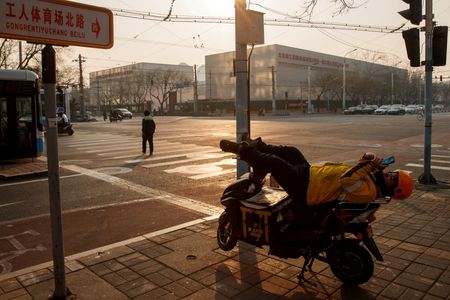

BEIJING — When Bao Zhang lost his job as a software tester, he turned to driving for a ride-hailing app to make ends meet. Working from 7 a.m. until nearly midnight in Beijing, the 30-year-old brings home around 6,000 yuan — roughly $885 — each month after covering vehicle rental and charging expenses. He sees little chance of getting back into the tech industry anytime soon.
Zhang’s situation is far from unique. Across China, tens of millions of workers are moving away from traditional employment and into the gig economy, driven by scarce job opportunities, a record number of college graduates entering the workforce, and limited unemployment benefits.
“Those who used to take taxis now have to drive them themselves,” Zhang said.
According to the China New Employment Forms Research Center, a think tank, the number of people in flexible employment — meaning those without a permanent, full-time contract — is expected to climb from 280 million in 2025 to 320 million this year. That figure represents roughly 44% of China’s total workforce and is nearly equal to the entire population of the United States.
Analysts describe the gig economy as a critical buffer absorbing workers displaced by multiple economic pressures. The collapse of China’s property market has wiped out construction jobs, while manufacturers are cutting staff through automation and cost reductions tied to tariffs, overcapacity, and fierce price competition. Increasingly, educated young people and white-collar professionals are also being pushed into gig work as domestic demand stays weak and artificial intelligence adoption accelerates.
“The proportion is extremely high,” said Yang Zhan, a cultural anthropology expert at the Hong Kong Polytechnic University. “It’s no longer limited to rural migrants and has spread to the middle class and university graduates.”
“China is upgrading manufacturing, and many industries that used to absorb large numbers of workers are being phased out. Then there is AI,” Zhan added.
China’s human resources ministry and the State Council Information Office did not respond to requests for comment.
While gig work helps cushion the financial blow of losing a formal job, it also creates long-term risks for China’s welfare system. One government adviser noted that gig workers are not required to make social insurance contributions, which puts additional pressure on an already underfunded system.
A 2019 report from the Chinese Academy of Social Sciences warned that the national pension fund could be depleted by 2035 as China’s population continues to age. A follow-up report in 2024 suggested that pushing back the retirement age could delay that depletion by eight to nine years.
“It may not be easy to find a solution,” the adviser said, citing the unstable incomes and contracts common in the gig sector. The adviser suggested Beijing focus on supporting the formal services industry to generate higher-quality jobs.
The financial strain on the social insurance system is already showing. An analysis by Gavekal Dragonomics found that central government transfers used to cover social insurance budget shortfalls have roughly tripled over the past decade to around 3 trillion yuan, and have doubled as a share of total government spending — now accounting for about 10%.
A second government adviser cautioned that placing heavier tax burdens on gig workers, many of whom are rural migrants, would be “highly unreasonable.” That adviser suggested birth subsidies might be a better long-term approach.
Of the 12 flexible workers interviewed by Reuters, only two said they were voluntarily contributing to social insurance. Two others said they paid in through formal part-time jobs held alongside their gig work. The remaining workers said they preferred to manage their own savings.
“I can take control, rather than wait for decades for others to pay me,” said Angel An, 24, who earns above the average ride-hailing income by marketing her services to tourists in Shanghai and nearby Suzhou through social media.
Zhang, meanwhile, deals with ongoing ankle and knee pain from spending long hours behind the wheel in traffic. He has chosen not to purchase medical insurance and said a pension feels “too far away” and would be too small to matter much anyway.
HSBC Asia economist Frederic Neumann warned that gig jobs fall short of the pay and stability many Chinese workers expect, and said this trend is weighing on consumer spending and overall economic growth.
“A whole new generation is growing up unaccustomed to the security and confidence that their parents for a long time enjoyed,” Neumann said.
Participation in formal social insurance programs among gig workers remains low. A government report from December 2025 found that as of the end of 2024, only 70.6 million flexible workers were enrolled in the urban employee pension scheme. Most migrant workers contribute only to the basic scheme, where monthly payouts can be as low as 163 yuan.
A Peking University survey of 30,000 delivery workers found that fewer than 10% would support mandatory social security contributions, which would cost workers roughly 10% of their income and employers about 25%.
“The urgent priority is to make it easier for flexible workers to be included in the employee social security system,” said Nomura’s chief China economist Ting Lu, who estimates only tens of millions are fully enrolled. “We need to reduce anxiety so that they save less and consume more,” he added.
Zhan, the anthropologist, said the government faces a difficult balancing act between requiring platform companies to contribute more to social welfare and preserving those companies’ ability to keep creating jobs. “The government very much needs the platform economy to absorb workers” and maintain social stability, she said, warning that major regulatory changes could deliver “a major shock” to the industry’s profits.
China’s official unemployment rate has stayed between 5% and 6% for roughly a decade, partly because anyone working even one hour per week is counted as employed — a definition that effectively absorbs many gig workers into the employed category.
Still, an oversupply of gig workers is starting to push wages down in some sectors. The think tank’s report found that China’s 16 million food delivery riders saw their average hourly pay rise 11% to 37.3 yuan in 2025, but wages for the country’s 37.2 million ride-hailing drivers fell by 1.8%. At least four cities, including the tech hub of Shenzhen, have issued warnings about ride-hailing market “saturation” since April.
The second government adviser said those warnings were intended only to raise public awareness, not to discourage people from taking gig work — noting that restricting such opportunities “would become a social stability issue.”
For workers like Li, a cleaner in his early 50s who delivers food until 10 p.m. to earn an extra 40 to 100 yuan a day, there is simply no alternative. He suspects the growing number of delivery riders is shrinking the earnings per order but says he has “no choice” but to continue.
“At my age, without education, what could I possibly do? In Beijing, most college students also have to deliver food,” said Li, who provided only his surname.