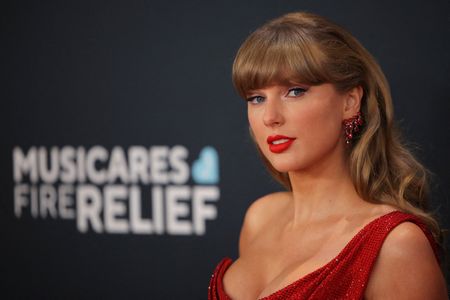

A federal judge has thrown out a lawsuit filed against pop superstar Taylor Swift, which accused her of lifting phrases from a Florida woman’s poetry and using them in more than a dozen of her songs.
U.S. District Judge Aileen Cannon ruled that plaintiff Kimberly Marasco failed to demonstrate that her poems qualified as protectable expression, that Swift had ever been exposed to the poems, or that an average person would find the songs and poems to be substantially similar.
Marasco, who represented herself in the case, was reached by email after the ruling and said she disagrees with the judge’s decision and intends to file an appeal.
Representatives for Swift and the other defendants — which include Republic Records and Universal Music Group — did not provide comment when contacted.
Swift, 36, was alleged to have drawn from Marasco’s poetry books when writing songs such as “Down Bad” and “I Can Do It with a Broken Heart,” both featured on Swift’s 2024 album “The Tortured Poets Department.”
Judge Cannon determined that any overlap between the two works involved only what she described as “unprotectable ideas, themes, metaphors, and isolated words.” She offered several examples of such common concepts, including facing adversity, being “gaslighted,” and the feeling of being “submerged” underwater.
This was not the first time the lawsuit was dismissed. Cannon had already thrown out an earlier version of Marasco’s complaint last September.
Regarding the new claims Marasco added, the judge wrote that “the works are not even substantially similar — a point plaintiff effectively concedes by characterizing the alleged copying as ‘paraphrase[s],’ ‘rephrase[s],’ and copying with ‘minor word substitutions.’”
Monday’s dismissal was issued with prejudice, which means Marasco is legally barred from filing an amended version of the complaint. Judge Cannon’s chambers are based in Fort Pierce, Florida.
In other Swift news, the singer married Travis Kelce, also 36, the star tight end for the Kansas City Chiefs, at Madison Square Garden in Manhattan on July 3.