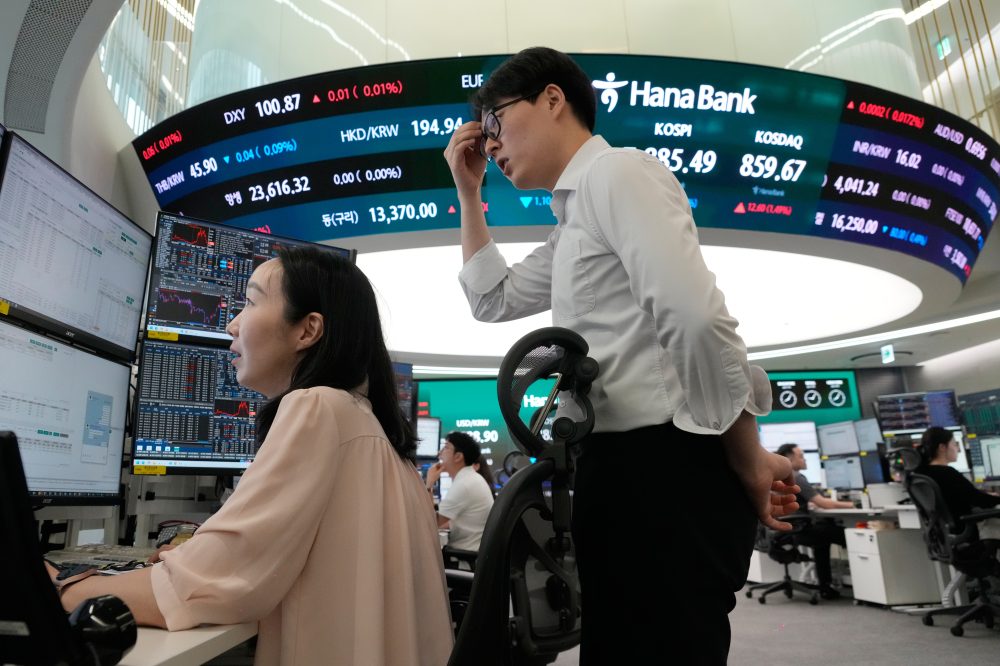

Asian stock markets fell sharply Tuesday even as a surge in artificial intelligence-related stocks pushed Wall Street’s S&P 500 close to a historic record the day before.
South Korea’s Kospi index dropped 7.6%, settling at 7,444.13. Shares in both Samsung Electronics and SK Hynix each fell 8.7% — a steep decline that came despite Samsung reporting its operating income jumped 19 times over to 89.4 trillion won, equivalent to $58.7 billion, in the most recent quarter. The company’s revenue also more than doubled during that period.
Stephen Innes of SPI Asset Management offered a striking take on the situation. “The first proper AI stress test may not have arrived with weak demand, a capex warning, or some sudden crack in the data center story. It may have arrived with Samsung posting an extraordinary quarter and the stock falling anyway,” he wrote in a commentary.
AI stocks have been swinging wildly amid growing concerns that valuations have climbed too high, with investors questioning whether the massive spending on AI chips and data centers can generate enough returns to justify the investment.
SK Hynix is looking to raise $28 billion this week by listing shares on the Nasdaq in the United States, which would rank it among the largest U.S. stock offerings ever — second only to SpaceX’s IPO last month, which raised $75 billion. SK Hynix’s stock in Seoul has more than tripled this year due to the AI boom, even after recent sharp losses.
Other Asian markets also declined. Tokyo’s Nikkei 225 dropped 1.8% to 68,493.52, with computer chipmaker Tokyo Electron losing 3.4% and Kioxia Holdings falling 10.7%. Hong Kong’s Hang Seng slipped 0.4% to 23,517.70, while China’s Shanghai Composite fell 1% to 3,999.03. Taiwan’s Taiex also lost 1.8%. Australia’s S&P/ASX 200 edged down 0.3%, while India’s Sensex managed a slight gain of 0.1%.
Back in the United States on Monday, the S&P 500 gained 0.7% to close at 7,537.54, landing within 1% of its record high even though most individual stocks within the index actually finished lower. The tech-heavy Nasdaq composite climbed 1.1% to 26,121.16, and the Dow Jones Industrial Average rose 0.3% to 53,055.91, setting a new record.
Broadcom was among the biggest drivers of the S&P 500’s gains, rising 3.7% after announcing long-term deals to supply silicon products to Apple. That came after two consecutive losses exceeding 2% the previous Wednesday and Thursday, before the Friday holiday ahead of the Fourth of July.
SpaceX, which is set to join the Nasdaq 100 index of the largest non-financial Nasdaq stocks, gave up an early gain and ended the day down 1%. Its inclusion in the index will require funds that track the Nasdaq 100 to purchase SpaceX shares.
Also in the AI space, TeraWulf jumped 4.9% after announcing that Anthropic agreed to a 20-year deal to use its data center located in Kentucky. TeraWulf expects the arrangement to generate roughly $19 billion in revenue. The company is currently shifting its focus away from bitcoin mining and toward high-performance computing.
In oil markets, Brent crude — the international benchmark — rose 52 cents to $72.51 a barrel, approaching the level it was at before the United States and Israel struck Iran in late February, which had caused prices to spike. U.S. benchmark crude added 43 cents, reaching $68.98 a barrel.
Uncertainty over oil supplies grew after a tanker traveling near the coast of Oman in the Strait of Hormuz caught fire early Tuesday after being struck by a projectile, according to the British military. The attack was the latest against a vessel passing through the narrow entrance to the Persian Gulf, a waterway through which one-fifth of all globally traded oil and natural gas once flowed during peacetime. Iranian state television said the liquefied natural gas tanker was targeted after failing to heed warnings, though it stopped short of claiming direct responsibility for the assault.
In currency markets, the U.S. dollar dipped to 161.73 Japanese yen from 162.09 yen, and the euro edged slightly lower to $1.1439 from $1.1442.