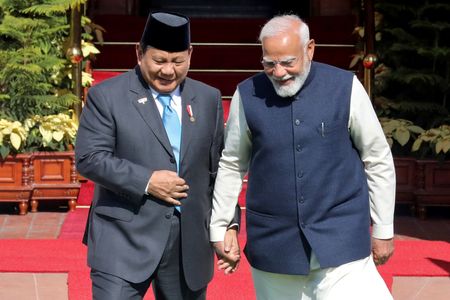

Indian Prime Minister Narendra Modi arrived in Indonesia on Tuesday for high-level talks with President Prabowo Subianto, with both leaders looking to lock in a series of agreements spanning defense cooperation, food security, and several other key areas.
The visit marks Modi’s first trip to the country since 2023. His itinerary includes stops in the capital city of Jakarta and the cultural city of Yogyakarta on Tuesday and Wednesday, after which he is scheduled to continue on to Australia and New Zealand.
India’s ambassador to Indonesia, Sandeep Chakravorty, told reporters last week that the two leaders plan to discuss memorandums of understanding covering health, space, pharmaceuticals, and food security. “Some are in process, some will be finalised in time, some may get delayed but there will still be outcomes related to the visit,” the ambassador said.
The two heads of state have met before — Prabowo traveled to New Delhi last year, where the two countries signed a broad set of agreements.
During his time in Yogyakarta, Modi announced Monday that he would visit Prambanan, Indonesia’s largest Hindu temple complex and a UNESCO World Heritage site. The ambassador added that both leaders are expected to announce the launch of restoration efforts at the site.
Defense matters are also high on the agenda. Chakravorty said the two nations hope to wrap up certain agreements involving BrahMos, a joint missile manufacturing venture between India and Russia. Defense discussions will also touch on maritime awareness and combating piracy.
Back in 2023, BrahMos disclosed it was in advanced negotiations with Indonesia over a potential deal valued somewhere between $200 million and $350 million for its missile systems. The company has already reached agreements with neighboring countries Vietnam and the Philippines.
Trade ties between the two nations are substantial — India is a significant purchaser of palm oil and coal from Indonesia, which is considered a global commodities powerhouse. In May, Indonesia announced plans to bring exports of its key strategic commodities under centralized government control in order to increase state revenues.
Chakravorty indicated India is not particularly concerned about that policy shift, saying: “We understand the reasons and we believe that we are part of the solution.”
Rajiv Bhatia, a distinguished fellow at the think-tank Gateway House and India’s former deputy chief of mission to Indonesia, published an opinion piece Monday suggesting the two countries already enjoy solid relations and have the potential to grow more closely aligned on the world stage.
“The two leaders are expected to achieve a closer, more aligned worldview, especially in the aftermath of the wars in Ukraine and the Gulf and amid the emerging entente cordiale between the U.S. and China,” Bhatia wrote in the Jakarta Post.