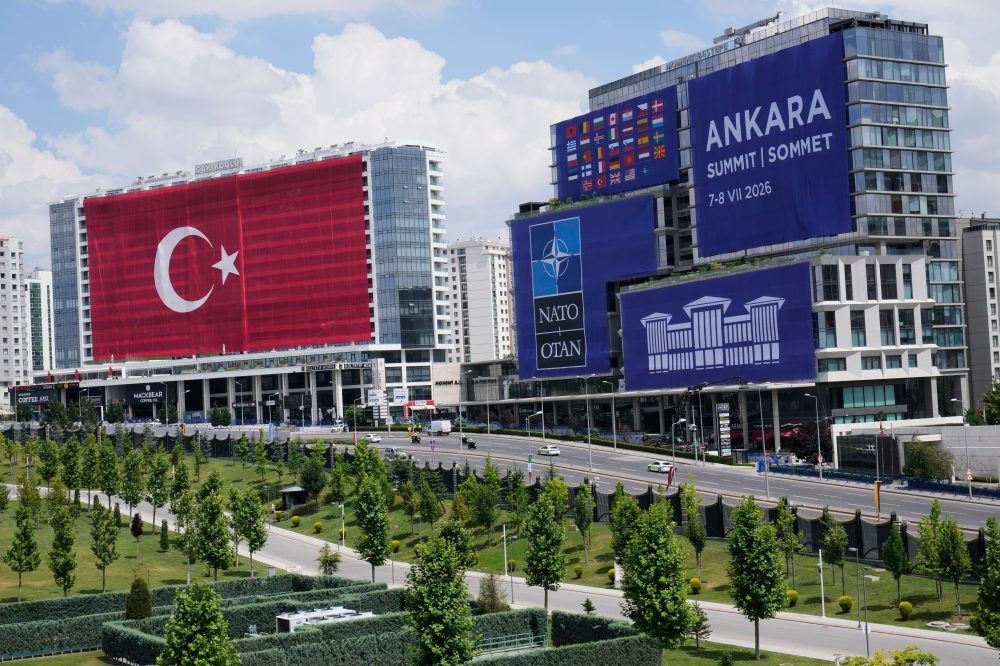

ANKARA, Turkey — NATO is preparing to unveil a series of new military contracts worth tens of billions of dollars Tuesday, in a direct effort to show U.S. President Donald Trump that member nations are not just spending more on defense — they’re turning that money into actual weapons and equipment.
The announcement, being called the “big reveal,” will feature several alliance leaders announcing new agreements with defense manufacturers, many of them based in the United States. Trump has previously dismissed NATO as a “paper tiger” that couldn’t function without American weapons and leadership.
“We will announce tens of billions in new contracts that will provide the crucial kit we need to deter and defend,” NATO Secretary-General Mark Rutte told journalists on the eve of the summit, which is being held over two days in Turkey.
The push to showcase defense investments follows an earlier attempt by Rutte to address U.S. concerns, when he presented a chart he called “The Trump Trillion” — illustrating $1.2 trillion in defense spending by European allies and Canada since 2017. Trump appeared unimpressed, expressing frustration that some NATO allies refused to support the Iran war, which he launched alongside Israel without consulting the alliance.
“We don’t need their money — we don’t need anything,” Trump said. “I just want loyalty.”
Among the expected announcements is a contract to replace NATO’s aging fleet of surveillance aircraft. While NATO does not own weapons — those belong to its 32 member nations — it does operate a fleet of AWAC surveillance planes that are roughly 50 years old, along with some newer surveillance drones.
Several of the new projects will be funded through a European Union loan program designed specifically for defense purposes, which can raise up to $170 billion through capital markets.
“We need to ensure that we are translating our economic might into military capabilities, putting the cash to work from defense plans to drones, from money to missiles and interceptors,” Rutte said.
The summit is taking place at President Recep Tayyip Erdogan’s expansive palace complex in Ankara. Trump has suggested he plans to arrive with favorable news for the Turkish leader, hinting that F-35 fighter jet sales to Turkey — halted since 2019 after Turkey bought Russian S-400 missile defense systems — could soon resume.
However, Israeli Prime Minister Benjamin Netanyahu pushed back Monday during an appearance on the morning program “Fox & Friends,” urging the U.S. not to sell F-35s to Turkey. He said Erdogan “calls openly for the annihilation of Israel.” Turkey and Israel have had a deeply strained relationship, with Erdogan regularly accusing Israel of committing genocide in its war in Gaza, which was triggered by the Hamas-led attack on southern Israel on October 7, 2023.
Netanyahu warned that arming Turkey with F-35s would “upset the power balance in the Middle East, which is ultimately guaranteed by Israeli air superiority and also, I think, by America’s posture in the Middle East.” Israel’s air force relies on hundreds of U.S. fighter jets, including F-35s, F-16s, and F-15s.
The broader theme of the summit centers on building a stronger Europe capable of handling more of its own security needs. The Trump administration has signaled that the U.S. intends to shift its focus toward China and the Indo-Pacific, leaving Europe to take on a larger share of its own defense responsibilities. The Pentagon has been promoting what it calls “NATO 3.0” — a restructured alliance in which European nations shoulder more of the burden.
But increasing defense budgets requires either raising taxes or pulling funding from other priorities. The U.K.’s Defense Secretary John Healey unexpectedly stepped down last month, citing the government’s reluctance to boost military spending despite growing threats.
Some nations in northern and central eastern Europe are increasingly worried that Russia may be planning a hybrid attack on the continent — combining traditional military force with tactics such as cyberattacks — as Russian President Vladimir Putin continues to struggle to achieve a decisive victory in Ukraine.
British Prime Minister Keir Starmer is attending what is expected to be his final foreign trip as leader, after announcing his resignation on June 22. His office said he will focus on “building a stronger and more European NATO.” Starmer has faced criticism from military officials, opposition lawmakers, and members of his own center-left party over the pace of defense spending increases. While his government has committed to reaching NATO’s target of spending 3.5% of gross domestic product on defense by 2035, no concrete roadmap exists to get there — current plans would bring spending to 2.7% of GDP by 2029.