
NASHVILLE, Tenn. (AP) — Viewers of the TV show “9-1-1: Nashville” might get the impression that the city is constantly ravaged by tornadoes turning concerts into disaster zones and sending tourists flying through the air. While that’s television drama, dangerous storms do strike Nashville on a regular basis — and when they do, many residents reach for their phones and turn to Nashville Severe Weather.
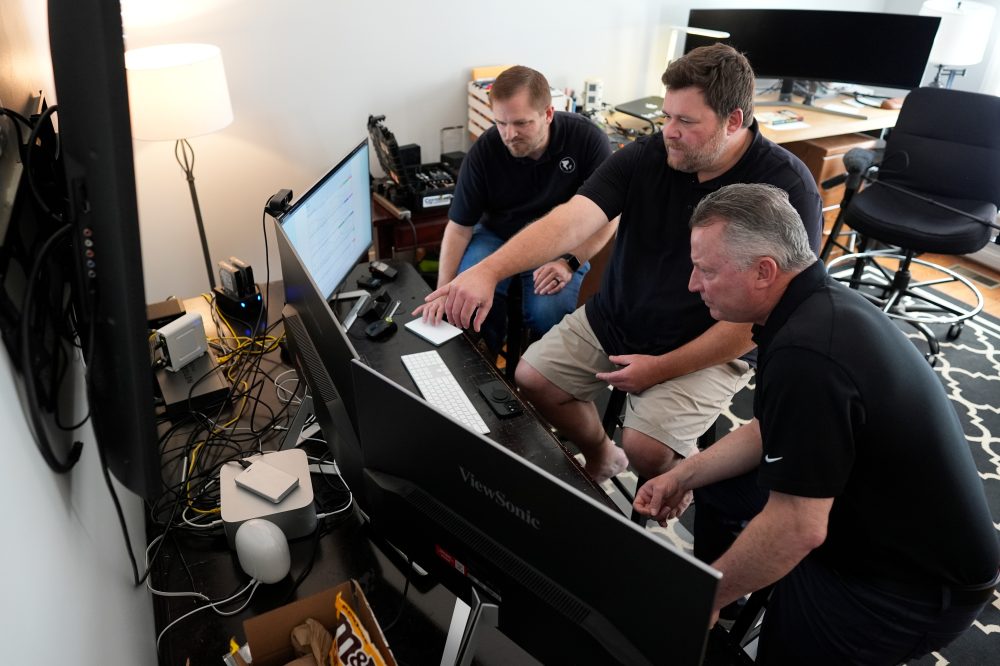
This volunteer-run operation has carved out a dedicated following on social media by doing something that seems almost out of place in today’s online world: staying calm. Volunteers Will Minkoff, Andrew Leeper, and Tom Johnstone livestream storm coverage that attracts tens of thousands of viewers who follow along in real time, asking questions and sharing what they’re seeing on the ground. It’s the kind of community-driven service that harkens back to the internet’s earliest ideals, long before the era of the influencer.
This is all unfolding at a moment when fewer people are sitting down to watch traditional local news broadcasts. Yet a professor of strategic communication at Belmont University in Nashville says an informal poll of his own students revealed many of them are regularly tuning in to Nashville Severe Weather.
“The millennials and Gen Z — and teaching college students, I know this all too well — their source of information is that handheld device,” he says. “It’s not turning on a TV. And it’s not even looking at a traditional media outlet’s online presence. It’s finding sources that provide them quick information when they need it.”
The growth of Nashville Severe Weather touches on several intersecting trends: a tornado alley that is moving eastward, a shifting climate, the dominance of social media, and the power of immediate, neighborhood-level information to protect lives.
The operation has grown over more than ten years, starting out as a Twitter feed and blog before expanding into regular YouTube livestreams whenever severe weather threatens Nashville or nearby counties. Because Leeper, Minkoff, and Johnstone all live in the area, they face the same dangers as the people watching them.
“There’s something about Nash Severe Weather that’s different from the hobbyist enthusiast,” the Belmont University professor says. “I think that’s why people are following them. That’s why they are trusting them. That’s why they’re tuning in and turning to them. … It is authentic and real.”
Leeper, who serves as a church pastor, speaks with a reassuring voice and keeps a sign on a shelf behind him that reads “prepared not scared.” During one storm, he had to step away from the livestream to wake his family and move them to safety — and he did it without a hint of panic, living out his own motto before returning to the stream once the danger had passed.
Katherine Moffat, who works as the executive director of the Tennessee Academy of Physician Assistants, says local TV weather coverage can sometimes feel “a little over-the-top” when storms approach. Nashville Severe Weather, she says, takes a different approach.
“They’re a little more calm and telling it to you straight,” she says. “They don’t get people overly excited.”
The demand for this kind of coverage is growing. Johnstone, a meteorologist who spent 33 years with the National Weather Service before joining the group last year, says the region traditionally known as Tornado Alley has been drifting away from the Midwest plains and toward states further east.
“The mid-South, especially down through Alabama, Mississippi, and into Tennessee and western Kentucky, has been where tornadoes have been most frequent … and people have been dying in the highest numbers,” he says.
Michelle Stewart gets all of her weather updates through push notifications from Nashville Severe Weather on her phone. She found the service especially valuable during an ice storm that knocked out power and internet access across much of the city for several days.
“They are very informative about, not just what to expect, but how to be prepared, and just giving everybody the lay of the land without it being too science-y. You know, it kind of feels like you’re talking to your neighbor,” says Stewart, a project manager at a healthcare research company. “They are so calming to me during those live events.”
Brett Withers, a former Nashville city councilman who witnessed two deaths in his district during a 2020 tornado that claimed 24 lives across Tennessee, calls Nashville Severe Weather a “godsend.”
“We have so many people moving to Nashville, and they might move from places where tornadoes are rare, if they ever happen,” he says.
The group’s popularity flies in the face of conventional social media wisdom. Their livestreams are not polished productions. There’s no manufactured drama, no storm chasing, no reporters standing outside in dangerous winds. The visual centerpiece is weather radar, with Minkoff, Leeper, and Johnstone — sometimes joined by other volunteers — each appearing from their own homes in small boxes along the edges of the screen. When they use graphics at all, they look like something a young child might have sketched out.
One beloved example is the “Dry Air Monster” — a stick figure with an oversized head and chomping jaws reminiscent of Godzilla. Nashville Severe Weather co-founder David Drobny created the character to illustrate how dry air could “eat” snow that was heading toward the city. In a Southern city where snow on the ground is a rare treat that often feels like a brief holiday, the monster’s catchphrase — “No Snow for You” — has become something of a local institution.
Their neighborhood-level focus allows them to do something even local TV stations struggle with: zeroing in on specific streets, schools, and churches to tell people exactly where a threat is headed.
“One of the things that Nash Severe can do that even the TV stations have trouble doing is really bring it down to intersection level, school level, church level to let people know where the danger and the threat is,” Johnstone says.
Their coverage runs both ways. Audience members contribute photos and video from the field and share observations in the chat. Nashville Severe Weather passes that information along to the National Weather Service and local TV meteorologists, while also fielding questions from viewers during streams.
Leeper recalls one particular day when schools dismissed early due to a tornado threat. When a child commented in the chat that they were home alone, he immediately shifted gears.
“We just stopped what we were saying on the stream, and I said, ‘Hey. It dawns on me that we’ve got a bunch of kiddos at home that are maybe by themselves. Hey. Here’s what you do,’” Leeper recalls. “I love those moments where we can just sort of put everything else aside to talk to the people who are listening, in whatever situation they’re in.”
Those moments keep the work grounded in something deeper than storm tracking. In 2023, a tornado took the lives of a mother and her young child living in a trailer in the area. Leeper didn’t know the family, but he attended the visitation.
“It just creates a whole other emotion when you walk into a funeral visitation for hurting families when it’s a weather event that you covered,” he says. “It’s not all action and adventure. It really affects people’s lives forever.”