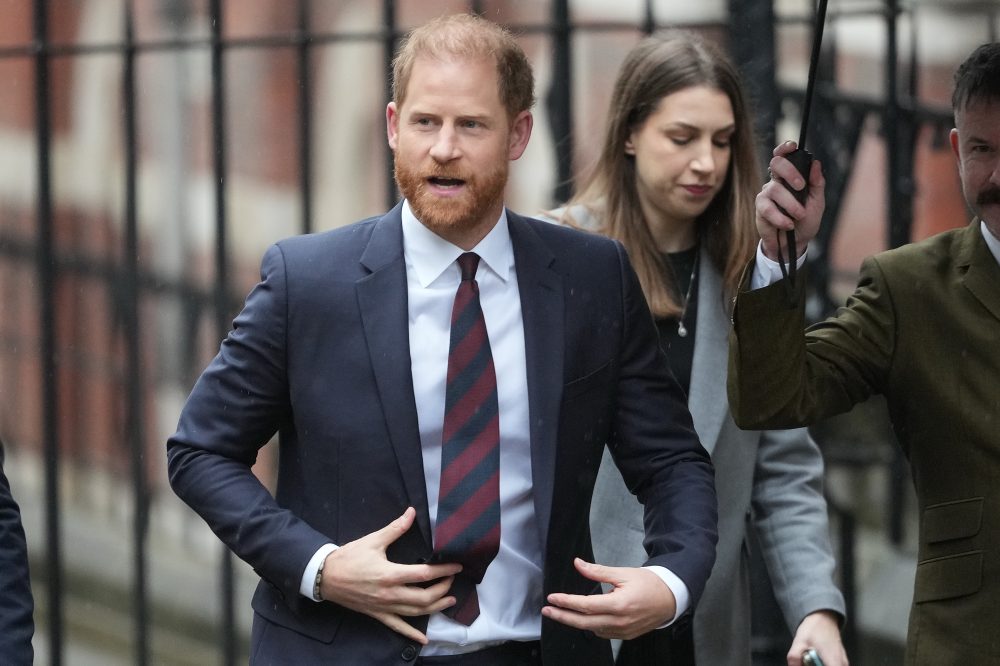

LONDON — Tuesday marks a turning point in Prince Harry’s years-long legal battle with the British press, as a judge in London’s High Court prepares to deliver a ruling in his privacy invasion lawsuit against the publisher of the Daily Mail.
The decision wraps up a series of three lawsuits in which Harry accused news outlets of unlawfully prying into his personal life. Harry and six co-claimants are seeking significant financial damages in the high-profile case, which involved an 11-week trial estimated to have cost roughly 40 million pounds — approximately $53.5 million.
Among those suing Associated Newspapers Ltd. alongside Harry are singer Elton John, actors Elizabeth Hurley and Sadie Frost, anti-racism activist Doreen Lawrence, former politician Simon Hughes, and John’s husband, David Furnish. The group alleged the company tapped their phones, intercepted voicemails, and used deceptive methods to collect private information.
The newspapers rejected those claims as “preposterous,” arguing that the approximately 50 articles in question were produced through legitimate reporting, with information coming from friends, royal aides, and publicists who voluntarily spoke to journalists.
The ruling arrives while Harry is visiting the United Kingdom, though attention has also turned to whether he will bring his wife, Meghan, Duchess of Sussex, and their children, Prince Archie and Princess Lilibet, to see his father, King Charles III, who is undergoing treatment for an undisclosed form of cancer.
Harry’s drive to challenge the press goes far beyond stories about his younger years or his romantic life. His testimony in February offered an emotional window into the deeper impact of press intrusion on his wellbeing.
He has long blamed the media for the 1997 death of his mother, Princess Diana, who was killed in a Paris car crash while being chased by paparazzi. He has also said relentless press attacks on his wife contributed to the couple’s decision to step back from royal duties and relocate to the United States in 2020.
“They continue to come after me, they have made my wife’s life an absolute misery,” Harry said, visibly emotional while testifying in court.
The phone hacking scandal, which began in the 1990s and stretched on for more than a decade, gave Harry an opening to pursue legal action — something unusual for a senior royal. Three years ago, he became the first high-ranking member of the royal family to appear in court in more than a century.
His legal efforts have already yielded results. In 2023, he won a ruling against the publishers of the Daily Mirror, which was found guilty of “widespread and habitual” phone hacking. More recently, Rupert Murdoch’s flagship U.K. tabloid, The Sun, issued an unprecedented public apology and agreed to pay substantial damages to settle a separate privacy lawsuit brought by Harry.
Harry’s attorney, David Sherborne, argued that the Daily Mail and its companion publication, the Mail on Sunday, deployed journalists, freelancers, and private investigators in a “clear, systematic and sustained use of unlawful information gathering” to spy on his clients. Sherborne pointed to payments made to private detectives and connected them to specific articles, including reporting on Harry’s then-girlfriend, Chelsy Davy, and her travel plans.
When he testified at the start of the trial in January, Harry said the press intrusions left him “paranoid beyond belief,” damaged his relationships, and seriously harmed his mental health.
Hurley testified that the Mail went as far as placing microphones outside her windows and obtaining her medical records, among what she described as “other monstrous, staggering things.”
“It is like there is someone peeping into your life and into your home,” she said in court. “My private life had been violated by violent intruders — that there had been sinister thieves in my home all along and that I had been living with them completely unaware.”
Defense attorney Antony White pushed back, saying the case was built on speculation and that the far more probable explanation was “ordinary, legitimate journalism.” He argued that Harry was “inclined to see unlawful evidence gathering, in particular voicemail interception, everywhere,” without sufficient proof to support those claims.
Unlike the Mirror case, the Mail trial featured journalists who were willing to defend their reporting in court. Some reporters identified official sources such as palace spokespersons, while others named their contacts directly to counter Harry’s claim that his inner circle did not leak information.
“They were not all tight-lipped,” said Katie Nicholl, a former Mail on Sunday editor. “I had very good sources in the inner circle.”
A significant legal question in the case was whether the claimants should have been permitted to bring allegations stretching back to the 1990s, well past a six-year statute of limitations. They argued the deadline did not apply because they only became aware of the hacking after private investigator Gavin Burrows came forward in 2021, saying he wanted to “do the right thing” and assist those he had targeted.
However, Burrows — who once apologized to Harry in a BBC documentary for aggressively targeting him for tabloids during his teenage years — testified at trial that he never worked for the Mail. He further claimed that a statement attributed to him had been fabricated by the claimants’ legal team and that his signature on the document had been forged.
Justice Matthew Nicklin pressed Sherborne multiple times on what would become of the case if the court rejected Burrows’ original statement. Sherborne maintained that other evidence still implicated the newspapers, while White argued that Burrows’ courtroom testimony effectively dismantled the entire case.
Burrows denied that he changed his account out of spite following a falling out with Harry’s legal team.
The ruling will be delivered remotely, without a courtroom hearing, while Harry is in London for charity engagements. Meanwhile, a potential family visit between Harry and King Charles remains uncertain, with disputes over security arrangements and accommodations still unresolved. A government committee declined to approve taxpayer-funded protection for Harry — an issue that has been the subject of repeated legal battles that Harry has consistently lost.