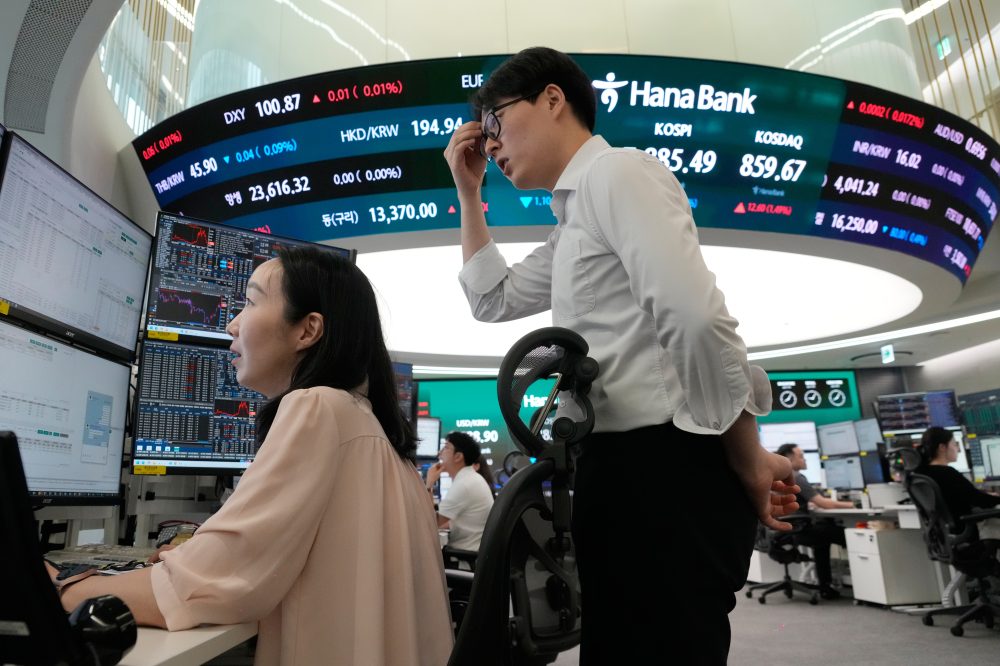

South Korea’s Samsung Electronics delivered a jaw-dropping earnings forecast Tuesday, projecting a second-quarter operating profit nearly 19 times higher than the same period a year ago — a figure that also surpasses the company’s total combined earnings over the past three years.
Despite the remarkable numbers, investors were not impressed. Samsung shares tumbled more than 8%, and South Korea’s main benchmark stock index fell 6.7%, as traders grew skeptical about whether the surge in artificial intelligence demand powering those results can continue at the same pace.
The sell-off spread across the region, with MSCI’s broadest measure of Asia-Pacific stocks outside Japan declining 1.7%, taking its cues from the South Korean market’s sharp retreat.
Market strategist Michael McCarthy of Moomoo Australia explained the mixed reaction this way: “Investors still want to be exposed, but they are very nervous about valuations.”
The market swings serve as a warning sign about the instability running through stock markets as the AI investment wave expands beyond just semiconductor and chip-equipment companies into energy firms, copper mining operations, and lithium producers.
Early European market futures showed a mixed picture Tuesday morning. The pan-region Euro Stoxx 50 futures were down 0.34%, German DAX futures slipped 0.3%, while FTSE futures edged 0.15% higher. U.S. S&P 500 e-mini futures were slightly positive, up 0.07%.
On the diplomatic front, U.S. President Donald Trump is traveling to Turkey to attend a NATO leaders summit. Before his arrival, European government leaders were preparing to announce arms deals valued at tens of billions of dollars, signaling their increased commitment to regional defense.
In currency markets, Japan’s yen strengthened slightly against the U.S. dollar, gaining 0.15% to trade at 161.83 per dollar and pulling back from the weaker 162 level, with traders remaining watchful for any official intervention.
Key economic events scheduled to influence markets include the Bank of England’s financial stability report, German industrial output figures for May, British Halifax housing data for June, Canadian leading index and trade balance figures, and U.S. trade data for May.