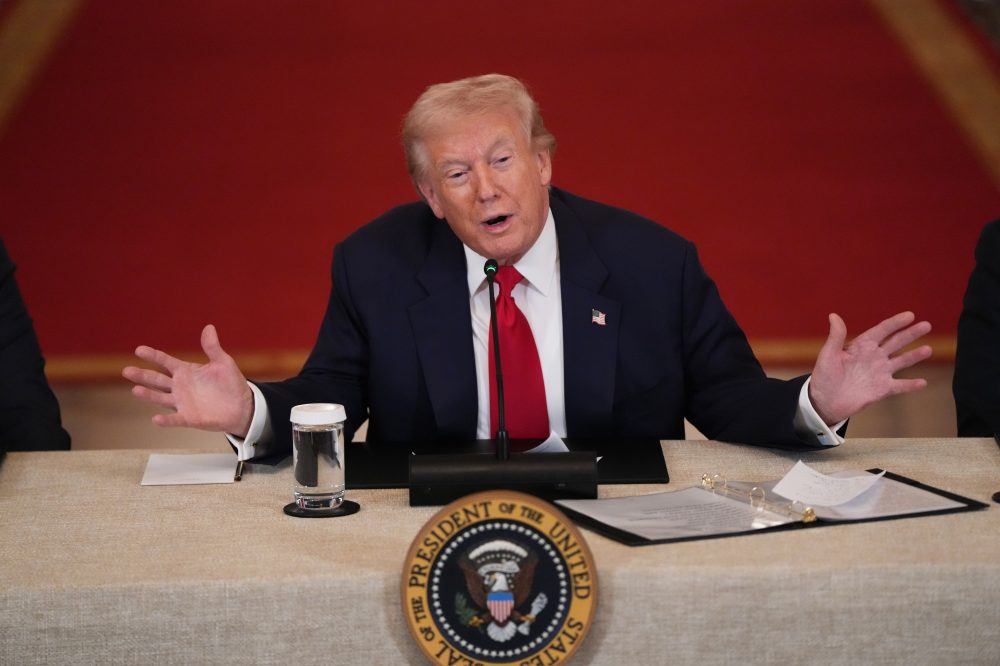
Major technology corporations made a significant commitment Wednesday at the White House, agreeing to shoulder the electricity costs for their massive data center operations instead of passing those expenses to American consumers.
The companies participating in this initiative include Google, Microsoft, Meta, Amazon, Oracle, xAI, and OpenAI, all of which have been rapidly expanding their artificial intelligence capabilities that require enormous amounts of power.
This commitment, dubbed the ‘Ratepayer Protection Pledge,’ was initially unveiled by President Trump during his State of the Union Address and addresses mounting worries that expanding data facilities are pushing up electric bills for households and small businesses during a period when the administration is working to control inflation.
The comprehensive agreement requires these technology firms to secure or purchase power supplies specifically for their facilities, whether through constructing new power plants or expanding existing ones. Additionally, the companies will fund improvements to electrical grid infrastructure and negotiate specialized utility rate structures.
Data centers require massive amounts of electricity to operate their server equipment and cooling systems, particularly as artificial intelligence technology advances. This has led to increased scrutiny from local communities and state officials as these facilities multiply across the country.
According to a Trump administration official, the industry recognizes it must win over public opinion. ‘They need the hearts and minds of Americans,’ the official noted, pointing to recent project cancellations and delays in multiple states due to local resistance.
The strategy aims to gain backing from municipalities that have previously opposed such developments, the official explained on condition of anonymity. ‘There will be no new data center development that’s going to happen without the local communities reading and understanding what this pledge is,’ the official stated.
This announcement comes as November’s midterm elections approach, with voters expressing growing concern about energy costs and the additional pressure these facilities place on the nation’s electrical infrastructure.
President Trump has encouraged these companies to develop dedicated power sources rather than depending entirely on regional electrical grids, balancing technological advancement with economic and political considerations regarding energy expenses.
However, some experts question whether this approach will quickly deliver new electricity supplies to relieve grid strain. Jon Gordon, a director at Advanced Energy United, a clean energy trade organization that includes data center operators, expressed skepticism about the timeline.
‘The real problem is the inability to get generation online fast enough to meet the data center demand,’ Gordon explained. ‘Hyperscalers paying for the generation doesn’t get it online any faster.’
Gordon also noted that the administration’s emphasis on natural gas and fossil fuel power sources, rather than faster-to-build renewable options like solar and wind, may slow progress.
Both supporters and critics will closely monitor whether this pledge results in concrete actions or remains primarily symbolic, as legislators and consumer advocacy groups have demanded stronger safeguards against utility rate increases linked to data center construction.
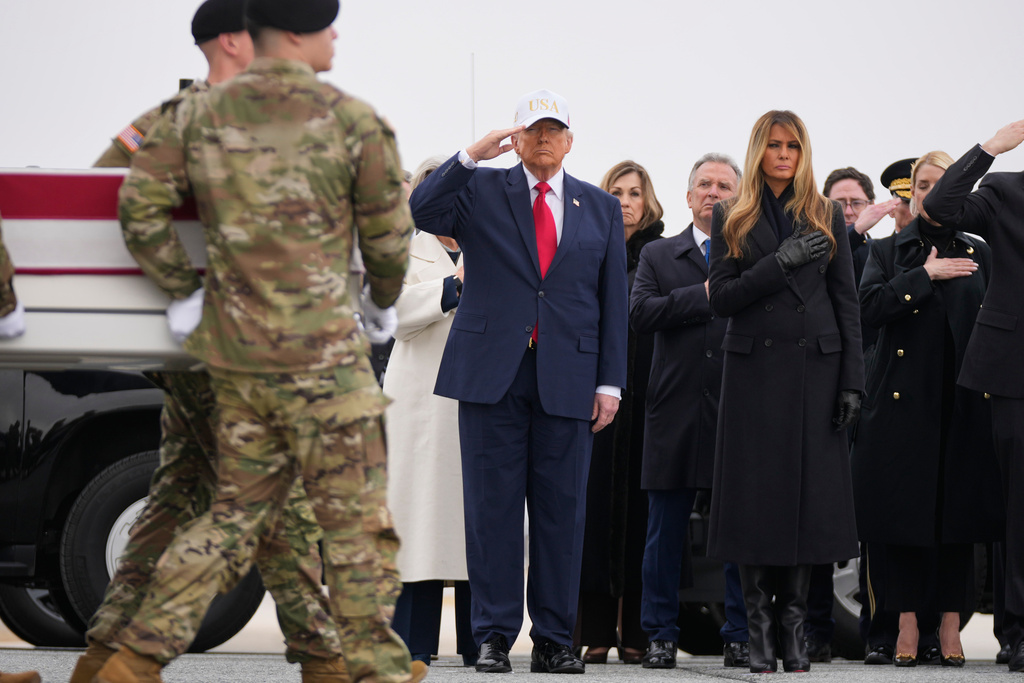
DOVER AIR FORCE BASE, Del. — President Donald Trump stood alongside mourning families Saturday at Dover Air Force Base during a solemn ceremony honoring six fallen U.S. service members who lost their lives in Middle East combat operations.
The ceremony, known as a dignified transfer, represents one of the most heartbreaking responsibilities any president must fulfill. Trump previously described witnessing these transfers as “the toughest thing I have to do” during his first presidential term.
Speaking to reporters aboard Air Force One while returning to Florida Saturday afternoon, Trump reflected on the emotional day. “It’s a very sad day,” Trump stated, adding that he was “glad we paid our respects.” He praised the families of the deceased, calling them “great people, great parents, wives, family” and noted that the “parents were so proud.”
Vice President JD Vance accompanied Trump to the ceremony, along with their wives. Several high-ranking administration officials attended, including Defense Secretary Pete Hegseth, who posted on social media Friday about “an unbreakable spirit to honor their memory and the resolve they embodied.” Also present were Attorney General Pam Bondi, White House chief of staff Susie Wiles, special envoy Steve Witkoff and Director of National Intelligence Tulsi Gabbard.
State officials from Iowa, Minnesota, Nebraska and Florida, including governors and senators, also participated in the respectful ceremony.
The service members who made the ultimate sacrifice were: Maj. Jeffrey O’Brien, 45, of Indianola, Iowa; Capt. Cody Khork, 35, of Winter Haven, Florida; Chief Warrant Officer 3 Robert Marzan, 54, of Sacramento, California; Sgt. 1st Class Nicole Amor, 39, of White Bear Lake, Minnesota; Sgt. 1st Class Noah Tietjens, 42, of Bellevue, Nebraska; and Sgt. Declan Coady, 20, of West Des Moines, Iowa, who received a posthumous promotion from specialist.
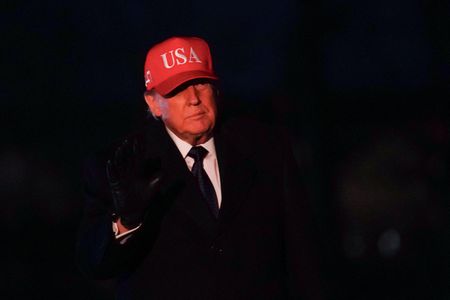
Following established protocol, Trump remained silent throughout the transfer ceremony. Dressed in a blue suit with red tie and white USA hat, the president offered salutes as each American flag-covered case was carefully moved from the military transport to waiting vehicles. The remains will be taken to mortuary facilities for final preparations before burial. Family members watched quietly during the approximately 30-minute ritual.
All six soldiers served with the Army Reserve’s 103rd Sustainment Command headquartered in Des Moines, Iowa, a unit responsible for providing essential supplies including food, fuel, water, ammunition and transportation equipment. The service members perished in a drone attack at a Kuwait command center, occurring just 24 hours after the United States and Israel began their military campaign targeting Iran.
Iowa Republican Senator Joni Ernst, a veteran of combat operations, spoke about the fallen soldiers earlier this week following their identification. “These soldiers engaged in the most noble mission: protecting their fellow Americans and keeping our homeland secure,” Ernst said. “Our nation owes them an incredible debt of gratitude that can never be repaid.”
The dignified transfer ceremony involves carrying flag-draped cases containing the remains of fallen service members from military aircraft to vehicles that transport them to the base’s mortuary facility, where they are prepared for burial.
Nicole Amor’s husband, Joey Amor, revealed earlier this week that his wife was scheduled to return home to him and their two children within days of her death.
“You don’t go to Kuwait thinking something’s going to happen, and for her to be one of the first – it hurts,” Joey Amor shared.
Major O’Brien had dedicated nearly 15 years to Army Reserve service, according to his professional profile. His aunt remembered him on social media, writing that O’Brien “was the sweetest blue-eyed, blonde farm kid you’d ever know. He is so missed already.”
Robert Marzan’s sister honored him in a Facebook tribute, describing him as a “strong leader” and devoted husband, father and brother.
“My baby brother, you are loved and I will hold onto all our memories and cherish them always in my heart,” Elizabeth Marzan wrote.
Despite being among the youngest in his training class, Declan Coady excelled at troubleshooting military computer systems and impressed his instructors, according to his father Andrew Coady, who spoke with The Associated Press.
“He trained hard, he worked hard, his physical fitness was important to him. He loved being a soldier,” Coady explained. “He was also one of the most kindest people you would ever meet, and he would do anything and everything for anyone.”
Cody Khork’s family remembered him as “the life of the party” with an “infectious spirit” and “generous heart,” noting his childhood dream of military service.
“That commitment helped shape the course of his life and reflected the deep sense of duty that was always at the core of who he was,” stated his mother Donna Burhans, father James Khork, and stepmother Stacey Khork.
Noah Tietjens came from a military background and had previously deployed to Kuwait alongside his father. When he returned home in February 2010, he reunited with his excited wife at a local church gymnasium.
Tietjens’ cousin Kaylyn Golike requested prayers for his surviving family members, particularly his 12-year-old son, wife and parents, as they cope with “unimaginable loss.”
Trump’s most recent Dover visit occurred in December when he honored two Iowa National Guard members and a U.S. civilian interpreter killed in a Syrian desert ambush. During his first presidency, he participated in multiple dignified transfers, including ceremonies for a Navy SEAL killed in a Yemen raid, two Army officers who died in an Afghanistan helicopter crash, and two Army soldiers killed in Afghanistan by someone wearing an Afghan army uniform.
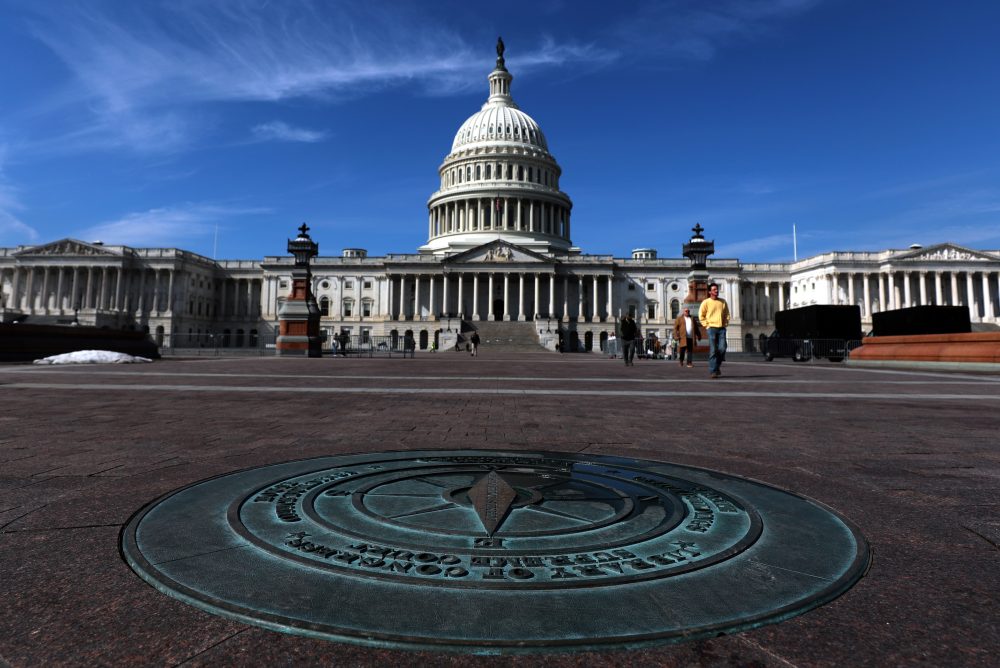
A memorial plaque paying tribute to law enforcement officers who served during the January 6, 2021 attack on the U.S. Capitol has finally been installed after being delayed for three years.
Capitol visitors can now see the permanent display that commemorates the police officers who defended the building and sustained injuries during the violent siege that took place more than three years ago.
The installation of this memorial represents a long-awaited recognition of the law enforcement personnel who were on duty during one of the most challenging days in recent Capitol history.
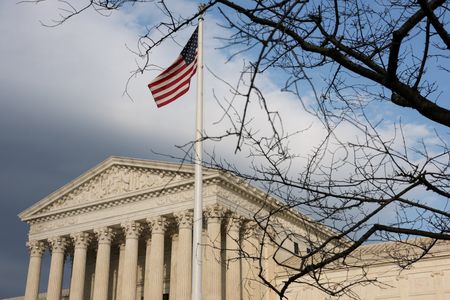
A federal judge delivered a significant blow to the former Trump administration Wednesday, ordering that businesses who paid import duties later invalidated by the Supreme Court must receive their money back.
U.S. Court of International Trade Judge Richard Eaton determined that “all importers of record” should “entitled to benefit” from last month’s Supreme Court decision that eliminated the substantial import duties former President Donald Trump had established under the 1977 International Emergency Economic Powers Act (IEEPA).
In his decision, Eaton declared that he exclusively “will hear cases pertaining to the refund of IEEPA duties.” This provides much-needed guidance on how tariff refunds will be processed, an issue the Supreme Court failed to address in its February 20 decision. Trade attorney Ryan Majerus from King & Spalding, who previously served as a U.S. trade official, anticipates the government will appeal or “seek a stay to buy more time for U.S. Customs to comply.”
The federal government accumulated over $130 billion from these now-invalidated tariffs by mid-December, and according to Penn Wharton Budget Model estimates, could face refund obligations totaling $175 billion.
The judge’s decision specifically addressed a lawsuit filed by Atmus Filtration, a Nashville, Tennessee-based manufacturer of filters and filtration equipment, seeking tariff refund rights.
Earlier this week, another federal court blocked the Trump administration’s efforts to delay the refund timeline. The U.S. Court of Appeals for the Federal Circuit advanced the refund process by transferring it to the New York trade court for resolution.
The U.S. Customs and Border Protection agency now faces the challenge of developing a refund processing system. While Customs regularly handles tariff refunds for errors, its current infrastructure was “not designed for a mass refund,” explained trade attorney Alexis Early from Bryan Cave Leighton Paisner. “The devil will be in the details of the administrative process.”
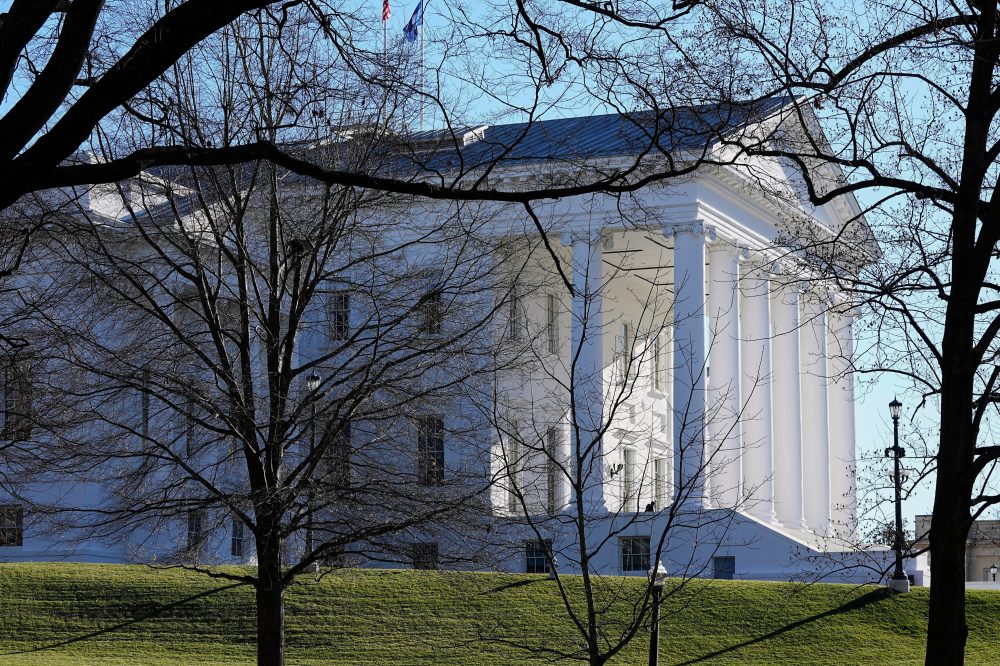
RICHMOND, Va. — Virginia’s highest court delivered its second ruling Wednesday permitting citizens to vote on a Democratic congressional map redrawing initiative that may secure the party an additional four seats in the U.S. House of Representatives, while justices continue examining legal objections to the proposal.
The justices determined that citizens statewide may participate in an April 21 referendum deciding whether to approve redistricting efforts occurring mid-decade. This decision follows a comparable court determination from the previous month in a connected legal matter.
However, the court has yet to determine the legality of the mid-decade redistricting constitutional amendment and public vote, suggesting the planned April election may prove meaningless should the state’s top court support a lower court decision that blocked the initiative. Advance voting for the referendum is scheduled to commence Friday.
Former President Donald Trump initiated an uncommon mid-decade map redrawing campaign last year by urging Republican leaders in Texas to restructure districts favoring his party’s congressional gains. The strategy aimed to preserve the GOP’s slim House control despite political challenges that historically benefit opposition parties during midterm elections.
This effort sparked similar redistricting campaigns across the nation. Republicans currently anticipate gaining nine additional House positions in Texas, Missouri, North Carolina and Ohio. Democrats project winning six more seats in California and Utah, while hoping to offset some or all of the remaining three-seat difference through Virginia’s efforts.
Virginia Democrats unveiled their new congressional district map in February, designed to deliver four additional seats to their party. The Democratic-controlled state legislature subsequently approved the proposed boundaries, and Governor Abigail Spanberger signed the measure into law.
Nevertheless, the redistricting plan takes effect only with voter approval and the state supreme court’s blessing.
Virginia Democratic legislators have characterized their redistricting initiative as a necessary counter to Trump’s excessive actions. Republican officials have expressed outrage over the proposed district boundaries, calling it an attempt by northern Virginia progressives to dominate the entire state.
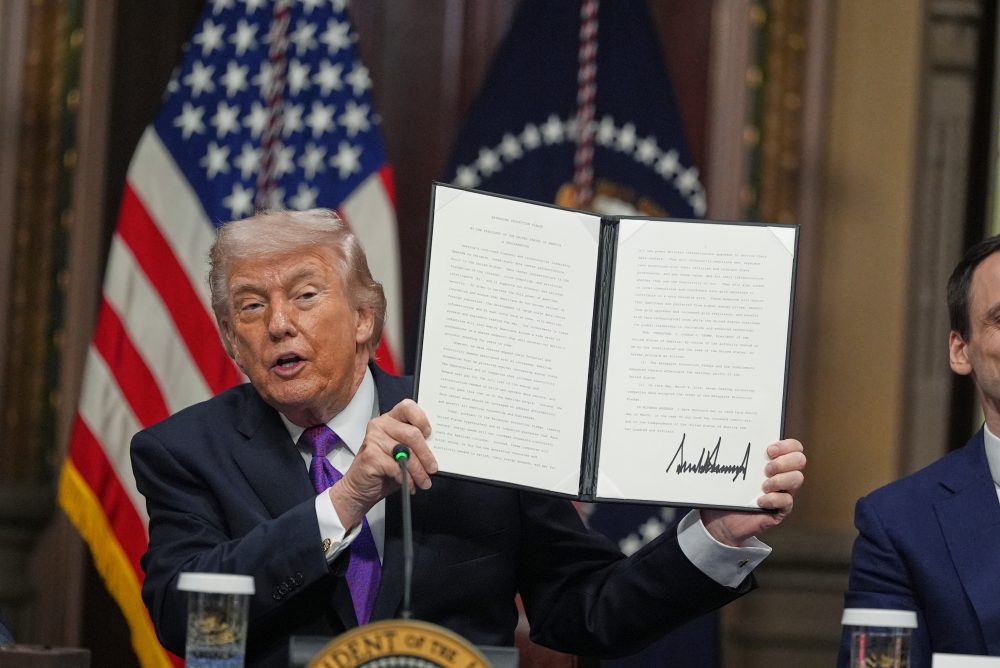
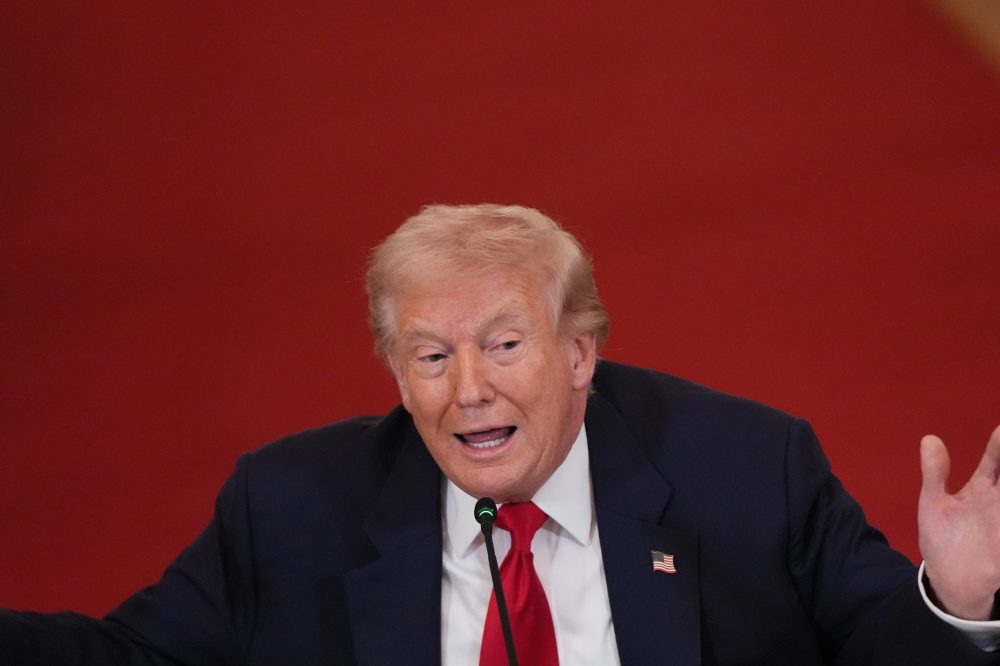
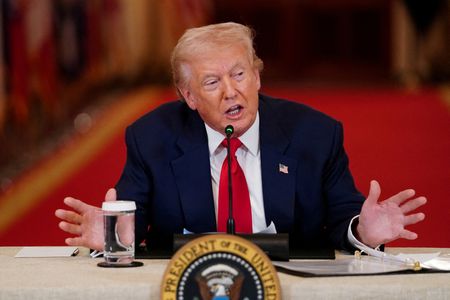
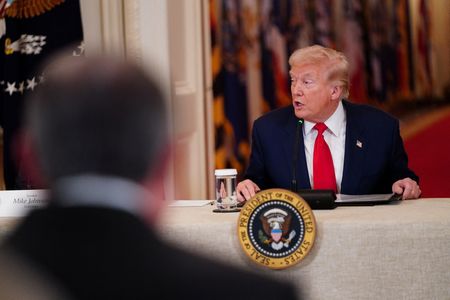
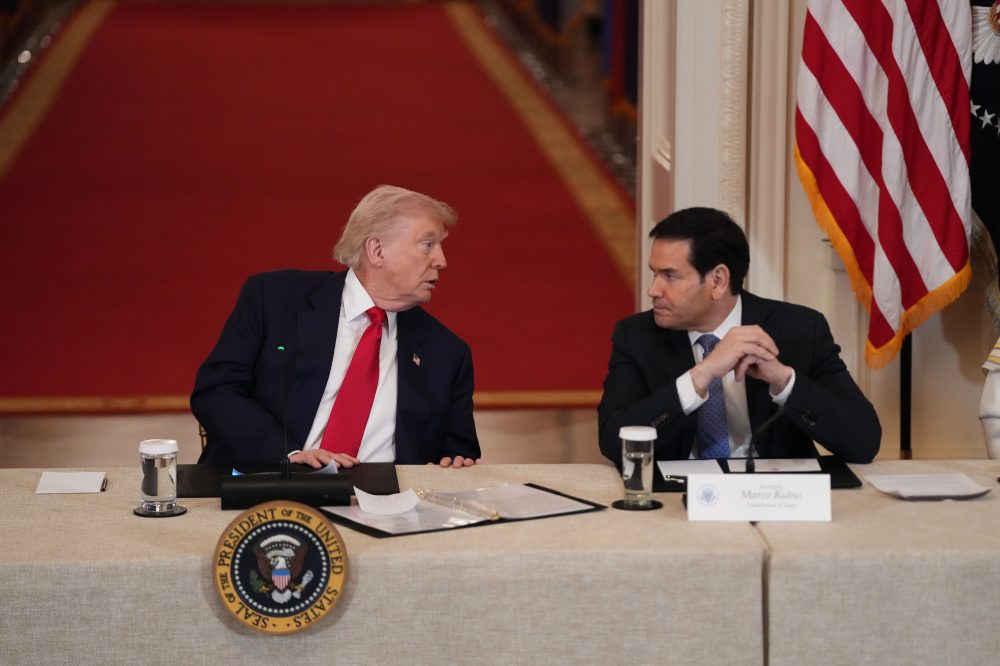
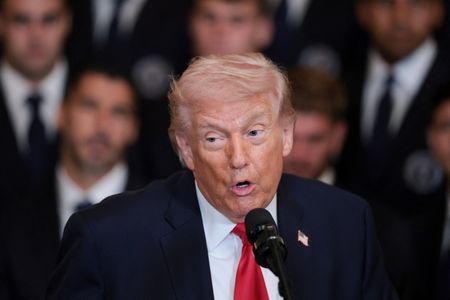
President Donald Trump welcomed major technology executives to the White House Wednesday to announce a voluntary commitment aimed at addressing public concerns about data centers driving up electricity costs for consumers.
“They need some PR help because people think that if a data center goes in there, electricity prices are going to go up,” Trump said. “It’s not going to happen.”
The administration is calling this initiative a “ratepayer protection” commitment, responding to widespread public anxiety that the rapid expansion of artificial intelligence infrastructure could burden households with higher utility expenses. While Trump initially mentioned this pledge during his State of the Union speech last month, specific implementation details remain limited.
Across the United States, communities have increasingly resisted data center projects due to worries about escalating power costs, environmental impact, and excessive water usage. Concerns over rising energy expenses also influenced Democratic electoral victories in Georgia, Virginia, and New Jersey during recent election cycles.
Trump views artificial intelligence as essential for attracting international investment and preserving America’s competitive edge economically and militarily, prompting his efforts to address public skepticism about the technology. However, questions remain about whether these corporate promises will effectively protect consumers from electricity price increases, which have risen 6.3% in the past year according to Labor Department data.
The president acknowledged that energy demand is projected to triple by 2035, primarily driven by AI development, necessitating substantial expansion of power generation facilities nationwide. While power plant construction spending surged in 2022, Census Bureau figures show it has declined somewhat since reaching its peak in October 2023. Trump has also advocated for eliminating wind energy projects while promoting coal-fired power generation, despite its contribution to climate change.
Major technology corporations signing onto this commitment include Google, Microsoft, Meta, Oracle, xAI, OpenAI, and Amazon.
The agreement outlines that participating companies plan to construct or purchase new power generation capacity for their facilities while funding necessary infrastructure improvements. These firms may also distribute surplus electricity to utility companies for public use, negotiate specialized pricing arrangements with public utilities, and prioritize local hiring for data center construction projects.
Energy policy specialists have voiced skepticism about whether technology company commitments can effectively slow rapidly increasing electricity costs. Although Trump characterized the pledge as requiring tech companies to produce their own power, experts note the agreement likely lacks federal enforcement authority. Electricity regulation primarily occurs at state levels with regional management through varying market frameworks nationwide.
This voluntary arrangement contains no enforcement provisions, and consumers have no mechanism to confirm whether technology companies fulfill their commitments, according to Lena Moffitt, executive director of environmental organization Evergreen Action.
“Now that energy prices have skyrocketed due to his corporate polluter-first policies, Trump is trying to cover up his mistakes with a photo op,” she said.
Jill Tauber, who serves as vice president of litigation for climate and energy at Earthjustice, emphasized the need for concrete policies rather than signed agreements of questionable legal significance.
“Data centers are increasing costs and pollution for communities across the country,” Tauber said in a statement. “More than a pledge, we urgently need strong policies and protections to ensure that data centers pay their way, disclose and mitigate their impacts, and are powered by clean energy.”
WASHINGTON (AP) — Tuesday’s opening round of primary elections delivered significant political drama across multiple states.
The spotlight focused heavily on Texas Senate primary contests. Democrats faced ballot confusion due to voting problems in the state’s second-most populous county, while the Republican race remains undecided and will proceed to a runoff election.
At least one sitting House member was defeated in their reelection bid, with several others awaiting final results as additional contests move toward runoffs and some remain undetermined.
Below are highlights from Tuesday’s major contests, analyzed through key data points.
What has become the costliest Senate primary battle in American history continues into May. Neither Senator John Cornyn nor Texas Attorney General Ken Paxton achieved the required 50% vote share to secure the nomination outright.
By Wednesday morning at 11:30 a.m., Cornyn maintained a lead over Paxton of approximately 26,000 ballots from roughly 2.1 million votes tallied.
The outcome defied expectations of clear ideological or regional patterns, even though the campaign was characterized as a clash between establishment and outsider forces. Narrow vote margins in Houston, Dallas and surrounding communities revealed how the competition crossed traditional boundaries rather than following predictable urban versus suburban lines.
Cornyn — who faced criticism from Paxton for being too closely tied to Washington Republicans and insufficiently devoted to President Donald Trump — secured victories in Texas’s most populous counties, including metropolitan areas around Dallas-Fort Worth, San Antonio, Austin and Houston. However, Paxton remained competitive, falling short by approximately 1,700 votes in Harris County, which includes Houston, and by 4,000 votes in Bexar County, encompassing San Antonio.
Meanwhile, Paxton captured several rapidly expanding suburban counties surrounding these major cities. In Montgomery County, located north of Houston, he accumulated a 21,000-vote lead that more than compensated for his combined deficits in Harris, Travis and Bexar counties.
The most significant gap between Cornyn and Paxton emerged in counties showing the least support for Trump. While this represents a relative measurement in Texas, where Trump secured at least 80% support in more than half the state’s counties during the 2024 presidential race, it still provided Cornyn with a 6,000-vote cushion.
In contrast, Paxton collected more total votes in counties where Trump achieved at least 70% support. This pattern aligns with Paxton’s positioning as the more MAGA-aligned candidate.
State Representative James Talarico’s complete primary victory stemmed partly from commanding leads in his Austin-area stronghold and smaller, rural counties throughout central Texas. With nearly complete ballot counting, he captured almost 70% of votes in these regions, many of which typically support Republican candidates in general elections.
Talarico also secured smaller yet decisive advantages in southern and western areas with substantial Hispanic populations. He earned approximately 60% support across border regions where Trump gained ground in 2024. Talarico won Hidalgo County at the southern border with nearly 70% and El Paso County in the west with over 60%.
Representative Jasmine Crockett’s primary support concentrated in urban centers around Houston and her Dallas home base. While these areas typically provide the most Democratic primary votes and often determine winners, Crockett’s margins proved more modest than Talarico’s performance in southern, central and western Texas.
Crockett achieved stronger results in East Texas, which contains counties with some of the state’s largest Black populations, but this region represented less than 8% of total primary turnout.
New congressional district maps in Texas and North Carolina contributed to increased spending in many Tuesday House races compared to previous cycles.
Texas’s 15th and 34th districts, both border seats redrawn to benefit Republicans, ranked among the state’s most expensive House contests. While both featured incumbents with minimal primary opposition, the races to select November challengers saw substantial financial investments.
North Carolina’s 1st District, expected to be the state’s only competitive House race in November, experienced similar dynamics. Five Republicans competed to challenge vulnerable Democratic incumbent Representative Don Davis. The winner, Laurie Buckhout, benefited from over $1 million in advertising expenditures alone, based on data from nonpartisan tracking firm AdImpact.
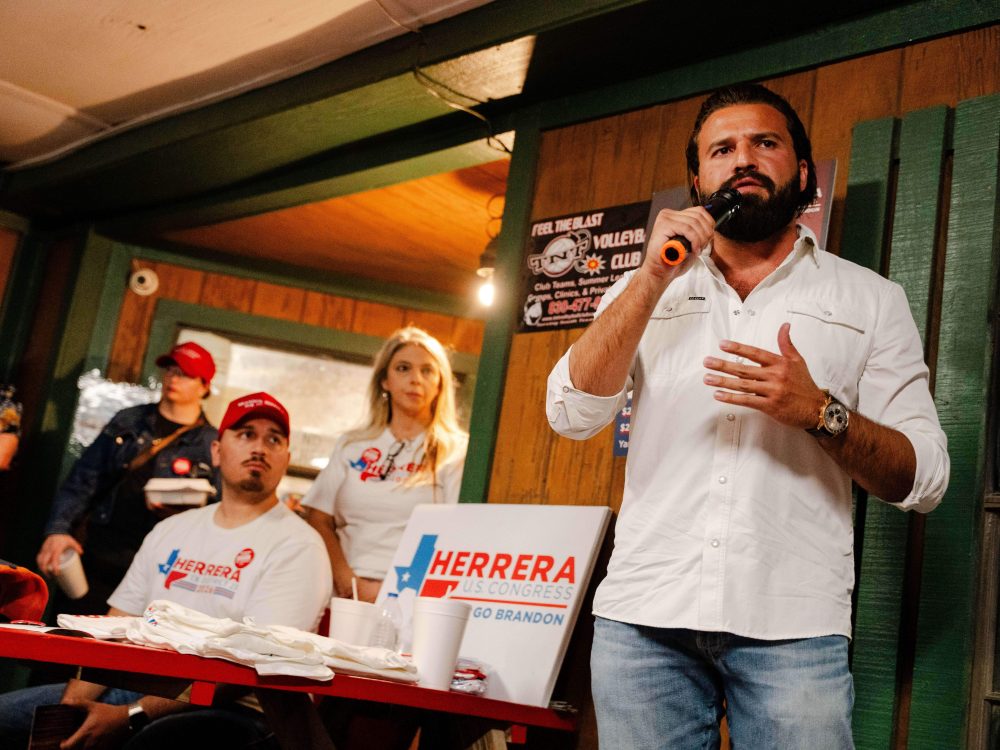
Additional costly races, including North Carolina’s 4th District and Texas’s 2nd and 23rd Districts, involved incumbents — who typically enjoy spending advantages — defending against challengers. Republican Representative Dan Crenshaw became 2026’s first House incumbent to lose reelection despite his campaign receiving more than $2.3 million in attack ads against opponent state Representative Steve Toth. Brandon Herrera invested almost $1.4 million in advertisements targeting Representative Tony Gonzales, whose reelection effort suffered from recent controversy.
Herrera and Gonzales will face each other in a runoff, while several other incumbents await final determinations.
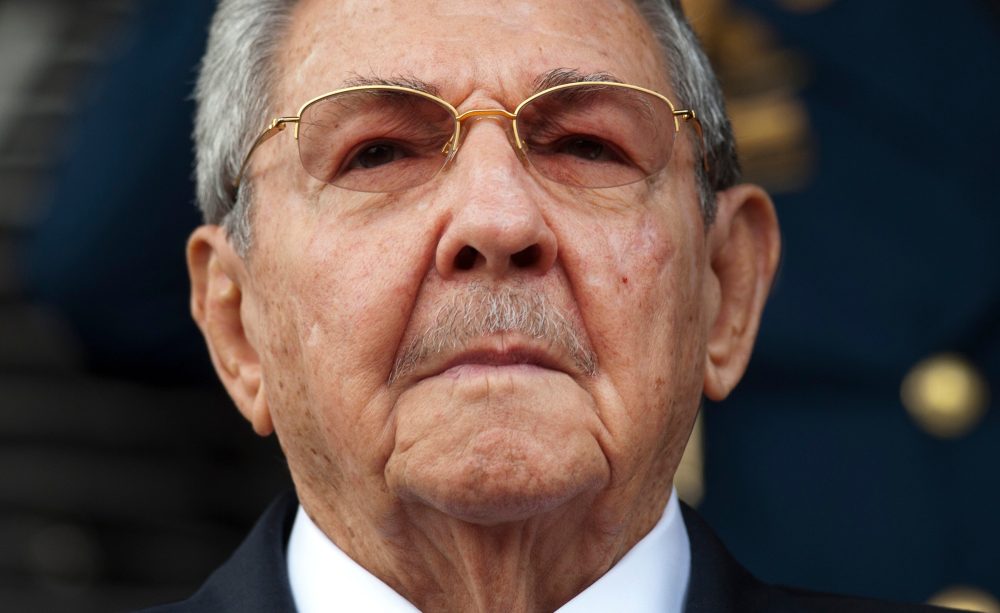
MIAMI (AP) — Florida’s top prosecutor announced Wednesday that the state will resume a criminal probe examining former Cuban leader Raul Castro’s alleged involvement in the deadly 1996 downing of aircraft flown by anti-communist Cuban exiles.
During a Miami press briefing Wednesday, Attorney General James Uthmeier revealed that a criminal inquiry targeting Castro that started years ago was halted under the Biden administration’s watch.
“When this came to my attention, we reactivated the files,” Uthmeier said. “So yes, that investigation will be ongoing.”
As the February 1996 incident’s 30th anniversary nears, multiple Miami-area Republican officials and Florida Senator Rick Scott have urged the Trump administration to restart federal criminal proceedings focused on Castro’s suspected involvement in shooting down two Brothers to the Rescue aircraft.
This revived focus on the case comes as Trump adopts an increasingly hardline approach toward Cuba’s communist government following the U.S. apprehension of Venezuela’s President Nicolas Maduro, a key Cuban ally.
In a February 13 correspondence to Trump, congressional representatives including Maria Elvira Salazar and Carlos Gimenez referenced historical news accounts suggesting Castro — who commanded Cuba’s armed forces during that period — authorized the attack on the civilian Cessna planes.
“We believe unequivocally that Raul Castro is responsible for this heinous crime,” lawmakers wrote. “It is time for him to be brought to justice.”
Speaking at Wednesday’s press event, Uthmeier emphasized the importance of holding accountable those who may have committed crimes against Florida residents.
“I can’t really say too much more at this point, but we are going to continue this investigation,” he said during the news conference. “I know a lot of members of the state legislature and other people here in Florida would like to see some resolution and ideally accountability.”
Uthmeier’s office declined to provide additional details about the ongoing investigation when contacted.
Cuban government representatives did not respond to requests for comment Wednesday.
So far, American courts have only secured one conviction related to the aircraft downing conspiracy. Gerardo Hernández, who led a Cuban spy network broken up by federal agents in the 1990s, received a life sentence but was freed by President Barack Obama in a December 2014 prisoner exchange after 16 years behind bars.
Two Cuban fighter pilots and their superior officer have also faced indictments but remain beyond U.S. law enforcement’s reach while residing in Cuba.
DENVER (AP) — Colorado’s Democratic governor is contemplating clemency for a former county clerk imprisoned for election fraud activities, following pressure from President Donald Trump.
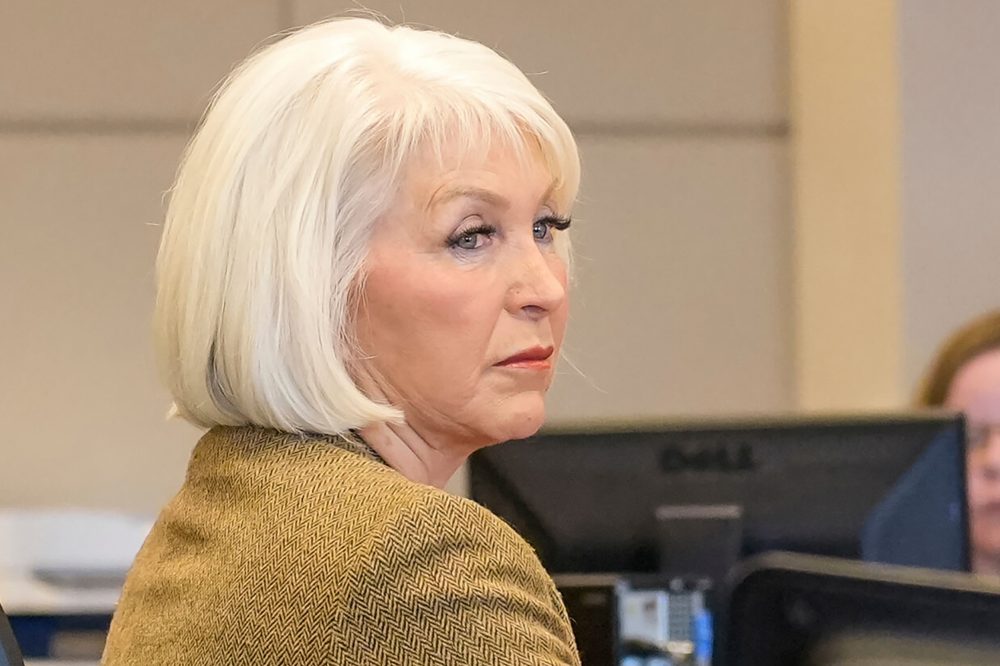
Governor Jared Polis drew sharp criticism Wednesday from the state’s top officials after indicating his willingness to consider reducing the sentence of former Mesa County Clerk Tina Peters. The attorney general, secretary of state, and local election officials association condemned the potential move as sending a dangerous message before upcoming midterm elections.
On Tuesday, Polis compared Peters’ situation to that of a former state legislator who received a much lighter sentence despite being convicted of similar charges. Peters is currently serving nine years in prison, while the former lawmaker received only probation and community service. The governor had previously called Peters’ sentence “harsh” in January, noting she had no prior criminal record.
“Justice in Colorado and America needs to be applied evenly, you never know when you might need to depend on the rule of law. This is the context I am using as I consider cases like this that have sentencing disparities,” Polis wrote on the social platform X.
Peters’ legal team praised the governor’s statements and expressed hope for her sentence to be reduced to time already served — approximately 17 months. They seek her release while pursuing appeals to overturn her convictions.
“Action takes real courage,” said one of her lawyers, John Case.
Case declined to discuss any potential communications with the governor’s office regarding clemency, citing the confidential nature of such proceedings.
Peters has gained support among those who believe Trump’s unfounded claims about the 2020 election being stolen, particularly conspiracy theory advocates.
Trump has threatened severe consequences against Colorado unless Peters is freed, and his administration has already suspended state funding.
Secretary of State Jena Griswold, a Democrat seeking the attorney general position, called Polis’ remarks “shocking and worrisome.” She criticized his comparison between Peters and former state Senator Sonya Jaquez Lewis, noting that while both were convicted of attempting to influence a public servant, they faced different additional charges.
Colorado Attorney General Phil Weiser, whose office participated in Peters’ prosecution, emphasized that Peters has shown no regret for her actions.
“Clemency should be based on remorse, rehabilitation, and extenuating circumstances — not on political influence, favor, or retribution,” stated Weiser, a Democrat running to succeed the term-limited Polis.
U.S. Senator Michael Bennet, also seeking to replace Polis as governor, opposed any pardon or sentence reduction for Peters.
“Donald Trump may be seeking revenge on Colorado, but surrendering to his political pressure will not make our state stronger or safer,” the Democrat declared.
Matt Crane, executive director of the Colorado County Clerks Association, argued there are minimal similarities between Peters’ and Lewis’ cases.
“It seems he’s tying himself in knots trying to find a way to commute her sentence,” he said of the governor.
Crane expressed concern that early release would send the wrong signal before midterm elections.
“The signal is it’s OK to work to undermine our elections because, whether it’s President Trump or Jared Polis, you’ll get a get-out-of-jail free card,” Crane said.
Governor spokesperson Shelby Wieman responded that Polis has questioned the disparity between Peters’ sentence and that of the former legislator.
Unlike many Democratic governors, Polis, who considers himself a political maverick, has occasionally taken conciliatory positions toward Trump. Upon Trump’s inauguration, Polis supported the Department of Government Efficiency concept under Elon Musk and endorsed Robert F. Kennedy Jr.’s nomination for Health and Human Services Secretary.
However, he has also criticized Trump’s positions on tariffs and immigration policies.
Both Peters and Lewis were found guilty of attempting to influence a public servant — a charge involving deception or threats to manipulate public officials.
Lewis faced one count of that charge plus three forgery counts. Prosecutors alleged she fabricated support letters during a legislative ethics probe into staff mistreatment allegations. Her attorney, Craig Truman, refused to comment on her case.
Peters was convicted for allowing an unauthorized computer expert to copy her county’s election system data before and after a 2021 state update. Confidential voting system passwords were subsequently published on social media and conservative websites. Peters claimed she was fulfilling her duty as clerk to preserve this information.
Peters was found guilty on three counts of attempting to influence a public servant, plus single counts of conspiracy to commit criminal impersonation, first-degree official misconduct, violation of duty, and failure to comply with secretary of state requirements.
Peters’ attorneys argue the judge violated her First Amendment rights by imposing a harsh sentence for her election fraud allegations. The judge labeled her a “charlatan” and declared she endangered the community by spreading voting misinformation and undermining democratic processes.
During January oral arguments, appeals court judges appeared receptive to the free speech defense.
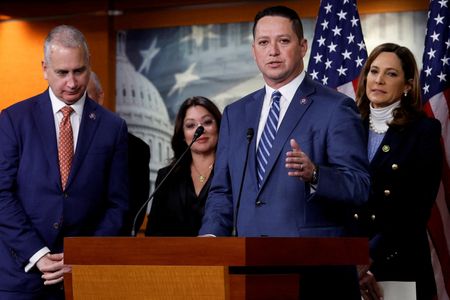
The House Ethics Committee announced Wednesday it will investigate Texas Republican Representative Tony Gonzales following accusations of sexual misconduct and preferential treatment involving a former congressional staffer who later took her own life.
The 45-year-old three-term lawmaker maintains his innocence amid the allegations, which have sparked calls for his resignation from multiple House Republicans. Fellow GOP Representative Anna Paulina Luna filed two separate measures Wednesday seeking to censure Gonzales and remove him from his committee positions.
According to the ethics panel’s statement, the investigation will examine whether Gonzales “engaged in sexual misconduct towards an individual employee in his congressional office and/or discriminated unfairly by dispensing special favors or privileges.”
The controversy centers around explicit text messages between Gonzales and former staff member Regina Santos-Aviles, which were published by the San Antonio Express-News. Santos-Aviles died by suicide in September.
These developments follow Tuesday’s Texas primary results, where Gonzales narrowly avoided defeat against challenger Brandon Herrera, a conservative YouTube personality and gun rights activist known as “the AK Guy.” With neither candidate securing 50% of the vote, the race heads to a May runoff. Gonzales led by fewer than 1,000 votes and previously defeated Herrera by just hundreds of votes in the 2024 primary.
Herrera has received backing from the House Freedom Caucus, the chamber’s most conservative faction.
In a February 22 social media post on X, Gonzales defended himself against what he called coordinated political attacks, stating: “During my six years in Congress not a single formal complaint has been levied against my office. Now days away from an election, coordinated political attacks reign in. IT WONT WORK. Half way through early voting and the intensity resides w/ TG voters. I’d rather be us than them.”
Gonzales’ office has not provided a response to requests for comment regarding the ethics investigation.
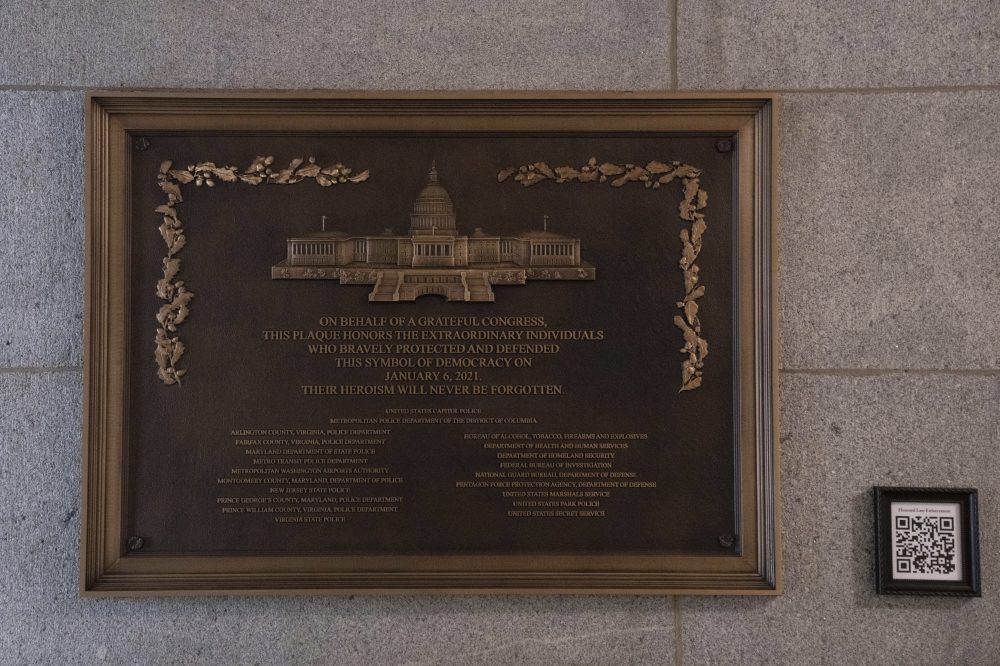
WASHINGTON — Capitol visitors can now see a permanent tribute to law enforcement officers who defended the building during the January 6, 2021 assault, following the quiet installation of a memorial plaque that had been delayed for three years.
Workers placed the commemorative marker near the Capitol’s West Front, close to where some of the most intense confrontations took place that day. The installation occurred on the Senate side of the building after senators unanimously approved moving forward with the project in January, following delays by House Speaker Mike Johnson.
The memorial bears an inscription reading: “On behalf of a grateful Congress, this plaque honors the extraordinary individuals who bravely protected and defended this symbol of democracy on January 6, 2021. Their heroism will never be forgotten.”
The Washington Post reported witnessing the installation around 4 a.m. Saturday morning.
Senator Thom Tillis of North Carolina spearheaded the installation effort while marking the fifth anniversary of the Capitol breach. Reflecting on his memories of hearing intruders forcing their way into the building, Tillis praised the officers who faced thousands of former President Donald Trump’s supporters before eventually forcing them out. “We owe them eternal gratitude, and this nation is stronger because of them,” Tillis stated.
The violent crowd that overwhelmed police barriers and stormed the building were repeating Trump’s unfounded allegations about election fraud following his 2020 defeat to Democrat Joe Biden. The mob halted the congressional certification of Biden’s electoral victory for several hours, forcing lawmakers to evacuate and causing significant property damage before authorities restored order. Over 140 officers from the Capitol Police, Metropolitan Police, and other departments sustained injuries during the incident.
The battle over the plaque’s installation unfolded as Trump prepared to return to the presidency and maintained Republican congressional support. Trump has characterized January 6 as a “day of love” and has attempted to shift responsibility for the violence onto Democrats and law enforcement.
Lawmakers enacted legislation in 2022 mandating the creation of an honorary plaque bearing the names of officers “who responded to the violence that occurred,” with a one-year installation deadline that went unmet.
Following more than a year of inaction and a legal challenge filed by two officers who defended the Capitol, Johnson claimed earlier this year that technical issues with the statute prevented the plaque’s installation.
Tillis subsequently brought a resolution to the Senate floor, which passed without opposition, authorizing placement of the memorial on the Senate side.
Metropolitan Police Officer Daniel Hodges, one of the plaintiffs in the ongoing lawsuit, indicated the legal action would continue despite the installation. Hodges, who was trapped and injured by rioters in heavy doors near where the plaque now stands, called Saturday’s overnight installation a “fine stopgap” but noted it doesn’t fully satisfy the original law’s requirements, including listing all officers’ names and meeting other technical specifications.
“The weight of a judicial ruling would help secure the memorial against future tampering,” Hodges explained. “Our lawsuit persists.”
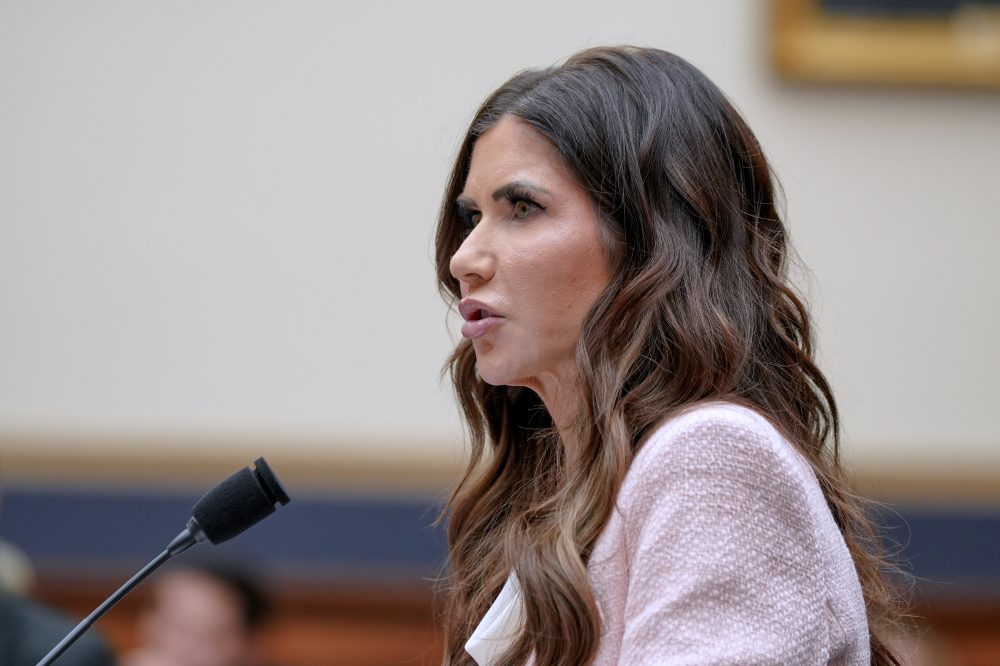
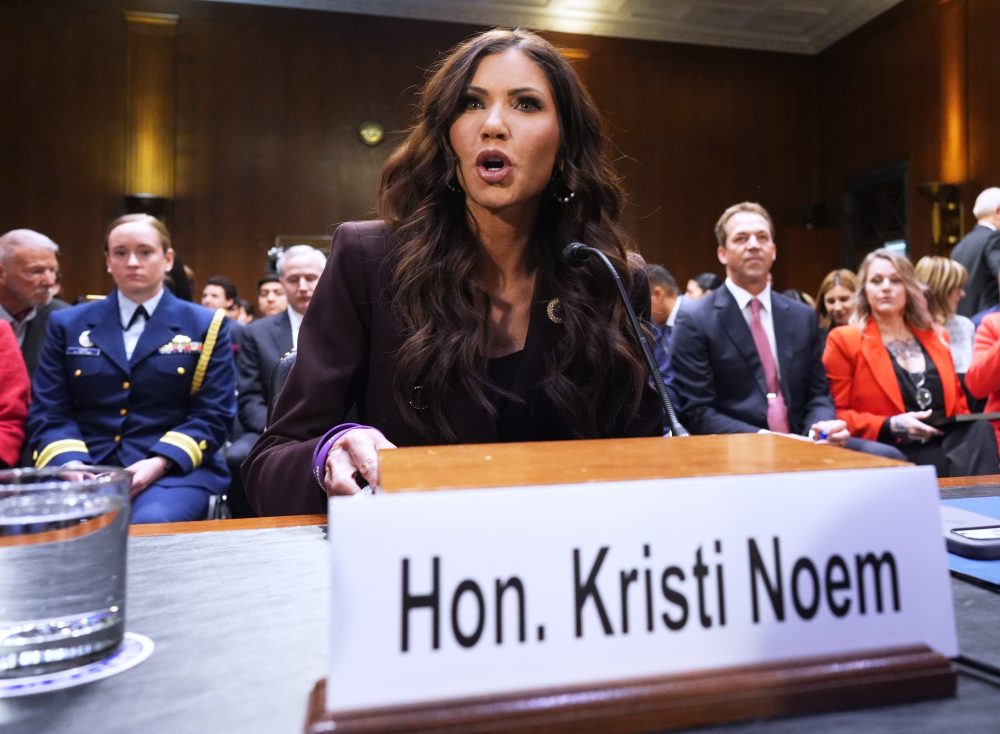
WASHINGTON — Secretary of Homeland Security Kristi Noem concluded two days of intense congressional hearings Wednesday, marking her first appearance before lawmakers following the fatal shooting of two demonstrators in Minneapolis by federal immigration agents.
Democratic members of Congress — along with several Republicans — delivered harsh criticism of Noem over claims that immigration officers under her leadership have violated the rights of both immigrants and U.S. citizens while employing unnecessary force. Lawmakers also questioned her department’s financial management of billions in congressional funding and accused her of avoiding responsibility.
The secretary, who leads President Donald Trump’s immigration enforcement efforts, maintains she has bolstered national security by reducing migration at the southern border. She defended immigration officers as law-abiding when confronting violent demonstrators. Most Republican lawmakers supported her position, describing Noem as working to address immigration issues left unresolved by President Joe Biden’s previous administration.
Throughout both hearing sessions, lawmakers repeatedly challenged Noem’s description of the deceased protesters, Renee Good and Alex Pretti, as armed troublemakers. Video footage and witness statements from bystanders have disputed Noem’s version of events.
House committee ranking Democrat Jamie Raskin of Maryland confronted Noem about her statements.
“You told a lie about them. You said they were domestic terrorists,” Raskin said.
Additional Democratic representatives questioned the use of force by DHS agents in removing individuals from vehicles and the detention of an American citizen taken from his Minneapolis residence while in sleepwear.
Noem encountered criticism from Republican lawmakers as well, particularly from outgoing Senator Thom Tillis of North Carolina, who labeled her leadership a “disaster” during Tuesday’s session.
Throughout the hearings, Noem countered the accusations, claiming Democrats possessed inaccurate information while defending her officers’ methods.
“We do targeted enforcement based on intelligence and go after the worst of the worst,” Noem said.
Addressing her post-shooting remarks on Tuesday, Noem explained she relied on information from field personnel and attributed responsibility to “violent protesters” for creating the chaotic situation officers faced.
According to a letter obtained by The Associated Press, Homeland Security Inspector General Joseph Cuffari stated that DHS leadership has “systematically obstructed” his office’s work across 11 cases, including one criminal probe with a “nexus” to the department.
Cuffari reported that his office was denied access to databases and prevented from taking other investigative steps.
Georgia Democratic Representative Hank Johnson questioned Noem about the correspondence, stating her department demonstrated a “pattern of obstructing investigations.”
Noem rejected the claim, saying Cuffari failed to specify what information he sought and his timeline for requests.
“He wants unfettered access to every single thing in the department. And that’s not the process,” Noem said.
Congress allocated $170 billion to Noem’s department, funding that has generated questions about its allocation and usage.
On Wednesday, the secretary faced questions about her department’s $220 million advertising campaign featuring Noem that urged undocumented individuals to depart voluntarily.
Democrats questioned whether contracts followed competitive bidding procedures and if Noem’s connections inappropriately benefited from the process.
“You’re using millions of dollars of taxpayer money in this way,” said Democratic Representative Joe Neguse, who labeled it fraudulent. “Ultimately I think there’s going to be accountability.”
Noem maintained the expenditures were legal.
The committee’s top Democrat also criticized Noem regarding her department’s acquisition of luxury aircraft.
The Associated Press previously reported that federal agents were claiming broad authority to forcibly enter suspects’ homes without judicial warrants — actions legal scholars say violate constitutional protections.
During both hearing days, Noem defended the warrants as proper and legal. She described their use in forced entries as limited, stating they were employed only 28 times under her leadership, without specifying locations.
“We do use it, but it’s very rare when we do,” Noem said.
However, even Republicans objected to the warrant usage. Kentucky Representative Thomas Massie stated he’s a “strong proponent of the Fourth Amendment, and I think it would be helpful if we stuck to that.”
California Democratic Representative Sydney Kamlager-Dove questioned Noem about her connection to Corey Lewandowski, a special government employee serving as one of the secretary’s senior advisers.
Lewandowski served as Trump’s initial 2016 campaign manager and remained one of his prominent supporters. He subsequently became a key Noem ally, facilitating her access to the former president’s political network.
Upon Noem’s appointment to DHS, Lewandowski received special government employee status — a role intended to restrict his working days at the department. However, his constant presence alongside Noem has raised questions about his actual work schedule and the nature of their relationship.
Kamlager-Dove described Lewandowski as wielding “unchecked” and “unconfirmed” authority and directly asked whether Noem and Lewandowski were romantically involved.
“At any time during your tenure as director of the Department of Homeland Security have you had sexual relations with Corey Lewandowski?” said Kamlager-Dove.
“Mr. Chairman, I am shocked that we are going down and peddling tabloid garbage in this committee today,” Noem responded. She denied the allegations, called the questioning offensive, and stated Lewandowski lacks decision-making authority.
WASHINGTON — Four people required medical attention following a violent altercation in a Senate office building Wednesday when a demonstrator fought back against law enforcement officers attempting to remove him from a committee hearing.
Brian C. McGinnis from North Carolina now faces six criminal charges, including three counts each of assaulting police officers and resisting arrest plus unlawful demonstration, according to Capitol Police officials.
“This afternoon, an unruly man who started to illegally protest during a hearing put everyone in a dangerous position by violently resisting and fighting our officer’s attempts to remove him from the room,” Capitol Police said in a statement.
Video footage captured McGinnis rising from his seat and beginning to yell during the Senate Armed Services committee session, with law enforcement immediately moving to escort him out. His outburst focused on U.S. military involvement in Iran, as he called out, “America does not want to send its sons and daughters to war for Israel!”
As officers attempted to escort McGinnis to the exit, he fought against their efforts and clung to a doorframe. Republican Senator Tim Sheehy of Montana, an Armed Services committee member and former Navy SEAL, rushed to help by pulling the demonstrator’s arm away from the door while other protesters claimed McGinnis’ hand was trapped.
According to Capitol Police, McGinnis “got his own arm stuck in a door to resist our officers and force his way back into the hearing room,” and received treatment for resulting injuries.
Senator Sheehy later posted on social media that his intention was to calm the volatile situation.
“This gentleman came to the Capitol looking for a confrontation, and he got one,” Sheehy stated. “I hope he gets the help he needs without causing further violence.”
Social media posts from an account bearing McGinnis’ name show him outside the Capitol building Wednesday morning before the hearing began. The profile identifies him as a “Green Party Candidate for US Senate.”
In the pre-hearing video, he explained his presence in Washington, saying he was “here in D.C. trying to speak out against the Senate” regarding potential military conflicts.
“Anyone who feels disillusioned and betrayed by our government, you are not alone,” he stated in the recording.
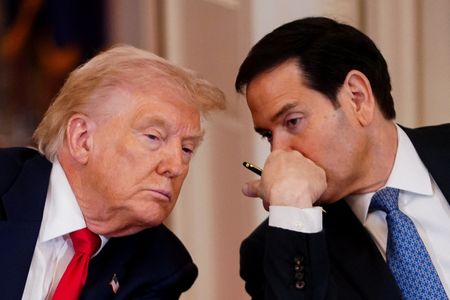
Former President Donald Trump announced Saturday that Cuba is actively seeking to establish an agreement through ongoing discussions with him and Secretary of State Marco Rubio.
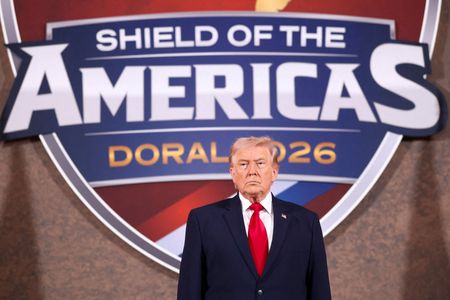
During his address at the “Shield of the Americas” conference featuring Latin American leaders in Miami, Florida, Trump characterized Cuba as being “at the end of the line.”
“They want to negotiate, and they are negotiating with Marco (Rubio) and myself and some others, and I would think a deal would be made very easily with Cuba,” Trump stated during the event.
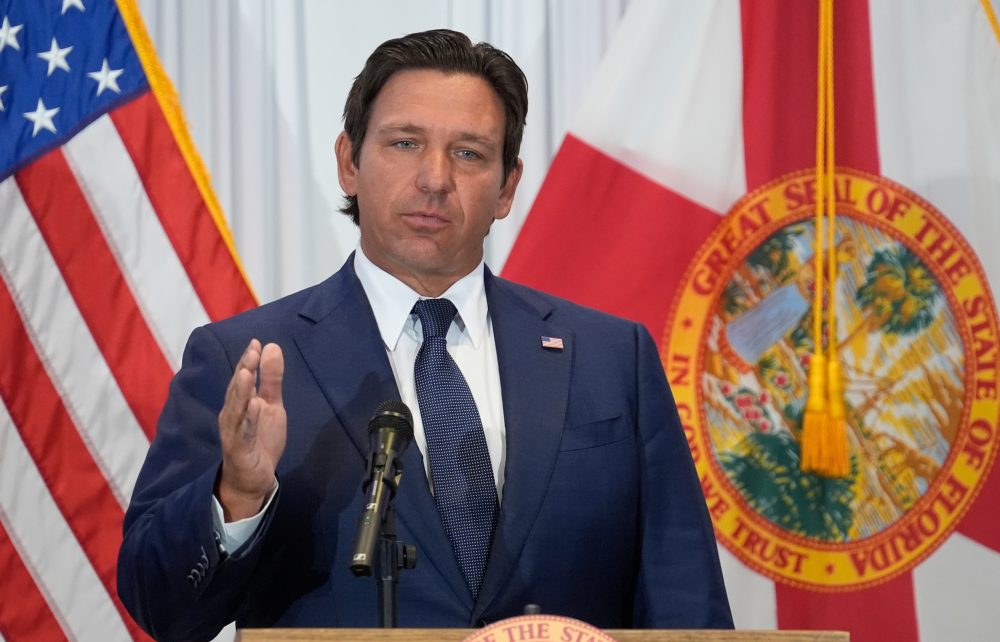
TALLAHASSEE, Fla. — A federal court has temporarily halted enforcement of Florida Governor Ron DeSantis’ controversial executive order from last year that classified two Muslim organizations as foreign terrorist groups.
U.S. District Judge Mark E. Walker issued a preliminary injunction on Wednesday, stating in his ruling that the First Amendment prevents the governor from continuing what he called a concerning pattern of exploiting executive power to make political statements while violating others’ constitutional protections.
DeSantis’ directive specifically named the Council on American-Islamic Relations and the Muslim Brotherhood as targets. The governor’s office had not responded to requests for comment by Wednesday evening regarding the court’s decision.
The Council on American-Islamic Relations, along with additional civil rights organizations, filed suit against DeSantis in December following the executive order’s release. The organization operates more than 20 chapters nationwide and focuses on legal advocacy, public policy work, and educational initiatives. Their legal challenge argues the executive order violates the law and constitution, particularly claiming DeSantis overstepped by assuming federal government authority reserved for identifying terrorist organizations.
The court’s injunction suspends the executive order’s implementation during ongoing litigation proceedings.
“The question before this Court is whether the Governor can, in a non-emergency situation, unilaterally designate one of the largest Muslim civil rights groups in America as a ‘terrorist organization’ and withhold government benefits from anyone providing material support or resources to the group,” Walker wrote.
Discrimination against Muslims has continued in various forms since the September 11, 2001 attacks, with increased anti-Islamic sentiment observed during the ongoing Gaza conflict spanning more than two years.
In their Florida legal filing, the Council on American-Islamic Relations emphasized their consistent opposition to terrorism and violence. The lawsuit contends DeSantis singled out the organization for protecting free speech rights in situations where state and other officials attempted to penalize or silence individuals expressing support for Palestinian human rights.
DeSantis’ order also applied the terrorist designation to the Muslim Brotherhood, described as a pan-Arab Islamic political organization. President Donald Trump recently issued an executive order in January identifying three Middle Eastern Muslim Brotherhood affiliates as terrorist groups.
The Florida governor’s directive orders state agencies to bar both organizations and their supporters from obtaining government contracts, employment opportunities, and funding from executive or cabinet-level departments.
According to the Council on American-Islamic Relations, approximately 500,000 Muslims live in Florida.
WASHINGTON — A prominent architect and historic preservation expert is raising serious concerns about President Donald Trump’s proposed White House ballroom addition, calling the massive project oversized and potentially damaging to America’s most iconic residence.
David Scott Parker, an American Institute of Architects Fellow whose company focuses on residential design and historic preservation, voiced his criticism to The Associated Press ahead of Thursday’s crucial vote by the National Capital Planning Commission. The federal agency will decide whether to greenlight the sprawling 90,000-square-foot addition, which already received approval from the U.S. Commission of Fine Arts in February.
“Everything here feels inflated,” Parker, who brings more than three decades of architectural experience to his assessment, told reporters. “The net effect of this is to adversely impact what is the most important historic — the most identifiable historic — house in the entire United States. This is permanent, what it will do to the White House.”
The former president revealed his ballroom plans last summer, arguing the White House needed proper indoor space for hosting distinguished visitors instead of relying on temporary lawn tents. Construction began in earnest when Trump ordered the East Wing’s demolition in October with minimal advance notice. Underground preparation work has continued since then, though White House representatives indicated above-ground building wouldn’t commence before April at the soonest.
The National Trust for Historic Preservation, a nonprofit organization, sought court intervention to pause construction until proper approvals were obtained from federal panels and Congress, plus public input opportunities. However, U.S. District Judge Richard Leon denied their temporary restraining order request last week, prompting the Trust to announce plans for a revised legal challenge.
Parker based his architectural critique on design drawings and documentation the White House provided to the fine arts commission in recent weeks.
According to Parker’s analysis, the ballroom alone would occupy roughly 22,000 square feet of the total footprint — far exceeding what’s necessary for Trump’s stated capacity of 1,000 guests. Industry standards typically allocate 15 square feet per person in ballroom settings, Parker explained. Using that calculation, Trump’s ballroom could shrink by 47 percent to approximately 15,000 square feet while still meeting capacity requirements.
The architect also questioned a proposed 4,000-square-foot porch and staircase facing south, arguing these features serve no functional purpose since they wouldn’t provide direct building access for guests. Parker additionally noted the porch design appears to violate Americans with Disabilities Act requirements.
White House officials responded Wednesday by asserting the ballroom would meet federal disability accommodation laws but declined to address Parker’s other criticisms.
The planned portico would dwarf similar architectural features on both the White House’s south side and the neighboring Treasury Department building.
Size-related objections have dogged the project since its announcement. At nearly double the main White House’s 55,000-square-foot dimensions, opponents contend the addition would dominate the historic mansion and disrupt the complex’s carefully balanced proportions.
Parker expressed particular alarm that the addition would protrude enough to block the intentional sight line connecting the White House and Capitol along Pennsylvania Avenue — a design element Pierre L’Enfant incorporated centuries ago when George Washington commissioned him to plan the nation’s capital.
“It’s hard to fathom that … one addition could have so many adverse impacts, symbolically, architecturally and historically,” Parker stated. “This literally violates the Founding Fathers’ intentions.”
Thursday’s commission meeting, scheduled as a virtual session, has drawn significant public interest. Agency records show Parker among more than 100 registered speakers, while thousands submitted written comments beforehand — with many expressing opposition to Trump’s ballroom proposal.
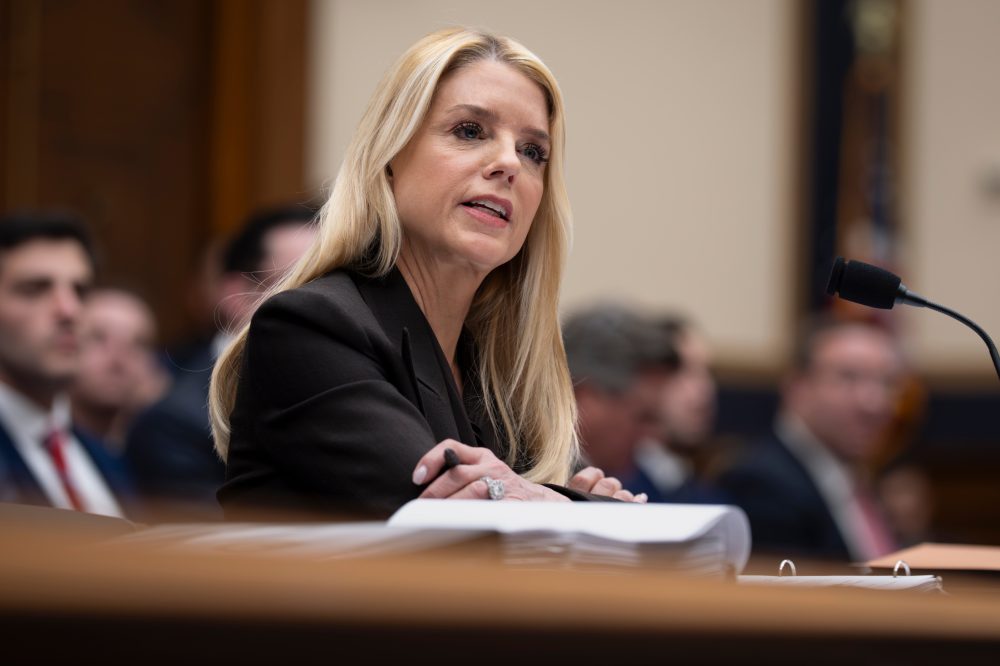
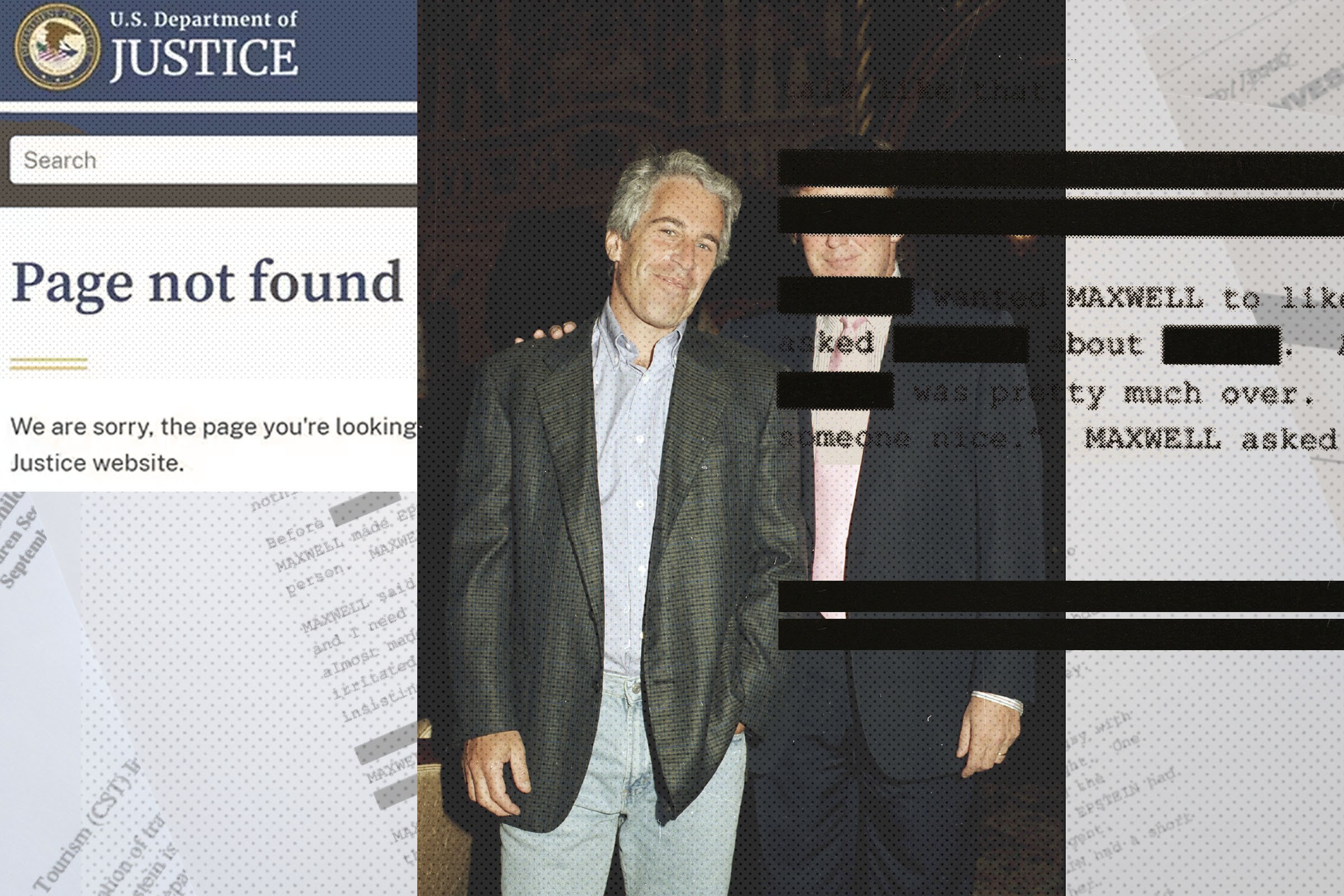
WASHINGTON — Members of the House Oversight Committee approved a subpoena Wednesday demanding Attorney General Pam Bondi testify about how the Justice Department has managed documents from the Jeffrey Epstein sex trafficking case.
The bipartisan vote saw five Republican lawmakers side with Democrats to back the subpoena introduced by GOP Representative Nancy Mace, demonstrating ongoing conservative dissatisfaction with how officials have reviewed and disclosed records connected to the convicted financier. The action represents a stern criticism of Bondi from Republican colleagues who have demanded transparency regarding Epstein’s exploitation of minors and his associations with wealthy, influential individuals.
“The American people want answers on the Epstein files, and so do we,” Mace, representing South Carolina, wrote on X.
Justice Department officials declined to immediately respond to the subpoena request.
The Epstein document controversy continues troubling the Trump administration over a year since Bondi faced criticism for distributing folders of materials containing no significant new information to conservative media figures at the White House. Following an extended examination period, the Justice Department announced in July that investigators found no Epstein “client list” and determined additional files should not be made public.
This conclusion triggered widespread anger that led Congress to enact legislation requiring the Justice Department to disclose the records. Following the initial December release, opponents have criticized the administration for mishandling the process and keeping too many documents secret. Government representatives have stated attorneys worked efficiently to properly examine, redact and publish millions of pages mandated by law.
“For months, Attorney General Bondi has been instrumental in orchestrating the White House’s cover-up of the Epstein files, and has failed to comply with our bipartisan subpoena for the release of the complete, unredacted files,” stated Representative Robert Garcia of California, the committee’s ranking Democrat. “The American people deserve transparency, survivors deserve justice, and we are demanding answers.”
Bondi has stood by the department’s document management and has claimed Democrats are exploiting the controversy to overshadow Trump’s achievements, despite vocal criticism emerging from the president’s own party members.
During a contentious congressional session last month, Democratic lawmakers criticized Bondi over careless redactions in the Epstein materials that revealed personal victim information and contained explicit photographs. Bondi informed legislators that the Justice Department removed files after learning they contained victim details and said personnel attempted their “very best” within the timeframe established by the release legislation.
The demand for Bondi’s testimony follows the Justice Department’s announcement last week that it would investigate whether documents were inappropriately withheld after multiple news outlets reported that certain records containing unverified allegations against Trump by a woman were excluded from public releases.
This development came after media reports indicated that a large collection of records released by the Justice Department omitted several interview summaries the FBI conducted with an unnamed woman who contacted authorities following Epstein’s 2019 arrest, alleging sexual assault by both Trump and Epstein during her minor years in the 1980s.
Former President Bill Clinton and former Secretary of State Hillary Clinton recently provided their own depositions to committee members regarding the former Democratic president’s relationship with Epstein from over twenty years ago.
Bill Clinton informed Congress members Friday that he “did nothing wrong” in his association with Epstein and observed no evidence of Epstein’s sexual misconduct. Hillary Clinton told lawmakers she had no awareness of Epstein’s criminal activities and could not recall “ever encountering Mr. Epstein.”
President Donald Trump revealed on Saturday his administration’s formation of a military partnership designed to eliminate drug cartels operating throughout the Western Hemisphere, stating that 17 countries have officially joined the coalition.
The announcement marks a significant expansion of anti-cartel efforts across the Americas, with Trump describing the initiative’s goal as the complete eradication of cartel operations in the region.
Details about which specific nations have committed to the alliance or the operational structure of the coalition were not immediately provided in the announcement.
WASHINGTON – Senators from both parties are expressing national security worries about Intel Corporation’s decision to test semiconductor manufacturing equipment produced by a company with strong ties to China.
Democratic Senator Elizabeth Warren and Republican Tom Cotton spearheaded the bipartisan effort Wednesday, sending concerns to Intel regarding ACM Research, a chipmaking equipment manufacturer based in Fremont, California.
ACM Research maintains substantial Chinese operations and has two international divisions that face U.S. sanctions. The company serves sanctioned Chinese firms including YMTC, CXMT and SMIC, raising fears that sensitive Intel information could be transferred to Chinese clients, according to the senators.
In their Wednesday letter to Intel CEO Lip-Bu Tan, the lawmakers stated: “By operating in Intel’s facilities, ACM could gain exposure to cutting-edge chipmaking processes that may materially improve the quality and competitiveness of ACM and Chinese military companies.”
Intel responded by clarifying that “ACM tools are not used in Intel’s semiconductor production processes,” emphasizing the company’s full compliance with U.S. laws and regular communication with government officials on security issues.
ACM Research did not provide immediate comment on the matter.
The company had previously stated it cannot discuss “specific customer engagements,” but confirmed that “ACMR’s U.S. team has sold and delivered multiple tools from our Asian operations to domestic customers.” ACM also disclosed shipping three tools to a “major U.S.-based semiconductor manufacturer” for testing purposes, with some meeting performance requirements.
The letter included signatures from Democrats Elissa Slotkin and Andy Kim, along with Republicans Jim Banks and Pete Ricketts, demonstrating cross-party anxiety about China’s expanding influence in American semiconductor production.
The House Selection Committee on China previously expressed concern in October about ACM Research selling semiconductor manufacturing equipment to a U.S. semiconductor company that certified ACM’s tools for production use.
The senators also highlighted Intel’s special obligations given the federal government’s ownership stake in the company, particularly following CEO Lip-Bu Tan’s challenges with former President Trump over alleged Chinese connections.
“This raises important questions about Intel’s fiduciary responsibility and approach to safeguarding the public interest, including how the company benefits American economic interests and taxpayers,” the lawmakers wrote.
They added: “Intel’s entanglements with blacklisted Chinese companies calls into question whether taxpayer dollars are subsidizing activities that could directly threaten U.S. national security and leadership in semiconductor manufacturing.”
WASHINGTON — Military operations against Iran have sparked a political debate over America’s defense inventory levels, highlighting manufacturing challenges that defense experts warn could impact future conflicts.
Trump administration officials maintain that U.S. forces possess adequate weaponry for the ongoing Iran conflict, which has entered its second week. On Friday, President Donald Trump announced via social media that multiple defense companies committed to increasing weapons manufacturing by four times “as rapidly as possible,” though specific weapon systems weren’t identified.
Democratic legislators have intensified scrutiny of national weapons reserves as military operations against Iran expand, with many calling Trump’s actions a “war of choice.” Defense analysts indicate missile defense systems face the greatest pressure, particularly Patriot and Terminal High Altitude Area Defense (THAAD) interceptors currently deployed in Ukraine and Israel.
“I’m not particularly worried about us actually running out during this conflict,” stated Ryan Brobst, a defense strategy researcher at the Foundation for Defense of Democracies. “It’s about deterring China and Russia the day after this conflict is over.”
American forces deploy both defensive systems to counter Iranian missile attacks launched in response to U.S. and Israeli strikes. However, Pentagon officials acknowledge difficulties stopping drone swarms from the Islamic Republic, prompting deployment of an American anti-drone technology successful against Russian drones in Ukraine. The Merops system offers cost advantages, firing at drones costing under $50,000 rather than using missiles worth hundreds of thousands of dollars.
Pentagon chief spokesman Sean Parnell stated that the U.S. military “has everything it needs to execute any mission at the time and place of the President’s choosing and on any timeline.”
Defense contractor Lockheed Martin announced Friday on X that it agreed to “quadruple critical munitions production” and “began this work months ago.” Neither Trump nor Lockheed provided timelines for achieving production targets.
Democratic lawmakers question the long-term consequences for America and its allies.
“We’ve been told again and again and again one reason that we can’t provide interceptors for the Patriot system or other munitions for Ukraine is that they’re in short supply,” Senator Richard Blumenthal, D-Conn., told CNN Thursday.
Senator Mark Warner, D-Va., informed reporters that American supplies have decreased following military engagements with Houthi rebels in Yemen and recent Republican administration conflicts. The Senate Intelligence Committee’s top Democrat didn’t specify which munition types he referenced.
“Our munitions are low. That’s public knowledge,” Warner stated. “It will require additional funding, funding where we have other domestic needs as well.”
Defense interceptor supplies face the greatest strain, according to Brobst, who serves as deputy director of the Center on Military and Political Power at the Foundation for Defense of Democracies, a Washington-based hawkish think tank.
THAAD systems target medium-range ballistic missiles, while Patriot systems counter short-range ballistic missiles and piloted aircraft. Approximately 25% of America’s entire THAAD inventory was reportedly used protecting Israel from Iranian ballistic missiles during last summer’s 12-day conflict with Iran, Brobst noted.
“These were already in very high demand and we had not procured enough before the conflict,” Brobst explained. “And now we’ve probably used, between the two of them, probably several hundred more.”
Exact quantities of U.S. THAAD and Patriot systems remain classified, with administration officials and Democratic lawmakers refusing to provide specifics.
Interceptor demand likely decreases as the U.S. and allies eliminate Iran’s weapons capabilities, Brobst observed. General Dan Caine, Joint Chiefs of Staff chairman, reported this week that Iranian ballistic missile launches dropped 86% from the conflict’s opening day.
Additional sought-after munitions include cruise missiles and precision-guided missiles, called “standoff” weapons, Brobst said. Their stockpiles appear healthier, with usage probably peaking early in the war as U.S. forces targeted Iran’s early-warning systems, air defenses and other installations.
Defense Secretary Pete Hegseth confirmed that American forces used more “standoff munitions at the start, but no longer need to.” He told reporters Wednesday they would employ “500-pound, 1,000-pound and 2,000-pound GPS- and laser-guided, precision gravity bombs.”
America maintains adequate supplies of these weapon types, which cost less but require aircraft to approach targets more closely, Brobst said.
The U.S. military plans to strengthen regional anti-drone capabilities with the Merops system that uses drones against drones. Small enough for a midsize pickup truck, it identifies drones and pursues them, utilizing artificial intelligence for navigation when satellite and electronic communications face jamming.
Brobst noted the advanced munitions shortage problem, especially interceptors, existed long before the Iran war, though “this has definitely not made it get any better by using up these munitions.”
“Successive administrations over multiple decades did not procure sufficient quantities of these interceptors, and when that happens, companies don’t have an incentive to expand their production capacity,” Brobst explained, adding that production increases require “significant time.”
The administration recently promised increased defense spending and accelerated production while directing the Pentagon to identify underperforming defense contractors with insufficient manufacturing investment.
Katherine Thompson, a former deputy senior adviser at the Pentagon during the current Trump administration, said former President Joe Biden reduced interceptor stockpiles by sending them to Ukraine.
“It was a short-term win for the Biden administration but a long-term strategic problem for the United States as a whole,” said Thompson, who departed her Pentagon role in October and now serves as a senior fellow in defense and foreign policy studies at the libertarian Cato Institute. “I would hope that the Trump administration doesn’t make that same mistake here.”
Riki Ellison, chairman of the Missile Defense Advocacy Alliance, said the U.S. military could relocate interceptors globally or obtain them from allies if necessary. He also highlighted Pentagon efforts encouraging defense contractors to increase production.
“We’re moving in that direction,” Ellison said. “That’s not going to be ready next week or anything, but it’s moving.”
President Donald Trump is scheduled to attend a solemn ceremony at Dover Air Force Base this Saturday, where he will honor six American soldiers who lost their lives in Middle East combat operations.
The ceremony, known as a dignified transfer, represents one of the most profound responsibilities any president must fulfill. Trump previously described witnessing these transfers as “the toughest thing I have to do” during his presidency.
Taking to his social media platform Friday evening, Trump announced: “I will be going to Dover Air Force Base tomorrow, with the First Lady and Members of my Cabinet, to pay our Highest Respect to our Great Warriors, who are returning home for the last time. GOD BLESS THEM ALL!”
The fallen service members include Sgt. 1st Class Nicole Amor, 39, from White Bear Lake, Minnesota; Capt. Cody Khork, 35, from Winter Haven, Florida; Chief Warrant Officer 3 Robert Marzan, 54, from Sacramento, California; Maj. Jeffrey O’Brien, 45, from Indianola, Iowa; Sgt. 1st Class Noah Tietjens, 42, from Bellevue, Nebraska; and Sgt. Declan Coady, 20, from West Des Moines, Iowa, who received a posthumous promotion from specialist.
All six Army Reserve members served with the 103rd Sustainment Command headquartered in Des Moines, Iowa, a unit responsible for delivering essential supplies including food, fuel, water, ammunition, and transportation equipment. Their deaths resulted from a drone attack on a command facility in Kuwait, occurring just 24 hours after U.S. and Israeli forces began their military offensive against Iran.
Iowa Republican Senator Joni Ernst, who has combat experience, honored the fallen soldiers after their identities were released, stating: “These soldiers engaged in the most noble mission: protecting their fellow Americans and keeping our homeland secure. Our nation owes them an incredible debt of gratitude that can never be repaid.”
The ceremonial process involves flag-draped transfer cases containing the soldiers’ remains being moved from the transport aircraft to vehicles that will carry them to the base’s mortuary facility. There, the service members receive final preparation for burial.
Joey Amor, Nicole’s husband, revealed earlier this week that his wife was expected to return home to their family and two children in just a few days.
“You don’t go to Kuwait thinking something’s going to happen, and for her to be one of the first – it hurts,” Joey Amor expressed.
Major O’Brien dedicated nearly 15 years to Army Reserve service, his LinkedIn profile shows. His aunt remembered him on Facebook as “the sweetest blue-eyed, blonde farm kid you’d ever know. He is so missed already.”
Robert Marzan’s sister paid tribute to him on Facebook, calling him a “strong leader” and devoted family man.
“My baby brother, you are loved and I will hold onto all our memories and cherish them always in my heart,” Elizabeth Marzan posted.
Despite being among the youngest in his training class, Declan Coady excelled at military computer system troubleshooting and made a strong impression on his instructors, according to his father Andrew Coady, who spoke with The Associated Press.
“He trained hard, he worked hard, his physical fitness was important to him. He loved being a soldier,” Coady explained. “He was also one of the most kindest people you would ever meet, and he would do anything and everything for anyone.”
Cody Khork’s relatives remembered him as “the life of the party” with an “infectious spirit” and “generous heart,” noting his childhood dream of military service.
“That commitment helped shape the course of his life and reflected the deep sense of duty that was always at the core of who he was,” his parents Donna Burhans, James Khork, and stepmother Stacey Khork said in their statement.
Noah Tietjens carried on his family’s military tradition, having previously deployed to Kuwait alongside his father. His February 2010 homecoming featured an emotional reunion with his wife at a local church gymnasium.
Tietjens’ cousin Kaylyn Golike requested prayers for his surviving family members, including his 12-year-old son, wife, and parents as they cope with this “unimaginable loss.”
Trump’s most recent Dover visit occurred in December, when he paid respects to two Iowa National Guard members and a U.S. civilian interpreter killed in a Syrian desert ambush. His first presidential term included multiple dignified transfer ceremonies, honoring fallen service members from various conflicts including a Navy SEAL from a Yemen operation, Army officers who died in an Afghanistan helicopter crash, and soldiers killed by an attacker wearing an Afghan army uniform.
A federal appeals court has denied the Trump administration’s request to eliminate immigration protections for over 350,000 Haitians currently residing and working legally in the United States.
The U.S. Court of Appeals for the District of Columbia Circuit voted 2-1 on Friday to reject the administration’s appeal of a lower court decision that prevented the Department of Homeland Security from terminating Haiti’s Temporary Protected Status designation.
The humanitarian initiative protects qualifying immigrants from removal proceedings and grants them employment authorization in the United States.
Homeland Security Secretary Kristi Noem has initiated efforts to eliminate TPS designations for twelve nations as part of Trump’s broader immigration enforcement strategy, contending the initiative was not designed to function as “de facto amnesty.”
The Trump administration sought to overturn District Judge Ana Reyes’ February ruling while pursuing their appeal. Her decision stemmed from a class-action case filed by Haitian immigrants attempting to maintain their legal status and avoid deportation.
Judge Reyes determined that Noem’s November decision to terminate the Haitians’ protected status likely contravened proper TPS cancellation protocols and violated constitutional equal protection guarantees under the Fifth Amendment.
The administration referenced previous Supreme Court decisions that permitted them to terminate TPS for Venezuelan nationals.
However, Circuit Judges Florence Pan and Brad Garcia, both Biden appointees, noted significant differences between the cases and emphasized that deported Haitians would face serious dangers, stating they would “be vulnerable to violence amid a ‘collapsing rule of law’ and lack access to life-sustaining medical care.”
Circuit Judge Justin Walker, appointed by Trump, disagreed with the majority decision, arguing the current case and previous Venezuelan litigation were “the legal equivalent of fraternal, if not identical, twins.”
The Department of Homeland Security declined to provide a statement regarding the court’s decision.
Haiti initially received TPS designation following the catastrophic 2010 earthquake. The United States has consistently extended this protection, with the most recent renewal occurring under the Biden administration in July 2024.
During that renewal, DHS referenced Haiti’s “simultaneous economic, security, political, and health crises,” which officials attributed to widespread gang control and governmental collapse.
Native American communities across the country are responding positively to President Trump’s nomination of Senator Markwayne Mullin to lead the Department of Homeland Security. Mullin, who belongs to the Cherokee Nation, represents what many tribal leaders see as an opportunity for better representation at the federal level.
The appointment comes at a time when Immigration and Customs Enforcement officers have faced allegations of targeting Native Americans through racial profiling practices. Tribal communities hope that having one of their own in this key leadership position could help address these longstanding concerns about discriminatory enforcement tactics.
Former President Donald Trump issued a stark warning on March 7th, declaring that Iran would face severe consequences on Saturday while hinting at the possibility of expanding military targets.
Writing on his Truth Social platform, Trump stated: “Today Iran will be hit very hard! Under serious consideration for complete destruction and certain death, because of Iran’s bad behavior, are areas and groups of people that were not considered for targeting up until this moment in time.”
The former president did not elaborate on specific details regarding the threatened actions or provide clarity on what expanded targeting might entail.
Trump additionally pointed to Iran’s apologies to neighboring countries following recent strikes, characterizing these diplomatic gestures as an act of capitulation.
President Donald Trump welcomed Latin American leaders to Florida on Saturday for a diplomatic summit focused on diminishing China’s expanding presence in the Western Hemisphere, occurring just days following American military strikes against Iran that have opened another battleground in Middle Eastern conflicts.
The meeting takes place as Trump gears up for discussions with Chinese President Xi Jinping in Beijing later this month. The current administration aims to strengthen ties with Latin American nations after witnessing years of increased Chinese commercial activity, financial lending, and infrastructure development throughout the region.
The Saturday event, called the “Shield of the Americas,” provides Trump an opportunity to demonstrate leadership domestically while Middle Eastern tensions create unpredictable outcomes, including potential increases in fuel costs.
Trump announced Thursday that Kristi Noem would serve as special representative for the “Shield of the Americas.” Noem previously held the position of Homeland Security secretary before Trump dismissed her from that role this week following growing congressional criticism.
The conference brings together right-leaning leaders who share Trump’s perspectives on security matters, immigration policies, and economic strategies, representing a wider conservative movement gaining ground across portions of Latin America.
Attendees are expected to include Argentina’s President Javier Milei, Chile’s incoming president Jose Antonio Kast, and El Salvador’s President Nayib Bukele, whose aggressive anti-gang policies, despite human rights organizations’ objections, have become a template for Latin America’s political right.
Regional politicians have visited Bukele’s massive “mega-prison” facility, where the United States deported over 200 Venezuelans last year without legal proceedings.
Other anticipated participants include Honduras’ President Nasry Asfura, who secured a narrow victory in a contested election with Trump’s endorsement, and Ecuador’s President Daniel Noboa, who has adopted elements of Trump’s economic platform and recently announced collaborative U.S. military operations targeting drug trafficking networks.
These leaders generally align with Trump’s tough stance on criminal justice and immigration issues, preferring enforcement approaches over comprehensive social reforms and supporting private enterprise over government intervention. Their political ascendance represents a significant rightward shift in parts of Latin America as the region navigates between American and Chinese spheres of influence.
Ryan Berg, who directs the Americas Program at the Center for Strategic and International Studies, noted this week that the summit marks the first occasion during Trump’s second presidency where Washington has assembled Latin American leaders in this format.
Berg indicated the discussions will likely address security concerns, narcotics trafficking, financial crimes, and China’s involvement in port facilities, telecommunications networks, and additional infrastructure projects.
According to Berg, China’s regional trade reached an unprecedented $518 billion in 2024, with Beijing providing over $120 billion in loans to Western Hemisphere governments.
China’s expanded engagement throughout Latin America — including satellite monitoring facilities in Argentina, port operations in Peru, and economic assistance to Venezuela — has frustrated multiple U.S. administrations.
Beijing has broadened its influence through commercial relationships, financial assistance, and infrastructure development, while the Trump administration has urged regional governments to limit China’s participation in port operations, energy initiatives, and other critical assets.
This pressure became evident recently when Panamanian officials took action against a Hong Kong-based company connected to Panama Canal operations, a vital international shipping route.
Washington has also implemented more direct measures in the region.
The United States apprehended Venezuelan President Nicolas Maduro on January 3 and moved to control the nation’s petroleum exports, while strengthening enforcement of the long-standing U.S. trade embargo against Cuba.
Multiple Trump administration representatives have informed Reuters that Trump’s action against Maduro was partly designed to challenge China’s regional goals, and that Beijing’s strategy of using debt arrangements to obtain discounted Venezuelan oil has ended.
WASHINGTON – The Trump administration has launched an unprecedented social media blitz featuring video game footage, cartoon characters, and Hollywood movie clips to promote its ongoing military operations against Iran to the American public.
A White House-produced video opening with scenes from the popular “Call of Duty” video game has garnered more than 58 million views across social platforms. The production seamlessly blends real combat footage of fighter jets, missile launches, and explosive strikes with Childish Gambino’s “Bonfire” soundtrack and a narrator proclaiming “We’re winning this fight.”
The video incorporates gaming elements like “Call of Duty” kill scores that appear following each explosion, creating what critics describe as a troubling merger of entertainment and warfare.
These digital campaigns mark a dramatic shift from traditional military communications. Where previous administrations relied on formal briefings and statistical presentations during conflicts, the current approach emphasizes flashy visuals reminiscent of action movies, complete with stealth aircraft cutting through clouds and cinematic explosions.
The content strategy focuses less on explaining the reasoning behind military action and more on showcasing American firepower with what officials call “an on-brand air of bravado.”
Distributed across X, TikTok, and Instagram, these productions incorporate references from popular culture, energetic soundtracks, and clips from blockbuster films, generating millions of views and widespread sharing among Trump supporters.
“Before it took time and lots of knowledge,” explained Craig Silverman, a researcher and cofounder of Indicator, a publication focused on digital deception. “And now some social media manager at the White House could play around with one of these tools for a half hour and come up with something that looks pretty good.”
Additional videos in the series feature Superman imagery alongside footage from “Braveheart,” “Top Gun,” “Iron Man,” and “Gladiator,” interwoven with scenes of military equipment being destroyed. Critics have condemned this approach as an inappropriate “gamification” of a conflict that has resulted in deaths among both American service members and Iranian civilians.
The administration has faced challenges articulating a coherent justification for the military campaign that commenced with U.S.-Israeli bombing operations on February 28. President Trump and cabinet officials have offered varying and sometimes conflicting explanations for the action.
Former Republican officials and communications specialists view these videos as an inappropriate display of military swagger rather than substantive policy communication.
“If you want to communicate, one of the main things they should be doing is communicating to the Iranian people why you are bombing their country, not how we are blowing stuff up,” stated James Glassman, who served as under secretary of state for public diplomacy and public affairs during the George W. Bush administration.
“This seems to be an effort to sell the war after it started by making it cool, to make it look like a video game.”
White House spokeswoman Anna Kelly defended the approach, telling Reuters that U.S. military forces were achieving or exceeding their objectives in the Iranian conflict.
“The White House will continue showcasing the many examples of Iran’s ballistic missiles, production facilities, and dreams of owning a nuclear weapon being destroyed in real time,” Kelly stated.
Among the most viral content is a video featuring an animated green lizard repeatedly touching a glowing screen, with each tap followed by missile launch footage and a voice repeating “lizard.” The lizard animation comes from Disney Pixar’s 2025 film “Elio” end credits and became a popular internet meme representing repetitive tasks.
Another production titled “OPERATION EPIC FURY” – the administration’s designation for the Iran campaign – features military imagery set to DJ Shlepki’s “Macarena turned.” The 38-second TikTok video shows B-1 and B-2 bombers along with what appears to be an F-35C fighter jet, though Reuters verified that some aircraft footage consists of older stock material unrelated to current operations. This video has accumulated over 18 million views.
The contrast between these productions and official military communications is stark. Joint Chiefs Chairman General Dan Caine recently spoke with “profound sadness and gratitude” while announcing the names of four of six American service members killed in the conflict, telling families “we grieve with you today.”
Meanwhile, a 14-second White House video intersperses military explosions with animated SpongeBob SquarePants repeatedly asking “Wanna see me do it again?” This production has reached over 9 million views on X and TikTok.
Kristopher Purcell, who worked in White House communications during the lead-up to Bush’s 2003 Iraq invasion, believes these videos target young male demographics that strongly supported Trump in the 2024 election.
He noted that the Bush administration spent months building public support before the Iraq invasion, while the current approach involves post-conflict justification through what he termed the “gamification” of warfare.
“It’s an insane way to do things,” Purcell said.
Despite the unconventional approach, experts acknowledge the Trump administration’s proven effectiveness in social media communication, particularly for reaching core supporters, even when methods deviate significantly from presidential traditions.
Harvard University’s John F. Kennedy School of Government professor Matthew Baum suggests the strategy may face limitations given Trump’s campaign promises of American isolationism.
“The problem here is that his base is not exactly entirely on board with the war in Iran. So it’s a difficult audience when it is usually the case that the MAGA base is ready to follow wherever he leads,” Baum observed.
President Donald Trump’s administration has launched an unprecedented campaign to curtail the authority of federal judges through strategic Supreme Court filings, according to a new analysis of court documents.
Since returning to office, Trump and his supporters have labeled federal judges who block his policies with harsh terms including “rogue,” “crooked,” and “lunatic,” characterizing their rulings as not just wrong but fundamentally illegitimate.
The administration’s approach goes beyond public criticism, however. A systematic review reveals Trump’s Justice Department has filed 31 emergency appeals to the Supreme Court since February 2025, with nearly all – 97% – asserting that lower court judges are improperly interfering with presidential constitutional authority.
This marks a dramatic shift from the previous administration. During Joe Biden’s entire four-year presidency, his Justice Department made similar claims in just 26% of its 19 emergency Supreme Court filings.
University of Virginia School of Law expert Payvand Ahdout explained the broader implications: “The administration is attacking the ability of federal judges to question or review the executive actions.”
“As the administration seeks to assert more unilateral power, robust judicial review is a problem for them,” Ahdout added.
Trump has aggressively pushed presidential power boundaries during his second term, prompting hundreds of legal challenges across multiple policy areas. The Supreme Court’s 6-3 conservative majority, which includes three Trump appointees, has generally sided with the administration in these emergency cases.
The high court has allowed Trump to dismiss federal employees, assume control of independent agencies, implement a transgender military ban, and deport migrants to nations with which they have no connection, among other controversial actions.
A Justice Department official, speaking anonymously about the legal strategy, defended the approach as appropriate.
“It should come as no surprise that this department is more forceful in defending Article II prerogatives,” the official said, referencing the constitutional clause that grants executive power to the president.
The administration’s emergency filings challenge judicial authority in multiple ways beyond claiming interference. Analysis shows 68% argue judges lack jurisdiction to review Trump’s actions, compared to just 16% of Biden’s emergency requests making similar arguments.
Additionally, 71% of Trump’s filings contend judges exceeded their authority in granting relief to plaintiffs, such as policy-blocking court orders. Under Biden, 63% made comparable arguments.
The Supreme Court’s emergency decisions typically provide minimal explanation, making it difficult to determine which administration arguments prove persuasive. The court handles these requests rapidly, usually without extensive briefing or oral arguments.
For example, when district judges blocked Trump’s removal of Democratic members from independent federal agencies – including labor boards, a consumer safety watchdog, and the Federal Trade Commission – the Justice Department argued courts cannot review such firings or reinstate officials.
The conservative majority permitted the removals while offering little reasoning, briefly citing previous rulings supporting presidential authority to dismiss agency officers wielding executive power.
The Justice Department’s strategy to limit judicial power comes amid concerns from Trump critics and some judges that administration officials sometimes ignore district court orders while continuing verbal attacks on the judiciary.
Trump has even criticized the Supreme Court, recently calling justices who opposed his global tariffs “lapdogs” influenced by foreign interests.
Barbara Lynn, a former federal judge in Texas who retired last year, connected the legal strategy to public rhetoric: “The administration’s position stated in briefs and argument is for a very narrow view of judicial review and judicial power. And that then manifests itself in the public square as: if judges move out of that more limited role, they’re crooks and corrupt.”
“That is a sad, inappropriate development, and runs the risk of there being, essentially, no checks and balances in this country if that view prevails,” said Lynn, who was appointed by former President Bill Clinton.
The administration’s filings use dramatic language to describe judicial actions, portraying judges as seizing or usurping presidential authority. In one case involving federal employee dismissals, the Justice Department warned of an “ongoing assault on the constitutional structure,” telling the Supreme Court: “Only this court can end the interbranch power grab.”
When a judge blocked Trump’s effort to eliminate teacher-training grants as part of his anti-diversity campaign, the administration asked the Supreme Court to end judges’ “unconstitutional reign as self-appointed managers of executive branch funding.”
Legal scholars offer varying perspectives on the administration’s approach. University of California, Berkeley law professor John Yoo, who served in George W. Bush’s Justice Department, said: “They are trying to accelerate things that the Roberts court itself had already started, which is to narrow judicial involvement in the president’s management of the executive branch.”
However, Georgia State University College of Law professor Eric Segall, who worked in George H.W. Bush’s Justice Department, criticized the tone: “They make it sound like every case is a five-alarm fire that will destroy the presidency of the United States if judges get involved.”
Philip Pro, a retired federal judge from Nevada appointed by Ronald Reagan, suggested the administration views courts as obstacles: “If I don’t agree with you as a member of the judiciary, then you’re an obstruction because I want to do what I want to do, whenever I want to do it, wherever I want to do it, and you can’t tell me otherwise.”
The Supreme Court may have signaled limits to the administration’s judicial power arguments in the case of Federal Reserve Governor Lisa Cook. Trump attempted to fire Cook based on unproven mortgage fraud allegations she denies – an unprecedented move threatening central bank independence.
During rare oral arguments in January, Chief Justice John Roberts challenged Solicitor General D. John Sauer: “If there is any level of cause then you can’t be right about the idea that courts can’t order anybody who’s been removed to be reinstated.”
A decision in the Cook case could establish important precedent regarding presidential power versus judicial oversight.
WASHINGTON — Black students in a predominantly white Pennsylvania school district faced constant harassment, with classmates calling them derogatory names including “slave” and “monkey” with little consequence, according to parents who filed a federal complaint.
These allegations were part of a 2024 civil rights complaint submitted to federal education officials regarding the Pennridge School District in Pennsylvania. However, the complaint has joined thousands of others sitting unaddressed following significant staffing reductions in the Trump administration.
“There was an expectation that something was going to happen,” explained Adrienne King, a parent of two students in the district who also serves as president of the NAACP Bucks County chapter. When no action occurred, “it’s a very hollow, empty feeling.”
The federal Education Department has traditionally served as the primary watchdog for discrimination in American schools. However, widespread layoffs and changing priorities have significantly reduced this function, leading to calls for state governments to fill the void.
Pennsylvania lawmakers are now considering legislation to create a state-level agency dedicated to investigating educational discrimination and protecting student civil rights — responsibilities that have historically fallen to federal authorities. Similar efforts are underway in other Democratic-controlled states, where advocates are pushing existing agencies to take on expanded roles in fighting discrimination based on race, disability, or gender.
This shift toward state-level enforcement presents potential challenges. Creating a state-by-state approach could result in inconsistent protection levels across the country. Some experts worry this trend might encourage the federal government to further reduce its civil rights enforcement efforts.
Pennsylvania State Senator Lindsey Williams delivered a direct statement last fall when announcing her proposal for a new state civil rights office modeled after the federal system. “If the federal government won’t stand up for our most vulnerable students, I will,” declared Williams, a Democrat.
While her legislation faces an uphill battle in the Republican-controlled state Senate when introduced this spring, Williams believes it could serve as a template for other states. She has already received inquiries from legislators elsewhere, and comparable measures have emerged in Maryland and Illinois.
In the short term, Pennsylvania advocates are pushing for increased funding of the Pennsylvania Human Relations Commission, an existing agency with authority to investigate schools and enforce student rights that is rarely utilized for educational matters. Currently, only 5% of the commission’s cases involve education, with most focusing on workplace discrimination.
Attorney Kristina Moon from the Education Law Center in Pennsylvania has begun directing families to file discrimination complaints with the state commission rather than federal agencies. She views this as the best available alternative for families left waiting amid federal dysfunction.
“It’s incredibly important for students and families to be aware of any other option available to them,” stated Moon, who is representing the families in the Pennridge case.
The commission has indicated willingness to accept cases that have stalled at the federal level, though officials acknowledge their constraints. The agency currently employs approximately 100 staff members, down from over 200 in previous years, raising questions about capacity to handle a significant increase in complaints.
Federal data from January 2025 shows more than 300 active investigations in Pennsylvania alone, each representing a potential case that could be transferred to state jurisdiction.
“It would be tough, I’ll be totally honest,” admitted Desireé Chang, the commission’s education director. “A stark influx would definitely put some weight on our agency. But we would do it because that is what we are charged with doing.”
Even before President Trump’s current term began, the federal Office for Civil Rights was overwhelmed by its caseload. Operations have slowed further following extensive layoffs that shuttered regional offices in Philadelphia, Boston, Chicago, and other cities. Remaining staff members report that comprehensive investigations have become uncommon as they prioritize resolving the most straightforward complaints.
Simultaneously, current Trump administration officials have redirected the office to target schools that provide accommodations for transgender students and athletes, claiming such policies discriminate against girls and women.
Trump administration officials attribute the complaint backlog to the previous administration’s policies. Some previously terminated employees have been rehired to help process pending cases.
The impact is being felt nationwide. Maryland recently introduced legislation granting the state’s Commission on Civil Rights new authority to investigate school discrimination. While the commission has long handled discrimination cases in housing and employment, students currently lack a comparable state-level complaint process.
During a recent hearing, commission officials endorsed the legislation and emphasized they can no longer depend on federal agencies to protect student rights.
“Offices have been closed, people have been fired, cases are piling up or not even moving — that’s why we sought to step in that gap and provide Maryland students an option,” explained Glendora Hughes, the commission’s general counsel.
In Massachusetts, advocates are focusing attention on the state education department’s Problem Resolution System, which investigates family complaints alleging schools violated state or federal law. However, advocates say the office’s case selection criteria and procedures lack transparency. A coalition recently requested clarification from the office.
Legal aid organizations are also stepping in to address gaps. The Southern Poverty Law Center has filed suit against a Louisiana school district on behalf of a 10-year-old student with autism. The lawsuit alleges the St. Tammany Parish School District unlawfully reduced the child’s classroom time to just two hours daily in 2024, down from a full school day. The organization noted this type of case would typically have been handled by federal authorities previously.
The federal Education Department’s most significant enforcement tool is its ability to withdraw federal funding from schools that violate civil rights laws. When faced with this threat, schools have historically agreed to implement changes requested by the agency.
State-level proposals include different enforcement mechanisms. Some would enable states to mediate family-school disputes and issue binding orders. In contrast, California’s newly established Office of Civil Rights focuses primarily on providing anti-discrimination guidance and training to local school districts.
In the Pennridge district, affected families are considering their options. King expressed little confidence in the federal complaint’s prospects, noting the harassment continues. Her daughters still encounter racial slurs at school and face insensitive remarks about their appearance. She worries about the long-term impact on their development.
“I feel as though my girls have normalized a lot of this, but for the sake of survival — middle school is hard,” she reflected. “You just want to be like everybody else.”
WASHINGTON — Congressional representatives are scheduled to cast ballots Thursday on legislation designed to constrain President Donald Trump’s military campaign against Iran, reflecting legislative concerns about the expanding conflict that has shifted American priorities both domestically and internationally.
This marks the second consecutive day of voting on such measures, following the Senate’s rejection of comparable legislation along partisan divisions. Members of Congress are now facing the immediate challenge of representing their constituents during wartime circumstances, including casualties, financial costs, and diplomatic relationships strained by a president’s independent decision to engage Iran militarily.
While the House vote is anticipated to be close, the results will offer an initial indication of political backing or resistance to the U.S.-Israel joint military effort and Trump’s justification for circumventing Congress, which holds exclusive constitutional authority to declare war.
“Donald Trump is not a king, and if he believes the war with Iran is in our national interest, then he must come to Congress and make the case,” stated Rep. Gregory Meeks, the leading Democrat on the House Foreign Affairs Committee.
Meeks noted that during his almost thirty-year congressional tenure, his most difficult decisions have involved authorizing American military personnel for combat operations.
These legislative votes represent a defining moment for the president and both political parties just days after the international conflict began, carrying similarities to America’s extended military engagements in Afghanistan and Iraq. Numerous veterans from those conflicts have subsequently sought elected office and now hold congressional seats.
Trump’s Republican Party, maintaining narrow majorities in both chambers, generally views the Iranian conflict not as initiating another war, but as concluding a regime that has threatened Western interests for decades. The military operation resulted in the death of Iran’s Supreme Leader Ayatollah Ali Khamenei, which some perceive as an opportunity for governmental transformation, while others caution about potential instability.
Rep. Brian Mast of Florida, the Republican chairman of the House Foreign Affairs Committee, publicly expressed gratitude to Trump for acting against Iran, stating the president exercised his constitutional powers to protect America from the “imminent threat” posed by that nation.
Mast, an Army veteran with bomb disposal experience in Afghanistan, characterized the war powers resolution as essentially requesting “that the president do nothing.”
Democratic lawmakers view Trump’s Iranian military campaign, influenced by Israeli Prime Minister Benjamin Netanyahu, as an optional conflict that challenges constitutional power distribution.
“The framers weren’t fooling around,” declared Rep. Jamie Raskin, D-Md., maintaining that the Constitution clearly designates Congress as the sole authority for war decisions.
Raskin emphasized that regardless of lawmakers’ positions on the Trump administration’s military operations, congressional debate is necessary. “It’s up to us, we’ve got to vote on it.”
Although congressional opinions largely align with party affiliations, bipartisan coalitions exist. Both House and Senate resolutions attracted cross-party support and opposition. The House is simultaneously voting on separate legislation declaring Iran the primary state sponsor of terrorism.
If enacted, the war powers resolution would immediately terminate Trump’s military authority unless Congress authorized the operations. The president would likely reject such legislation.
As an alternative approach, a small Democratic group has introduced different war powers legislation permitting the president to continue military action for thirty days before requiring congressional authorization. This measure is not expected to receive immediate consideration.
Following Saturday’s surprise Iranian attack, Trump has worked to build support for a conflict that Americans across political spectrums were already reluctant to enter. Trump administration representatives spent extensive time in private Capitol Hill meetings this week attempting to reassure legislators about their control of the situation.
Six American military personnel died during weekend drone attacks in Kuwait, with Trump acknowledging additional American casualties are possible. Thousands of Americans overseas have sought emergency flights, frequently contacting congressional offices for assistance evacuating the Middle East.
Defense Secretary Pete Hegseth indicated the conflict could last eight weeks, double the president’s initial projection. Trump has not ruled out deploying ground troops to what has primarily remained an aerial bombing operation. Regional casualties number in the hundreds.
The administration states its objective involves destroying Iranian ballistic missiles believed to protect nuclear capabilities. Officials also claimed Israel was prepared to act against Iran, and American installations would face retaliation without preemptive strikes. Wednesday brought news of American forces destroying an Iranian naval vessel near Sri Lanka.
“This administration can’t even give us a straight answer of as to why we launched this preemptive war,” commented Rep. Thomas Massie, the Kentucky Republican who frequently breaks from party positions.
Massie and Rep. Ro Khanna, D-Calif., who previously collaborated on releasing Jeffrey Epstein documents, successfully brought the war powers resolution to floor consideration despite House Speaker Mike Johnson’s objections.
Johnson has cautioned that restricting presidential authority during active military operations would be “dangerous.”
Senate Republican leadership successfully, though narrowly, blocked multiple war powers resolutions regarding various conflicts during Trump’s second presidency. This particular measure, however, presented different circumstances.
Highlighting Wednesday’s significance, Democratic senators occupied the chamber and remained at their desks during voting procedures.
“Today every senator — every single one — will pick a side,” Senate Democratic leader Chuck Schumer announced before voting commenced. “Do you stand with the American people who are exhausted with forever wars in the Middle East or stand with Donald Trump and Pete Hegseth as they bumble us headfirst into another war?”
Sen. John Barrasso, holding the second-ranking Senate Republican leadership position, responded that “Democrats would rather obstruct Donald Trump than obliterate Iran’s national nuclear program.”
The Senate legislation failed 47-53, primarily following party lines, with Republican Sen. Rand Paul of Kentucky supporting the measure and Democratic Sen. John Fetterman of Pennsylvania opposing it.
JEFFERSON CITY, Mo. (AP) — Despite congressional gridlock over President Donald Trump’s push for stringent citizenship verification in voting, Republican-controlled states are advancing their own legislation demanding documentary evidence of citizenship for voter registration and maintenance on electoral rolls.
This week saw final passage of citizenship documentation laws in South Dakota and Utah, while Florida’s House has approved similar measures and Missouri held committee discussions. Meanwhile, Michigan advocates for voter citizenship verification delivered 750,000 petition signatures this week, seeking to place a constitutional amendment before voters in November.
Current federal statutes already ban non-citizens from participating in U.S. elections, with violations carrying penalties including fines, jail time, and deportation.
Voter registration currently requires individuals to swear under oath, with perjury penalties, that they hold U.S. citizenship. However, Trump argues this system falls short and wants voters to present citizenship documentation.
The proposed federal Safeguard American Voter Eligibility Act, known as the SAVE America Act, would mandate documentary citizenship proof for voter registration. Acceptable documents would include U.S. passports, naturalization certificates, or birth certificates paired with government-issued photo identification.
The federal proposal also includes photo ID requirements for ballot casting, which numerous states already enforce. While the Republican-controlled House passed the measure last month along largely partisan lines, Senate Democrats have threatened a filibuster, creating an impasse.
The new South Dakota and Utah laws establish dual-track voting systems. Citizens providing documentation can participate in all elections, while those without such proof may only vote in federal contests for president, Senate, and House seats.
This split system mirrors Arizona’s approach, where tens of thousands of undocumented voters can only participate in federal elections. Arizona adopted this framework following a 2013 Supreme Court decision preventing states from mandating citizenship documentation for federal voting.
Both South Dakota and Utah’s measures become effective upon gubernatorial approval, potentially affecting newly registered voters before November’s elections.
Utah’s legislation additionally directs election administrators to utilize U.S. Immigration and Customs Enforcement’s online verification system for checking existing voters’ citizenship status. Flagged individuals would receive notices requesting citizenship proof to maintain full voting eligibility.
The Michigan initiative and Florida House legislation take different approaches, avoiding upfront citizenship documentation requirements during registration. Instead, these measures establish background verification processes that could trigger citizenship documentation requests.
Michigan’s proposal would have the secretary of state examine driver’s license records, jury duty files, and federal Homeland Security and Social Security databases to verify registered voters’ citizenship. Flagged individuals unable to provide citizenship proof would face removal from voter rolls.
Florida’s bill would mandate election officials verify all registered voters’ citizenship through the state’s driver’s license database. Anyone whose citizenship remains unverified would need to submit documentary evidence.
Trump and Republican allies have spent years highlighting concerns about non-citizen voting in American elections. While documented instances remain uncommon, some cases have emerged.
In 2024, a Chinese student faced perjury and attempted illegal voting charges after registering with a University of Michigan student ID and falsely claiming U.S. citizenship. He subsequently contacted local clerks requesting ballot retrieval before leaving the country.
This incident partially motivated the Michigan ballot initiative, according to Paul Jacob, chairman of Americans for Citizen Voting, the supporting organization.
“We want a system we can have confidence in,” Jacob said. “The way you avoid big problems in elections is to fix the small problems when they rise up and present themselves.”
Constitutional amendments restricting voting to “only citizens” have garnered strong support in state ballot measures. However, voting rights advocates warn that documentary proof requirements create complications.
During recent Florida House discussions, Democratic state Rep. Ashley Gantt shared her aunt’s story of being born at home in South Carolina when some hospitals excluded Black patients. Without a birth certificate, demonstrating citizenship has proven challenging, Gantt explained.
Citizenship proof laws “would stop many thousands — if not more — U.S. citizens from voting in Florida,” said Michelle Kanter Cohen, policy director and senior counsel at the nonprofit Fair Elections Center. “It requires documentation that a lot of eligible citizens don’t have, or don’t have access to.”
A 2024 University of Maryland Center for Democracy and Civic Engagement study found approximately 21 million people — representing 9% of voting-age citizens — lack citizenship documentation or cannot readily obtain it.
States implementing citizenship proof requirements frequently face legal challenges.
Kansas adopted such requirements 15 years ago, ultimately blocking over 31,000 U.S. citizens from voter registration. Federal courts ruled the Kansas law unconstitutionally burdened voting rights, and enforcement ceased in 2018.
New Hampshire and Louisiana both enacted citizenship proof laws two years ago, sparking lawsuits. New Hampshire’s law underwent trial last month and awaits judicial decision. Louisiana’s election commissioner admitted in December court documents that the requirement hasn’t been enforced.
A nonprofit organization also challenged Wyoming’s citizenship proof law from last year. However, a federal court dismissed the case, ruling the group lacked legal standing to sue.
DORAL, Fla. — President Donald Trump plans to meet with leaders from across Latin America on Saturday at his golf resort near Miami, as his administration attempts to show continued dedication to strengthening America’s foreign policy focus on regional neighbors while managing multiple international crises.
The meeting, called the “Shield of the Americas” summit, takes place just two months following Trump’s bold military operation targeting Venezuelan President Nicolás Maduro, bringing him and his spouse to the United States to face charges related to drug conspiracy.
Even more significant is Trump’s recent decision to partner with Israel in launching military action against Iran a week ago, a conflict that has already resulted in hundreds of casualties, disrupted worldwide financial markets, and destabilized the broader Middle East region.
Trump’s availability for the Latin American gathering will be constrained, as he must also travel to Dover Air Force Base in Delaware to attend the dignified transfer ceremony for six American service members who died in a drone attack on a Kuwait command facility, occurring one day after the U.S.-Israel military campaign against Iran began.
However, through this summit, Trump aims to redirect focus toward the Western Hemisphere, even if temporarily. He has promised to reestablish American leadership in the area and counter what he views as decades of Chinese economic expansion in America’s traditional sphere of influence.
“Under previous leaders, we grew obsessed with every other theater and every other border in the world except our own,” Defense Secretary Pete Hegseth told regional leaders and defense ministers who gathered in Florida this week for talks on countering drug cartels. “These elites reduced our power and presence in this hemisphere, opting for a benign neglect that was anything but benign.”
Confirmed participants from Argentina, Bolivia, Chile, Costa Rica, the Dominican Republic, Ecuador, El Salvador, Guyana, Honduras, Panama, Paraguay, and Trinidad and Tobago will attend the event at Trump National Doral Miami, the same golf facility scheduled to host the Group of 20 summit later this year.
This summit concept for conservative-minded leaders throughout the hemisphere developed after the cancellation of what would have been the 10th Summit of the Americas, which was abandoned during last year’s U.S. military buildup near Venezuela’s coast.
The Dominican Republic, serving as host and under White House pressure, had excluded Cuba, Nicaragua and Venezuela from the regional meeting. However, when leftist leaders from Colombia and Mexico threatened to boycott in protest — and without Trump’s confirmed attendance — Dominican President Luis Abinader made a last-minute decision to delay the event, referencing “deep differences” across the region.
The Shield of the Americas title reflects Trump’s vision for an “America First” regional foreign policy approach that utilizes U.S. military and intelligence resources not seen in the area since the Cold War concluded.
Significantly absent will be the region’s two major powers — Brazil and Mexico — along with Colombia, historically central to U.S. anti-drug efforts in the region.
Richard Feinberg, who assisted in planning the original 1994 Summit of Americas while serving on the Clinton administration’s National Security Council, noted the sharp differences between then and now.
“The first Summit of the Americas, with 34 nations and a carefully negotiated comprehensive agenda for regional competitiveness, projected inclusion, consensus and optimism,” said Feinberg, now professor emeritus at the University of California-San Diego. “The hastily convened Shield of the Americas mini-summit conjures a crouched defensiveness, with only a dozen or so attendees huddled around a single dominant figure.”
Following his return to office, Trump has prioritized combating Chinese influence throughout the hemisphere. His national security approach features what he calls the “Trump Corollary” to the 19th century Monroe Doctrine — which originally sought to prevent European interference in the Americas — by focusing on Chinese infrastructure projects, military partnerships and investments in regional resource sectors.
The initial example of this more assertive strategy was Trump’s pressure on Panama to exit China’s Belt and Road Initiative and examine long-term port agreements with a Hong Kong-based company, following U.S. threats to reclaim the Panama Canal.
Most recently, the American capture of Maduro and Trump’s commitment to “run” Venezuela could disrupt oil exports to China — previously Venezuela’s largest crude oil customer before the operation — and bring one of Beijing’s strongest regional partners under Washington’s influence. Trump is set to visit Beijing later this month for discussions with Chinese President Xi Jinping.
Yet even leaders closely supportive of Trump have shown hesitation to cut Chinese connections, according to Evan Ellis, a specialist on Chinese regional involvement at the Center for Strategic and International Studies.
For numerous nations, China’s trade-centered diplomacy addresses crucial financial needs in an area facing substantial development obstacles from poverty alleviation to infrastructure limitations. Meanwhile, Trump has reduced foreign aid to the region while rewarding countries supporting his immigration enforcement policies — an approach that remains unpopular across the hemisphere.
“The U.S. is offering the region tariffs, deportations and militarization whereas China is offering trade and investment,” said Kevin Gallagher, director of Boston University’s Global Development Policy Center, who has written extensively about China’s economic diplomacy in the Americas. “Leaders in the region would do well to remain neutral and hedge, such that they can leverage increased U.S.-China rivalry to their own benefit.”
Before the summit, Trump revealed his appointment of Kristi Noem, recently removed from her role as Department of Homeland Security secretary, as his special envoy for the Shield of the Americas.
Noem indicated Trump will reveal “a big agreement” during the summit focusing on “how we’re going to go after cartels and drug trafficking in the entire Western Hemisphere.”
Welcoming home fallen service members in flag-draped caskets represents one of the most somber duties any commander-in-chief must face, highlighting the ultimate price paid in military conflicts.
President Donald Trump’s scheduled Saturday appearance at Dover Air Force Base to pay respects to six American troops killed in Middle East operations may prove particularly challenging given his administration’s limited efforts to rally public backing for the military engagement. His past remarks regarding military service have also generated significant controversy.
The president has demonstrated reverence on certain occasions, including recent Medal of Honor presentations recognizing battlefield courage from earlier wars.
However, his approach can also turn blunt or dismissive. Following coordinated strikes against Iran with Israeli forces last week, Trump cautioned about potential American losses. Regarding warfare, he stated in a recorded message, “that’s the way it is.”
Trump regularly highlights American military prowess and individual acts of heroism.
“Today you entered the ranks of the bravest warriors ever to stride the face of the earth,” Trump addressed retired Command Sgt. Maj. Terry P. Richardson during last week’s Medal of Honor presentation for Vietnam War actions that saved 85 fellow service members.
At last month’s State of the Union, Trump honored Army Chief Warrant Officer 5 Eric Slover with the same decoration. The helicopter pilot sustained four gunshot wounds in Venezuela while maintaining aircraft control and protecting his crew.
“The success of the entire mission and the lives of his fellow warriors hinged on Eric’s ability to take searing pain,” Trump remarked.
Yet during ceremonies honoring wounded veterans, he occasionally introduces political commentary or tangential remarks.
“Their valor gave us the freest, greatest and most noble republic ever to exist on the face of the earth,” Trump declared at last year’s Arlington National Cemetery Memorial Day service.
He then criticized his Democratic predecessor Joe Biden, calling America “a republic that I am fixing after a long and hard four years.”
Trump’s initial political controversy centered on attacking Sen. John McCain’s military record.
“He is a war hero because he was captured. I like people who weren’t captured,” he remarked in 2015.
McCain endured torture during over five years of Vietnamese captivity, declining early release offers ahead of fellow Americans due to his Navy admiral father’s high rank.
Several former first-term officials alleged Trump called deceased service members “suckers” and “losers” when reportedly avoiding a 2018 visit to an American military cemetery in France. Trump rejected these claims, asking, “What animal would say such a thing?”
Previous Trump staff members also claimed he avoided appearing with military amputees, allegedly saying “it doesn’t look good for me.”
In 2017, he reportedly told a fallen soldier’s widow that her husband “knew what he signed up for,” according to a Florida congresswoman who overheard the conversation. Another deceased soldier’s father accused Trump of breaking a $25,000 donation promise. The White House claimed the payment was made following public outcry.
In 2020, Trump minimized traumatic brain injuries sustained by service members during Iranian missile attacks on an Iraqi base, retaliation for the U.S. killing of Iranian general Qassem Soleimani.
“I heard that they had headaches and a couple of other things, but I would say and I can report it is not very serious,” Trump commented.
Trump, who obtained Vietnam War draft deferments, has repeatedly expressed interest in receiving military decorations.
“I always wanted to get the Purple Heart. This was much easier,” Trump told a veteran who gifted his medal during the 2016 campaign. The Purple Heart honors service members wounded or killed by enemy action.
During Monday’s Medal of Honor ceremony, Trump again joked about earning a medal personally, calling it “a great honor.”
“I’ve tried numerous times to get one by myself,” Trump said. “I keep getting shut down. They say: ‘You can’t do it, sir. Bad protocol.’”
“Very bad, I would say the worst,” he continued. “But I’m only kidding.”
President Donald Trump is launching an extensive transformation of the nation’s capital, featuring plans for a massive $400 million White House ballroom, a towering 250-foot arch, and major Kennedy Center renovations.
These wide-ranging redesign initiatives would represent the most significant changes by any U.S. president since Theodore Roosevelt spearheaded major National Mall modifications in the early 1900s. During the 1950s, Harry Truman completely renovated the White House interior.
The following outlines Trump’s major renovation projects, which have sparked intense criticism from citizens focused on economic concerns and the protection of historical sites.
WHITE HOUSE BALLROOM
Trump has described his proposed 90,000-square-foot ballroom as “the Greatest of its kind ever built,” designed to match the current White House in both height and proportions. With a projected cost of $400 million, he plans to secure funding through private donors and corporate sponsors.
However, the president’s excitement for this project, designed to accommodate 1,000 guests, has not gained widespread public support. He has encountered significant opposition after tearing down the East Wing to create space for the new structure, breaking previous promises to preserve it.
An October Washington Post-ABC News-Ipsos survey revealed that 56% of Americans oppose the ballroom project, while only 28% express support.
Historic preservation advocates and project critics have condemned the East Wing’s destruction — which previously contained the first lady’s offices and the White House movie theater — and expressed worry that the new structure could dwarf the main residence.
Construction activities generate constant noise between the White House and Treasury Department, creating disruptions expected to persist throughout Trump’s remaining three years in office.
The National Capital Planning Commission, led by a senior White House official, is set to receive public input on the project and may vote on its approval Thursday.
KENNEDY CENTER
Congress originally established the John F. Kennedy Center for the Performing Arts to commemorate the Democratic president killed in 1963. The name remained unchanged for decades until a Trump-selected board voted to rebrand it as the Trump-Kennedy Center last year.
The renowned cultural venue experienced numerous show cancellations and declining ticket sales following Trump’s takeover.
Trump announced February 1 that the facility will shut down for two years starting July 4 for extensive renovations. Trump maintains the building requires major updates, pointing to plumbing issues and deteriorating stonework.
He has stated he won’t demolish the Kennedy Center but will renovate it instead, though critics remember similar assurances about the East Wing before its demolition. He projects renovation costs at $200 million.
INDEPENDENCE ARCH
On the opposite side of the Potomac River from the Lincoln Memorial sits an ordinary highway traffic circle where Trump envisions constructing the Independence Arch — a monument similar to Paris’s Arc de Triomphe but significantly larger.
The proposed arch, topped with eagle sculptures and a Statue of Liberty-style figure, would reach approximately 250 feet in height. This exceeds the Lincoln Memorial’s height and approaches the 288-foot U.S. Capitol, visible throughout much of Washington.
For comparison, Paris’s Arc de Triomphe stands 164 feet tall.
Trump explained to reporters January 31 that he wanted a large arch because “we’re the biggest, most powerful nation.”
The arch’s actual 250-foot height remains uncertain, as aviation officials worry it might disrupt flight patterns for aircraft approaching Ronald Reagan Washington National Airport several miles away.
THE OVAL OFFICE
Trump began his primary White House redecoration effort when he returned to the Oval Office in January 2025.
He redesigned the historic room with golden accents and figurines, portraits of notable Americans retrieved from storage — including some difficult to identify — and a Declaration of Independence copy displayed behind black fabric on the wall.
Sculptures of Abraham Lincoln and Benjamin Franklin now sit on tables beside his desk. The abundance of decorative items creates a crowded, library-like atmosphere compared to previous presidential styles, though Trump enjoys the design and frequently conducts visitor tours.
THE ROSE GARDEN AND WHITE HOUSE GROUNDS
Beyond the Oval Office, Trump removed the Rose Garden’s famous grass lawn and installed a white stone patio with umbrella-shaded tables, creating a design similar to his Mar-a-Lago Club pool area in Palm Beach, Florida. He justified the stone installation by explaining that women in high heels would sink into the grass.
Along the adjacent colonnade pathway, Trump hung portraits of all 47 American presidents, each accompanied by a plaque featuring Trump’s personal assessment of that individual.
Still resentful over his 2020 election defeat to Democrat Joe Biden, Trump substituted Biden’s portrait with a picture of an autopen, a signing device he and fellow Republicans have criticized Biden for using, despite its common use among recent presidents.
Throughout other White House grounds, Trump has installed large flagpoles on the North and South Lawns.
LINCOLN BATHROOM
Within the White House, Trump demolished the green-tiled, vintage-style bathroom in the Lincoln Bedroom and installed a contemporary replacement featuring white and black marble.
The original green-tiled Lincoln bathroom originated during Truman’s White House renovation in the 1950s, according to a 2007 Washington Post report.
During that period, President George W. Bush and first lady Laura Bush renovated the Lincoln Bedroom, which Lincoln had used as his office. The Post article covering the Bush renovation noted they had preserved the “well-maintained” bathroom.
Federal immigration authorities have detained a Colombian journalist working for a Spanish-language news organization in Nashville, with the Trump administration stating she will receive proper legal proceedings.
Estefany Maria Rodriguez Florez, who works as a reporter for Nashville Noticias, was apprehended by U.S. Immigration and Customs Enforcement officers in Tennessee’s capital city on Thursday. She is currently being held at an ICE detention facility.
Federal agents claim Rodriguez Florez breached the terms of her visa. However, her legal representation told local news outlets that “up until now, she hasn’t had a case with ICE charging her with anything.”
According to her attorneys, Rodriguez Florez has been residing in the United States for five years and “frequently reports on stories critical of ICE.” Her legal team filed an urgent petition in federal court, claiming she was apprehended without a proper warrant.
Both ICE officials and Department of Homeland Security representatives clarified on Friday that officers possessed an “administrative warrant” during Wednesday’s arrest.
“She will receive full due process and remains in ICE custody pending the outcome of her immigration proceedings,” a DHS spokesperson stated.
ICE has become central to Trump’s immigration enforcement efforts, which civil rights groups argue undermines free speech protections and due process rights while fostering a dangerous climate. Trump maintains his policies are designed to reduce unauthorized immigration and strengthen national security.
Her legal team revealed that Rodriguez Florez had a scheduled appointment with ICE’s Enforcement and Removal Operations for March 17. The agency had previously postponed meetings with her twice – first because of severe winter weather, then when an officer couldn’t locate her appointment in their system.
Nashville Noticias reported that their journalist was with her spouse outside a fitness center on Wednesday when officers surrounded their vehicle, which displayed the news organization’s branding, and took her into custody.
Her attorneys explain that Rodriguez Florez initially entered the country on a tourist visa, subsequently applied for political asylum, later wed an American citizen, and currently holds a valid employment authorization. They note that she and her husband have submitted paperwork to change her immigration status to permanent resident.
The Trump administration contends that her tourist visa did not permit her to remain in the United States past 2021.
WASHINGTON – Federal officials announced Friday that the United States will back maritime insurance claims totaling as much as $20 billion for Gulf region shipping operations, seeking to restore confidence among oil and gas transport companies during wartime operations against Iran.
The U.S. International Development Finance Corporation revealed the insurance program following President Donald Trump’s Tuesday directive for the agency to establish political risk coverage and financial backing for Gulf maritime commerce. Shipping traffic for oil and liquefied natural gas tankers had come to a complete standstill in the Strait of Hormuz, the critical waterway separating Iran and Oman where approximately one-fifth of the world’s daily oil supply typically passes through.
According to the DFC, the insurance coverage will be implemented on an ongoing, rotating schedule and will concentrate initially on protecting ship hulls, machinery, and cargo from potential losses.
A federal jury has found a Pakistani man guilty of participating in an Iranian-orchestrated assassination conspiracy aimed at former President Donald Trump and other high-ranking American officials, according to the U.S. Department of Justice.
Asif Merchant was found guilty Friday of attempting to orchestrate killings on American soil as payback for the U.S. drone strike that eliminated Iranian General Qassem Soleimani during Trump’s presidency in 2020.
The assassination scheme, which unfolded in 2024, also set its sights on then-President Joe Biden and Republican presidential candidate Nikki Haley, federal prosecutors revealed.
Justice Department officials stated that Merchant was found guilty of “murder for hire and attempting to commit an act of terrorism transcending national boundaries,” all under direction from Iranian government operatives.
The Brooklyn federal court proceedings began just last week, coinciding with Trump’s recent military operations against Iran conducted alongside Israeli forces, which have escalated into one of the region’s most significant conflicts in recent years.
During testimony, Merchant acknowledged his involvement with Iran’s powerful Islamic Revolutionary Guards Corps, though he claimed his participation was coerced to safeguard his family members living in Tehran.
Merchant testified that while he was never given explicit orders to eliminate any particular individual, his Iranian contact mentioned three specific targets during meetings held in Iran’s capital city.
Federal authorities successfully disrupted the assassination plot before any violence could occur. The scheme unraveled when someone Merchant approached for assistance in April 2024 contacted law enforcement and agreed to work as an undercover informant, the Justice Department reported. Merchant was subsequently taken into custody and entered a not guilty plea.
Iran’s Islamic Revolutionary Guards Corps wields significant influence throughout the country, combining military capabilities with economic control and extensive intelligence operations. Iranian officials have consistently rejected allegations of targeting Trump or other American leaders.
Recent military strikes by U.S. and Israeli forces have resulted in at least 1,332 Iranian civilian casualties with thousands more injured, according to Iran’s United Nations representative. The attacks have claimed the lives of several top Iranian officials, including Supreme Leader Ayatollah Ali Khamenei.
American military officials report that six U.S. service members died in an attack on a Kuwaiti facility, while Israeli authorities count at least 10 civilian deaths within Israel’s borders.
LOS ANGELES (AP) — California Republican Congressman Darrell Issa made a surprising announcement Friday that he will not seek reelection, abandoning his earlier pledge to fight for his seat in a newly redrawn district.
“It’s the right time for a new chapter and new challenges,” Issa stated. “Serving in Congress has been the honor of my life.”
The wealthy former car alarm executive, ranked among Congress’s richest members, gained prominence as a fierce critic of President Barack Obama and Secretary of State Hillary Clinton during his tenure leading the House Oversight and Government Reform Committee.
Issa’s unexpected decision adds complications to the battle for Southern California’s 48th District, which underwent significant boundary changes last November when California voters approved new congressional maps designed to benefit Democrats.
Without an incumbent candidate, Republicans face greater challenges in defending the seat, potentially threatening the party’s narrow House majority.
Following the redistricting process, Issa had contemplated relocating to Texas to pursue a congressional seat there but ultimately chose to remain in California.
“I can hold this seat. I’m not quitting on California and neither should anyone else,” the San Diego County-based representative had declared in an earlier statement.
The revised congressional boundaries, championed by Democratic Governor Gavin Newsom, aim to flip up to five GOP-controlled seats to Democratic hands this election cycle, countering President Donald Trump’s efforts to secure five additional Republican seats in Texas.
WASHINGTON — During a White House roundtable Friday, President Donald Trump made a startling comparison, telling reporters that handling the Iran conflict was simpler than tackling college sports reform and controlling athlete salaries — a remark he later seemed to reconsider.
The president gathered sports industry leaders including former Alabama head coach Nick Saban, SEC Commissioner Greg Sankey, and Notre Dame Athletic Director Pete Bevacqua for more than an hour of discussion about how lucrative athlete deals and recent NCAA changes like the transfer portal have damaged college athletics.
While presidents typically juggle numerous complex issues simultaneously, the timing of this extended sports discussion was particularly notable, occurring just one week after U.S. and Israeli military operations against Iran. When a journalist began questioning him about Iran, Trump cut them off, stating: “That’s an easy problem compared to what we’re doing here.”
After a follow-up question regarding his Thursday dismissal of Homeland Security Secretary Kristi Noem, the president expressed frustration, saying “Ugh” before asking, “Is it possible to stay on this subject, just for once?”
Trump later showed more contemplation when questioned about his focus on college sports amid global crises.
“I saw what was happening with college sports. And it doesn’t sound very important compared to what’s happening in Iran and other places,” he acknowledged. “But it is very important to me. And if I can get it done, I’ll get it done.”
The president did briefly address Iran, rating U.S. military operations “a 12 to 15” on a scale of one to ten.
College athletics, especially football, enjoys massive popularity and presents ongoing governance challenges. Trump has repeatedly criticized the NCAA’s name, image and likeness policies that allow athletes to earn increasingly substantial payments.
He argues that high-revenue sports like football are undermining smaller programs and women’s athletics, claiming some universities are spending so heavily on athlete compensation that they face financial ruin.
The roundtable followed Trump’s private meetings with senior officials, presumably addressing Iran and other pressing matters. He announced that defense contractors had committed to boosting weapons manufacturing during those discussions.
Nevertheless, it was unexpected that Trump — accompanied by Secretary of State Marco Rubio and Chief of Staff Susie Wiles — dedicated such extensive time to collegiate sports issues.
The president heard Saban quip, “I’m just a football coach.”
House Speaker Mike Johnson, Florida Governor Ron DeSantis, and others shared their passion for college football and concerns about its direction. Former Ohio State coach Urban Meyer contributed his perspective, along with New York Yankees President Randy Levine. No active college athletes joined the discussion.
“I’m here as long as you need me,” Trump promised the group, which included former Secretary of State Condoleezza Rice, a previous College Football Playoff Selection Committee member.
The gathering centered on Trump urging Congress to approve the SCORE Act or similar legislation. This proposed law would establish new college sports regulations, though critics denounce it as favoring the NCAA and major athletic programs.
When informed the legislation likely wouldn’t gain congressional approval, Trump pledged to create his own executive order addressing college sports.
“If this doesn’t work, colleges are going to be destroyed,” he warned.
It remained unclear how this would differ from his July executive order requiring federal agencies to determine whether college athletes qualify as school employees. Trump instead expressed nostalgia for pre-name, image and likeness era policies.
“Is there any way we could go back to the old system, which I thought was fantastic?” Trump wondered aloud, supporting a return to scholarship-based compensation while suggesting athletes could receive “some compensation, more minimal, but a lot.”
The Trump administration filed an appeal Friday with a federal court, seeking to restore executive orders that targeted four prominent law firms after lower courts blocked the controversial directives.
In documents submitted to the U.S. Court of Appeals for the District of Columbia Circuit, the Justice Department argued that four federal judges exceeded their judicial authority when they struck down the orders. The department claimed the judges “bent over backwards” to invalidate Trump’s directives against Perkins Coie, WilmerHale, Jenner & Block and Susman Godfrey “without considering their plainly constitutional aspects and applications.”
The targeted law firms had filed legal challenges, claiming the Republican president was illegally retaliating against them. They argued the punishment came because they represented Trump’s political opponents, clients who sued over his policies, or employed attorneys who participated in previous government investigations involving the president.
The executive orders Trump issued would have prevented lawyers from these firms from entering federal buildings and terminated government contracts with the firms’ clients.
Federal judges determined Trump’s actions breached First Amendment free speech protections and Fifth Amendment due process guarantees, leading them to issue permanent injunctions against the directives.
The Justice Department’s appeal came after an unusual sequence of events earlier this week. On Monday, the department moved to drop its appeals of the court decisions, only to reverse course the next day. Friday’s filing represents the first time the administration has detailed its legal reasoning for wanting to reinstate the orders.
WilmerHale responded Friday with a statement saying “we disagree with the government’s decision to appeal this judicial consensus, and we will proudly continue to defend our clients and our firm.”
Trump had criticized the four law firms for what he called “weaponizing” the court system against him and his supporters, while also condemning their workplace diversity initiatives as discriminatory.
In the appeal filing, the Justice Department framed the dispute as being “not about the sanctity of the American law firm” but rather “about lower courts encroaching on the constitutional power of the president” regarding national security and related issues.
Nine additional major law firms, including Paul Weiss, Skadden Arps, Latham & Watkins and Kirkland & Ellis, avoided similar targeting by reaching agreements with Trump last year. These settlements required the firms to commit nearly $1 billion in pro bono legal services supporting causes Trump endorses.
Friday marked the deadline for the administration to submit its initial appeal documents. The D.C. Circuit has not announced when it will schedule oral arguments on the matter.
The Trump administration is directing federal agencies to develop additional strategies for tackling rising energy costs as the conflict with Iran continues to drive up fuel prices, sources familiar with the discussions revealed.
According to one source, high-ranking officials have instructed the Energy, Transportation, and Treasury departments, along with the Environmental Protection Agency, to present additional policy alternatives. The focus remains on actions President Trump can take independently, without requiring Congressional approval.
These directives suggest the administration is preparing for potentially more aggressive intervention should oil and gasoline costs continue their upward trajectory. Political experts warn that elevated fuel prices could damage Trump and Republican candidates in the upcoming November midterm elections, where Congressional control hangs in the balance.
White House spokeswoman Taylor Rogers addressed the coordination efforts, stating: “Obviously the White House is coordinating with the interagency on this important issue, if we were not, it would be a problem. President Trump and his entire energy team have had a strong game plan to keep oil prices stable well before Operation Epic Fury began, and they will continue to review all credible options and execute on them when appropriate.”
On Friday, both domestic and international crude oil futures surpassed $90 per barrel, with U.S. prices jumping more than 12 percent. The increase stems from Middle Eastern supply disruptions caused by the Strait of Hormuz’s effective shutdown during the escalating U.S.-Israeli military campaign against Iran.
American gasoline costs have spiked in recent weeks to heights not witnessed since late 2024. Regular unleaded now averages more than $3.30 nationally, while diesel has reached $4.26 per gallon.
The administration has maintained a measured approach to energy market intervention, concerned that overly aggressive tactics might produce negative consequences. Officials emphasize that comprehensive measures require careful planning, warning that poorly executed initiatives could destabilize markets, undermine public confidence, and create political problems. Industry experts remain doubtful about the administration’s ability to significantly impact pricing.
Among the strategies under consideration are suspending federal gasoline taxes and relaxing environmental standards for summer fuel blends to permit higher ethanol content, as Reuters previously documented.
The Treasury Department is examining a proposal involving oil futures markets, though no immediate announcement is planned.
Trump issued an order Tuesday directing the U.S. International Development Finance Corporation to offer insurance protection against losses from political instability or conflict affecting Gulf maritime commerce. This action followed the complete halt of oil and liquefied natural gas tanker traffic through the Strait of Hormuz, which handles approximately 20 percent of global daily oil shipments.
Market reaction to the insurance initiative has been mixed. Analysts question whether financial guarantees alone can address the operational and security challenges created by escalating regional tensions.
The administration announced Friday it would provide reinsurance coverage for up to $20 billion in Gulf region losses to encourage confidence among oil and gas shipping companies during the Iranian conflict.
The Trump administration has developed new regulations governing artificial intelligence contracts with civilian agencies, mandating that AI firms must permit unlimited lawful applications of their technology systems, according to a Financial Times report published Friday.
The proposed regulations, which the Financial Times reviewed in draft form, would compel artificial intelligence companies wanting government contracts to provide the United States with permanent, irrevocable licensing rights for any legal application of their AI systems.
These new requirements come as tensions escalate between military officials and Anthropic, an artificial intelligence company, over restrictions on government use of AI technology.
Reuters has not been able to independently confirm the Financial Times reporting on these proposed guidelines.
Treasury Secretary Scott Bessent indicated Friday that the United States may eliminate sanctions on additional Russian oil supplies, following Washington’s decision to grant a 30-day exemption permitting Russian crude oil stuck at sea to be sold to India.
Speaking on Fox Business’ “Kudlow” show, Bessent stated, “We may unsanction other Russian oil.”
The Treasury Secretary explained that vast quantities of restricted oil remain in limbo on vessels worldwide. “There are hundreds of millions of sanctioned barrels of sanctioned crude on the water and in essence, by unsanctioning them, Treasury can create supply, and we are looking at that,” Bessent said.
The comments come as the administration weighs options for addressing global oil markets and supply concerns.
WASHINGTON – President Donald Trump addressed sports industry leaders on Friday, declaring that escalating expenses related to college football player compensation are damaging university athletic programs across the nation and require congressional intervention. The president also indicated he may issue an executive order addressing the situation.
During the White House East Room event, Trump explained that name, image and likeness compensation agreements for football players have created financial strain for universities, with some institutions being forced to eliminate other athletic programs like fencing.
“We have to save college sports,” Trump stated to the assembled sports leaders.
The landscape changed dramatically following a 2021 Supreme Court decision that permitted college athletes to receive compensation for their name, image and likeness rights, overturning a previous NCAA prohibition that had been in place until five years prior.
Trump emphasized that congressional legislation is necessary to reform how NIL agreements are utilized.
“The amount of money being spent and lost by otherwise very successful schools is astounding,” he remarked.
House Speaker Mike Johnson, speaking at the same gathering, confirmed that lawmakers are developing legislation to tackle the issue and expressed confidence in bipartisan backing.
“We want to accomplish the necessary ends, and we think we’re very close,” Johnson stated.
Former Alabama football coach Nick Saban advocated for implementing an effective revenue-sharing framework and finding solutions for football players who remain eligible to compete for six or seven years, reaching their mid-twenties while still in college athletics.
HONOLULU — Colleen Hanabusa, a groundbreaking politician who became Hawaii’s first female state Senate president before serving multiple terms in the U.S. House of Representatives, passed away Friday morning at age 74.
Mike Formby, her longtime friend and former House chief of staff, confirmed that Hanabusa died following a five-month fight against cancer.
Hawaii Governor Josh Green announced her death Friday and directed both U.S. and state flags to fly at half-staff through Monday morning as a mark of respect.
Green praised Hanabusa for breaking down barriers as the state Senate’s first female leader and noted that she “spent decades advocating for her community with strength, determination and heart.” He added, “Her legacy of leadership and public service will continue to inspire generations to come.”
The attorney grew up in Waianae on Oahu’s west side, where her family operated an automotive service business.
From 1999 through 2010, she served constituents from the Waianae Coast and Leeward Oahu regions in the state legislature.
A pivotal moment in her career came in 2012 when U.S. Senator Daniel Inouye passed away while Hanabusa was serving in Congress. Inouye had written a hand-signed note on his final day, expressing his desire for Hanabusa to take his place, describing it as his “last wish.”
However, then-Governor Neil Abercrombie selected Lieutenant Governor Brian Schatz for the Senate position instead.
Determined to honor Inouye’s request, Hanabusa later abandoned her House seat to pursue the Senate role.
“Brian was not elected. He was appointed,” she stated during that campaign. “And I don’t think the people have really had an opportunity to weigh in on who they want to represent them in the United States Senate.”
The 2014 Senate race ended in heartbreak for Hanabusa, who fell short by less than one percent against Schatz.
She successfully regained her former House position in 2016, returning to Washington for another term.
Following that victory, she shared her concerns about Donald Trump’s presidential election win.
“I just didn’t expect the rest of the nation to vote as resoundingly as they did,” Hanabusa commented after her own election results came in. “It’s just a statement about how they feel. And when you think about the things that he said and he stood for, it’s got to give everyone cause to just pause and think about, ‘What are we saying to the world, what are we saying to each other?’”
In 2018, she once again left her congressional role to seek the governor’s mansion but was defeated by former Governor David Ige in the Democratic primary contest.
Most recently, Honolulu’s mayor named Hanabusa to oversee the city’s troubled rail project, which has faced significant delays and cost overruns, in 2021.
Her husband John Souza survives her, along with two cherished dogs, Frannie and Pupper, according to Formby, who currently works as managing director in the Honolulu mayor’s office.
The Pentagon’s top technology official has revealed new details about a contentious dispute with artificial intelligence company Anthropic regarding the military use of autonomous weapons systems, including discussions about President Trump’s planned Golden Dome missile defense initiative that would deploy American weapons in space.
Defense Undersecretary Emil Michael, who serves as the Pentagon’s chief technology officer, described Anthropic’s ethical limitations on its Claude chatbot as unreasonable barriers as the military works to increase automation in drone swarms, underwater vessels, and other combat systems to match capabilities being developed by competitors like China.
“I need a reliable, steady partner that gives me something, that’ll work with me on autonomous, because someday it’ll be real and we’re starting to see earlier versions of that,” Michael stated during a podcast that aired Friday. “I need someone who’s not going to wig out in the middle.”
These revelations follow the Pentagon’s official classification of the San Francisco-based Anthropic as a supply chain security threat, effectively terminating its defense contracts through regulations meant to protect national security infrastructure from foreign interference.
The AI company has announced plans to challenge the classification in court, as the designation impacts its partnerships with other defense contractors.
President Trump has also directed federal agencies to cease using Claude immediately, though he granted the Pentagon a six-month transition period to remove the technology from classified military networks, including systems currently deployed in the Iran conflict.
According to Anthropic, the company only sought to limit two specific applications of its technology: widespread surveillance of American citizens and completely autonomous weapon systems.
Michael, who previously worked as an Uber executive, shared his perspective on months of discussions with Anthropic CEO Dario Amodei during an appearance on the “All-In” podcast, hosted by Silicon Valley investors Jason Calacanis, David Friedberg, and Chamath Palihapitiya.
Notably absent from the episode was co-host David Sacks, a former PayPal executive who now serves as Trump’s AI advisor and has publicly criticized Anthropic, particularly for recruiting former Biden administration personnel after Trump’s return to office.
When negotiations stalled last week, Michael publicly attacked Amodei on social media, claiming he “has a God-complex” and “wants nothing more than to try to personally control” military operations. However, during the podcast, he framed the disagreement as part of the military’s broader integration of artificial intelligence.
Michael explained that the military is creating protocols for various levels of automated warfare based on threat assessment.
“This is part of the debate I had with Anthropic, which is we need AI for things like Golden Dome,” Michael explained, describing a hypothetical situation where the United States would have just 90 seconds to counter a Chinese hypersonic missile attack.
He argued that a human missile defense operator “may not be able to discriminate with their own eyes what they’re going after,” while an automated response would pose minimal risk “because it’s in space and you’re just trying to hit something that’s trying to get you.”
In another example, he asked, “who could oppose if you have a military base, you have a bunch of soldiers sleeping, that you have a laser that can take down drones autonomously?”
Responding to Michael’s podcast statements, Anthropic referenced an earlier comment from Amodei stating “Anthropic understands that the Department of War, not private companies, makes military decisions. We have never raised objections to particular military operations nor attempted to limit use of our technology in an ad hoc manner.”
Michael, who assumed his role as defense undersecretary for research and engineering last May, said he took control of the military’s “AI portfolio” in August. At that time, he began reviewing Anthropic’s existing contracts, some established during the Biden administration, questioning usage terms he considered overly restrictive.
“I need to have the terms of service be rational relative to our mission set,” he explained. “So we started these negotiations. It took three months and I had to sort of give them scenarios, like this Chinese hypersonic missile example. They’re like, ‘OK, we’ll give you an exception for that.’ Well, how about this drone swarm? ‘We’ll give an exception for that.’ And I was like, exceptions doesn’t work. I can’t predict for the next 20 years what (are) all the things we might use AI for.”
This led the Pentagon to demand that Anthropic and other AI companies permit “all lawful use” of their technology, according to Michael.
While Anthropic refused this broader authorization, its competitors including Google, OpenAI, and Elon Musk’s xAI accepted the terms, though some are still preparing their systems for classified military applications, Michael noted. Anthropic’s other major concern involved preventing bulk surveillance of American citizens.
“They didn’t want us to bulk-collect public information on people using their AI system,” Michael said, characterizing the negotiations as “interminable.”
Anthropic has challenged aspects of Michael’s account of the discussions and stressed that its proposed safeguards were limited in scope and not related to any current Claude applications. The dispute’s next phase will likely unfold in federal court.
President Donald Trump issued a stark warning about American higher education during a White House meeting Friday, claiming the nation’s entire university system faces collapse unless urgent action addresses the financial chaos in college athletics.
Speaking to sports officials, lawmakers, and education leaders gathered in the East Room, Trump announced plans to issue a comprehensive executive order within seven days aimed at forcing Congressional action on the mounting crisis. The president acknowledged his order would likely face legal challenges that could return the matter to federal courts.
“The whole educational system is going to go out of business because of this,” Trump stated when questioned about prioritizing sports issues amid other pressing national concerns.
The crisis stems from recent changes allowing college athletes to receive compensation for their name, image, and likeness, which has created severe budget strains for many universities while regulatory frameworks remain incomplete.
Trump expressed nostalgia for the previous system, saying “I thought the system of scholarships was great,” referring to the former era when student-athletes received only educational financial aid. He criticized the court settlement that enabled current payment structures as “horrible,” calling it something that “threw the sports world and college the college athletic world into ‘tithers.’”
Meeting attendees – including conference commissioners, NCAA leadership, and Olympic officials but notably excluding any of the NCAA’s 550,000 student-athletes – largely agreed on the need for immediate intervention. The gathering focused on the SCORE Act, a stalled House bill that could serve as the foundation for reform efforts.
House Speaker Mike Johnson indicated sufficient votes now exist to advance the legislation, though significant disagreements remain about funding solutions.
Texas Tech regent Cody Campbell, present at the summit, requested inclusion in a smaller working group to help craft Trump’s executive order. Campbell has advocated for revising the Sports Broadcasting Act to permit college conferences to combine their television rights, potentially generating an additional $6 billion to sustain athletic programs for decades.
However, major conferences including the Southeastern Conference and Big Ten dispute these projections.
SEC Commissioner Greg Sankey emphasized the urgency of Senate action, telling lawmakers: “This is not about revenue, this is about structures and national standards.” He outlined how the SCORE Act would address multiple issues, including a controversial limited antitrust exemption for the NCAA that faces Democratic opposition.
Senator Ted Cruz of Texas, whose committee plays a crucial role in advancing legislation, stressed the need to examine both expenses and revenue streams in developing solutions.
“If we wait another year, wait another two years, the programs in your state are going away and the students in your state are losing their scholarships,” Cruz warned. “It would be an absolute travesty if we let that happen.”
MINNEAPOLIS (AP) — A south Minneapolis grocery store owner who has been serving Latino families for more than five years says his business is now facing closure because of lasting financial harm from the country’s most extensive immigration enforcement operation.
Daniel Hernandez reports that his customers continue avoiding public spaces or have dramatically cut back their purchases, while 10 out of 12 Latino small businesses leasing space in his building have remained closed since the operation began. Despite the Trump administration reducing the scope of the crackdown and dismissing Homeland Security Secretary Kristi Noem on Thursday, the economic consequences continue to affect the community.
The Mexican immigrant explained that since the enforcement action started in December, just one tenant — an ice cream shop owned by Ecuadorians — has managed to reopen.
“I don’t know if my business will survive, being honest,” Hernandez said. “The amount of damage is so big that I am afraid.”
Noem’s removal came following growing criticism of her leadership, particularly regarding her management of the enforcement operation and the response to fatal shootings of two Minneapolis residents, Renee Good and Alex Pretti, by federal agents.
The exact number of Immigration and Customs Enforcement and other federal personnel remaining in Minnesota remains unclear after reaching approximately 3,000 during the operation’s peak. Noem testified to Congress this week that 650 officers were still deployed.
However, Minnesota Senator Amy Klobuchar reported to Minnesota Public Radio that White House border coordinator Tom Homan contacted her to dispute that figure, stating they had reduced staffing to the original level of slightly more than 100 ICE agents, plus additional investigators handling fraud cases.
Federal immigration and homeland security agencies did not respond to Friday requests for clarification.
Similar to Hernandez’s Colonial Market, numerous immigrant-owned businesses and those serving immigrant populations are experiencing continued financial difficulties from dramatic sales declines.
“Instead of spending $150, now they spend $30, $40,” Hernandez said.
Some customers have stopped visiting entirely — either from fear of detention regardless of immigration status, or because financial constraints prevent them from working.
Minneapolis Mayor Jacob Frey reported last month that small businesses have suffered collective revenue losses in the tens of millions. He calculated the federal immigration operation cost the city’s economy $203 million during January alone and resulted in 76,000 residents experiencing food insecurity.
“We warn our community that the fight is not over,” stated Jaylani Hussein, executive director of the Minnesota chapter of the Council on American-Islamic Relations and a Somali American, during Friday’s press conference. “It is a good day to say good riddance to Kristi Noem. But it’s not a good day to walk away from the fight.”
Many activists believe their intensive community mobilization against the operation was instrumental in forcing the administration to retreat. They credit the experience with creating robust neighborhood support systems that will endure and continue advocating for social justice.
Minneapolis resident Patty O’Keefe, who was arrested in January for following a federal agent’s vehicle, expressed satisfaction about Noem’s departure but emphasized more changes are needed.
“It’s a sign that we’re winning, that the Trump administration feels like they have to make a change to save face because they’re losing public support and losing the narrative,” she said. “And I think it’s a testament to the hard work of Minnesotans who fought back against this war of political retribution and xenophobia that has been and continues to be waged against us.”
Brandon Sigüenza, who was arrested alongside O’Keefe, said the community isn’t celebrating because the enforcement continues.
“I don’t think Minneapolitans are necessarily dancing in the streets. Because there’s still no justice for Renee Good, there’s still no justice for Alex Pretti,” Sigüenza said.
Psychologist Lucy Olson helped establish a covert grassroots network that expanded to include 2,000 volunteers supporting approximately 500 immigrant families with legal aid, housing, food, and rental assistance. She believes the mutual support systems created during the crackdown will persist to address ongoing community needs.
“For those of us who had the honor of participating as volunteers, I think we will never be the same,” Olson said. “I think there’s been cross-cultural friendships, the opportunity to build out neighborhood networks that have changed the face of our city.”
Civil rights attorney and activist Nekima Levy Armstrong told the press conference with Hussein that Noem should have been dismissed following Good and Pretti’s deaths.
Levy Armstrong, an ordained nondenominational Christian minister, is among 39 individuals facing indictments for their alleged participation in a January protest at a St. Paul church where pastor David Easterwood serves as a senior local ICE official. She said she had been praying for Thursday’s news of Noem’s dismissal.
“So while we celebrate the fact that this woman has been removed from her high perch — where she thought she was untouchable, she thought she could literally allow these agents to get away with murder — we recognize that this system is very broken,” Levy Armstrong said.
Brenda Lewis, who leads Fridley Public Schools in suburban Minneapolis, said Noem’s dismissal “doesn’t really matter” because student safety in her district remains compromised.
Fridley, serving many Somali and Ecuadorian families, has experienced increased ICE presence over two months. Federal vehicles appeared in neighborhoods near schools and at school board members’ residences.
Among the district’s approximately 2,700 students, more than 112 have withdrawn enrollment, Lewis reported. An additional 400 students are attending virtually. The district has also lost $130,000 in funding due to decreased meal program participation.
“It’s not a Democrat or a Republican issue,” Lewis said. “It’s about children’s safety, and we need to really come together and ensure that this absolute removal of safety for school children by a federal agency can never ever happen again in the state or the country.”
While Minnesota’s leading Republican officials generally backed Noem’s management of the operation, they have remained largely quiet about her removal. House Majority Whip Tom Emmer — the state’s highest-ranking Republican — did not respond to Friday requests for comment.
However, moderate GOP state Senator Jim Abeler from suburban Anoka noted he contacted Noem in January expressing “grave concerns” about some of her officers’ conduct in Minnesota.
“With her departure, I hope that what happened in Minnesota won’t happen anywhere else,” Abeler said in a statement.
A Brooklyn federal jury delivered a guilty verdict Friday against a Pakistani businessman who orchestrated a failed assassination scheme targeting American political leaders, with prosecutors linking the plot to Iran’s military forces.
Asif Merchant, 47, was found guilty on terrorism and murder-for-hire charges after a week-long trial where he admitted to attempting to arrange killings during the height of the 2024 presidential election season. The jury reached their decision in just a few hours of deliberation.
During his testimony, Merchant revealed he was following orders from an operative within Iran’s Revolutionary Guard, the country’s elite paramilitary force. He stated that while his handler never identified specific targets, discussions included then-presidential candidate Donald Trump, sitting President Joe Biden, and former UN Ambassador Nikki Haley, who was also seeking the Republican nomination at the time.
Iran’s government has rejected accusations of plotting to eliminate American officials.
The conspiracy unraveled when Merchant demonstrated his intentions to an associate by arranging items on a napkin to simulate a shooting at a political rally. When he requested help finding professional killers, the associate instead connected him with undercover FBI operatives who documented their interactions.
During a meeting in a parked Manhattan vehicle, Merchant told the supposed assassins he required services that might involve eliminating “some political person” and provided them with $5,000 in cash.
“This man landed on American soil hoping to kill President Trump — instead, he was met with the might of American law enforcement,” Attorney General Pam Bondi declared following the conviction.
Defense attorney Avraham Moskowitz has not responded to requests for comment.
Merchant spent decades working in Pakistan’s banking sector before transitioning to clothing and other commercial ventures. He maintains families in both Pakistan and Iran and previously traveled to America for his textile business operations.
According to his court testimony, Merchant encountered a Revolutionary Guard intelligence officer approximately three years ago. This contact provided him with surveillance evasion techniques and various assignments, including the assassination plan.
Merchant insisted he felt compelled to follow his handler’s directions to safeguard family members living in Iran. He claimed he reluctantly participated while expecting to be apprehended and able to clarify his circumstances to law enforcement before any violence occurred.
“I was going along with it,” he testified in Urdu through a court translator.
Federal prosecutors highlighted that Merchant confessed to actively pursuing the scheme on behalf of the Revolutionary Guard, which the United States designates as a terrorist organization, and failed to voluntarily contact authorities.
Law enforcement arrested him on July 12, 2024, as he prepared to depart for Pakistan. This occurred one day before a separate, unrelated assassination attempt against Trump in Butler, Pennsylvania. Officials indicated the Pennsylvania shooter appeared to operate independently, though they had been monitoring Iranian threats against Trump, which Iran dismissed as “unsubstantiated and malicious.”
When Merchant later spoke with FBI agents about potential cooperation, he did not mention acting under duress to protect his family.
Prosecutors contended he failed to substantiate his defense of operating under coercion. Merchant attempted to convince jurors he simply believed the agents wouldn’t accept his explanation because they appeared to “think that I am some type of super-spy,” which he insisted he was “absolutely not.”
Merchant now faces a potential life sentence in federal prison.
The Executive Director of the National Symphony Orchestra has resigned from her position, leaving the prestigious ensemble based at Washington’s Kennedy Center for the Performing Arts.
Jean Davidson announced her resignation on Friday, telling the New York Times that “It’s no secret that this has been a really hard year.” She revealed that she began seeking new employment opportunities several months ago and will now lead the Wallis Annenberg Center for the Performing Arts in California.
The National Symphony Orchestra has not yet provided a response to requests for comment regarding Davidson’s departure.
Her resignation comes during a period of significant upheaval at the Kennedy Center, the nation’s premier cultural venue named in honor of President John F. Kennedy following his death. President Donald Trump has assumed the role of chairman and implemented major organizational changes, including installing a board that voted to incorporate his name into the institution. Trump recently revealed plans to shut down the Kennedy Center for a two-year renovation period.
Democratic Representative Joyce Beatty, who serves as an ex-officio Kennedy Center board member, initiated legal action last year challenging the name modification. She has now expanded her lawsuit to request court intervention to prevent efforts to “shutter and gut” the facility.
Roma Daravi, the center’s vice president of public relations, responded to the legal challenges in a statement, saying “We’re confident the court will uphold the board’s decision on the name change and the desperately needed renovations which will continue as scheduled.”
Beatty’s lawsuit also alleges that Trump-appointed Republican board members illegally removed voting privileges from her and other congressional ex-officio board members representing both political parties.
When asked about the voting rights dispute, Daravi’s office directed inquiries to previous statements made to the Washington Post, where she maintained that ex-officio members have historically not participated in voting. “The bylaws were revised to reflect this longstanding precedent and everyone received the technical changes both before the meeting and after revisions,” Daravi explained in correspondence with the Post.
The Kennedy Center has experienced numerous performance cancellations since Trump’s return to office, with dozens of artists withdrawing from scheduled appearances. While various reasons have been cited for these cancellations, several performers have specifically mentioned disagreement with elements of Trump’s political agenda. The venue traditionally hosts significant cultural events, including the annual Kennedy Center Honors ceremony held each December.
ATLANTA — Georgia Republican legislators are advancing additional measures to restrict local prosecutors, claiming their probe into Fulton County District Attorney Fani Willis demonstrates the necessity for such actions.
Willis secured an indictment in August 2023 against Trump and 18 co-defendants, alleging their involvement in a comprehensive conspiracy to unlawfully reverse the 2020 presidential election outcome. The case was thrown out in November when courts prohibited Willis and her team from continuing the prosecution due to an “appearance of impropriety” related to a romantic involvement she maintained with a prosecutor she recruited to spearhead the case.
Multiple state senators supporting legislation that cleared the chamber Friday are campaigning for statewide positions, with primary elections scheduled for May 19. The prospects for prosecutor-related bills remain uncertain in the House, which maintains less partisan divisions than the Senate while still under Republican leadership.
The Senate-approved legislation expands the grounds for disciplining or dismissing local prosecutors through a commission established in 2024 to oversee elected district attorneys throughout Georgia, along with elected solicitors general handling minor offenses in certain counties.
The proposal empowers the commission to take action against prosecutors for breaching bar regulations, failing to inform crime victims about prosecutorial decisions, not responding to public records requests, or demonstrating “undue bias or prejudice” toward defendants.
“We received substantial evidence and heard testimony regarding prosecutor behavior and the genuine erosion of public confidence in the independence and fairness of prosecuting attorneys statewide,” stated Sen. Bill Cowsert, an Athens Republican seeking the attorney general position.
While Cowsert rejected claims the legislation specifically targeted Willis, Republican Lt. Gov. Burt Jones, who has received Trump’s backing in his gubernatorial campaign, offered a different perspective.
“Fani Willis’ lawfare against President Trump and his supporters has demonstrated the critical importance of oversight through the Prosecuting Attorneys Qualifications Commission,” Jones declared in a statement. “This legislation provides the PAQC with tools to address DAs who avoid transparency, participate in unprofessional conduct, and fail to fulfill their obligations to crime victims.”
Among 140 complaints submitted to the commission in 2025, only three complaints concerning the same rural county solicitor general avoided dismissal. Washington County Solicitor General Michael Howard stepped down in July during an investigation, promising never to seek prosecutor office again.
Senators previously approved legislation strengthening the commission’s investigation capabilities during the session. However, this represents a modest result from the investigation, which included Willis’ own December appearance featuring heated exchanges with Republican Sen. Greg Dolezal, who is seeking the lieutenant governor role.
A second Friday proposal failed that would have required district attorneys and certain county officials in five Democratic-leaning metro Atlanta counties to run on nonpartisan ballots. This change would have affected Willis, a Democrat. Sen. Ed Setzler, a Republican from Acworth, contended nonpartisan officials would deliver better results. The measure collapsed after eight Republicans opposed it.
A third proposal initially would have permitted Georgia’s attorney general to intervene in major criminal cases without district attorney approval, but Democrats supported the revised version after Cowsert modified it to allow district attorneys to seek assistance.
The state Senate established the Special Committee on Investigations in January 2024 to examine misconduct allegations against Willis, an elected Democrat, regarding her Trump prosecution.
WASHINGTON — Homeland Security Secretary Kristi Noem’s tenure came to an abrupt end Thursday when President Donald Trump announced her dismissal, following intense congressional scrutiny over a controversial $220 million advertising campaign that prominently showcased the outgoing secretary.
The dismissal followed two days of heated congressional hearings where Noem faced sharp questioning from Republican lawmakers about the expensive ad campaign, which included a video of her riding horseback through a forest near Mount Rushmore while delivering tough border security messages.
According to an administration official speaking anonymously, the costly advertising effort and several other leadership missteps, including problems with an immigration operation in Minnesota and staff management issues, contributed to Trump’s decision to remove her from the position.
Throughout her 13-month service, Noem consistently positioned herself as the visible representative of the department’s immigration enforcement efforts. Her social media presence featured numerous videos showing her participating in migrant arrest operations, photographs of her at an El Salvadoran prison, and airport announcements where she blamed Democrats for government shutdowns.
The Mount Rushmore advertisement combined patriotic imagery including rocket launches and wheat fields with footage of Trump’s swearing-in ceremony and his response to an assassination attempt. In the video, Noem delivers a stern warning while dressed in western attire.
“Anyone who searches for freedom can always find a home here, but that freedom’s a precious thing. And we defend it vigorously. You cross the border illegally, we’ll find you,” Noem states in the promotional material.
“But if you come here the right way, your American dream can be as big as these open skies. From President Trump and me, Welcome home,” she continues.
During this week’s congressional questioning, Republican Senator John Kennedy of Louisiana challenged the appropriateness of the massive spending while the administration fought against government waste. Kennedy directly asked about presidential approval for the campaign.
“The president approved ahead of time you spending $220 million running TV ads across the country in which you are featured prominently?” Kennedy inquired.
“Yes, sir,” Noem responded. “We went through the legal processes. Did it correctly.”
Lawmakers also pressed Noem about contract awards related to the campaign. The Associated Press previously reported that the Department of Homeland Security bypassed standard competitive bidding procedures, citing urgent border conditions, and awarded initial funding to two firms with Republican connections.
When Noem defended the campaign’s effectiveness to Kennedy, he replied sharply: “Well, they were effective in your name recognition.”
Kennedy suggested the campaign created serious problems for the president, expressing doubt about Trump’s supposed approval. “It’s just hard for me to believe knowing the president as I do, that you said, ‘Mr. President, here’s some ads I’ve cut and I’m going to spend $220 million running them’ that he would have agreed to that,” Kennedy stated.
Trump later contradicted Noem’s testimony in an NBC News interview, claiming ignorance about the campaign and expressing displeasure with it.
“I spent less money than that to become president. I didn’t know about it,” Trump said.
Kennedy revealed that Trump contacted him Tuesday evening in an angry state about the situation. “Her version and the president’s version of whether the president, A) was informed and B) consented are decidedly different,” Kennedy explained.
Following Noem’s termination, Kennedy described speaking with Trump after the secretary’s testimony, saying the president was “mad as a murder hornet.”
When Trump initially selected Noem for his Cabinet, he praised their long relationship and called her “very strong” on border security. As recently as January, following controversy in Minneapolis, Trump said she was performing “great.”
Beyond the Mount Rushmore advertisement, Noem appeared in additional promotional content and maintained a constant social media presence showing her fieldwork. From her first days in office, she made herself visible during enforcement operations, including arrests in New York City where she wore protective gear and described removing “dirtbags off the streets.”
Her public appearances included piloting aircraft in Alaska, participating in firefighting training exercises, and accompanying agents during a Chicago raid near a Walmart location. In one controversial video, she stood before crowded prison cells in El Salvador, warning potential illegal immigrants about possible consequences.
While Noem successfully elevated her public profile, she ultimately became another senior administration official to clash with the president and face removal from her position. Trump announced Oklahoma Republican Senator Markwayne Mullin as her replacement and said Noem would serve as “Special Envoy for The Shield of the Americas,” a new Western Hemisphere security initiative.
MIAMI — Federal prosecutors in Miami are exploring potential criminal charges against officials from Cuba’s government, sources familiar with the situation report. This development unfolds as President Trump continues discussing the prospect of a “friendly takeover” of the Caribbean nation.
Jason Reding Quiñones, who serves as the federal prosecutor for South Florida, has assembled a specialized team combining federal attorneys with agents from the Drug Enforcement Administration and additional agencies. Their mission involves developing criminal cases targeting individuals linked to Cuba’s government and ruling Communist Party, according to sources who requested anonymity since they lack authorization to speak publicly about the initiative.
The specific Cuban leaders under scrutiny and the nature of potential charges remain unclear at this time.
When asked for comment Friday, the Justice Department stated that “federal prosecutors from across the country work every day to pursue justice, which includes efforts to combat transnational crime.”
This prosecutorial effort emerges amid Trump’s increasingly confrontational approach toward Cuba’s communist regime.
Following the recent capture of Venezuelan leader Nicolás Maduro, a key Cuban ally, Trump announced last month that his administration was conducting high-level discussions with Havana officials regarding “a friendly takeover” of the island. He reiterated these assertions this week, indicating Cuba would receive his focus after concluding military action with Iran.
“They want to make a deal so bad,” Trump commented regarding Cuba’s leadership.
Although Cuba has diminished as a primary national security concern in Washington over recent years, it continues holding significant importance for Miami’s federal prosecutor’s office, where Cuban-American exile communities heavily influence the region’s political, economic, and cultural landscape.
The local FBI division maintains a specialized Cuba unit that played a crucial role in 2024’s arrest of former Ambassador Victor Manuel Rocha, who faced accusations of secretly working for Cuba since the 1970s.
Recently, multiple Miami-area Republican representatives, along with Florida Senator Rick Scott, have urged the Trump administration to revive criminal proceedings related to the 1996 incident where four aircraft operated by anti-communist exiles were shot down.
In their February 13 correspondence to Trump, legislators including Representatives Maria Elvira Salazar and Carlos Gimenez referenced decades-old reporting suggesting former President Raúl Castro, who commanded Cuba’s military then, authorized the attack on the unarmed Cessna planes.
“We believe unequivocally that Raúl Castro is responsible for this heinous crime,” the lawmakers stated. “It is time for him to be brought to justice.”
Though no charges against Castro have been announced, Florida’s attorney general indicated this week that state-level proceedings into the incident would begin.
The current administration has also criticized Cuba for failing to assist American anti-terrorism initiatives, placing it among a small group of nations including North Korea and Iran that the United States designates as state terrorism sponsors.
This classification results from Cuba’s protection of American fugitives and its unwillingness to surrender Colombian rebel commanders during their peace negotiations with that South American country.
AUSTIN, Texas — A Texas congressman’s unexpected withdrawal from his reelection campaign has positioned a controversial firearms enthusiast to claim the Republican nomination in a massive congressional district spanning the state’s border region.
Brendan Herrera, age 30, first became well-known through online videos featuring himself firing various weapons while using the moniker ‘The AK Guy.’ Two years ago, he narrowly lost to incumbent Representative Tony Gonzales but managed to push the race to a runoff in this week’s primary election.
On Thursday evening, Gonzales announced his exit from the race following his acknowledgment of an extramarital relationship with a former employee who subsequently took her own life. This development leaves Herrera without any Republican opposition in Texas’s 23rd congressional district.
Democratic candidates are hoping to capitalize on the situation by portraying Herrera as an extreme right-wing candidate, though they face significant challenges in a solidly conservative district that extends 800 miles along the Mexican border.
‘I appreciate Tony Gonzales for making the appropriate decision,’ Herrera said in a statement. ‘I look forward to being the voice of TX23 that our district deserves.’
After relocating from North Carolina to Texas in 2020, Herrera amassed millions of followers through YouTube content showcasing firearms testing at shooting ranges. He identifies as a ‘Second Amendment Absolutist’ and has been highly critical of Gonzales’s backing of gun control measures following the tragic shooting at Robb Elementary in Uvalde, located within their district.
Herrera has drawn scrutiny for controversial remarks regarding the Holocaust. During a 2022 video, he referred to a German submachine gun as ‘the original ghetto blaster’ while performing goose-stepping movements to German music.
In the same footage, while shooting at a White Claw beverage can, a masked companion asks Herrera whether he’s ‘hiding any White Claw underneath the floorboards?’
Herrera responds affirmatively before yelling, ‘Gestapo right there!’ and firing at a case of drinks. He then remarks, ‘they did not see that coming,’ deliberately pronouncing ‘not see’ to sound like ‘Nazi.’
The video later shows Herrera stating, ‘I’m not really a big fan of fascism,’ while claiming his comments were historical humor.
Democratic candidate Katy Padilla Scott, a former educator, quickly condemned Herrera over the controversial footage Friday morning.
‘Parents I talk to in #TX23, particularly those in Uvalde, are disgusted that this man could represent our families in Congress,’ Padilla Scott wrote on social media.
However, Republican officials remain confident about retaining the seat and dismiss Democratic chances of capturing it with Herrera as their nominee.
‘Texas’ 23rd District is deep red, and Democrats know it,’ stated Christian Martinez, spokesperson for the National Republican Congressional Committee. ‘While they talk a big game in Washington, they don’t even have a credible recruit and are too busy defending their own vulnerable members across Texas to compete here.’
Texas Republican strategist Brendan Steinhauser suggested his party must weigh whether Herrera creates unnecessary complications during a challenging midterm cycle.
The party prefers to consider the district ‘in the bag and off the board,’ he explained, but ‘it probably won’t be.’
‘They’re going to take a look at this one,’ Steinhauser noted. ‘Does it hurt the Republican Party to support this particular candidate?’
The district ranks as the nation’s second-largest and served as a consistent congressional battleground until redistricting occurred in 2021. It became a Republican stronghold in 2024 when former President Donald Trump won the area by almost 15 percentage points.
Trump had previously backed Gonzales. Recently, an attorney representing the former president issued a ‘cease and desist’ notice to Herrera’s campaign, alleging they distributed misleading campaign materials featuring Trump’s likeness.
Support for Gonzales deteriorated amid the controversy surrounding his affair and the woman’s suicide, with House Republican leadership pressuring him to abandon his campaign.
Gonzales indicated he will complete his current term, helping his party preserve its narrow House majority.
ATLANTA (AP) — Georgia’s political landscape has shifted into high gear as candidates officially entered the race Friday for the state’s May 19 primary elections, setting up competitive battles for both the U.S. Senate seat and the governor’s mansion in this pivotal swing state.
The Republican field challenging Democratic incumbent U.S. Senator Jon Ossoff is emphasizing their allegiance to President Donald Trump while directing their criticism primarily at the sitting senator rather than attacking fellow GOP contenders. Meanwhile, candidates vying to replace term-limited Republican Governor Brian Kemp are positioning themselves within crowded primary fields from both major parties.
The candidate qualification period in Georgia transforms the state Capitol into a political showcase where hopefuls deliver their campaign messages and demonstrate their electoral strength. Here’s what emerged from the proceedings:
The Republican challenge to Ossoff includes U.S. Representatives Mike Collins and Buddy Carter, along with Derek Dooley, who previously coached football at the University of Tennessee.
During a Monday rally with his supporters, Ossoff made his case for re-election, stating that voters should return him to office because “they recognize this president has gone too far, that the chaos and the corruption and the cruelty are wrong for Georgia and wrong for the country.”
The incumbent senator emphasized that voters understand “a need for checks and balances” against Trump, cautioning: “My opponents will be his puppets.”
Collins labeled Ossoff “California’s third senator” while highlighting his endorsements, including Wednesday’s backing from The Club for Growth, a conservative advocacy organization.
“We need to be spending every minute that we got making sure that this country is safe, making sure it’s productive, and making sure that it is affordable to people here,” Collins stated.
Dooley emphasized that his coaching background provides him with skills to connect with voters who typically don’t support Republican candidates.
“It’s important we have a candidate that can appeal to a lot of these crossover voters, people who don’t always vote in the midterms, who don’t always vote Republican,” he explained.
Carter expressed a singular focus during his qualification registration: “We’ve got to get rid of Jon Ossoff.”
“My plan is to win,” Carter declared. “Let’s keep the main thing the main thing.”
Health care executive Rick Jackson became the final major gubernatorial candidate to qualify Friday, greeting schoolchildren during his registration while asserting that despite his substantial advertising expenditures, “there is no way to buy an election. You’ve got to earn it.”
Lieutenant Governor Burt Jones, who has Trump’s endorsement, expressed confidence despite Jackson’s high-profile campaign launch into the eight-candidate Republican field.
“The newness is going to wear off, and they’re going to look to the person who’s been most consistent throughout the years,” Jones said. “And I have that.”
Secretary of State Brad Raffensperger successfully completed his qualification Wednesday without incident, despite a 2022 Georgia Republican Party resolution urging party officials to block his candidacy. This resolution reflects the significant animosity many Republican activists hold toward Raffensperger after he declined to assist Donald Trump in overturning his 2020 Georgia election defeat.
Raffensperger is avoiding those controversies in his gubernatorial campaign, focusing instead on economic issues: “the most important thing right now is how do you kind of deal with this affordability crisis and you create good paying jobs.”
Attorney General Chris Carr, another major Republican contender, highlights his accomplishments in job recruitment and crime prevention, noting that constituents “care about jobs, safety, education, affordability.”
“They don’t really want to talk about social issues the way the right and the left traditionally have,” Carr observed, despite ongoing debates between Jackson and Jones regarding transgender policy issues.
Keisha Lance Bottoms, the former Atlanta mayor widely considered the Democratic frontrunner among eight candidates, told reporters Monday that her policy agenda including affordability measures, free technical education, and state income tax relief for teachers will resonate beyond Democratic voters to general election participants who haven’t supported Democrats in the past 24 years.
“I’m speaking my truth on what I feel a leader and a governor in this state needs to offer to people, so I don’t have to worry about changing my message for a general election audience,” Bottoms explained.
Geoff Duncan, who switched from Republican to Democrat, continued emphasizing his potential appeal to crossover voters, saying he remains “focused on the affordability crisis, the health care crisis, and unfortunately still the Donald Trump crisis.”
Former state Senator Jason Esteves promoted his own policy platform while criticizing both Bottoms and Duncan. He pointed out that Bottoms declined to seek re-election as mayor and that Duncan, after supporting Republican initiatives as lieutenant governor that he now opposes, also withdrew from political life.
“We can’t afford to have folks that will stay silent, nor can we have folks that are going to be absent or quit when the going gets tough,” Esteves declared.
Former DeKalb County CEO Mike Thurmond became emotional while describing his impoverished childhood as a Black man and his subsequent political achievements as proof of the “American dream.”
“I’m here representing all of those Georgians who couldn’t afford to be here today, who are pulling two jobs, working overtime, can’t afford the pay their insurance,” he said.
The leader of the National Symphony Orchestra at Washington’s Kennedy Center is stepping down to take over operations at a Los Angeles performing arts venue, marking another high-profile exit from the nation’s premier cultural institution.
Jean Davidson will become the new executive director and CEO of the Wallis Annenberg Center for the Performing Arts, officials announced Friday. Davidson had been running the National Symphony Orchestra since joining the Kennedy Center in 2023, following an eight-year tenure leading the Los Angeles Master Chorale at The Music Center.
“The arts are where a community sees itself, and where it imagines what’s possible next,” Davidson stated. “I’m honored to join the Wallis Annenberg Center for the Arts at this pivotal moment.”
Kennedy Center President Richard Grenell praised Davidson’s contributions in a statement to The Associated Press, saying she deserved recognition for her work.
“I have enjoyed working with Jean to cultivate new donors and patrons while cleaning up the financial mess at the (center),” he commented.
In her own statement to The Associated Press, Davidson reflected on her time with the orchestra: “It has been a great honor to serve the NSO and to work alongside Gianandrea Noseda, Steven Reineke, the extraordinary musicians, and the dedicated staff and board. I’m deeply proud of everything we’ve accomplished together.”
However, Davidson revealed to the Los Angeles Times that staying at the Kennedy Center had become increasingly challenging due to circumstances beyond her influence.
The departure comes as the Kennedy Center faces significant upheaval under Trump’s renewed focus on the institution. Unlike his first presidency when he largely overlooked the venue, Trump has now made it central to his campaign against what he calls “woke” culture. He removed the center’s former leadership and installed new trustees who voted to rebrand it as the Trump Kennedy Center, though legal experts say such a change requires congressional approval.
The turmoil has prompted several prominent artists including Renée Fleming, Philip Glass and Bela Fleck to cancel scheduled performances. The Washington National Opera also ended its long-standing partnership with the center. Trump recently announced plans to shut down the facility this summer for a two-year renovation project.
Davidson will replace Robert van Leer at the Wallis, who recently departed to become performing arts program director at the William and Flora Hewlett Foundation.
President Donald Trump plans to continue his strict immigration enforcement policies under the guidance of key adviser Stephen Miller, despite removing Homeland Security Secretary Kristi Noem from her position, according to current and former government officials and congressional members.
Trump terminated Noem’s role on Thursday following months of disputes over aggressive immigration enforcement methods and congressional concerns regarding department contracts and internal chaos within her agency.
However, Miller — who serves as White House deputy chief of staff and designs Trump’s immigration policies — maintains his authority over immigration matters, according to three government officials. Trump’s selection for the next homeland security secretary, Oklahoma Senator Markwayne Mullin, is considered to share Trump’s strict immigration stance.
“Stephen is a survivor,” one official commented, speaking anonymously about internal White House operations. The source indicated that Noem’s dismissal reflected concerns about policy implementation rather than opposition to Trump’s restrictive immigration agenda.
When asked for comment, a White House representative stated that Miller coordinates various issues — spanning from immigration to anti-cartel activities — and is “working to ensure the President’s policy agenda is implemented.”
Neither the Department of Homeland Security nor Mullin’s office provided responses to comment requests.
Trump secured his return to the White House in 2024 through a campaign emphasizing the prevention of unauthorized immigration and increased deportations. Immigration served as one of Trump’s strongest polling topics after taking office and became a central Republican Party priority. However, following criticism of aggressive enforcement in American cities, public support for his immigration policies has decreased in recent months, according to Reuters/Ipsos polling data.
Republicans maintain slim majorities in both congressional chambers but face November midterm elections that could threaten their Washington control.
White House spokesperson Karoline Leavitt posted on X Thursday regarding Noem’s removal, stating that Trump’s immigration objectives remain constant.
“President Trump’s immigration agenda is keeping our border secure and deporting illegal alien criminals from our country, and it will continue without interruption,” she declared.
During Noem’s tenure, DHS deployed thousands of federal immigration officers to Los Angeles, Chicago, Minneapolis and other Democrat-controlled cities to locate immigration violators, conducting operations in residential areas and pursuing day workers in Home Depot parking facilities.
Following the fatal shooting of two American citizens — Renee Good and Alex Pretti — by federal agents in Minneapolis, the administration announced it would adopt a less visible “targeted” strategy for immigration arrests.
Current and former federal immigration personnel reported no immediate policy changes since Noem’s departure announcement, though several anticipated the administration would continue avoiding high-profile operations in American cities after the Minneapolis incident.
The 48-year-old Mullin joined the Senate in 2023 after serving ten years in the House of Representatives. Similar to Noem, he operates a ranch and owns a cattle operation in Oklahoma that doubles as a wedding venue among other enterprises.
Despite being a freshman senator, Mullin has distinguished himself among the 100 senators, occasionally presiding over Senate sessions while wearing a prominent, light-colored cowboy hat.
He briefly pursued mixed martial arts fighting and attracted significant media coverage in 2023 when he stood during a Senate hearing to challenge Teamsters President Sean O’Brien to “stand your butt up” and fight.
Mullin supported a Republican-backed funding measure last year that allocated a record $170 billion for immigration enforcement through September 2029 and endorses fundamental aspects of Trump’s immigration agenda.
Republican legislators commended Mullin following news of Trump’s nomination for DHS secretary, a role requiring Senate majority approval.
“He’s strong on the border and that’s what we need,” Missouri Republican Senator Eric Schmitt told reporters Thursday. “The deportations will continue.”
Noem faced harsh criticism from both parties for quickly labeling Good and Pretti as participants in “domestic terrorism” after their deaths and before completing a thorough investigation.
Mullin similarly characterized Pretti as dangerous despite video evidence contradicting that assertion. During a Fox News interview on January 24, the day Pretti died, he called Pretti “a deranged individual” who carried a loaded weapon and intended “to cause max damage.”
Capitol Hill Democrats celebrated Noem’s departure but maintained that the Trump administration’s immigration enforcement methods require modification. Democrats have withheld DHS funding since mid-February attempting to pressure the White House toward more moderate approaches.
Connecticut Democratic Senator Chris Murphy indicated that funding negotiations operate from the White House and expressed doubt that Noem’s firing would resolve the deadlock.
“I think we’re better off without her, but she wasn’t running the department,” Murphy stated Thursday. “Stephen Miller runs that department and will continue to run the department so I don’t really think much will change.”
Queen Anne’s County residents can attend the regular commissioners meeting scheduled for Tuesday evening, March 10th, beginning at 5:30 PM.
Those interested in reviewing what topics will be discussed can access the meeting agenda through the county’s official website at qac.org in the AgendaCenter section.
The meeting provides an opportunity for community members to observe local government proceedings and stay informed about county business and decisions affecting the area.
WASHINGTON — Legal representatives for The New York Times made their case Friday before a federal judge, arguing that restrictive Pentagon policies are preventing journalists from providing Americans with crucial information about military activities during wartime.
During the initial court hearing for the newspaper’s lawsuit against the Defense Department, Times lawyer Theodore Boutrous emphasized to U.S. District Judge Paul Friedman the critical need for public awareness, stating: “It’s more important than ever for the public to know as much as they can.”
While Judge Friedman did not issue an immediate decision on whether to compel the Pentagon to restore press credentials for reporters who departed the facility last October rather than accept the new restrictions, his comments indicated doubt regarding central elements of the government’s justification for the policy.
The judge, appointed by former Democratic President Bill Clinton, expressed that it is “more important than ever” for Americans to access “a variety of views” concerning federal government operations and leadership decisions.
“A lot of things need to be held tightly and secure, but openness and transparency allows members of the public to know what their government is doing,” Friedman stated.
Justice Department lawyer Michael Bruns defended the credentialing requirements as serving the government’s “compelling interest” and fulfilling its “statutory obligation” to safeguard national security information.
“This is not a trivial exercise,” Bruns contended.
Friedman indicated his intention to render “as prompt a decision as I can, because I know it’s important for lots of reasons.”
The Times filed suit against the Pentagon and Defense Secretary Pete Hegseth in December, alleging the credentialing requirements infringe upon journalists’ constitutional protections for free speech and due process.
Times representative Charles Stadtlander referenced recent U.S. military actions against Iran and resulting American military casualties, saying these events “illuminate the public’s right to access deep, impartial reporting on the details of the military actions happening as we speak.”
“Today was an important opportunity for The New York Times’s lawyers to make our case for the clear importance and public service of allowing journalists to report fully on the Pentagon,” Stadtlander commented.
The Pentagon’s current press pool consists primarily of conservative media organizations that accepted the policy terms. News outlets that declined the new requirements, including The Associated Press, have maintained their military coverage from locations outside the building.
Separately, The Associated Press awaits a ruling from a three-judge appeals court panel regarding its own legal challenge against the Trump administration. The AP alleges retaliation through reduced access to presidential activities due to the outlet’s refusal to adopt the president’s renaming of the Gulf of Mexico.
Pentagon officials have defended their approach as implementing “common sense” regulations that shield the military from potential national security breaches.
“The goal of that process is to prevent those who pose a security risk from having broad access to American military headquarters,” government lawyers stated.
Times legal counsel argues the policy aims to suppress critical media coverage of President Donald Trump’s administration.
“The First Amendment flatly prohibits the government from granting itself the unbridled power to restrict speech because the mere existence of such arbitrary authority can lead to self-censorship,” they contended.
The newspaper also challenges the Pentagon’s inconsistent application of its regulations. The Times highlighted that Trump supporter Laura Loomer, a right-wing commentator who accepted the Pentagon requirements, seemingly violated policies against soliciting unauthorized information through her “tip line” promotion.
Government officials did not object to Loomer’s “general tip line” while determining that a Washington Post tip line breaches policy because it allegedly “targets” military personnel and department staff.
WASHINGTON — Federal officials granted authorization Friday allowing business transactions with Venezuela’s government-controlled gold mining operation, Minerven, marking another step in the Trump administration’s strategy to influence the South American nation’s valuable natural resources.
The authorization came following a visit by U.S. Interior Secretary Doug Burgum to Venezuela earlier this week, where he held discussions with acting President Delcy Rodríguez and met with representatives from over 24 American mining and mineral extraction firms. Many of these companies had previously conducted operations in Venezuela before withdrawing.
During his visit, Burgum reported that Venezuelan officials provided safety guarantees to mining enterprises considering investments in the nation, where mineral-wealthy regions have historically been dominated by guerrilla fighters, criminal organizations and other unlawful groups.
The new authorization specifically prohibits individuals and businesses from Russia, Iran, North Korea and Cuba from participating in any agreements with Minerven.
This initiative represents part of the Trump administration’s broader effort to counter China’s dominance in critical mineral markets, particularly those resources found in abundance throughout Venezuela. The licensing arrangement supports the administration’s broader strategy to stabilize the historically troubled nation after U.S. forces captured former President Nicolás Maduro two months earlier.
In related developments involving Venezuela’s natural resources, American authorities recently moved to claim legal control over a sanctioned oil tanker and approximately 2 million barrels of crude oil that were confiscated near Venezuela’s coastline in December. This January, Rodríguez enacted legislation allowing private ownership in Venezuela’s petroleum industry.
Congressional representatives engaged in heated debate Wednesday over whether families using food stamps should be allowed to purchase hot rotisserie chicken as the House Agriculture Committee reviewed the Farm Bill.
The discussion centered around an amendment proposed by Representative Rick Crawford, a Republican from Arkansas, that would expand the Supplemental Nutrition Assistance Program to include heated rotisserie chicken. Under current regulations, SNAP recipients can buy the same chicken only when it’s served cold.
The amendment has garnered backing from lawmakers across party lines during the committee’s markup session, suggesting potential for the change to move forward in the legislative process.
Queen Anne’s County Commissioners have approved moving forward with nine zoning text amendments that were proposed by local residents.
During their meeting on February 24, 2026, the commissioners decided to send these citizen-initiated proposals to the Planning Commission for their review and recommendations.
The Planning Commission will now examine each of the nine proposed amendments before making their recommendations back to the County Commissioners.
A former White House aide turned federal prosecutor who pursued high-profile cases against Donald Trump’s political adversaries is now under scrutiny by the Florida Bar for potential professional misconduct.
Lindsey Halligan, who briefly held the position of acting U.S. attorney for Virginia’s Eastern District, is the subject of an active disciplinary investigation, according to confirmation from Florida Bar officials. The Campaign for Accountability, a watchdog organization that requested the inquiry, made public a letter verifying the ongoing probe.
Bar representatives confirmed an open file exists regarding Halligan but refused additional comment, citing the confidential nature of disciplinary proceedings. Halligan has not responded to requests for comment about the investigation.
The disciplinary action stems from Halligan’s controversial tenure leading one of the Justice Department’s most respected prosecution offices. Despite lacking federal prosecution experience, she was placed in the role last September after the Trump administration pressured out her predecessor, Erik Siebert, seeking charges against former FBI Director James Comey and New York Attorney General Letitia James.
While Halligan successfully obtained indictments in both cases, her prosecutorial approach immediately drew criticism. Defense attorneys representing Comey highlighted numerous procedural problems in the grand jury proceedings, pointing to legal and factual mistakes that compromised the process.
A federal judge harshly criticized Halligan in November for making “fundamental misstatements of the law,” particularly her alleged indication to grand jurors that Comey lacked Fifth Amendment protection against self-incrimination.
Both prosecutions ultimately collapsed when another judge determined Halligan’s Justice Department appointment violated legal requirements. She departed the position in January following these rulings.
The bar complaint revisits these events and alleges Halligan may have breached professional conduct standards by continuing to identify herself as the district’s acting U.S. attorney in court documents even after judicial determination that her service was illegal.
According to the complaint, “In this way, Ms. Halligan appears to have issued false or misleading communications regarding herself and her services.”
Queen Anne’s County officials have released their latest government newsletter, encouraging residents to stay connected with local government developments and activities.
The March 6, 2026 edition of the Queen Anne’s County Government News is now available for residents to review on the county’s official website. County officials are urging community members not to overlook this opportunity to stay informed about important local government updates and events happening in their area.
Interested residents can access the current newsletter by visiting the county’s website at qac.org, where they can find the complete publication detailing recent government activities and upcoming events.
Florida International University has opened a formal investigation after discovering a group chat containing racist slurs, antisemitic remarks, and misogynistic content that was initiated by a Miami-Dade Republican Party official.
According to the Miami Herald, which reviewed and confirmed the authenticity of the messages, the chat included university students along with prominent conservative figures from the campus community. State Republican leadership has publicly condemned the content.
University officials announced Thursday that campus police are examining student behavior in the chat while working alongside local, state, and federal law enforcement agencies.
“FIU does not and will not tolerate violence, hate, discrimination, harassment, racism or antisemitism,” declared university President Jeanette Nunez, who previously served as Florida’s lieutenant governor and as a Republican state legislator. “This is not who we are. This is not what FIU stands for.”
Florida’s Republican Party issued its own statement announcing “an internal review of this situation” while denouncing “the repugnant comments” as being “completely contrary” to the party’s values and principles.
This incident follows a similar controversy from last fall when New York’s Republican State Committee suspended a Young Republican group after offensive group chat messages surfaced, including inappropriate jokes about sexual assault and casual references to gas chambers.
The Republican Jewish Coalition joined the chorus of criticism Friday, with spokesman Sam Markstein reinforcing the Florida GOP’s position.
“Antisemitism and bigotry have no place in the Republican Party,” Markstein stated.
WASHINGTON – The Treasury Department announced Friday it has lifted Russia-related sanctions against a United Arab Emirates shipping company, according to an official notice posted on the agency’s website.
Globe Trekkers, a freight and logistics firm operating out of the UAE, had previously been subject to U.S. sanctions tied to Russia. The Treasury’s website confirmed the company’s removal from the sanctions list as of March 6.
The notice provides no additional details about the reasoning behind the decision to remove the sanctions or the timeline for when they were originally imposed on the logistics company.
MIAMI – A senior White House official declared Thursday that eliminating drug cartels throughout the Western Hemisphere requires military intervention rather than conventional law enforcement methods.
Stephen Miller, who serves as Deputy Chief of Staff at the White House, addressed Latin American defense officials during a gathering at the U.S. Southern Command headquarters in Florida.
“We have learned after decades of effort is that there is not a criminal justice solution to the cartel problem,” Miller stated during his remarks to the assembled defense leaders at the conference.
Miller’s comments represent a significant policy position regarding how the United States views the ongoing battle against organized crime networks operating across the Americas.
WASHINGTON – President Donald Trump delivered a firm message Friday regarding potential negotiations with Iran, declaring that the United States would only accept complete capitulation from the Middle Eastern nation.
The president stated that “unconditional surrender” would be the only terms under which America would consider striking any agreement with Iran.
Trump’s remarks signal a hardline stance toward diplomatic relations with the Islamic Republic, leaving little room for traditional negotiation processes.
The chairman of the House Financial Services Committee expressed optimism Friday that Federal Reserve Chair Jerome Powell will deliver his mandatory congressional briefing in the near future.
During an interview with Bloomberg TV, the committee leader indicated he expects the first of two annual Fed updates to lawmakers to take place shortly. Powell, who is preparing to step down from his role, typically provides this testimony between the Federal Reserve’s initial two policy meetings each year.
However, the appearance remains unscheduled as the Justice Department continues investigating comments Powell made during his testimony before senators last summer. This ongoing probe has created uncertainty around the timing of the Fed chair’s required congressional update.
CHICAGO (AP) — Campaign printing shops working overtime. Debate coordinators struggling with too many participants. Political advertisements flooding television screens and social platforms.
These indicators reveal Illinois is experiencing one of its most chaotic primary election cycles in recent memory.
With congressional lawmakers leaving office at unprecedented rates nationwide, Illinois feels this wave of departures more intensely than most states. Six House and Senate positions have become available in this strongly Democratic state due to senior lawmakers stepping down. This situation has created an unusual opportunity for the party to bring in fresh candidates — with almost 60 contenders competing for these six positions — allowing winners to influence the future Democratic caucus. However, it has also given voters extensive research to complete before the March 17 primary.
“Having all these names and faces thrown at you and trying to remember which one is which, it’s disorientating,” voter James Beatley said.
For his entire 21 years, the same Chicago-area representative, departing Rep. Danny Davis, has served him. Now Beatley faces 13 Democratic options. This has already sparked animated conversations about campaign financing and term limits among fellow Democrats at the University of Illinois Chicago, a political activity center in the country’s third-largest city where Beatley attends school.
He hasn’t made his choice yet.
According to Associated Press research, Illinois accounts for approximately one-fourth, or five of 21, of all Democratic House departures and 10% of total House retirements nationwide. One expert’s analysis shows this represents Illinois’ highest number of vacant House positions in at least seven decades.
Presently, five of Illinois’ 17 congressional positions, roughly 29%, stand empty. University of Illinois political researcher Brian Gaines notes the percentage reached similar levels twice during the 1940s, when seven of Illinois’ then-26 seats were vacant.
Departing officeholders claim it’s time to rebuild the party amid an increasingly polarized political climate, despite sacrificing experience.
“Illinois is undergoing tremendous change, and you can kind of feel it,” said the 84-year-old Davis, who was first elected in 1996. “It opens up opportunities for a new generation of leadership.”
The numerous contenders in the five vacant Chicago-area House races include candidates in their twenties, attorneys, and two former members seeking to return. They’ve disagreed over Israel-related funding and opposition to harsh immigration enforcement that disrupted cities like Chicago.
Rep. Jan Schakowsky’s district, where she’s stepping down after 14 terms, has the most candidates. Fifteen Democrats include Evanston Mayor Daniel Biss, digital creator Kat Abughazaleh, and state legislators.
Maria Lordots, pursuing teaching studies at UIC, will cast her ballot in Schakowsky’s district, covering parts of Chicago’s North Side and surrounding areas. The 20-year-old has examined candidate websites but found social media frustrating.
“You see a few clips, and that sort of influences you to or away from a candidate,” she said. She’s backing Abughazaleh due to dissatisfaction with establishment Democrats.
Roberto Gomez-Valadez, a 21-year-old UIC business student, understands her frustration.
He lives in a Chicago suburb where Rep. Robin Kelly is pursuing retiring Sen. Dick Durbin’s position. Kelly’s district features 10 Democratic contenders including state legislators and former Rep. Jesse Jackson Jr., son of the late civil rights leader.
“It’s overwhelming,” said Gomez-Valadez, who intends to support state Sen. Robert Peters because of his accessibility during their personal meeting. “When there’s so many candidates, overlapping opinions, it’s so much harder to stand out.”
Rep. Raja Krishnamoorthi is also seeking the Senate position, leaving eight Democrats competing for his congressional seat, including former Rep. Melissa Bean. Another vacancy exists due to Rep. Jesus “Chuy” Garcia’s departure, though the Democratic primary remains uncontested following Garcia’s political maneuvering to place his chief of staff on the ballot.
Even experienced political observers struggle to follow all the debates.
The League of Women Voters has organized candidate discussions for roughly a century. Illinois coordinators report this year’s debate count exceeds double the typical number.
“It’s usually our schtick, and it’s a thing this time around,” said Roberta Borrino from the League of Women Voters of Illinois.
The candidate overflow has created space and time constraints. Some discussions span two days. One organization had candidates present in groups, with some waiting in separate rooms while others debated.
During a recent UIC debate for Davis’ district, three candidates shared each microphone. Candidates received 45 seconds for responses and one rebuttal during two hours.
“You have to get really good at answering questions in barely no time,” said candidate Anabel Mendoza, a 28-year-old immigrant rights organizer. “You get really good at getting to the point.”
Some residents are receiving congressional political mail for the first time.
Richard Lewandowski operates a family printing business in Chicago that’s operated for 50 years. To meet campaign mailer demand, workers are laboring seven days weekly for up to 12 hours daily.
“You only see a midterm like this once every 20 years,” Lewandowski said.
Competitive state Legislature races and constitutional officer contests add to the intensity. Billionaire Gov. JB Pritzker, pursuing a third term, has endorsed his Lt. Gov. Juliana Stratton for the Senate.
Since most Democratic primary victors are expected to win in November, the stakes remain high.
Election officials report encouraging signs of recovery after 2024 recorded the lowest turnout in over 50 years. Statewide primary participation two years ago reached 19%, according to the Illinois Board of Elections.
In Chicago, over 43,000 early ballots have been submitted by mail and in person with two weeks remaining until the primary. This number doubles the approximately 20,000 from the 2022 midterm primary and roughly quadruples the 10,000 from 2018 with the same timeframe, according to the Chicago Board of Elections.
“When districts are competitive it does bring additional people to the polls,” board spokesman Max Bever said.
In a major cabinet shake-up, President Trump has removed Kristi Noem from her position as Secretary of Homeland Security and announced that Oklahoma Republican Senator Markwayne Mullin will step into the role.
The personnel change represents a significant shift in the administration’s national security leadership team. Noem, who previously served as South Dakota’s governor before taking the homeland security post, has been replaced effective immediately.
Senator Mullin, a Republican representing Oklahoma, will now transition from his legislative duties to head the massive federal department responsible for border security, immigration enforcement, and domestic terrorism prevention.
In separate developments, the Department of Justice has made public additional documentation connected to the Jeffrey Epstein investigation that had previously been withheld from public view.
Defense Secretary Pete Hegseth’s recent criticism of media coverage highlighting American military deaths reflects a decades-old government concern about news reporting that shows the human toll of armed conflict.
Speaking at a Pentagon briefing Wednesday about the ongoing Iran conflict, Hegseth criticized news organizations for their coverage of six U.S. Army reservists who died in an Iranian strike on a Kuwait operations facility.
“When a few drones get through or tragic things happen, it’s front-page news,” Hegseth said. “I get it. The press only wants to make the president look bad. But try for once to report the reality. The terms of this war will be set by us at every step.”
White House press secretary Karoline Leavitt reinforced Hegseth’s position during her own briefing when CNN’s Kaitlan Collins questioned the remarks.
“You take every single thing this administration says and try to use it to make the president look bad,” Leavitt said. “That’s an objective fact.”
This tension between government officials and journalists over war coverage traces back to the Vietnam conflict of the 1960s, when television brought graphic battlefield images directly into American homes for the first time. Many officials believed these nightly broadcasts gradually shifted public opinion from support to opposition.
Since Vietnam, Americans have rarely witnessed such detailed, up-close coverage of military operations – a pattern that continues with the current conflict led by President Donald Trump and Hegseth.
Timothy Naftali, a senior research scholar at Columbia University’s School of International and Public Affairs, explained the government’s approach.
“For many presidents, the lesson seemed to be: Don’t allow the realities of war into people’s living rooms if you can help it,” Naftali said.
Modern warfare coverage often resembles video game imagery – distant explosions lighting up the sky – while the human suffering remains largely hidden from public view.
During World War II, journalists worked alongside military units, with correspondents like Ernie Pyle and Walter Cronkite, plus photographers Robert Capa and Margaret Bourke-White becoming widely recognized. However, television had not yet become prevalent.
Vietnam marked perhaps the most open American conflict for media access. Correspondents based in the region provided continuous reports of casualties and destruction.
When CBS anchor Walter Cronkite, host of America’s most-watched evening newscast, visited Vietnam in 1968 and declared negotiated peace the only sensible solution, President Lyndon Johnson reportedly said: “If I’ve lost Cronkite, I’ve lost Middle America.”
The 1991 Gulf War brought new restrictions when President George H.W. Bush became upset over split-screen television coverage showing returning service members’ coffins while he was simultaneously joking with reporters at the White House. The Pentagon subsequently prohibited such ceremony coverage, citing family privacy concerns, though critics argued it aimed to prevent coffin imagery.
This prohibition remained largely intact until President Barack Obama ended it in 2019.
Journalists attempting to reach combat zones during 2000s conflicts faced significant movement restrictions or complete access denial. Jessica Donati, who reported for The Wall Street Journal and Reuters in Afghanistan, noted in a 2021 Modern War Institute article that “it’s easier these days for journalists in Afghanistan to embed with the Taliban than with the U.S. military.”
The current conflict’s distance from American territory and limited ground operations in Iran have kept U.S. casualties relatively low, making individual deaths more significant news events. Multiple journalists have noted that military casualty reporting existed long before Trump’s presidency, with CNN’s Jake Tapper calling Hegseth’s statement “a warped way of looking at the world” and “ahistorical.”
“The news media covers fallen service members because they have made the ultimate sacrifice for their country,” he said. “It’s a tribute. It’s an honor.”
Ground reporting from Iran has been extremely limited. CNN’s Frederik Pleitgen led the first U.S.-based television network team to enter the country Thursday, traveling across the nation to Tehran.
Washington Post military correspondent Dan Lamothe responded to Hegseth’s comments on social media, pledging to continue casualty coverage regardless of administration criticism – work performed under presidents from both parties.
“These efforts haven’t always been perfect,” Lamothe wrote. “But they’ve highlighted sacrifices by American servicemembers and their families, and shortcomings that sometimes allowed these deaths to happen. We’ll continue to do so. It’s too important to stop.”
Robert H. Reid, who served as a senior Stars and Stripes editor from 2014 to 2025, discovered that military readers wanted comprehensive coverage beyond casualty statistics. They sought personal details about fallen service members – their backgrounds, families, and interests.
Reid, who spent most of his career as an Associated Press international correspondent, emphasized the importance of honoring these individuals’ sacrifices through detailed reporting, noting that in decades to come, only their loved ones will remember them.
“The public needs to know that war is not a video game,” Naftali said. “It affects people.”
The Trump administration will convene top executives from major defense companies at the White House Friday to address the urgent need for increased weapons manufacturing, according to sources familiar with the plans.
The high-level meeting comes as military officials work to rebuild weapons inventories that have been significantly reduced following recent U.S. military actions against Iran and other operations worldwide.
Major defense corporations, including Lockheed Martin and RTX (formerly Raytheon), along with their key suppliers, have received invitations to participate in the discussions, sources revealed on condition of anonymity due to the private nature of the meeting.
The gathering highlights the administration’s intensified efforts to restore weapons supplies after Iranian operations consumed substantial munitions reserves.
Pentagon officials have encountered challenges reaching agreements with large defense companies as rapidly as desired, a U.S. official disclosed to Reuters earlier this week.
Neither Lockheed Martin nor the White House provided immediate responses to requests for comment, while RTX chose not to discuss the upcoming meeting.
The current administration has increasingly pressured defense manufacturers to focus on production capabilities rather than distributing profits to shareholders. In January, Trump issued an executive order designed to identify contractors who may be underperforming on government contracts while prioritizing shareholder distributions.
Following Russia’s 2022 invasion of Ukraine and Israel’s military campaigns in Gaza, the United States has depleted weapons stockpiles worth billions of dollars, including artillery equipment, ammunition supplies, and anti-tank missile systems.
Preparations for Friday’s meeting included a previously undisclosed conference call Wednesday evening between Deputy Defense Secretary Steve Feinberg and selected defense contractors, according to sources who requested anonymity. The Pentagon has not yet responded to requests for comment regarding this development.
The discussions center around agreements with major contractors such as Lockheed Martin, according to two government sources and one industry executive. The company secured a seven-year deal with the Pentagon in January to boost annual PAC-3 missile interceptor production capacity from approximately 600 units to 2,000 units yearly. Additionally, Lockheed has announced plans to increase Terminal High Altitude Area Defense (THAAD) missile interceptor production four-fold, from 96 to 400 units annually.
Air defense system demand, particularly for PAC-3 interceptors, has increased dramatically among the U.S. and allied nations due to rising geopolitical tensions and ongoing conflicts involving Iran.
The White House gathering may align with the announcement of a supplemental budget request totaling approximately $50 billion, which Reuters initially reported Tuesday. These additional funds would finance the replacement of weapons utilized in recent conflicts, including Middle Eastern operations. The preliminary figure remains subject to change based on operational duration.
This supplemental funding request would supplement an extra $150 billion in defense spending already incorporated into Republicans’ comprehensive legislative package, which they have described as “one big beautiful bill.”
BERLIN – German Chancellor Friedrich Merz encounters his inaugural electoral challenge this Sunday as Baden-Wuerttemberg residents cast their ballots in a crucial state election that could reshape his political standing since assuming office last May.
The southwestern German state, renowned as the headquarters of Mercedes-Benz and a traditional automotive manufacturing hub, previously served as a reliable conservative territory. However, Merz’s Christian Democratic Union (CDU) has spent the last ten years playing second fiddle to a Green Party-dominated government coalition.
Current polling data indicates this political arrangement may persist, though uncertainty remains over whether 37-year-old political newcomer Manuel Hagel from the CDU or seasoned Green Party candidate Cem Ozdemir will emerge victorious to succeed the well-regarded Green incumbent Winfried Kretschmann.
Recent ZDF polling shows both candidates locked in a tight race at 28% each, raising concerns that a Green Party triumph could fuel internal criticism of Merz, whose approval numbers have reached historic depths.
However, Ozdemir, the moderate former agriculture minister, would likely pose minimal challenges to federal government operations in the Bundesrat, Germany’s upper legislative chamber representing state interests.
Election observers will closely monitor the performance of the far-right Alternative for Germany (AfD), which polling suggests maintains approximately 20% support, reflecting the party’s nationwide momentum in recent years.
Merz has categorically rejected any collaboration with the AfD, whose influence in Baden-Wuerttemberg – among Germany’s wealthiest regions – has grown amid the automotive sector’s ongoing struggles.
The evolving German political landscape becomes evident through the potential entry of the far-left Left Party into state parliament and the dramatic decline of the center-left Social Democrats to single-digit polling numbers.
The U.S.-led Iranian conflict casts uncertainty over the election, having already driven up fuel costs and threatening broader economic consequences if hostilities persist, though direct voting impact appears minimal.
“Voters are smart, they know that in Baden-Wuerttemberg, it’s about state political issues,” said Manfred Guellner, head of the polling group Forsa.
Following Sunday’s Baden-Wuerttemberg contest, neighboring Rhineland-Palatinate will hold its election on March 22, with additional votes scheduled in Saxony-Anhalt, Berlin and Mecklenburg-Vorpommern this September.
Three former U.S. presidents will gather in Chicago this Friday to pay their respects to civil rights icon Jesse Jackson, who passed away last month at age 84.
Former Presidents Joe Biden, Barack Obama, and Bill Clinton are scheduled to attend the public memorial service alongside thousands of other mourners at the House of Hope, a venue with 10,000 seats located on Chicago’s South Side.
Jackson dedicated his life to championing voting rights and fighting against segregation throughout his 84 years.
This Friday’s ceremony is anticipated to be the most significant tribute celebrating Jackson’s life and contributions to American society.
Current President Donald Trump will be absent from the service due to scheduling conflicts and other commitments, according to a White House representative.
Chicago Mayor Brandon Johnson, who is scheduled to deliver remarks at the service, stated: “Rev. Jackson will be remembered for his oratory prowess, but in Chicago we knew him as a brilliant strategist, master negotiator and organizing savant.”
The guest list also includes former First Ladies Jill Biden and Hillary Clinton, the latter having served as Secretary of State. Musical performances will feature Jennifer Hudson, BeBe Winans, and Pastor Marvin Winans, event organizers announced.
Some scholars view the gathering of prominent Democratic figures as a response to the current administration’s stance on diversity and civil rights programs.
The Trump administration has rolled back various diversity initiatives and has criticized educational materials about slavery that it considers “anti-American.” The administration has also endorsed reinstating Confederate monuments that honor Civil War leaders who defended slavery.
University of Chicago American history professor Jane Dailey explained: “It’s fair to interpret the attention that this event is getting as speaking back to the people who are complaining about diversity.”
Commemorative activities started in Chicago the previous week, attracting elected leaders, activists, and local residents. Jackson’s remains were also displayed for public viewing in South Carolina, his birthplace.
As a powerful orator and long-time Chicago resident, Jackson became a central figure in America’s civil rights movement following Martin Luther King Jr.’s assassination in 1968. For more than fifty years, he worked tirelessly to eliminate segregation and expand political participation for African Americans and other underrepresented groups.
Jackson’s two bids for the presidency energized millions of new voters through his “Rainbow Coalition” movement, compelling the Democratic Party to focus on issues important to working families, agricultural communities, and people of color.
Professor Dailey noted: “He pried open windows for other people in his insistence on opening the political process to more and more people.”
Federal health officials have issued new guidance to state governments across the nation, making it clear that children cannot be removed from their homes simply because parents disagree with their child’s desire to identify as a different gender. The Department of Health and Human Services distributed the directive to all 50 states following scattered incidents where such family separations have reportedly occurred. The Trump administration is taking action to prevent these situations from spreading further. According to HHS officials, “Parents have the right to raise their children according to their religious beliefs.”
Citizens turned out Thursday to express their strong opposition to President Trump’s proposed ballroom project during a public hearing before the approval board.
The regulatory body responsible for reviewing the president’s ballroom proposal received extensive public testimony, with the overwhelming majority of speakers voicing their disapproval of the plan.
The hearing provided a forum for community members to share their concerns about the proposed development with the decision-making panel.
Transgender individuals living in Kansas are grappling with the consequences of recently passed legislation that has made their official identification documents invalid.
The new state law has effectively nullified the driver’s licenses and birth certificates of transgender Kansas residents, leaving many to evaluate their next steps in response to this significant change in state policy.
The legislation represents a major shift in how the state handles identification documents for transgender citizens, creating uncertainty for those affected by the new requirements.
Queen Anne’s County officials have given the green light to additional budget funding designed to help local residents buy homes and provide support for essential community workers.
The county commissioners voted to approve the budget amendment, which will increase resources available through existing homeownership assistance initiatives. The expanded funding aims to make homebuying more accessible for residents while also supporting members of the county’s essential workforce.
The budget modification represents the county’s continued commitment to addressing housing affordability challenges and ensuring critical workers can afford to live in the communities they serve.
CHICAGO — A distinguished gathering of political leaders, Grammy-winning musicians, religious figures and elected officials will come together Friday in Chicago to honor the legacy of Rev. Jesse Jackson Sr., the renowned civil rights leader who died last month.
The tribute ceremony for the Martin Luther King Jr. protégé and former two-time presidential hopeful comes after previous memorial gatherings that attracted substantial attendance in both Chicago and South Carolina, Jackson’s birthplace.
Friday’s Chicago memorial — taking place at a prominent African American church featuring a 10,000-capacity venue — is projected to be the most well-attended. The Rainbow PUSH Coalition, the organization Jackson established, confirmed that former Democratic presidents Barack Obama, Joe Biden and Bill Clinton will be present, along with former Vice President Kamala Harris. Gospel artist BeBe Winans is among the scheduled musical performers.
“These homegoing services are welcome to all. Democrat, Republican, liberal, conservative, right wing, left wing because his life is broad enough to cover the full spectrum of what it means to be an American,” Jackson’s son, Jesse Jackson Jr., stated last month. “Dad would have wanted us to have a great meeting to discuss our differences, to find ways of moving forward and moving together.”
The veteran civil rights activist passed away last month at 84 following his struggle with a uncommon neurological condition that impacted his movement and speech capabilities. According to family members, he remained active at his office until the previous year and used hand gestures to communicate. Among his last public appearances was the 2024 Democratic National Convention held in Chicago.
Jackson’s endeavors spanned the globe as he championed causes for disadvantaged and marginalized communities, focusing on voting access, healthcare, employment opportunities and educational advancement. He achieved diplomatic successes with international leaders and utilized the Rainbow PUSH Coalition to transform calls for African American empowerment and self-reliance into corporate accountability, pushing business leaders toward creating a more inclusive and fair society.
Memorial services held in Chicago and South Carolina brought together community leaders, student organizations and ordinary citizens who expressed how Jackson’s initiatives — from educational scholarships to prisoner advocacy — had impacted their lives. Multiple states lowered their flags to half-staff as a mark of respect.
Plans for Washington, D.C. services were postponed after House Speaker Mike Johnson rejected a request to have Jackson lie in honor at the U.S. Capitol rotunda, citing that tradition generally limits such recognition to specific officials, including former presidents. Information about any future Washington event has not been released.
During Jackson’s final months, he welcomed numerous visitors to Chicago, including the Clintons and Rev. Al Sharpton, who also participated in last week’s Chicago memorial service.
“He has been the central mentor of my life,” Sharpton remarked. “The challenge for us that we’ve got to make sure that all he lived for was not in vain.”
The Trump administration has decided against using the Treasury Department to intervene in oil futures trading, according to a Bloomberg News report published Friday that cited an unnamed source with knowledge of the discussions.
While administration officials had considered involving the Treasury Department in market operations, they ultimately concluded that such intervention would have minimal impact on oil prices, the report indicated.
Oil prices worldwide have surged since hostilities with Iran began Saturday, with the expanding conflict causing disruptions to Middle Eastern oil supplies. However, prices dropped Thursday for the first time in nearly a week after reports emerged suggesting possible U.S. market intervention.
According to Bloomberg News, officials also showed reluctance to immediately utilize the Strategic Petroleum Reserve, noting that the reserve currently sits at approximately 60% capacity.
Neither the White House nor Treasury Department provided immediate responses to requests for comment after business hours, and Reuters was unable to independently confirm the Bloomberg report.
On Thursday, a senior White House official had indicated that Treasury was expected to soon unveil measures designed to address climbing energy costs resulting from the Iran conflict, potentially including oil futures market actions.
The official, who requested anonymity when discussing internal deliberations, declined to elaborate on specific details of the proposed plan, stating they preferred not to preempt any Treasury announcement.
WASHINGTON – Federal authorities on Thursday made public previously unreleased FBI interview records from the Jeffrey Epstein investigation, documents that contain serious allegations made by an anonymous woman during multiple meetings with agents.
The woman spoke with FBI investigators on four separate occasions during 2019 as federal authorities examined the activities of Epstein, who faced sex trafficking charges. While the Justice Department had earlier confirmed these interviews occurred and released one summary detailing her accusations against Epstein regarding teenage abuse, three additional interview summaries had remained undisclosed until now.
According to the newly released documents, posted on the department’s official website Thursday, the woman alleged that Trump tried to coerce her into performing oral sex following an introduction by Epstein. She claimed this incident occurred in New York or New Jersey during the 1980s when she was 13 to 15 years old.
White House representatives did not provide immediate comment on these revelations. However, according to Politico’s initial reporting on the matter, White House press secretary Karoline Leavitt described the woman’s accusations as “completely baseless accusations, backed by zero credible evidence.”
Justice Department officials have issued warnings that some documents contain “untrue and sensationalist claims made against President Trump.” Reuters was unable to verify the woman’s allegations independently, and FBI documentation indicates agents ceased contact with her in 2019.
Department officials explained on social media platform X that Thursday’s released records were part of 15 documents that had been “incorrectly coded as duplicative” and consequently not published previously.
These revelations emerge amid congressional criticism of how the Justice Department has managed Epstein investigation documents, which federal law mandates be made available to the public. Democratic lawmakers have alleged that Trump’s administration has withheld records connected to Trump, prompting a House committee to vote for subpoenaing Attorney General Pam Bondi for questioning about document handling procedures.
Trump has maintained that his relationship with Epstein concluded in the mid-2000s and has denied knowledge of the financier’s criminal activities. Previously disclosed department records indicate Trump used Epstein’s aircraft multiple times during the 1990s, which Trump has disputed. Following initial sexual misconduct allegations against Epstein, Trump contacted Palm Beach’s police chief stating that “everyone has known he’s been doing this,” according to FBI interview documentation.
During the woman’s final recorded interview in October 2019, conducted while Trump served as president, agents inquired whether she would provide additional information about Trump. The agent documented her response, writing that she “asked what the point would be of providing the information at this point in her life when there was a strong possibility nothing could be done about it.”
Texas Republican Representative Tony Gonzales announced Thursday evening that he is dropping out of his reelection campaign following his public acknowledgment of an extramarital relationship with a former member of his staff.
The congressman’s decision to withdraw from the race comes after he confirmed the affair, which has created significant political fallout for the Texas lawmaker.
Gonzales had been seeking another term in Congress before the personal scandal emerged, prompting his exit from the electoral contest.
A federal judge will conduct a private meeting Friday with government attorneys to establish procedures for distributing up to $175 billion in tariff refunds following last month’s Supreme Court ruling that declared the levies unconstitutional.
Judge Richard Eaton of the U.S. Court of International Trade will convene with legal representatives from the customs agency tasked with reimbursing more than 300,000 importers who paid the contested tariffs. Court clerk Gina Justice confirmed Thursday that the private session constitutes a “settlement conference.”
Federal attorneys have indicated that processing refunds for former President Donald Trump’s trade policies presents an unprecedented challenge requiring individual examination of tens of millions of tariff transactions.
While federal courtrooms typically operate with public access, judges occasionally conduct private sessions to address scheduling matters or handle confidential information. The court’s online calendar lists Friday’s gathering as a “closed conference.”
The refund procedure case stems from a lawsuit filed by Atmus Filtration Inc, a single importer claiming $11 million in improper tariff payments. Despite being filed recently, this case has become the primary vehicle for determining refund litigation affecting approximately 2,000 similar cases.
Atmus representatives will participate in Friday’s 10:30 a.m. meeting through remote access, according to court records. Neither the company’s legal team nor U.S. Customs and Border Protection responded to comment requests.
Judge Eaton, selected by the court to oversee these matters, expressed his preference for establishing procedures that avoid courtroom proceedings. On Wednesday, he issued comprehensive orders directing CBP to begin processing illegal tariff refunds for potentially hundreds of thousands of importers through existing agency mechanisms, clarifying that the directive extends beyond just Atmus.
The Supreme Court’s February 20 decision invalidated extensive portions of Trump’s tariff program, determining the former president overstepped his constitutional authority and undermining a cornerstone of his economic agenda. However, the high court offered no refund guidance, prompting Justice Brett Kavanaugh to warn in his dissent that the reimbursement process could become a “mess.”
Most affected importers are small enterprises, with many expressing concern about the potentially expensive and time-consuming refund procedures.
During Friday’s conference, Eaton anticipates CBP attorneys will present solutions for processing paperwork from 79 million shipments and distributing refunds.
“I don’t believe that any of this has to be chaotic with respect to anybody, because I know that you’re going to try to come up with a way of doing it,” Eaton stated during Wednesday’s proceedings. “And so on Friday, we’re going to hear at least the initial ideas from the customs service as to how this will proceed.”
A legal professional familiar with similar trade refund matters told reporters they anticipate Friday’s meeting will produce a publicly announced process, potentially as early as the same day, enabling relatively swift refunds for most importers without requiring litigation.
Several importers, including VOS Selections and Learning Resources, initiated lawsuits in early 2025 that ultimately reached the Supreme Court. Legal representatives for VOS Selections and other importers have requested case transfers to Judge Eaton, though the court has not yet responded to these requests.
LOS ANGELES (AP) — An eleventh-hour effort by California’s leading Democratic Party official to reduce the number of candidates running for governor has failed spectacularly, keeping the race packed with contenders and heightening Democratic worries about a potential Republican victory in November.
Current Democratic Governor Gavin Newsom, who is stepping down, has recognized party concerns that numerous Democratic hopefuls might split votes in the June 2 primary, potentially creating an opening for a Republican to win the governorship in a state that typically votes overwhelmingly Democratic.
With Friday marking the final day for candidates to officially join the race, California Democratic Party Chair Rusty Hicks’ recent appeal for struggling candidates to withdraw has been mostly disregarded. Only former state Assembly majority leader Ian Calderon has dropped out since then. Meanwhile, Hicks faces accusations from Democratic contenders of intimidation, elitism, and insensitive comments about race.
Democratic political strategist Bill Carrick from Los Angeles explained that Hicks was making an unrealistic request, asking candidates in an open race to quit when no clear frontrunner has emerged and the primary remains months away.
“People don’t say, ‘You want me to drop out? OK,’” Carrick observed, pointing out that candidates have spent months or longer building campaigns and fundraising.
Even candidates polling poorly in this confused field “don’t see themselves so far from being competitive,” Carrick noted.
This gubernatorial contest represents the first time since California voters approved the state’s “top two” primary format over ten years ago that no dominant candidate has emerged, drawing numerous Democrats into the competition.
The Democratic field features current and former congressional members Katie Porter, Rep. Eric Swalwell, and Xavier Becerra, who previously led health policy in the Biden administration. Other contenders include former state controller Betty Yee, billionaire Tom Steyer, former Los Angeles Mayor Antonio Villaraigosa, state education chief Tony Thurmond, and San Jose Mayor Matt Mahan. Following his withdrawal Thursday, Calderon backed Swalwell’s candidacy.
On the Republican side, the main contenders are Riverside County Sheriff Chad Bianco and conservative media personality Steve Hilton, both allies of President Donald Trump.
Reflecting widespread party anxiety, Hicks contended that a crowded Democratic field might fragment the party’s primary support into tiny portions, potentially allowing two Republican candidates to reach the November election. Under California’s distinctive top-two primary structure, all candidates appear on a single ballot, and only the two highest vote-getters proceed to the general election, regardless of their party affiliation, making an all-Republican November contest theoretically possible.
Hicks cautioned that having no Democratic candidate in the November election could reduce voter participation when the party seeks to reclaim House control and counter Trump’s Washington agenda.
Most candidates remained unmoved by the appeal. Thurmond, who is Black, stated the party is “essentially telling every candidate of color … to drop out.” Mahan argued Thursday that candidates still have sufficient time to gain traction, observing that “people are just starting to tune in.”
A recent survey by the nonpartisan Public Policy Institute of California showed the field divided into two tiers, with Hilton, Porter, Bianco, Swalwell, and Steyer running competitively, while remaining candidates lag significantly behind.
Both Swalwell and Porter expressed concerns Thursday about Democrats being shut out of the general election, though neither specified which candidates should withdraw.
“That’s a decision for individual candidates to make,” Swalwell informed reporters following a candidate debate.
Porter warned that California cannot risk electing a governor who would support Trump’s agenda.
“There is a role for every candidate, always, in every race, to look at whether or not they have a path forward,” Porter told reporters Thursday. “I’m sure those are hard moments for them.”
Sam Rodriguez, who previously served as the state party’s political director, suggested Hicks should have sought delegate backing for a resolution encouraging lower-performing candidates to withdraw if they cannot demonstrate substantial polling support.
Such an approach might have proven more effective. While Hicks made his appeal alone as chair, recent party changes have worked “to give the delegates more voice,” Rodriguez explained.
A Texas Democrat who secured his party’s U.S. Senate nomination through internet stardom now faces a Republican offensive targeting his extensive online presence.
James Talarico built his path to victory over years of viral content creation, but GOP operatives are now combing through his digital footprint to weaponize progressive statements on divisive topics including race relations, gender identity, faith, and border policy. Conservative strategists believe these remarks could sink his chances in Texas, where Democrats have long struggled to gain electoral ground.
Before achieving national recognition through his online presence, Talarico served as a relatively obscure state representative. The seminary student and Baptist preacher’s grandson transformed his profile by appearing on numerous podcasts and maintaining an active social media presence. His ability to frame liberal policies through religious arguments has impressed Democratic leaders who see potential for statewide appeal.
However, this extensive media presence has provided opposition researchers with abundant material. Following his primary victory over Rep. Jasmine Crockett this Tuesday, conservative groups immediately began circulating video compilations of controversial moments.
In one legislative address, Talarico declared that “God is nonbinary,” though he later clarified this was meant as theological provocation to illustrate that “God is beyond gender.”
Another clip shows him saying “Our southern border should be like our front porch. There should be a giant welcome mat out front,” but omits his continuation: “and a lock on the door.”
A five-year-old social media post where Talarico wrote “Radicalized white men are the greatest domestic terrorist threat in our country” while discussing mass shootings targeting minority communities has drawn particular attention.
Chris LaCivita, a Republican strategist working for a super PAC backing incumbent Senator John Cornyn, shared that post and called it “great ad copy” for his party. Cornyn faces Attorney General Ken Paxton in a GOP runoff election.
Former President Donald Trump also weighed in, describing Talarico to Politico as “a terribly weak candidate” who is “more woke than even the very highly untalented Jasmine Crockett.” Trump predicted Talarico would be “much easier than her” to beat in November.
“He is radically out of touch with Texans and they will not vote for this in November,” stated Samantha Cantrell, speaking for the National Republican Senatorial Committee.
During his Wednesday victory address, Talarico prepared supporters for incoming attacks, attributing them to wealthy interests and political establishment figures clinging to influence.
“They’re going to throw everything they have at us,” he told the crowd. “They’re going to call me a radical leftist. They’re going to call me a fake Christian. They’ll call our movement un-Texan, un-American. They’ll call us a threat.”
Talarico framed the expected criticism as evidence that “we’re a threat to their corrupt system.”
“Our campaign is building a movement poised to change the politics of this state and take power back for working people,” responded campaign spokesperson JT Ennis. “While they lob stale attacks to mislead Texans, we are uniting the people of Texas to win in November.”
Democratic strategists hope GOP primary voters will select Paxton, who carries baggage from corruption allegations, personal scandals, and his own history of inflammatory rhetoric.
While Trump has indicated he will endorse in the Republican primary, he has not revealed timing or his preferred candidate. Party leadership is pushing him to support Cornyn’s bid for a fifth term.
New York City Mayor Zohran Mamdani offers a recent example of a Democrat overcoming scrutiny for progressive positions that became political vulnerabilities. Mamdani appeared on Fox News to apologize to police officers for previous criticism, including 2020 calls to “defund this rogue agency.”
However, the political landscapes of New York and Texas differ dramatically. Trump carried Texas by nearly 14 percentage points while losing New York by a similar margin.
EL PASO, Texas — A comprehensive investigation has uncovered alarming conditions at Camp East Montana in El Paso, Texas, the United States’ largest Immigration and Customs Enforcement detention center, according to documents and recordings obtained by The Associated Press.
Emergency call records from over 100 incidents, combined with witness testimonies and legal documents, paint a troubling picture of overcrowded conditions, inadequate medical care, insufficient nutrition, and widespread psychological distress at the facility.
Former and current detainees paint a grim picture of daily life for approximately 3,000 individuals housed in noisy, unsanitary conditions. They report difficulties accessing healthcare while illnesses spread throughout the population, significant weight loss due to inadequate meals, and intimidation from security personnel who reportedly use physical force during confrontations.
“Every day felt like a week. Every week felt like a month. Every month felt like a year,” said Owen Ramsingh, a former property manager in Columbia, Missouri, who spent several weeks in the camp before his deportation in February to the Netherlands. “Camp East Montana was 1,000% worse than a prison.”
A Department of Homeland Security spokesperson who did not provide their name rejected claims of subprime conditions, saying Camp East Montana detainees receive food, water and medical treatment in a facility that is regularly cleaned.
The investigation revealed several key findings:
Emergency response data from El Paso shows facility personnel contacted 911 services almost daily during the first five months following the center’s mid-August launch, totaling 130 documented calls.
Audio recordings capture harrowing moments: one features a man weeping after being attacked by another detainee, while another documents a physician reporting a man repeatedly striking his head against walls while expressing thoughts of self-harm. A third call involves a nurse describing a pregnant woman experiencing intense pain while infected with coronavirus.
Medical emergencies have affected detainees ranging from a 19-year-old who fell from his bunk to a 79-year-old experiencing breathing difficulties. Documentation shows at least 20 incidents involved seizures, with several resulting in significant head injuries.
The emergency calls demonstrate a pattern of self-harm attempts and expressions of suicidal ideation among detainees.
Two fatalities have occurred at the facility. On Jan. 3, ICE reported that security personnel responded to a 55-year-old Cuban man’s self-harm attempt, subsequently using restraints and physical force to subdue him. Medical examiners determined Geraldo Lunas Campos’s death was a homicide caused by asphyxia.
On Jan. 14, personnel reported the suicide death of a 36-year-old Nicaraguan man, occurring days after his detention while working in Minnesota.
Beyond these deaths, El Paso records document at least six additional suicide attempts.
The DHS spokesperson said the facility’s staff “closely monitors at-risk detainees” and provides mental health treatment.
The Washington Post reported in September that a required ICE inspection found conditions at the facility violated at least 60 federal standards for immigration detention. But that report has never been released, unlike dozens of other inspections at facilities posted on ICE’s website.
DHS has called claims of violations described in the Post story false without explaining why the inspection report was wrong. ICE’s current database on detention facilities indicates Camp East Montana has never been inspected but is scheduled for one this fiscal year.
A DHS spokesperson said ICE’s Office of Detention Oversight recently completed an inspection at Camp East Montana but provided no other information and the results have not been made public.
U.S. Rep. Veronica Escobar, an El Paso Democrat who has toured the camp several times, is calling for its closure.
“This facility should not be operational. It feels like this contractor is reinventing the wheel, and people are losing their lives in their experiment,” she said.
She said the facility had temporarily cut its population below 1,900 when she visited last month and will be closed to visitors temporarily because of a measles outbreak.
During one inspection, a female detainee presented Escobar with a small portion of scrambled eggs that remained frozen in the center. The congresswoman discovered that detainees had organized protests after administrators eliminated juice, fruit and milk from their meal service.
Escobar met with a detainee from Ecuador who said his arm had been broken during a violent arrest by immigration agents in Minnesota. Weeks later, the congresswoman could still the fractured bones in his forearm poking up under the skin.
Escobar called for an investigation into contractor Acquisition Logistics LLC, which was awarded a contract worth up to $1.3 billion to build and operate the camp. She said the company, which didn’t return messages, and its subcontractors were not delivering services paid for by taxpayers.
“People should be moved by the abject cruelty, but if they’re not, I hope they’re moved by the fraud and corruption,” Escobar said.
If you or someone you know needs help, the national suicide and crisis lifeline in the U.S. is available by calling or texting 988. There is also an online chat at 988lifeline.org
ATLANTA — Republican leaders in Georgia are growing increasingly concerned as their party faces a divided primary field while Democratic Senator Jon Ossoff leads the nation in campaign fundraising and continues building support among voters.
The situation in Texas this week has only heightened these worries. Without former President Donald Trump stepping in with an endorsement to narrow the field, Senator John Cornyn and state Attorney General Ken Paxton are heading toward a costly and divisive runoff that could drain resources from more competitive races across the country.
While Trump has indicated he will eventually pick a side between the Texas candidates, he hasn’t revealed his timeline or preference. There’s also no indication the former president plans to get involved in Georgia’s May 19 primary, potentially setting up Republicans for the same challenging scenario.
State party chair Josh McKoon expressed his concerns about the timeline, saying “I’d like to have as many days as I can to focus the public’s attention on the choice between our nominee and Sen. Ossoff.” He added, “Assuming that President Trump does not weigh in, it seems like it is more likely than not that we will have a runoff.”
Three major Republican candidates are vying for the nomination: Representative Mike Collins, Representative Buddy Carter, and former football coach Derek Dooley. All three have branded themselves as the strongest Trump ally who could best serve the former president’s agenda in Washington. A Trump endorsement would likely determine the winner given his influence within the party.
Faith & Freedom Coalition chairman Ralph Reed emphasized the power of Trump’s backing, calling it “the gold standard of the party” and “the strongest endorsement I’ve ever seen in my career.”
Ossoff appears to welcome the Republican infighting over Trump’s support. During a speech at Georgia’s state capitol this week, he said, “My opponents have already made clear they will be Donald Trump’s puppets.”
National Republican leaders are sounding alarms about the fractured field. Senator Tim Scott of South Carolina, who chairs the National Republican Senatorial Committee, told The Washington Examiner last month that the crowded primary could lead to a general election defeat in Georgia.
“We need to get it down to one candidate as soon as possible,” Scott explained. “And if we are able to do so, we have a chance to be successful there. But as long as we have three candidates, it’s going to be tougher for us.”
Republican strategist Stephen Lawson, who supports Collins, warned that Ossoff “continues every day going unscathed.” He stressed, “I do think there has to be some sense of urgency on settling on a candidate and clearing the field sooner rather than later.”
Collins has secured numerous in-state endorsements and backing from the Club for Growth, an influential conservative organization. He markets himself as the “America First MAGA candidate.” However, he’s currently dealing with an ethics complaint from a congressional watchdog alleging his policy adviser and former chief of staff improperly hired his girlfriend as an intern despite her not completing required work. Collins has dismissed the complaint as “bogus.”
Carter, a longtime political figure in southeast Georgia, positioned himself differently in a recent interview, stating “I’m the one without any baggage.” He calls himself a “MAGA warrior” and has advocated for stronger immigration enforcement throughout the state, despite criticism of harsh tactics used elsewhere.
The financial disparity between parties is stark. Ossoff has amassed more than $25.5 million in campaign funds, while his potential Republican opponents lag far behind: Collins with $2.3 million, Dooley with $2.1 million, and Carter with $4.2 million (much of it his own money).
Despite this gap, McKoon remains optimistic that Republican donors will rally around whoever emerges as the nominee and help level the playing field financially.
Trump’s endorsement history in Georgia presents a mixed record. In 2021, his backed candidates David Perdue and Kelly Loeffler lost to Ossoff and Senator Raphael Warnock. The following year, Warnock defeated Trump-endorsed football legend Herschel Walker.
Carter speculated that Trump might avoid making an endorsement to protect the narrow Republican House majority, which includes both Carter and Collins. “The president really is probably going to sit this one out,” Carter predicted.
Collins took a different approach, praising Trump’s strategic timing, saying he has “always had the impeccable ability to put his name on someone at the right time to get the most bang for his buck.”
The candidates aren’t just working to prove their Trump loyalty to voters—they’re also trying to convince the former president they have the best chance of winning in November. According to Reed, electability is Trump’s primary concern.
“The only thing that drives Trump more than finding candidates that are loyal both philosophically and personally is identifying and getting behind candidates that can win,” Reed explained. “He wants to win.”
WASHINGTON — The Trump administration’s effort to eliminate what it considers “wokeness” from the military is dramatically altering how the Pentagon works with American universities, severing decades-old partnerships with elite institutions that have educated top military leaders while forming new alliances with Christian colleges and state schools.
Last week, Defense Secretary Pete Hegseth continued his restructuring efforts by removing over a dozen top-tier universities from a military fellowship program that traditionally serves as a pathway to senior leadership positions. While this represents a relatively small change, it carries significant symbolic weight and has university administrators worried about additional reductions that could remove military personnel from their programs entirely.
Despite Hegseth’s broad declarations about ending all military enrollment at institutions he labels as anti-American, his actual cuts have been more selective. His focus has remained on graduate-level programs and professional certificates while leaving intact a much larger initiative that provides educational funding for approximately 200,000 active-duty and reserve personnel.
This broader initiative, called Tuition Assistance, provides financial support to service members pursuing education at virtually any accredited American institution. The funding reaches hundreds of campuses, including the same selective schools that Hegseth claims have “gorged themselves” on government dollars. However, an Associated Press review reveals that non-Ivy League institutions receive far more Pentagon funding, particularly large online universities and some for-profit schools that have faced fraud allegations.
The AP’s examination of 2024 data shows that approximately 350 military members used Tuition Assistance at Harvard, Johns Hopkins University, George Washington University, and other institutions targeted by Hegseth’s eliminations. In comparison, over 50,000 enrolled at the American Public University System, a for-profit online education provider with only a 22% graduation rate.
More than one-third of students receiving the benefit enrolled at for-profit institutions, exceeding enrollment at all private nonprofit colleges combined. State universities attract the largest share of military students through the program, with roughly 40% selecting these campuses. The benefit provides up to $4,500 annually.
The Pentagon’s decision to influence where service members should pursue education represents a dramatic departure from previous policy and constitutes “incredible overreach,” according to Lindsey Tepe, who specializes in military education at the American Council on Education, an organization representing university presidents.
“This is clearly the start of a broader effort to reshape military education, and I do think that this is a bad precedent to set,” Tepe said.
The changes have sparked anxiety about potential additional cuts, with some questioning whether programs like Tuition Assistance, Reserve Officers’ Training Corps, or other military educational initiatives covering law, medicine, and engineering studies might face similar restrictions.
Hegseth’s memo from last week made no reference to these programs. Instead, he focused on the Senior Service College Fellowship, an elite program allowing military personnel to pursue advanced education at universities, research institutions, and government agencies. This opportunity typically goes to mid-career professionals advancing toward leadership or specialized military positions.
The program affects relatively few students, with fewer than 80 participants across the 15 universities being eliminated this fall, according to Pentagon documentation. Beyond several Ivy League institutions, the Defense Department announced it would prohibit Georgetown University, Carnegie Mellon University, and the Massachusetts Institute of Technology.
Alumni from these institutions include numerous current and former military leaders. Retired Army General James McConville, who served as army chief from 2019 to 2023, completed a fellowship at Harvard, his military record shows. Lt. Gen. William Graham Jr., who currently heads the U.S. Army Corps of Engineers, participated in MIT’s program.
Some critics argue the Trump administration is sacrificing technical knowledge for political ideology by excluding these institutions. These universities typically house leading researchers in artificial intelligence, cybersecurity, and quantum computing fields, explained William Hubbard, a vice president at Veterans Education Success, a nonpartisan organization.
“I’m not sure our enemies would be too upset about this,” said Hubbard, a Marine Corps veteran. “If I were waking up in Beijing and heard this news, I would be pleased.”
Harvard, frequently criticized by President Donald Trump, faces additional penalties. The Pentagon announced it’s prohibiting all graduate-level professional military education at Harvard, including fellowships and certificate programs.
Harvard’s government school responded this week by allowing active-duty personnel to postpone admission for up to four years. The institution also secured “expedited consideration” for these students at alternative universities, including the University of Chicago and Tufts University.
Notably, Hegseth earned his master’s degree from Harvard but ceremonially returned his diploma during a 2022 Fox News broadcast.
In last week’s memo, Hegseth criticized elite universities he describes as “factories of anti-American resentment” that undermine military principles. He recommended 15 replacement institutions for the fellowship program, selected for promoting intellectual freedom and having “minimal public expressions in opposition of the Department,” according to the document.
Liberty University tops the replacement list, a Christian institution with 16,000 campus students in Virginia and another 120,000 in online programs. The school already maintains a substantial military presence, enrolling over 7,000 students through Tuition Assistance, the AP analysis shows. Recent scandals have affected the campus, including the 2020 resignation of longtime president Jerry Falwell Jr.
Liberty issued a statement saying it hasn’t yet coordinated with the Pentagon about potential partnerships but appreciates Hegseth’s leadership. “We love this country and fully support the men and women in uniform who devote their lives in service to our nation,” the statement said.
Hillsdale College, a conservative Christian school separately working with the White House on the nation’s 250th anniversary celebration, also appears on the list. Hillsdale President Larry Arnn stated that too many institutions have abandoned America’s founding principles.
“If officers want serious education in the principles they swear to defend, Hillsdale is exactly where they should be,” Arnn said.
The replacement institutions include several flagship state universities, such as premier research schools like the University of Michigan, which recently reduced diversity, equity and inclusion programs, and the University of North Carolina. Hegseth stated that redirecting the fellowship will ensure “a more rigorous and relevant education to better prepare them for the complexities of modern warfare.”
A coalition of 24 states filed a federal lawsuit Thursday challenging President Donald Trump’s recently implemented 10% tariffs on imported goods, marking the first court challenge to the administration’s latest trade policy moves.
The legal action comes after the Supreme Court delivered a major blow to Trump’s trade agenda on February 20, invalidating most of his earlier tariff program. In response, Trump immediately announced new import duties using different legal justification.
According to a spokesperson from Oregon’s Attorney General office, the participating states – predominantly led by Democratic leadership and including New York, California, and Oregon – contend that these replacement tariffs violate federal law just like their predecessors.
The lawsuit, being filed in New York’s U.S. Court of International Trade, challenges Trump’s use of the Trade Act of 1974 to justify the tariffs. The states maintain this law was designed for addressing urgent monetary crises, not the standard trade imbalances that occur when wealthy countries like America purchase more goods internationally than they sell abroad.
Treasury Secretary Scott Bessent indicated Wednesday that the current 10% rate established in Trump’s February 20 executive order will likely increase to 15% in the coming days.
Tariffs have become a cornerstone of Trump’s international strategy during his second presidency, with the administration asserting broad executive power to implement trade duties without congressional approval. However, the Supreme Court’s February ruling significantly undermined this approach by rejecting Trump’s use of the International Emergency Economic Powers Act for tariff authority.
Following that judicial setback, Trump publicly criticized the opposing justices and pivoted to Section 122 of the Trade Act of 1974 – another law that had never previously been utilized for U.S. tariff implementation. The administration has also maintained other import duties on products including automobiles, steel, and aluminum using more established legal frameworks that face fewer court challenges.
The plaintiff states contend that the Trade Act specifically permits tariffs only for addressing “balance of payments” shortfalls – a economic condition not seen since Richard Nixon’s presidency when America was transitioning away from the gold standard.
These balance-of-payments provisions were primarily created to handle monetary emergencies such as dramatic dollar devaluation in international currency markets, the states argue. They claim Trump has incorrectly applied this standard to target ordinary “trade deficits” that naturally occur when nations import more than they export.
The legal filing seeks a court injunction halting the new tariffs and requiring refunds for any payments already collected under Section 122 authority.
Separately, the court system is managing approximately 2,000 business lawsuits seeking reimbursement for over $130 billion in tariff payments made under the now-invalidated IEEPA program before the Supreme Court’s February decision. On Wednesday, the court directed U.S. customs officials to begin processing these refund requests.
Congressional Democrats are drafting new legislation to crack down on prediction betting platforms following suspicious trading activity that raised red flags about potential insider knowledge of military operations.
Representative Mike Levin of California and Senator Chris Murphy are spearheading the legislative effort after traders made substantial profits betting on events in Iran just hours before U.S.-Israeli air strikes occurred.
“Chris Murphy and I are working on this. It’s unbelievably clear to me that if anyone is using prior knowledge of military action for financial gain that should be absolutely illegal,” Levin said during a recent interview.
The controversy centers around platforms like Polymarket and Kalshi, where users can place bets on real-world events. Analytics company Bubblemaps discovered that six trading accounts earned $1.2 million in profits from wagers on the removal of Iran’s Supreme Leader Khamenei, placing these bets just hours before the military action that resulted in his death.
Current federal law through the Commodity Exchange Act prohibits event contracts considered “contrary to the public interest,” including those related to warfare, terrorism, or assassinations. However, Levin argues these existing regulations provide too much wiggle room for betting platforms.
“There is no good way for people to be betting on war and death,” Levin stated, noting that fellow Democratic colleagues share his concerns and he anticipates building broader support for the initiative.
This isn’t the first time such platforms have drawn scrutiny. Last month, six Democratic senators criticized the betting sites after an unidentified trader earned approximately $410,000 in profits by wagering on Venezuelan President Nicolas Maduro’s removal from power.
Following Saturday’s revelation about the Iran-related trades, both Levin and Murphy took to social media platform X to express their concerns. Murphy indicated the suspicious activity demonstrated that insiders were capitalizing on warfare and promised to introduce legislation “ASAP.”
Polymarket responded to criticism this week by removing betting options related to the possibility of nuclear explosions worldwide after facing significant online backlash.
A Kalshi representative defended their platform’s practices, stating they prohibit and actively monitor for insider trading violations. “We also don’t list markets directly tied to death,” the spokesperson added.
Polymarket, which primarily operates in international markets, has previously defended prediction markets as tools that utilize collective intelligence to generate accurate and unbiased forecasts.
While the proposed legislation faces an uphill battle to become law in the immediate future, it adds mounting pressure on prediction betting platforms amid growing concerns that such wagering could incentivize conflict or the disclosure of classified government information.
Federal authorities have released previously undisclosed documents from Jeffrey Epstein case files that make reference to President Trump, according to reports from NPR.
The Department of Justice made these materials available to the public after an investigation by NPR discovered that numerous pages of documentation had been held back from earlier releases.
The newly published records are connected to accusations involving the alleged sexual abuse of a minor, according to the reporting.
NPR’s investigation revealed that dozens of pages of Epstein-related documentation had been kept from public view before this latest release by federal authorities.
A leading Republican member of Congress is cautioning Treasury Secretary Scott Bessent against permitting expanded Chinese business investment in the United States, arguing it could damage President Trump’s manufacturing revival initiatives.
Representative John Moolenaar, who leads the House select committee focused on China policy, sent correspondence to Bessent expressing concerns about Chinese companies that receive government backing, enabling them to sustain losses while pushing out American competitors.
According to the March 4th correspondence reviewed by news outlets, Moolenaar warned that welcoming increased Chinese investment would help China’s struggling economy while weakening the administration’s national security protections and domestic industrial rebuilding efforts.
“Beijing seeks to subsidize its broken economic model on the back of the American taxpayer and capitalize on the ill-gotten gains of its mass intellectual property theft by exporting its state-subsidized industrial overcapacity to our shores,” Moolenaar said.
The congressman’s letter arrives before Trump’s anticipated meeting with Chinese President Xi Jinping, scheduled for March 31 through April 2. Administration officials hope the leaders can reach agreement on extending the current tariff cease-fire despite continuing industrial and technology competition.
Chinese direct investment in America has dropped significantly in recent years as government officials discuss the importance of “de-risking” the nation’s economy, though some reports suggest both countries are exploring ways to restart mutual investment opportunities.
Trump has prioritized American manufacturing revival through his economic policies, including tariff strategies, and has worked to secure investment pledges from allies in critical sectors like computer chip production and shipbuilding.
In February 2025, the president issued an executive directive highlighting concerns about Chinese investment that could target America’s most valuable technological assets.
The U.S. Trade Representative’s office stated this week in policy documents that it would pursue “constructive foreign investment” that strengthens America’s industrial foundation without compromising national security.
While not directly mentioning China, the USTR’s 2026 Trade Policy Agenda committed to utilizing the Committee on Foreign Investment in the United States to protect against security risks and encourage “productive, market-based investment.”
Moolenaar specifically cautioned against expanded access for Chinese companies in automotive and lithium-ion battery sectors. The Michigan representative has previously examined Ford’s collaboration with Chinese battery manufacturer CATL, which Pentagon officials say has connections to China’s military.
Treasury Secretary Bessent and Chinese Vice Premier He Lifeng, China’s chief trade representative, are scheduled to meet in mid-March to prepare for the presidential summit.
Neither China’s Washington embassy nor the Treasury Department immediately responded to requests for comment regarding potential discussions about increasing reciprocal investment between the nations.
Delaware Attorney General Kathy Jennings has teamed up with a multi-state coalition of attorneys general and governors to file legal action against President Trump’s newest tariff policies, which they claim are being unlawfully imposed on American consumers and businesses.
The legal challenge takes aim at President Trump’s recent push to expand tariffs globally without securing proper authorization from Congress.
“With this second round of illegal tariffs, the…” Jennings stated, referring to the administration’s continued efforts to implement these trade measures.
WASHINGTON – Following a Supreme Court decision in late February that declared President Donald Trump’s emergency tariffs unlawful, a federal judge has mandated that the U.S. government commence refund payments that could total as much as $182 billion, according to budget experts.
Senior Judge Richard Eaton of the Court of International Trade issued the directive on Wednesday, requiring the Customs and Border Protection agency to present preliminary plans by Friday for a comprehensive refund system designed to prevent thousands of separate legal challenges.
During Wednesday’s court proceedings, Eaton emphasized the government’s obligation, stating: “I want to make it clear to the customs service that they have to refund any money that was unlawfully collected.”
However, the specific process for distributing these refunds remains uncertain at this time.
Research teams from major universities have provided varying calculations of the potential refund amounts based on tariff data and projections.
The Penn Wharton Budget Model at the University of Pennsylvania projects that CBP accumulated as much as $182 billion in total revenue from tariffs enacted under the International Emergency Economic Powers Act spanning from February 4, 2025, through February 23, 2026.
Their analysis, conducted specifically for Reuters, utilized a comprehensive forecasting system examining tariffs across approximately 11,000 product classifications from 233 nations worldwide.
Using an alternative calculation method, Penn-Wharton researchers arrived at a secondary estimate of roughly $177 billion in IEEPA tariff collections. This figure was determined by analyzing what percentage of overall U.S. Treasury customs income consisted of IEEPA tariffs through December 14, then projecting that same proportion to subsequent customs revenues.
According to the most recent CBP data from December 14, IEEPA tariff assessments totaled $133.5 billion.
Meanwhile, Yale University’s Budget Lab calculated IEEPA tariff collections at $168 billion through February 19, using forward estimates based on the December 14 CBP assessment figures, placing their projection somewhat below Penn-Wharton’s estimates.
Yale researchers also determined that by January 2026, all Trump-era tariffs implemented in 2025 increased average inflation-adjusted customs revenue by $194.8 billion compared to the 2022-2024 baseline. This encompasses a $174.7 billion increase throughout 2025 and an additional $20.1 billion in January 2026 alone.
The Yale team calculated that before the Supreme Court struck down the IEEPA tariffs, the effective U.S. tariff rate had reached 9.9%.
Following the high court’s decision, the Trump administration implemented an interim 10% worldwide tariff using Section 122 of the Trade Act of 1974, with plans to increase it to 15%.
The Committee for a Responsible Federal Budget projects the 10% tariff will produce approximately $35 billion in fresh net revenue during the 150-day period permitted under current law, potentially reaching $50 billion at the 15% level.
Any extension would require Congressional authorization, but if approved or replicated through alternative tariff mechanisms, CRFB estimates decade-long revenue could surpass $900 billion at 10% or reach $1.3 trillion at 15%.
According to CRFB analysis, the Section 122 tariffs would compensate for more than half the revenue loss from the Supreme Court ruling at 10%, and over three-quarters at 15%.
Penn Wharton’s projections for 10-year Section 122 revenue are slightly higher, estimating $1.51 trillion assuming a 15% rate, with potential 2026 revenue of $136 billion if maintained for a full year.
The Defense Department has made good on the Trump administration’s warning by officially classifying artificial intelligence firm Anthropic as a supply chain threat in an extraordinary action that may compel federal contractors to cease using the company’s Claude AI assistant.
Pentagon officials announced Thursday they have “officially informed Anthropic leadership the company and its products are deemed a supply chain risk, effective immediately.”
This determination appears to close the door on any additional discussions with Anthropic, coming almost one week after President Donald Trump and Defense Secretary Pete Hegseth alleged the firm poses risks to national security.
The president and defense secretary revealed a list of potential sanctions last Friday, coinciding with tensions over Iran, following Anthropic CEO Dario Amodei’s refusal to compromise on his concerns that the company’s technology might enable widespread domestic surveillance or fully automated weapons systems.
The California-based firm did not provide an immediate response to requests for comment Thursday. Anthropic has previously threatened litigation if the Pentagon moved forward with what the company characterized as a “legally unsound” measure “never before publicly applied to an American company.”
Pentagon representatives did not respond to inquiries by deadline.
Several defense contractors have already begun severing relationships with Anthropic, an emerging leader in the technology sector that markets Claude to numerous businesses and government organizations. Lockheed Martin announced it will “follow the President’s and the Department of War’s direction” while seeking alternative large language model providers.
“We expect minimal impacts as Lockheed Martin is not dependent on any single LLM vendor for any portion of our work,” the defense contractor stated. It remains unclear whether this classification targets Anthropic’s use across all federal contractors or specifically those working with military agencies.
The Pentagon’s choice to implement regulations originally created to counter supply threats from foreign enemies has drawn swift condemnation from critics and some allies of Trump’s Republican government. Federal regulations define supply chain risk as a “risk that an adversary may sabotage, maliciously introduce unwanted function, or otherwise subvert” a system to disrupt, compromise or conduct surveillance.
Senator Kirsten Gillibrand, a New York Democrat serving on both the Senate Armed Services Committee and Senate Intelligence Committee, described it as “a dangerous misuse of a tool meant to address adversary-controlled technology.”
“This reckless action is shortsighted, self-destructive, and a gift to our adversaries,” she stated in a written response Thursday.
Neil Chilson, a former Federal Trade Commission Republican chief technologist who currently oversees AI policy at the Abundance Institute, characterized the move as “massive overreach that would hurt both the U.S. AI sector and the military’s ability to acquire the best technology for the U.S. warfighter.”
Earlier Thursday, a coalition of former defense and national security leaders sent correspondence to federal legislators voicing “serious concern” regarding the classification.
“The use of this authority against a domestic American company is a profound departure from its intended purpose and sets a dangerous precedent,” wrote the group of former officials and policy specialists, including ex-CIA director Michael Hayden and retired military leaders from the Air Force, Army and Navy.
The letter emphasized that such classifications are designed to “protect the United States from infiltration by foreign adversaries — from companies beholden to Beijing or Moscow, not from American innovators operating transparently under the rule of law. Applying this tool to penalize a U.S. firm for declining to remove safeguards against mass domestic surveillance and fully autonomous weapons is a category error with consequences that extend far beyond this dispute.”
Despite losing major defense contractor partnerships, Anthropic has seen dramatic growth in consumer adoption during the past week as users support its ethical position. The company reports more than one million daily Claude signups this week, propelling it ahead of OpenAI’s ChatGPT and Google’s Gemini as the leading AI application in over 20 nations on Apple’s app store.
The Pentagon conflict has also intensified Anthropic’s competitive feud with OpenAI, which announced a Friday agreement with the Pentagon to essentially substitute ChatGPT for Anthropic in classified settings.
OpenAI CEO Sam Altman later acknowledged he regretted hastily pursuing an agreement that “looked opportunistic and sloppy.”
WASHINGTON — Federal officials on Thursday made public previously unreleased documents from the Jeffrey Epstein investigation that contain unverified allegations against President Donald Trump, which the Justice Department says were accidentally excluded from earlier document releases.
Last week, the department announced it was reviewing whether any records had been improperly held back after multiple media outlets noted that certain FBI interview summaries from 2019 were missing from the large collection of documents already released to the public.
Federal agents had conducted four separate interviews with a woman making accusations against Trump, but only one interview summary had appeared in the initially published files.
Thursday’s release revealed these missing documents had been “incorrectly coded as duplicative,” leading to their unintentional omission from the investigative materials concerning the disgraced financier, who took his own life in 2019 while facing sex trafficking charges.
“As we have consistently done, if any member of the public reported concerns with information in the library, the Department would review, make any corrections, and republish online,” the department stated on X.
Trump has repeatedly rejected any misconduct related to Epstein. The Justice Department previously stated in January that certain documents include “untrue and sensationalist claims against President Trump that were submitted to the FBI right before the 2020 election.”
These latest revelations emerge amid continued controversy surrounding Attorney General Pam Bondi’s oversight of the file releases mandated by congressional legislation. On Wednesday, five House Oversight Committee Republicans joined Democratic colleagues in voting to subpoena Bondi for sworn testimony, reflecting growing dissatisfaction within the president’s own party.
The Trump administration has encountered persistent political challenges since document releases began in December, with opponents claiming the department has concealed certain files, applied excessive redactions, or in other instances, failed to adequately protect sensitive information. The department accidentally published unredacted nude photographs showing victims’ faces along with names, email addresses and other identifying details.
Justice Department representatives have stood by their document handling procedures, emphasizing their efforts to comply with legal requirements for rapid release while safeguarding victims. Officials have acknowledged that mistakes were unavoidable considering the massive volume of materials, the numerous attorneys reviewing documents, and the mandated timeline for publication. The department maintains its authority to withhold records that could expose abuse victims, duplicate materials, legally privileged communications, or information tied to active criminal cases.
Among Thursday’s newly released documents were records involving a woman who reached out to federal agents following Epstein’s 2019 arrest. She alleged that a man called “Jeff” residing in Hilton Head, South Carolina, had sexually assaulted her there during the 1980s when she was approximately 13 years old. The woman explained to investigators that she was unaware of the perpetrator’s identity at the time, but years later determined he was Jeffrey Epstein after a friend sent her his photograph from a news article.
During a subsequent interview one month later, the woman made additional allegations, claiming Epstein had orchestrated her mother’s imprisonment, physically abused her, facilitated sexual encounters with other men, and once transported her to New Jersey or New York, where she alleged biting Donald Trump during an attempted sexual assault.
Federal investigators interviewed the woman twice more, requesting additional details about her claimed encounters with Trump, but noted she refused to provide further information and ceased communication. No evidence exists that Epstein maintained residence in South Carolina, and it remains uncertain whether Trump and Epstein had any relationship during the alleged timeframe.
This woman’s account represents one of numerous unsubstantiated and sometimes bizarre reports that federal authorities received from citizens alleging improper conduct by Trump and other prominent figures following Epstein’s arrest.
CHICAGO (AP) — Democratic Party leaders are grappling with how to reconstruct a successful coalition capable of regaining control in Washington, with many seasoned politicians looking back to when the party faced similar divisions before being transformed by Rev. Jesse Jackson’s groundbreaking campaign.
Through his two White House runs, Jackson — who stood as the nation’s leading civil rights figure at the time — assembled what he called a Rainbow Coalition, bringing together voters from different racial and economic backgrounds to mirror America’s diversity. Though Jackson didn’t secure the nomination in either race, his approach became so powerful that it evolved into an aspirational model for Democrats.
“America is not like a blanket, one piece of unbroken cloth, the same color, the same texture, the same size,” Jackson said in his 1984 Democratic National Convention speech. “America is more like a quilt. Many patches, many pieces, many sizes, all woven and held together by a common thread.”
Barack Obama’s successful presidential campaigns, built on a multicultural voter base that mirrored Jackson’s concept, led many Democrats to view the Rainbow Coalition as their path to victory.
“What Reverend planted in American politics were seeds that continue to blossom and bloom,” said Donna Brazile, a former chair of the Democratic National Committee and longtime mentee to Jackson.
However, this approach has weakened recently as Donald Trump’s conservative movement has dominated among white working-class Americans while also gaining ground with minority communities that previously formed the backbone of Democratic support.
Democratic officials are now preparing for intense internal debates about reviving the Rainbow Coalition and applying lessons from Jackson’s legacy following his death last month.
Jackson’s organizational network has reshaped party leadership.
Brazile launched her political career working on Jackson’s initial presidential run. Similar to other activists Jackson guided, she advanced through Democratic ranks, serving in Washington D.C. government and advising Bill Clinton’s campaigns before managing Al Gore’s 2000 presidential effort.
“In electoral politics, Jesse Jackson became a player because he understood the power of the Black vote,” said Brazile. She also remembered his strategy to expand beyond that base. “Reverend told us straight up that our patch was not big enough,” she said. “Reverend began shifting his rhetoric from Black empowerment to speak to any of those who didn’t have a seat at the table.”
During her role as Democratic National Committee chair in 2016, Brazile oversaw an election where party officials faced criticism for how they handled Bernie Sanders’ insurgent challenge to Hillary Clinton.
Defending her leadership while acknowledging the recurring tensions between progressive and moderate wings, Brazile pointed to lessons from her own journey.
“Reverend understood that you needed a roux,” said Brazile, referring to the cooking technique. “In gumbo, you need the seasoning of those who came before but every now and then you also need some new salt. We have to coexist. The moderates need the progressives, and the progressives need the moderates. That’s the dance of American politics.”
Brazile’s progression from Jackson supporter to party establishment isn’t unusual. Numerous Democratic officials credit Jackson as their mentor and continue following his example for building broad voter coalitions. Others point to his campaigns as their political starting point, invoking his influence while proposing vastly different directions for the party.
With party leaders and potential 2028 candidates gathering in Chicago for Jackson’s memorial services, many are reflecting on his political impact.
Progressive leaders view Trump’s upcoming second presidency as an opportunity to redirect both Democrats and the nation toward an ambitious liberal agenda.
“He served to challenge the party as a moral leader,” said Rev. William Barber, a minister and Jackson mentee who co-chairs the Poor People’s Campaign focused on economic justice. “He didn’t spend time saying what he was against. He spent all of his time talking about what he was for.”
Barber announced that activists, religious leaders and progressive legislators will convene soon to discuss adapting Jackson’s movement to today’s political environment.
“Anyone serious about taking on the extremism we see going on now in Congress and general assemblies and the presidency needs to grab onto the vision that was expressed in 1988 because it is so necessary in this moment,” Barber said regarding Jackson’s second campaign message.
Though Jackson maintained clear political positions, other proteges emphasize his willingness to work with people across the political spectrum. Some believe he would encourage Democrats to adopt realistic strategies for the challenging 2028 race.
“He was incredibly progressive. But he was even more so pragmatic. He was a problem solver,” said Steven Benjamin, Columbia, South Carolina’s first Black mayor and Jackson mentee. Benjamin contends Jackson’s practical approach enabled his diverse coalition and that Democrats need bold yet careful planning.
“I would tell all those who may consider themselves somewhere under the Democratic banner that we’ve got to find ways to coalesce around central values and never compromising those values,” said Benjamin, a former Biden senior adviser and Third Way think tank board member. “Everything else, you have to find ways to be thoughtful and pragmatic about how to actually solve problems.”
Additional observers highlighted Jackson’s magnetic personality and commitment to hearing from the varied communities he represented.
“We have to learn, as Reverend Jackson and others of his day did so effectively, to listen more than we talk,” said Antjuan Seawright, a Democratic strategist. “We have to show up and hear from folks about what their priorities are, instead of showing up, telling people what we think their priority should be.”
OKLAHOMA CITY — President Donald Trump’s decision to nominate Oklahoma Senator Markwayne Mullin for the position of Homeland Security secretary has created an unforeseen opening in the U.S. Senate from the reliably conservative state.
Oklahoma Governor Kevin Stitt will have the authority to select Mullin’s successor should he vacate his Senate position, according to state law. In a Thursday statement, Stitt indicated he plans to choose “a strong, small government conservative voice to support President Trump.”
Mullin had not served a complete six-year Senate term, having won election in 2022 to complete the remaining time left by the late Senator Jim Inhofe, who resigned before his term ended.
The person Stitt selects will serve only temporarily in the Senate role. State legislation prevents the appointee from seeking election in the upcoming race scheduled for November, a provision lawmakers created to eliminate any incumbency benefits.
The open Senate position in Oklahoma is expected to trigger a cascade of political movements throughout the state. Potential candidates being discussed include Representatives Kevin Hern from Tulsa and Stephanie Bice from Oklahoma City, along with former Oklahoma House Speaker T.W. Shannon, whom Mullin beat in a Republican primary runoff during 2022.
The three-day candidate filing window opens April 1st. Republican candidates are anticipated to have a significant advantage in maintaining party control of the seat.
President Donald Trump expressed little worry about climbing fuel costs connected to ongoing military actions against Iran, stating in an exclusive Reuters interview Thursday that the operation takes priority over economic concerns at gas stations.
When questioned about higher pump prices, Trump responded, “I don’t have any concern about it. They’ll drop very rapidly when this is over, and if they rise, they rise, but this is far more important than having gasoline prices go up a little bit.”
This represents a notable change from Trump’s recent messaging, as he had celebrated declining fuel costs during last month’s State of the Union speech and at a Texas energy rally just hours before Saturday’s air strikes commenced.
Political experts warn that sustained increases in gas costs could damage Republican chances in November’s midterm elections, where congressional control hangs in the balance. Public dissatisfaction with living expenses and economic management already poses challenges for the administration.
While Trump publicly downplays the price increases, behind-the-scenes efforts are underway. White House Chief of Staff Susie Wiles and Energy Secretary Chris Wright have contacted oil industry leaders to explore solutions for rising energy costs, press secretary Karoline Leavitt confirmed Thursday.
A White House source, speaking anonymously, revealed urgent coordination between energy and national security teams to develop price-reduction strategies.
The same official disclosed that Wiles cautioned in internal meetings that inaction on rising prices would prove “catastrophic” for Republicans in upcoming elections.
Trump has projected a four-to-five-week duration for the Iran campaign, though political and military analysts question this timeline, noting the administration hasn’t clearly defined success goals as the conflict expands regionally.
During the interview, Trump ruled out accessing the Strategic Petroleum Reserve, the world’s largest emergency oil stockpile. He expressed confidence that the Strait of Hormuz, a vital oil shipping route near Iran, would stay operational because Iran’s naval forces are at the “bottom of the sea.”
International oil markets have surged 16% since Saturday’s conflict began, as regional supply disruptions spread throughout the Middle East.
According to AAA’s fuel price tracking, the national gas average has climbed 27 cents since last week, reaching $3.25 per gallon. Current prices sit 15 cents above last year’s levels.
Trump characterized the increases as minimal, saying costs “haven’t risen very much.”
The administration is wagering that both the Iran conflict and resulting fuel price pain will be temporary.
Energy advisors have informed Trump’s team that initial market shock has been less dramatic than anticipated, recommending patience, according to two sources familiar with internal discussions.
These advisors cautioned that premature administration intervention could backfire by unsettling markets if prices don’t drop quickly.
Secretary of State Marco Rubio announced earlier this week that the administration was preparing measures to address rising energy costs, but only risk insurance for oil tankers and potential naval escorts through the Strait of Hormuz have been revealed so far.
Three energy industry executives told Reuters the White House faces limited effective options for reducing energy prices.
“When you look across the menu of policy options, domestically or within other countries, they can be helpful, but they don’t move the needle far,” one executive said anonymously to speak freely about administration policies. “I think the primary focus is … to do whatever they can to restore transits through the Strait of Hormuz itself.”
Internal discussions include various alternatives such as suspending federal gasoline taxes and relaxing environmental rules for summer fuel blends to permit higher ethanol content, the two sources revealed.
Officials also considered releasing Strategic Petroleum Reserve supplies, but Trump’s Reuters comments ruled out that possibility for now.
Congressional Republican leadership, including House Speaker Mike Johnson, has similarly dismissed gas price concerns, even as the party prepares to emphasize economic achievements in midterm campaigns.
WASHINGTON – Former President Donald Trump announced Thursday that Iranian officials are contacting Washington seeking diplomatic negotiations while U.S. and Israeli military operations continue against Iran.
During remarks at a White House gathering with Inter Miami soccer team, Trump described the Iranian outreach: “They’re calling, they’re saying ‘how do we make a deal?’ I said you’re being a little bit late.”
The former president praised ongoing military operations against Iran, claiming they have severely damaged Tehran’s weapons systems and naval forces. Trump stated the strikes are eliminating Iran’s missile and drone capabilities, adding “their navy is gone – 24 ships in three days.”
Trump also issued a direct appeal to Iranian diplomatic personnel worldwide: “We also urge Iranian diplomats around the world to request asylum and to help us shape a new and better Iran.”
Iran’s United Nations mission in New York refused to provide comment on Trump’s statements.
Regarding energy markets, Trump indicated that oil prices have “pretty much stabilized” but suggested additional measures to ease pressure on petroleum costs would be announced shortly.
A senior White House official confirmed earlier Thursday that the Treasury Department plans to reveal new initiatives targeting rising energy costs, potentially including actions related to oil futures trading.