
ATLANTA (AP) — Georgia’s political landscape has shifted into high gear as candidates officially entered the race Friday for the state’s May 19 primary elections, setting up competitive battles for both the U.S. Senate seat and the governor’s mansion in this pivotal swing state.
The Republican field challenging Democratic incumbent U.S. Senator Jon Ossoff is emphasizing their allegiance to President Donald Trump while directing their criticism primarily at the sitting senator rather than attacking fellow GOP contenders. Meanwhile, candidates vying to replace term-limited Republican Governor Brian Kemp are positioning themselves within crowded primary fields from both major parties.
The candidate qualification period in Georgia transforms the state Capitol into a political showcase where hopefuls deliver their campaign messages and demonstrate their electoral strength. Here’s what emerged from the proceedings:
The Republican challenge to Ossoff includes U.S. Representatives Mike Collins and Buddy Carter, along with Derek Dooley, who previously coached football at the University of Tennessee.
During a Monday rally with his supporters, Ossoff made his case for re-election, stating that voters should return him to office because “they recognize this president has gone too far, that the chaos and the corruption and the cruelty are wrong for Georgia and wrong for the country.”
The incumbent senator emphasized that voters understand “a need for checks and balances” against Trump, cautioning: “My opponents will be his puppets.”
Collins labeled Ossoff “California’s third senator” while highlighting his endorsements, including Wednesday’s backing from The Club for Growth, a conservative advocacy organization.
“We need to be spending every minute that we got making sure that this country is safe, making sure it’s productive, and making sure that it is affordable to people here,” Collins stated.
Dooley emphasized that his coaching background provides him with skills to connect with voters who typically don’t support Republican candidates.
“It’s important we have a candidate that can appeal to a lot of these crossover voters, people who don’t always vote in the midterms, who don’t always vote Republican,” he explained.
Carter expressed a singular focus during his qualification registration: “We’ve got to get rid of Jon Ossoff.”
“My plan is to win,” Carter declared. “Let’s keep the main thing the main thing.”
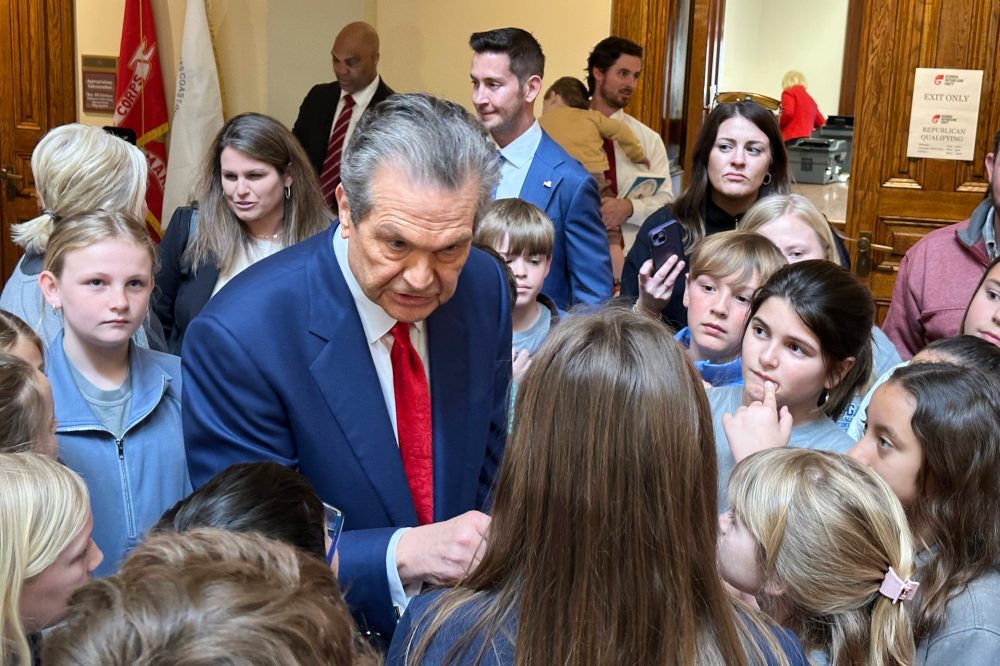
Health care executive Rick Jackson became the final major gubernatorial candidate to qualify Friday, greeting schoolchildren during his registration while asserting that despite his substantial advertising expenditures, “there is no way to buy an election. You’ve got to earn it.”
Lieutenant Governor Burt Jones, who has Trump’s endorsement, expressed confidence despite Jackson’s high-profile campaign launch into the eight-candidate Republican field.
“The newness is going to wear off, and they’re going to look to the person who’s been most consistent throughout the years,” Jones said. “And I have that.”
Secretary of State Brad Raffensperger successfully completed his qualification Wednesday without incident, despite a 2022 Georgia Republican Party resolution urging party officials to block his candidacy. This resolution reflects the significant animosity many Republican activists hold toward Raffensperger after he declined to assist Donald Trump in overturning his 2020 Georgia election defeat.
Raffensperger is avoiding those controversies in his gubernatorial campaign, focusing instead on economic issues: “the most important thing right now is how do you kind of deal with this affordability crisis and you create good paying jobs.”
Attorney General Chris Carr, another major Republican contender, highlights his accomplishments in job recruitment and crime prevention, noting that constituents “care about jobs, safety, education, affordability.”
“They don’t really want to talk about social issues the way the right and the left traditionally have,” Carr observed, despite ongoing debates between Jackson and Jones regarding transgender policy issues.
Keisha Lance Bottoms, the former Atlanta mayor widely considered the Democratic frontrunner among eight candidates, told reporters Monday that her policy agenda including affordability measures, free technical education, and state income tax relief for teachers will resonate beyond Democratic voters to general election participants who haven’t supported Democrats in the past 24 years.
“I’m speaking my truth on what I feel a leader and a governor in this state needs to offer to people, so I don’t have to worry about changing my message for a general election audience,” Bottoms explained.
Geoff Duncan, who switched from Republican to Democrat, continued emphasizing his potential appeal to crossover voters, saying he remains “focused on the affordability crisis, the health care crisis, and unfortunately still the Donald Trump crisis.”
Former state Senator Jason Esteves promoted his own policy platform while criticizing both Bottoms and Duncan. He pointed out that Bottoms declined to seek re-election as mayor and that Duncan, after supporting Republican initiatives as lieutenant governor that he now opposes, also withdrew from political life.
“We can’t afford to have folks that will stay silent, nor can we have folks that are going to be absent or quit when the going gets tough,” Esteves declared.
Former DeKalb County CEO Mike Thurmond became emotional while describing his impoverished childhood as a Black man and his subsequent political achievements as proof of the “American dream.”
“I’m here representing all of those Georgians who couldn’t afford to be here today, who are pulling two jobs, working overtime, can’t afford the pay their insurance,” he said.