
WASHINGTON (AP) — Tuesday’s opening round of primary elections delivered significant political drama across multiple states.
The spotlight focused heavily on Texas Senate primary contests. Democrats faced ballot confusion due to voting problems in the state’s second-most populous county, while the Republican race remains undecided and will proceed to a runoff election.
At least one sitting House member was defeated in their reelection bid, with several others awaiting final results as additional contests move toward runoffs and some remain undetermined.
Below are highlights from Tuesday’s major contests, analyzed through key data points.
What has become the costliest Senate primary battle in American history continues into May. Neither Senator John Cornyn nor Texas Attorney General Ken Paxton achieved the required 50% vote share to secure the nomination outright.
By Wednesday morning at 11:30 a.m., Cornyn maintained a lead over Paxton of approximately 26,000 ballots from roughly 2.1 million votes tallied.
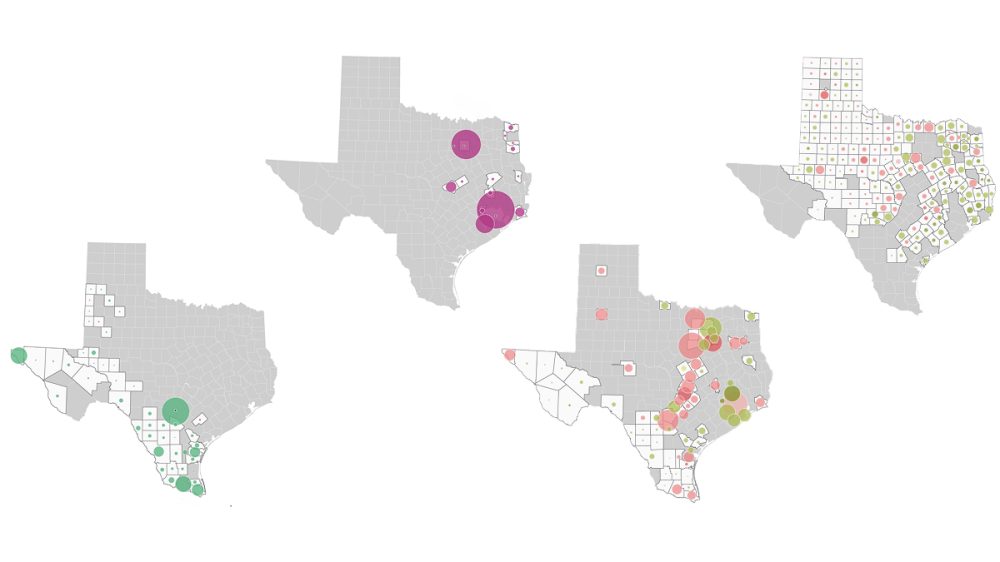
The outcome defied expectations of clear ideological or regional patterns, even though the campaign was characterized as a clash between establishment and outsider forces. Narrow vote margins in Houston, Dallas and surrounding communities revealed how the competition crossed traditional boundaries rather than following predictable urban versus suburban lines.
Cornyn — who faced criticism from Paxton for being too closely tied to Washington Republicans and insufficiently devoted to President Donald Trump — secured victories in Texas’s most populous counties, including metropolitan areas around Dallas-Fort Worth, San Antonio, Austin and Houston. However, Paxton remained competitive, falling short by approximately 1,700 votes in Harris County, which includes Houston, and by 4,000 votes in Bexar County, encompassing San Antonio.
Meanwhile, Paxton captured several rapidly expanding suburban counties surrounding these major cities. In Montgomery County, located north of Houston, he accumulated a 21,000-vote lead that more than compensated for his combined deficits in Harris, Travis and Bexar counties.
The most significant gap between Cornyn and Paxton emerged in counties showing the least support for Trump. While this represents a relative measurement in Texas, where Trump secured at least 80% support in more than half the state’s counties during the 2024 presidential race, it still provided Cornyn with a 6,000-vote cushion.
In contrast, Paxton collected more total votes in counties where Trump achieved at least 70% support. This pattern aligns with Paxton’s positioning as the more MAGA-aligned candidate.
State Representative James Talarico’s complete primary victory stemmed partly from commanding leads in his Austin-area stronghold and smaller, rural counties throughout central Texas. With nearly complete ballot counting, he captured almost 70% of votes in these regions, many of which typically support Republican candidates in general elections.
Talarico also secured smaller yet decisive advantages in southern and western areas with substantial Hispanic populations. He earned approximately 60% support across border regions where Trump gained ground in 2024. Talarico won Hidalgo County at the southern border with nearly 70% and El Paso County in the west with over 60%.
Representative Jasmine Crockett’s primary support concentrated in urban centers around Houston and her Dallas home base. While these areas typically provide the most Democratic primary votes and often determine winners, Crockett’s margins proved more modest than Talarico’s performance in southern, central and western Texas.
Crockett achieved stronger results in East Texas, which contains counties with some of the state’s largest Black populations, but this region represented less than 8% of total primary turnout.
New congressional district maps in Texas and North Carolina contributed to increased spending in many Tuesday House races compared to previous cycles.
Texas’s 15th and 34th districts, both border seats redrawn to benefit Republicans, ranked among the state’s most expensive House contests. While both featured incumbents with minimal primary opposition, the races to select November challengers saw substantial financial investments.
North Carolina’s 1st District, expected to be the state’s only competitive House race in November, experienced similar dynamics. Five Republicans competed to challenge vulnerable Democratic incumbent Representative Don Davis. The winner, Laurie Buckhout, benefited from over $1 million in advertising expenditures alone, based on data from nonpartisan tracking firm AdImpact.
Additional costly races, including North Carolina’s 4th District and Texas’s 2nd and 23rd Districts, involved incumbents — who typically enjoy spending advantages — defending against challengers. Republican Representative Dan Crenshaw became 2026’s first House incumbent to lose reelection despite his campaign receiving more than $2.3 million in attack ads against opponent state Representative Steve Toth. Brandon Herrera invested almost $1.4 million in advertisements targeting Representative Tony Gonzales, whose reelection effort suffered from recent controversy.
Herrera and Gonzales will face each other in a runoff, while several other incumbents await final determinations.