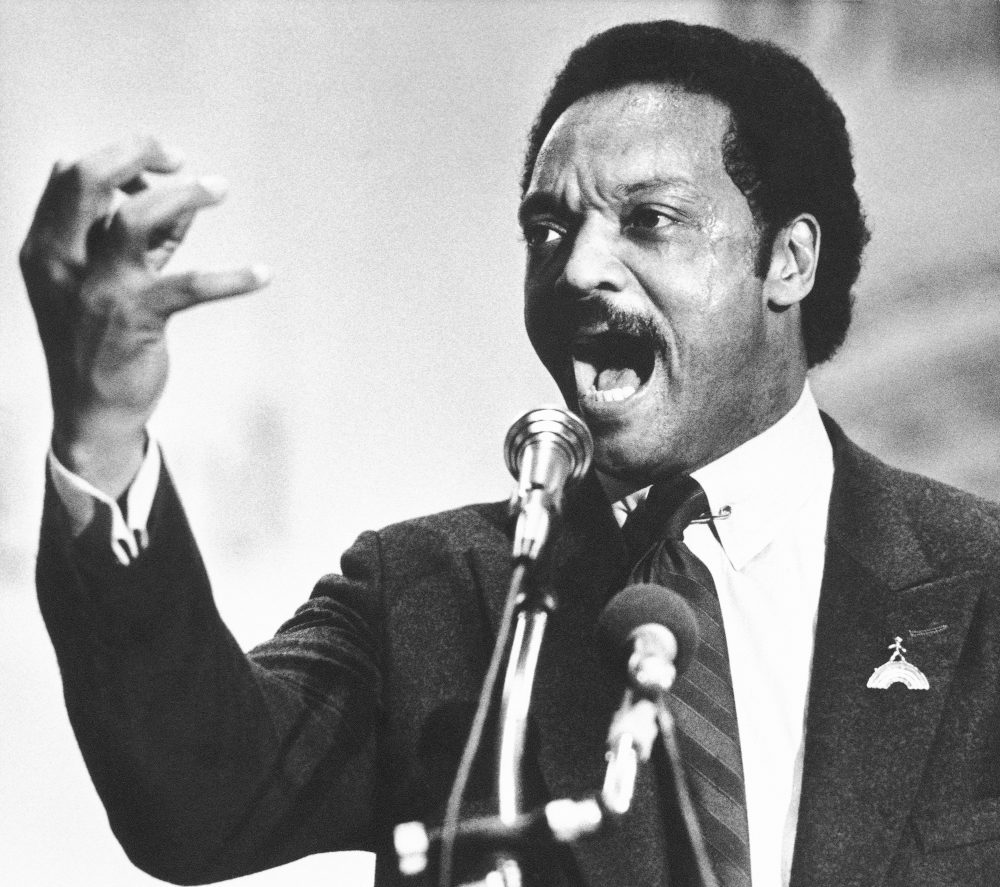

CHICAGO (AP) — Democratic Party leaders are grappling with how to reconstruct a successful coalition capable of regaining control in Washington, with many seasoned politicians looking back to when the party faced similar divisions before being transformed by Rev. Jesse Jackson’s groundbreaking campaign.
Through his two White House runs, Jackson — who stood as the nation’s leading civil rights figure at the time — assembled what he called a Rainbow Coalition, bringing together voters from different racial and economic backgrounds to mirror America’s diversity. Though Jackson didn’t secure the nomination in either race, his approach became so powerful that it evolved into an aspirational model for Democrats.
“America is not like a blanket, one piece of unbroken cloth, the same color, the same texture, the same size,” Jackson said in his 1984 Democratic National Convention speech. “America is more like a quilt. Many patches, many pieces, many sizes, all woven and held together by a common thread.”
Barack Obama’s successful presidential campaigns, built on a multicultural voter base that mirrored Jackson’s concept, led many Democrats to view the Rainbow Coalition as their path to victory.
“What Reverend planted in American politics were seeds that continue to blossom and bloom,” said Donna Brazile, a former chair of the Democratic National Committee and longtime mentee to Jackson.
However, this approach has weakened recently as Donald Trump’s conservative movement has dominated among white working-class Americans while also gaining ground with minority communities that previously formed the backbone of Democratic support.
Democratic officials are now preparing for intense internal debates about reviving the Rainbow Coalition and applying lessons from Jackson’s legacy following his death last month.
Jackson’s organizational network has reshaped party leadership.
Brazile launched her political career working on Jackson’s initial presidential run. Similar to other activists Jackson guided, she advanced through Democratic ranks, serving in Washington D.C. government and advising Bill Clinton’s campaigns before managing Al Gore’s 2000 presidential effort.
“In electoral politics, Jesse Jackson became a player because he understood the power of the Black vote,” said Brazile. She also remembered his strategy to expand beyond that base. “Reverend told us straight up that our patch was not big enough,” she said. “Reverend began shifting his rhetoric from Black empowerment to speak to any of those who didn’t have a seat at the table.”
During her role as Democratic National Committee chair in 2016, Brazile oversaw an election where party officials faced criticism for how they handled Bernie Sanders’ insurgent challenge to Hillary Clinton.
Defending her leadership while acknowledging the recurring tensions between progressive and moderate wings, Brazile pointed to lessons from her own journey.
“Reverend understood that you needed a roux,” said Brazile, referring to the cooking technique. “In gumbo, you need the seasoning of those who came before but every now and then you also need some new salt. We have to coexist. The moderates need the progressives, and the progressives need the moderates. That’s the dance of American politics.”
Brazile’s progression from Jackson supporter to party establishment isn’t unusual. Numerous Democratic officials credit Jackson as their mentor and continue following his example for building broad voter coalitions. Others point to his campaigns as their political starting point, invoking his influence while proposing vastly different directions for the party.
With party leaders and potential 2028 candidates gathering in Chicago for Jackson’s memorial services, many are reflecting on his political impact.
Progressive leaders view Trump’s upcoming second presidency as an opportunity to redirect both Democrats and the nation toward an ambitious liberal agenda.
“He served to challenge the party as a moral leader,” said Rev. William Barber, a minister and Jackson mentee who co-chairs the Poor People’s Campaign focused on economic justice. “He didn’t spend time saying what he was against. He spent all of his time talking about what he was for.”
Barber announced that activists, religious leaders and progressive legislators will convene soon to discuss adapting Jackson’s movement to today’s political environment.
“Anyone serious about taking on the extremism we see going on now in Congress and general assemblies and the presidency needs to grab onto the vision that was expressed in 1988 because it is so necessary in this moment,” Barber said regarding Jackson’s second campaign message.
Though Jackson maintained clear political positions, other proteges emphasize his willingness to work with people across the political spectrum. Some believe he would encourage Democrats to adopt realistic strategies for the challenging 2028 race.
“He was incredibly progressive. But he was even more so pragmatic. He was a problem solver,” said Steven Benjamin, Columbia, South Carolina’s first Black mayor and Jackson mentee. Benjamin contends Jackson’s practical approach enabled his diverse coalition and that Democrats need bold yet careful planning.
“I would tell all those who may consider themselves somewhere under the Democratic banner that we’ve got to find ways to coalesce around central values and never compromising those values,” said Benjamin, a former Biden senior adviser and Third Way think tank board member. “Everything else, you have to find ways to be thoughtful and pragmatic about how to actually solve problems.”
Additional observers highlighted Jackson’s magnetic personality and commitment to hearing from the varied communities he represented.
“We have to learn, as Reverend Jackson and others of his day did so effectively, to listen more than we talk,” said Antjuan Seawright, a Democratic strategist. “We have to show up and hear from folks about what their priorities are, instead of showing up, telling people what we think their priority should be.”