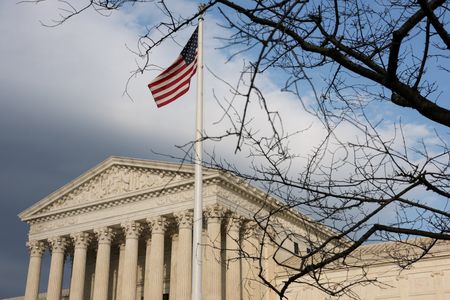

President Donald Trump’s administration has launched an unprecedented campaign to curtail the authority of federal judges through strategic Supreme Court filings, according to a new analysis of court documents.
Since returning to office, Trump and his supporters have labeled federal judges who block his policies with harsh terms including “rogue,” “crooked,” and “lunatic,” characterizing their rulings as not just wrong but fundamentally illegitimate.
The administration’s approach goes beyond public criticism, however. A systematic review reveals Trump’s Justice Department has filed 31 emergency appeals to the Supreme Court since February 2025, with nearly all – 97% – asserting that lower court judges are improperly interfering with presidential constitutional authority.
This marks a dramatic shift from the previous administration. During Joe Biden’s entire four-year presidency, his Justice Department made similar claims in just 26% of its 19 emergency Supreme Court filings.
University of Virginia School of Law expert Payvand Ahdout explained the broader implications: “The administration is attacking the ability of federal judges to question or review the executive actions.”
“As the administration seeks to assert more unilateral power, robust judicial review is a problem for them,” Ahdout added.
Trump has aggressively pushed presidential power boundaries during his second term, prompting hundreds of legal challenges across multiple policy areas. The Supreme Court’s 6-3 conservative majority, which includes three Trump appointees, has generally sided with the administration in these emergency cases.
The high court has allowed Trump to dismiss federal employees, assume control of independent agencies, implement a transgender military ban, and deport migrants to nations with which they have no connection, among other controversial actions.
A Justice Department official, speaking anonymously about the legal strategy, defended the approach as appropriate.
“It should come as no surprise that this department is more forceful in defending Article II prerogatives,” the official said, referencing the constitutional clause that grants executive power to the president.
The administration’s emergency filings challenge judicial authority in multiple ways beyond claiming interference. Analysis shows 68% argue judges lack jurisdiction to review Trump’s actions, compared to just 16% of Biden’s emergency requests making similar arguments.
Additionally, 71% of Trump’s filings contend judges exceeded their authority in granting relief to plaintiffs, such as policy-blocking court orders. Under Biden, 63% made comparable arguments.
The Supreme Court’s emergency decisions typically provide minimal explanation, making it difficult to determine which administration arguments prove persuasive. The court handles these requests rapidly, usually without extensive briefing or oral arguments.
For example, when district judges blocked Trump’s removal of Democratic members from independent federal agencies – including labor boards, a consumer safety watchdog, and the Federal Trade Commission – the Justice Department argued courts cannot review such firings or reinstate officials.
The conservative majority permitted the removals while offering little reasoning, briefly citing previous rulings supporting presidential authority to dismiss agency officers wielding executive power.
The Justice Department’s strategy to limit judicial power comes amid concerns from Trump critics and some judges that administration officials sometimes ignore district court orders while continuing verbal attacks on the judiciary.
Trump has even criticized the Supreme Court, recently calling justices who opposed his global tariffs “lapdogs” influenced by foreign interests.
Barbara Lynn, a former federal judge in Texas who retired last year, connected the legal strategy to public rhetoric: “The administration’s position stated in briefs and argument is for a very narrow view of judicial review and judicial power. And that then manifests itself in the public square as: if judges move out of that more limited role, they’re crooks and corrupt.”
“That is a sad, inappropriate development, and runs the risk of there being, essentially, no checks and balances in this country if that view prevails,” said Lynn, who was appointed by former President Bill Clinton.
The administration’s filings use dramatic language to describe judicial actions, portraying judges as seizing or usurping presidential authority. In one case involving federal employee dismissals, the Justice Department warned of an “ongoing assault on the constitutional structure,” telling the Supreme Court: “Only this court can end the interbranch power grab.”
When a judge blocked Trump’s effort to eliminate teacher-training grants as part of his anti-diversity campaign, the administration asked the Supreme Court to end judges’ “unconstitutional reign as self-appointed managers of executive branch funding.”
Legal scholars offer varying perspectives on the administration’s approach. University of California, Berkeley law professor John Yoo, who served in George W. Bush’s Justice Department, said: “They are trying to accelerate things that the Roberts court itself had already started, which is to narrow judicial involvement in the president’s management of the executive branch.”
However, Georgia State University College of Law professor Eric Segall, who worked in George H.W. Bush’s Justice Department, criticized the tone: “They make it sound like every case is a five-alarm fire that will destroy the presidency of the United States if judges get involved.”
Philip Pro, a retired federal judge from Nevada appointed by Ronald Reagan, suggested the administration views courts as obstacles: “If I don’t agree with you as a member of the judiciary, then you’re an obstruction because I want to do what I want to do, whenever I want to do it, wherever I want to do it, and you can’t tell me otherwise.”
The Supreme Court may have signaled limits to the administration’s judicial power arguments in the case of Federal Reserve Governor Lisa Cook. Trump attempted to fire Cook based on unproven mortgage fraud allegations she denies – an unprecedented move threatening central bank independence.
During rare oral arguments in January, Chief Justice John Roberts challenged Solicitor General D. John Sauer: “If there is any level of cause then you can’t be right about the idea that courts can’t order anybody who’s been removed to be reinstated.”
A decision in the Cook case could establish important precedent regarding presidential power versus judicial oversight.