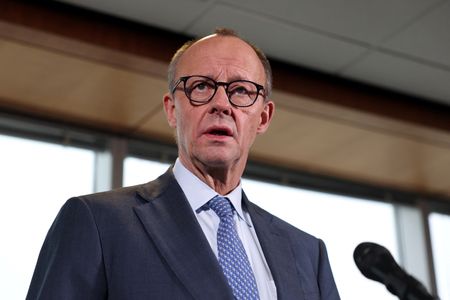

BERLIN – German Chancellor Friedrich Merz encounters his inaugural electoral challenge this Sunday as Baden-Wuerttemberg residents cast their ballots in a crucial state election that could reshape his political standing since assuming office last May.
The southwestern German state, renowned as the headquarters of Mercedes-Benz and a traditional automotive manufacturing hub, previously served as a reliable conservative territory. However, Merz’s Christian Democratic Union (CDU) has spent the last ten years playing second fiddle to a Green Party-dominated government coalition.
Current polling data indicates this political arrangement may persist, though uncertainty remains over whether 37-year-old political newcomer Manuel Hagel from the CDU or seasoned Green Party candidate Cem Ozdemir will emerge victorious to succeed the well-regarded Green incumbent Winfried Kretschmann.
Recent ZDF polling shows both candidates locked in a tight race at 28% each, raising concerns that a Green Party triumph could fuel internal criticism of Merz, whose approval numbers have reached historic depths.
However, Ozdemir, the moderate former agriculture minister, would likely pose minimal challenges to federal government operations in the Bundesrat, Germany’s upper legislative chamber representing state interests.
Election observers will closely monitor the performance of the far-right Alternative for Germany (AfD), which polling suggests maintains approximately 20% support, reflecting the party’s nationwide momentum in recent years.
Merz has categorically rejected any collaboration with the AfD, whose influence in Baden-Wuerttemberg – among Germany’s wealthiest regions – has grown amid the automotive sector’s ongoing struggles.
The evolving German political landscape becomes evident through the potential entry of the far-left Left Party into state parliament and the dramatic decline of the center-left Social Democrats to single-digit polling numbers.
The U.S.-led Iranian conflict casts uncertainty over the election, having already driven up fuel costs and threatening broader economic consequences if hostilities persist, though direct voting impact appears minimal.
“Voters are smart, they know that in Baden-Wuerttemberg, it’s about state political issues,” said Manfred Guellner, head of the polling group Forsa.
Following Sunday’s Baden-Wuerttemberg contest, neighboring Rhineland-Palatinate will hold its election on March 22, with additional votes scheduled in Saxony-Anhalt, Berlin and Mecklenburg-Vorpommern this September.