
CHICAGO (AP) — Campaign printing shops working overtime. Debate coordinators struggling with too many participants. Political advertisements flooding television screens and social platforms.
These indicators reveal Illinois is experiencing one of its most chaotic primary election cycles in recent memory.
With congressional lawmakers leaving office at unprecedented rates nationwide, Illinois feels this wave of departures more intensely than most states. Six House and Senate positions have become available in this strongly Democratic state due to senior lawmakers stepping down. This situation has created an unusual opportunity for the party to bring in fresh candidates — with almost 60 contenders competing for these six positions — allowing winners to influence the future Democratic caucus. However, it has also given voters extensive research to complete before the March 17 primary.
“Having all these names and faces thrown at you and trying to remember which one is which, it’s disorientating,” voter James Beatley said.
For his entire 21 years, the same Chicago-area representative, departing Rep. Danny Davis, has served him. Now Beatley faces 13 Democratic options. This has already sparked animated conversations about campaign financing and term limits among fellow Democrats at the University of Illinois Chicago, a political activity center in the country’s third-largest city where Beatley attends school.
He hasn’t made his choice yet.
According to Associated Press research, Illinois accounts for approximately one-fourth, or five of 21, of all Democratic House departures and 10% of total House retirements nationwide. One expert’s analysis shows this represents Illinois’ highest number of vacant House positions in at least seven decades.
Presently, five of Illinois’ 17 congressional positions, roughly 29%, stand empty. University of Illinois political researcher Brian Gaines notes the percentage reached similar levels twice during the 1940s, when seven of Illinois’ then-26 seats were vacant.
Departing officeholders claim it’s time to rebuild the party amid an increasingly polarized political climate, despite sacrificing experience.
“Illinois is undergoing tremendous change, and you can kind of feel it,” said the 84-year-old Davis, who was first elected in 1996. “It opens up opportunities for a new generation of leadership.”
The numerous contenders in the five vacant Chicago-area House races include candidates in their twenties, attorneys, and two former members seeking to return. They’ve disagreed over Israel-related funding and opposition to harsh immigration enforcement that disrupted cities like Chicago.
Rep. Jan Schakowsky’s district, where she’s stepping down after 14 terms, has the most candidates. Fifteen Democrats include Evanston Mayor Daniel Biss, digital creator Kat Abughazaleh, and state legislators.
Maria Lordots, pursuing teaching studies at UIC, will cast her ballot in Schakowsky’s district, covering parts of Chicago’s North Side and surrounding areas. The 20-year-old has examined candidate websites but found social media frustrating.
“You see a few clips, and that sort of influences you to or away from a candidate,” she said. She’s backing Abughazaleh due to dissatisfaction with establishment Democrats.
Roberto Gomez-Valadez, a 21-year-old UIC business student, understands her frustration.
He lives in a Chicago suburb where Rep. Robin Kelly is pursuing retiring Sen. Dick Durbin’s position. Kelly’s district features 10 Democratic contenders including state legislators and former Rep. Jesse Jackson Jr., son of the late civil rights leader.
“It’s overwhelming,” said Gomez-Valadez, who intends to support state Sen. Robert Peters because of his accessibility during their personal meeting. “When there’s so many candidates, overlapping opinions, it’s so much harder to stand out.”
Rep. Raja Krishnamoorthi is also seeking the Senate position, leaving eight Democrats competing for his congressional seat, including former Rep. Melissa Bean. Another vacancy exists due to Rep. Jesus “Chuy” Garcia’s departure, though the Democratic primary remains uncontested following Garcia’s political maneuvering to place his chief of staff on the ballot.
Even experienced political observers struggle to follow all the debates.
The League of Women Voters has organized candidate discussions for roughly a century. Illinois coordinators report this year’s debate count exceeds double the typical number.
“It’s usually our schtick, and it’s a thing this time around,” said Roberta Borrino from the League of Women Voters of Illinois.
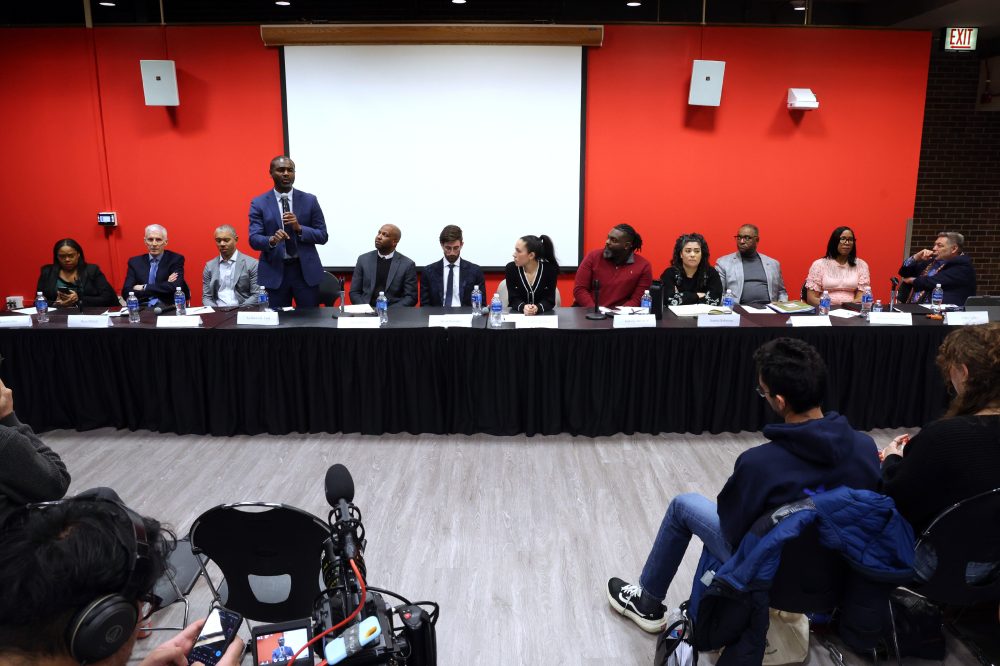
The candidate overflow has created space and time constraints. Some discussions span two days. One organization had candidates present in groups, with some waiting in separate rooms while others debated.
During a recent UIC debate for Davis’ district, three candidates shared each microphone. Candidates received 45 seconds for responses and one rebuttal during two hours.
“You have to get really good at answering questions in barely no time,” said candidate Anabel Mendoza, a 28-year-old immigrant rights organizer. “You get really good at getting to the point.”
Some residents are receiving congressional political mail for the first time.
Richard Lewandowski operates a family printing business in Chicago that’s operated for 50 years. To meet campaign mailer demand, workers are laboring seven days weekly for up to 12 hours daily.
“You only see a midterm like this once every 20 years,” Lewandowski said.
Competitive state Legislature races and constitutional officer contests add to the intensity. Billionaire Gov. JB Pritzker, pursuing a third term, has endorsed his Lt. Gov. Juliana Stratton for the Senate.
Since most Democratic primary victors are expected to win in November, the stakes remain high.
Election officials report encouraging signs of recovery after 2024 recorded the lowest turnout in over 50 years. Statewide primary participation two years ago reached 19%, according to the Illinois Board of Elections.
In Chicago, over 43,000 early ballots have been submitted by mail and in person with two weeks remaining until the primary. This number doubles the approximately 20,000 from the 2022 midterm primary and roughly quadruples the 10,000 from 2018 with the same timeframe, according to the Chicago Board of Elections.
“When districts are competitive it does bring additional people to the polls,” board spokesman Max Bever said.