Stock markets across Asia moved higher on Friday, riding momentum from a record-breaking performance by the Dow Jones Industrial Average, even as artificial intelligence stocks sent mixed signals to investors.
South Korea’s Kospi index, which had tumbled nearly 8% the day before, clawed back some of those losses with a 2.8% gain, finishing at 7,863.22. Samsung Electronics, the nation’s largest company and a significant producer of computer chips, surged 7%. Smaller competitor SK Hynix also climbed, rising 4.9%.
Japan’s Nikkei 225 moved up 0.9% to close at 69,368.30. Chipmaker Tokyo Electron slid 2.5%, while memory manufacturer Kioxia jumped 6.6%.
Hong Kong’s Hang Seng index advanced 1.7% to 23,444.45, and China’s Shanghai Composite rose 0.7% to 4,056.81. Taiwan’s Taiex bucked the regional trend, slipping 0.6%. Australia’s S&P/ASX 200 gained 1.3%, settling at 8,834.90.
U.S. futures pointed modestly higher, and oil prices also ticked up. American markets were shut Friday for the Independence Day holiday.
Back on Thursday, the Dow led U.S. markets with a 1.1% gain, reaching a new record of 52,900.07. However, the broader market told a more complicated story. The S&P 500 ended the day barely changed, edging up less than 0.1% to close at 7,483.24 — even though roughly seven out of every ten stocks within the index finished higher. The Nasdaq composite fell 0.8% to 25,382.67, dragged down by continued weakness in chip stocks.
One piece of economic data gave markets a lift: a report showing U.S. employers added 57,000 jobs last month. While that figure fell short of the 100,000 jobs economists had anticipated and represented a slowdown from May’s hiring pace, it carried a silver lining. A softer job market could ease pressure on inflation, which has been rising globally due to oil price spikes tied to the war with Iran. With oil prices now retreating below pre-war levels, slower inflation in the coming months could reduce the need for the Federal Reserve to raise interest rates multiple times this year.
Lower interest rates are generally welcomed by investors because they make borrowing cheaper for households and businesses, which can fuel economic activity. They also tend to push stock and investment prices higher.
Cryptocurrency-related stocks also had a strong session after bitcoin’s price climbed roughly 2%, rebounding from near its lowest point since 2024. Robinhood Markets gained 3.8%, and Coinbase Global rose 3.9%.
Meanwhile, computer chip companies continued to struggle. Concerns have mounted that chip stocks were bid up too aggressively during the AI frenzy, and that the massive investments in chips and data centers may not generate the profits and productivity gains investors originally hoped for.
Memory chip maker Micron Technology reversed an early gain to finish down 5.5%, one day after plunging 10.6%. Nvidia declined 1.4%, and Lam Research dropped 10.2%. These companies carry extra weight on the S&P 500 because of how large they’ve grown during the AI boom. Nvidia alone carries a total market value of nearly $4.7 trillion, giving its stock movements an outsized influence on the broader index.
In currency and commodity markets, Brent crude, the international oil benchmark, rose 0.6% to $72.26 per barrel. U.S. benchmark crude gained 0.5% to $69.05 per barrel. The dollar weakened against the Japanese yen, falling to 161.17 yen from 161.97. The euro strengthened slightly against the dollar, rising to $1.1439 from $1.1431.
Four people lost their lives and ten more were wounded as Russian forces launched overnight attacks on Ukraine, officials announced via Telegram in the early morning hours of Friday.
In the Sumy region, which borders Russia, a drone strike hit a residential home, claiming the lives of two women, an elderly man, and a girl not yet two years old. Three additional people were hurt in that attack, according to Oleh Hryhorov, who leads the regional military administration.
Meanwhile, in Kryvyi Rih — a city in central Ukraine and the hometown of President Volodymyr Zelenskiy — a Russian missile slammed into a densely populated urban neighborhood, leaving seven people injured. Oleksandr Vilkul, head of the city’s defence council, confirmed the details of that strike.
Friday has been designated a day of mourning in Kyiv, following a devastating Russian assault on the capital on Thursday that killed at least three dozen people — making it the deadliest attack on Kyiv so far this year.
Global stock markets are wrapping up their best week in roughly two months, powered by encouraging economic data from across Asia and a U.S. jobs report that took pressure off the Federal Reserve to raise interest rates anytime soon.
The MSCI All-Country World Index — a broad measure of global equity performance — climbed 1.7% for the week. The gains came after Purchasing Managers’ Index data released Friday for China, Japan, Australia, and Singapore all pointed to solid economic expansion across the region.
Those results helped lock in gains that began building after Thursday’s underwhelming U.S. employment report, which reduced expectations that the Federal Reserve would move quickly to raise borrowing costs.
Asian markets had a bumpy start to Friday’s session after tech hardware stocks dropped in response to weakness among chipmakers during U.S. trading. However, MSCI’s broad index of Asia-Pacific shares outside Japan ultimately climbed 1.1%, snapping a two-day slide. South Korea’s Kospi index led the regional advance.
Markets largely brushed aside a notable admission from Silicon Valley. Meta CEO Mark Zuckerberg, speaking at an internal company meeting Thursday, acknowledged that the social media giant’s ambitious artificial intelligence overhaul has not gone as smoothly as planned. A recording of the remarks was obtained by Reuters. Zuckerberg said AI agents — software capable of performing complex tasks independently — had not advanced as fast as he had anticipated.
In early European trading, pan-regional futures rose 0.3%, German DAX futures gained 0.5%, and FTSE futures were up 0.2%. U.S. S&P 500 futures also edged 0.3% higher.
The U.S. dollar held steady against the Japanese yen at 161.125, giving back some earlier gains as trading volume thinned due to a U.S. holiday Friday. Currency traders also remained cautious about the possibility of intervention in the market.
On a lighter note, fans eagerly awaiting a rumored wedding between pop star Taylor Swift and NFL player Travis Kelce at New York’s Madison Square Garden may need to temper their expectations. The New York Post’s Page Six reported Thursday that the couple may have already quietly tied the knot.
Key economic events to watch Friday include industrial output and services activity data from France and Germany, eurozone services figures, and a UK services report. The United Kingdom is also scheduled to hold government debt auctions for one-month, three-month, and six-month maturities.
SEATTLE (AP) — Mariners right-hander Bryce Miller was on the verge of pitching history Thursday night, taking a no-hit effort into the seventh inning against the Los Angeles Angels before Nolan Schanuel broke it up with a bloop single to right field.
Through the first six innings, Miller was nearly untouchable — striking out seven batters and not allowing a single walk. He threw 50 of his 69 pitches for strikes. The only Angel to reach base before the seventh inning did so without a hit: Denzer Guzmán advanced to second base in the fourth inning on a throwing error by Seattle third baseman J.P. Crawford with two outs.
After Schanuel’s single ended the no-hit bid, Guzmán added another single in the same inning. Despite the hits, Miller worked through the seventh and preserved a 1-0 lead.
The 27-year-old Miller entered Thursday’s game with a 3-2 record and a 1.97 ERA. He missed the start of the season after straining his left oblique muscle during spring training, eventually joining Seattle’s rotation in mid-May.
On the other side, Angels rookie Walbert Ureña was also flirting with a no-hitter, holding Seattle hitless through five innings before Crawford led off the sixth with a double to snap that bid as well.
The last Mariners pitcher to throw a no-hitter was James Paxton, who accomplished the feat on May 8, 2018, in a road game at Toronto. Paxton, who grew up in Canada, made that a memorable moment for his home country.
For the Angels, they haven’t been on the losing end of a no-hitter since September 11, 1999 — the longest active streak without being no-hit in all of Major League Baseball. In that game, Minnesota Twins left-hander Eric Milton shut them out 7-0 at Minnesota.
International soccer fans traveled to North America for the World Cup action, but many are leaving just as impressed by what’s on the plate as what’s on the pitch.
“It’s greasy, it’s disgusting, but it’s absolutely glorious,” said Jack Goodwin, a soccer fan from London, describing the American food he sampled in Dallas, Boston, New York, and Atlanta.
Goodwin didn’t stop there. “I don’t want to say this because it’s a little bit harsh, but the portions are a little bit larger — a lot more tastier — so I can understand the, um, obesity here. I don’t want to be harsh, but yes, the food is fantastic here.”
Visitors are going out of their way to sample regional favorites and American chains unavailable back home, including In-N-Out Burger and Buc-ee’s convenience stores. Norway striker Erling Haaland even shared a photo on X showing him standing outside Katz’s Delicatessen in New York.
Harrison Murphy, who traveled from London with his brother to catch the knockout rounds, stopped into a Chick-fil-A in Atlanta for breakfast.
“Have you had Chick-fil-A? It was fantastic and so cheap. The sauces are free! It was remarkable,” Murphy said. “I said, ‘This is my first time, what should I try?’ The woman said, ‘You’ve got to try the Chick-fil-A sauce.’ My God, was it fantastic.”
Gary Bishop, a resident of Glasgow, Scotland, had never encountered poutine — widely regarded as Canada’s national dish — before arriving in Toronto for the tournament. After trying it, he called it “absolutely delicious.”
“It was like chips with gravy, cheese. But it was a really thick gravy. Different from back home. Vinegar, there was lots of vinegar through it,” said Bishop, who was wearing a Scotland jersey while walking through Toronto’s FIFA Fan Festival. “Really nice.”
Not all visitors are seeking something new. A Texas beer distributor, Andrews Distributing, welcomed a busload of Dutch fans to its Dallas warehouse for Heinekens and dancing.
Restaurant owners across host cities — from Cuban eateries in Miami to barbecue spots in Kansas City and taco trucks in Mexico City — say the influx of fans has been a thrill.
“I have not seen anything like this ever in my life,” said Paul Barker, founder and principal of Pauli’s, a Boston restaurant celebrated for its heaping sandwiches and comfort food. Fans from Scotland, Brazil, England, and other countries have queued up for his famous lobster rolls and posed for photos with staff, Barker said.
“Food becomes a natural conversation starter,” he added. “It’s just been incredible for us to be part of this.”
Some chains have leaned into the World Cup moment. Waffle House, the round-the-clock breakfast chain with 2,000 locations across the South, launched a pop-up shop in downtown Atlanta selling branded soccer balls, jerseys, and patriotic merchandise. The company said in a statement that it was “honored by the enthusiasm and curiosity” shown by visiting fans.
For others, the attention came as a pleasant surprise. Whataburger, a Texas-based chain with 1,100 locations, found itself going viral after fans from Japan and other countries shared their visits on social media.
“The attention has been completely organic and honestly pretty entertaining,” said Whataburger President and CEO Debbie Stroud. “We knew the World Cup would bring the world to Texas and our footprint across 17 states. We just didn’t realize so many visitors would leave talking about a patty melt.”
Terry Black’s Barbecue, a small Texas chain, anticipated that authentic barbecue would be high on visitors’ wish lists. The company began ordering extra meat more than a month before the tournament for its Dallas and Fort Worth locations, each roughly 20 minutes from the World Cup stadium.
The chain takes four days to season and prepare its beef brisket, then smokes it for 12 hours. Turkey, pork, and sausages are also smoked on pits that run continuously, 24 hours a day.
Managing the surge of World Cup visitors has required a great deal of extra planning, said Darien Kapture, the chain’s senior vice president of food and beverage operations. But it has also brought unforgettable moments, including a night when Argentina supporters packed Terry Black’s Dallas location to celebrate their team’s win over Austria.
“They were hooting and hollering and praising the brisket,” Kapture said. “It’s great to see that these folks are coming to America and getting to experience what we experience every day.”
Goodwin, the London visitor who said he “blew his mortgage” on a U.S. World Cup road trip with his father, called Terry Black’s barbecue “the most gorgeous food ever.”
“The best food we’ve had here is in Dallas,” Goodwin said. “Texas barbecue. Unbelievable.”
Not every reaction has been glowing. Some fans have grumbled about steep food prices inside World Cup stadiums, and one British fan told the BBC that a cup of breakfast tea purchased from Dunkin’ was “not great.”
But positive reviews have far outnumbered the complaints. Ranch dressing, in particular, has won over so many international visitors that the Transportation Security Administration issued a lighthearted reminder encouraging tourists to pack bottles of it in their checked luggage before heading home.
Russian President Vladimir Putin is brushing aside serious fuel shortages gripping his country, even as Ukraine continues targeting oil refineries and energy infrastructure deep inside Russian territory.
Putin has called the disruptions to Russia’s energy sector “not critical” and has pushed back against ceasefire efforts, making clear he intends to keep fighting until Russia’s objectives are fulfilled.
The Russian leader has framed Ukraine’s strikes on energy facilities as a tactic to draw attention away from Ukrainian battlefield losses — though outside analysts say Russian forces have largely stalled in their advance over recent months. Putin appears confident his government can contain the fuel crisis before it weakens his grip on power or public backing for a war he started more than four years ago.
Overnight into Thursday morning, Russian forces launched a massive, 11-hour assault on the Ukrainian capital, killing at least 21 people. It stands as one of the most deadly attacks on Kyiv since Russia began its full-scale invasion.
Since March, Ukraine has carried out more than 50 reported strikes on oil refineries and other energy sites inside Russia and in occupied Crimea. Ukrainian officials have said the campaign is designed to pressure Moscow toward ending the war.
At minimum, the attacks have made the conflict feel far more real for millions of ordinary Russians, undermining Putin’s long-standing message that the war has little impact on daily life at home.
According to Chris Weafer, CEO of the consultancy Macro-Advisory, roughly one-third of Russia’s oil refining capacity has been knocked out. The damage is expected to be both lasting and expensive to fix.
Even a major refinery near Moscow — despite the capital’s heavy air defenses — has been struck twice. The second hit, on June 18, sparked a fire and damaged critical equipment that officials say may not be fully repaired until the end of this year.
Russian government figures show gasoline production has dropped by about 17%, falling to around 850,000 barrels per day. Fuel rationing has been put in place across numerous regions, and drivers have been forced to wait in long lines just to fill their tanks.
The hardest-hit area has been Crimea — the Ukrainian territory Russia illegally seized in 2014 — where gasoline sales to private individuals have been suspended entirely.
Last weekend, Putin convened a government meeting specifically to address the fuel situation. In televised remarks, he acknowledged the country was going through a “difficult period” and pledged to speed up repairs to damaged energy facilities. He also said Russia would look into importing gasoline to offset what he called “temporary” shortages, and announced that the country’s defense industry would ramp up production of air defense systems to counter future Ukrainian strikes.
Putin characterized Ukraine’s attacks as an effort to fracture Russian society, stop Moscow’s military push, and pressure the Kremlin into negotiations on terms favorable to Ukraine.
“We will not give them that chance,” he declared.
While Putin insisted Ukraine’s long-range strikes on Russian oil infrastructure “have absolutely no effect on the situation at the front,” Western military analysts say mid-range Ukrainian strikes have disrupted Russian supply lines and slowed the pace of their advance, creating a battlefield stalemate.
Putin maintains that Russian troops are still making progress along the roughly 1,000-kilometer (620-mile) front line. In a state television interview last weekend, he cited the names of specific small villages and even individual streets inside Ukraine as evidence of Russian gains.
Putin responded to Ukrainian President Volodymyr Zelenskyy’s offer to meet by suggesting Zelenskyy come to Moscow — a proposal Ukraine immediately ruled out.
Putin has also rejected a truce proposed by Kyiv and its Western allies, arguing it would simply allow Ukrainian forces to rest and rebuild their strength.
Any ceasefire, Putin has said, would require Ukraine to pull back from the portion of the Donetsk region it still holds — a demand Ukraine has flatly refused. He has also said a final peace agreement must require Ukraine to give up its pursuit of NATO membership, scale back its military, and guarantee protections for Russian language and culture.
In his Sunday interview, Putin claimed Ukraine had privately proposed limiting the fighting to the four regions Russia annexed but never fully captured: Donetsk, Luhansk, Kherson, and Zaporizhzhia. He said he turned it down, arguing it would allow Ukraine to shift forces from other areas and concentrate them against Russian advances in those four southeastern regions.
“Faced with a catastrophic shortage of personnel, the armed forces of Ukraine apparently believe this could be their salvation,” Putin said. “Saving the Kyiv regime is not part of our plans,” he added.
The Kremlin confirmed the proposal came through private diplomatic channels; Ukrainian officials have not publicly addressed it.
Putin also rejected a Ukrainian suggestion to mutually stop deep strikes into each other’s territory, saying Russian strikes reaching deep into Ukraine are “much more powerful, sensitive and, frankly speaking, destructive.”
Thursday’s deadly strike on Kyiv once again hit residential neighborhoods, even as Russia claimed it was going after military targets. Ukrainian strikes inside Russia, by contrast, have overwhelmingly focused on oil facilities, weapons factories, and other military-related infrastructure.
According to a United Nations count, more than 16,000 Ukrainian civilians have lost their lives since the war began.
From June 26 through July 2, 2026, dramatic images captured major events unfolding across Latin America and the Caribbean.
In Venezuela, rescue workers pressed on in their search for survivors following a pair of earthquakes that struck on June 24. The disaster claimed hundreds of lives and left a significant number of people still missing.
On the soccer field, Mexico ended a 40-year absence from the World Cup knockout rounds, defeating Ecuador by a score of 2-0 to advance to the Round of 16.
Pride Month wrapped up with vibrant festivities around the region, highlighted by the annual Pride parade held in Mexico City.
This photo collection was assembled by photojournalist Jorge Saenz, who is based in Asuncion, Paraguay.
WELLINGTON, New Zealand — He came home the way many young males do — returning to the stretch of Australian coastline where he was born. But Neil is no ordinary local. He weighs as much as a small car, has more social media followers than the entire human population of his home state, and leaves a trail of bent metal and broken fences wherever he goes. Neil is a 1,000-kilogram (2,200-pound) elephant seal, and he is causing quite a stir.
Back in June, the boisterous, blubbery 5-year-old hauled himself ashore in southern Tasmania for his twice-yearly visit to coastal towns, a routine he follows after months of feeding out at sea. This is his 12th visit to land, and it has proven to be his most eventful yet.
Neil has already racked up an impressive list of offenses during this trip: picking fights with parked vehicles, knocking over traffic bollards, destroying a sign warning people about seals, and plowing through a fence that stood no chance against him. When he is not causing mayhem, he simply parks himself wherever he pleases — including the middle of the road — bringing entire towns to a halt.
Despite all of this, officials say their greatest worry is not the property damage. It is the fans.
Neil has built a TikTok following of 1.4 million people — more than double the human population of Tasmania — largely because of his rebellious behavior. Some online admirers have crowned him a kind of anti-establishment hero. Scientists, however, say his antics are simply what young male elephant seals do.
Sophia Volzke, an elephant seal researcher at the University of Tasmania in Hobart, explained that juvenile male elephant seals must practice for the intense dominance battles they will face as adults, where males rear up and slam their chests together to compete for breeding rights. Since there are no other young seals around for Neil to spar with, he has been rehearsing on Toyotas instead.
At a news conference in Hobart on Thursday, Kris Carlyon from Tasmania’s Department of Natural Resources and Environment asked the public to give Neil some space.
“Neil’s fame is a bit of a double-edged sword,” Carlyon said. “We have had some pretty silly behavior, instances with people carrying their small babies up close to him and simply trying to get that shot for Instagram.”
Officials have urged people to avoid publicly sharing which town Neil is currently visiting, fearing that a dangerous encounter between the seal and an overeager fan could force rangers to relocate him — a risky operation for everyone involved.
Carlyon also raised a more sobering possibility, pointing to a 2023 incident in Norway where a walrus named Freya, who had attracted massive crowds, was euthanized after authorities determined she posed a growing risk to public safety.
“There is a risk here of essentially loving Neil to death,” Carlyon warned.
It is completely normal for seals to return twice a year to the beaches where they were born to rest, shed fur, and fast. Many species wander into coastal towns during these visits. What makes Neil exceptional is that he is the only male elephant seal currently coming ashore in Tasmania.
Volzke explained that elephant seal breeding populations live on sub-Antarctic islands south of Tasmania, and Neil’s mother would have traveled from one of those islands to give birth. Female elephant seals have been spotted in Tasmania before, but they are much smaller — reaching only the size Neil was at one or two years old — and do not create nearly the same level of disruption.
“Humans got rid of those animals and now maybe they are coming back and repopulating areas that they were previously seen in,” Volzke said. “We do need to find a way to coexist.”
That coexistence may become increasingly challenging. If Neil survives to adulthood, he could grow to 5 meters (16 feet) in length and weigh three times what he does now. However, Volzke noted that roughly 90% of male elephant seals do not live long enough to reach breeding age, which is around 10 years old.
For the moment, Neil has claimed a particular stretch of sidewalk as his own, lying there contentedly and unbothered. He has shown a peculiar fondness for an orange traffic cone, which delights his online followers to no end. Rangers have tried to move him along, but he keeps coming back to the same spot.
“He’s obviously decided this puddle surrounded by bollards, which are horizontal at the moment, is his spot,” Carlyon said Thursday.
Residents of the town currently hosting Neil have mixed feelings about their famous guest. Dale Creamer, a local who says he has not been personally inconvenienced by the seal, offered a philosophical take on the situation.
“He’s one of our biggest exports at the moment,” Creamer said. “It’s Neil’s world and we’re just living in it.”
TAIPEI, Taiwan — Lam Wing-kee, a former Hong Kong bookseller who rose to international prominence as a symbol of defiance against Beijing’s suppression of free expression, has passed away in Taiwan at the age of 70, according to the island’s official Central News Agency, which cited an unnamed source.
The news agency did not disclose a cause of death, but reported that Lam had experienced a cancer relapse last year. He was admitted to MacKay Memorial Hospital in Taipei on Tuesday, slipped into a coma on Wednesday, and died Thursday evening.
Lam had previously worked at Causeway Bay Books in Hong Kong before relocating to Taipei in 2019, driven by concerns over potential legal jeopardy. He reopened the bookstore under its original name in the Taiwanese capital in 2020.
Taiwan’s President Lai Ching-te shared his condolences on Facebook following the news of Lam’s death.
“The passing of Mr Lam Wing-kee is deeply saddening, but the courage he left behind would not fade,” Lai wrote. “Taiwan will remember that a Hong Kong bookstore worker once told us in the most ordinary yet most steadfast way how precious freedom is and reminded us that democracy requires the efforts of generation after generation to defend it.”
Lam was among five individuals connected to Causeway Bay Books who vanished in late 2015. The shop had been known for selling books and magazines that claimed to expose private details about Chinese leaders and the controversies surrounding them.
Among the five, publisher Gui Minhai disappeared from his vacation home in Thailand and was subsequently sentenced to ten years in a Chinese prison on charges of illegally providing intelligence to foreign entities.
In a bold act of defiance, Lam held a press conference in 2016 where he publicly contradicted the Chinese government’s version of events surrounding the disappearances of the five booksellers.
Lam described being taken by Chinese authorities in October 2015 after he crossed from Hong Kong into the mainland city of Shenzhen. He said he was blindfolded and placed on a 13-hour train journey to the eastern city of Ningbo, where he was held under around-the-clock surveillance in a room for five months, monitored by rotating two-person teams.
At a packed news conference in Hong Kong, he recounted being compelled to appear on Chinese state television to deliver a confession to alleged crimes.
As recently as June, Lam told the Central News Agency that he had temporarily shuttered his Taipei bookstore due to health concerns and could not predict when it would reopen.
Since the large-scale anti-government demonstrations that swept Hong Kong in 2019, Chinese and Hong Kong authorities have imposed increasingly strict controls over the territory. In June, Hong Kong police arrested two individuals on suspicion of distributing seditious publications and receiving funding from foreign political organizations, acting under a recently enacted national security law.
WASHINGTON — President Trump made his mark on this year’s U.S. Senate races by pushing aside certain Republican incumbents and elevating his preferred candidates in their place. But a major question now looms: will he use his enormous political fund to back them up?
With November’s elections just four months away, there’s still no clear answer on how much MAGA Inc. — the nation’s largest political action committee, sitting on $382 million as of last month — intends to invest in critical Senate contests. That uncertainty has continued even as Senate Republican leaders have pressed Trump’s inner circle, both behind closed doors and in public statements, to help pay for the consequences of the president’s choices.
The most glaring example is Texas, where Trump threw his support behind outspoken conservative Ken Paxton over incumbent Sen. John Cornyn. Some Republicans are frustrated, arguing that what should have been a safe Republican seat has now become a competitive race that will pull money away from other important battlegrounds. Democratic nominee James Talarico, a state lawmaker, has made Paxton’s lengthy record of corruption allegations a cornerstone of his campaign.
Cornyn didn’t mince words about who should be writing the checks. “The president picked Paxton, and he’s got $350 million dollars,” Cornyn recently told Semafor. “I think he can spend his money.”
A second headache has surfaced in North Carolina, where Sen. Thom Tillis chose not to seek reelection following a falling-out with Trump last year over healthcare spending. Trump then endorsed Michael Whatley — his own handpicked former chair of the Republican National Committee — to run for the seat. Democrats are now eyeing the race as a pickup opportunity, with former Gov. Roy Cooper as their candidate.
Some Republican campaign strategists are counting on MAGA Inc. to contribute to Whatley’s effort in North Carolina, where advertising across the state’s multiple major metro areas doesn’t come cheap.
Republicans are also expecting to benefit from party committees following a U.S. Supreme Court ruling earlier this week that allows official party organizations to make unlimited direct donations to candidates’ campaigns. Still, even that potential windfall falls short of what Trump has accumulated in MAGA Inc. Despite being constitutionally prevented from seeking a third term, Trump began fundraising almost immediately after winning reelection, regularly hosting events at his resort properties where admission has run as high as $1 million per person.
James Blair, the former White House political director who stepped down from his government role to oversee the president’s midterm strategy, gave little away when pressed on the topic during an interview with former Republican spokesman Sean Spicer on his podcast.
“The president is going to expend substantial resources to win the midterms,” Blair said. “He cares deeply about the party winning.”
As a super PAC, MAGA Inc. is permitted to raise unlimited amounts from individuals and corporations. However, it cannot legally coordinate with individual campaigns or national Republican committees — a restriction that has added to the uncertainty about what the group actually plans to do.
More than two months have passed since Blair, along with White House Chief of Staff Susie Wiles, pollster Tony Fabrizio, and political adviser Chris LaCivita gathered at Washington’s Waldorf Astoria hotel to map out MAGA Inc.’s approach. That meeting was centered on lining up vendors — including advertising firms, door-knocking operations, and digital media companies — that had worked with the Trump team in past elections and would be deployed once a strategy was finalized.
Throughout much of this year, Trump has focused on settling scores with Republicans he felt had wronged him. He viewed Cornyn as insufficiently loyal, harbored resentment toward Sen. Bill Cassidy of Louisiana for voting to convict him during an impeachment trial, and publicly called Rep. Thomas Massie of Kentucky the “worst Republican Congressman in history.” Each of those lawmakers went on to lose their primaries to Trump-endorsed opponents.
Cornyn’s defeat has left Senate Republicans uneasy, with some estimating that Paxton’s nomination could force the party to spend an additional $100 million just to hold onto the Texas seat.
The Senate Leadership Fund, the main super PAC aligned with Senate Majority Leader John Thune, is still expected to run ads in Texas but is unlikely to make it a top priority given its commitments in other states.
Democrats need a net gain of four seats to reclaim the Senate majority, and they view Alaska, Maine, North Carolina, and Ohio as their strongest opportunities. The Senate Leadership Fund has already pledged $342 million across those four states, as well as Iowa, Georgia, Michigan, and New Hampshire.
When Paxton traveled to Washington following his primary victory on May 26, he held what was described as a friendly meeting with Thune, with both sides focused on moving ahead together, according to people familiar with the conversation who were not authorized to speak on the record.
Later that same day, Thune made clear he believed Trump should be contributing financially to a candidate that Senate Republicans hadn’t sought out in the first place.
“We will do what we need to do to make sure the state stays red,” Thune told reporters. “But I’m certainly hopeful the president and the resources he can bring to bear will be engaged.”
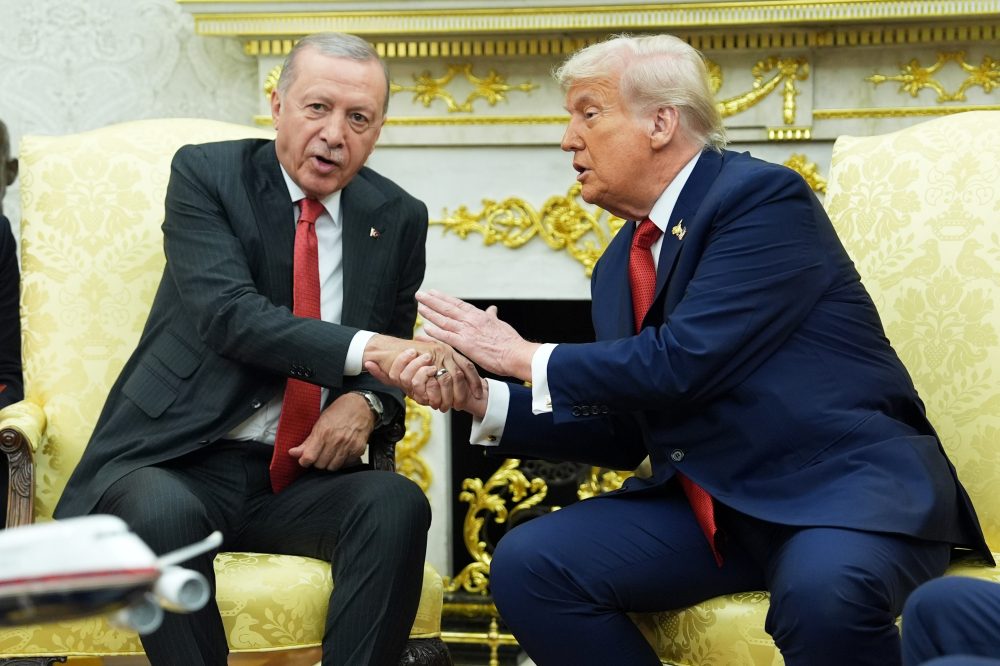
WASHINGTON (AP) — While President Donald Trump has publicly criticized and clashed with many of his European counterparts set to attend next week’s NATO summit, Turkey’s leader has used his personal friendship with the U.S. president to guarantee Trump’s attendance at the Ankara gathering — and the visit could come with a major defense bonus for Turkey.
Trump has repeatedly praised the Turkish president, referring to him as a “hell of a leader” and a close friend. “I would not have gone for most people,” Trump said last week. “But he called me up. He said: ‘Please, I have it in Turkey. You got to be there. The United States has to be in there.’ And so I’m going out of respect to President Erdogan.”
That personal rapport has helped Erdogan prevent the turmoil that Trump’s absence would have created for the alliance — especially at a moment when Trump has been threatening to withdraw U.S. troops from Europe and reduce America’s involvement in NATO, causing anxiety among allies. Trump has long pressured NATO members to increase their defense budgets and has recently criticized them for not supporting his confrontation with Iran.
Adding to the appeal, Trump has hinted he may announce something during his visit connected to jet engines and the possible sale of F-35 fighter jets — a deal that has been blocked for years due to Turkey’s close relationship with Russia.
Trump’s well-documented admiration for strongman-style leaders has made him a longtime fan of Erdogan, who first consolidated power as prime minister and is now in his 13th year as Turkey’s president.
“His relationship with Erdogan, which is pretty strong, is consistent with what seems to be a pattern of his preference,” said Philip Gordon, who previously served as national security adviser for Vice President Kamala Harris. “It has often been pointed out he seems to have better relationships with adversaries and autocrats, and he certainly says nicer things about them than with allies.”
Gordon, now affiliated with the Brookings Institution, added, “Erdogan is taking full advantage of it.”
Trump is expected to hold a one-on-one meeting with Erdogan on the sidelines of the summit, making him the first U.S. president to visit Turkey since Barack Obama did so in 2015. The previous administration kept Erdogan at a distance throughout its four years in office, citing concerns about Turkey’s democratic regression and its ties to Russia.
Opposition groups and human rights organizations have accused Erdogan of weakening democratic institutions and restricting free speech, pointing to what they describe as ongoing, unfounded legal actions against journalists, activists, opposition politicians, and others.
Soner Cagaptay of the Washington Institute noted that Erdogan and Trump developed a personal chemistry during Trump’s first term. When the previous administration invited Erdogan to visit the U.S. in 2024 following Turkey’s endorsement of Finland and Sweden’s NATO membership, Erdogan chose not to attend.
“That was Erdogan’s way of signaling to Trump, ‘Hey, you are going to probably win the elections,’” Cagaptay said. “I think Trump saw that as a giant gesture.”
During a recent meeting with NATO Secretary-General Mark Rutte, a reporter asked Trump whether he was bringing “a big gift bag for Erdogan,” referencing Turkey’s desire for F-110 jet engines and F-35 fighter jets.
“Yeah, I think so,” Trump answered. “Yeah, I’m going to probably do something that’s going to make him very happy.” Trump had also floated the idea last September that the U.S. might begin selling F-35s to Turkey.
Turkey was removed from the F-35 program in 2019 after it acquired Russian-made S-400 missile defense systems. American officials have long worried that Turkey operating the Russian system could allow Moscow to collect data on the F-35’s performance and capabilities.
At a White House meeting, Vice President JD Vance said the administration was looking into ways to move forward with the jet sale, stressing that any transaction would require Turkey to be in compliance with U.S. law. There is notable bipartisan resistance in Congress to selling F-35s to Turkey while Ankara still holds the Russian missile defense systems, including from prominent Republicans like Senate Foreign Relations Committee Chairman Jim Risch of Idaho.
Separately, Turkey is seeking to buy F-110 jet engines to power its domestically built KAAN fighter aircraft. The State Department recently moved toward enabling those sales, sending key lawmakers a notification that it intended to bypass congressional objections to more than $700 million worth of jet-engine sales to Ankara, according to two individuals granted anonymity to describe details of a non-public notification.
“In this case, the State Department did not even attempt to justify its decision,” said New York Rep. Gregory Meeks, the leading Democrat on the House Foreign Affairs Committee, in a statement last week. “It did not invoke any emergency authority, did not present a written rationale, and for months refused to make a good-faith effort to brief me on implications of the sale for the U.S.-Turkey relationship, Turkey’s continued possession of the Russian S-400 system, and other regional security concerns.”
The broader relationship between Washington and Ankara is thawing in other areas as well. Earlier this year, the Justice Department dismissed a significant case against Turkey’s state-owned Halkbank, which had faced accusations of helping Iran avoid U.S. sanctions.
When Trump returned to the White House for his second term, he named a longtime personal friend as ambassador to Turkey: Tom Barrack, a close ally who also chaired his inaugural committee. “Barrack is playing a crucial role as a facilitator in the relationship,” said Ahmet Kasim Han, a professor of international relations at TED University in Ankara.
Erdogan and Trump have spoken by phone frequently about Syria, Gaza, and the broader Middle East, and Turkey joined Trump’s Board of Peace established to oversee the Gaza ceasefire. Trump claimed this month that he asked Erdogan to stay out of the conflict with Iran and that the Turkish leader agreed, though there is no evidence Turkey had any plans to become involved.
Trump made his admiration for Erdogan clear even while standing alongside Israeli Prime Minister Benjamin Netanyahu at a joint press conference last year. Netanyahu, whose government is in conflict with Ankara, had hoped to gain Trump’s backing in countering Turkish influence in Syria — but instead watched as Trump heaped praise on Erdogan and urged Netanyahu to be “reasonable.”
Following his meeting with Trump at last year’s NATO summit in The Hague, Erdogan told reporters that the U.S. president responds to his calls quickly — an illustration of just how close their relationship has become.
“With my friend Trump, we are opening the door to a new era in Turkish-American relations,” Erdogan said. “The process of telephone diplomacy between us has never exceeded 24 hours so far. When we call, the other side responds within 24 hours.”
AMSTERDAM — The Dutch military has announced a major financial commitment to drone technology, pledging tens of millions of euros over three years to work alongside Dutch defense tech company Intelic on building advanced drone software.
Both the Dutch Defence Ministry and Intelic stated their shared goal is to develop a common software platform capable of allowing unmanned systems built by different manufacturers to function together seamlessly on the battlefield.
Junior defence minister Derk Boswijk pointed to the ongoing conflict in Ukraine as a key lesson in modern warfare. “Ukraine teaches us that not only the hardware, but also the software is of great importance,” he said. “Making different drone systems work together makes the fight easier.”
The new partnership will be built on top of Intelic’s existing NEXUS command-and-control software, which the company says has already seen real-world use on the battlefield in Ukraine since last year.
Intelic CEO Maurits Korthals Altes highlighted the rapidly expanding drone industry across Europe as a driving force behind the need for interoperability. “Europe now has more than 700 drone manufacturers, and that number continues to grow,” he said. “For defence organisations, the challenge is no longer access to technology, but ensuring those technologies can operate together.”
A San Francisco jury has found seven pro-Palestinian protesters guilty on misdemeanor charges connected to a 2024 demonstration that brought traffic on the Golden Gate Bridge to a standstill for four hours.
San Francisco District Attorney Brooke Jenkins announced Thursday that each of the seven defendants was convicted on six misdemeanor counts, which included false imprisonment, obstruction of a thoroughfare, and unlawful assembly. One of the seven was additionally found guilty of refusing to disperse.
The seven individuals convicted are Bhavika Anandpura, River Allen, Rocky Chau, Sara Cantor, Conrad de Jesus, Sarah Ferrell, and Em Tillotson, according to local media reports.
The jury was unable to reach a unanimous decision on the most serious charge — felony conspiracy — which carries a potential sentence of up to 15 years. That charge involves an agreement between two or more individuals to commit a crime, combined with an act taken to carry it out.
All seven defendants are scheduled to be sentenced in August and could face as much as five years in a county jail on the misdemeanor convictions.
Jenkins said her office would weigh its options going forward. “At this time we will evaluate our options and consider next steps,” she stated.
Defense attorneys maintained that the protesters felt a moral obligation to speak out against Israel’s military campaign in Gaza and the United States government’s backing of Israel. They also argued that the demonstrators turned to blocking the bridge only after other approaches — such as writing letters and reaching out to congressional representatives — failed to produce any response.
Prosecutors from Jenkins’ office contended that the four-hour traffic blockade created a genuine safety hazard for drivers caught in the backup.
Attorney Nuha Abusamra, who represented one of the defendants, told local outlet KQED that the outcome on the lesser charges represented a win. “Taking a bridge and blocking traffic for a few hours years ago is the bare minimum that we should be doing as American citizens while our tax dollars continue to fund the mass genocide of Palestinians,” she said.
The 2024 protest was part of a broader wave of demonstrations across the United States calling for an end to Israel’s military operations in Gaza and demanding that universities pull investments from companies with ties to Israel.
Israel’s ongoing assault on Gaza has resulted in the deaths of tens of thousands of people, created a severe hunger crisis, and displaced nearly the entire population of the territory. Rights experts, scholars, and United Nations inquiries have described the situation as a genocide. Israel has characterized its actions as self-defense, citing a Hamas-led attack in October 2023 that killed 1,200 people and resulted in more than 250 individuals being taken hostage.
India has formally notified two major messaging platforms — Telegram and Signal — over worries that their username features could be exploited for impersonation and other harmful activities, according to a government source who spoke on Friday.
The source, who requested anonymity, said both platforms have been asked to detail what protections they have in place to keep users safe. The notices are part of a wider government effort to hold digital platforms more accountable for how their features are used.
The action follows a similar move against Meta’s WhatsApp, which was directed by Indian authorities to halt the gradual rollout of its own username feature in the country. That feature, once fully implemented, would allow users to contact each other without needing to share their phone numbers.
The latest notices represent a further escalation in India’s oversight of online platforms. The government had already blocked Telegram in recent weeks, and has clashed repeatedly over the years with Elon Musk’s X over demands to remove certain content.
NANTOU, Taiwan — Taiwan put more than 370 government and military officials through one of its most intense war preparedness exercises yet this week, simulating a terrifying cascade of crises: a Chinese naval blockade, a devastating earthquake exploited by Beijing, hijacked TV broadcasts, sabotaged power and infrastructure, a run on banks, civil unrest, and ultimately a full-scale military invasion.
The two-day drill took place in central Taiwan’s Nantou County, and Reuters was given rare, exclusive access to the closed-door exercise — the first of its kind testing whether local officials in that mountainous county, working alongside central government and military agencies, could keep the region functioning under wartime conditions.
The exercise is part of a broader effort by President Lai Ching-te to strengthen Taiwan’s readiness for conflict as Beijing’s military activity around the island continues to escalate.
Chi Lien-cheng, the minister without portfolio who oversaw the drill, spoke directly about the stakes involved. “Our adversary is right on our doorstep, just across the Taiwan Strait. That is very close,” he told Reuters.
“If you don’t defend your own country, who else will defend you? I think people are beginning to understand that,” Chi said, while also acknowledging that shortcomings remain and that real-world resources could fall short in an actual emergency. “But that’s all right. We are here to see how they carry out the exercise — whether they have the will to absorb these concepts and put them into practice.”
China has never ruled out using military force to bring Taiwan under its authority. Taiwan’s government maintains that only the island’s own people have the right to determine their future.
As the drill was wrapping up on Thursday, Taiwan’s military reported that China had conducted yet another “joint combat readiness patrol” around the island, deploying warships and at least 22 military aircraft, among them nuclear-capable H-6 bombers.
China’s Taiwan Affairs Office accused President Lai of deliberately stoking tensions. Spokesperson Zhu Fenglian stated Thursday: “This will only push Taiwan into the dangerous situation of war and conflict. He is, through and through, a destroyer of cross-strait peace, a creator of crises in the Taiwan Strait, and an instigator of war.”
The drill opened with a seven-hour tabletop planning session before shifting the following day to hands-on field exercises, which included simulating the shooting down of a Chinese drone near a power plant and setting up food distribution stations for civilians.
A simulated magnitude 6.8 earthquake — in which 12 people were killed in the scenario — added significant pressure, forcing officials to simultaneously manage disaster relief, damaged infrastructure, growing public unrest, and wartime operational planning.
Large screens in the drill’s command center displayed a U.S. military-developed tactical mapping and communications system showing real-time positions of simulated enemy targets. Two Taiwanese government platforms using interactive maps and icons helped visualize the unfolding crises, including the movement of ambulances and other emergency resources.
A key focus of this year’s exercise was deeper coordination between civilian and military operations. Lin Fei-fan, deputy secretary-general of Taiwan’s National Security Council and the official overseeing the resilience-building program, said military reserve commands worked directly alongside local governments throughout the drill.
“The message to our adversary is clear: when they know Taiwan’s society is prepared, they will have to think very carefully about whether to launch such a costly war against Taiwan — one that may not succeed,” Lin said.
Drawing on lessons learned from the conflicts in Ukraine and the Middle East, officials said they have worked to make these exercises more realistic. That has included moving hospital operations underground and bringing in professional hackers to attack and stress-test government computer networks and websites.
One scenario involved a Chinese drone strike on the command center itself, leaving the status of 75 officials uncertain and requiring authorities to activate a backup operations facility.
A military official who took part in the drill, speaking anonymously given the sensitivity of the exercise, reflected on its purpose: “We can’t actually put them through a real war, so we can only use scenarios to help them understand that war is extremely cruel — all situations will be severe and urgent. If you have not made these preparations in peacetime, you will not be able to respond.”
Nantou officials were assigned a specific strategic role: transforming Taiwan’s only landlocked county into a so-called “rear area” — a refuge for civilians evacuating other parts of the island and a fallback zone for military operations while frontline troops engaged Chinese forces.
Dozens of grassroots government units from across the country also joined the exercises via livestream, responding to unfolding scenarios and rapid questions from commanders in the response center.
Officials were questioned in precise detail about their readiness — from how many draft-age men a local government could mobilize overnight to how many cans of baby formula the county had in stock.
The exercise also tested how local authorities would handle information warfare. At one point in the simulation, local television broadcasts were hijacked and replaced with Beijing propaganda, while fake flyers spreading misinformation appeared on the streets — a scenario reminiscent of the 2025 Taiwanese television drama “Zero Day Attack.”
Officials practiced holding mock press conferences and were trained to identify and counter false information.
Lee I-yuan, a 75-year-old borough chief who led a community response team during the drill, said the exercise helped him learn how to tell fact from fiction in a crisis. “If the other side attacks, they will definitely use AI to spread false information,” he said.
New York City police confirmed Thursday that a man died from severe burns sustained near the United Nations headquarters, and activists along with a media outlet representing exiled Tibetans have identified him as a Tibetan man who set himself on fire in a call for independence.
Officers responded to an emergency call at approximately 6:30 p.m. Eastern Time Thursday and found the man with extensive burns. He was transported to Bellevue Hospital, where he was later pronounced dead. Police said an investigation remains underway and did not release his name.
Voice of Tibet, a media organization run by exiled Tibetans, identified the man as activist Logba Rangzen, stating he had “self-immolated outside the UN headquarters in New York after a live appeal for Tibetan independence and unity.”
According to local news site amNewYork, Rangzen worked as an Uber driver and arrived at the scene carrying a Tibetan flag. The outlet spoke with fellow Uber driver Lobsang Paljor, who said he recognized Rangzen from events within the Tibetan community. Paljor told the publication that Rangzen “was enraged by the restrictions the Chinese government had placed on his countrymen.”
The incident took place against the backdrop of China’s new ethnic unity law, which took effect this week. Both the United States and the European Union have voiced concern about the legislation, which gives Beijing a legal framework to take action against people even outside its own borders.
The law establishes a “shared” national identity among China’s 55 ethnic minority groups, including Tibetans and Uyghurs — groups that have historically resisted aspects of Chinese governance. Tibetans worldwide have spoken out against the new law.
Acts of self-immolation by Tibetans protesting Beijing’s policies in Tibet and surrounding regions with large Tibetan populations have occurred before.
China took control of Tibet in 1950, characterizing the takeover as a “peaceful liberation” from feudalistic serfdom. International human rights organizations and exiled Tibetans have long condemned what they describe as oppressive Chinese rule in Tibetan areas — accusations Beijing consistently denies.
Ethnic minority issues remain a deeply sensitive matter within China. Tibetans and other minority groups face heavy surveillance for any perceived signs of “separatism.” Since Xi Jinping assumed the presidency in 2012, Beijing has tightened its institutional grip on Tibet.
Tencho Gyatso, president of the International Campaign for Tibet, remembered Rangzen as “a tireless advocate for Tibet” and said he was “deeply saddened” by the loss.
Houston Rockets forward Tari Eason is staying put, as multiple reports Thursday night indicate the 25-year-old has reached an agreement on a five-year, $81.5 million contract to remain with the organization.
Eason enters this deal as a restricted free agent. Under the final team option year of his rookie contract, he was slated to earn $5.7 million for the 2025-26 season, according to ESPN, which was first to report the new agreement. The Athletic notes that the fifth and final year of the new deal includes a player option.
During the most recent regular season, Eason put up averages of 10.5 points, 6.3 rebounds, 1.5 assists, and 1.2 steals per game across 60 appearances, including a career-best 34 starts and 25.8 minutes per night. When the postseason arrived, he elevated his game significantly, averaging 13.8 points, 6.7 rebounds, 1.7 assists, and 2.5 steals over six playoff games, starting four of them.
Looking at his overall body of work, Eason has averaged 10.4 points, 6.3 rebounds, 1.3 assists, and 1.3 steals in 23.6 minutes per game across 221 regular-season contests — with 55 starts — since breaking into the league in 2022.
Houston originally brought Eason into the fold by selecting him 17th overall in the 2022 NBA Draft.
Seattle Mariners center fielder Julio Rodriguez had to exit Thursday’s home contest against the Los Angeles Angels after being struck in the head by a wayward throw during the game.
Rodriguez had drawn a walk with one out in the bottom of the first inning. The next batter, Dominic Canzone, hit a ground ball to Angels first baseman Nolan Schanuel, who attempted to fire the ball to second base to complete an inning-ending double play. Instead, the throw struck Rodriguez in the back of his batting helmet just as he began his slide into the bag. The ball bounced away into center field. Rodriguez reacted by pumping his fist and shouting toward the dugout, but then doubled over with his hands resting on his knees.
Mariners head athletic trainer Kyle Torgerson and manager Dan Wilson both came out onto the field to check on Rodriguez, spending a few minutes speaking with him and third-base coach Carlos Cardoza. After that evaluation, Rodriguez was allowed to remain in the game.
He returned to his position in center field to start the top of the second inning. However, during the bottom of that same inning, Rodriguez was spotted on the bench in conversation with Torgerson once again. Shortly after, he left the field with the trainer and headed into the clubhouse.
When the Mariners returned to the field for the third inning, Victor Robles had taken over in center field in Rodriguez’s place.
TOKYO — Japan’s Finance Minister Satsuki Katayama reiterated on Friday that the government stands prepared to act on currency fluctuations, as traders kept a close eye on the possibility of official intervention in the foreign exchange market.
Speaking at a regularly scheduled press conference, Katayama addressed concerns about the yen’s ongoing slide. “Our stance has not changed. We will respond appropriately at any time as needed,” she said.
The minister also noted that Japanese officials have maintained close communication with their counterparts in the United States regarding currency matters — and that those conversations have continued “even when the U.S. is on holiday.”
On Thursday, the yen moved sharply higher against the dollar, prompting speculation among traders that authorities may have stepped in. However, many in the market felt the move was too modest to confirm an intervention. The yen then received an additional lift after U.S. employment data came in weaker than anticipated, pushing the dollar down.
By Friday, the yen was trading at 161.2 per dollar. Earlier in the week, the currency had sunk to 162.84 per dollar — its weakest level in 40 years.
Katayama also turned attention to rising Japanese government bond yields, pledging that the government remains committed to keeping confidence in the bond market intact and ensuring the long-term health of public finances.
Benchmark government bond yields in Japan surged to a level not seen in nearly 30 years on Friday, reflecting growing investor anxiety over the country’s fiscal outlook.
Oil prices nudged higher on Friday morning as traders took a cautious but hopeful stance ahead of the long Fourth of July weekend in the United States, with diplomatic efforts between the U.S. and Iran continuing to hold.
Brent crude futures climbed 17 cents, or 0.24%, reaching $72.10 per barrel as of 0155 GMT. West Texas Intermediate also gained ground, rising 14 cents, or 0.20%, to $68.83 per barrel.
U.S. financial markets are set to close Friday in observance of the Independence Day holiday on Saturday.
In the session prior, both benchmark prices fell to their lowest points since before the U.S.-Israeli military campaign against Iran got underway in late February. For the week overall, Brent slipped just 0.02% while WTI edged up 0.12% — the smallest weekly price swings for either benchmark in months.
Tim Waterer, chief market analyst at KCM Trade, described the current mood in the market this way: “It’s a case of guarded optimism, with the market wanting to believe the peace efforts will hold, but it’s still hedging its bets until it sees real evidence on the water.”
The reopening of the Strait of Hormuz is prompting some oil-producing nations to boost output. Before the conflict began, the waterway handled roughly one-fifth of the entire world’s daily supply of oil and liquefied natural gas.
Kuwait’s oil production surged dramatically in June, climbing to 1.65 million barrels per day — up from just 580,000 barrels per day in May. A source with knowledge of the situation told Reuters on Thursday that the OPEC member ramped up exports following the U.S.-Iran interim peace agreement.
Meanwhile, at least five large supertankers carrying a combined 10 million barrels of Saudi oil have already passed through the Strait of Hormuz. According to trade sources and shipping data, Saudi Aramco has shifted to spot pricing in an effort to accelerate sales across Asian markets.
DUBAI, United Arab Emirates — A high-ranking general who commands Iran’s paramilitary Revolutionary Guard has come out of hiding as the country gears up for an elaborate, multi-day funeral honoring the late Supreme Leader Ayatollah Ali Khamenei.
Iranian state media published photographs of Gen. Ahmad Vahidi attending a planning meeting related to the funeral of Khamenei, who was 86 years old, and later sitting beside his casket during a smaller ceremony held Thursday night near the supreme leader’s former residence in downtown Tehran.
According to experts, Vahidi has become a key figure in shaping Iran’s hardline position during negotiations aimed at potentially ending its war with the United States. He is believed to belong to a small inner circle in direct communication with Iran’s new Supreme Leader Ayatollah Mojtaba Khamenei, who has reportedly remained out of public view after being wounded in Israeli strikes on February 28 — the same attack that killed his father, the elder Khamenei.
Vahidi himself had not made any public appearances since February 8, several weeks before the Iran war broke out.
Video footage released by Iranian state media captured the mourning ceremony near the husseiniyah at Khamenei’s compound in Tehran. An Israeli airstrike during the opening moments of the war took the life of Khamenei along with several of his family members. According to state media, his body lay inside a coffin placed on a stage, with red tulips arranged in front of it and what appeared to be paper butterflies suspended from the ceiling above.
Mourners dressed in black — identified by state media as families who lost loved ones in both the 12-day war in 2025 and the more recent Iran conflict — tossed scarves and other personal items toward attendants who brushed them against the coffin, a traditional practice in Iran.
State media later showed images of Khamenei’s casket covered by a red flag bearing white calligraphy reading “Ya Hussein,” a Shiite phrase commemorating the 7th-century martyrdom of the Prophet Muhammad’s grandson. The flag had previously flown over the Imam Hussein golden-domed shrine in Karbala, Iraq. Traditionally, such a flag carries dual meaning — representing the blood of someone unjustly killed and serving as a call for vengeance.
Starting Saturday, Iran will conduct a dayslong funeral for Khamenei, with his remains transported to cities throughout Iran and into neighboring Iraq. The proceedings will kick off at the Grand Mosalla in Tehran, where officials plan to close streets and suspend normal daily activities as the nation mourns the leader who governed Iran for decades with a firm grip while repeatedly clashing with Western nations.
HONOLULU (AP) — Residents of U.S. territories in the western Pacific are preparing for what could be another super typhoon, arriving just months after the most powerful tropical cyclone on the planet this year already tore through the region.
In the U.S. Commonwealth of the Northern Mariana Islands, electricity has still not been fully restored following Super Typhoon Sinlaku, which unleashed violent winds and heavy rainfall back in April. Some displaced residents continue to live in tents after their homes were completely destroyed.
“We’re getting ready to do this all over again,” said Edwin Propst, a former lawmaker who now works in the governor’s office on Saipan, where it was already Friday. “The timing is terrible.”
Typhoon Bavi is expected to intensify into a super typhoon by Sunday night through early Monday, which is when it is projected to arrive in the Marianas, according to Paul Stanko, a senior meteorologist with the National Weather Service based in Guam.
A tropical cyclone earns the designation of super typhoon when its maximum sustained winds reach at least 150 mph (241 kph). Stanko noted that super typhoons are comparable to a high-end Category 4 or Category 5 hurricane.
As of Friday, Bavi was located 760 miles (1,223 kilometers) east of Guam, carrying maximum sustained winds of 80 mph (129 kph), according to the weather service.
Stanko said some residents are actually hoping the storm tracks toward Guam rather than the Northern Marianas, which would give the harder-hit islands more time to recover from Sinlaku.
“That’s what we’re actually hoping for because then Saipan wouldn’t get it as bad,” Stanko said.
Propst said he was hearing the same sentiment from people on Guam as well.
“That’s so island-style,” he said. “God bless them for saying that.”
Guam lies west of the International Date Line and carries the nickname “Where America’s Day Begins” because it is several hours ahead of Hawaii, Alaska, and the continental United States. The island is also home to two major U.S. military installations.
Propst said residents were boarding up windows with plywood and stockpiling gasoline, recalling how gas station lines stretched on for weeks following Sinlaku.
The Rev. Francis Hezel, assistant pastor of Santa Barbara Catholic Church in Dededo, Guam, said he hopes no island takes a direct hit from the storm. Having lived through many typhoons, he said he wasn’t overly alarmed and remained hopeful that Bavi would shift course.
“Right now the pattern is heading towards us, but those patterns change,” he said.
Even so, church staff and community members were taking precautions.
“This is getting to be the normal thing now, typhoon preparedness,” Hezel said. “It’s happening more frequently.”
El Niño conditions are known to ramp up hurricane activity in the Pacific. Scientists say the El Niño warming cycle, combined with a planet already heating up due to fossil fuel emissions, is likely to intensify extreme weather events around the world.
Although Sinlaku caused no deaths on land, Propst said the community continues to grieve the six crew members of a cargo ship that capsized during the storm. Searchers recovered one body, but the U.S. Coast Guard called off the search — which had lasted more than 100 hours — before the remaining crew members were found.
Propst acknowledged that recovery from Sinlaku has come a long way, but said the islands are “not quite there yet.”
“A few more months would have been good,” he said.
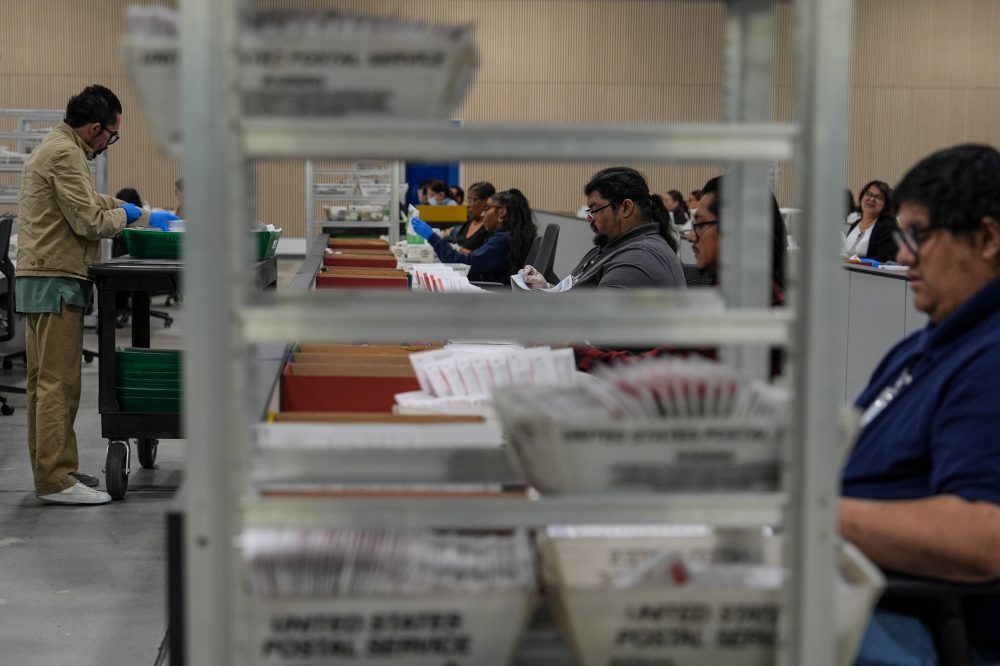
Nine Democratic governors sent a formal letter Thursday urging the U.S. Postal Service to withdraw a proposed regulation tied to an executive order signed by President Donald Trump — one that would create a federal list of eligible voters and potentially restrict who receives ballots through the mail.
Trump signed the executive order back in March. It directed U.S. Citizenship and Immigration Services and the Social Security Administration to build a so-called “citizenship list” for each state, with the Postal Service then limiting mail-in ballots only to individuals appearing on those lists.
The Postal Service moved to implement the order by filing a proposed rule in late May. However, a federal judge has since stepped in, blocking the executive order entirely and prohibiting agencies from carrying it out. The judge determined the order was unconstitutional, reasoning that only states and Congress — not the president — hold the authority to establish election rules.
The letter was organized by Illinois Gov. JB Pritzker and co-signed by eight other Democratic governors representing California, Connecticut, Minnesota, New York, Pennsylvania, Rhode Island, Washington, and Wisconsin. The governors pointed to the court’s ruling and called on the Postal Service to rescind the proposed rule it had put forward in response to Trump’s directive.
“Far from ensuring integrity in federal elections,” the governors wrote in their six-page letter, “the Proposed Rule would undermine trust in elections, needlessly complicate voting processes, arbitrarily disenfranchise millions of eligible voters, and undermine states’ constitutional role in ensuring free and fair elections.”
The governors also argued the rule would hand the federal government “unilateral power to refuse to deliver their ballots if a state refuses to collaborate with President Trump’s unlawful directives.”
The Postal Service had not responded to requests for comment as of Thursday. The agency had filed the proposed rule in the Federal Register after a judge in a separate lawsuit declined to block the executive order at that time, since the administration had not yet taken steps to carry it out. The groups behind that lawsuit — Democratic and civil rights organizations — have since filed an appeal.
Postal workers themselves have also pushed back on the order. Jonathan Smith, president of the American Postal Workers union, previously stated that their role was not to “verify voter eligibility” but rather to “move mail from one destination to the next.”
This marks the second executive order on election oversight that Trump has issued since returning to office. His first order — also blocked by the courts — centered on requiring documented proof of citizenship to register to vote.
Both orders stem from Trump’s focus on voting by noncitizens, a practice that studies and investigations by state and local authorities have found to be extremely rare. Trump has also repeatedly raised concerns about mail-in voting as a source of fraud, despite using it himself.
Experts and researchers have found no evidence of widespread problems with mail voting, a method that has grown in popularity among voters of both parties. A 2025 report from the Brookings Institution found mail ballot fraud to be extraordinarily uncommon — roughly four cases for every 10 million ballots cast by mail.
WASHINGTON — The U.S. Air Force announced Thursday that it is launching an investigation into an active-duty officer who stood on the steps of the Capitol in uniform and publicly demanded the impeachment of President Donald Trump and Vice President JD Vance.
The officer, identified as Major Jason Watson, made his remarks Wednesday during a protest event. According to video footage of the demonstration posted online, Watson criticized both Trump and Vance over several issues, including what he described as going to war with Iran without authorization from Congress.
Video from the event also shows U.S. Capitol Police detaining Watson at one point. He was holding a sign at the protest calling for the impeachment, conviction, and removal of both Trump and Vance.
The office of Air Force Secretary Troy Meink released a statement addressing the situation without specifically naming Watson. The statement acknowledged reports of an Air Force officer protesting at the Capitol and confirmed that an investigation “will proceed unimpeded.”
“The Department takes allegations of misconduct seriously, including any that might undermine the nonpartisan nature of our military,” the office stated in a post on X.
Federal law places significant limits on what active-duty military personnel can do when it comes to political activities, especially while wearing their uniform. Additionally, Article 88 of the Uniform Code of Military Justice specifically forbids officers from using “contemptuous words against the President, the Vice President, Congress” or other U.S. officials.
Watson appeared to acknowledge the potential consequences of his actions during his remarks at the protest. “What matters far more than who I am is what I have to say and the price I’m willing to pay to say it,” he said.
Attempts to reach Watson for comment were unsuccessful.
The U.S. dollar was on course Friday for its steepest weekly decline in nearly three months, after a lackluster June employment report caused markets to rethink how soon the Federal Reserve might raise interest rates again.
The dollar’s weakness carried into early Asian trading hours, with the euro hovering close to a two-week high at $1.1442. The British pound also held firm at $1.3361, putting it on pace for a 1.2% gain for the week — its strongest weekly performance in close to three months.
The Australian dollar, which tends to reflect investor appetite for risk, was trading at $0.6935 and appeared set to break a four-consecutive-week losing streak. New Zealand’s currency was at $0.5702, up 1.2% for the week.
The dollar index — a measure of the greenback’s value against a group of major currencies including the yen and the euro — slipped 0.2% to 100.77, following a 0.5% drop the day before. For the week overall, the index was down 0.58%, marking its worst weekly showing since early April.
The catalyst for the dollar’s retreat was a sharp slowdown in U.S. job growth last month. Nonfarm payrolls rose by just 57,000 in June, falling well short of the 110,000 increase analysts had anticipated. The labor force participation rate also fell to 61.5%, its lowest point in more than five years.
The soft data caused traders to reduce their bets on a Federal Reserve rate increase happening soon. Markets are now pricing in a 52% probability of a rate hike at the Fed’s September meeting, down from 64% the day before, according to CME FedWatch.
U.S. Treasury yields also retreated. The yield on two-year notes — which are especially sensitive to interest rate expectations — ended a three-day winning streak with a four basis-point decline.
Sim Moh Siong, an FX strategist at OCBC, said the jobs data sends a message that should ease some pressure on the Fed. “At the margin, it is dovish, helping to ease concerns about labour market overheating and the need for more aggressive policy tightening,” he said. He added, however, that the broader outlook still favors the dollar — especially against lower-yielding currencies — as long as expectations for Fed tightening remain in place.
The Japanese yen, which had been battered in recent weeks, got some breathing room from the dollar’s stumble. The yen was last trading at 161.01 per dollar after gaining nearly 1% in the prior session, bouncing back from multi-decade lows.
Investors remained watchful for possible government intervention in currency markets. Japanese officials have shifted away from their previous practice of issuing public warnings, instead signaling a more targeted effort to squeeze currency speculators and make it more costly to bet against the yen.
A member of a Japanese government advisory panel, Toshihiro Nagahama — known as an economic adviser to Prime Minister Sanae Takaichi — said Thursday that the Bank of Japan should continue raising interest rates at a gradual pace in order to address the yen’s excessive decline.
Tony Sycamore, an analyst at IG, said the situation leaves an important question unanswered. “The bigger question is what comes next,” he said, identifying 162.83 as a near-term ceiling for the dollar-yen exchange rate. “Whether it becomes a more meaningful medium-term high will ultimately depend on incoming U.S. data and, to some degree, developments in the Japanese government bond market.”
Milwaukee Brewers right-handed pitcher Jacob Misiorowski acknowledged Thursday that he will likely miss out on pitching in this year’s All-Star Game, even if he earns a roster spot on the National League squad.
The reason comes down to scheduling. Misiorowski is set to take the mound on July 12 against the Pittsburgh Pirates in what will be Milwaukee’s final game before the All-Star break. Because that start falls so close to the July 14 All-Star Game in Philadelphia, he would not be eligible to pitch in it.
After serving as the losing pitcher in Thursday’s 7-2 defeat to the Cincinnati Reds, Misiorowski opened up about his frustration with the situation.
“I get it,” Misiorowski said. “I get we’re not looking for right now. We’re looking for September, October. It sucks — obviously I want to throw in a game like that — but so be it.”
The hard-throwing 24-year-old has put together one of the most impressive pitching seasons in baseball this year. He carries a 9-4 record with a 1.47 ERA over 17 starts and leads the entire major leagues with 156 strikeouts in just 104 innings pitched. In late June, one of his pitches was clocked at 105.5 mph, making him one of the most talked-about arms in the sport.
Misiorowski is no stranger to the All-Star stage. Just one year ago, he was selected to pitch for the National League despite having made only five big-league starts at the time. That selection raised some eyebrows around the league, but he went on to throw a scoreless inning in the game.
“It makes it a little easier,” Misiorowski said of having that experience under his belt. “It makes it a little cooler. You get to be one of the guys, the veterans you were there with last year who kind of got to be in the background and watch it, so it’s fun.”
In Thursday’s loss to Cincinnati, Misiorowski struck out 10 batters over five innings. He surrendered five runs — four of which were unearned — to match a career-worst total, while giving up five hits and walking no one.
He also allowed two home runs in the game, tying a season-worst mark he first set on April 14 when he gave up two long balls to the Toronto Blue Jays in a no-decision outing.
The performance continued a rough recent stretch for Misiorowski, who has now dropped two of his last three starts after previously reeling off seven consecutive victories.
Montreal Canadiens goaltender Jakub Dobes has agreed to a three-year contract extension valued at $16.07 million, the team announced Thursday.
The 25-year-old had been on track to become a restricted free agent after next season, but the new deal locks him in through the 2029-30 campaign. Starting in 2027-28, the contract carries an average annual value of $5.357 million. Dobes had previously signed a two-year, $1.93 million deal back in July 2025.
This past season, Dobes turned in an impressive performance, going 29-10-4 with a 2.78 goals-against average and a .901 save percentage across 43 games, including 42 starts. He topped all rookie goaltenders in victories. His strong play continued into the postseason, where he went 9-10 with a 2.66 goals-against average and a .908 save percentage as Montreal advanced all the way to the Eastern Conference finals.
His outstanding debut campaign earned him a spot on the NHL All-Rookie Team for the 2025-26 season.
Over his two-year NHL career, Dobes has compiled a record of 36-14-7 with a 2.77 goals-against average and a .904 save percentage in 59 regular-season appearances, with 57 of those being starts.
Montreal originally selected Dobes in the fifth round of the 2020 NHL Draft.
Stock markets across Asia got off to a rocky start Friday morning following a weaker-than-expected U.S. employment report that dampened hopes for a near-term interest rate increase by the Federal Reserve.
The MSCI index tracking Asia-Pacific shares outside of Japan swung between positive and negative territory before nudging up just 0.1%, coming off two straight days of losses. South Korea’s Kospi dragged on the broader regional index, reflecting steep drops in chipmaker stocks seen during U.S. trading. Meanwhile, S&P 500 e-mini futures and Nasdaq e-mini futures each gained 0.1%, while Japan’s Nikkei 225 fell 1%.
Data released Thursday showed U.S. job growth dropped off sharply in June, with payroll figures for the previous two months also revised downward — signs that the labor market is losing steam. The unemployment rate dipped to 4.2% in June from 4.3% in May, though the decline came as workers exited the labor force, pushing the workforce participation rate to its lowest point in over five years.
Analysts at Westpac noted in a research report that “the figures challenged the narrative that the Fed remains on track to hike in the second half of this year.”
The disappointing employment numbers cooled trader expectations for a rate hike in the near future and increased the likelihood that the Fed will leave rates unchanged until October. According to the CME Group’s FedWatch tool, Fed funds futures now reflect a 46.8% probability that the central bank will hold rates steady at its September 15-16 meeting — up from a 35.8% chance just one day earlier.
On Wall Street Thursday night, results were mixed. The S&P 500 finished flat, the Nasdaq Composite slipped 0.8%, but the Dow Jones Industrial Average climbed to a record closing high. U.S. markets will remain closed Friday in honor of the Independence Day holiday.
The U.S. dollar edged up 0.2% against the Japanese yen, trading at 161.435 yen as Asian markets opened, with overall trading volume thinned due to the holiday. The dollar recovered some ground after a volatile Thursday session, during which the yen surged briefly following a Reuters report that Japanese authorities had adopted a new strategy for their market interventions. The reason behind the yen’s sudden rally was not immediately clear.
The U.S. dollar index, which gauges the greenback’s value against six major currencies, held steady at 100.98 after sliding 0.5% the day before.
In commodity markets, Brent crude futures fell 0.4% to $71.49 per barrel when Asian trading resumed. Gold edged up 0.1% to $4,125.49.
In the cryptocurrency space, bitcoin slipped 0.4% to $61,306.45, while ether dropped 0.7% to $1,692.16.
Mars Petcare US, Inc., based in Franklin, Tennessee, has announced a voluntary recall covering two specific lots of a popular canned dog food product.
The recalled item is PEDIGREE® Can High Protein Chopped Chicken & Duck Flavor wet dog food, sold in 13.2-ounce cans. The company says the recall was prompted by concerns that the product may have been fraudulently distributed and could contain foreign material.
Pet owners who have purchased this product are encouraged to check their supply and take appropriate action. The recall was announced on July 2, 2026.
NEW YORK — For decades, penalty shootouts were considered football’s cruelest gamble — a stomach-churning walk to the spot where careers could be made or shattered in an instant. But something has shifted. At this World Cup, the penalty kick is no longer treated as a roll of the dice. Instead, teams are approaching it as a highly specialized skill, backed by data, psychology, and serious preparation.
Germany and the Netherlands found out the hard way, both being sent home in the round of 32 following shootout losses to Paraguay and Morocco respectively. Belgium, meanwhile, saw the opposite result when Youri Tielemans converted a crucial penalty in stoppage time during extra time, completing a dramatic comeback win over Senegal.
Geir Jordet, a professor at the Norwegian School of Sport Sciences and author of the book “Pressure,” which examines the psychology of penalty kicks, says the notion that shootouts are simply a matter of luck is outdated and dangerous thinking.
Speaking to Reuters, Jordet said that in any successful World Cup run, a penalty shootout is almost impossible to avoid. “To not spend time on that is very strange,” he said.
“Ultimately there will be a young player whose legacy will be defined by the failure in a penalty shootout, which is a massive negative emotional trauma that we’re inflicting on this player as a coaching staff, as an FA, and even as a football industry,” Jordet added.
His research is extensive. For “Pressure,” Jordet reviewed video footage of all 718 shots taken in men’s penalty shootouts at the World Cup, European Championship, and Champions League from the time shootouts were introduced in 1970 through 2023.
One of his most striking findings: 53% of players who missed a penalty displayed the same kind of body language afterward — shrinking physically, dropping to the ground, covering their faces, staring downward, or avoiding eye contact with teammates on the walk back.
No country knows this pain better than England. “The England story is fascinating,” Jordet said. “They lost six out of seven penalty shootouts in the ’90s and early 2000s. And this was common knowledge in England that we go far in the tournament, we have fantastic talent, and then we lose on penalties. So then they took hold of this and they orchestrated something new. They created these big penalty projects… they’re very pioneering and innovative, comprehensive in their approach.”
Under current manager Thomas Tuchel, England is continuing that work. Tuchel views penalties as a matter of execution and repetition. “The FA has a programme in place. We follow this programme in detail, and it’s just an important and very specific part of football that comes into play in knockout matches,” he said.
Spain’s coach was equally direct about the subject. “Kicking a penalty is not something that happens at random,” he said. “Just as we have specialists in free kicks, in corner kicks, we have specialists in penalties. Not everybody can shoot a penalty. We have to focus on the psychological aspect as well. For some of them, it’s much harder, and others are just eager to shoot penalties.”
Jordet’s research zeroes in on subtle signs of stress that players often don’t even realize they’re showing — the rushed walk from midfield, the anxious expression, the way a player reacts the moment the referee’s whistle sounds.
“Facial expressions will indicate anxiety,” Jordet said. “But the question is always, how do you deal with these emotions?”
He noted that some players treat the referee’s whistle like a starting signal, rushing to strike before they’ve mentally settled. “The ones who react to the whistle very quickly, that to me is not a particularly good sign because it could indicate that their focus is basically on their emotions and not on the task at hand,” he said.
There are exceptions, however. Kylian Mbappe, Jordet noted, is “one of the quickest penalty takers in the world” but continues to excel because his rapid approach is simply part of how he plays the game naturally.
Tielemans, who used a short run-up on his decisive penalty against Senegal, credited preparation as much as composure in the moment. “We’ve been practising the last few days,” he said. “In that moment you just try to be confident and trust your abilities.”
Goalkeepers, too, have undergone a transformation. Morocco’s Yassine Bounou — known as Bono — has turned the penalty duel into something of a psychological chess match. “Goalkeepers have been through a revolution,” Jordet said. “Goalkeepers are more prepared. So far in this World Cup, we’re seeing how goalkeepers have kind of gained a little bit of an edge by just being smarter than the penalty takers and using analytics and data better than what we have seen in the past.”
Bono’s specialty, according to Jordet, is manipulating penalty takers who wait for the goalkeeper to commit first. “He has developed this into an art,” Jordet said. “He has shown that against some of the top penalty takers in the world using this technique.” In the Morocco-Netherlands shootout, two Dutch players missed the target entirely, and Bono stopped a third attempt.
“Bono uses this double fake movement where he moves on the goal line at exactly the right moment to deceive (the taker) into believing that he’s going to go to the left, but in fact he’s going to the right,” Jordet explained.
Brazil’s coach Carlo Ancelotti has taken preparation to another level, dividing his squad into two groups for full shootout simulations — players line up at midfield, walk to the spot, and go through the entire process while he observes their body language and patterns.
Despite all the preparation, analysis, and coaching, one thing remains certain: somewhere in this tournament, another young player’s entire legacy may come down to a single shot from 12 yards out.
New Zealand Prime Minister Christopher Luxon announced Friday that Indian Prime Minister Narendra Modi will travel to New Zealand for an official visit next week — the first such trip by an Indian head of government in 40 years.
The two countries reached a major trade milestone in April, signing a free trade agreement that will eliminate 95% of tariffs on goods exported from New Zealand.
“Prime Minister Modi’s visit is historic, with this being the first to New Zealand by an Indian Prime Minister in 40 years,” Luxon said in an official statement.
Modi is scheduled to touch down in Auckland on July 10 and will depart the country the following day.
A split federal appeals court has placed new limits on the Trump administration’s power to keep immigrants locked up while their deportation cases move through the courts, ruling Wednesday that migrants cannot remain in custody beyond 90 days without being given the chance to appear before an immigration judge to request release on bond.
The decision came from a 2-1 panel of the 5th U.S. Circuit Court of Appeals, based in New Orleans, and could have significant consequences for thousands of people currently held by U.S. Immigration and Customs Enforcement in states that fall under that court’s jurisdiction, including Texas and Louisiana.
The case centers on a legal interpretation the U.S. Department of Homeland Security adopted last year, which took the position that non-citizens already living inside the United States — not just those arriving at the border — qualify as “applicants for admission” under federal immigration law. That classification subjects them to mandatory detention with no opportunity for a bond hearing while their cases are pending.
The Board of Immigration Appeals, which operates under the Justice Department, issued a ruling in September endorsing that interpretation. Following that decision, immigration judges across the country began ordering mandatory detention under the new standard.
A different panel of the same 5th Circuit had previously been the first appeals court in the country to back the Trump administration’s reading of the law. However, that earlier February ruling left open the question of whether the Constitution’s Fifth Amendment due process protections still require those detained migrants to receive a bond hearing.
Thursday’s majority opinion, written by U.S. Circuit Judge Leslie Southwick, addressed that constitutional question directly. Southwick pointed to a 2001 U.S. Supreme Court decision making clear that due process protections apply to everyone within the country’s borders — including the two Mexican nationals and one Honduran citizen whose cases were before the court.
“It is part of the historic majesty of this long-ago founding charter that it makes no exceptions in providing basic rights to those within our boundaries, including a right to be heard when personal liberty is taken,” Southwick wrote. Southwick was appointed to the bench by Republican President George W. Bush.
U.S. Circuit Judge Cory Wilson, who was appointed by President Trump, wrote a dissenting opinion, arguing that “the majority marginalizes the Constitution’s express grant of plenary authority over immigration matters to Congress.”
An attorney representing the migrants through the American Immigration Council, Rebecca Cassler, said in a statement that they “are delighted that the panel recognized the core constitutional principle that the due process clause does not allow the government to lock them away indefinitely.”
A spokesperson for the Department of Homeland Security, which oversees ICE, pushed back on the ruling, stating the agency disagrees with the decision “and is confident in its legal position regarding mandatory detention.” The spokesperson also noted that the administration had asked the U.S. Supreme Court just last week to take up a similar ruling issued by another federal appeals court.
Federal appeals courts remain divided on whether the administration’s interpretation of immigration law is legally sound, setting the stage for the Supreme Court to potentially settle the dispute.
MIAMI — For generations, soccer has set itself apart from other major team sports with one defining quality: once the opening whistle sounds, the game runs on its own terms.
Coaches can’t call timeouts, TV networks can’t dictate stoppages, and for 45 straight minutes, the action flows without interruption. That, at least, has been the tradition — but a series of recent rule changes is quietly rewriting it.
FIFA introduced three-minute hydration breaks in each half of World Cup matches to shield players from the intense summer heat of North America. On their own, cooling stops might seem like a minor adjustment. But stacked alongside VAR reviews, extended stoppage time, and prolonged injury delays, they are raising a bigger question: how much can the sport change before it stops feeling like the game fans have always known?
Changing the Rhythm
None of these adjustments were meant to fundamentally alter soccer’s character. VAR was brought in to improve decision-making accuracy. Expanded stoppage time was designed to recover minutes lost during delays. And hydration breaks were added out of concern for player safety in extreme conditions.
Together, however, they are transforming the flow of matches — opening new windows for coaches to regroup, broadcasters to reset, and players to catch their breath in ways that would have seemed far-fetched just ten years ago.
One moment that captured attention: U.S. coach Mauricio Pochettino was seen huddling his players around a laptop during a hydration break in a pre-tournament friendly against Senegal — a scene that looked far more like an NBA timeout than a traditional soccer game.
What started as a health measure has taken on a tactical dimension, giving managers a chance to stop momentum, reorganize their teams, and deliver detailed instructions at pivotal moments in a match.
The breaks also create predictable windows for broadcasters. Advertisers now have guaranteed visibility at fixed points in every game — something that does not normally exist in soccer.
Michael Johnson, a research analyst covering the U.S. sports industry for S&P Global, told Reuters the hydration breaks could be “extremely valuable” for networks looking to sell ad time. Johnson added that commercials in those windows could “potentially command Super Bowl-level prices” — somewhere in the range of $7 million to $9 million.
Fans Push Back
Not everyone is welcoming the change. England supporters, used to the non-stop pace of the Premier League, loudly booed hydration breaks during World Cup matches. Still, Thomas Tuchel’s squad made good use of them after falling behind early, rallying to win over the Democratic Republic of Congo.
FIFA President Gianni Infantino defended the breaks on Instagram, saying: “After an intense start to both halves, England used their hydration breaks well to regroup, reorganise and get on the front foot before finding the net twice in the final 15 minutes.”
Infantino added: “These breaks are so important to give players a break during tournament play, while also allowing all coaches a dedicated moment in every match — not just depending on the weather conditions — to engage directly with their players.”
Football’s rule-making body, IFAB, confirmed that cooling breaks of between 90 seconds and three minutes are permitted. Infantino noted the breaks were applied in every World Cup match regardless of temperature, in the name of fairness across the tournament.
Former Premier League striker and television commentator Stan Collymore was blunt in his criticism on social media: “The breaks create a stop of momentum. I’ve never seen one match in thousands I’ve watched or played in that’s been better with more stoppages. Not one.”
Collymore’s view reflected a broader sentiment online. An analysis by PeakMetrics found that 75% of digital conversation surrounding hydration breaks was unfavorable, with many fans complaining that games now feel as though they’re split into four quarters.
Here to Stay?
Whether hydration breaks become a permanent fixture remains an open question. UEFA says its existing cooling-break rules are adequate, and the Premier League has no current plans to adopt the practice. But soccer has a history of embracing changes that once seemed unimaginable — from the back-pass rule to VAR to longer stoppage time. Hydration breaks may yet join that list.
A closely watched private survey released Friday shows Japan’s services sector shifted back into growth mode in June, snapping a brief pause that had stalled activity in May.
The S&P Global final Japan Services Purchasing Managers’ Index, known as the PMI, climbed to 52.2 in June, up from 50.0 in May. Any reading above 50.0 signals that business activity is expanding, while anything below that threshold indicates a slowdown.
The June rebound marked the 14th time in the past 15 months that the sector has registered growth, with May being the lone exception. Even so, the pace of that growth was described as modest and came in slightly below the average rate seen over the past year.
New business coming into service firms increased at one of the fastest rates recorded in the past two years. That growth came despite a continued and notable drop in new business from overseas, which has now declined for three straight months. Some companies pointed to stronger demand in the transportation sector, tied to new product launches and upcoming events.
Cost pressures were a significant concern, with input prices climbing at their steepest rate since June 2022. Higher costs for oil, energy, food, and wages all contributed to that increase. On the other hand, the prices that companies charged their own customers actually eased back from the near-record levels seen in May.
Hiring continued, though at a modest pace. Employment growth picked up slightly from May’s recent low but still fell short of the average seen during a 10-month stretch of payroll increases.
Annabel Fiddes, Economics Associate Director at S&P Global Market Intelligence, offered this assessment: “Although growth momentum improved, overall business confidence strengthened only slightly in June, as uncertainty over the war and rising expenses weighed on forecasts.”
The broader Composite PMI, which factors in both the manufacturing and services sectors, rose to 52.8 in June from 51.1 in May — the strongest reading in three months.
Escaping the heat this Fourth of July weekend will be no easy feat for millions of people in the eastern United States, with some communities already scrapping or scaling back their Independence Day festivities because of dangerous conditions.
The National Weather Service issued a warning Thursday that hazardous, record-setting heat will continue across much of the central and eastern U.S. through Friday, with the East Coast expected to remain in the grip of extreme temperatures through the weekend. Forecasters called for highs in the upper 90s Fahrenheit across the Northeast, and both New York City and Boston hit 100 degrees on Thursday. When humidity is factored in, conditions will feel even more punishing — putting a damper on celebrations marking 250 years of American independence.
“Anywhere you go in southern New England, you will be dealing with dangerous heat today, tomorrow and Saturday,” said Bryce Williams, a meteorologist with the National Weather Service.
In Boston, organizers pushed back the gates-open time for the Boston Pops Fireworks Spectacular from noon to 4 p.m. on Saturday due to the heat. Philadelphia officials shortened the route of a Thursday morning parade, scrapped an afternoon all-American Block Party, and delayed the start times of an evening picnic and concert at Independence Mall.
In Lower Windsor Township, Pennsylvania, an America 250 celebration that was to include food trucks, games, and the highway department’s dump truck has been moved to July 8. Norristown, Pennsylvania canceled its Saturday parade entirely, citing concerns for the safety of residents, participants, and first responders — though evening fireworks and an afternoon event with games, food, and music are still set to take place.
“The parade is one of our community’s most beloved traditions, and we share in the disappointment of its cancellation, especially as we celebrate America’s 250th birthday,” said Interim Municipal Administrator Jayne Musonye.
Gettysburg National Military Park in Pennsylvania relocated outdoor programming to indoor venues. Amtrak also canceled several train routes Thursday due to the heat, including Acela service between Boston and Washington, and warned that other trains could run at reduced speeds, causing delays through Saturday.
A heat dome — a high-pressure system that traps heat and humidity over a region — has been bearing down on areas stretching from the Midwest to the East Coast. Beyond holiday events, officials in many communities have opened cooling centers for residents seeking relief. In Boston, several air-conditioned museums are offering free admission to city residents, while pools and waterparks in Providence, Rhode Island have extended their hours.
At a Philadelphia Phillies home game against the Pittsburgh Pirates on Wednesday, the temperature had already climbed to 98 degrees by first pitch. Sixteen pallets of bottled water were handed out to fans at no charge.
Bill Christy, 69, of Philadelphia, was making his way through the heat with two teenagers he had brought along for company. “They’re young, they can handle it,” he said. “I’ll just go up in the shade somewhere if I get hot.”
Nearby, a fife and drum corps was marching through the lower concourse in full uniform. “Usually it’s wool regimental. But this is linen, it’s cool,” said Debbie Mayes of Ewing, New Jersey, a member of the Washington Crossing Fife and Drums. “We’re fine. They’ve been very kind to us, letting us take breaks and providing water.”
In New York City, Taylor Swift fans were braving the heat outside Madison Square Garden, hoping to catch the superstar before her Friday wedding. Amanda Powell, visiting from Little Rock, Arkansas, admitted the conditions were tougher than expected. “It’s super hot,” she said. “Being from Arkansas, we thought we could handle the heat, but it’s been very warm.”
Central Park in Manhattan reached 100 degrees Thursday afternoon — the first time the famous park has hit triple digits since 2012, according to the National Weather Service.
At the Franklin Park Zoo in Boston, staff worked hard to keep animals comfortable in the extreme heat. Workers gave African penguins frozen blocks of ice packed with herring, offered frozen pellets to Nigerian dwarf goats, and tossed frozen treats into the enclosure of Western lowland gorillas, who eagerly scrambled to snatch them up.
“All of my animals have been doing a really great job of staying under the fan, staying near a sprinkler,” said zookeeper Brooke Cannon. “I’m running around with the hose hitting them a little bit here and there. Yeah, it’s not their favorite, but you know sometimes you got to do what you got to do to make sure that they’re not making poor choices.”
Despite the brutal conditions, the zoo drew plenty of visitors — though many were seen fanning themselves or standing under misters to find relief. Some were already regretting the trip. “It’s too hot in the summer and this is not the right time to come and visit zoo,” said Bhargavi Patha, who was visiting with her husband and 14-month-old son. “The heat is exhausting us. We are draining and we had to drink a lot of water to see all the animals.”
The heat wave is also putting pressure on electric grids across the region. New York Mayor Zohran Mamdani urged residents to set their air conditioners to 78 degrees to avoid overtaxing the power supply — a step previous mayors, including former Mayor Rudy Giuliani, have also recommended. The request drew criticism from conservative voices online. By early Thursday afternoon, New York Gov. Kathy Hochul, a Democrat, asked all state residents to raise their thermostats to 75 degrees or higher, limit unnecessary appliance use, and conserve electricity, citing high demand and what she called “unexpected load challenges.”
Florida Gov. Ron DeSantis, a Republican who frequently sparred with the mayor on social media, responded on X with: “Is this what was meant by the warmth of collectivism?” — a reference to a phrase the democratic socialist mayor used during his inaugural address.
The rapid expansion of data centers is adding further strain to the grid. Operators in New York state, New England, and the grid serving 13 mid-Atlantic and Midwestern states all projected electricity demand would peak Thursday before easing slightly on Friday. As of Thursday evening, no emergency calls had been issued to reduce consumption, even as usage ran roughly 40% above a typical summer day.
PJM Interconnection, which manages the grid serving 65 million people from New Jersey to Illinois, had anticipated Thursday would set an all-time summer electricity demand record, but usage ultimately fell just short of the mark set in 2006. In preparation, PJM secured an order from the U.S. Department of Energy allowing utilities to require data centers and other large power users to disconnect from the grid and switch to backup sources — such as diesel generators — before resorting to rolling blackouts.
A major Canadian hydropower transmission line supplying New York City went offline Wednesday due to an equipment failure in Canada, but operator Hydro-Québec reported the line was repaired and back in service by 12:30 p.m. Thursday.
Delaware State Fire Marshal investigators are looking into a serious four-alarm fire that damaged several homes in a Wilmington neighborhood.
The fire broke out shortly after 3:00 PM on July 2, 2026, in the 1500 block of Clayton Road in Wilmington. Emergency crews were quickly dispatched to the area after the blaze was reported.
The Five Points Fire Company led the response, with additional support from multiple mutual aid fire companies that were called in to help battle the flames.
The Office of the Delaware State Fire Marshal is now conducting an investigation to determine what caused the fire. Further details are expected to be released as the investigation continues.
A federal judge on Thursday pushed back against the Trump administration, demanding stronger assurances that it would hold off on renovating a historic Washington, D.C., golf course while legal proceedings are still underway.
U.S. District Judge Ana Reyes said she grew concerned after President Donald Trump posted on social media that sweeping renovations to the East Potomac Golf Links would kick off on September 1. She also pointed to detailed course redesign plans that were on display when Trump visited the site on Sunday, saying they suggested the project was further along than officials had let on publicly.
Despite her concerns, Reyes stopped short of issuing any formal ruling Thursday. After speaking with the government’s attorney, she said the administration appeared to be operating within the proper legal framework — for now.
“I’m just not there yet,” she said, explaining her decision not to act. “I’m not going to assume the agency is going to act in bad faith.”
Reyes gave both sides two weeks to agree on legal language that would assure her and the plaintiffs that they would not suddenly find out in the “middle of the night” that bulldozers had arrived at the course “chopping down cherry trees.”
The hearing came after the plaintiffs suing to block the administration’s plans requested urgent court intervention. Their filing cited Trump’s recent visits to several Washington landmarks he has been altering or renovating as the reason for their renewed concern.
Trump, who is known for his passion for golf, shared his vision for the course online, writing: “When completed, this Course will have the ability to host Major Golf Tournaments, including The U.S. Open, The Ryder Cup, The PGA Championship, and other top PGA Tour events.” However, major tournament locations are typically selected years in advance, making it unclear when or whether the course could actually host such events.
During Trump’s visit to the course, renowned golf course designer Tom Fazio was present and brought along extensive design plans. Judge Reyes said it was difficult to believe someone who earns “millions” designing golf courses would have created a full proposal and personally accompanied Trump simply “out of the goodness of his heart.”
Michael Robertson, the Justice Department attorney representing the government, pushed back on that characterization. He said Fazio had not been officially hired or designated by the Interior Department and that the process remained open to proposals from other designers. Robertson described the plans that had been seen as merely “conceptual.”
Robertson also repeatedly reminded Reyes that the project still faces a lengthy approval process involving multiple oversight bodies, including the National Capital Planning Commission and the U.S. Commission of Fine Arts. Reyes noted, however, that the Planning Commission is largely made up of Trump allies who have already signed off on several of his projects, including a White House ballroom and renovations to the Lincoln Memorial Reflecting Pool.
The golf course renovation is just one piece of a larger controversy surrounding the site. The course has also been used as a disposal area for debris from the demolition of the East Wing of the White House, which Trump ordered torn down to make way for a new ballroom.
Reyes said she would need the plaintiffs to provide evidence that the debris poses a genuine threat to people and the environment before she would consider ordering its removal.
This lawsuit is the latest in a string of legal challenges aimed at pushing back on the administration’s aggressive efforts to reshape public spaces across the nation’s capital. Reyes referenced those other projects repeatedly, saying she wanted to prevent the administration from completing work before the courts could weigh in. “I don’t want a destroyed East Wing, a destroyed reflecting pool” before knowing whether the work had been properly approved, she said.
The East Potomac Golf Links is 106 years old and has been at the center of this lawsuit since February. The complaint, filed against the Department of the Interior, argues that the administration’s plans to overhaul East Potomac Park — which includes the golf course — would break the law established by Congress when it created the park in 1897.
The DC Preservation League, which brought the lawsuit, first sought an emergency halt to the project in May, citing fears that construction was about to begin immediately.
Among the 16 children discovered living in appalling conditions inside an Ohio home, some were unable to speak, and one — an 18-year-old with a developmental disability — could not write her own name.
Following their rescue on Tuesday, seven of the children were hospitalized, including one who was in critical condition, according to investigators. Their conditions as of Thursday had not been publicly updated. Child welfare authorities have been granted temporary custody of all 16 children.
If investigators’ allegations prove accurate, these children face a long and difficult path toward healing — one that will require undoing years of abuse, neglect, and deep emotional trauma. Experts note that not every foster family is equipped to handle cases this severe, and Ohio, like many states, already faces a shortage of available foster homes that is only growing harder to address.
Officials have indicated that some of the children may need to be placed in specialized treatment facilities as part of their recovery process.
Ohio Attorney General Andy Wilson addressed the situation at a news conference this week, saying he had never encountered anything like the conditions these children endured. “It’s going to take a lot of work to address the emotional harm and some of the issues that are going to result from this,” Wilson said. “But we need to make sure those kids are surrounded and loved and supported by people who truly care for them.”
Four individuals — the children’s parents and grandparents — have been arrested and charged with child endangerment. Defense attorneys have asked the public to withhold judgment and allow the facts to emerge through the legal process.
Past cases involving children rescued from severe abuse have illustrated just how steep the recovery challenges can be. In one Michigan case, children were found alone in a home so contaminated that law enforcement evidence technicians had to wear hazmat suits to enter.
In Southern California in 2018, 13 children were freed from a home where they had been locked up and starved by their parents for years. That abuse, centered in the community of Perris — roughly 60 miles southeast of Los Angeles — went undetected until a then-17-year-old named Jordan Turpin slipped out of the house and dialed 911. When authorities arrived, all but the youngest of the 13 siblings, a 2-year-old, were dangerously underweight and had gone months without bathing.
Their parents, David and Louise Turpin, admitted guilt to charges of torture and prolonged abuse and were sentenced to life in prison, with the possibility of parole after 25 years.
Despite their rescue, the Turpin children later encountered additional failures within the very system designed to protect them. Six of the siblings were placed in a foster home where they say they were abused again — describing in a lawsuit being struck with sandals and forced to eat their own vomit. The foster family was convicted in the case, and the foster father received a seven-year prison sentence in 2024.
A 2022 investigation conducted by a law firm hired by Riverside County to examine the children’s care found that the county’s child welfare system was understaffed and underfunded. The report concluded that caseworkers were managing excessive caseloads that made it nearly impossible to ensure the safety and well-being of “our most vulnerable populations.”
Scott Britton, assistant director of the Public Children Services Association of Ohio, said that not every foster family has the capacity to care for children carrying multiple and complex traumas. He noted that Ohio’s system is already stretched thin, with one in four children currently in custody not because of abuse or neglect, but due to behavioral health challenges, developmental disabilities, or juvenile justice involvement.
“We have a lot of kids with significant and serious needs, not all of which unfortunately can be met by a foster family,” Britton said. “So we unfortunately are all too accustomed to managing a very broad range of significant deficits in children.” He added that residential care facilities and psychiatric treatment centers often must fill the gap.
Across the country, child welfare systems are under enormous strain. State and federal data indicate that worker turnover rates range from 20% to 40% in some areas, driven by burnout and the emotional weight of the job. Recruiting and retaining qualified workers remains a persistent struggle, with rural communities and high-need regions often the hardest hit.
In New Mexico, the state’s child welfare agency is facing legal action following a scathing report released in April by the New Mexico Department of Justice, which outlined widespread systemic failures. The state’s top prosecutor, Attorney General Raúl Torrez, linked those failures to the deaths of 14 children over the past two years, citing lapses in decision-making and oversight at the Children, Youth and Families Department.
Back in Ohio, Britton expressed cautious optimism about new state investments in children’s services and behavioral health resources. He said he is hopeful that a statewide Medicaid-managed care plan designed specifically for children and adolescents with serious behavioral health needs could make a meaningful difference. “I’m not saying it’s enough,” he said. “We could use more and a lot of it depends on where you’re located.”
In California, Riverside County and a foster care agency agreed to a $13.5 million settlement with the six Turpin siblings who were placed in the abusive foster home. Their attorneys said the case helped drive meaningful reforms to the county’s child welfare system.
Nearly four years after the Turpin children were rescued, one of the siblings, Jennifer Turpin, spoke with ABC News in a 2021 interview about her desire to move forward. “I want the Turpin name to be, like, ‘Wow, they’re strong, they’re not broken,’” she said. She has since written a book about her experiences titled “Where was God?” Her author biography reads: “She has been through hell and came out strong and resilient.”
Federal health officials are reporting that more than 120 people aboard a Princess Cruises ship were struck by a highly contagious stomach virus during a recent voyage departing from San Francisco.
The Ruby Princess, which set sail on June 12 on a 20-day round trip to Canada and Alaska, saw 102 passengers and 23 crew members come down with norovirus, according to the U.S. Centers for Disease Control and Prevention. The ship docked back in San Francisco on Thursday.
Norovirus spreads easily, often through contaminated food, surfaces, or close contact with infected individuals — conditions commonly found in crowded environments like cruise ships. While the illness is usually brief, it can pose a serious risk to people with underlying health conditions, young children, and adults 65 and older.
The CDC says symptoms typically include a sudden onset of vomiting, diarrhea, and stomach pain, which can persist for up to three days.
The outbreak was reported to the CDC on Saturday. Officials noted that not all infected individuals were sick at the same time, nor were all of them ill when the ship arrived or departed port. In total, the Ruby Princess carried 3,032 passengers and 1,144 crew members on the voyage.
In a statement, Princess Cruises said the ship’s crew acted quickly and put “enhanced sanitation protocols across the ship” into effect. The company added that the vessel would be fully cleaned and disinfected before heading out on its next trip later Thursday.
Health officials noted that seven illness outbreaks on cruise ships within CDC jurisdiction have been reported so far this year, with norovirus being the most common cause.
The CDC says the best defense against norovirus is frequent and thorough handwashing — especially after using the restroom and before eating or drinking. Scrubbing with soap and water for at least 20 seconds is recommended. Officials caution that hand sanitizer alone is not effective against norovirus.
Montreal Canadiens goaltender Jakub Dobes has secured his future with the team, agreeing to a three-year contract extension worth $16.07 million on Thursday.
The 25-year-old had been on track to become a restricted free agent following next season, but the new deal keeps him in Montreal through the 2029-30 campaign. The extension carries an average annual value of $5.357 million, kicking in starting with the 2027-28 season. He had previously signed a two-year, $1.93 million contract back in July 2025.
Dobes put together an impressive debut season, finishing with a 29-10-4 record, a 2.78 goals-against average, and a .901 save percentage across 43 games, including 42 starts. He led all rookie goaltenders in victories. His strong play carried into the postseason as well, where he went 9-10 with a 2.66 goals-against average and a .908 save percentage as the Canadiens pushed all the way to the Eastern Conference finals.
His efforts earned him a spot on the NHL All-Rookie Team for the 2025-26 season.
Over his two-year NHL career, Dobes has compiled a 36-14-7 record with a 2.77 goals-against average and a .904 save percentage in 59 regular-season appearances, with 57 of those being starts.
Montreal originally selected Dobes in the fifth round of the 2020 NHL Draft.
A Southern California man has admitted in federal court to sending fraudulent ransom messages to the family of a missing elderly woman whose disappearance has gripped the nation — the mother of “Today” show co-host Savannah Guthrie.
Derrick Callella, 42, entered guilty pleas Thursday to two counts of harassment by telecommunications device in U.S. District Court in Tucson. The charges represent the only criminal conviction so far connected to the disappearance of 84-year-old Nancy Guthrie, who vanished from her Tucson, Arizona home five months ago.
Each count carries a maximum sentence of two years in prison and a $250,000 fine. However, under the terms of Callella’s plea agreement with federal prosecutors, the Hawthorne, California resident is expected to receive five years of probation rather than prison time, according to a spokesperson for the U.S. Attorney’s Office. His formal sentencing has been scheduled for September 10.
Despite the guilty plea, the question of what happened to Nancy Guthrie remains unanswered. The underlying kidnapping investigation continues without resolution.
Nancy Guthrie, described as being in fragile health with limited mobility, was last seen at her home on January 31. A friend alerted family members the following day after she failed to appear at church as planned. When relatives went to check on her, they found the home empty.
Investigators noted that Guthrie had left behind critical personal belongings, including her wallet, cellphone, hearing aid, and medication. DNA testing later confirmed that blood discovered on her front porch belonged to her.
Callella was taken into custody on February 5 — just four days after Guthrie was reported missing. Court records and FBI statements revealed that local media had already received a ransom note on February 2 demanding bitcoin payment and laying out deadlines.
In his guilty plea, Callella acknowledged that on February 4 he called and texted Guthrie’s family asking about a bitcoin transfer. According to the U.S. Attorney’s statement, “he acknowledged that he knew an earlier ransom demand had been made.”
The statement went on to say that “Callella also admitted that his actions were meant to harass the family by seeking information about the investigation into the missing person’s disappearance.”
The guilty plea came one day after the FBI’s Phoenix field office posted on X that investigators had received “several” ransom notes during the course of the investigation. Some were characterized as “extortion attempts without legitimacy,” while others are still being treated as potentially authentic. The FBI has continued to classify Nancy Guthrie’s disappearance as a kidnapping-for-ransom case.
Last week, celebrity news outlet TMZ.com reported receiving an email from an individual claiming to know who abducted Guthrie and claiming to possess video of the “main guy” involved, as well as footage of Guthrie on the day she allegedly died.
An FBI official, who spoke to Reuters anonymously due to the ongoing nature of the investigation, said Tuesday that the latest TMZ correspondence and two ransom notes that surfaced in February have all been determined by investigators to lack credibility.
MIAMI — Argentina’s head coach Lionel Scaloni is embracing the enormous wave of fan support pouring into Miami ahead of his team’s World Cup showdown with Cape Verde, calling the passionate supporters a 12th member of the squad.
Miami has served as home base for Argentina captain Lionel Messi ever since he signed with Inter Miami back in 2023. The city is also home to roughly 30,000 Argentine residents in southern Florida — the single largest concentration of Argentines living in any major metropolitan area across the United States.
By the time Friday’s round-of-32 match against the African underdogs gets underway, estimates put the Argentine fan presence in the city at around 60,000 people. Scaloni made clear at his pre-match news conference at Miami Stadium that he couldn’t be happier about it.
“Their support is something that I love,” the coach said. “We feel their support, they strengthen us and it’s not extra pressure for us. I hope that they enjoy seeing their team and hopefully we can bring them joy.”
“Our fans are our 12th player. Our players were Argentina fans when they were little. Now they’re wearing this jersey. I think that this shows the team’s character,” he added.
The iconic sky blue and white striped jersey — which earned Argentina’s national team the nickname “Albiceleste” — was on full display Friday as hundreds of fans packed a beachside park for a “Banderazo,” a traditional Argentine pep rally. The three-time world champions were well represented, with flags and banners hanging from trees, some depicting both Messi and the late football legend Diego Maradona lifting the World Cup trophy. Massive cuts of beef sizzled on charcoal and driftwood grills nearby.
After an early thunderstorm rolled through, the celebration resumed with drums, music, and fans wading into the seaweed-filled ocean while chanting songs in honor of their national team.
While Scaloni acknowledged Cape Verde as a legitimate threat not to be underestimated, many fans in attendance had little doubt about the outcome. Fan Geronimo Guenen predicted a comfortable Argentine victory.
“Argentina is going to come away with a very good 3-0, 2-0 victory, and that’s it,” Guenen said. “Argentina has everything it needs to win; it has a very good team, Messi is in very good form, he’s had that throughout his career, and now, above all, we can compete with anyone.”
The Texas Rangers saw three players walk out the door Thursday when outfielder Jarred Kelenic and veteran right-handed pitchers Joe Ross and Chris Paddack each turned down outright assignment offers and elected to become free agents.
Paddack’s time in Texas was remarkably brief. He joined the club on Monday and took the mound that same evening in a bulk relief role against the Cleveland Guardians, giving up two runs and seven hits across four innings. The very next day, he was designated for assignment and eventually cleared waivers. The 30-year-old has now cycled through the Miami Marlins, Cincinnati Reds, and Rangers all in the same season, compiling a 0-7 record with a 6.79 ERA across 14 appearances, including nine starts.
Ross, 33, fared somewhat better during his Texas stint, pitching in five games and surrendering four earned runs over eight innings for a 4.50 ERA, though he did take one loss. He began the year with the Arizona Diamondbacks and now carries a 9.26 ERA across eight total relief outings covering 11 and two-thirds innings.
Kelenic, 26, also had a short stay in Texas — his second team this season and the fourth organization of his major league career. Once considered a top prospect with the New York Mets and Seattle Mariners, Kelenic started 2025 with the Chicago White Sox before being granted free agency at the end of May. He quickly signed with Texas but appeared in just seven games, going 1-for-8 at the plate.
In additional roster moves, the Rangers selected the contract of right-hander Ben Peoples from Triple-A Round Rock, optioned right-hander Winston Santos back to Round Rock, and shifted left-hander Jordan Montgomery’s rehab assignment from Double-A Frisco up to Triple-A.
Peoples, 25, was acquired from the White Sox in exchange for catcher Ben Hartl earlier this week and could be in line for his major league debut with Texas. With Triple-A Charlotte, he posted a 5-1 record and a 2.39 ERA over 29 relief appearances, striking out 45 batters while issuing 21 walks.
Santos, 24, made his major league debut on Wednesday, allowing two runs on two hits over two innings of relief work during a 9-4 loss at Cleveland.
Former NFL running back Chris Johnson revealed on Monday during an appearance on “Good Morning America” that he has been diagnosed with ALS. Two days after that conversation with former New York Giants defensive end Michael Strahan, Johnson took to social media to ask supporters to bring back a viral fundraising movement that went quiet after 2014.
The ALS Ice Bucket Challenge took the country by storm during the summer of 2014, generating $115 million in donations for the ALS Association, according to the organization’s own website.
“Years ago, the ALS Ice Bucket Challenge united millions of people around one cause and helped change the fight against this disease,” Johnson wrote in his social media post. “Today, I’m asking you to help me do it again.”
The original 2014 movement was launched by three men living with ALS — Anthony Senerchia, Pete Frates, and Pat Quinn — and inspired 17 million people to dump buckets of ice water over their heads while donating to ALS charities. Beyond the money raised, the campaign brought widespread attention to ALS, also known as Lou Gehrig’s disease, and helped fund both research and care for those living with the condition.
In his post, Johnson credited former Utah basketball player Hunter Mecum as the spark behind his decision to revive the challenge. Mecum posted a video of himself completing the challenge in Johnson’s honor and then called out “2,000 active NFL players” to follow suit — a nod to Johnson’s legendary 2,000-yard rushing season.
Johnson himself has nominated former NFL players LenDale White, Marshawn Lynch, and Adam “Pacman” Jones to participate. White previously shared the backfield with Johnson during their time together in Tennessee.
Johnson also posted his own video completing the challenge and directed supporters to donate to Massachusetts General Hospital’s Sean M. Healey & AMG Center for ALS. As of Thursday, his campaign had raised more than $33,000.
Both Lynch and White have already responded with their own videos. White then passed the challenge along to Deion Sanders, Vince Young, and Mike Sims-Walker. Johnson’s daughter has also joined the effort, nominating her brothers and LeBron James to take part.
Johnson was selected 24th overall in the 2008 NFL Draft. During his second season in 2009, he became just the sixth running back in league history to rush for 2,000 yards in a single season, carrying the ball 358 times for 2,006 yards — a feat that earned him the nickname CJ2K. Over his 10-year NFL career with the Tennessee Titans, New York Jets, and Arizona Cardinals, he accumulated 2,163 carries for 9,651 yards and 55 touchdowns.
The ALS Association describes the disease as one that causes “a person’s brain [to lose] connection with the muscles, slowly taking away their ability to walk, talk, eat and eventually breathe. Although there is still no cure or treatment that halts progression, new treatments are helping to slow and ease symptoms.”
Drivers heading along Valley Road between Grove View Drive and Limestone Road should be prepared for intermittent lane closures in both directions.
The closures are related to construction activity in the area and are expected to remain in effect until 6AM.
Traffic may be affected in both directions during this time, so motorists are encouraged to allow extra travel time or consider alternate routes if possible.
A westbound lane on Walnut Shade Road is currently shut down between Millchop Lane and Barney Jenkins Road as construction crews work in the area.
The lane closure is scheduled to remain in place until 1:00 PM. Drivers heading in the westbound direction should expect potential delays and may want to consider using an alternate route until the work is completed.
A volunteer archivist made a remarkable discovery last May while sorting through old naval documents at Britain’s National Archives — a rare early copy of America’s Declaration of Independence, tucked away for centuries among the papers of a Royal Navy captain.
Michael Scurr, a retired insurance executive who has spent the past 11 years volunteering at the National Archives every Thursday morning, was carefully working through correspondence when he came across a document attached to a report about the capture of an American privateer ship called the Dalton on Christmas Eve 1776. The enclosure was labeled simply as “another paper.”
When Scurr unfolded it and saw the word “Declaration” at the top, he knew immediately what he had found.
“I thought, oh, right, OK, this is definitely a Declaration of Independence,” he told The Associated Press. “How exciting is this?”
Researchers at the National Archives have since confirmed that the document is a rare early printing of America’s founding document, produced just days after the original was signed on July 4, 1776, as a way to spread word that 13 American colonies had broken from British rule. This particular version was printed in Exeter, New Hampshire, between July 16 and 19, 1776.
It is one of only 11 known surviving copies of what is called the Exeter printing — and the only one ever identified outside the United States. The National Archives announced the find Thursday, just ahead of the 250th anniversary of American independence.
What makes the discovery especially significant, historians say, is not just its age. The document was aboard a ship operating under the authority of the newly formed Continental Congress, carrying orders signed by its president, John Hancock. Amanda Bevan, who leads the National Archives’ project to catalog Royal Navy captain correspondence from the American Revolution, explained that the public knows a great deal about hardships faced by the Continental Army on land, but far less attention has been paid to Americans who took to the seas to challenge British naval power and disrupt trade.
Finding the declaration on board a ship also sheds light on how such documents may have been used in practice, Bevan said. She believes the Dalton’s captain would have read both his orders and the declaration aloud to his crew, as was common custom at the time.
“They know why they’re fighting, but this puts it in a language which makes it greater than them,” Bevan said. “They’re not fighting because they’re aggrieved in particular. They’re fighting for an ideal. And I think that just to find the declaration in a theater of war where people are committing themselves to fight for their country on the wide ocean is really something special.”
The Dalton was an 18-gun privateer — a privately owned vessel authorized by the Continental Congress to fight on behalf of the new nation and bolster its small navy. Captain Thomas Fitzherbert, commanding the 64-gun HMS Raisonnable, pursued the Dalton for seven hours on Christmas Eve before capturing the vessel off the coast of Portugal. The ship’s 120-man crew was then imprisoned in Plymouth, England, under brutal conditions.
One crew member, Charles Hebert, was only 19 years old when he was taken captive. He recorded his more than two years of imprisonment in personal journals, describing starvation, sickness, and repeated punishment before finally being freed through a prisoner exchange. Despite the harsh treatment, many of the crew members survived.
American historians are equally excited about the find. Matthew Skic, director of collections and exhibitions at the Museum of the American Revolution in Philadelphia, said the document offers a direct physical link to the Dalton’s captain, who carried word of American independence across the ocean.
“It’s not just a document, it’s an artifact,” Skic said. “It’s a tangible connection to the past, because holding that piece of paper in the archivist’s hand today is a way to transport us back to 1776. The baton being passed, in a way.”
Skic added that the discovery is a reminder that history still has secrets left to reveal.
“Even though 250 years has gone by, we still do not know everything about the American Revolution, and there are still finds left to be discovered.”
VANCOUVER, British Columbia — The leaders of Canada and the Philippines stood together Thursday and announced plans to build stronger ties in trade, energy, and security, as Canada actively seeks to reduce its reliance on the American market.
Canadian Prime Minister Mark Carney described Filipino-Canadians as being “at the very heart” of Canada, adding that both nations stand to gain through a strategic partnership focused on energy security and critical minerals.
Philippine President Ferdinand Marcos Jr. expressed alignment between the two countries, saying, “We share the same aspirations, in terms of what we would want to achieve in the world.”
Together, the two leaders committed to working toward a Canada-Philippines free trade agreement, expanding defense and maritime cooperation across the Indo-Pacific, and building on economic ties bolstered by Canada’s community of one million Filipino residents.
Canada is currently in trade negotiations with both the Philippines individually and a wider bloc of Southeast Asian nations. Carney is aiming to wrap up those discussions before he travels to Manila in November, when Marcos will be presiding over the summit of the Association of Southeast Asian Nations.
Carney has made it a stated goal to double Canada’s exports to countries other than the United States over the next ten years, pointing to American tariffs as a factor that is cooling investment interest.
President Donald Trump has been sounding alarms in recent days, warning that communism could threaten the United States if Democrats win control in the upcoming midterm elections.
During a visit to the newly opened Theodore Roosevelt Presidential Library in North Dakota on Wednesday, Trump pivoted from the event’s purpose to deliver a political warning. “It’s the biggest threat to our country, including World War I, World War II, Pearl Harbor, September 11th,” he declared.
The week before, speaking at the Faith & Freedom Coalition’s 2026 policy conference, Trump referred to Democrats as “hard core, godless Communists.”
These latest attacks have come on the heels of primary victories by democratic socialist candidates and echo similar rhetoric Trump has used throughout his time in politics. Vice President J.D. Vance and other Republican leaders have repeated similar talking points — but political experts say the characterizations simply don’t hold up.
Here’s what the facts actually show.
TRUMP’S CLAIM: “It’s becoming a communist party. These are not social Dumocrats, these are hardcore, godless Communists.”
WHAT EXPERTS SAY: According to political scholars, no candidate who openly belongs to the U.S. Communist Party has ever been elected to state or federal office. While there are segments within the Democratic Party that have expressed some sympathy for communist ideas, experts emphasize that even those members still support a market-based economy. Painting the entire party as communist, they say, is simply not accurate. Trump has recently taken to spelling “Democrats” as “Dumocrats” as a form of mockery.
Marc Selverstone, who directs presidential studies at the University of Virginia’s Miller Center for Public Affairs, put it plainly: “The reality is that none of these major political figures in the Democratic Party, even those further out on the left, are identifying as communists.” He added that the label serves as a way to portray Democrats as extreme and outside the mainstream.
Selverstone, who has written a book on international communism, noted that Democrats who lean toward socialism or democratic socialism are still nowhere near embracing core communist principles — such as eliminating private property or placing the entire economy under central government control.
Democratic socialists, by contrast, support expanding the social safety net while operating within a democratic system. Their priorities typically include universal healthcare, higher taxes on wealthy individuals, and tighter regulation of corporations.
Some democratic socialists are affiliated with the Democratic Socialists of America, which is a political and activist organization — not a political party.
Trump himself has spoken openly about the political usefulness of such labels. In August 2024, while speaking with reporters at his New Jersey golf club, he described his strategy for defeating his then-Democratic opponent, former Vice President Kamala Harris — whom he called “comrade Kamala” — by saying: “All we have to do is define our opponent as being a communist or a socialist or somebody who is going to destroy our country.”
When asked to respond to Trump’s communist accusations against Democratic candidates, Kendall Witmer, the Democratic National Committee’s rapid response director, said the president is “grasping at straws” as the midterms approach.
On the other side, Olivia Wales, a White House spokeswoman, defended Trump’s position, saying that “the Democrats’ embrace of socialism and communism is an existential threat to our country” and that Trump will “keep calling out their radicalism.”
The Communist Party USA itself has a limited presence in American politics. Co-chair Joe Sims said the organization has brought in roughly 20,000 members over the past several years and is still working to determine how many remain active. Even Sims acknowledged that recent Democratic candidates can’t accurately be described as members of his party. “I don’t know of any of those candidates who are members of the Communist Party or who subscribe to Marxism in the tradition that our party comes from,” he said. “Not that it would be a crime if there are such forces, but at this stage, I really don’t see it.”
Two Democratic candidates have drawn particular attention. Darializa Avila Chevalier, a declared democratic socialist who defeated a five-term New York City congressman in the Democratic primary, has faced questions about deleted social media posts that expressed sympathy toward communism. She said in a statement that she is “proud to be a democratic socialist,” and her campaign confirmed she does not identify as a communist.
Graham Platner, who won the Maine Democratic primary for U.S. Senate and will face longtime Republican incumbent Sen. Susan Collins in November, has also faced criticism over old online comments — including one in which he referred to himself as a communist. But in an interview with CNN last October, he said: “I’m not a communist. I’m not a socialist.”
Harvey Klehr, a professor emeritus at Emory University and a recognized expert on American communism, said it is unlikely that Democrats who flirt with communist-adjacent ideas actually consider themselves members of the Communist Party.
While a small number of communist candidates have won local offices across the country, experts agree that no openly Communist Party member has ever secured a state or federal seat.
Historians also note that accusing political opponents of being communists or Marxists without evidence has deep roots in American politics. The most notorious example is Sen. Joseph McCarthy, who led efforts in the 1950s to blacklist people suspected of communist ties. McCarthy’s chief counsel during those televised hearings was Roy Cohn — who later became a mentor and close associate to Trump as he built his real estate career in New York.
Maurice Isserman, a professor of American history at Hamilton College and an expert in American communism, offered this perspective: “I think it’s part of the arsenal of the right, which today means the Republican Party, largely, to pull out these accusations of communism, of godless communism.”
DALLAS — Federal prosecutors say they have video evidence showing rapper Pooh Shiesty demanding to be released from a fellow rapper’s record label while an armed man stood guard at the door during an alleged robbery at a Texas music studio back in January.
Court records show the video was entered as evidence in federal court in Dallas, where Pooh Shiesty — whose legal name is Lontrell Williams Jr. — along with eight other individuals face charges of kidnapping and extortion. According to prosecutors, the victims were held at gunpoint after traveling to Dallas to discuss Pooh Shiesty’s recording contract with Gucci Mane’s 1017 Records label.
The victims have been identified only by their initials in court filings. One victim, referred to as R.D., is described as the owner of 1017 Records. Gucci Mane’s legal name is Radric Delantic Davis. Notably, a song called “Crash Dummy” that Gucci Mane put out this spring contains the lyrics: “I thought it was a business meeting, but it was a set up.”
The court filing was submitted by prosecutors in response to a motion Pooh Shiesty filed last month seeking home confinement. In that motion, he argued the evidence against him was not strong enough to justify keeping him behind bars while awaiting trial — a detention order that a judge had put in place back in April.
Prosecutors disagreed, saying the motion should be denied and that the case against Pooh Shiesty was “extraordinarily strong.”
According to prosecutors, they have secured the cooperation of all five victims and witnesses involved in the case, along with cellphone location data. Surveillance footage also places the defendants at the scene. Additionally, there is video showing the owner of 1017 Records being pressured into stating that Pooh Shiesty had been “dropped” from the label.
Prosecutors say that just before the video was recorded, Pooh Shiesty produced a printed contract release and demanded the record label owner sign it. When the man initially refused, Pooh Shiesty allegedly pointed an AK-style pistol at his head, after which the man signed the document.
Prosecutors also say that rapper BIG30 — whose legal name is Rodney Wright — recorded the video on his cellphone, while another defendant stood at the door armed with a weapon resembling an AK-47 style rifle.
The record label owner was allegedly robbed of approximately $450,000 worth of property, including his wedding band, a watch, a pair of earrings, and cash.
Prosecutors have also noted that at the time of the alleged incident, Pooh Shiesty was already serving home confinement stemming from a prior firearms conspiracy conviction out of Florida, and was required to wear an electronic monitoring device.
Attorneys representing Pooh Shiesty and BIG30 had not responded to requests for comment as of Thursday.
Gucci Mane is widely recognized as one of the founding figures of trap music, alongside fellow Atlanta rappers T.I. and Jeezy. He first rose to prominence in the mid-2000s with his breakout hit “Icy” and has since built an extensive music catalog.
A team of researchers at Tel Aviv University’s Gray Faculty of Medical and Health Sciences has uncovered a way that cancerous tumors manipulate a routine immune system function to help themselves grow — a finding that scientists say could pave the way for new treatment strategies aimed at restoring the body’s natural ability to fight cancer.
The study was led by Dr. Merav Cohen alongside doctoral students Roi Balaban and Ori Moskowitz, and the results were published in the scientific journal Science Immunology.
At the center of the research are macrophages — immune cells whose normal job is to clean up dead and damaged cells in the body. Under healthy conditions, this cleanup process helps keep tissue functioning properly and reduces inflammation. However, the researchers discovered that inside tumors, this same process can alter the behavior of those immune cells in ways that actually benefit the cancer.
To study this phenomenon, the research team created a new tool called Effero-seq, a technology designed to track what happens to immune cells after they absorb dead cells. Using this method, the scientists observed that macrophages that consumed dead cancer cells underwent what the researchers called a “reprogramming” — switching on genes linked to tumor development.
Working with a melanoma model, the team examined what these altered immune cells actually do inside a tumor. They found that macrophages that had absorbed dead cancer cells began promoting the growth of new blood vessels within the tumor. Those new vessels delivered oxygen and nutrients to the tumor, enabling it to expand more quickly. On top of that, these same macrophages became less sensitive to signals that would normally activate the immune system’s cancer-fighting response.
The researchers also extended their analysis to human patients, looking at data from individuals diagnosed with uveal melanoma, a type of eye cancer. They found that patients whose tumors showed a higher presence of immune cells carrying the genetic signature identified in the study tended to have lower survival rates.
Dr. Cohen said the results shed important new light on how tumors are able to manipulate the immune system for their own benefit.
“The better we understand these mechanisms, the better equipped we will be to develop treatments that block them and restore the immune system’s ability to fight cancer,” she said. “This research points to a new and promising therapeutic target, one that focuses not only on the cancer cells themselves, but also on the processes that enable them to thrive.”
HOUSTON — Luc de Fougerolles has emerged as one of the brightest young players for Canada at this year’s World Cup, but the 20-year-old defender says he still has plenty to learn as the team prepares for a round-of-16 showdown against Morocco in Houston on Saturday.
The centre back started all three of Canada’s group stage matches and also came off the bench in the round of 32 against South Africa. Despite his young age, he carries himself with the composure of a much more experienced player.
Born in London to a Canadian father and an Iranian-born English mother, De Fougerolles came up through the youth system at Fulham before heading to Belgian club Dender on loan for the 2025/26 season — his first real taste of regular senior club competition.
Now he finds himself a key piece of what many are calling the greatest Canadian soccer team ever assembled.
“I just kind of love playing in the big games, and I feel like in this tournament you have to grow up,” De Fougerolles told reporters in Houston on Thursday. “It’s tough when everything comes quickly as well, so you learn during the tournament. I’ve learned some good lessons in the group stage, especially, and in the last knockout game. And I’m ready to keep learning and growing.”
Beyond the matches themselves, De Fougerolles says recovering properly has been just as critical — particularly given the intense heat the team has dealt with in Houston this week.
“The only thing that we’ve been doing is watching the football and recovering. It’s about being ready for the next game,” he said. “I think you learn different techniques about how to get through, and also me learning from the older guys who’ve maybe been and done it before here, playing in this heat and recovering. So I’m trying to take things from them and help myself recover for the next game.”
While De Fougerolles remains under contract with Fulham, his club future is the last thing on his mind right now.
“There’s so much going on, it’s happening so quickly, it’s pretty easy to forget about club football for the moment,” he said. “And it’s what I’ve been doing. And I’m sure, after the World Cup, we’ll see what happens.”
Brazil’s Agriculture Ministry has begun putting new inspection measures into place covering the production of meat and meat-based products, according to a report Thursday from Brazilian news outlet Globo Rural. The outlet cited a government document distributed to federal agriculture auditors as the source of the information.
The move is aimed at preventing the European Union from blocking imports of several Brazilian agricultural products — including beef, poultry, eggs, and live animals — a ban that could take effect as early as September.
The EU announced the potential import restrictions back in May. The decision is connected to European rules that limit the use of certain antimicrobial substances in animals raised for food production.
Brazil’s Agriculture Ministry had not responded to a request for comment at the time of the report.
Terrion Arnold, the former Detroit Lions cornerback now facing serious criminal charges, may not be out of the NFL just yet — at least according to his legal team.
Arnold, 23, was arrested last week on charges of armed robbery and kidnapping stemming from an incident that occurred in February near Tampa, Florida. He was released from custody on $1 million bond.
Prosecutors have been pushing for stricter conditions on Arnold’s release, including house arrest and a GPS monitoring bracelet. However, defense attorney Harvey Steinberg filed an objection with a Florida judge, arguing those measures would interfere with his client’s ability to pursue employment with another NFL franchise.
The Lions cut Arnold on Monday following his arrest. Because Arnold is not a fully vested NFL veteran, he was subject to the waiver wire, which would have allowed other teams to claim him as of Thursday.
Earlier in the proceedings, the court had agreed that a tracking device could hinder Arnold’s ability to do his job — but that ruling came before the Lions made their decision to release him, which may now shift the judge’s thinking on the matter.
In his written objection, Steinberg stated: “Although Mr. Arnold has been released by the Detroit Lions organization, he already has been contacted by three other NFL clubs regarding his services.”
Despite that claim, the NFL’s daily transactions report showed no team had submitted a waiver claim on Arnold as of Thursday afternoon.
One of the most memorable images from the U.S. team’s World Cup run has nothing to do with goals or saves — it’s the sight of American players joining tens of thousands of fans in belting out John Denver’s “Take Me Home, Country Roads” after their matches.
Even head coach Mauricio Pochettino, a native of Argentina who now lives in Spain, jumped into the celebration following Wednesday’s 2-0 victory over Bosnia-Herzegovina, singing the words to Denver’s beloved anthem while embracing players and staff.
The John Denver estate told the Associated Press it is “thrilled” by the song’s renewed popularity at the World Cup. The estate says “Country Roads” has stood the test of time because its message goes beyond any single place, and that the “simple, clear, and relatable” lyrics make it ideal for a crowd sing-along.
“Everyone knows what ‘Take me home to the place I belong’ is about,” the estate said Thursday. “It’s not limited to West Virginia.”
Interestingly, despite the song’s deep connection to West Virginia in the lyrics, co-writer Bill Danoff has said the inspiration actually came from a drive he and his then-wife and co-writer Taffy Nivert took along Maryland’s winding Clopper Road to attend a family reunion in Gaithersburg — roughly 25 miles, or about 40 kilometers, east of the West Virginia border.
“I just started thinking, country roads, I started thinking of me growing up in western New England and going on all these small roads,” Danoff told Washington’s WRC-TV in 2020. “It didn’t have anything to do with Maryland or anyplace.”
At the time, Danoff hadn’t spent much time in West Virginia. He was, however, familiar with Appalachian music he heard growing up in Springfield, Massachusetts, broadcast from Wheeling, West Virginia’s well-known WWVA radio station. He also cited West Virginia-born actor Chris Sarandon and West Virginian members of a commune who regularly came to his performances as additional inspirations.
Danoff said he and Nivert originally intended to pitch the song to Johnny Cash, but one evening they played an unfinished version for their friend John Denver at their apartment, and Denver persuaded them to let him record it instead. Released in 1971, it became Denver’s biggest hit and has remained popular ever since.
“I don’t know all of the ways that song must have touched people, but I’m grateful that I have somehow been able to say something that has meaning for others,” Denver wrote in later years. Denver passed away in a plane crash in 1997.
According to The Athletic, FIFA officials added “Country Roads” to its postgame playlist choices specifically to help create a shared moment between the U.S. team and its fans.
The song made its first appearance after the U.S. team’s second match, following their 2-0 win over Australia in Seattle. It was an instant sensation both inside the stadium and across social media, as fans embraced the sight of U.S. players waving and singing along to the crowd.
“You could feel the connection with the fans,” midfielder Weston McKennie told reporters after that match.
The song didn’t land quite as well on June 25 at Los Angeles Stadium, coming on the heels of a demoralizing, though ultimately inconsequential, last-minute loss to Turkey.
But it roared back Wednesday night in Santa Clara, California, as the U.S. beat Bosnia-Herzegovina to punch their ticket to the round of 16. Midfielders McKennie and Sebastian Berhalter were among the most spirited, swinging their arms and wandering the field while singing to the crowd.
Even at matches not involving the U.S. team, the song has been played during hydration breaks — and has been met with loud cheers from fans who, just moments before, were booing those same breaks.
This isn’t the first time “Country Roads” has taken on a life of its own in sports. It has long been a tradition at West Virginia University football games, where fans serenade the team after home wins. The song has also found a following in Germany, where fans have been singing it during the NFL’s annual games there since the first match in Munich in 2022 — a tradition carried over from Oktoberfest celebrations. Manchester United supporters in the English Premier League have even adapted the lyrics to reference their home ground, Old Trafford.
While “Country Roads” serves as the U.S. team’s unofficial anthem at this tournament, England’s national squad has similarly adopted Oasis’ “Wonderwall.” The English players lined up with arms over each other’s shoulders and sang the 1995 hit after their 4-2 opening win against Croatia — a moment captain Harry Kane called “one of my favorite ever moments in an England shirt.” The team has kept the postgame tradition going after every match since.
The FBI has called on field offices across the United States to send more than 200 personnel to support its ongoing investigation into the 2020 presidential election in Georgia’s Fulton County.
An internal memo obtained Thursday by The Associated Press instructs the bureau to “surge” a total of 260 investigative analysts and staff operations specialists to the effort. The memo characterizes the probe as a “priority investigation.”
According to the memo, each assigned staffer is expected to review an estimated 708 records by July 17. While the document itself does not spell out the nature of the investigation, individuals familiar with the matter — who requested anonymity to speak about internal decisions — confirmed the request is tied to the Georgia 2020 election probe.
Earlier this year, FBI agents seized hundreds of boxes of ballots and other election-related documents from Fulton County, Georgia’s most populous county. The county is heavily Democratic and encompasses most of the city of Atlanta. A Fulton County spokesperson declined to comment, citing the pending investigation. The memo’s contents were first reported by MS NOW.
President Donald Trump and his allies have repeatedly and falsely claimed that widespread voter fraud denied him victory in the 2020 election. Georgia’s presidential vote was tallied three separate times — including one full hand recount — and every count confirmed Democrat Joe Biden’s victory in the state.
The Justice Department has previously stated that it is examining “irregularities that occurred during the 2020 presidential election in the County.”
Louisiana’s Republican attorney general was hit with criminal charges Thursday after a New Orleans grand jury handed down an indictment, alleging she tried to intimidate local officials who stood against a new law restructuring the city’s court system.
Attorney General Liz Murrill had warned eight New Orleans officials — among them Mayor Helena Moreno and District Attorney Jason Williams — that they risked being removed from their positions for opposing the legislation. That law wiped out the Orleans Parish criminal court clerk position, a post that had just been won by Calvin Duncan, a man who had spent decades behind bars due to a wrongful conviction. Duncan had secured the job with 68% of the vote.
Republican Governor Jeff Landry had pushed legislators to pass the law, and they did so just days before Duncan was scheduled to begin serving in May. Many of Duncan’s supporters viewed the move as an effort by a majority white conservative Legislature to override the will of voters in a predominantly Black Democratic city within a deeply red state.
Governor Landry fired back at the indictment on social media Thursday, pledging to pardon Murrill “as fast as the law allows.” In a post on X, he called the Orleans criminal justice system “a circus at its finest” and labeled it a “Kangaroo court.”
The Republican Attorneys General Association also condemned the indictment, calling it “as outrageous as it is dangerous.” The organization argued that Murrill had simply been “issuing a legal opinion and warning public officials about the law” as part of her official role. Critics of Murrill, however, viewed her communications as an effort to pressure officials into compliance with the law.
Before the legislation was finalized, local officials had held a swearing-in ceremony for Duncan on the steps of the Orleans Parish Criminal District Court — two weeks ahead of when he was set to take office — while lawmakers were still debating the bill that would eliminate his position.
Mayor Moreno, a Democrat, issued a statement saying the indictment is “a matter for the courts” but stopped short of directly commenting on the accusations against Murrill. “My focus, as always, remains on fulfilling the responsibilities the people of New Orleans elected me to carry out,” Moreno said.
Assistant Attorney General Laurie White, who is handling the prosecution, spoke to reporters following the indictment. “We’re very interested in elected officials in New Orleans not being intimidated or threatened by letter or any other way,” White said. She added that she expects the case to be “very simple” and “very open and shut.”
When asked about Governor Landry’s pledge to pardon Murrill, White responded bluntly: “Let’s get her convicted, and then he can pardon her.”
Gellert Global Group, based in Elizabeth, New Jersey, has announced a recall of 8.1-ounce packages of ALDI Brand Fusia Asian Inspirations Kimchi & Tofu Kimbap after it was discovered the product may contain undeclared fish in the form of tuna.
The concern is significant for shoppers who have fish allergies or serious sensitivities. Consuming a product with an undisclosed allergen can trigger reactions ranging from severe to potentially fatal for those affected.
If you or someone in your household has a fish allergy and has purchased this item, do not eat it. Check your refrigerator or pantry for the 8.1 oz package and take appropriate action to avoid any health risk.
The Iranian government and the Islamic Revolutionary Guard Corps (IRGC) are taking steps to seize St. Peter Evangelical Church in Tehran — the oldest Protestant church in Iran — while demanding that families living on the historic property vacate at once. Church leaders say this is part of a broader crackdown against Iran’s evangelical Christian community.
According to church officials, armed intelligence agents and regime representatives showed up and threatened church leaders with jail time, ordering the 20 low-income Christian families residing on the compound to leave immediately.
Church leaders say the property is being taken through EIKO — the Execution of Imam Khomeini’s Order — and re-registered through the Islamic Revolutionary Court in a process designed to strip the church of its legal standing.
St. Peter Evangelical Church was founded in 1872 by American Presbyterian missionaries and has served Tehran’s Protestant community for nearly 150 years. Known locally as the Qavam church due to its location on Si-e-Tir Street — formerly called Qavam-ol-Saltaneh Street — the church sits on a city-block-sized compound in the heart of downtown Tehran.
In a formal letter signed by the Executive Secretary of the Synod of the Evangelical Church of Iran in Diaspora, church leaders described their “severe distress” over the situation and accused Iranian authorities of growing bolder since negotiations toward a possible US-Iran agreement got underway.
“The regime is no longer afraid of the international community,” the letter states.
Officials say authorities have already taken a 10,000-square-meter garden belonging to the church, which is now occupied by four IRGC officials. A new property deed has reportedly been issued in the IRGC’s name, leaving church employees and members legally classified as trespassers on land the church has historically owned.
Iranian authorities have countered that the church had improperly rented portions of the property to its members.
Church leaders connected this latest action to the destruction of the Evangelical Church of Mashhad on June 4, describing both incidents as part of a growing pattern of pressure on Iran’s Protestant community.
“It is clear that without a swift response to this crisis, we may be deprived of our last remaining church centres in the country,” the synod’s letter warned. The letter called on the international community to step in and stop “the ongoing process of expelling Christians from their places of worship and the occupation and destruction of these properties.”
Human rights advocates and the Anti-Defamation League’s Task Force on Middle East Minorities said they are documenting the property seizures as illegal evictions and serious violations of religious freedom.
Demonstrations erupted across Israel on Thursday as the country marked 1,000 days since the devastating October 7 Hamas massacre. Protesters gathered outside the residences of government officials, blocked major roads and access routes to the Knesset, and demanded accountability for how the government has handled both the ongoing war and the hostage crisis.
Among the targeted locations were the Hod Hasharon home of Education Minister Yoav Kisch and the residence of Knesset Speaker Amir Ohana. Dozens of demonstrators gathered outside Ohana’s home, where much of the anger was directed at Prime Minister Benjamin Netanyahu’s recent appearance on Channel 14. Protesters took particular issue with Netanyahu’s comment that what had changed since October 7 was that he had “lost a little weight,” with many calling it evidence of “zero management, zero accountability, zero leadership.”
Tensions also flared near the Knesset itself, where demonstrators tried to block access to the parliament building. Protesters reported that police moved in to forcibly remove participants from the area.
At Karkur Junction on Route 65, demonstrators unrolled a large banner that read, “A thousand days of mourning, abandonment, whitewashing, failure,” while others blocked the intersection waving yellow flags. Protests were also documented at Ra’anana Junction.
Outside the Kirya military headquarters in Tel Aviv, Danny Elgart, whose brother Itzik Elgart died while in Hamas captivity, addressed the crowd. “Those who came out alive — returned. Those who were abducted alive, abandoned in captivity, murdered and returned in a coffin — did not return,” he said.
Yoram Yehudai, whose son Ron Yehudai was killed at the Nova music festival, spoke emotionally about the toll of the past 1,000 days. “1,000 days of a bleeding heart. We find no time for healing, for recovery, because we have to fight for a state commission of inquiry,” he said. Responding to Netanyahu’s remarks, he added: “This is humiliating. This is chutzpah. Disrespect for the families and the citizens of the state. Is this a joke? I haven’t laughed at jokes for a thousand days.”
On a Tel Aviv beach, a sand installation carried the message: “Their blood cries out from the ground. 7. 1000 days of failure, abandonment and bereavement.”
At the United Nations, Israel’s Ambassador Danny Danon addressed the General Assembly to mark the milestone. “A thousand days after the October 7 massacre, the world must listen to the victims of terror and to the country fighting terrorism day and night,” he said. “No terrorist deserves a UN badge, a UN salary or a UN cover story. If we want to defeat terrorism, we must stand together against it and not grant it immunity.”
U.S. Route 9 is closed in both directions between Minos Conaway Road and Greenview Road as crews respond to a vehicle fire in the area.
The closure is currently in effect, and motorists traveling through that stretch of roadway are urged to find an alternate route until the scene is cleared and the road reopens.
No further details regarding injuries or the circumstances surrounding the fire have been provided at this time. Drivers should remain alert for emergency vehicles and follow any detour instructions from local authorities.
The United States is on the verge of a monumental milestone — its 250th birthday — but just how enthusiastic is the American public about the occasion?
As the nation prepares for the big anniversary celebration, many are asking whether the mood across the country reflects genuine pride and excitement, or something more complicated.
It’s also prompting a look back at the last time America marked a major anniversary of this scale: the bicentennial celebration of 1976, when the country turned 200. How does the spirit surrounding this upcoming 250th compare to the energy of that landmark year?
House Democrats have released a sharply worded report claiming that President Trump is using the United States’ upcoming 250th anniversary celebrations as an opportunity for personal benefit rather than national commemoration.
The 55-page document takes direct aim at Freedom 250, a group backed by the White House that has been organizing events tied to the nation’s birthday milestone. According to the report, the organization has employed questionable fundraising tactics while capitalizing on the historic occasion.
The accusations from House Democrats paint a picture of a celebration that has been steered away from its patriotic purpose and toward private financial interests. The report alleges the group has essentially been “hijacking” what should be a unifying national event.
Watchdog organizations had already expressed concerns about Freedom 250’s operations before the Democratic report was published, suggesting that scrutiny of the group’s activities had been building for some time.
Trump was recently seen speaking at a rally that served as a kickoff for the Great American State Fair, one of the anniversary events organized under the Freedom 250 umbrella.
Jewish organizations across Canada are sounding the alarm over a surge in antisemitism that has become so severe, some community members are now seriously exploring leaving the country altogether. Groups are arranging trips to Panama and Tulsa, Oklahoma, for Jewish Canadians who say they no longer feel secure at home.
The Toronto-based Tafsik Organization, a Jewish civil rights group, told The Media Line it is organizing a trip to Panama this month for people interested in relocating, following two earlier trips that drew dozens of participants. Meanwhile, the US-based organization Tulsa Tomorrow reported that more than 1,500 Canadians have expressed interest this year in its exploratory visits to Tulsa, with antisemitism frequently cited as the driving reason for considering a move.
Tulsa Tomorrow expects approximately 85 Canadians to visit this year, with its twice-yearly trips capped at 100 participants. In prior years, those trips attracted no more than 10 Canadians. The organization says it has helped three Canadian families permanently relocate since 2022.
Michael Sachs is one person who already made the move. He left Canada with his family last July after facing serious security threats while serving as director of the Friends of Simon Wiesenthal Centre for Western Canada in Vancouver. The threats were significant enough that police provided him with security assistance, and at one point protesters told his children that their parents were killers.
Sachs recalled that his wife, who had long kept her Star of David hidden, felt comfortable enough to wear it openly when they first visited Tulsa through the Tulsa Tomorrow program. “As a Jew, I feel that Tulsa has been a relief of stress for us as a Jewish family,” he said.
Rivka Campbell, executive director of Beth Tikvah Synagogue in Toronto, said she has noticed more community members weighing immigration to Israel or moves to places they consider safer, such as the United States or Panama. She noted that some older Jewish community members who spend their winters in warmer parts of the US say they feel a sense of relief when they leave Canada. “We hear about how different it is. It’s almost like they can breathe when they leave Toronto,” she told The Media Line.
These conversations are unfolding against the backdrop of a sharp increase in antisemitic incidents that began after the October 7, 2023, Hamas-led attacks in Israel and the subsequent war in Gaza. B’nai Brith Canada documented 6,800 antisemitic incidents in 2025 — the highest number recorded since the organization began publishing annual reports in 1982.
Prime Minister Mark Carney stated in a speech last month that more than two-thirds of all religion-motivated hate crimes in Canada last year were directed at Jewish Canadians, a group that makes up roughly 1% of the country’s population.
In May, three people described by police as “visibly identifiable” members of the Jewish community were shot at with an imitation firearm while standing outside a Toronto synagogue. Following an arrest in the case, acting Deputy Chief Joe Matthews of the Toronto police said, “We recognize that Jewish residents have been living with a heightened sense of fear due to repeated incidents targeting their community, and this only adds to that, which is unacceptable.”
Campbell described the nature of antisemitism as becoming more brazen and open. She argued that existing hate crime laws are not being enforced with enough seriousness. “I know there’s this feeling, ‘Well, if we arrest them, they’ll probably get off.’ So what? So what? Arrest them anyway,” she said. “Send a message that we don’t tolerate hate in any form.”
Conservative Deputy Leader Melissa Lantsman, who also serves as a member of parliament, told The Media Line that elected officials have failed to enforce the laws already on the books, which she believes has contributed to the rise in antisemitism. “Nobody should have to ask their government to enforce a law, because that’s the government’s job — but that’s where we’re at today. The fact that this is even controversial shows you just how much work we have to do to restore normalcy here in Canada,” she said.
A new federal law set to take effect in July will make it a criminal offense to intimidate or obstruct people trying to access places of worship, schools, and community centers used by identifiable groups. Public Safety Canada wrote in an email to The Media Line that “these measures are intended to address gaps in law enforcement and send a clear and consistent signal that hate will not be tolerated.”
Prime Minister Carney also launched the Ministerial Advisory Council on Rights, Equality and Inclusion last month, saying it would evaluate antisemitism in Canada and help develop a coordinated government response to the issue.
Kim Werker, president of the Reform Jewish Community of Canada, told The Media Line that most of the antisemitic content she has personally encountered has been online, but that she has grown more cautious about being openly Jewish in public. “There are times I have tucked my Star of David into my shirt,” she said.
Werker noted that antisemitic language has become more casually used, with some teenagers now hearing it regularly. She said Jewish students have felt physically unsafe on certain university campuses in recent years. “What I’m seeing more are comments that indicate that people in our Canadian society do not see Jews as worthy of the same kinds of compassion and support as anyone else in Canada,” she said.
Amir Epstein of the Tafsik Organization told The Media Line he personally knows dozens of people who have already left Canada because of antisemitism and many more who are preparing to do so. “This is where we’ve come down to in our community, that people are really seriously looking to leave,” he stated.
Epstein said he himself has been falsely accused of being a Mossad agent and has received ongoing death threats. He said the volume of inquiries from older community members about leaving Canada grew so large that Tafsik created a program called Plan B — a Panama trip held in February and March for participants between the ages of 40 and 70. “We’re always getting emails from people saying, ‘Where do we go? What do we do?’ So, people are very seriously looking to leave,” he said.
At Tafsik events attended by 700 to 1,500 people, Epstein said roughly two-thirds of those present typically raise their hands when asked if they are considering leaving Canada. He noted that older community members have been more active in exploring relocation, while Jews under 40 appear less inclined to consider moving. Panama is viewed by many as a practical option because permanent residency there is considered relatively accessible.
Epstein acknowledged that Tulsa is not a realistic option for many families due to the difficulty and expense of immigrating to the United States. He noted that Orthodox Jews may be more likely to consider Israel, while more secular Jews may be put off by the cost of living there or by the language barrier.
Campbell said the feeling of vulnerability has deepened because hate crimes are not being met with a strong enough response. She said she has felt less safe over the past two years and lives with a constant worry about the threat of a lone attacker. “Of course, we feel physically vulnerable, 100%. And some will say, yeah, today may be OK, but there’s this underlying feeling of it’s a matter of time,” she said.
Iraq’s top diplomat and the head of the Gulf Cooperation Council sat down in Baghdad on Tuesday to explore ways to bring Iraq and its Gulf neighbors closer together, with both sides voicing strong support for deeper cooperation under Iraq’s newly established government.
Iraqi Foreign Minister Fuad Hussein said the visit was a reflection of a mutual desire to strengthen the relationship between Iraq and GCC member states, while also working to advance the interests of both Iraqi and Gulf citizens.
Hussein outlined his government’s goal of building balanced relationships with Gulf Arab nations across a range of sectors. He also acknowledged that regional difficulties in recent years had put a strain on those ties, and emphasized how critical it is to keep working toward improvement.
GCC Secretary-General Jasem Mohamed Albudaiwi offered his congratulations to Iraq on forming its new government, expressing confidence that the development could mark the beginning of a fresh chapter in relations between the Gulf bloc and Baghdad.
Iraq’s Foreign Ministry reported that Albudaiwi told officials he had been dispatched to Baghdad directly by GCC member states to send a clear message of their dedication to building stronger bonds and expanding joint efforts with Iraq.
Albudaiwi also commended the Iraqi government for referring cases related to attacks on Gulf states to the court system, stating that those found responsible must face prosecution and be held accountable under the law.
After their discussions wrapped up, Hussein and Albudaiwi appeared together at a joint press conference held at the Foreign Ministry, where they addressed further opportunities for cooperation between Iraq and the Gulf states.
The high-level visit underscored the shared desire of both Iraq and the GCC to strengthen political relationships as Iraq’s new leadership seeks to build closer engagement with its neighbors in the Gulf region.
The World Bank has signed off on a seven-year loan worth $1.25 billion for Nigeria, with the goal of speeding up private sector investment, generating employment, and easing the cost of living by reducing obstacles to cross-border trade.
The money will be channeled through the Nigeria Actions for Investment and Jobs Acceleration program, known as NAIJA, which is part of the World Bank’s larger Country Partnership Framework covering the years 2026 through 2032.
The program is built around a set of government-backed reforms targeting key sectors including infrastructure, agriculture, healthcare, trade, and fiscal management.
Among its most ambitious targets, the initiative aims to bring electricity access to 32 million Nigerians. It also seeks to expand internet access to 58 million people, provide support to 9.5 million farmers, and improve healthcare and nutrition services for 40 million residents.
The loan is also intended to make it easier for businesses to operate and for goods to move across borders, with the ultimate aim of growing the private sector and putting more people to work.
A portion of the funds comes with strings attached. States will only qualify for performance-based grants if they meet specific budget transparency requirements, tying some of the money directly to accountability standards.
This loan represents one piece of the World Bank’s long-term strategy with Nigeria, which pairs financial investment with governance improvements and runs through 2032. The approval arrives as Nigerian officials continue pushing forward with economic reforms meant to attract investment and stimulate growth.
Not everyone is on board with the deal. Some members of the public and civil society groups have voiced concern over Nigeria’s expanding external debt load and its ongoing dependence on borrowing from foreign sources.
Those who back the program counter that putting money into electricity, digital infrastructure, farming, and healthcare is meant to raise living standards and set Nigeria up for stronger economic performance over the long haul.
Beyond job creation, the NAIJA program is also designed to help bring down inflation by lowering regional trade barriers and creating a more favorable environment for private investment — all under the umbrella of the seven-year World Bank financing arrangement and the broader 2026-2032 Country Partnership Framework.
Israel finished 2025 with approximately 195,000 dollar millionaires and a rising average personal wealth figure, but a new global report also revealed that median wealth fell during the same period — a sign that the gap between higher- and middle-wealth households is widening.
The 2025 UBS Global Wealth Report, released Tuesday, placed Israel 18th out of 56 countries that together represent more than 92% of all wealth worldwide. Average wealth per Israeli adult climbed to $312,108 by the close of 2025, up from $284,224 the year before. Israel dropped one spot compared to the previous report, landing just behind Ireland and ahead of South Korea in the rankings.
The number of Israeli dollar millionaires grew by 4.7% during 2025, adding more than 8,800 people to that group and bringing the total to around 195,000. That means millionaires now make up 3.2% of Israel’s adult population.
The report highlighted that more than 82% of Israelis’ gross personal wealth is held in financial assets such as stocks, cash, and pension funds — the second-highest proportion among all countries surveyed, trailing only Sweden.
On a global scale, UBS said personal wealth saw its strongest yearly growth since 2017, continuing a three-year upward trend. Close to 1 million new dollar millionaires were created around the world during 2025 — more than 2,600 per day. Switzerland topped the list for average personal wealth globally, with the United States in second place and Luxembourg in third.
Even so, Israel’s median wealth per adult actually declined to $83,843, placing the country 24th globally — a contrast to the rising average figure.
The UBS report noted the disparity directly: “Israel has enjoyed strong growth in average wealth per adult so far this decade, to the tune of over 15% when measured in local currency net of inflation. Median wealth, on the other hand, contracted by more than 12% over the same timeframe of 2020-2025.”
The report also pointed out that during 2025, Tel Aviv stock indexes hit record highs in spite of ongoing war and regional instability, the shekel gained ground against both the dollar and the euro, and technology exits surged 340% to $58.8 billion — even as the country faced escalating war costs and a growing debt load.
Separately, figures from Forbes Israel counted 52 Israeli billionaires, placing the country third in the world for billionaires per capita. Research from the Taub Center also found that Israel continues to grapple with high levels of wealth and income inequality.
A group of more than 100 influential figures from India and Pakistan has come together to urge Prime Ministers Narendra Modi and Shehbaz Sharif to end the long-running diplomatic standoff between their countries and restore normal relations.
The effort was organized by O.P. Shah, a prominent Indian peace activist who serves as founder-chairman of the Centre for Peace and Progress, a civil society organization dedicated to promoting dialogue and reconciliation between the two nations.
The letter, which has been widely covered by major Indian news outlets, bears the signatures of 117 notable individuals — 61 from India and 56 from Pakistan.
Those who signed the letter are calling for a return to structured, comprehensive diplomatic talks, pointing to the negotiation framework that was in place between 2004 and 2007 as a potential model to follow.
The document lays out a step-by-step plan for reducing hostilities. Among the proposals: reinstating high commissioners in both countries, reopening the Atari-Wagah border crossing along with other key trade and transport routes, lifting restrictions on commercial airspace, and relaxing visa rules to make it easier for families, students, and business travelers to cross between the two countries.
The signatories warned that the ongoing tensions are taking a serious toll — both human and economic — and are dimming the prospects of millions of young people across South Asia. The letter argues that the needs and hopes of nearly two billion people must be placed above political disagreements and longstanding historical disputes.
The initiative has attracted widespread attention given the prominence of those who signed it. Indian signatories include former Jammu and Kashmir chief ministers Farooq Abdullah and Mehbooba Mufti, Hurriyat leader Mirwaiz Umar Farooq, former intelligence chief A.S. Dulat of India’s top spy agency RAW, as well as lawmakers, scholars, and public intellectuals such as Mani Shankar Aiyar, Manoj Jha, and Apoorvanand.
On the Pakistani side, signatories include former foreign minister Khurshid Mahmud Kasuri, veteran diplomat Ashraf Jehangir Qazi, physicist Pervez Hoodbhoy, and civil society advocates Beena Sarwar and Salima Hashmi.
The letter arrives at a particularly tense moment in relations between the two countries, following an escalation that grew out of a conflict between the nuclear-armed neighbors in May 2025.
Supporters of the initiative say it builds on small but encouraging signs of renewed engagement, including recent informal diplomatic contacts in Colombo and public statements from some members of India’s political establishment stressing the value of keeping communication lines open.
While both governments continue to face significant domestic political pressures and deep-rooted security concerns, the letter reflects an ongoing push from civil society voices who believe that dialogue is essential to preventing further conflict and opening the door to greater regional economic cooperation.
As of now, neither New Delhi nor Islamabad has issued an official response to the appeal.
Israel’s parliament, the Knesset, took a preliminary step Wednesday toward making Torah study a constitutionally protected principle, advancing a proposed Torah Study Basic Law through its first reading.
The bill, sponsored by Knesset members Moshe Gafni, Yaakov Asher, and Yitzhak Pindrus, passed by a vote of 63 to 53. If it becomes law, the legislation would formally designate Torah study as a “fundamental value” of the state.
Supporters of the measure argue it would place Torah study on equal footing with other core constitutional principles. However, legal experts have raised alarms, warning the law could be used to justify exemptions from mandatory military service — and that in cases of conflict between the rights of Torah students and military personnel, the legislation could give constitutional priority to Torah study.
Prime Minister Benjamin Netanyahu took part in the floor debate and cast his vote in favor of the bill. Four members of the governing coalition broke ranks and voted against it: Yuli Edelstein, Dan Illouz, Sharren Haskel, and Moshe Solomon.
Opposition figures wasted no time condemning the vote. Together chairman Naftali Bennett issued a sharp rebuke, saying, “Immediately after the new government is formed, we will repeal the Basic Law of Torah Humiliation. The law will disappear, but the mark of shame on the miserable Knesset members who supported it will remain.”
Yashar chairman Gadi Eisenkot was equally critical, stating, “The attempt to turn draft evasion into a Basic Law is a direct blow to our national backbone. At a time when the burden on those who serve is reaching record levels and the price they pay is unbearable, the coalition is choosing to create a bypass route for draft evasion.”
Backers of the legislation framed it differently, saying the bill is meant to restore Torah study to what they view as its rightful place in the Jewish state. Speaking before the full parliament, sponsor Yitzhak Pindrus argued that Torah study stands above military service as the nation’s highest value.
Fellow sponsor Moshe Gafni explained his motivation, saying, “In recent years there has been a degradation in the honor of the Torah. Therefore, under the instruction of the leading Torah sages, I decided to bring this Basic Law to restore the honor of the Torah, which has sustained the Jewish people for thousands of years and distinguishes us from all other nations.”
United Torah Judaism chairman Yitzhak Goldknopf described the bill’s purpose as recognizing “the Torah of Israel that was given at Mount Sinai,” and argued that Torah students should not be treated “as though he were a thief.”
The 22nd Maccabiah Games got underway in Jerusalem on July 1 with a grand opening ceremony held at Teddy Stadium, drawing thousands of Jewish athletes from across the globe to kick off two weeks of international competition.
Held under the theme “More Than Ever,” the event featured a traditional march of athletes, live musical performances, large-scale multimedia displays, and a fireworks show. According to organizers, approximately 5,000 athletes representing around 35 countries took part in the opening procession.
The Games run through July 13 and are expected to draw between 8,000 and 10,000 competitors from 55 countries, competing across more than 30 sports. Participants are divided into Junior, Open, Masters, and Paralympic divisions, and the competition also includes wounded Israel Defense Forces veterans.
Israeli television personality Assi Azar and dancer Anna Aronov served as hosts for the evening. The ceremony was directed by Eldar Gohar Grossman and included the ceremonial lighting of the Maccabiah torch.
Israel’s 2025 Eurovision Song Contest representative Yuval Raphael opened the night with a new musical arrangement. Netta Barzilai, who won the 2018 Eurovision Song Contest, performed a duet alongside singer and actress Anna Zak.
Musician Idan Raichel also took the stage, joined by former hostages Daniella Gilboa and Edan Alexander. American actress, social media personality, and Israel advocate Montana Tucker performed an original song and co-hosted the athletes’ parade with American-Israeli musician and content creator Michael HarPaz.
The production featured hundreds of dancers along with multimedia presentations shown on two massive LED screens.
Often called the “Jewish Olympics,” the Maccabiah is recognized as the world’s largest Jewish athletic competition. Organizers described this year’s edition as the biggest gathering held in Israel since October 7, 2023.
Rather than concentrating events at a single location, competitions will take place throughout northern, central, and southern Israel — with organizers characterizing the entire country as the event’s “Olympic village.” The program also includes community activities and “Days of Hope” events in communities near the Gaza Strip.
One of the newest ideas being floated for Gaza’s postwar transition involves the creation of Hamas-free zones — referred to more carefully by planners as “temporary communities” — inside the Israeli-controlled Green Zone. The concept would allow Palestinian civilians to access shelter, services, and protection under a future Palestinian civilian authority.
However, the proposal — designed to offer a practical starting point while diplomatic efforts remain stalled — also highlights the central challenge facing President Donald Trump’s Board of Peace: most of the plan’s institutional framework exists only on paper, while the tools needed to actually carry it out inside Gaza remain blocked, unfinished, or politically disputed.
Representatives of the Board of Peace and related bodies have been holding meetings in Cyprus this week, following a preparatory workshop in Cairo, to advance the work of the National Committee for the Administration of Gaza, known as the NCAG. This Palestinian technocratic body is expected to replace Hamas’ rule in the territory. The committee was announced earlier this year to lead reconstruction and humanitarian relief efforts, but it remains stationed outside Gaza and has not yet entered the enclave.
The security side of the plan faces similar uncertainty. The Board of Peace has been working to establish both a Palestinian police force and an International Stabilization Force, referred to as the ISF, but no clear operational timeline has been set. Moroccan officers arrived in Israel on June 18 to join the early-stage ISF headquarters in southern Israel, according to the Board of Peace and reports citing the French global news agency AFP — but that arrival does not constitute an active deployment inside Gaza.
The Board of Peace’s near-term backup plan appears to center on establishing temporary communities within the Green Zone, with a first location reportedly being planned near Rafah, in the portion of Gaza currently held by the Israel Defense Forces. The goal is to create areas where civilians can receive humanitarian aid, housing, and services outside of Hamas-controlled territory. But even this limited approach raises significant questions: whether Palestinians would willingly relocate to areas under Israeli military control, whether the NCAG would lose credibility by operating there, and whether Israel would approve the steps needed for construction and administration.
On the diplomatic front, the message is straightforward: Hamas giving up its weapons is the key to unlocking Phase Two of the Gaza plan. According to a report seen by The Associated Press, the Board of Peace intends to ask the UN Security Council to pressure Hamas to disarm. That report identifies Hamas’ refusal to accept verified disarmament, surrender control, and allow a civilian transition as the primary obstacle to full implementation.
Hamas has pushed back against that framing, accusing the Board’s report of ignoring what the group characterizes as Israeli violations of the ceasefire — including issues related to humanitarian access, troop withdrawals, and restrictions at Gaza’s border crossings.
That dispute has locked the ceasefire framework in a standoff over sequencing. Israel says it will not pull back without full Hamas disarmament. Hamas says it will not discuss disarmament until Israel addresses what it considers failures to implement Phase One and provides international guarantees. The Board of Peace says reconstruction cannot begin where weapons remain. Palestinians and Arab mediators argue that without a clear Israeli withdrawal timeline and a political horizon, disarmament cannot be sold to the Palestinian public.
Dr. Gershon Baskin, co-founder and co-director of the Alliance for Two States and Middle East director of the International Communities Organisation, argued that the Board of Peace should not wait for a perfect agreement before taking action. He told The Media Line that the NCAG should stop being “a committee waiting outside Gaza” and instead become a functioning authority operating within the Strip.
Baskin’s proposal centers on the immediate creation of a Palestinian-administered Green Zone. In his view, the NCAG should move into the Israeli-controlled area of Gaza, Palestinian police should be deployed there, the ISF should take up positions along the Yellow Line, and civilians should be given the option to relocate to areas where shelter, food, medical care, schools, and jobs can be provided.
For Baskin, the urgency is as much about institution-building as it is about humanitarian relief. He argued that Palestinian civilian governance must become visible on the ground before the political framework falls apart into another cycle of violence. The Green Zone, in his view, is not meant to be a permanent solution but rather an operational bridge — a way to establish secure Palestinian-administered areas, move civilians into them voluntarily and safely, and gradually reduce the territory controlled by both Hamas and the Israeli military.
The logic is both humanitarian and political: to create a visible alternative to Hamas rule without waiting for Hamas to agree to full disarmament. Baskin argued that the Green Zone should steadily expand while Hamas-controlled space shrinks and Israel’s military presence can be rolled back in stages.
He also emphasized employment as a stabilizing force. Reconstruction work — clearing rubble, fixing water systems, building temporary housing, staffing clinics, and reopening schools — is presented as a broader strategy to weaken Hamas’ hold over Gazan society by giving civilians a tangible alternative.
Katherine Prescott, a senior political advisor at the U.S. Department of State, offered a far more skeptical view of where the plan actually stands. She argued that the problem goes beyond technical delays — it reflects a deeper conflict between institutions that exist on paper and institutions that still cannot function inside Gaza.
Speaking about the NCAG, she told The Media Line: “The committee exists, has a chair, has a mission statement, and has not entered Gaza. Israel blocked its members in January, and there is no current timeline for entry. The PA and Hamas both publicly support it and are both working against it behind the scenes. That is not a technical problem. That is the problem.”
Her assessment of the ISF was equally direct. “There is no force. There is a commander, a coordination center, and outreach to over 70 countries that has produced no firm commitments. The current design confines the ISF to a buffer zone behind the IDF’s yellow line, which means it would operate precisely where Hamas is not,” she said. “That is not stabilization. That is theater with a UN mandate,” she added.
The contradiction is evident on the ground. The ISF is central to the Board of Peace’s design, but at this stage it functions more like a coordination structure than a deployed security force. Morocco’s participation carries symbolic weight, particularly since Arab and Muslim-majority involvement is considered essential for the plan’s regional legitimacy. Yet without deployment inside Gaza, a legal framework, Israeli approval, and clear rules of engagement, the force cannot yet fulfill the role assigned to it.
Prescott also highlighted the unresolved disarmament roadmap put forward by Nickolay Mladenov, the Board of Peace’s director-general and high representative for Gaza. “There is no agreed verification mechanism, no distinction between light and heavy weapons that both parties accept, and no third party with the leverage to break the deadlock. The talks in Cairo this month are real, but the gap is not procedural,” she said.
A previously reported disarmament proposal would require Hamas to surrender weapons in phases over eight months, allow the destruction of tunnels and military infrastructure, and transfer security authority to the NCAG. It would begin with the technocratic committee assuming security and administrative control and end with an Israeli withdrawal after Gaza is verified as weapons-free. However, Reuters reported that Palestinian factions — including Hamas and Palestinian Islamic Jihad — criticized the proposal for placing disarmament ahead of reconstruction, Israeli withdrawal, and political guarantees.
Meanwhile, Israeli security concerns appear to be growing. According to an unsourced report from Kan, senior officers in the IDF’s Military Intelligence Directorate and Southern Command warned Chief of Staff Lt. Gen. Eyal Zamir that Hamas’ military wing is preparing for renewed conflict. The report said Hamas was manufacturing explosive devices and anti-tank missiles, recruiting young fighters, restarting training for its elite Nukhba force, rebuilding underground infrastructure, and attempting to smuggle drones and communications equipment from Sinai.
The same report indicated that these senior officers believe fighting must resume, while the United States opposes a renewed Israeli offensive and prefers to maintain the current status quo while continuing to advance the Board of Peace initiative.
Prescott declined to comment directly on intelligence assessments but said the public record points to the same core dilemma regarding Hamas’ military posture: “Hamas is degraded and still armed enough to veto Phase Two indefinitely. That is the situation,” she noted.
The Gaza situation also intersects with broader regional diplomacy now centered on Washington and Tehran. Since a June 17 memorandum of understanding between the United States and Iran, U.S. diplomatic attention has been heavily consumed by the Iran track — including discussions over sanctions relief, Iranian assets, maritime access, the nuclear file, the Strait of Hormuz, and Iranian militia networks.
“Gaza was not formally linked to the Iran war, but it was functionally deprioritized by it. The June 17 memorandum gives Washington breathing room. Whether that translates into serious reengagement on Gaza is a political question, not a diplomatic one, and the answer is not obvious,” Prescott said.
The question of accountability is also becoming more urgent, and the absence of a clear political endpoint remains one of the most sensitive issues in the postwar framework. “The Board and ISF are authorized through December 2027 with no binding political endpoint, no path to statehood, and an enforcement posture that, based on Mladenov’s own leaked correspondence, does not apply equally to both parties. That is a legitimacy problem that compounds over time,” she noted.
“My honest summary: the architecture exists, the institutions do not function, and the central obstacle — Hamas’ weapons — has no agreed solution. Everything else is negotiation over sequencing,” Prescott added.
For now, the Board of Peace continues to move forward. Workshops are being held. The NCAG is being prepared. Moroccan officers have arrived. Temporary communities are being discussed. Palestinian police training is being planned. The Security Council is being asked to reaffirm that Hamas must disarm.
But the gap between planning and execution remains vast. Hamas still holds weapons and local coercive power. Israel still controls much of Gaza and has not agreed to a clear withdrawal timeline. Both the Palestinian Authority and Hamas have reasons to resist an independent technocratic body that could bypass their influence. The ISF is not yet a deployed force. And Washington is divided between managing Gaza and handling the fallout from the Iran diplomatic track.
The result is a ceasefire framework with institutions, documents, and diplomatic language — but still lacking the political leverage needed to turn those elements into facts on the ground. The concept of Hamas-free camps may become the first real test of whether the Board of Peace can build a functioning alternative inside Gaza. It may also reveal whether the plan can survive without an answer to the question that has blocked every other step: Who, if anyone, can compel Hamas to surrender its weapons — and what will Israel, the Palestinians, and the broader region receive in return?
A couple headed out for a day of fishing in Maine got far more excitement than they bargained for when they stumbled onto a wild scene straight out of a nature documentary — a moose calf sprinting for its life with a large black bear hot on its heels.
Elvia and Todd Malcolm were in Telos Township, Maine, roughly an hour from their home in Lincoln, when they first noticed a female moose near the edge of a wooded area. The moose then turned down a side road, and Todd Malcolm saw an opportunity.
“I said to Elvia, I said, ‘Grab your phone because you’re going to get a chance to get a picture of a moose,’” Todd Malcolm told The Associated Press.
The couple pulled over to watch the moose and quickly realized something was wrong. She appeared agitated and was making grunting sounds, as though she was calling out to a calf.
Moments later, both the calf and the bear burst out of the tree line, charging directly toward them. Todd Malcolm said he immediately knew the bear would catch the calf if nothing was done — and he wasn’t about to let that happen.
“I put the truck in drive and I just stepped on the gas,” he said. He made clear he wasn’t trying to injure the bear, only to place the truck between the predator and the calf. “I knew what I had to do and I just did it.”
The bear veered off sharply and vanished into the woods. As Todd Malcolm described it, “Boom, gone, right in the woods.”
His wife was flooded with relief once the danger had passed.
“My heart was racing because I did not want to witness the bear catching the calf,” Elvia Malcolm said. “As soon as the calf got past the truck and we were able to get the bear to give up the chase, I looked up the road and saw that they were together, the mom and the calf.”
Once things calmed down, Elvia Malcolm scrolled through the photos she had snapped during the chaos and was stunned to find she had actually captured clear images of the chase in action.
“I really thought I probably got like a bug on the windshield when I started to look at them,” she said. “I took them through the front windshield of the truck. I wasn’t outside the truck. No way was I getting outside the truck.”
After confirming the mother moose and her calf were safely back together, the Malcolms carried on to their fishing destination, where they ended the day by catching brook trout.
Westbound travelers on County Seat Highway, also known as Route 9, are facing a temporary slowdown near Hardscrabble Road due to an active flagging operation.
The traffic control measure is expected to remain in effect until 3:00 PM. Drivers in the area should anticipate possible delays and allow extra travel time.
Motorists are encouraged to consider alternate routes if possible to avoid the disruption.
Wall Street wrapped up a shortened holiday trading week on a mixed note Thursday, with semiconductor weakness pulling down the Nasdaq even as a disappointing jobs report took some pressure off the Federal Reserve when it comes to raising interest rates.
U.S. markets will be closed Friday, July 3, in observance of Independence Day.
Key Market Highlights
Despite the uneven session, all three major U.S. stock indexes finished the week in positive territory. Europe’s STOXX index reached a record closing high. Among S&P 500 sectors, healthcare led the way as the strongest performer, while technology stocks — dragged down by chipmakers — brought up the rear. The U.S. dollar fell following the softer jobs data, while the Japanese yen surged. Treasury yields pulled back as the employment numbers dampened expectations for near-term rate hikes. In commodities, front-month WTI crude oil settled up 0.2% and Brent crude gained 0.3%, while gold climbed more than 2%.
Jobs Report Draws Attention
The U.S. economy added just 57,000 jobs in June, and the unemployment rate dipped to 4.2% as the overall workforce shrank. The modest figure gave Federal Reserve policymakers less reason to pursue additional interest rate increases, analysts noted.
Iran Prepares for State Funeral of Supreme Leader
Iran’s ruling clerics are making preparations for an extended period of national mourning following the death of Ayatollah Ali Khamenei, who was killed during the first round of Israeli and U.S. military strikes. Funeral ceremonies are scheduled to take place in Tehran over the weekend, with large processions planned across the country into next week. Organizers are hoping to draw millions of participants to demonstrate the enduring strength of the Islamic Republic following what they described as an existential conflict.
Hedge Funds Post Strong Quarter
Hedge funds closed out June with double-digit year-to-date gains, according to a Goldman Sachs note reviewed by Reuters. Funds relying on fundamental analysis of company finances posted an 18.4% return for the quarter — the strongest performance on Goldman’s records — bringing their year-to-date result to 17.4%. Individual stock pickers returned 4% last month. However, losses tied to market volatility and short positions on oil weighed on some funds, as crude prices fell back to pre-Iran war levels.
Nation’s Largest Power Grid Braces for Heat and Data Center Demand
PJM, the largest electrical grid in the United States, is preparing for potentially record-breaking energy consumption driven by a powerful heat wave and the rapid expansion of energy-intensive data centers. The grid operator forecast a peak power demand of 166.2 gigawatts around 6 p.m. EDT Thursday, which would surpass a 20-year demand record. PJM officials said they have sufficient capacity to handle the anticipated load.
Other Stories to Watch
Tesla reported record vehicle deliveries in the second quarter, with a rebound in European demand helping offset slower sales in North America. Meanwhile, Tesla competitor Rivian raised its 2026 delivery forecast, sending its share price sharply higher. U.S. factory orders fell in May, weighed down by a decline in commercial aircraft orders. Separately, U.S. and Iranian delegates concluded talks in Doha, where discussions covered the potential unfreezing of Iranian assets and shipping activity in the Strait of Hormuz.
What Could Move Markets Next Week
Traders will be watching for developments in the Middle East, energy market shifts, and social media activity from Trump. A range of international economic reports are also on the calendar, including services sector data from the UK, Germany, Italy, France, Sweden, Spain, the UAE, and India; unemployment figures from Norway; industrial output from France, Spain, and Brazil; inflation data from Turkey; retail sales from Italy; consumer confidence from Mexico; and Brazil’s trade balance.
The Department of Homeland Security announced Thursday that it is investigating a cyberattack on one of its information-sharing networks.
In an official statement, DHS acknowledged a “recent cyber incident” involving what it described as an “unclassified legacy information sharing environment.” The agency offered no additional details and did not answer follow-up questions from reporters.
GovExec, the outlet that first broke the story, identified the affected system as the Homeland Security Information Network — a platform used to share sensitive, though unclassified, data with a range of partners including foreign law enforcement agencies, local authorities, and other organizations. Citing two anonymous sources with knowledge of the matter, GovExec reported the breach is believed to have taken place sometime between late May and early June.
U.S. Senator Mark Warner, the leading Democrat on the Senate Intelligence Committee, weighed in on the seriousness of the situation. He noted that the data moving through the network, “while not classified, is highly sensitive, and its exposure risks national security.”
Senator Warner urged both DHS and the Justice Department to “thoroughly investigate” the incident, calling for answers on who carried out the breach and exactly what information was accessed or exposed.
Lockheed Martin has emerged as the leading candidate to purchase Ultra Maritime from private-equity firm Advent International in a deal that could be valued at approximately $3.5 billion, according to a report published Thursday by the Financial Times, which cited sources with knowledge of the situation.
Negotiations are still underway, and the Financial Times reported that an official announcement could come as soon as next week. Despite Lockheed Martin’s front-runner status, the report noted that multiple other potential buyers remain active participants in what is described as a competitive auction process.
Neither Lockheed Martin nor Advent responded to requests for comment from Reuters.
Ultra Maritime focuses on anti-submarine warfare and undersea defense technologies. The company is part of a larger group called Cobham Ultra, which was formed after Advent acquired British aerospace company Cobham in 2019 and later merged it with Ultra Electronics following that company’s acquisition in 2022.
The potential acquisition reflects a broader trend among defense contractors looking to grow their military technology holdings at a time of rising global tensions and increased defense spending, fueled in part by the ongoing war in Ukraine and conflict in the Middle East.
Shares of Lockheed Martin dipped slightly in after-hours trading following the report.
Taylor Swift and Travis Kelce have quietly gotten married in a private ceremony, ahead of a planned celebration set to take place at New York’s Madison Square Garden, according to a Thursday report from the New York Post’s Page Six.
The celebrity news outlet said it based its reporting on multiple unnamed sources familiar with the matter.
A spokesperson for Swift did not immediately return a request for comment on the report.
When Congress passed a law to help those harmed by toxic burn pits, it left a significant group behind — thousands of American civilians who worked for the government and were exposed to the very same dangerous substances.
Now, there is a growing push to correct that oversight and extend benefits to those civilian workers who have so far been excluded from the protections that others received.
Burn pits were used to dispose of waste at military and government sites, releasing toxic smoke that has been linked to serious health problems. While the law addressed the needs of many who were affected, civilian government workers who faced the same exposures were not included in the coverage.
Efforts are now underway to change that, with advocates working to ensure that these civilians receive the same recognition and benefits as others who suffered similar harm from burn pit exposure.
Dover Police have now opened a homicide investigation following the death of an 18-year-old Dover resident who was shot in the early morning hours of June 28, 2026.
At around 12:13 a.m. that Sunday, officers were called to the rear alley behind the 400 block of Kent Avenue in the Capital Green area after reports of a shooting. When they arrived, they found Christopher Waters suffering from a gunshot wound to his upper body. He was found in the passenger seat of a vehicle at the scene. Officers provided immediate first aid until emergency medical personnel arrived and transported Waters to a nearby hospital, where he was listed in critical condition.
Investigators combed the scene and recovered more than 30 shell casings, indicating a significant volume of gunfire.
Waters did not survive his injuries. On July 2, 2026, at approximately 12:30 a.m., he died while still hospitalized. As a result, the case has been reclassified as a homicide investigation.
In a related development, investigators also recovered a black Honda Accord believed to be connected to the shooting. The vehicle was discovered burned in a field along Andrews Lake Road in the Felton area and is currently being examined as part of the ongoing investigation.
Detectives are asking anyone with information about this incident to reach out to Detective Boney at (302) 736-7111. Those who wish to remain anonymous can submit tips to Delaware Crime Stoppers by calling 1-800-TIP-3333 or by visiting delaware.crimestoppersweb.com online. A cash reward may be available for information that leads to an arrest.
Delaware State Police have arrested a 59-year-old New Castle woman accused of making a false 9-1-1 call to deliberately draw emergency responders to her location so she could attack them.
According to investigators, the incident unfolded on Wednesday, July 1, 2026, beginning around 1:45 p.m. Two emergency medical technicians from the Holloway Terrace Fire Company were dispatched to the 200 block of West 9th Street in New Castle after a woman reported difficulty breathing. The EMTs provided medical care at the scene and transported the patient to Christiana Hospital, located at 4755 Ogletown Stanton Road in Newark.
Once they arrived at the hospital, the woman — later identified as Lori Mangini — suddenly attacked both EMTs, leaving them with injuries that were not life-threatening. Troopers responded to the hospital to investigate the assault.
As the investigation progressed, authorities determined that Mangini had placed the 9-1-1 call with no genuine medical emergency. She reportedly believed that emergency medical personnel and hospital staff had played a role in the death of one of her family members, and she intentionally used the false call to get healthcare workers within reach.
Mangini was taken into custody and transported to Troop 6. She was arraigned in the Justice of the Peace Court and held at the Department of Correction on a $5,500 secured bond. She faces the following charges:
Assault Second Degree — Injuring an EMT (Felony) — 2 counts
Dozens of devoted readers lined up outside a prominent Tokyo bookstore in the early morning hours Friday, eager to get their hands on Haruki Murakami’s newest novel the moment it became available at midnight.
The book, titled “The Tale of KAHO,” is notable for being the first full-length novel by the celebrated Japanese author to feature a solitary female lead character, according to Shinchosha Publishing Co.
Murakami shared a brief message on his publisher’s campaign website, offering readers a glimpse into the story. “Kaho, a picture book author, is just an average young woman. But truly bizarre things start happening around her,” he wrote. “I wrote this novel as I put myself in her shoes.”
The author’s comment caught many fans off guard, given that the vast majority of Murakami’s central characters throughout his career have been young or middle-aged men.
Naoyuki Yamano, who was first in line to purchase the new title, expressed his enthusiasm for the shift in storytelling. “I’m excited about finding out how the story evolves around a female character,” he said.
The novel traces its roots to a short story also called “Kaho,” which Murakami first presented at a book reading held two years ago at Waseda University — his own alma mater in Tokyo — alongside Mieko Kawakami, a well-known female author and admirer of his work. That original short story later appeared in the June 2024 issue of the monthly literary magazine Shincho.
The plot centers on 26-year-old Kaho, who goes on a blind date set up by her book editor. During dinner, her date delivers a startling remark: “I’ve never seen one as ugly as you,” despite having dated many women before. Rather than feeling hurt or angry, the curious Kaho becomes determined to understand what he meant — and soon, strange and unexplainable events begin unfolding around her.
Since that initial story, Murakami has written three additional “Kaho” installments for Shincho magazine, with the most recent appearing in the March edition. He has woven all four stories into a 352-page novel organized into four chapters: “Kaho and the Motorcycle Man,” “The Anteater of Musashi-sakai,” “Kaho and the Termite Queen,” and “The Guardian Angel, Elephant Egg and Scarlett Johansson.”
This release arrives three years after Murakami’s previous novel, “The City and Its Uncertain Walls,” a story following a male protagonist as he navigates themes of love, loss, and the blurred line between reality and the subconscious.
WASHINGTON — Immigration and Customs Enforcement made 10,000 arrests over just five days at the end of June, signaling a dramatic escalation in the Trump administration’s push to carry out mass deportations across the country.
The figures came from a source with knowledge of the data who spoke on condition of anonymity because the information has not been officially released to the public. The five-day window ran from Friday through Tuesday, averaging approximately 2,000 arrests each day. It was not disclosed where the arrests occurred.
The New York Times was first to report on the arrest spike.
The Department of Homeland Security responded with a statement: “Since Day One, DHS law enforcement has been delivering on President Trump’s promise to the American people to arrest and deport criminal illegal aliens including murderers, rapists, pedophiles, gang members, and terrorists. Our message is clear: if you come to our country illegally, we will find you, we will arrest you, and we will deport you.”
The surge in arrests is accompanied by a rise in detention numbers. The population held in ICE facilities climbed to around 39,000 in June, up from roughly 30,000 per month since February, according to information obtained by The Associated Press.
Because ICE does not make its arrest data publicly available, direct comparisons across time periods are difficult. However, data provided to UC Berkeley’s Deportation Data Project and reviewed by the AP shows that 2,000 arrests per day would represent a significant jump. December saw the highest daily arrest average since Trump took office, at 1,283 per day. In January, during a major enforcement operation in Minneapolis and surrounding areas, the national daily average was about 1,212 arrests.
The Minneapolis operation proved to be a turning point. Two American citizens were killed by immigration officers while protesting the crackdown there, prompting Border Czar Tom Homan to begin reducing the number of officers deployed in Minnesota. The administration also began stepping back from the type of high-visibility enforcement operations that had been a hallmark of then-Homeland Security Secretary Kristi Noem’s tenure.
Under Noem, operations led by former Border Patrol Chief Gregory Bovino were frequently marked by confrontations between immigration officers and protesters — scenes that were often shared prominently on the department’s social media pages.
Arrests dropped to an average of 1,057 per day in February, according to the Deportation Data Project, which obtained the ICE data through a Freedom of Information Act lawsuit. That data only extends through February.
After Noem was removed from her post, her replacement as Homeland Security Secretary, Markwayne Mullin, indicated he would pursue a lower-profile style of enforcement and expressed a desire to keep the department out of the news cycle. Still, Mullin was expected to continue advancing President Trump’s immigration priorities.
HAMDEN, Ohio — A small village in southern Ohio is grappling with a disturbing question: How did 16 children endure years of abuse and neglect inside a home — right in the community — without anyone knowing?
Residents of Hamden, workers at nearby stores where the family shopped, and even the law enforcement officers who responded to the scene have been left struggling to make sense of it. The limited details released by investigators have done little to provide a complete picture.
The children were never enrolled in any school, the family had moved throughout southern Ohio over the past two decades, and neighbors reported they had never once laid eyes on a child at the property. According to investigators, the children were kept largely confined to a single small room under deeply disturbing conditions.
Authorities said they had originally gone to the home on Tuesday for an unrelated investigation when they stumbled upon the children — who ranged in age from 1 and a half years old to 18 years old. Some of the children were unable to speak.
Seven of the children were transported to hospitals, with one reported to be in critical condition. Their conditions as of Thursday were not immediately known. The Ohio Department of Children and Youth has been granted temporary custody of all 16 children.
A neighbor named Josh Odell, who has a direct view of the backyard, told WSYX-TV that he had never once seen a child there. “I really hope they all get better. But, I mean, it obviously weighed on my conscience that I wished I could have done something,” he said.
Another neighbor, Joseph Stewart, 60, told the Associated Press that he saw “no kids at all” during the time the family lived three houses down from him — a home he said he could clearly see from the street. “It’s a sad situation,” Stewart said. He has lived on the street for six years and described it as “a quiet neighborhood.”
Four adults — identified as the children’s parents and grandparents — were taken into custody on child endangerment charges. Gary Siders Jr., 36, Gary Siders, 73, Elizabeth Siders, 33, and Christina Siders, 67, all pleaded not guilty. Each had their bond set at $300,000.
Investigators have not publicly disclosed the nature of the original investigation that brought them to the home on Tuesday. However, court records indicate that a warrant had been issued that same day for Siders Jr. related to misdemeanor indecent exposure charges stemming from alleged incidents on four separate days in May. He has also pleaded not guilty to those charges.
By Thursday, the home — located roughly 60 miles southeast of Columbus — had been boarded up, with police tape and piles of trash still visible outside. The day before, a door had been left open, revealing heaps of garbage and children’s toys inside, along with a debris-filled yard and deck strewn with discarded tires and a high chair.
The house sits on a road running alongside a steep railroad embankment in a village of fewer than 1,000 people. While neighboring properties are separated by trees and dense brush, the home itself is clearly visible from the road.
Investigators said the family appeared to have deliberately avoided leaving a medical or government paper trail as they moved around southern Ohio over the years. The only school district in the area confirmed it has no record of any of the children ever being enrolled.
“These folks were pretty good at hiding these kids,” Ohio Attorney General Andy Wilson said during a news conference Wednesday.
Authorities are also reviewing whether the family had ever been reported to any child services agencies in the past.
According to investigators, the children spent most of their time crammed into a room measuring approximately 12 feet by 12 feet, surrounded by human waste.
“They looked like almost feral animals. It was terrible,” Wilson said.
WASHINGTON — The U.S. Supreme Court has refused to step in and stop an $800-a-day fine imposed on a former Fox News journalist who is refusing to name the confidential sources behind her reporting on a Chinese American scientist.
The high court turned away an emergency request from Catherine Herridge, a veteran investigative journalist who has been held in civil contempt of court. The contempt finding is connected to a lawsuit brought by scientist Yanping Chen against the federal government over the leak of private information about her.
Chief Justice John Roberts had previously placed a temporary hold on the fine while the justices weighed the appeal. On Thursday, the court announced it would not grant Herridge’s request to pause the fine. Justice Brett Kavanaugh was the lone justice who indicated he would have allowed the stay.
In 2017, Herridge authored a series of reports for Fox News examining Chen’s alleged connections to the Chinese military. The stories raised questions about whether a professional school Chen established in Virginia was being used to funnel information about American military personnel to the Chinese government.
Fox News Media issued a statement expressing its displeasure with the ruling. “Protecting the confidentiality of journalistic sourcing and the integrity of the newsgathering process is fundamental to a free and functioning democracy. While we are deeply disappointed by the Court’s decision, our commitment to defending these critical First Amendment principles remains unwavering and we will be reviewing our options to further fight this injustice,” the network said.
Attorneys representing Herridge did not respond to requests for comment.
Chen’s legal team contends that the reporting drew on materials leaked from the government’s investigation into statements she made on immigration paperwork related to her involvement with a Chinese astronaut program. Those materials reportedly included portions of an FBI interview summary, personal photos, and details pulled from her immigration and naturalization documents, as well as an internal FBI PowerPoint presentation.
The FBI investigation into Chen lasted six years but resulted in no charges. In 2018, she filed a lawsuit against the FBI and the Justice Department, claiming the leak destroyed both her personal life and professional reputation, triggering a wave of hate mail and even death threats. Her lawsuit accused the government of violating the Privacy Act, which bars the unauthorized public release of private personal information.
A federal judge ordered Herridge to answer questions about her source or sources during a deposition with Chen’s attorneys. U.S. District Judge Christopher Cooper in Washington ruled that Chen’s need to identify the leaker for her lawsuit outweighed Herridge’s right to protect her source.
Herridge sat for a sworn deposition but refused to answer questions about her sources. The judge subsequently held her in contempt, and the daily fine was set to begin after an appeals court panel upheld the ruling.
Press freedom advocates have been watching the case with concern, arguing that compelling journalists to break promises of confidentiality could discourage future sources from sharing information that might expose government misconduct.
Chen’s attorneys say they have tried every other available avenue to identify the leaker, and that knowing who it is remains essential to proving their Privacy Act claim.
Before becoming an independent journalist, Herridge worked for both Fox News and CBS News.
KANSAS CITY, Missouri — When World Cup fans arrive at Kansas City’s match venue, they are greeted by something distinctly American just steps away across the parking lot: the home ballpark of Major League Baseball’s Kansas City Royals.
As the World Cup draws massive international crowds, MLB has found itself as the only major U.S. sports league in the middle of its season during the tournament — making it a natural first stop for visiting fans looking to experience American sports firsthand.
Baseball clubs are eager to take advantage of the moment, even as they acknowledge the challenge of converting a passing curiosity into genuine, long-term fandom for a sport that moves at a very different pace than soccer.
“We want to open our doors to the world,” said the Royals’ president of business operations, Cullen Maxey. “We share the parking lot, so naturally we should be able to lean in on that a little bit and invite people to Royals games. We think that gives everybody a really unique opportunity to get a little taste of America.”
With the NBA Finals and the Stanley Cup both concluding right as the World Cup got underway — and the NFL season still months away — baseball has emerged as the primary way for international soccer fans and players alike to get a feel for American sports culture.
Every one of the 11 U.S. cities hosting World Cup matches has an MLB franchise, and Kansas City has become one of the most visible examples of that crossover.
England captain Harry Kane and several teammates attended a Royals game during the group stage of the tournament, with head coach Thomas Tuchel even taking a turn at throwing out the ceremonial first pitch.
“He had a pretty good throw. I want to say he’s got baseball in his future if he wants to,” Maxey joked. “It was amazing for everybody to have them out here and be a part of our game. I think what the England players enjoyed most was talking to our players. They’re professional athletes, they’re at the top of their game, so those relationships probably mean more to them than anything else.”
Kane himself acknowledged baseball’s appeal, noting that while he doesn’t closely follow the regular season, he enjoys the sport and has visited a couple of ballparks before.
The Royals weren’t the only team drawing international attention. In New York, Norwegian fans showed up in numbers at a Mets game. In Boston, nearly 1,000 Germany supporters attended a matchup between the Red Sox and the New York Yankees, just days after Scotland fans marched to Fenway Park and celebrated alongside Red Sox supporters. Those same Scottish fans also took in a Miami Marlins game in Florida.
Still, for many of these international visitors, the draw is more about soaking in American culture than becoming devoted baseball fans — a reality that underscores the challenge MLB faces in turning a one-time visit into ongoing interest.
Andre Rienzo, a former player for the Chicago White Sox and Miami Marlins and the first Brazilian-born pitcher in MLB history, said the sport’s appeal isn’t always easy to grasp right away — especially in soccer-dominated countries like his native Brazil.
“If you read a book about the rules, you don’t understand anything,” Rienzo said. “You need to go to the game, be with someone, understand it play by play.”
At a recent Royals game, Argentine visitor Javier Lanza admitted his trip was more about the overall experience than the sport itself, noting that many of his friends attending games didn’t really understand baseball at all. Fellow Argentine Giuliano Jorge echoed that sentiment: “I prefer the NBA, but it’s kind of about the experience. I’d never been before, and since I’m in the U.S., I couldn’t pass up the chance to come.”
Rienzo encouraged newcomers to look past the slower tempo that can initially frustrate fans used to the nonstop action of soccer, suggesting they focus on the atmosphere and give the game a fair chance even if it feels slow at first.
Maxey remained optimistic that genuine interest could take root as more soccer fans spend time with the sport. “It’s an inviting atmosphere,” he said. “If you don’t know soccer, you don’t understand the beauty of the sport. If you don’t know baseball, you don’t understand the beauty of the sport.”
ElevenLabs, a company that uses artificial intelligence to generate realistic human-sounding voices, is weighing a secondary stock sale that would give its employees an opportunity to sell their shares, according to a Bloomberg News report published Thursday citing sources close to the situation.
If the deal moves forward, it could put ElevenLabs’ total value at roughly $22 billion, with the transaction expected to be wrapped up by September, the report indicated.
The move reflects a growing trend among AI companies, which have been increasingly offering employees the chance to sell stock as a way to compete for — and hold onto — top engineering and research talent in an intensely competitive industry.
ElevenLabs was co-founded by Piotr Dabkowski and CEO Mati Staniszewski in 2022. The London-based firm develops AI-powered tools, including a widely used platform that converts written text into lifelike spoken audio.
Earlier this year, in February, the company completed a Series D funding round that brought in $500 million and placed its valuation at $11 billion — roughly half of what the proposed secondary sale would suggest today.
ElevenLabs had not responded to a request for comment at the time of the report.
Australian soccer icon Sam Kerr is making her way back to the National Women’s Soccer League, and she’s bringing an impressive collection of hardware with her.
The 32-year-old forward has signed with Gotham FC, completing what she describes as a full-circle journey after spending the past six and a half years with Chelsea in England. During that stretch, Kerr helped lift the London club to 11 major trophies, including five Women’s Super League championships.
Kerr is no stranger to the NWSL — she actually holds the league’s all-time scoring record and was named its Most Valuable Player twice, despite having been away from the competition for years. She previously suited up for the club from 2015 to 2017, when it was still called Sky Blue FC, and also had a stint with Chicago.
“When I was here previously, I was just like a young kid. I was striving to be the best,” Kerr said at a press conference Thursday. “I come back with a lot of experience and a lot of trophies under my belt.”
The 2023 Ballon d’Or runner-up pointed to Gotham’s track record as a key factor in her decision to return as a free agent. The club claimed the NWSL championship in both 2023 and 2025, making it, in Kerr’s view, the closest thing to the competitive environment she experienced at Chelsea.
She also noted that the style of play in the NWSL presents a different kind of challenge. “The NWSL is more open, it’s more counter-attacking, it’s more, I guess, physically demanding,” she said. “Most games that we played for Chelsea, we would go in expecting to win. I think in the NWSL, it’s a much more even playing field, which is quite different and something I loved about the league when I was here.”
Beyond soccer, Kerr has personal reasons for planting her feet in the United States. Her partner, midfielder Kristie Mewis, is American, and the couple’s young son Jagger even made an appearance at Thursday’s press conference, climbing onto Kerr’s lap during the event.
Kerr’s new contract runs through 2030, giving her the kind of long-term stability she didn’t have earlier in her career. “Last time I played in the NWSL, I was moving around every two years and I didn’t want to do that this time,” she said. “I wanted to commit to somewhere and put roots down somewhere and allow myself to get comfortable in the league, get comfortable with the team that I’m in.”
LeRoy Irvin, the cornerback who defined the Los Angeles Rams’ defensive backfield throughout the 1980s, has passed away at 68 years old.
The Rams organization confirmed the news Thursday in a brief statement, saying: “We mourn the loss of Rams Legend LeRoy Irvin. We extend our condolences to his family and friends during this difficult time.”
The team did not disclose when or where Irvin died, nor did they reveal a cause of death.
Irvin played his college ball at Kansas before the Rams selected him in the third round — 70th overall — of the 1980 NFL Draft. He spent the entire decade in Los Angeles, then wrapped up his professional career with the Detroit Lions during the 1990 season.
During his time with the Rams, Irvin appeared in 143 games, starting 104 of them. He picked off 34 passes for 654 yards and found the end zone five times on interception returns. He also recovered 13 fumbles, taking one back for a touchdown.
In his final season with Detroit, Irvin started all 16 games, recording one interception and forcing a fumble.
Irvin earned first-team All-Pro honors in both 1981 and 1986 and was selected to the Pro Bowl twice. In 11 playoff appearances, he hauled in four interceptions for 149 yards.
Pro Football Hall of Fame member Eric Dickerson, who shared four full seasons as Irvin’s teammate, took to social media Thursday to honor his former colleague.
“Devastated to hear about the passing of my brother, teammate, and Rams legend Leroy Irvin,” Dickerson wrote. “Leroy wasn’t just a lockdown corner and a fierce competitor on the field; he was a true friend and a great man who always brought incredible energy. Rest in peace, my brother. Sending my thoughts and prayers to the Irvin family and all of Rams Nation.”
Canada’s fairy-tale run at the World Cup rolls on, with the team set to face a stiff challenge from Morocco on Saturday in Houston, where a spot in the quarter-finals is on the line.
For a country better known for producing hockey legends than soccer stars, Canada’s run at just their third-ever World Cup appearance has already written itself into the nation’s sporting history books.
Star forward Alphonso Davies finally saw action in the tournament during the round-of-32 win over South Africa, entering as a substitute in the 75th minute. He could earn a starting spot against Morocco on Saturday.
Much of the pressure Canada carried into the tournament has melted away. Regardless of Saturday’s outcome, the team has already shattered multiple records — including earning their first-ever World Cup point and notching their first-ever World Cup victory.
That sense of playing with nothing to lose may be one of Canada’s biggest advantages heading into the match.
Coach Jesse Marsch didn’t sugarcoat the challenge ahead. “Preparing for Morocco is like a gory, horrible nightmare,” he said. “(But) we want to be here and we expect to be here. So we know that everybody’s going to write us off, and in that is an opportunity.”
Morocco, meanwhile, is unlikely to be moved by Canada’s underdog story.
While Canada has emerged as one of the tournament’s most feel-good stories, the Atlas Lions arrived in the United States with far bigger goals in mind. Four years ago in Qatar, they became the first African nation ever to reach a World Cup semi-final, knocking out powerhouses Spain and Portugal before finishing fourth overall.
Rather than resting on that historic achievement, Morocco has shown in this tournament that Qatar was no fluke. They drew with Brazil to finish atop their group and then eliminated the Netherlands in the round of 32.
Organized, athletic, and technically sharp, Morocco carries the confidence of a squad that believes another deep run is well within reach. Many of the key players from their 2022 semi-final run are still on the roster, giving them a significant experience edge over Canada.
Morocco manager Mohamed Ouahbie made clear his team isn’t taking anything for granted. “If we get things wrong, we’ll go home,” he said. “We need to ensure that we have all the tools and we’re using the tools in our arsenal to go as far as we can.”
PHILADELPHIA — NBA star Jaylen Brown says he is still trying to make sense of the trade that will take him away from the Boston Celtics and deliver him to one of the franchise’s biggest rivals, the Philadelphia 76ers.
Brown — who won the 2024 NBA Finals MVP award, earned five All-Star selections, and ranked fourth in the league in scoring this past season — is headed to Philadelphia as part of a deal confirmed Wednesday by a person familiar with the agreement’s terms.
In exchange for Brown, Boston will receive Paul George along with a collection of draft picks that could amount to two first-round selections and two second-round picks. The person who confirmed the deal spoke to the Associated Press on the condition of anonymity, noting that the trade has not yet received the required approval from the league.
Brown took to social media Thursday to share his thoughts on the move. “I’m still processing how this all went down,” he wrote. “I’m excited and disappointed at the same time. I earned my respect from this city. I never asked for shortcuts or special treatment. I simply showed up every day, put my head down, and accepted every challenge.”
He continued: “The relationships I built here, the battles we fought together, the championship we brought to this city, and the connection I shared with the fans, I’ll carry on with me.”
This past season placed an enormous burden on Brown after teammate Jayson Tatum missed the majority of the year recovering from an Achilles tendon tear he suffered during the 2025 playoffs. Brown responded by posting the best statistical numbers of his career, averaging 28.7 points, 6.9 rebounds, and 5.1 assists per game.
Despite those impressive numbers, reports suggest Brown felt undervalued in Boston — particularly after it came to light that the Celtics had included him in trade discussions with Milwaukee when Giannis Antetokounmpo was available on the market.
“Saying goodbye isn’t easy when you’ve invested your heart into something,” Brown wrote in his post.
For Philadelphia, the acquisition gives two-time NBA scoring champion Joel Embiid another elite star alongside him. The Sixers also feature All-Star guard Tyrese Maxey and second-year standout VJ Edgecombe as core pieces of their roster. The deal was engineered by new team president of basketball operations Mike Gansey, who pulled it off within his first month in that role.
Brown closed his message on an upbeat note, looking ahead to his new chapter. “I’m excited for what’s ahead and grateful for the opportunity to join Philadelphia,” he wrote. “Every city has its own identity, its own passion, and its own expectation. I respect that, and I’m looking forward to earning that respect the only way I know how, through the work.”
He signed off with a direct message to his new fan base: “Philly — throw the ball up let’s get it!”
The latest federal agricultural report shows that total cheese production in the United States climbed to 1.28 billion pounds, marking a notable increase from recent months.
According to the data, output was up 2.0 percent compared to May 2025, and also rose 1.1 percent when measured against April 2026. The figures do not include cottage cheese in the overall total.
Westbound Churchmans Road at Ogletown Stanton Road is currently closed following a crash, according to traffic officials.
Motorists traveling through the area are urged to plan for delays and consider using alternate routes until the roadway is reopened. No further details regarding the crash have been made available at this time.
Drivers should stay alert for updates as conditions change.
A crash on eastbound Ogletown Stanton Road at Churchmans Road has resulted in the closure of the right lane, according to traffic officials.
Motorists traveling through that area should be prepared for slowdowns and consider using an alternate route until the lane is reopened. No additional details about the crash or a timeline for clearing the scene have been provided at this time.
Farmers saw peanut prices slip during the most recent reporting period, according to newly released federal agricultural data.
For the week ending June 27, the average price paid to farmers for all farmer stock peanuts came in at 21.2 cents per pound. That figure represents a drop of 3.2 cents compared to the prior week’s average.
The data was released as part of a regular weekly price summary tracking what farmers are receiving for their peanut crops at the farm level.
TORONTO (AP) — Canadian Prime Minister Mark Carney announced Thursday that a proposed pipeline designed to move Alberta oil to the Pacific Coast will not disturb the existing ban on oil tankers along northern British Columbia’s coastline. The statement came as his government works to address environmental concerns while also trying to calm growing separatist sentiment in the oil-rich province of Alberta.
Carney said Alberta Premier Danielle Smith would be announcing details about a potential pipeline route later Thursday at a joint news conference held in Calgary.
Expanding pipeline access to the Pacific has become a top priority for Carney’s government, which is looking to move Canadian oil exports beyond reliance on the U.S. market. The push also comes in response to longstanding grievances in Alberta, where many felt the previous federal government stood in the way of the province’s energy industry and stoked separatist feelings.
Alberta is scheduled to hold a public vote this fall on whether to pursue a referendum on separating from Canada. Progress on a pipeline could help reduce some of that separatist pressure.
Not everyone is on board, however. British Columbia and some First Nations communities have voiced opposition to routing a pipeline through northern British Columbia.
Carney was firm on one point: “The tanker ban will remain in place. We will be protecting the northern coast of British Columbia,” he said.
He also announced Thursday that British Columbia would receive compensation for environmental risks in the event a pipeline is constructed through the southern portion of the province.
An earlier agreement between Ottawa and Alberta had included language that could have adjusted the oil tanker ban along parts of the British Columbia coast. But British Columbia Premier David Eby said Thursday he had secured a firm commitment to keep the northern tanker ban intact, preserving the province’s unspoiled northern coastline.
“It ensures that the northern tanker ban remains in place, and it ensures that if a pipeline goes ahead, British Columbians are fairly compensated in the environmental risks,” Eby said.
Carney has set an ambitious goal of doubling Canada’s exports to countries other than the U.S. over the next ten years. He has also argued that a new pipeline could reduce the price gap that currently affects Canadian oil sold into U.S. markets.
Former Prime Minister Justin Trudeau’s Liberal government had also opposed any pipeline that would cross through northern British Columbia and the Great Bear Rainforest. Trudeau did approve one pipeline running from Alberta to British Columbia’s southern coast, but rejected the Northern Gateway project due to pushback from environmental groups and Indigenous communities.
Alberta holds one of the largest proven oil reserves anywhere in the world, and Canada is actively working to gain greater access to markets in Asia.
WASHINGTON — A former Olympic athlete is now facing a felony charge tied to what President Donald Trump has described as vandalism at the Reflecting Pool in Washington, D.C.
David Hearn, a 67-year-old former Olympic canoe racer from Bethesda, Maryland, was indicted Thursday on a single count of property destruction in a Washington, D.C. court.
District of Columbia U.S. Attorney Jeanine Pirro stated that Hearn tore up newly installed sealant on the pool in what she called “a deliberate act” that resulted in $1,000 worth of damage. Pirro alleged that Hearn “forcefully and violently” pulled up the bottom liner “with both hands” and behaved in a belligerent manner toward a pool employee who instructed him to stop.
“This is a case with tremendous evidence,” Pirro said, also noting that prosecutors are currently handling approximately six other related cases.
Hearn had previously given a different account to The Associated Press. He said that on June 19, he reached into the pool to get a closer look at coating that had already begun peeling away on its own. He said he briefly made contact with a piece that was still attached to the side of the pool, then released it shortly after a park worker asked him to stop.
Hearn had previously owned a company that manufactured composite materials used in the construction of watercraft. He told reporters he had stopped at the pool while out on a 64-mile bicycle ride.
He also said he was held by National Guard troops and Park Police for five hours before being released without charges at that time.
Earlier this month, President Trump stated that federal authorities had made “multiple arrests” of individuals he accused of vandalizing the Reflecting Pool. The comments came as Trump faced questions about why the pool’s $14-million-plus renovation project — launched in connection with the nation’s 250th anniversary — appeared to have run into significant problems.
WASHINGTON — A new report released Thursday by House Democrats accuses consultants with ties to President Donald Trump of potentially committing financial fraud by steering donations away from the official bipartisan organizer of America’s 250th anniversary celebration and into a rival group created by his administration.
The report is based in part on interviews conducted by Democratic staff members of the House Committee on Natural Resources. Those interviews indicate that donors who wanted to help celebrate the nation’s milestone were caught in what could be described as a bait-and-switch scheme — one that, if accurate, may have broken several criminal laws.
According to the report, donors who believed they were sending money to America250 — a bipartisan committee established by Congress — were instead handed banking and routing numbers belonging to a separate but similarly named organization called Freedom 250.
The critical distinction, Democrats say, is that Freedom 250 was created under the Trump administration as what the report describes as “a vehicle for a Christian nationalist, partisan, and Trump-centered vision of American identity.”
Freedom 250 has pushed back against the report’s findings. Spokesperson Danielle Alvarez, who previously worked as a spokesperson for the Trump campaign and the Republican National Committee, called the report “categorically false” and a “partisan smear from politicians who would rather manufacture division” than honor a national milestone.
“Freedom 250 remains fully committed to uniting Americans at this historic moment and giving all Americans a spectacular birthday they can be proud of — and we won’t be distracted by those rooting for it to fail,” Alvarez said.
The group has been behind a series of high-profile events, including a UFC cage fight at the White House on Trump’s 80th birthday, a Great American State Fair on the National Mall, and an upcoming July 4 celebration featuring a Trump speech and what the president has described as the “show of a lifetime.”
Democrats argue the situation reflects a larger pattern in which Trump took over the nation’s 250th birthday festivities, funneling tens of millions of dollars in taxpayer funds and private donations toward efforts that boosted “the President’s ego, political ideology and pet projects.” A significant portion of that spending allegedly went to companies with connections to Trump’s political operation, including event planners tied to the rally that took place just before the January 6, 2021, Capitol riot.
Rep. Jared Huffman, the ranking Democrat on the Natural Resources Committee, expressed strong criticism of the situation. “The American people are the big losers in this,” he said. “I’m old enough to remember the bicentennial in 1976. No one cared about party labels or political agendas, religious agendas or anything else. Donald Trump stole that. He took this unifying America250 moment, and he made it all about himself.”
The White House did not respond to a request for comment.
The Democratic report details how the Trump administration moved to take control of America250, the nonprofit arm of the U.S. Semiquincentennial Commission, which Congress established in 2016 to coordinate celebrations marking the anniversary of the signing of the Declaration of Independence.
After facing resistance, the administration created Freedom 250 last fall as a limited liability corporation operating as a wholly owned subsidiary of the National Park Foundation, the fundraising arm of the National Park Service.
Freedom 250 appears to have only one employee: CEO Keith Krach, a wealthy Trump supporter who held a position in the State Department during the president’s first term.
Democrats contend this organizational structure allows Freedom 250 to function as a “financial black box,” avoiding the competitive bidding, accounting, and transparency requirements that would normally apply to a federally connected entity receiving tens of millions in public and private funds.
Under a major tax and spending legislation passed by Congress, $150 million in federal money was set aside for the Interior Department to fund 250th anniversary events. America250 had anticipated receiving $100 million of that total but has so far only received $25 million, according to the Democratic report.
Huffman noted that even in his capacity as a member of a congressional oversight committee, he cannot determine exactly how much taxpayer money has been redirected to Freedom 250.
The report also alleges that Krach traveled to the World Economic Forum in Davos, Switzerland, in January to personally solicit foreign government officials and business executives for financial contributions to the birthday celebrations. Trump appointees at the State Department, including some ambassadors, are also said to have hosted fundraising events abroad and sent written requests for foreign donations to Freedom 250. Alvarez denied that the group accepts foreign donations, and Krach did not respond to a request for comment.
Among Freedom 250’s publicly identified sponsors are defense contractors, oil companies, and major technology firms — many of which hold federal contracts, have matters pending before federal agencies, or are companies in which Trump has personally invested. Democrats warned this creates the appearance of a pay-to-play arrangement in which donors to Trump’s favored projects might receive preferential treatment from his administration.
No public accounting of the total corporate donations has been released. Freedom 250 also permits donors to remain anonymous, and contributions are tax deductible.
The potential criminal wrongdoing alleged in the report centers on fundraising activities by Meredith O’Rourke, who served as national finance director for Trump’s 2024 presidential campaign and as a board member for the parent company of his Truth Social media platform.
O’Rourke’s firm, Forward Strategies, originally worked as a contractor for America250, which partnered with the White House to organize last year’s military parade in Washington timed to Trump’s 79th birthday. O’Rourke has also been a leading fundraiser for other Trump-backed initiatives, including the construction of a White House ballroom, a planned renovation of the Kennedy Center, and the Garden of American Heroes project.
After Freedom 250 was established last year, the report claims corporate donors were pressured to pull their financial commitments from America250 and redirect their support to the new Trump-backed entity.
Democrats say they interviewed donors who were misled by fundraisers — including O’Rourke — into thinking they were giving to America250, but were provided wire transfer instructions that sent their funds to a bank account controlled by Freedom 250. The report suggests this conduct could constitute wire fraud. O’Rourke did not respond to a request for comment.
BROCKTON, Mass. — A Massachusetts city that is home to one of the largest Cape Verdean populations in the country is implementing a nighttime curfew before Cape Verde’s upcoming World Cup game, after police reported that recent postgame celebrations turned violent, with shootings and stabbings leaving multiple people injured.
Brockton Mayor Moises Rodrigues announced the measure at a Wednesday news conference, calling it a “temporary safety curfew.” Cape Verde, an island nation located off Africa’s western coast that is making its first-ever World Cup appearance this year, is set to take on Argentina in the tournament’s knockout round on Friday.
“The purpose of this curfew is to protect public safety, reduce criminal activity associated with post-game celebrations, and enable police, fire and emergency personnel to effectively maintain order and respond to emergencies,” Rodrigues said.
The curfew will be in effect from 10 p.m. Friday through 5 a.m. Saturday across parts of Brockton, a suburb of Boston where thousands of fans have flooded downtown streets after Cape Verde’s previous matches — waving flags, dancing, and celebrating well into the night. Bars and other establishments that serve alcohol will stop admitting new customers at 7 p.m., with last call set for 9:30 p.m.
Brockton holds one of the biggest Cape Verdean communities anywhere in the nation. Roughly one out of every five residents traces their roots to Cape Verde, and the city has long been known informally as the “11th island” of the Cape Verdean archipelago.
Cape Verde’s historic run in the World Cup has energized its diaspora, drawing large and enthusiastic crowds in Brockton following each match. City officials have consistently emphasized that the vast majority of those gatherings have been peaceful.
However, police say a pattern of violence has also followed the celebrations. According to Brockton police, at least nine people have been shot in incidents connected to World Cup matches or crowd gatherings downtown. Additional victims were hurt in stabbings.
In recent days, detectives released surveillance images and video from several of those shootings — including one near Main Street as crowds assembled on June 21 and a second that same night at a nearby gas station — and asked the public to help identify those responsible. Police also said they connected a suspect in a separate investigation to a shooting that took place after a World Cup match.
Officials confirmed that the curfew does not apply to first responders, people commuting to or from work, or those seeking medical attention. First Amendment rights, including the ability of journalists to cover events, will also be honored.
Police Chief Brenda Perez acknowledged that the department is short-staffed and has needed to call on outside help — including the Massachusetts State Police, the Plymouth County Sheriff’s Office, and nearby police departments — during previous celebrations. She said more than 200 officers were deployed during recent World Cup gatherings, though she declined to outline specific plans for Friday night.
Steve Hooke, who leads the Brockton Emergency Management Agency, confirmed that the city has formally requested National Guard assistance, but he would not discuss operational specifics or whether that request has been approved.
Delaware State Police have charged two Wilmington men in connection with the robbery of an armed hotel security guard in New Castle, following a weeks-long investigation that stretched into Pennsylvania.
According to investigators, the incident took place on June 13, 2026, at around 11:00 p.m. at the Best Night Inn, located at 1200 West Avenue in New Castle. Two suspects approached a security guard working at the hotel, physically held him down, and pulled his firearm directly from his holster before fleeing the scene in a sedan. The guard was not hurt during the confrontation.
Troopers identified the getaway vehicle as a Nissan Sentra and named 19-year-old Donald Shepherd and 18-year-old Sy Aire Wilson, both of Wilmington, as the suspects. The Delaware State Police Criminal Investigations Unit assumed responsibility for the case as the investigation continued.
Working alongside the United States Marshals Service First State Fugitive Task Force, detectives tracked the Sentra to Brookhaven, Pennsylvania. Further investigation revealed that Shepherd and Wilson were staying at an apartment in the unit block of Fairway Road in Newark, Delaware. Authorities secured a search warrant for that address.
On June 30, 2026, the Delaware State Police Special Operations Response Team helped carry out the search warrant. Both suspects were taken into custody without any resistance during the operation.
Shepherd was processed at Troop 2, arraigned through the Justice of the Peace Court, and sent to the Department of Correction on an $18,000 cash bond. He faces one count each of Robbery Second Degree and Conspiracy Second Degree, both felonies.
Wilson was also processed at Troop 2 and arraigned before being committed to the Department of Correction on a $24,000 cash bond. He faces the same charges — Robbery Second Degree and Conspiracy Second Degree, both felonies.