
Escaping the heat this Fourth of July weekend will be no easy feat for millions of people in the eastern United States, with some communities already scrapping or scaling back their Independence Day festivities because of dangerous conditions.
The National Weather Service issued a warning Thursday that hazardous, record-setting heat will continue across much of the central and eastern U.S. through Friday, with the East Coast expected to remain in the grip of extreme temperatures through the weekend. Forecasters called for highs in the upper 90s Fahrenheit across the Northeast, and both New York City and Boston hit 100 degrees on Thursday. When humidity is factored in, conditions will feel even more punishing — putting a damper on celebrations marking 250 years of American independence.
“Anywhere you go in southern New England, you will be dealing with dangerous heat today, tomorrow and Saturday,” said Bryce Williams, a meteorologist with the National Weather Service.
In Boston, organizers pushed back the gates-open time for the Boston Pops Fireworks Spectacular from noon to 4 p.m. on Saturday due to the heat. Philadelphia officials shortened the route of a Thursday morning parade, scrapped an afternoon all-American Block Party, and delayed the start times of an evening picnic and concert at Independence Mall.
In Lower Windsor Township, Pennsylvania, an America 250 celebration that was to include food trucks, games, and the highway department’s dump truck has been moved to July 8. Norristown, Pennsylvania canceled its Saturday parade entirely, citing concerns for the safety of residents, participants, and first responders — though evening fireworks and an afternoon event with games, food, and music are still set to take place.
“The parade is one of our community’s most beloved traditions, and we share in the disappointment of its cancellation, especially as we celebrate America’s 250th birthday,” said Interim Municipal Administrator Jayne Musonye.
Gettysburg National Military Park in Pennsylvania relocated outdoor programming to indoor venues. Amtrak also canceled several train routes Thursday due to the heat, including Acela service between Boston and Washington, and warned that other trains could run at reduced speeds, causing delays through Saturday.
A heat dome — a high-pressure system that traps heat and humidity over a region — has been bearing down on areas stretching from the Midwest to the East Coast. Beyond holiday events, officials in many communities have opened cooling centers for residents seeking relief. In Boston, several air-conditioned museums are offering free admission to city residents, while pools and waterparks in Providence, Rhode Island have extended their hours.
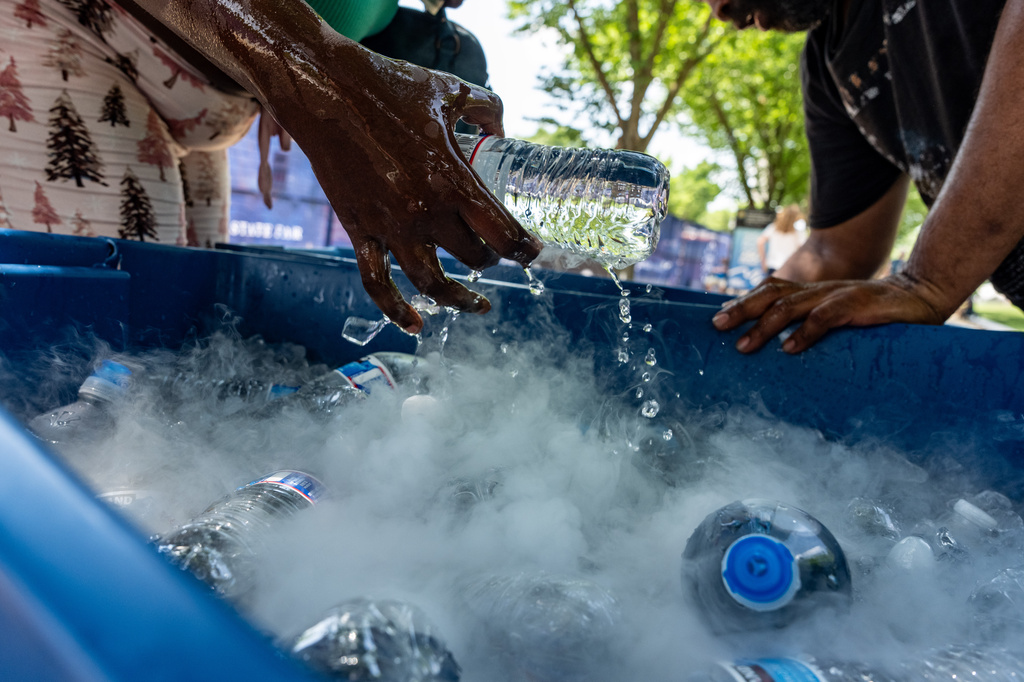
At a Philadelphia Phillies home game against the Pittsburgh Pirates on Wednesday, the temperature had already climbed to 98 degrees by first pitch. Sixteen pallets of bottled water were handed out to fans at no charge.
Bill Christy, 69, of Philadelphia, was making his way through the heat with two teenagers he had brought along for company. “They’re young, they can handle it,” he said. “I’ll just go up in the shade somewhere if I get hot.”
Nearby, a fife and drum corps was marching through the lower concourse in full uniform. “Usually it’s wool regimental. But this is linen, it’s cool,” said Debbie Mayes of Ewing, New Jersey, a member of the Washington Crossing Fife and Drums. “We’re fine. They’ve been very kind to us, letting us take breaks and providing water.”
In New York City, Taylor Swift fans were braving the heat outside Madison Square Garden, hoping to catch the superstar before her Friday wedding. Amanda Powell, visiting from Little Rock, Arkansas, admitted the conditions were tougher than expected. “It’s super hot,” she said. “Being from Arkansas, we thought we could handle the heat, but it’s been very warm.”
Central Park in Manhattan reached 100 degrees Thursday afternoon — the first time the famous park has hit triple digits since 2012, according to the National Weather Service.
At the Franklin Park Zoo in Boston, staff worked hard to keep animals comfortable in the extreme heat. Workers gave African penguins frozen blocks of ice packed with herring, offered frozen pellets to Nigerian dwarf goats, and tossed frozen treats into the enclosure of Western lowland gorillas, who eagerly scrambled to snatch them up.
“All of my animals have been doing a really great job of staying under the fan, staying near a sprinkler,” said zookeeper Brooke Cannon. “I’m running around with the hose hitting them a little bit here and there. Yeah, it’s not their favorite, but you know sometimes you got to do what you got to do to make sure that they’re not making poor choices.”
Despite the brutal conditions, the zoo drew plenty of visitors — though many were seen fanning themselves or standing under misters to find relief. Some were already regretting the trip. “It’s too hot in the summer and this is not the right time to come and visit zoo,” said Bhargavi Patha, who was visiting with her husband and 14-month-old son. “The heat is exhausting us. We are draining and we had to drink a lot of water to see all the animals.”
The heat wave is also putting pressure on electric grids across the region. New York Mayor Zohran Mamdani urged residents to set their air conditioners to 78 degrees to avoid overtaxing the power supply — a step previous mayors, including former Mayor Rudy Giuliani, have also recommended. The request drew criticism from conservative voices online. By early Thursday afternoon, New York Gov. Kathy Hochul, a Democrat, asked all state residents to raise their thermostats to 75 degrees or higher, limit unnecessary appliance use, and conserve electricity, citing high demand and what she called “unexpected load challenges.”
Florida Gov. Ron DeSantis, a Republican who frequently sparred with the mayor on social media, responded on X with: “Is this what was meant by the warmth of collectivism?” — a reference to a phrase the democratic socialist mayor used during his inaugural address.
The rapid expansion of data centers is adding further strain to the grid. Operators in New York state, New England, and the grid serving 13 mid-Atlantic and Midwestern states all projected electricity demand would peak Thursday before easing slightly on Friday. As of Thursday evening, no emergency calls had been issued to reduce consumption, even as usage ran roughly 40% above a typical summer day.
PJM Interconnection, which manages the grid serving 65 million people from New Jersey to Illinois, had anticipated Thursday would set an all-time summer electricity demand record, but usage ultimately fell just short of the mark set in 2006. In preparation, PJM secured an order from the U.S. Department of Energy allowing utilities to require data centers and other large power users to disconnect from the grid and switch to backup sources — such as diesel generators — before resorting to rolling blackouts.
A major Canadian hydropower transmission line supplying New York City went offline Wednesday due to an equipment failure in Canada, but operator Hydro-Québec reported the line was repaired and back in service by 12:30 p.m. Thursday.