
MIAMI — For generations, soccer has set itself apart from other major team sports with one defining quality: once the opening whistle sounds, the game runs on its own terms.
Coaches can’t call timeouts, TV networks can’t dictate stoppages, and for 45 straight minutes, the action flows without interruption. That, at least, has been the tradition — but a series of recent rule changes is quietly rewriting it.
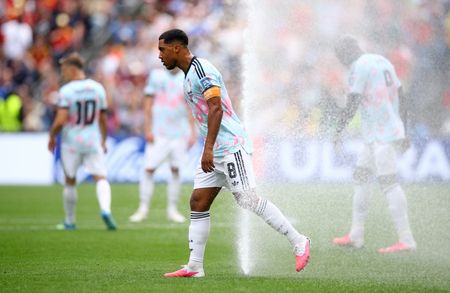
FIFA introduced three-minute hydration breaks in each half of World Cup matches to shield players from the intense summer heat of North America. On their own, cooling stops might seem like a minor adjustment. But stacked alongside VAR reviews, extended stoppage time, and prolonged injury delays, they are raising a bigger question: how much can the sport change before it stops feeling like the game fans have always known?
Changing the Rhythm
None of these adjustments were meant to fundamentally alter soccer’s character. VAR was brought in to improve decision-making accuracy. Expanded stoppage time was designed to recover minutes lost during delays. And hydration breaks were added out of concern for player safety in extreme conditions.
Together, however, they are transforming the flow of matches — opening new windows for coaches to regroup, broadcasters to reset, and players to catch their breath in ways that would have seemed far-fetched just ten years ago.
One moment that captured attention: U.S. coach Mauricio Pochettino was seen huddling his players around a laptop during a hydration break in a pre-tournament friendly against Senegal — a scene that looked far more like an NBA timeout than a traditional soccer game.
What started as a health measure has taken on a tactical dimension, giving managers a chance to stop momentum, reorganize their teams, and deliver detailed instructions at pivotal moments in a match.
The breaks also create predictable windows for broadcasters. Advertisers now have guaranteed visibility at fixed points in every game — something that does not normally exist in soccer.
Michael Johnson, a research analyst covering the U.S. sports industry for S&P Global, told Reuters the hydration breaks could be “extremely valuable” for networks looking to sell ad time. Johnson added that commercials in those windows could “potentially command Super Bowl-level prices” — somewhere in the range of $7 million to $9 million.
Fans Push Back
Not everyone is welcoming the change. England supporters, used to the non-stop pace of the Premier League, loudly booed hydration breaks during World Cup matches. Still, Thomas Tuchel’s squad made good use of them after falling behind early, rallying to win over the Democratic Republic of Congo.
FIFA President Gianni Infantino defended the breaks on Instagram, saying: “After an intense start to both halves, England used their hydration breaks well to regroup, reorganise and get on the front foot before finding the net twice in the final 15 minutes.”
Infantino added: “These breaks are so important to give players a break during tournament play, while also allowing all coaches a dedicated moment in every match — not just depending on the weather conditions — to engage directly with their players.”
Football’s rule-making body, IFAB, confirmed that cooling breaks of between 90 seconds and three minutes are permitted. Infantino noted the breaks were applied in every World Cup match regardless of temperature, in the name of fairness across the tournament.
Former Premier League striker and television commentator Stan Collymore was blunt in his criticism on social media: “The breaks create a stop of momentum. I’ve never seen one match in thousands I’ve watched or played in that’s been better with more stoppages. Not one.”
Collymore’s view reflected a broader sentiment online. An analysis by PeakMetrics found that 75% of digital conversation surrounding hydration breaks was unfavorable, with many fans complaining that games now feel as though they’re split into four quarters.
Here to Stay?
Whether hydration breaks become a permanent fixture remains an open question. UEFA says its existing cooling-break rules are adequate, and the Premier League has no current plans to adopt the practice. But soccer has a history of embracing changes that once seemed unimaginable — from the back-pass rule to VAR to longer stoppage time. Hydration breaks may yet join that list.