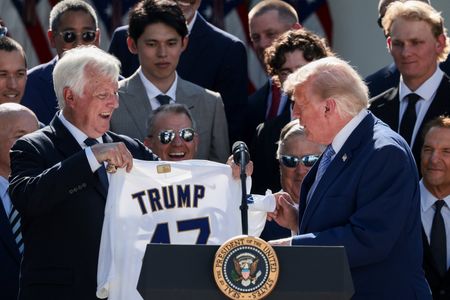

WASHINGTON — President Trump made his mark on this year’s U.S. Senate races by pushing aside certain Republican incumbents and elevating his preferred candidates in their place. But a major question now looms: will he use his enormous political fund to back them up?
With November’s elections just four months away, there’s still no clear answer on how much MAGA Inc. — the nation’s largest political action committee, sitting on $382 million as of last month — intends to invest in critical Senate contests. That uncertainty has continued even as Senate Republican leaders have pressed Trump’s inner circle, both behind closed doors and in public statements, to help pay for the consequences of the president’s choices.
The most glaring example is Texas, where Trump threw his support behind outspoken conservative Ken Paxton over incumbent Sen. John Cornyn. Some Republicans are frustrated, arguing that what should have been a safe Republican seat has now become a competitive race that will pull money away from other important battlegrounds. Democratic nominee James Talarico, a state lawmaker, has made Paxton’s lengthy record of corruption allegations a cornerstone of his campaign.
Cornyn didn’t mince words about who should be writing the checks. “The president picked Paxton, and he’s got $350 million dollars,” Cornyn recently told Semafor. “I think he can spend his money.”
A second headache has surfaced in North Carolina, where Sen. Thom Tillis chose not to seek reelection following a falling-out with Trump last year over healthcare spending. Trump then endorsed Michael Whatley — his own handpicked former chair of the Republican National Committee — to run for the seat. Democrats are now eyeing the race as a pickup opportunity, with former Gov. Roy Cooper as their candidate.
Some Republican campaign strategists are counting on MAGA Inc. to contribute to Whatley’s effort in North Carolina, where advertising across the state’s multiple major metro areas doesn’t come cheap.
Republicans are also expecting to benefit from party committees following a U.S. Supreme Court ruling earlier this week that allows official party organizations to make unlimited direct donations to candidates’ campaigns. Still, even that potential windfall falls short of what Trump has accumulated in MAGA Inc. Despite being constitutionally prevented from seeking a third term, Trump began fundraising almost immediately after winning reelection, regularly hosting events at his resort properties where admission has run as high as $1 million per person.
James Blair, the former White House political director who stepped down from his government role to oversee the president’s midterm strategy, gave little away when pressed on the topic during an interview with former Republican spokesman Sean Spicer on his podcast.
“The president is going to expend substantial resources to win the midterms,” Blair said. “He cares deeply about the party winning.”
As a super PAC, MAGA Inc. is permitted to raise unlimited amounts from individuals and corporations. However, it cannot legally coordinate with individual campaigns or national Republican committees — a restriction that has added to the uncertainty about what the group actually plans to do.
More than two months have passed since Blair, along with White House Chief of Staff Susie Wiles, pollster Tony Fabrizio, and political adviser Chris LaCivita gathered at Washington’s Waldorf Astoria hotel to map out MAGA Inc.’s approach. That meeting was centered on lining up vendors — including advertising firms, door-knocking operations, and digital media companies — that had worked with the Trump team in past elections and would be deployed once a strategy was finalized.
Throughout much of this year, Trump has focused on settling scores with Republicans he felt had wronged him. He viewed Cornyn as insufficiently loyal, harbored resentment toward Sen. Bill Cassidy of Louisiana for voting to convict him during an impeachment trial, and publicly called Rep. Thomas Massie of Kentucky the “worst Republican Congressman in history.” Each of those lawmakers went on to lose their primaries to Trump-endorsed opponents.
Cornyn’s defeat has left Senate Republicans uneasy, with some estimating that Paxton’s nomination could force the party to spend an additional $100 million just to hold onto the Texas seat.
The Senate Leadership Fund, the main super PAC aligned with Senate Majority Leader John Thune, is still expected to run ads in Texas but is unlikely to make it a top priority given its commitments in other states.
Democrats need a net gain of four seats to reclaim the Senate majority, and they view Alaska, Maine, North Carolina, and Ohio as their strongest opportunities. The Senate Leadership Fund has already pledged $342 million across those four states, as well as Iowa, Georgia, Michigan, and New Hampshire.
When Paxton traveled to Washington following his primary victory on May 26, he held what was described as a friendly meeting with Thune, with both sides focused on moving ahead together, according to people familiar with the conversation who were not authorized to speak on the record.
Later that same day, Thune made clear he believed Trump should be contributing financially to a candidate that Senate Republicans hadn’t sought out in the first place.
“We will do what we need to do to make sure the state stays red,” Thune told reporters. “But I’m certainly hopeful the president and the resources he can bring to bear will be engaged.”
“It’s going to be an expensive race,” he added.