
Nine Democratic governors sent a formal letter Thursday urging the U.S. Postal Service to withdraw a proposed regulation tied to an executive order signed by President Donald Trump — one that would create a federal list of eligible voters and potentially restrict who receives ballots through the mail.
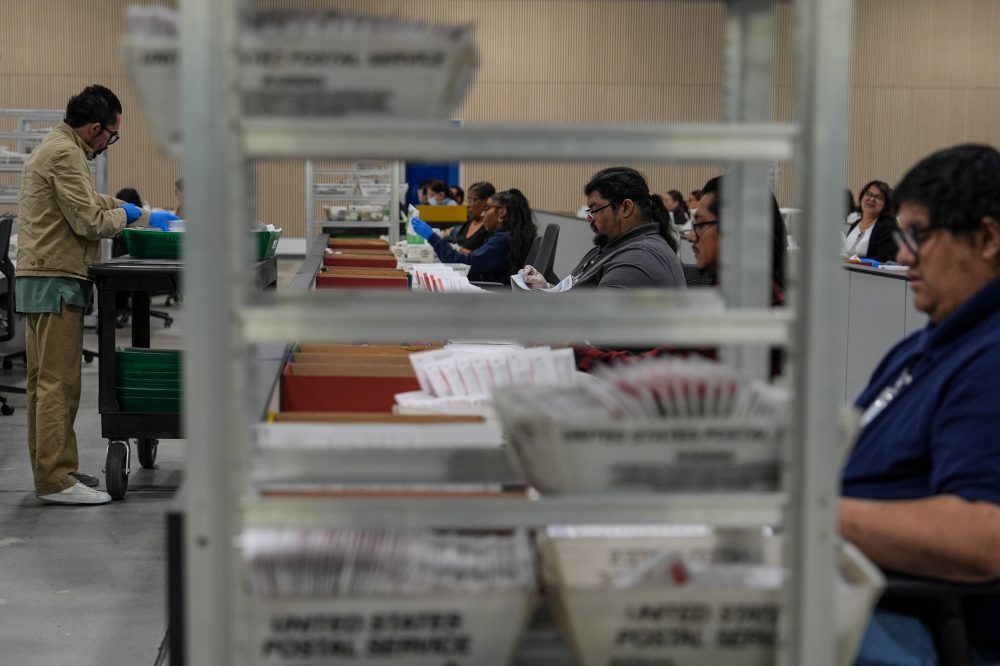
Trump signed the executive order back in March. It directed U.S. Citizenship and Immigration Services and the Social Security Administration to build a so-called “citizenship list” for each state, with the Postal Service then limiting mail-in ballots only to individuals appearing on those lists.
The Postal Service moved to implement the order by filing a proposed rule in late May. However, a federal judge has since stepped in, blocking the executive order entirely and prohibiting agencies from carrying it out. The judge determined the order was unconstitutional, reasoning that only states and Congress — not the president — hold the authority to establish election rules.
The letter was organized by Illinois Gov. JB Pritzker and co-signed by eight other Democratic governors representing California, Connecticut, Minnesota, New York, Pennsylvania, Rhode Island, Washington, and Wisconsin. The governors pointed to the court’s ruling and called on the Postal Service to rescind the proposed rule it had put forward in response to Trump’s directive.
“Far from ensuring integrity in federal elections,” the governors wrote in their six-page letter, “the Proposed Rule would undermine trust in elections, needlessly complicate voting processes, arbitrarily disenfranchise millions of eligible voters, and undermine states’ constitutional role in ensuring free and fair elections.”
The governors also argued the rule would hand the federal government “unilateral power to refuse to deliver their ballots if a state refuses to collaborate with President Trump’s unlawful directives.”
The Postal Service had not responded to requests for comment as of Thursday. The agency had filed the proposed rule in the Federal Register after a judge in a separate lawsuit declined to block the executive order at that time, since the administration had not yet taken steps to carry it out. The groups behind that lawsuit — Democratic and civil rights organizations — have since filed an appeal.
Postal workers themselves have also pushed back on the order. Jonathan Smith, president of the American Postal Workers union, previously stated that their role was not to “verify voter eligibility” but rather to “move mail from one destination to the next.”
This marks the second executive order on election oversight that Trump has issued since returning to office. His first order — also blocked by the courts — centered on requiring documented proof of citizenship to register to vote.
Both orders stem from Trump’s focus on voting by noncitizens, a practice that studies and investigations by state and local authorities have found to be extremely rare. Trump has also repeatedly raised concerns about mail-in voting as a source of fraud, despite using it himself.
Experts and researchers have found no evidence of widespread problems with mail voting, a method that has grown in popularity among voters of both parties. A 2025 report from the Brookings Institution found mail ballot fraud to be extraordinarily uncommon — roughly four cases for every 10 million ballots cast by mail.