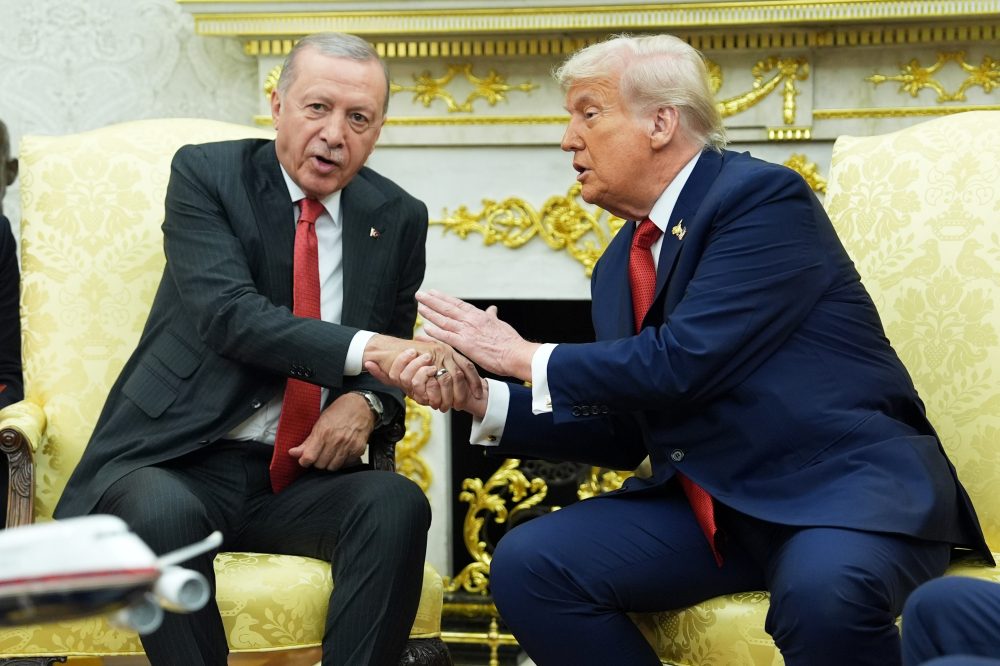

WASHINGTON (AP) — While President Donald Trump has publicly criticized and clashed with many of his European counterparts set to attend next week’s NATO summit, Turkey’s leader has used his personal friendship with the U.S. president to guarantee Trump’s attendance at the Ankara gathering — and the visit could come with a major defense bonus for Turkey.
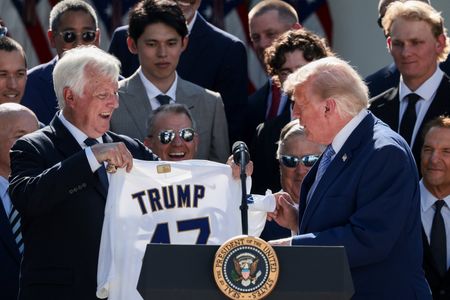
Trump has repeatedly praised the Turkish president, referring to him as a “hell of a leader” and a close friend. “I would not have gone for most people,” Trump said last week. “But he called me up. He said: ‘Please, I have it in Turkey. You got to be there. The United States has to be in there.’ And so I’m going out of respect to President Erdogan.”
That personal rapport has helped Erdogan prevent the turmoil that Trump’s absence would have created for the alliance — especially at a moment when Trump has been threatening to withdraw U.S. troops from Europe and reduce America’s involvement in NATO, causing anxiety among allies. Trump has long pressured NATO members to increase their defense budgets and has recently criticized them for not supporting his confrontation with Iran.
Adding to the appeal, Trump has hinted he may announce something during his visit connected to jet engines and the possible sale of F-35 fighter jets — a deal that has been blocked for years due to Turkey’s close relationship with Russia.
Trump’s well-documented admiration for strongman-style leaders has made him a longtime fan of Erdogan, who first consolidated power as prime minister and is now in his 13th year as Turkey’s president.
“His relationship with Erdogan, which is pretty strong, is consistent with what seems to be a pattern of his preference,” said Philip Gordon, who previously served as national security adviser for Vice President Kamala Harris. “It has often been pointed out he seems to have better relationships with adversaries and autocrats, and he certainly says nicer things about them than with allies.”
Gordon, now affiliated with the Brookings Institution, added, “Erdogan is taking full advantage of it.”
Trump is expected to hold a one-on-one meeting with Erdogan on the sidelines of the summit, making him the first U.S. president to visit Turkey since Barack Obama did so in 2015. The previous administration kept Erdogan at a distance throughout its four years in office, citing concerns about Turkey’s democratic regression and its ties to Russia.
Opposition groups and human rights organizations have accused Erdogan of weakening democratic institutions and restricting free speech, pointing to what they describe as ongoing, unfounded legal actions against journalists, activists, opposition politicians, and others.
Soner Cagaptay of the Washington Institute noted that Erdogan and Trump developed a personal chemistry during Trump’s first term. When the previous administration invited Erdogan to visit the U.S. in 2024 following Turkey’s endorsement of Finland and Sweden’s NATO membership, Erdogan chose not to attend.
“That was Erdogan’s way of signaling to Trump, ‘Hey, you are going to probably win the elections,’” Cagaptay said. “I think Trump saw that as a giant gesture.”
During a recent meeting with NATO Secretary-General Mark Rutte, a reporter asked Trump whether he was bringing “a big gift bag for Erdogan,” referencing Turkey’s desire for F-110 jet engines and F-35 fighter jets.
“Yeah, I think so,” Trump answered. “Yeah, I’m going to probably do something that’s going to make him very happy.” Trump had also floated the idea last September that the U.S. might begin selling F-35s to Turkey.
Turkey was removed from the F-35 program in 2019 after it acquired Russian-made S-400 missile defense systems. American officials have long worried that Turkey operating the Russian system could allow Moscow to collect data on the F-35’s performance and capabilities.
At a White House meeting, Vice President JD Vance said the administration was looking into ways to move forward with the jet sale, stressing that any transaction would require Turkey to be in compliance with U.S. law. There is notable bipartisan resistance in Congress to selling F-35s to Turkey while Ankara still holds the Russian missile defense systems, including from prominent Republicans like Senate Foreign Relations Committee Chairman Jim Risch of Idaho.
Separately, Turkey is seeking to buy F-110 jet engines to power its domestically built KAAN fighter aircraft. The State Department recently moved toward enabling those sales, sending key lawmakers a notification that it intended to bypass congressional objections to more than $700 million worth of jet-engine sales to Ankara, according to two individuals granted anonymity to describe details of a non-public notification.
“In this case, the State Department did not even attempt to justify its decision,” said New York Rep. Gregory Meeks, the leading Democrat on the House Foreign Affairs Committee, in a statement last week. “It did not invoke any emergency authority, did not present a written rationale, and for months refused to make a good-faith effort to brief me on implications of the sale for the U.S.-Turkey relationship, Turkey’s continued possession of the Russian S-400 system, and other regional security concerns.”
The broader relationship between Washington and Ankara is thawing in other areas as well. Earlier this year, the Justice Department dismissed a significant case against Turkey’s state-owned Halkbank, which had faced accusations of helping Iran avoid U.S. sanctions.
When Trump returned to the White House for his second term, he named a longtime personal friend as ambassador to Turkey: Tom Barrack, a close ally who also chaired his inaugural committee. “Barrack is playing a crucial role as a facilitator in the relationship,” said Ahmet Kasim Han, a professor of international relations at TED University in Ankara.
Erdogan and Trump have spoken by phone frequently about Syria, Gaza, and the broader Middle East, and Turkey joined Trump’s Board of Peace established to oversee the Gaza ceasefire. Trump claimed this month that he asked Erdogan to stay out of the conflict with Iran and that the Turkish leader agreed, though there is no evidence Turkey had any plans to become involved.
Trump made his admiration for Erdogan clear even while standing alongside Israeli Prime Minister Benjamin Netanyahu at a joint press conference last year. Netanyahu, whose government is in conflict with Ankara, had hoped to gain Trump’s backing in countering Turkish influence in Syria — but instead watched as Trump heaped praise on Erdogan and urged Netanyahu to be “reasonable.”
Following his meeting with Trump at last year’s NATO summit in The Hague, Erdogan told reporters that the U.S. president responds to his calls quickly — an illustration of just how close their relationship has become.
“With my friend Trump, we are opening the door to a new era in Turkish-American relations,” Erdogan said. “The process of telephone diplomacy between us has never exceeded 24 hours so far. When we call, the other side responds within 24 hours.”