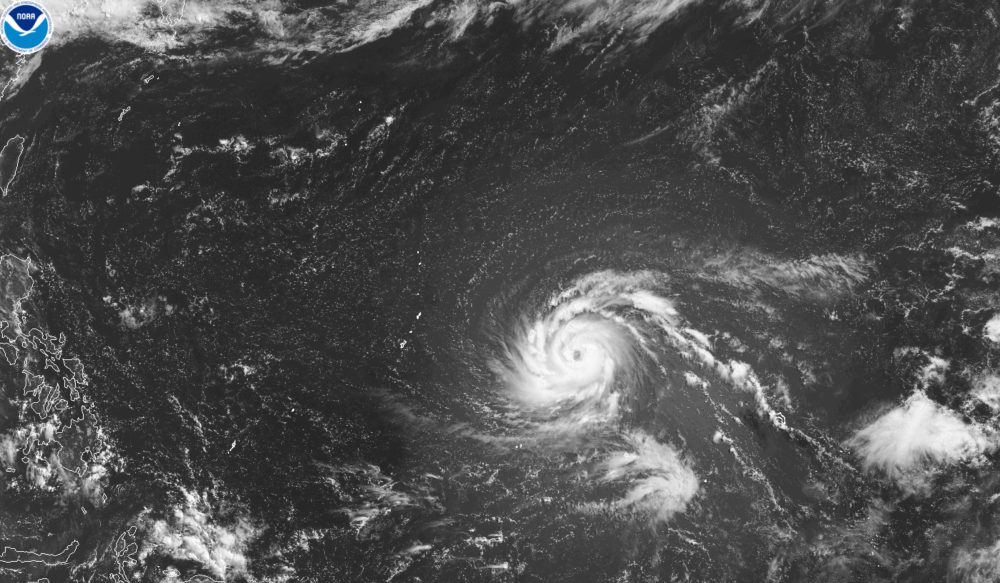

HONOLULU (AP) — Residents of U.S. territories in the western Pacific are preparing for what could be another super typhoon, arriving just months after the most powerful tropical cyclone on the planet this year already tore through the region.
In the U.S. Commonwealth of the Northern Mariana Islands, electricity has still not been fully restored following Super Typhoon Sinlaku, which unleashed violent winds and heavy rainfall back in April. Some displaced residents continue to live in tents after their homes were completely destroyed.
“We’re getting ready to do this all over again,” said Edwin Propst, a former lawmaker who now works in the governor’s office on Saipan, where it was already Friday. “The timing is terrible.”
Typhoon Bavi is expected to intensify into a super typhoon by Sunday night through early Monday, which is when it is projected to arrive in the Marianas, according to Paul Stanko, a senior meteorologist with the National Weather Service based in Guam.
A tropical cyclone earns the designation of super typhoon when its maximum sustained winds reach at least 150 mph (241 kph). Stanko noted that super typhoons are comparable to a high-end Category 4 or Category 5 hurricane.
As of Friday, Bavi was located 760 miles (1,223 kilometers) east of Guam, carrying maximum sustained winds of 80 mph (129 kph), according to the weather service.
Stanko said some residents are actually hoping the storm tracks toward Guam rather than the Northern Marianas, which would give the harder-hit islands more time to recover from Sinlaku.
“That’s what we’re actually hoping for because then Saipan wouldn’t get it as bad,” Stanko said.
Propst said he was hearing the same sentiment from people on Guam as well.
“That’s so island-style,” he said. “God bless them for saying that.”
Guam lies west of the International Date Line and carries the nickname “Where America’s Day Begins” because it is several hours ahead of Hawaii, Alaska, and the continental United States. The island is also home to two major U.S. military installations.
Propst said residents were boarding up windows with plywood and stockpiling gasoline, recalling how gas station lines stretched on for weeks following Sinlaku.
The Rev. Francis Hezel, assistant pastor of Santa Barbara Catholic Church in Dededo, Guam, said he hopes no island takes a direct hit from the storm. Having lived through many typhoons, he said he wasn’t overly alarmed and remained hopeful that Bavi would shift course.
“Right now the pattern is heading towards us, but those patterns change,” he said.
Even so, church staff and community members were taking precautions.
“This is getting to be the normal thing now, typhoon preparedness,” Hezel said. “It’s happening more frequently.”
El Niño conditions are known to ramp up hurricane activity in the Pacific. Scientists say the El Niño warming cycle, combined with a planet already heating up due to fossil fuel emissions, is likely to intensify extreme weather events around the world.
Although Sinlaku caused no deaths on land, Propst said the community continues to grieve the six crew members of a cargo ship that capsized during the storm. Searchers recovered one body, but the U.S. Coast Guard called off the search — which had lasted more than 100 hours — before the remaining crew members were found.
Propst acknowledged that recovery from Sinlaku has come a long way, but said the islands are “not quite there yet.”
“A few more months would have been good,” he said.