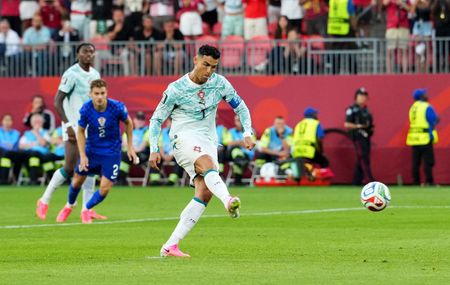

NEW YORK — For decades, penalty shootouts were considered football’s cruelest gamble — a stomach-churning walk to the spot where careers could be made or shattered in an instant. But something has shifted. At this World Cup, the penalty kick is no longer treated as a roll of the dice. Instead, teams are approaching it as a highly specialized skill, backed by data, psychology, and serious preparation.
Germany and the Netherlands found out the hard way, both being sent home in the round of 32 following shootout losses to Paraguay and Morocco respectively. Belgium, meanwhile, saw the opposite result when Youri Tielemans converted a crucial penalty in stoppage time during extra time, completing a dramatic comeback win over Senegal.
Geir Jordet, a professor at the Norwegian School of Sport Sciences and author of the book “Pressure,” which examines the psychology of penalty kicks, says the notion that shootouts are simply a matter of luck is outdated and dangerous thinking.
Speaking to Reuters, Jordet said that in any successful World Cup run, a penalty shootout is almost impossible to avoid. “To not spend time on that is very strange,” he said.
“Ultimately there will be a young player whose legacy will be defined by the failure in a penalty shootout, which is a massive negative emotional trauma that we’re inflicting on this player as a coaching staff, as an FA, and even as a football industry,” Jordet added.
His research is extensive. For “Pressure,” Jordet reviewed video footage of all 718 shots taken in men’s penalty shootouts at the World Cup, European Championship, and Champions League from the time shootouts were introduced in 1970 through 2023.
One of his most striking findings: 53% of players who missed a penalty displayed the same kind of body language afterward — shrinking physically, dropping to the ground, covering their faces, staring downward, or avoiding eye contact with teammates on the walk back.
No country knows this pain better than England. “The England story is fascinating,” Jordet said. “They lost six out of seven penalty shootouts in the ’90s and early 2000s. And this was common knowledge in England that we go far in the tournament, we have fantastic talent, and then we lose on penalties. So then they took hold of this and they orchestrated something new. They created these big penalty projects… they’re very pioneering and innovative, comprehensive in their approach.”
Under current manager Thomas Tuchel, England is continuing that work. Tuchel views penalties as a matter of execution and repetition. “The FA has a programme in place. We follow this programme in detail, and it’s just an important and very specific part of football that comes into play in knockout matches,” he said.
Spain’s coach was equally direct about the subject. “Kicking a penalty is not something that happens at random,” he said. “Just as we have specialists in free kicks, in corner kicks, we have specialists in penalties. Not everybody can shoot a penalty. We have to focus on the psychological aspect as well. For some of them, it’s much harder, and others are just eager to shoot penalties.”
Jordet’s research zeroes in on subtle signs of stress that players often don’t even realize they’re showing — the rushed walk from midfield, the anxious expression, the way a player reacts the moment the referee’s whistle sounds.
“Facial expressions will indicate anxiety,” Jordet said. “But the question is always, how do you deal with these emotions?”
He noted that some players treat the referee’s whistle like a starting signal, rushing to strike before they’ve mentally settled. “The ones who react to the whistle very quickly, that to me is not a particularly good sign because it could indicate that their focus is basically on their emotions and not on the task at hand,” he said.
There are exceptions, however. Kylian Mbappe, Jordet noted, is “one of the quickest penalty takers in the world” but continues to excel because his rapid approach is simply part of how he plays the game naturally.
Tielemans, who used a short run-up on his decisive penalty against Senegal, credited preparation as much as composure in the moment. “We’ve been practising the last few days,” he said. “In that moment you just try to be confident and trust your abilities.”
Goalkeepers, too, have undergone a transformation. Morocco’s Yassine Bounou — known as Bono — has turned the penalty duel into something of a psychological chess match. “Goalkeepers have been through a revolution,” Jordet said. “Goalkeepers are more prepared. So far in this World Cup, we’re seeing how goalkeepers have kind of gained a little bit of an edge by just being smarter than the penalty takers and using analytics and data better than what we have seen in the past.”
Bono’s specialty, according to Jordet, is manipulating penalty takers who wait for the goalkeeper to commit first. “He has developed this into an art,” Jordet said. “He has shown that against some of the top penalty takers in the world using this technique.” In the Morocco-Netherlands shootout, two Dutch players missed the target entirely, and Bono stopped a third attempt.
“Bono uses this double fake movement where he moves on the goal line at exactly the right moment to deceive (the taker) into believing that he’s going to go to the left, but in fact he’s going to the right,” Jordet explained.
Brazil’s coach Carlo Ancelotti has taken preparation to another level, dividing his squad into two groups for full shootout simulations — players line up at midfield, walk to the spot, and go through the entire process while he observes their body language and patterns.
Despite all the preparation, analysis, and coaching, one thing remains certain: somewhere in this tournament, another young player’s entire legacy may come down to a single shot from 12 yards out.